All posts by admin

An Indian and a Pakistani Fight Together for a Grand Slam of Fairy-Tale Coincidences

India’s UN envoy Hardeep Singh Puri shakes hands with Qureshi as Bopanna (second from left) and Pakistan ambassador Abdullah Hussain Haroon look on in New York. Jay Mandal/ On Assignment

Sept. 9: If there ever was a Grand Slam of political correctness, it will unfold tomorrow at Flushing Meadows.

Before you say “Yuck!” and turn the page, consider the conspiracy of coincidences.

• An Indian and a Pakistani will play in a Grand Slam final at the US Open on Friday.

• Forgot to mention: they will play on the same side.

• On the stands will be the Indian and Pakistani ambassadors to the UN. They were there on Wednesday night when the two stormed into the final.

• Sania Mirza, whose marriage raised the question which cricket team will she support, and her husband Shoaib Malik can finally support the same team. And they play her game.

• Finally, did you notice that the match is taking place on the eve of Id and Ganesh Chaturthi, which fall on the same day this year?

Rohan Bopanna and Aisam-Ul-Haq Qureshi may or may not win the US Open men’s doubles final on Friday.

But the 30-year-olds will add the taut thwack of the tennis racquet to the coliseum of sport diplomacy that so far has been echoing with the zing of the ping pong and the thud of the willow smacking leather.

For the good souls who refuse to give up and religiously light candles on the Wagah border each year, Bopanna and Qureshi, dubbed the “Indo-Pak Express”, may seem like a made-to-order dream come true.

Bopanna, who traces his roots to Coorg, and Qureshi, born in Lahore, first played together in 2003 but did not become devoted teammates until this year, when they played under the slogan “Stop War, Start Tennis”.

Both acknowledge the burden of expectations they carry. “It’s a great feeling to know that you can make a difference,” Bopanna said. “Hopefully, this will encourage a healthier relationship between India and Pakistan.

Qureshi concedes that the peace initiative has changed their lives. “I think what changed both our careers was when we became ambassadors of peace…. The first time we initiated our campaign about Stop War and Start Tennis, I think, was the main week everybody started to take notice of it,” Qureshi said.

Peace and Sport, an organisation in Monaco which promotes reconciliation through sport, supplied them with T-shirts and sweatshirts with the slogan: “Stop War, Start Tennis.”

Joë Bouzou, president and founder of Peace and Sport, said of the new Indo-Pakistan tennis alliance: “Their story of friendship through sport is a real inspiration for youngsters.”

But don’t take the bilateral bond too far. The two do not profess to be similar.

“We don’t have many things in common, to be honest,” Qureshi said. “He likes spicy food; I don’t. He likes to dance to slow songs; I don’t. He’s got a big game; I don’t.”

The pair’s advance has come at a time Pakistan is going though crises on multiple fronts: the war on terror has bitterly divided the country, floodwaters are ravaging its hinterland and the lone shining beacon of cricket is now caught in a “spot-fixing” scandal.

“I can’t thank Rohan enough for being my partner and playing with me. Pakistan has been going through a lot for the last two or three years from all the terrorist attacks and the flooding now for the last few months and the cricket scandal also,” Qureshi said.

Bopanna pointed to one tangible accomplishment. “We are glad that our journey is bringing people together and also having a positive impact,” he said.

Yes, they did make some twain meet. Among the spectators yesterday when Bopanna and Qureshi beat Eduardo Schwank and Horacio Zeballos to advance to their first Grand Slam final were the Indian and Pakistani ambassadors to the UN, Hardeep Singh Puri and Abdullah Hussain Haroon, respectively.

It was the first time that any two diplomats from India and Pakistan had sat together to watch them play. “It was a beautiful thing to see,” Qureshi said

Perhaps aware of the role chance as well as compulsions play in such pairings, Puri was somewhat circumspect. He merely chose to say that “this is sports, but it shows the great potential”. Haroon was more forthright: “Hardeep and I are in the New York area and we are always looking for avenues to open and this is a magnificent one.” 

But both will be aware that sport diplomacy — which mesmerised people in 1971 when an American team played ping pong in China in what was immortalised as the “ping heard around the world” — has set up false dawns in the past in the subcontinent.

The wily Zia-ul Haq twice scored brownie runs on the cricket pitch (see chart)but failed to pull India and Pakistan out of the rut of mistrust.

The tennis truce has come at a time Prime Minister Manmohan Singh is spearheading a peace initiative with Pakistan. It may appear ironic that Singh’s decision not to attend the UN General Assembly this month and risk another fruitless meeting in New York with the Pakistani leadership may actually help his cause of peace with Islamabad.

The high-decibel publicity for the Indo-Pak Express at the US Open this week appears to have resulted in an inevitability that the two countries must now make some progress towards tennis diplomacy to supplement their ongoing joint efforts for more people-to-people exchanges.

Some tennis buffs may feel that it is just as well, therefore, that the Prime Minister is excusing himself from the General Assembly and, instead, sending external affairs minister S.M. Krishna in his place to New York. Tennis is as close to Krishna’s heart as politics.

It may thus turn out that as it gets closer to another meeting between Krishna and foreign minister Shah Mehmood Qureshi, tennis may act as a guarantee against a fresh round of accusations of bad faith.

Among Americans who are never lagging in offers of overt and covert help in taking forward the India-Pakistan peace process, there are already whispers about the Bopanna-Qureshi tango and the presence of their respective UN ambassadors eventually leading to a match with a court on their volatile border.

But the Indians are acutely aware that like in almost everything else, in tennis too, it is not a relationship of equals between India and Pakistan. Pakistan simply does not have many top tennis players, so Qureshi turned to someone with whom he has subcontinental compatibility.

Forget such nitpicking for a day and let Sania have the last word.

Sania tweeted using Bopanna’s nickname Bofors (yes, the gun that helped beat back the Kargil invaders): “wooowwww!! U guys on fire:) well done bofors… Sports and love can bring ANYTHING together… who would have thought Indians and Pakistanis would be cheering for the same team to win!”

WITH INPUTS FROM NYTNS, ARCHIS MOHAN AND OUR SPORTS BUREAU

source: http://www.telegraphindia.com / Front page> Story / by K.P. Nayar / Friday Sep 10th, 2010
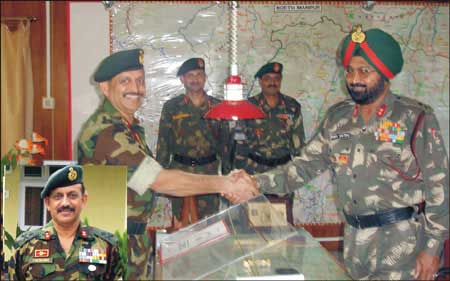
Maj Gen Chengappa is New IG AR (S)

Imphal:

Major Gen BK Chengapa who earlier commanded the 14 Garhwal Rifles in Manipur has taken over as the IG AR (South) from Maj General BS Ghotra who has been posted to a coveted appointment at Integrated Defence Headquarters.


Incoming IG AR (S) Maj Gen Chengapa shakes hands with his predecessor BS Ghotra

In a statement, PIB (Defence Wing) said that Maj Gen Chengapa hails from Coorg in Karnataka and his earlier association with Manipur has enabled him to experience the rich socio-cultural dynamics of the State.

The new IG is a veteran of the 1971 Indo-Pak war and has experienced CI Ops in JK and the North East as well as at the battle field of Siachen, said PIB.

Gen Chengapa had also commanded the 25 Sector AR at Arunachal Pradesh.

Prior to his present assignment as the IG AR (South) Gen Chengapa was the Head of Faculty as the College of Defence Management, Secunderabad.

source: http://www.e-pao.net / The Sangai Express / Home> Headlines / Aug 29th

Tangy Twin Cuisine

Gourmets around the country are slowly waking up to the culinary charms of Karnataka’s two most prominent cuisines—Bunt and Coorgi.

The culinary map of Karnataka reads like a dream. With rich vegetarian fare in the north, fragrant seafood dishes along the coast and spicy meaty fare down south, the state offers a range of delicacies for all palates. However, not many people are aware of this rich culinary diversity. Of India’s four southern states, Karnataka’s gastronomic marvels are the least known. While Tamil Nadu is famous for its distinct Chettinad cuisine, Kerala for its rich Moplah fare and Andhra Pradesh for its royal Hyderabadi repast, the delectable dishes of Karnataka have been languishing on the sidelines for several years now. Apart from Udupi’s trademark masala dosa and the customary lemon rice, not many people are even aware of the state’s two distinctive cuisines, Bunt and Coorgi, indigenous to these warrior communities. All that is set for a change as more and more restaurants are inviting local chefs from the two communities to present these hidden gems to foodies. With hotels like The Park in New Delhi organising Bunt food festivals on a regular basis and eateries devoted to Coorgi cuisine opening up by the dozen in Bangalore, the twin cuisines are all set to become the next big thing on the Indian food map.

MIRROR IMAGES

The two regional fares are often considered twins as they mirror each other in the liberal use of coconut and rice; and yet their cooking methods couldn’t be more distinct. Being a coastal community, Bunts make wide use of all forms of seafood ranging from crab, mussels and even seaweed. Imaginative combinations of rice and fish dominate the cuisine of this Tulu speaking community, concentrated in the Udupi and Mangalore districts of southwest Karnataka. Just adjacent to these districts lies Coorg, the land of coffee and cardamom plantations. Unlike their fish eating neighbours, Coorgis are avid meat eaters, with lamb, pork and chicken forming a huge part of the meal.

Their warrior lineage has left a distinctive mark on their food. If one peeks into the pages of history, Bunts trace their descent from the Nagavanshi order of Kshatriyas. Their moment of glory as warriors arrived during the rule of the Vijaynagara Emperors of the Tuluvu dynasty. Even today, this fiery legacy lives on in their spirited nature, muscular stature and simple yet delectable cuisine. Each dish is robust in taste, rich in proteins and doesn’t involve too many ingredients or complicated cooking processes.

Just like Bunts, Coorgis too identify themselves with the Kshatriya clan. In fact, this hilly coffee haven has given the nation many a military leader, right from Field Marshal KM Cariappa to General KS Thimayya. Coorgis’ love for meat goes back to the times when they used to hunt wild boar and other game in the dense forests.

Both communities like their food tangy and hot, but their spice mix marks one cuisine distinct from the other. While Bunt cuisine makes use of coconut, red chillies, mustard and curry leaves in varying proportions, Coorgi fare relies heavily on aromatic green masala, which is made in huge quantities in every traditional household for repeat use. “Bunts make use of kokum to give a tangy flavour to their food, but Coorgis infuse piquancy in their dishes by using a black fruit vinegar,” says master chef CB Shankaran of Sheraton’s south Indian restaurant, Dakshin. It is this play of spices and ingredients that makes these two cuisines similar and yet individualistic in various ways.

FISHY FARE

Whether it is the cooking techniques or recipes, Bunts haven’t deviated from their age-old culinary traditions. Every well-honed chef avoids the use of spice powders available in the market; but for Bunt women, it is nothing short of sacrilege. Their cooking process starts very early on from the roasting and grinding of spices. No form of seafood is wasted. The bangude masala fry or banana wrapped grilled mackerel and the yeti ghee roast or prawns prepared with cashewnut and ghee are just some of the highlights of this seafood repast.

“Coconut is an extremely vital part of the cuisine, whether grated or as milk. One usually starts a meal with a drink called bonda, which is fresh coconut water churned with the tender pulp,” says Dr Sapna S, a Bangalore based medico who has been doing intensive research on countryside cuisine. Though an average meal in a Bunt household includes numerous courses, the meal remains delightfully light and simple.

Lunch would include pathrode (double cooked pinwheel of arbi leaves), a spicy fish fry, mansade keema fry (pan tossed mutton dumplings with coriander and mint masala), flaky kori roti made of rice and generally served with a fragrant chicken curry called kori gassi. Dinner, however, is a shorter meal, with lots of papads and appalams served with the food. “For dinner, we have something very interesting called the sawunder thethi or spoon fried omelette. The egg is cooked in a spoon and has a nice fluffy, smoky feel to it,” explains Sapna of the concept.

Modern kitchen gadgets and appliances don’t bedazzle Bunt women. Many still prefer to use wood fire and traditional cooking utensils. “The food is usually roasted or baked. Bunts believe in slow cooking and they simply abhor the use of a pressure cooker,” says Chef Bakshish Dean of The Park Hotel, New Delhi.

If you are visiting a traditional Bunt household, you might just get lucky and get to sample the fiery porcupine curry. Considered a special delicacy, the dish is prepared by removing the thorns from the porcupine and cutting it into medium sized pieces. “We then soak it in salt and turmeric and cook it. It is a very soft meat and is cooked with a lot of spices,” says Sapna.

STRICTLY NON-VEGETARIAN

Like Bunts, Coorgis too love their rice. They simply can’t do without their fragrant Sannakki rice, which grows in abundance in the valleys of Coorg. “We make something called akki ooti or rotis made of rice flour. These can be eaten with curries or chutneys made of coconut or sesame,” says Muthu Bopanna, who runs the popular homestay Gowri Niwas in Coorg, along with her husband. Known widely for her culinary skills, guests come from far and wide to sample her pandi curry.

Here too, Coorgis are in sync with Bunts in their love for puttu. There are more than ten varieties of puttu that are made using a variety of herbs and are eaten in combination with spicy meat dishes. There is the kadadambuttu made from rawa and rice and steamed like idlis, then there is the papputu made from milk and shredded coconut and the nulluputtu that is pressed into string hoppers using a mould.

However, nothing delights Coorgis more than having a pork dish in their meal. “The pandi curry or pork curry is one of the highlights of their meal. It makes for a good breakfast dish as well,” explains Satish Warrier, owner of Gunpowder, a restaurant located in Delhi’s upmarket Hauz Khas Village and known for its finger licking pork curry. And the locals don’t believe in eating their meat lean and mean. The sizzling sound of rich wholesome fat dripping from the meat onto the pan is music to their ears.

With Coorg being the land of coffee, cardamom, cinnamon, orange and pepper, it is no wonder then that fragrant spices are widely used in cooking. “Our food is not high on the chilli quotient but on the masala quotient,” says Muthu. While Coorgi food is a feast for meat lovers, there is something for the veggies as well. Mangoes, jackfruit, horse gram, yams and bananas are used to make delicious curries and chutneys.

“Most vegetarian dishes are very seasonal. Take the baimbale curry made from tender bamboo shoot which is made just after the rains. Then there is the koomu curry made from wild mushrooms that is made during the monsoons,” she adds.

Festivals hold a very special place in Coorgi households. No ceremony is considered complete until meat and liquor are served. “We are essentially ancestor worshippers, so for any festival we cook whatever the ancestor liked,” says Muthu. Known for their hospitality, Coorgis ensure that no one leaves the table dissatisfied.

CULINARY MARVELS

Whatever their similarities or distinctions, these rich cuisines stir the imagination with their exotic ingredients and unique lineage. Each meal has something exceptional to offer; each bite carries with it the sweetness of the hills, the tanginess of the coast and the rustic charm of the two communities. These twin cuisines need to be sampled to be believed.

source: http://www.openthemagazine.com / Open> Features > Food / By Avantika Bhuyan / Shome Basu / Jan 30th, 2010

Hard Work Pays

Go green: Amidst nature
Special Arrangement/   Go green: Amidst nature

A comprehensive report on all their activities conducted helped them win this accreditation.

It’s another feather in the cap for the prestigious Coorg Public School (COPS) in Gonicoppa in Kodagu as it has won the International School Award (ISA) instituted by the British Council for its all round achievement this year.

Various activities

The school had organised a plethora of activities with a range of subject areas and collaborative work with partner schools overseas. Annual results have remained outstanding since its inception.

Visitors from the U.S.A, UK, and Thailand had come to the school and several interesting interactive sessions with resource persons from India and abroad were held. Return visits by the COPS students to those countries have made them bolder and instilled tremendous amount of confidence in them, Senior Principal of the COPS, M.D. Nanjunda says

Field trips and nature camps were organised and they had helped students gain experience. Exchanging information on the minute details of even plants in the gardens showed the keenness of the learners. Fashion show, quiz, skits, debates and awareness campaigns were also a part of those activities.

Reporting work

A dossier compiled by the students involving 11 projects such as Fruit World, Famous Monuments, Freedom Fighters, Costumes, Flowers, Snakes, Birds, Dances of the world, Celebrations of National Festivals, Organic Farming across the world and Coffee, reflected the concept of international education that formed the base on which COPS made the grade.

The British Council had adjudged the dossier as the most comprehensive and well structured documentation of the elaborate work. COPS now had the privilege of using the British Council logo on school literature, website and promotional materials.

Aiming globally

Moreover, it will enable it to create an international environment for students to further strengthen their contacts with schools abroad. This prestigious award will be presented to the school in October. Prof. Nanjunda says the efforts of the staff and students had fetched the award and it was a great accomplishment in pursuit of excellence. “The objective of the school is to empower students with global education,” Prof. Nanjunda adds.

source: http://www.thehindu.com / Life & Style > Kids / by Jeevan Chinappa / Jun 15th, 2010

Better Sports Infrastructure Needed : Pramila

Asian Games bronze medal-winner Pramila K. Aiyappa has said that proper sports infrastructure is needed to train sportspersons, and the State Government must provide all the facilities they require to excel.

She was speaking after inaugurating a two-day sports meet organised by the Mysore District Journalists’ Association (MDJA) at Chamundi Vihar Stadium here on Saturday.

Laying a synthetic track at the stadium would go a long way in inspiring sportspersons, she said. It would also help them perform well at the higher level, Ms. Aiyappa said. The Department of Youth Services and Sports could facilitate the synthetic athletic track at the stadium, she noted.

A product of Kudige Sports Hostel in Kodagu, Ms. Aiyappa urged parents to encourage children who showed keenness in sports and understand that proper training could take them a long way. The media should play a proactive role in encouraging sportspersons by projecting them through articles, Ms. Aiyappa said. Such encouragement would help young athletes make a mark in national and international events, she added.

Later, Ms. Aiyappa was felicitated by the MDJA.

source: http://www.thehindu.com / by Staff Correspondent / News > States> Karnataka / Mysore, Jul 03rd, 2011


A New Trend for Team’s Leadership Set by Michael Jack Nobbs

  • A new trend for team’s leadership set by Michael Jack Nobbs

The new Chief Coach of the men’s team, Michael Jack Nobbs, introduced a new trend for the team’s leadership. This new concept was introduced yesterday at the national hockey camp in Bangalore, India,

Instead of a single captain for the team, he proposed the idea of a group of 4-5 players who will be responsible to resolve problems and take decisions for the team. He believed that it will help in strengthening the relationship among the players.

Nobbs stated that Arjun Halappa will be the last captain of the team and this group leadership will be exercisable for the next few years.

The Australian Olympian expressed that in case of the captain and coach’s absence or hesitation to talk to, the players will have an additional option to whom they may address their matter to and further said, “However, if there is a leadership group, other players can walk up to these players and discuss things they are not comfortable discussing with me.”

Nobbs will be announcing the names of the group members after some days on personal observation and assessment of leadership qualities. He stated, “Every player will be asked to fill out forms comprising personal details. There will be questions as to what his goals are, what he would expect his role to be and the like. We will assess all the data before making announcing the names of the leaders.”

The coach has already discussed the idea with a few of the team players who had no objections.

This concept was first set by the former Indian coach, Ric Charlesworth, during his coaching to the Australian women hockey team in 1996 and 2000, bringing home the Olympic gold medals. Later it was used for the men’s side of Australia followed by the cricket coach, John Buchanan, who tested it on the Kolkata Knight Riders team.

According to the Australian centre-half, passing on the responsibility improves the productivity of the team as a whole. In case of a single leader, there is low probability of creating followers. Therefore, this concept has also broken the hierarchal aspect that will lead to a higher number of followers under the new model.

source: http://www.bettor.com / by David Hubbard / Sports News > Hockey News /

Approbation from Squash Afficionados

Players worldwide are eagerly waiting for the chance to compete in the Olympics and win medals: Joshna Chinappa. File photoPlayers worldwide are eagerly waiting for the chance to compete in the Olympics and win medals: Joshna Chinappa.  The Hindu .File photo

Squash has been shortlisted by the International Olympic Committee for consideration in the 2020 Olympic Games.

The news has been greeted with enthusiasm by the squash fraternity by and large. “We are delighted that squash has been included on the IOC’s shortlist again,” said PSA CEO Alex Gough.

WSF’s backing

The World Squash Federation has been leading the bid to have the sport added to the Olympic programme.

Reacting to the development, the WSF President N. Ramachandran said, “We are delighted to be given this new opportunity. I am confident that we will be able to show the IOC Programme Commission, the Executive Board and wider IOC membership that our case has become even stronger over recent years.

Great Olympic sport

“I truly believe that squash will be a great Olympic sport. It fulfils all the criteria for inclusion in the Games, has proven universality and growth and we have an absolute commitment from all our top athletes that an Olympic medal would be the pinnacle of their careers.”

“We also have high-profile World champions, exciting World championships for men and women, massive participation from juniors to masters on all continents and a healthy, thriving programme of youth development worldwide,” he said.

Innovations

Mr. Ramachandran also mentioned the “exciting technical innovations” in recent years, including courts that could be put in iconic settings.

“Squash is a wonderful example of one-on-one sporting gladiatorial competition and should make a perfect addition to the Games,” he added, saying

“Our campaign starts with new energy and vigour.”

PTI adds:

“Players worldwide are eagerly waiting for the chance to compete in the Olympics and win medals,” said top woman player Joshna Chinappa.

Indian men’s squash ace Saurav Ghosal, meanwhile, said that players world over were confident that the sport will become part of the Olympic movement sooner than later.

“Players worldwide were more than happy and confident that the Squash would become part of Olympic movement sooner than later with the game being shortlisted by the world body,” said Ghosal, world ranked 26th.

source: http://www.thehindu.com / Special Correspondent / Sports > Other Sports / Chennai / Jul 05th, 2011

Don’t Fear the King Cobra, says Expert

MADIKERI:

When you spot a king cobra, no matter how petrfied you are, stay put. Don’t run for cover, is herpetologist Snake Satish’s advice.

The king cobra, he says, is a shy creature. “When we walk in the forests, the reptile catches the earth’s vibration and moves away from it,” he explains. Satish works as a warden and estate manager in Coorg Public School, Gonikoppal

Popularly known as Snake Satish, he has captured 42 king cobras in the past eight years in Kodagu. Most of them have been freed into the forests. The snakes have been caught from houses and estates. Most of his catches were from Karike, Padi, Perambadi Cherambane, Heggala, Shanthalli and Kundalli areas.

King cobras are shot dead out of sheer fear. “There has been no incident of death due to a king cobra bite in Kodagu, Satish says. Though they are aplenty in Kodagu, the shy and slithery creatures are rarely sighted. They are active in August and September. One among the most venomous snakes in the world, the king cobra feeds on members of its own ilk and other little snakes. It is the only snake to build its own nest.

source: http://www.timesofindia.indiatimes.com / by G Rajendra / TNN / Jul 07th, 2011

Tribals to Take on City Life in Reality Show


Let alone televisions and cars, even toothbrushes are alien to some of them. Yet, eight tribal men from the interiors of Karnataka have dared to face 60 days of city life in Bangalore for a Kannada reality show, where they’ll learn a few English words and even do ramp walks.From living isolated lives in their respective tribes, these men aged between 25 and 34 will be slipping into jeans and wearing shirts to adapt to the Bangalore crowd for Kannada channel Suvarna’s Halli Haida, Pyeteg Banda, which means – “Village lad lands in the city.”

The show is a result of the success of Pyete Hudgir, Halli Lifeu (City girl, village life), which garnered an average viewership of 1mn people with a maximum response from youths, Anup Chandrasekharan, business head of Suvarna said.

“This new show is a sequel to Pyete Hudgir, Halli Lifeu. For the first season, we took eight city girls to experience village life. But this time, we decided to bring not just village boys but tribals to the city and see how they adapt themselves here,” Chandrasekharan said.

According to Chandrasekharan, it costs them up to Rs700,000-Rs800,000 per episode to produce such a show.

The team behind the show took approximately three months to research on Karnataka tribes and has brought together contestants from tribes such as Bedar, Sholaga, Haki Pikki, Kodavas of Coorg, Kurubas and others.

“Our research teams went to various parts of Karnataka and went into the interiors to look for these boys. It used to be very difficult because even the closest shop to their place of stay used to be 25-30km away.

“It was also extremely tough to convince them, their parents and relatives. In fact, there is going to be one guy on the show whose wife is pregnant, and by the time he goes back to his tribe, she would have delivered their child. Still he has come to see what a city looks like,” Chandrasekharan said.

“Most of them have not seen a TV, a car, a mobile phone. And they don’t even use something as basic as a toothbrush or toothpaste. Here we will try introducing them to many new things,” he said.

The eight tribal contestants will stay at a huge house in Bangalore and will be teamed with one city girl each. The girls will mentor them through their transformation and the contestants will be eliminated one by one in subsequent weeks, depending on their performance.

“We plan to have ramp walk contests, change their dressing style, teach them a few English words – and it should be interesting to see how a person who has lived all his life in a remote place adapts to the city atmosphere,” Chandrasekharan said.

The winner will get a “cash compensation,” but the amount hasn’t been decided yet.

source: http://www.gulf-times. com / Doha / IANS – New Delhi / Tuesday Aug 24th, 2010

Lingo Lure

Regional Indian languages such as Bhojpuri and Haryanvi may not have made it to India’s Constitution, but their knowledge can qualify you for selection to political positions in the US government


Language : Kutchi
State:
Gujarat
Spoken by:
aprox 866000
Language family: Indo-aryan
Spoken in Kutch region of Gujarat and often termed as a dialect of Gujarati, Kutchi has more resembling dialect with Sindhi. It is believed that the language has assimilated features of Gujarat, Rajasthani and Sindhi. However, a group of language teachers believe that Kutchi is a combination of Gujarati and Sindh.
Language: Kodava takk
State: Karnataka
Spoken by:  500,000
Language family: D
ravidian
The language is often referred as Kodava or Coorgi in English. It is the language of Kodavas. However, other communities and tribes in Kodagu also speak this  language. It doesn’t have significant written literature.
Language : Magahi
State:
Bihar
Spoken by:  11,362,000
Language family:
Indo-European Indo-aryan
Magahi is spoken in and around Patna, Gaya, Nalanda and Rajgir. Written in Devnagri, the language was believed to be practised by Lord Buddha in his preachings. A few books in Jainism have also been composed in Magahi.
Language : Haryanvi
State: H
aryana
Spoken by:   30 million
Language family:
Indo-aryan
Prominently spoken in Haryana and adjoining
Delhi, Haryanvi has an influence of Punjabi.  The language has many  dialects.
Language : Chhattisgarhi
State:
Chhattisgarh
Spoken by:  11.5 million
Language family:
Indo-aryan
Like Sanskrit and Hindi, Chhattisgarhi is written in Devnagri. It is also spoken in Madhya Pradesh.
Language : Bhojpuri
State:
Uttar Pradesh, Bihar
Spoken by:  12o million
Language family: Indo-aryan
Bhojpuri is one of the most popular languages in UP and Bihar. The language has derived its vocabulary from Sanskrit, Hindi, Urdu. Around 70 million people in UP and 50 million in Bihar speak Bhojpuri. It is estimated that 170 million people across the world speak this language.
Language : Awadhi
State:
Uttar Pradesh
Spoken by:  20 million
Language family: Indo-aryan
Considered as dialect of Hindi, Awadhi is a colloquial language of Awadh region which comprises Kanpur and Allahabad. Important works in Awadhi are the Ramcharitmanas of Tulsidas, the Padmawat of Malik Mohammad Jaisi.
Language  : Marwadi
State:
Rajasthan
Spoken by:  13.2 million
Language family: Indo-aryan
A large populace in Rajasthan communicate in Marwadi. The language has Devnagri script. It is also spoken in some parts of Gujarat and Pakistan.


source: http://www.ahmedabadmirror.com / Ahmedabad > Home > News > Reports > Story / Tuesday Feb 17th, 2009