Category Archives: Women/Girls (wef. Sept 03rd, 2022)

Travel: A taste of Coorg

Go to this picturesque coffee-growing region with an appetite for a unique cuisine and distinctive experiences.
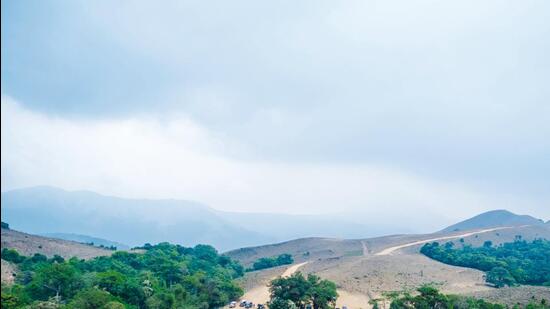
From coffee to e-bikes and Victorian-style rosebushes and stately mansions, Coorg has it all (Airbnb)

Driving just five hours down a smooth highway from Bengaluru, I spent a long weekend in Coorg, interacting with some of its local entrepreneurs, signing up for off-beat experiences and enjoying some of the most beautiful roads in the southern peninsula. Far from the tourist throngs, I spent the weekend finding unique things to do.

#NowTrending

Walking through lush green coffee plantations with retired serviceman Ganapathy, I received an articulate explanation on the farm-to-cup process. The swashbuckling Ganapathy’s stately colonial mansion sits plum in the middle of a large family-run coffee estate, supplying beans to a larger chain of wholesalers and producers. For a coffee addict like me, this was a fascinating experience.

Later that morning, over a cup of freshly brewed Coorg filter coffee, I chatted with his daughter, Anjali, who runs the hugely popular Bengaluru-based Pigout Coorg Kitchen.
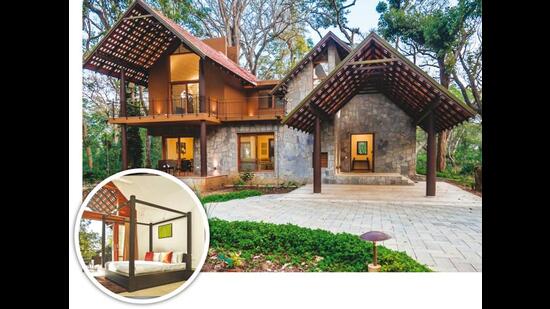
The swashbuckling Ganapathy’s stately colonial mansion sits plum in the middle of a large family-run coffee estate, supplying beans to a larger chain of wholesalers and producers (Airbnb)

“Kodava cuisine is unique and completely undiscovered in India, right from the ingredients and meat we use to the cooking styles,” Anjali said. “Through my food, our homestay and this coffee estate, we want to put Coorg on the map in the most experiential way possible.”

As Anjali laid out a spread of her famous pandi (pork) curry, pumpkin curry and rice (akki) rotis, I realised that the Ganapathys’ little universe is a destination on the verge of a major tourism revolution.

“Never before has Coorg been trendier,” Anjali said of the beautiful region in the heart of Karnataka, known for its flavourful food, gorgeous people and spectacular landscapes. While Coorg has always been popular among weekend roadtrippers from Bengaluru, it’s only recently that it has witnessed interest from discerning travellers across the country.
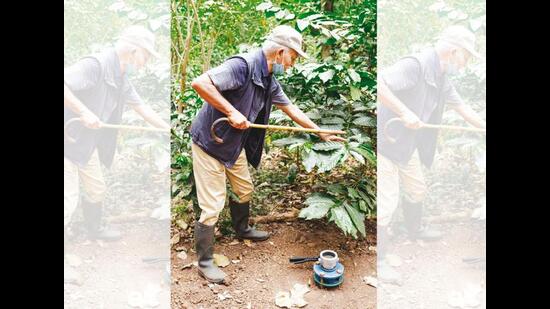
There are enough experiences in Coorg to set it apart from other destinations (Airbnb)

E-bikes and homestays

My initial impression of this place was just how stunning the roads are. You can spend hours meandering through coffee plantations, hillside roads and picture perfect villages. For a base, I chose the stylish Acacia Villa just off the main road. This massive three-bedroom villa, listed on Airbnb features an ultra-modern chalet aesthetic, blending perfectly with the forest around it.

After a leisurely morning walk through the woods, I made a quick dash to Madikeri, for an e-bike experience. A homegrown startup, BLive, specialises in e-bike tours across different Indian destinations. After a quick briefing, my friends and I dashed up and down the slopes on our e-bikes, but not without a pit stop at a local coffee producer. The e-bike tour took us to some lovely spots, including a lake and the top of a hill. If you enjoy cycling, this is definitely recommended.
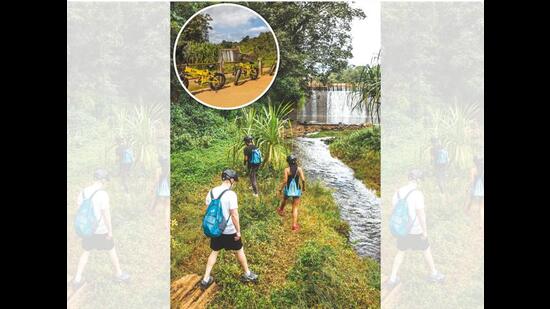
You can spend hours meandering through coffee plantations, hillside roads and picture perfect villages (Airbnb)

After all that physical exertion, it was time to discover one of Coorg’s oldest and most loved spots. The approach to Old Kent Estate was just wide enough for our car to squeeze through, which meant that it was truly cut off (read: no phone network) from the rest of the world.

In the middle of Victorian-style rose bushes, coffee plantations and green slopes, I stepped into a gorgeous colonial mansion dating back to 1800. Once belonging to a British colonel and now family-run by the Thaikappas, the Old Kent bungalow is a treasure trove of antique furniture, centuries-old artefacts and beautiful decor, restored to perfection. Here, the young proprietor of the estate, Sadat, manifests his love for coffee in the form of a high-end coffee bar inside the bungalow.
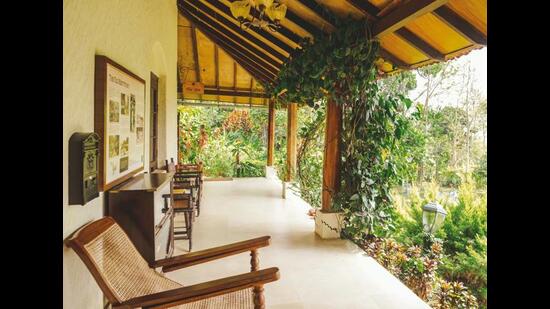
There’s also a gorgeous colonial mansion dating back to 1800 once belonging to a British colonel and now family-run by the Thaikappas (Airbnb)

One too many freshly-brewed espresso shots down, I strolled around the Airbnb-listed estate and sat in the garden for a quick snack and a couple of pictures while Sadat told me that his clients tend to look for slow luxury, experiencing things like hikes, coffee tastings, village visits and cooking sessions.

Kodava charm

That evening, I hopped into an old open-top Mahindra Commander with some locals and off-roaded (not for the faint of heart) all the way to the top of Mandalpatti, to the panoramic sunset point. While the peak in itself is pretty standard, the trek up and down is definitely worth the trouble.
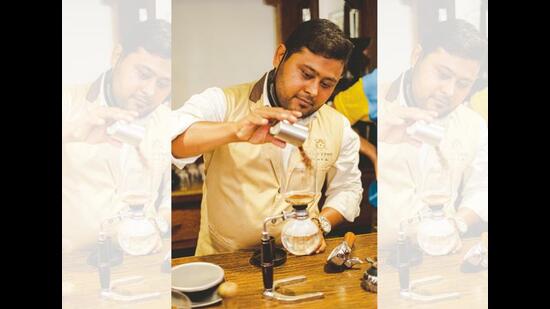
Coorg is home to large family-run coffee estate that supply beans to a larger chain of wholesalers and producers (Airbnb)

My last night in Coorg was at the stately mansion-cum-estate of Preet and Prem. The two manage their own estate and also run the gorgeous Udaya Homestay about 45 minutes away. “I drive 45 minutes one way every morning to deliver a homemade breakfast to my homestay guests, so it is as authentic as possible,” I was told.

I was introduced to Preet’s mother-in-law, the family matriarch, who regaled us with stories of elephants in her backyard and talked us through the cultural uniqueness of a Kodava wedding as we feasted on some more pork curry, local vegetables, biryani and rotis.

I was charmed by the subtle pleasures of Coorg. Here you find great food experiences, awesome coffee trails and places to sip a brew, trendy locals who are always willing to share stories and food, and hospitality entrepreneurs creating new experiences for travellers. Plan a trip to Coorg if you have a couple of days to spare and are hungry for unique experiences.
Riaan Jacob George
Riaan Jacob George

Riaan Jacob George is a luxury content and social media specialist

From HT Brunch, February 20, 2022 /Follow us on twitter.com/HTBrunch / Connect with us on facebook.com/hindustantimesbrunch
Bags Medical Design Excellence Award

Madikeri:

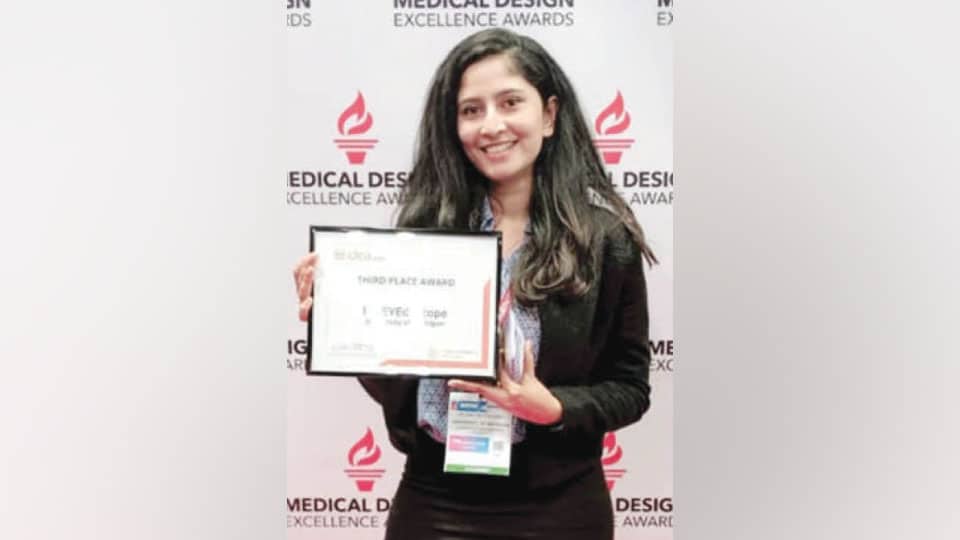
Palandira Vichal Muthanna has won the Medical Design Excellence Award-2019 with her team. The team stood third in national-level competition “BMEidea-2019” where teams across the United States with new innovative medical technologies participated.

The award ceremony was held at Jacob K. Javits Convention Centre, New York, on June 11.  During her research at the University of Michigan, Vichal and her team developed a new device called ‘KalEYEdoscope’ to track the progression of a condition called ‘Age-related Macular Degeneration’

Macular Degeneration is the leading cause of blindness in the world and currently there is no device in the market to help track its progression on a regular basis. The award was in recognition of their work in the development of this innovative, simple and novel medical device and in support to further develop the same.

Palandira Vichal is an M.Tech in Bio-Medical Signal Processing and Instrumentation from BMS Engineering College in Bengaluru. Earlier, she had invented a device to monitor the vitals of both mother and child during labour. The device invented by Vichal not only monitored the vital parameters of both mother and child, but also raised an alarm in case of any fluctuations so that the doctors and medical staff can rush to the patient’s rescue.

Vichal completed her early education in St. Joseph’s Girls High School, Madikeri and higher secondary education at Vidyaniketan PU College, Gonikoppal. She did her engineering from Vidyavardhaka College of Engineering in Mysuru and M. Tech from BMS College of Engineering in 2015.

Vichal is the daughter of Palandira Jaya Muthanna and Mithuna Dechamma (daughter of Mukkatira Doremani Ponnappa) of Murnad in Kodagu district and grand-daughter of Karnataka Rajyotsava Awardee late Palandira Devaiah.

In her academics, Vichal was the co-ordinator for the Indian Society for Technical Education (ISTE) for 4 years from 2009-2013. She was the Branch Association (IMPULSE) Co-ordinator for two years in Vidyavardhaka from 2011-2013. She won the Gandhian Young Technological Innovation Award -2006 from Biotechnology Industry Research Assistance Council (BIRAC) – Society for Research and Initiatives for Sustainable Technologies and Institutions (SRISTI) for her project ‘Device for Intrapartum MaternoFetal Care.’

source: http://www.starofmysore.com / Star of Mysore / Home> News / June 21st, 2019

Kodagu Mattu Dakshina Kannada Jilla Gowda Mahila Samaja Celebrates Silver Jubilee

Mysore/Mysuru:

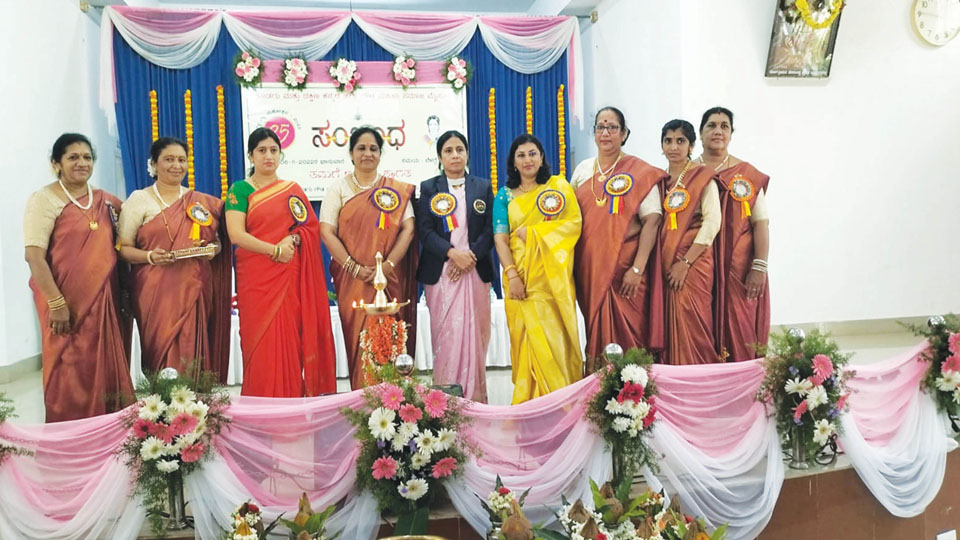
‘Sambandha,’ the Silver Jubilee celebration programme of Kodagu mattu Dakshina Kannada Jilla Gowda Mahila Samaja, Mysuru, was inaugurated by Pradhan Mantri Poshan Shakti Nirman Scheme, Bengaluru, Assistant Director P.S. Leelavathi at the Samaja premises in Vijayanagar this morning.

SAADHYA Trust for Social Development Founder-Head Achuda Arathi Harish was the chief guest. Samaja President Devajana Geetha Montadka presided. Income Tax Department, Bengaluru, Additional Commissioner K.M. Sulochana released the souvenir on the occasion.

Speaking after inaugural function, P.S. Leelavathi said that youths of today must utilise education and job opportunities and achieve in their respective fields. Elders should guide the youngsters, she added.

Samaja President Devajana Geetha Montadka spoke about the establishment of the Samaja and its objectives.

Uluvarana Lalitha Madaiah, T.M. Meenakshi, Paanathale Asha Vasanth and Mukkati Divya were felicitated on the occasion for their achievements in their respective fields. Samaja office-bearers were present.

source: http://www.starofmysore.com / Star of Mysore / Home> News / November 06th, 2022

Silver Jubilee Of Kodagu And Dakshina Kannada Gowda Mahila Samaja

Kodagu Mathu Dakshina Kannada Jilla Gowda Mahila Samaja, Mysuru, will be holding its Silver Jubilee celebration programme at its premises in Vijayanagar tomorrow (Nov. 6) at 10.30 am. Pradhan Mantri Poshan Shakti Nirman Scheme, Bengaluru, Assistant Director P.S. Leelavathi will inaugurate while Income Tax Department, Bengaluru, Additional Commissioner K.M. Sulochana will release the souvenir on the occasion.

SAADHYA Trust for Social Development Founder – Head Achuda Arathi Harish will be the chief guest.  Samaja President Devajana Geetha Montadka  will preside.

source: http://www.starofmysore.com / Star of Mysore / Home> In Briefs / November 05th, 2022

Spilling The Beans On Coffee In India

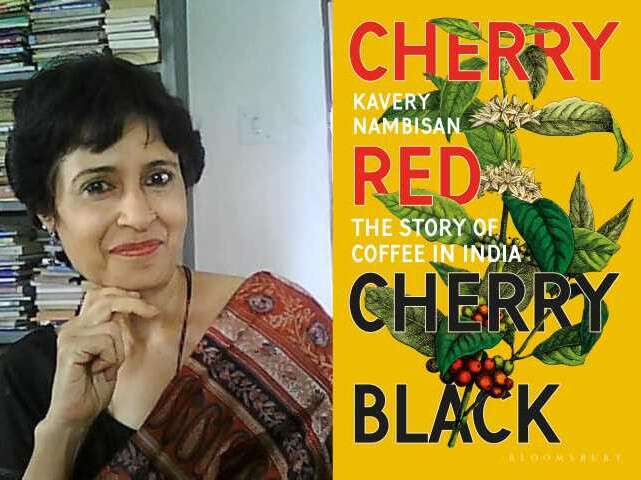
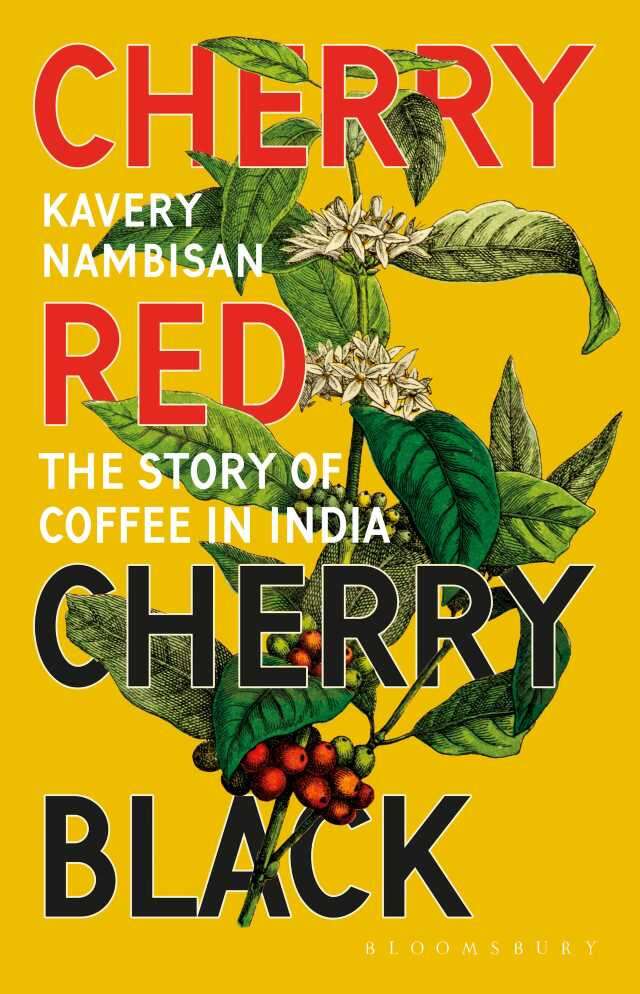
Kavery Nambisan’s new book Cherry Red, Cherry Black details the fascinating story of coffee in India 


Kavery Nambisan was born on a coffee estate, grew up among the “twisted branches and dark green leaves of the coffee bushes”; her parents joked that she was among those children who had been “plucked off the coffee bushes.”

It is therefore fitting that the surgeon’s latest book Cherry Red, Cherry Black (Bloomsbury India) is about the history of coffee in India.

Written with anecdotes woven into chronology, this comprehensive look at the coffee industry reveals intriguing nuggets – the origins of the coffee terms ‘Robusta’ and ‘Arabica’; the story of how Southern India became coffee country (it’s more complex than the Baba Budan tale); how coffee made sugar popular… Kavery explores the world of coffee far beyond its cultivation via the journeys of rulers and invaders and the ways of governance and tribute to its current status as one of the most valuable legally-traded commodities in the world. With the pride of a true Kodava, she writes of how coffee cultivation in Coorg (now Kodagu) changed the social, ecological and economic nature of the land and its people, and of the planters clubs that still exist.

A large part of the book details the story of how Tata Coffee, with whom the author has been associated in her medical avatar, came to be, but its scope goes far beyond company history and personalities to showcase coffee’s ability to be the great leveller available to every layer of society, and details the journey of the bean from plant to cup. Readers will be fascinated to know that the coffee served at Starbucks is made with beans from Kodagu, Hassan and Chikmagalur and cured in Kushalnagar. 


Excerpts from an interview

You speak of yourself as “almost a child plucked off a coffee plant”. How was the experience of going back with research to discover what is such an integral part of your childhood? How long has this book been in the making? Have there been any surprising learnings?

Yes, coffee has been integral to my being, but I did not consciously think about it until recently when I started to write this book.  It has been a pleasure to discover the history behind coffee, and, along with it, to learn more clearly certain aspects of local history. I started to read up sometime after the middle of 2018 and wrote in 2019 but was unable to conduct some important interviews during the period when Covid came and went. After that, everything had to be ‘fast-forward.’ 

As for surprise learnings, yes, of course. There can be no better way of learning something new than writing about it. I learned much.


You are a proud Kodava and now live and work again in Kodagu. What aspects of life there do you enjoy most, both connected to coffee and otherwise?

I have worked as a surgeon in Kodagu for over 10 years, off and on. My husband and I built a house in a village here and it is surrounded by coffee estates that do not belong to us – so pleasure without responsibility! The tall shade trees that surround us are a blessing – with so much life going on in the branches and the undergrowth. As a doctor, I have a great rapport and a serious commitment to my neighbours, many of them being daily wage earners in the estates. I think we live a good life.


What does your own coffee cache look like? What would we find in there?

You would find a cache of roasted coffee beans (a blend of Arabica and Robusta). I roast the beans every few weeks or so and use about 10% of chicory to enhance its strength.


You’ve detailed a bewildering number of ways to prepare a cup of good coffee. Which is your favourite?

I use three methods, depending on my mood. Filter coffee (in the afternoons); the Moka pot or a rustic brew (adding coffee powder to just boiled water and letting it steep for two to three minutes) in the mornings. Always with a little milk and jaggery.      


India Coffee House remains your coffee house of choice in Bengaluru. Tell us what you have there when you visit these days?

It’s a great place to hang around with friends. I always have coffee and, if peckish, an omelette or a cutlet. I have been frequenting this grand old place (although now in a changed location) from my medical college days. Satisfaction guaranteed. 

source: http://www.femina.in / Femina / Home> Life> Books / by Primrose Monteiro D’Souza / November 04th, 2022

Railway Kodava Association Get-Together Held

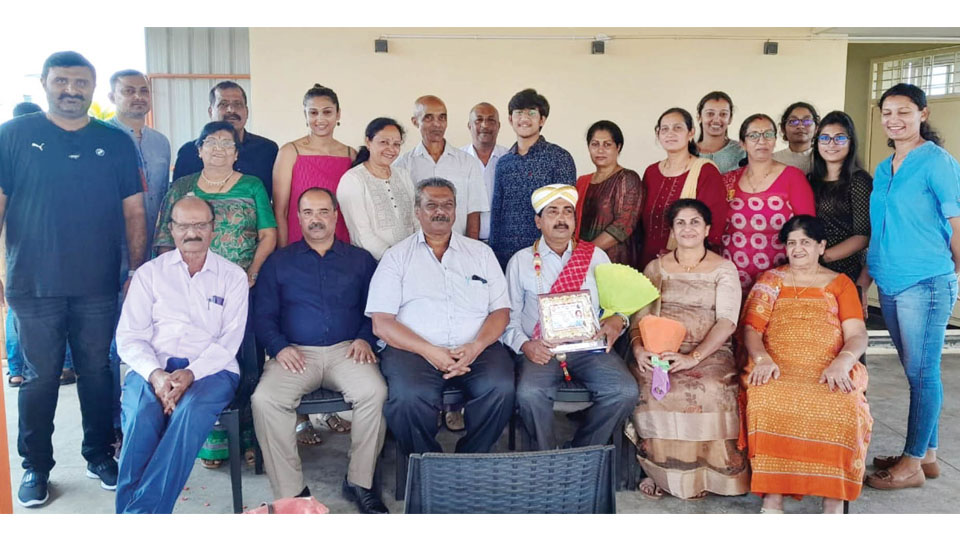
Chottemanda Monnappa is seen with Kullachanda Kesari – Association President, Nellamada Cariappa – Secretary, Noorera Yeshu Bipin – Joint Secretary, Chendanda Nirmala Subramani, Coluvanda Chengappa, Bachamada Vasanth and other members and their families.

Railway Kodava Association get-together was held recently at Simply Kodavas in Vijayanagar.

On the occasion, Association Member Chottemanda Monnappa, who retired on superannuation, was felicitated.

He is seen with Kullachanda Kesari – Association President, Nellamada Cariappa – Secretary, Noorera Yeshu Bipin – Joint Secretary, Chendanda Nirmala Subramani, Coluvanda Chengappa, Bachamada Vasanth and other members and their families.

source: http://www.starofmysore.com / Star of Mysore / Home> Photo News / October 29th, 2022

Bharatiya Vidya Bhavan’s Kodagu Disaster Management Initiative — 4 Years On…

Madikeri:

In 2018 Kodagu was struck by a rain disaster never heard of or seen before causing landslides, devastating floods and destroying houses and properties of the people, specially in North Kodagu area of Madikeri and Somwarpet Taluks.

Thousands of people were homeless and had to take shelter in schools and public buildings turned into Gruel Centres (Ganji Kendras), where free food was provided. It was a heart-rending sight of hapless, suffering people.

The Government and many NGOs and social organisations rushed to help the victims of the disaster. Among them was also the Bharatiya Vidya Bhavan (BVB), Madikeri Kendra. September 2018 was the month, BVB launched its Bhavan’s Project Coorg to contribute its mite to help the victims of the great natural disaster. This month BVB is completing four years of its service to a section of the victims which is being continued successfully even now and will continue.

For the Bhavan’s Project Coorg initiative, BVB chose one village known as Kalur village which was badly hit with landslides resulting in loss of houses and cultivated lands — coffee estates and paddy fields. It was the worst disaster in the history of Kodagu.

Naturally, several families were in deep shock and limbo as their source of livelihood was completely destroyed. The future looked bleak. How long could they continue in the rehabilitation (relief) camp?

At such a dismal situation, BVB extended its helping hand to the women of Kalur village by taking them under the protective wings of Bhavan’s Project Coorg. It was an initiative to provide both psychological and financial stability to them.

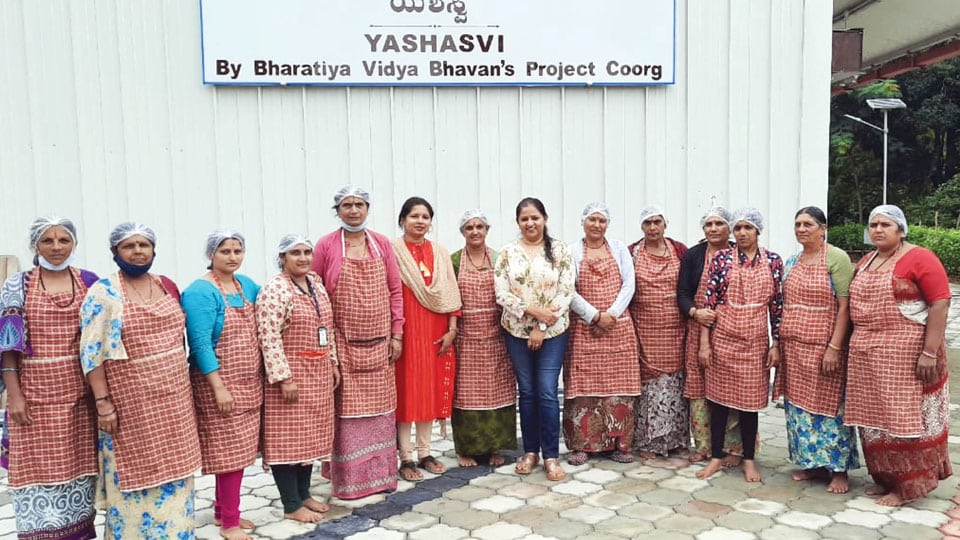
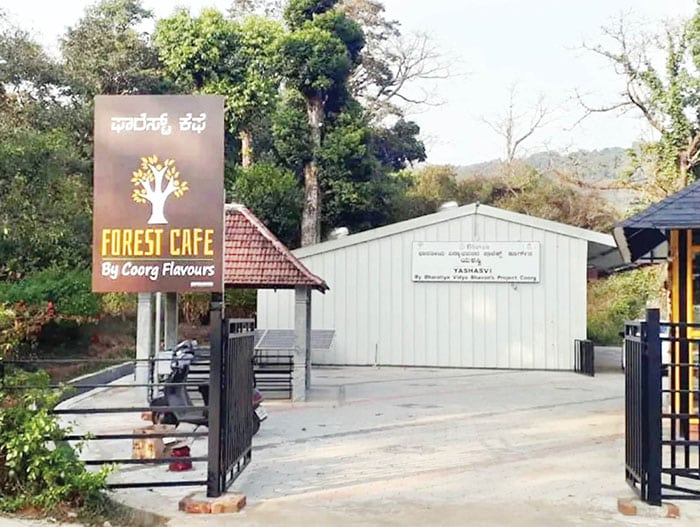
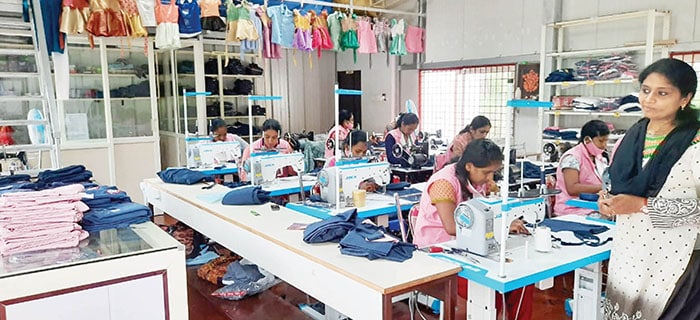
To begin with, BVB started skill development programmes by imparting training in food processing and tailoring to the agricultural women of Kalur village under a programme known as Yashasvi. BVB took 65 women of the village to train them in food processing and tailoring.

After training, they were provided work on a regular basis and they began to produce a line of packaged high quality masalas, apparently with a Coorg flavour, under the brand name, “Coorg Flavours.”

Simultaneously, Tailoring Unit was set up with sewing machines and required facilities, which now undertakes to produce school and NCC uniforms, uniforms required for Government Departments and  private organisations. Every woman working here earns sufficient income because of BVB’s initiative.

Today, Food Processing Unit makes different products like home-made chocolates, masalas etc. BVB’s Project Coorg has two stores, which helps sustaining this project, at Madikeri, capital of Kodagu district. Thus BVB made self-reliance possible for hapless women.

Support from people is needed to make this initiative grow and sustain.

For more information, contact BVB Madikeri Hon. Secretary Balaji Kashyap on Mob: 98458-31683.

source: http://www.starofmysore.com / Star of Mysore / Home> News / By K.B. Ganapathy, Chairman, BVB Mysuru / September 15th, 2022

Kuppya Chele: Attire of a warrior culture

Traditional clothes, jewels and accessories set the Kodavas apart.

Madikeri :

Rituals and culture narrate the history and ancestral beliefs of a community. Traditional attire binds a community and signifies their identity, while also promoting its culture. One such is the Kodava community, nestled in the picturesque district of Kodagu, and boasts of a unique culture and even more unique attire.

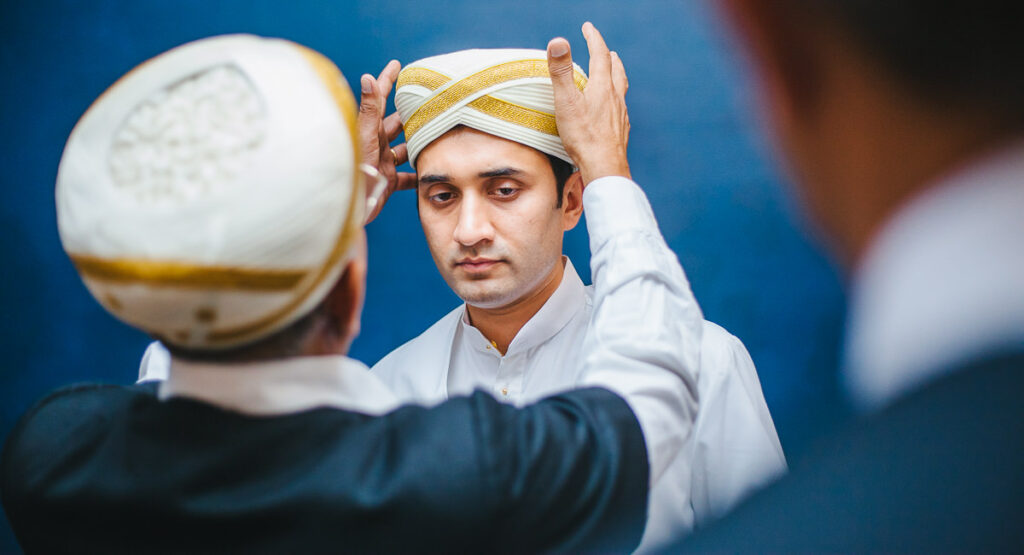
Anyone who has attended a Kodava wedding will be familiar with the traditional dress worn by Kodava men. A half-sleeved knee-length black wraparound coat, a silk sash girding the waist and headgear make up the attire, known as ‘Kuppya Chele’.

“In the Kodava language, ‘Kuip’ translates to heat, and ‘ya’ means absent. In simple words, the attire that protects one from heat is the ‘Kuppya’,” analysed Bacharaniyanda Appanna, a Kodava historian. To hold the ‘Kuppya’ in place, a cloth belt called the ‘chele’ is used. The ‘Kuppya Chele’ is accessorised with traditional weapons.

Kodavas are a native Dravidian race that settled amid the thick forests of the ‘Malayadri Sahyadri’ range and speak the original Dravidian language of Kodava. Ancestors wore ‘Kuppya’ made of indigenous plant fibre called ‘Bolakka Balli’.

“When clothes started coming in from Kerala through the barter system, the ‘Kuppya’ or knee-length coat was stitched in white cloth. However, when the British came to Kodagu in 1834, the priests of the Church had issues with this attire. Since the white ‘kuppya’ resembled the habit of Christian priests, the British passed an order to change the colour of the Kodava attire,” explained Apanna.

It is said that the elders voiced their resentment against the British for meddling with their culture. However, a mutual understanding was arrived at. “During this rift, serge fabric came to India from England. Black serge was imported in large quantities, and became more convenient as it rarely appeared dirty. The ‘kuppya’ was soon stitched in black serge, but to ensure the survival of ancestral culture, white ‘kuppya’ is mandated on special occasions. The bridegroom, temple head or priest, village head or ‘thakka mukyasta’ are mandated to wear white ‘kuppya’. Even a dead body is dressed in white ‘kuppya’,” explained Appanna.

The ‘chele’ also witnessed a touch of modernisation, and the 25-ft long strong multipurpose cloth has been replaced with fancy brightly-coloured silk cloth. “During war times, the ‘chele’ was used to tie enemies and for other purposes,” said Appanna.

A married youngster wears the Kodava
saree adorned with ‘pathak’

The comfort sari
The women of the community also wear unique attire, and a mythological story is intertwined around it. The Kodava women wear a sari that is pleated at the back and the ‘pallu’ or loose end is wrapped around the front. “According to mythology, seer Agasthya and Cauvery had a rift, and Cauvery left Talacauvery discreetly. She showed up after ten days at Bhagamandala, and then left towards Balamuri, where villagers stopped her and requested her to stay. However, she flowed with great force, which caused the saris worn by the women to turn backwards. She was then calmed and promised to show herself every year during the Cauvery Sankramana celebrations,” narrated Appanna.

This sari also has scientific symbolism. Since Kodava women participated in agricultural activities, the back-pleat saris were more comfortable, and women could even climb trees easily. These saris hold great significance for the community and are paired with headgear called the ‘vasthra’. “Both Kodava men and women wear the head cloth. Our ancestors believed that the sun’s rays should never fall behind the neck and they covered it with ‘vasthra’. However, the headgear has been modernised to suit current trends and has intricate artwork, especially those worn by women,” he explained.

Traditional jewels
The traditional knife called the ‘peecha katthi’, which was used in self-defence during ancestral times, forms part of the men’s attire and symbolises the tribal and warrior culture of the community. The ‘peecha kathi’ or dagger, and ‘odi kathi’ or traditional sword, are accessories for men, while a variety of traditional jewels add a touch of cultural flavour to the women’s saris.

“‘Peecha kathi’ was fixed to the attire using the ‘chele’. Earlier, these daggers had handles of wood. Now, they are carved in silver and gold and shine brightly on the traditional attire,” Appanna said.


The women have seven types of jewels. “At Talacauvery, the seven seers or ‘sapta rishis’ meditated. One could also find seven ponds at the centre, which are now covered. As a sign of blessings from the seers, the Kodava tradition mentions seven types of adornments from head to toe. However, only a few jewels have stood the test of time,” he explained.

Among the jewels, ‘Pathak’ holds great significance for married women. “When a girl goes to her husband’s house, her parents pack ten essential items – mostly traditional brass items – to be sent with her. These items are given to help her lead an independent life in her husband’s house, and must not be brought back to the girl’s house unless the couple is separated. To protect these items, a jewel consisting of ‘Naga’ (snake) god’s incarnation is tied by the mother of the bride during the wedding ceremony, called the ‘Pathak’,” explained Appanna. This jewel holds symbolic significance and is similar to a ‘mangal sutra’, while other traditional jewels include the ‘joe maale’ and ‘kokke thaati’.

Primarily nature worshippers, the culture, traditions and rituals of Kodavas are unique and tribal in nature. While the size of the community has shrunk in the past, steps are now in place to revive the community’s rich culture.

source: http://www.newindianexpress.com / The New Indian Express / Home> States> Karnataka / by Prajna GR, Express News Service / October 30th, 2022

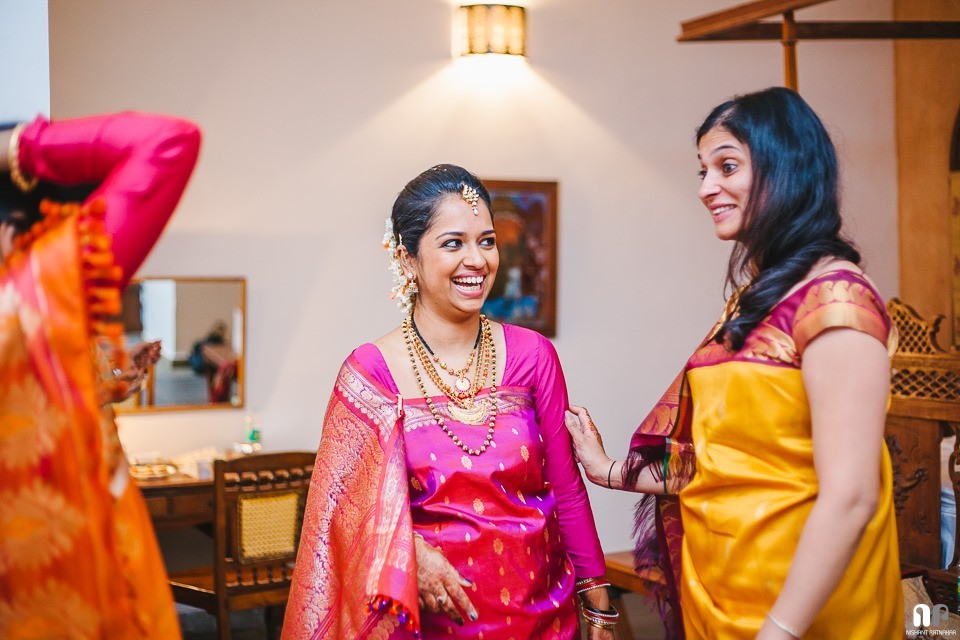
A Coorgi Wedding at the Tamarind Tree

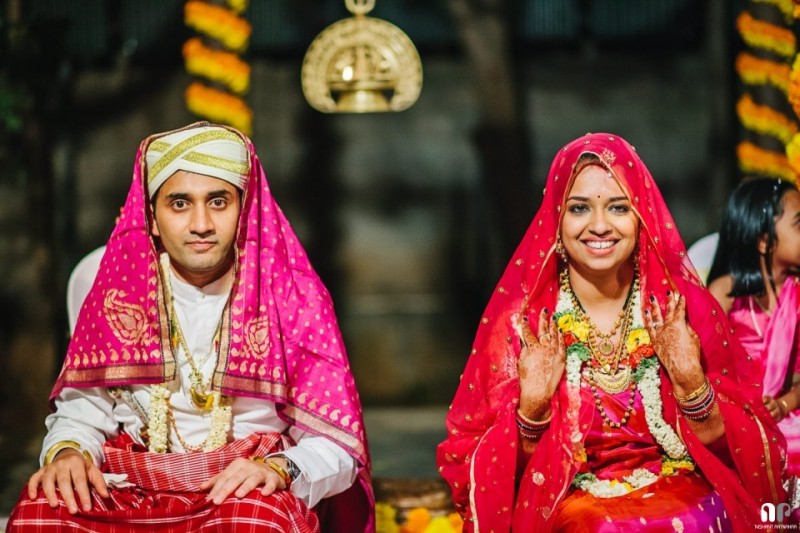
Moments from the wedding of Aditi and Rathan. Tamarind Tree, Bangalore, February 2015. To know more about the weddings that I photograph, do read the following link, www.nishantratnakar.com/services/wedding-packages/

As a wedding photographer traveling across India to different destinations on assignments, I love the fact that I get to see the sheer diversity of this country. It is a rarity that more than two weddings in my calendar year would follow the same rituals, style & customs. Here is a wedding of the Kodava or Coorgi community that I photographed earlier this year. The Kodavas are a Hindu community who primarily hail from Coorg/Madikeri district of Karnataka.

This was a wedding where there were two different ceremonies held. The first was a Hindu Arya Samaj wedding ceremony conducted during the afternoon, and it was followed by the traditional Coorgi ceremony in the evening.

This is a gallery with photographs from the Coorgi/Kodava ceremony of the wedding. The wedding was held at the Tamarind Tree Bangalore, a boutique wedding destination location on the outskirts of Bangalore city. It was a pleasure shooting this beautiful wedding of the lovely couple Adithi & Rathan. I wish them a very happy married life.

Moments from the wedding of Aditi and Rathan. Tamarind Tree, Bangalore, February 2015. To know more about the weddings that I photograph, do read the following link, www.nishantratnakar.com/services/wedding-packages/

To know more about my commissioned documentary wedding photography assignments, do check the link Wedding Photography Packages.  To contact me for assignment or other queries, do write to me using this contact form.

If you have enjoyed viewing this gallery, then feel free to share this link with other using one of the sharing options provided below.

source: http://www.nishantratnakar.com / Nishant Ratnakar

Kodagu’s monsoon delicacies

Traditional treats

As monsoon was the prime season to sow paddy — Kodagu’s main crop in the days of yore — people had no time for any other activity. So, this season was regarded as inauspicious and no ceremonies or celebrations were held. In between, the people would forage for these seasonal treats and prepare mouth-watering delicacies.

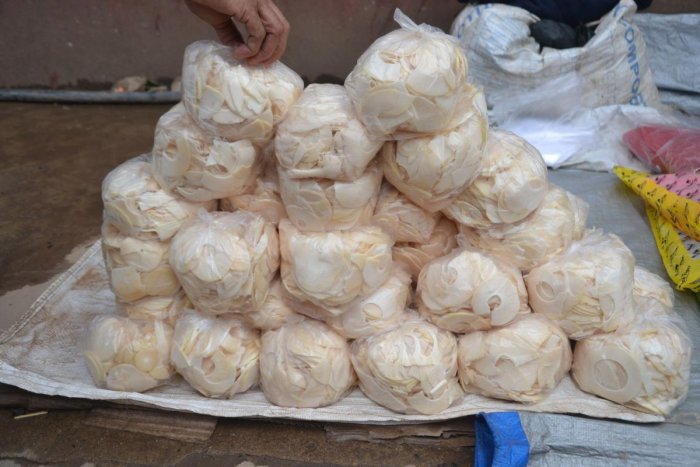
Processed bamboo shoots being sold in Kodagu. Photos by Arjun Bopanna, Niveditha Harish and Nisha Poovaiah

The aromas of baimbale curry (bamboo shoots curry), kummu curry (mushroom curry), kembu curry (colocasia curry), njand curry (crab curry), bhel meen curry (fish found in flooded paddy fields), pole meen curry (stream fish curry), therme thoppu palya (fiddlehead fern fry) are indicative of monsoon in this district located in the Western Ghats. These dishes are exclusively prepared during the wet months.

“The foremost reason these dishes are consumed only during the monsoon months is that the main ingredients such as aal kummu, baimbale are only available during this season,” says Chef Naren Thimmaiah.

According to Naren, cooking styles in each region would have developed purely on a trial-and-error basis. “Our elders would have realised when to eat what, the good and bad traits of a dish through experience,” he adds.

Purple delight

Unique sweet dishes prepared during this season are maddh payasa and maddh putt from maddh thoppu (Justicia Wynaadensis). Maddh translates to medicine in Kodava language and thoppu is leaf. The extract obtained from the leaves and stems of this plant imparts a beautiful, deep bluish-purple colour to the dish. 

These dishes are prepared and consumed only on Kakkada padinett, the eighteenth day of kakkada month (early August) in the Kodava calendar, when this plant is believed to have accumulated 18 medicinal properties.

The plant, rich in antioxidative and anti-inflammatory properties, is said to improve overall health. Its anti-microbial properties are also said to boost immunity during the monsoon months, when one is more likely to fall ill.

Another quintessential monsoon dish is baimbale curry made from bamboo shoots. The shoots are cut into small pieces and soaked in water for two days to remove the acidic toxins. The shoots are said to have anti-inflammatory, anti-ulcer, anti-diabetic and anti-oxidant properties. The baimbale curry is best had with akki roti called otti.

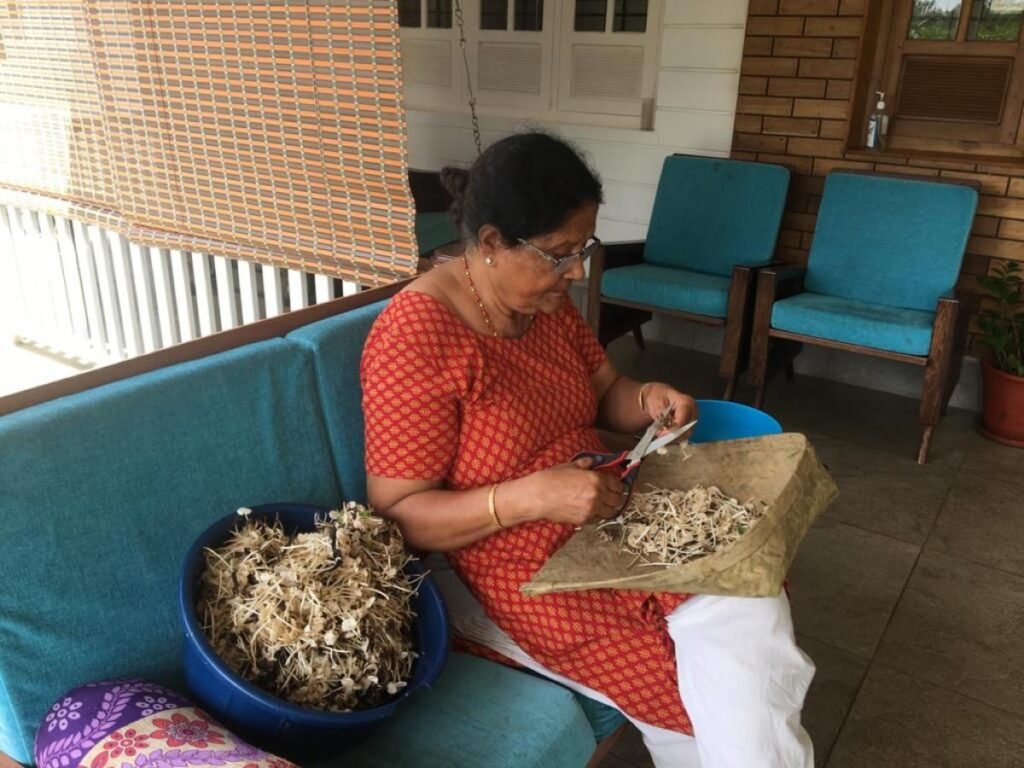
A woman preparing Kodagu delicacies. Photos by Arjun Bopanna, Niveditha Harish and Nisha Poovaiah

Surprise yields

Mushrooms, called kummu, also make great ingredients. These edible fungi grow in small patches and gathering them is a fun activity but it takes a trained eye to distinguish between edible and poisonous mushrooms. 

Another Kodava delicacy is prepared from fiddlehead ferns, called therme thoppu. These ferns are found near the banks of water bodies such as ponds, streams and rivers. Only the tender shoots of these wild ferns are selectively picked. The easiest way to cook it is to saute it with onions, dried chillies and salt. It is best had with otti. 

Like therme thoppu, kembu (colocasia) is generally found near water bodies and marshy lands. There are three varieties of kembu: red stemmed (chonda) kembu, green stemmed kembu and mara kembu. Mara kembu grows under the shelter of large trees. While Tulunadu is famous for the patrodes made from colocasia leaves, in Kodagu people mainly prepare curry using it.

With the onset of the monsoon, people also make dishes from jackfruit seeds.

Apart from these seasonal plants, people also get a good catch of crabs and fish in the flooded paddy fields and streams. Piping hot curries prepared from crabs and fish add to the charm of the monsoon months.

“All the traditional food prepared during the chilly monsoon season adds heat to the body. Also, pepper is used widely in the region, which again adds heat to the body,” Naren says.

Naren explains that as the people were expected to work in the rains and were most likely to get cuts and wounds, the food consumed would build up body temperature and aid in quicker healing of the wounds. “There were no tablets available then, the the foods themselves had medicinal values,” he says.

Preserved for future use

While these dishes are prepared only in the rainy season, bamboo shoots, jackfruit seeds, hog plums (ambatte) and fish are preserved for later use.

Bamboo shoots and hog plums are stored in brine; fish are coated with salt, smoked and dried.

These foods are so culturally ingrained that people staying elsewhere either make it a point to go to Kodagu to procure these food items or get their relatives to send across these delicacies.

“The food items sourced from Kodagu have an altogether different taste. So, preparing dishes by getting the ingredients from Kodagu is a special feeling,” says Sudha Poovaiah, who is settled in Bengaluru. 

source: http://www.deccanherald.com / Deccan Herald / Home> Spectrum> Spectrum Top Stories / by Dhanyata M Poovaiah / September 18th, 2021