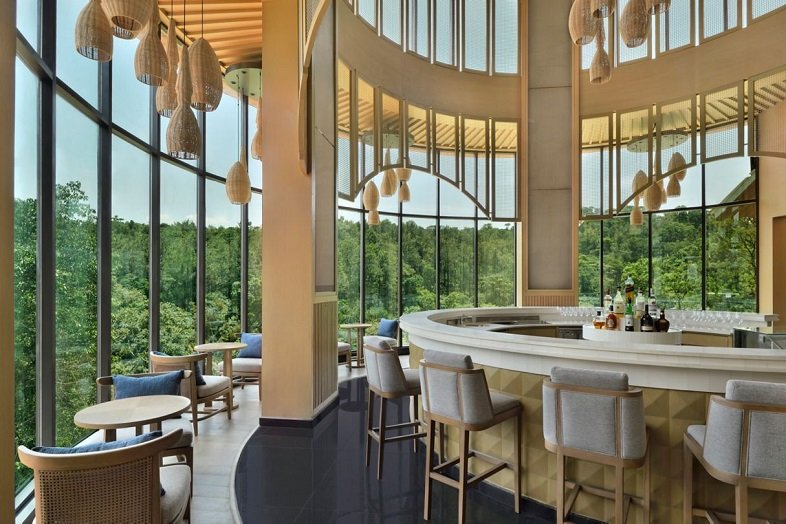
Marriott Hotels, an esteemed flagbearer within Marriott Bonvoy’s illustrious array of 31 hotel brands, has unveiled the Coorg Marriott Resort & Spa amidst the tranquil landscapes of Coorg, Karnataka. Nestled amid the verdant expanse of the Makandur forest, this modern haven offers a gateway to immersive local escapades, all cradled within the serene sanctuary of a lush botanical haven.
Renowned as one of Southern India’s premier hill station destinations, Coorg boasts enchanting vistas of mist-shrouded hills and luxuriant landscapes, providing a picturesque canvas for travelers. What sets this locale apart is not only its breathtaking natural allure but also the spectrum of exhilarating activities on offer, including intrepid treks, exploration of coffee plantations, and the enchantment of cascading waterfalls.
“We are thrilled to bring Marriott Hotels to Coorg, famously known as the Scotland of India, a land endowed with breath-taking natural splendor and glorious history. This opening underlines our commitment and focus as we continue to expand our footprints across leading travel destinations within India, providing travelers with trusted and high-quality accommodation choices” said Ranju Alex, Area Vice President, South Asia, Marriott International. “Marriott Hotels continues to live its legacy of Wonderful Hospitality, earning the trust of travelers around the globe.”
With 108 elegantly appointed villas and cottages, the Coorg Marriott Resort & Spa showcases panoramic emerald landscapes. Each villa boasts abundant natural light, plush bedding, and modern conveniences. Moreover, the resort extends its warm hospitality to four-legged companions, enhancing the vacation experience.
Within the dining sphere, the resort presents a diverse culinary offering. Madiker Kitchen caters to a global palate with international favorites and traditional Coorgi cuisine. Grills By The Valley promises a forest-framed dining experience with innovative dishes and skillfully crafted cocktails. The Greatroom welcomes guests to indulge in artisanal teas, coffees, and creatively infused cocktails amidst a library setting. As the day winds down, the swim-up Pool Bar provides an ideal setting for sundowners and light bites.
“We are delighted to welcome guests to our stunning new resort in Coorg,” said Randal Whelpdale, General Manager at Coorg Marriott Resort & Spa. “Coorg is a unique blend of serene landscapes, vibrant traditions, and outdoor adventure. We are thrilled to showcase its natural beauty and charm through our exceptional facilities, curated local experiences, and warm hospitality.”
source: http://www.businessnewsweek.in / Business News Week / Home> Business / by Sujata / August 11th, 2023
The fifth edition of the World Coffee Conference is coming to India. The event is set to unite the global coffee industry on sustainable topics of discussion, including circular economy and regenerative agriculture.
Since the 18th century, commercial coffee has been thriving in India. Over time, the country has evolved from a tea drinking nation to one with a strong coffee identity.
Coffee is traditionally cultivated in the Western Ghats, and is rapidly spreading to the areas of Andhra Pradesh and Odisha and the North East states. This year however, all eyes will be on Bangalore, the largest city of the southern Indian state of Karnataka, as it hosts one of the largest global events in the coffee sector.
For the first time since 2016, the International Coffee Organisation (ICO), a multilateral intergovernmental organisation for coffee, and its Members, will host the World Coffee Conference (WCC) from 25 to 28 September.
The event is foreseen in the International Coffee Agreement 2007 treaty, in which the organisation aims to host every four to five years. The WCC first took place in London, the United Kingdom, in 2001; followed by Salvador, Brazil in 2005; Guatemala City, Guatemala in 2010; and Addis Adaba, Ethiopia in 2016.
COVID-19 pressed pause on the last scheduled event, and now, the world is ready to unite in an Asian country for the first time.
“The renewed interest and commitment by India to organise this high-level event is exciting. It will not only be a forum to discuss critical topics for the global sector, but to be involved in a technologist exhibition, and technical workshops and a Growers’ Conclave run by the Coffee Board of India. We will see top-tier company representatives, government representatives, United Nations partners, and even Vietnam will be coming with more than 20 delegates. They see it as a huge opportunity to showcase the way they produce and trade coffee,” says ICO’s Head of Operations, Gerardo Patacconi.
The iconic Bangalore Palace Grounds will be the host venue for the international conference and coffee technology fair. The Government of India will host the WCC 2023, chaired by the Indian Minister of Commerce and Industry, Shri Piyush Goyal.
The WCC will be held in conjunction with the G20 Summit under the country’s presidency. It will also integrate the 5th CEOs and Global Leaders Forum, and the 136th Session of the International Coffee Council.
All 75 ICO member countries are ready to attend the WCC, with the conference expected to attract more than 1500 registered delegates and 10,000 business visitors from across the globe.
WCC 2023 will bring together representatives from government, the private sector, development partners, as well as civil society and academia, coffee producers and importers, leading coffee associations, global coffee experts, roasters and more.
They will gather to discuss and debate on coffee market trends, technology, and best practices for building a circular coffee economy, regenerative agriculture, sustainability through consumption, innovation and access to finance, with the goal to collaborate towards building a sustainable coffee industry from bean to cup.
Guest speakers will present on this year’s event theme, ‘Circular Economy and Regenerative Agriculture,’ addressing market trends, challenges, best practices, technologies, and strategic and financial solutions to build a resilient and sustainable future for the coffee sector, and production issues surrounding sustainability and cultivation, living income, and climate change, in compliance with the Sustainable Development Goals and Environmental, Social and Governance practices.
“On 1 October 2022, the International Coffee Day, ICO members decided on this topic theme. The reason is that there is a growing interest and opportunity at the different levels of the supply chain on circularity. This year we are also launching the Coffee Development Report on circular economy, and we are also looking into how to move circularity into action,” Patacconi says.
“There is huge opportunity for increasing jobs and income through circularity, so transforming waste, whatever form that takes, into a business opportunity is important, as is the work we match with living income for livelihood and prosperity of farmers. There are scattered, good examples, but we need to bring them together so that everybody can have access to this knowledge.”
Patacconi notes there are three levels of outcomes expected from this year’s high-level discussions at the “Davos of Coffee”. First, is a high level of engagement of both policy makers and industry around the event themes, including opportunities to discuss trends in the coffee sector, and changing regulatory framework.
The second is to determine practical solutions in terms of technology that could be made available, and third, is about access to financial resources, knowledge, and markets.
“Through the ICO we really want to promote the creation of a centre for coffee circular economy, which we are now advancing with the help of our members. We are also joining the Lavazza Foundation and United Nations agencies such as UNIDO (United Nations Industrial Development Organization) and ITC (International Trade Centre) for the creation of Coffee Circular Economy Hub to share knowledge and help implement win-win solutions from coffee farms to cup,” Patacconi says.
While it’s important that policy makers are engaged in this year’s WCC, Dr KG Jagadeesha, CEO of the Coffee Board of India, says it’s crucial to have participation from producers.
“It’s extremely important for everyone across the value chain to attend, including consuming countries. This event is exclusively dedicated to growers, and we invite growers from different coffee growing nations such as Vietnam, Brazil, Central and South America, and African countries to attend,” he says.
The international community is also invited to visit India’s exotic coffee growing estates from 23 to 24 September to appreciate the unique qualities of its thick, shade-grown canopy coffee.
“India is currently the sixth largest grower of coffee and fifth largest exporter in the world. We have half a million families dependent on cultivating coffee in India. Two million people are directly or indirectly involved in coffee value chain, and the coffee sector in India, especially domestic coffee market, is expanding. The percentage of youth who are passionate, dynamic drinkers is expanding. They are highly qualified, and their tech-savvy connection to social media and influence is driving the market.”
For a traditional tea-drinking nation, which is low-cost and easy to prepare, Jagadeesha says the renewed uptake of coffee consumption is impressive and a sign of development because living incomes and standards have improved, thereby allowing the younger generation to afford the luxury of quality coffee.
“The evolution of coffee in India is not just about access to coffee chains, it’s about offering an experience for the youth to gather and connect in urban areas, a place to unite and exchange ideas,” Jagadeesha says. “Bangalore, in particular, is the Silicon Valley of India. It’s home to a lot of technology parks and I.T companies, as well as the highest number of technical colleges. It’s the place to be for coffee. It’s a cosmopolitan city with a significant proportion of foreign nationals, and a large number of coffee chains, including Blue Tokai, Koinonia Coffee Roasters, and Third Wave Coffee have all made their mark here.
“This is a city worth exploring for coffee, and a country that invites the world to its doorstep and share its excitement for the future of possibilities.”
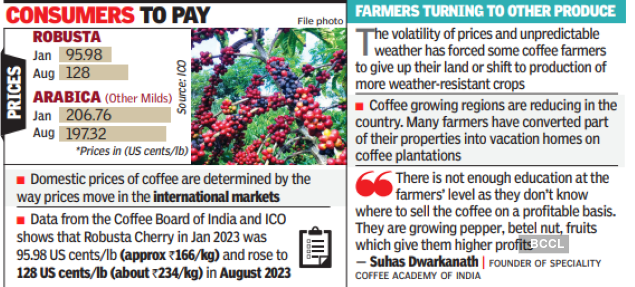
A shortage of coffee beans around the world, in particular due to weather problems in India and lack of supply from Brazil and Vietnam, has led to domestic market prices rising steeply. A well-known coffee trader in Pune, Gandhi’s Coffee, said he had to pass on a Rs50/kg price hike to customers.
Be it the humbled pulses, vegetables or even exalted gourmet offerings, food prices are now steaming hot, singing consumers’ budgets and making policy decisions tougher for rate-setters while they perhaps sip on coffee. But halt, for even the world of coffee, that beloved elixir that often serves as the morning oracle, is now demanding a premium spot on the rate chart.
Hold onto your mugs, coffee enthusiasts, because it looks like your beloved brew is about to take you on a rollercoaster ride through the wild world of caffeine economics.
This increase in cost is attributed to a shortage of coffee beans on a global scale, particularly stemming from Brazil and Vietnam, coupled with unexpected rains affecting bean quality in India. This unfavorable situation has led to a surge in domestic market prices.
Coffee traders, who usually acquire premium beans from Chikkamagaluru in Karnataka, have begun transferring this price escalation to their customers.
Latha Aravind, a resident of Mumbai’s Matunga, said that the cost of usual mixed coffee grounds – a blend of Robusta and Peaberry beans – has risen from around Rs 580/kg to about Rs 640 to Rs 650/kg.
“Prices have shot up and may keep rising,” she told Times of India.
Rajesh Gandhi, owner of Gandhi’s Coffee, a well-known coffee trading enterprise in Pune, said that he had to pass on a Rs 50/kg price hike to the end consumers, as Robusta beans have undergone an approximate 50% price surge, while Arabica beans area dearer by about 15%.
Ajit Raichur, a coffee trader from Kumardhara Traders, said that coffee prices are typically adjusted annually in January. However, this year witnessed an additional price hike of Rs 50/kg across all available bean varieties in July.
GM Dharmendra, a wholesale green coffee (raw beans) trader based in Bengaluru, said he lost 30% to 40% business over the last few months. “Many small coffee retailers in the area have shut shop or they are buying poor quality beans at cheaper rates. Many customers have shifted to instant coffee,” he added.
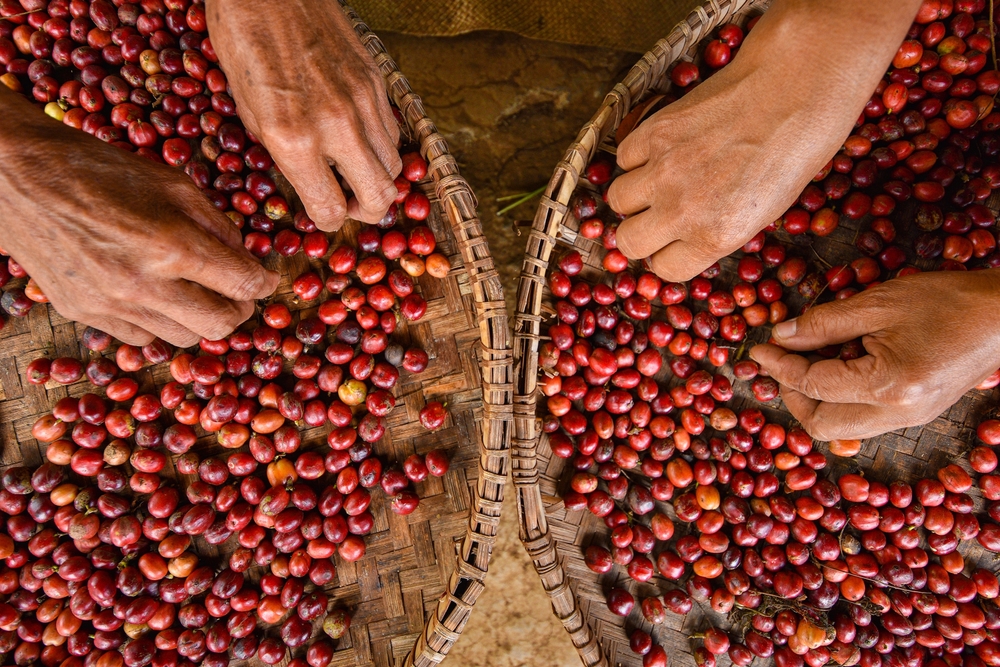
The coffee-growing region of Chikkamagaluru has borne the brunt of climate change impacts. Rohan Kuriyan, manager of Balanoor Plantations and Industries, reported a 20% decrease in yield due to untimely rainfall during blossom days, compared to the previous year. “The average cost of picking has also gone up. We ended up doing four rounds of selective harvesting instead of the usual two because of the uneven ripening of the cherries,” he added.
“With some positive news about better crop in Brazil, Arabica prices have started softening in the international markets. However, prices are expected to be a bit higher in the domestic market which is growing at double digits because of demand and less production,” Challa Srishant, MD of CCL Products (India) and member of the Coffee Board of India, said.
CCL Products, known for its ‘Continental’ coffee brand, has raised prices from Rs 280 to Rs 360 for a 200g jar within a year, with a further 10% increase planned for the next quarter. Observers in the industry have noted that the diminishing price gap between Arabica and Robusta has inclined consumers towards the smoother and sweeter profile of Arabica beans.
“For planters, operational costs have gone up – right from labour costs to fertilizer and pesticide costs. Coffee prices (Arabica) are a little lower now than they were last year but traders usually buy in bulk and therefore it appears like they are protecting their bottom line in case prices rise again,” Mahesh Shashidhar, chairman of Karnataka Planters’ Association said.
The harvesting season for Robusta beans is six-to-seven months away, and there is uncertainty about the next crop. Karnataka remains a dominant player, contributing 70% of India’s coffee production, while Kerala and Tamil Nadu also cultivate coffee. Industry stakeholders have collectively absorbed various price increases at different junctures. Although prices haven’t been adjusted yet, Amit Bhatta, founder of the specialty coffee brand Aeka Coffee, conceded that an additional 15% to 20% increase could prompt a shift of this burden onto the end consumers.
(with inputs from ToI)
source: http://www.economictimes.indiatimes.com / The Economic Times / Home> India> Business News > Industry> Cons Products> Food / ET Online / August 09th, 2023
Karnataka gives impetus to coffee with focus on sustainability through circular economy and regenerative agriculture. The state is the indisputable leader and produces over 70% of the total coffee produced in the country. It produced 2.33 lakh metric tonne of coffee in the last financial year, which is the highest coffee production by any state in the country.
By focusing on sustainability through circular economy approach, the state is implementing practices that aim to minimise waste, maximise efficiency in resources, and encourage environment-friendly practices throughout the coffee production process. In addition, the adoption of regenerative agriculture can enable to restore and enhance soil health leading to a more robust and sustainable coffee plantation.
The key coffee producing districts known as ‘The Land of Coffee’ are Hassan, Kodagu, Shivamogga and Chikkamagaluru. From a national perspective, the key production areas of coffee are Karnataka, Kerala and Tamil Nadu, which aggregate a total production of 92% in the country.
Going by the capability and competence of coffee growers, the state government is looking to unlock access to global coffee markets and tap the promising opportunities. In this regard, Bengaluru is playing host to the 5th World Coffee Conference (WCC) 2023 for the first time in Asia from September 25-28, 2023, at the Bangalore Palace.
The organisers are the International Coffee Organization (ICO), in collaboration with the Coffee Board of India, Ministry of Commerce and Industry, Government of India, Government of Karnataka and the coffee industry provides unparalleled business opportunities for global coffee stakeholders. For the four-day event, WCC has appointed Rohan Bopanna, India’s doubles tennis player & Arjuna awardee as its Brand Ambassador.
Evolving around the theme of the conference: “Sustainability through Circular Economy and Regenerative Agriculture,” the event will feature conference, exhibition, skill-building workshops, CEOs & global leaders forum, growers conclave and a myriad of networking events, all focused on advancing sustainability in the coffee industry.
It will also include producers, curers, roasters, exporters, policy makers, researchers and everyone passionate about coffee from 80+ countries to join at WCC 2023, with a 4-day intensive programme focused on building a sustainable coffee industry through discussion, debate, and collaboration, said the organisers.
During the unveiling of the WCC 2023 Logo and Theme- “Sustainability through Circular Economy and Regenerative Agriculture”, Dr S Selvakumar, Principal Secretary of the Karnataka Commerce & Industries Department, said that, Karnataka is undoubtedly the coffee capital of India. “There is tremendous opportunity for investments across the coffee value chain- from bean to cup right from equipment companies, coffee machines, soluble coffee brands as well as café chains. This in turn leads to increased employment opportunities for our talent from farm to cafes. Therefore, we are privileged to be the host state for this event.”
Dr K G Jagadeesha, CEO and Secretary, Coffee Board of India, said, “WCC 2023 holds great promise for the global coffee sector, specially the Indian coffee industry fostering growth and sustainable practices while showcasing its rich coffee heritage to the world.
WCC 2023 will host an impressive array of participants, including ICO member country representatives, coffee growers, coffee roasters, coffee curers, farm to cup industry, HoReCa, café owners, coffee nations, policy makers, start-ups, R&D and students.
Bengaluru awaits to host this extraordinary global gathering, which will showcase commitment towards sustainability and innovation in the coffee industry. Previous editions of the conference were successfully held in England (2001), Brazil (2005), Guatemala (2010), and Ethiopia (2016), receiving immense appreciation from coffee enthusiasts worldwide.
source: http://www.fnbnews.com / FnBNews.com , Food & Beverage News / Home> Top News / August 02nd, 2023
Sushant Dash is the CEO of Ratan Tata-backed coffee chain which is the largest coffee company in the world, now with hundreds of stores in India.
Ratan Tata’s company Tata Group, which is one of the leading conglomerates in the country, had acquired the world’s leading coffee company – Starbucks. The CEO of Starbucks India, brought to this country by Tata Group, is Sushant Dash.
Sushant Dash was appointed as the CEO of Tata Starbucks, which is the Indian branch of Starbucks with hundreds of stores opened across the country. Dash was appointed as the CEO of Starbucks in 2021, a decade after the international brand came to India.
Starbucks entered the Indian market in 2012 by entering into a 50-50 deal with Tata Group. After opening hundreds of stores across the country, Starbucks India now has a revenue of over Rs 683 crore. Starbucks has overall revenue of Rs 2.60 lakh crore internationally.
Sushant Dash was one of the initial Tata employees to be a part of the Starbucks India project, responsible for the entry of the world’s largest coffee company to open its doors in India. As of 2023, Tata Starbucks has over 340 stores in the country.
Sushant Dash, who became the CEO of Tata Starbucks in 2021, has been associated with the Tata Group for a very long time, initially being a part of Tata Consumer Products, which is the company that produces Tata Tea, Tata Salt, and Tetley beverages.
Before being the CEO of Tata Starbucks, Dash held the position of president of, packaged beverages business, India, Bangladesh, and the Middle East at Tata Consumer Products, overseeing the international business of the company on the beverage front.
While the exact salary of Sushant Dash has not been disclosed by the company yet, the range of salary of Tata CEOs is around Rs 2 crore to Rs 3 crore, according to their annual financial reports.
source: http://www.dnaindia.com / DNA / Home> Business / by DNA Web Team / July 24th, 2023
Italy’s biggest coffee roaster Lavazza, has announced the launch of Il Mattino Vivace its first pure filter coffee blend to be sourced and processed in India for the domestic market.
Coffee is being sourced from Chikmagalur and Coorg in Karnataka and processed in Lavazza’a manufacturing facility at Sri City in Andhra Pradesh.
The facility at Sri City in Tada began its commercial operations a few weeks ago, Fresh and Honest Cafe Ltd Managing Director Silvio Zaccareo said.
Fresh and Honest Cafe Ltd is a 100 percent subsidiary of Lavazza.
Zaccareo declined to reveal the size of investment made at the factory or the number of employees working in it.
II Mattino Vivace meaning ‘lively morning’ is made from Arabica and Robusta beans roasted for the “at home” segment.
“Lavazza is known the world over for its expertise in art of blending for over four generations. II Mattino Vivace is a result of combining that expertise and our understanding of the unique consumer preferences in Indian market”, he said.
To a query, he said the coffee powder would be available in retail outlets across the country. “We are planning to complete first stage distribution by end of this month”.
Zaccareo said the company inaugurated Coffee Training Centre last year which was the first largest centre outside Italy.
The centre trains professionals, carries out research and explores new forms of taste. “We have trained more than 1,000 people,” he said.
source: http://www.retailnews.asia / RetailNews.asia / Home / by Retail Asia / July 14th, 2023
Indian Badminton Doubles Players, Ashwini Ponnappa and Tanisha Crasto have achieved their career-best rankings in BWF Rankings. In the recent update by the BWF, the duo successfully climbed up one place to reach 60th rank. This is the highest they have achieved in their entire career.
The pair recently won the Nantes International Challenge title by defeating the prolific duo of Hung En-Tzu and Lin Yu-Pei of Chinese Taipei. The event took place at the Salle Metropolitana de la Trocardaiare, Paris. Ashwini is a Commonwealth gold medallist and a world-class player with many titles under her belt.
Meanwhile, Tanisha has astoundingly proven herself. She paved her way through the domestic circuit and has shown his talent alongside experienced players. Both of them have performed exceptionally well in the recent past and are willing to stick with the winning ways.
Ashwini attained the highest-ever ranking of 10 in women’s double alongside Jwala Gutta in 2015. While Tanisha had the highest rank of 115 with Shruti Mishra. This duo has come a long way to achieve this feat in the BWF Rankings update. They display the depth in the Indian Badminton pool and the nurturing of this depth.
Other Indian Players to Gain in Recent BWF Rankings
Apart from these two, Simran Singhi and Ritika Thaker moved up to 64th rank. Swetaparna Panda and Rutaparna Panda advanced to 66, while the Palak-Unnati pair moved to the 90th position. All of these Ranks were achieved in the Women’s Doubles category.
In the Men’s Single category, Kiran George moved up three places to achieve the 53rd position. While in the Men’s Doubles category, P.S.Ravikrishna and S.Sankar climbed up four places to grab the 70th ranking. The pair of Achutaditya-Venkata Harsha also made meager progress by moving to 80th place in the rankings.
These are some major updates from the BWF Rankings update in July 2023 and the players would be motivated to further progress in the same manner.
source: http://www.sportskeeda.com / SportsKeeda / Home> Badminton / by SportzConnect / edited by Yash Singh / July 05th, 2023
The recent census of elephants in Kodagu forests has indicated that there are 1,103 jumbos in the jungles. The census was taken up for three days last month. The number of elephants has increased in Kodagu though the region is in the middle of human-wildlife conflict.
Conservator of forests (Kodagu circle) BNN Murthy and DCF (Madikeri division) AT Poovaiah said that the census was taken up after a gap of six years. The elephant census, which was conducted in Karnataka, Kerala, Tamil Nadu , was conducted in 23 ranges of four divisions in the district namely Madikeri, Virajpet, Madikeri wildlife division, and Nagarahole Tiger Reserve. About 800 personnel were involved in the census.
The elephant census was conducted in three phases. On the first day, the number of elephants was directly recorded through a block count. On the second day, indirect enumeration was done and on the third day, enumeration was done using the lake and dams by observing the number of elephants coming to drink water.
For enumeration operations, the enumerators roamed forest areas on foot and recorded the marks of elephants seen in the forest as per the prescribed document. The number of male, female and baby elephants in a herd of elephants was determined, officials noted.
There were 200 teams of three people each. Arms were provided to each team as a precautionary measure, the officials stated.
The forest officials said that there are a large number of elephants dwelling in the plantations also and if this number is detected, the number of elephants will increase substantially.
source: http://www.timesofindia.indiatimes.com / The Times of India / Home> News> City News> Mysuru News / by G. Rajendra / TNN / June 07th, 2023
The All India Tennis Association (AITA) on Tuesday unveiled a 12-member squad for the continental quadrennial games. Doubles specialist Rohan Bopanna will once again represent India in the tennis competition at the Asian Games. On September 23, the Asian Games will get underway in Hangzhou.
The potential singles players for the team are Sasikumar Mukund and Sumit Nagal, who both competed in doubles at the 2018 Asian Games alongside Ramkumar Ramanathan. Bopanna, 43, and Ramkumar are most likely to team up. The other two members of the group, Yuki Bhambri and Saketh Myneni , are already paired on the ATP Tour.
Ankita Raina, who won bronze in singles at the 2018 Asian Games, will serve as the team’s captain. Karman Kaur Thandi, Rututaj Bhosle, Sahaja Yamlapalli, Vaidehi Chaudhari, and Prarthane Thombare are the other active members.
The nucleus of the Indian delegation in both the men’s and women’s divisions is essentially unchanged, with Ramanathan, Nagal, and Bopanna also being part of the Jakarta Games team. Ankita, Karman, Ruturaj, and Prarthana are among the four female players that participated in the Jakarta tournament five years ago. Sahaja and Vaidehi are the two new players.
source: http://www.sportscafe.in / Sports Cafe / Home> Tennis> National> News / by Sports Cafe Desk / June 21st, 2023
India’s coffee growth is being affected by unpredictable weather patterns, including insufficient rainfall, temperature fluctuations, drought, and heavy flooding.
While Baba Budan, the Sufi monk, planted the smuggled seven coffee beans in the bountiful hills of Chikmagalur, little did he know that India, one day, would be the 6th largest coffee producer, with Karnataka contributing 71 per cent of coffee production to the world. Though the coffee culture has evolved through the years, and there has been a significant boom globally for coffee, the threat for your morning cup is real and is right there knocking on the doors–climate change!
Unpredictable weather patterns are affecting most parts of the world, including India. The country grows a lot of Robusta and Arabica, and both these varieties suffer prolonged periods of inadequate rainfall, temperature rise, drought and heavy flooding.
The Case With Arabica And Robusta Samia Subhani, a fourth-generation coffee planter and the founder of “The Kaimara Belt Coffee,” sounded distressed. Her family has been into coffee growing and trading for over 150 years, and their estate in the Baba Budangiri hills grows Arabica, the most demanding variety. Subhani’s estate has 50-80 farmers working on the plantation daily, all dependent entirely on coffee farming. But with the ongoing effects of climate change, coffee is going through a difficult phase putting all their lives at risk.
Arabica is the most demanding variety of coffee when it comes to cultivation. Photo Credit: Shutterstock
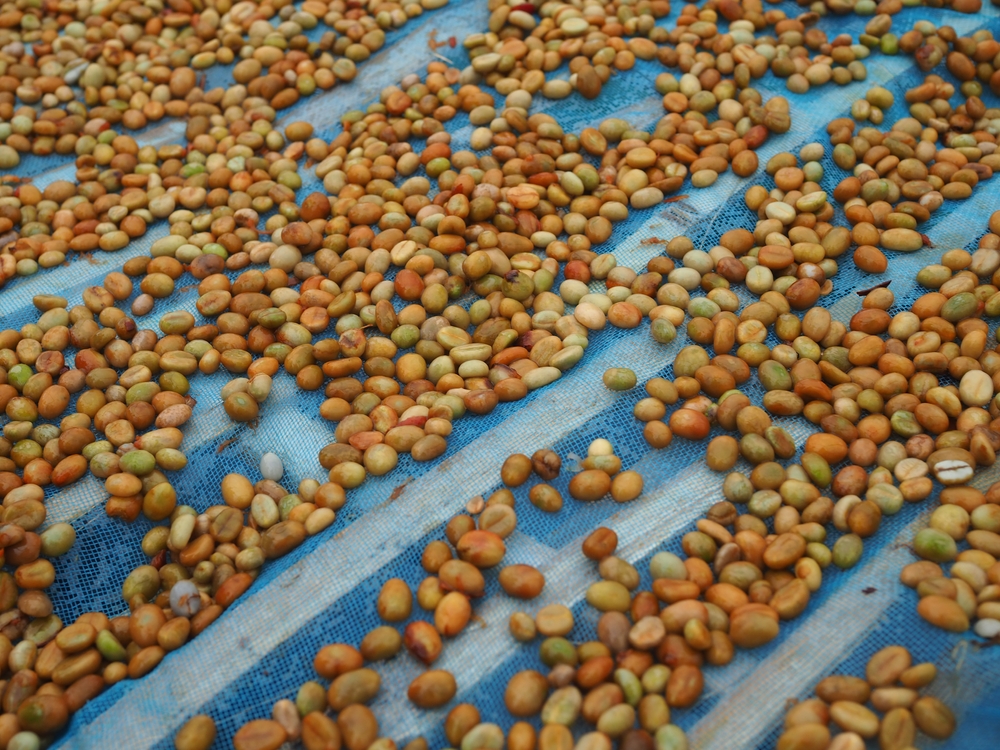
“Climate change causes leaf shedding, reduced coffee plant productivity, and increased vulnerability to pests. Extreme cold delays plant flowering and lowers berry quality. Heavy rains at irregular times cause cherries to burst and drop prematurely. Continuous heavy rains before harvest prevent drying, leading to crop spoilage,” Subhani explained.
But like they say, every solution has a problem. Subhani mentioned that we must dig deeper into our pockets and follow some mitigation measures to maintain the yield and deliver quality coffee to patrons. “So, we provide artificial rains during droughts, maintain proper irrigation in the system, avoid using harmful pesticides to control soil erosion and use only soil-friendly organic fertilisers.”
While this is the situation in an Arabica coffee plantation at Chikmagalur, Coorg, popularly known as the “Scotland of India,” is known to grow more of Robusta.
“Climate change is certain to impact coffee yields due to temperature changes. Coorg is experiencing water scarcity, affecting coffee production. Coffee plants require water, nutrients, rainfall, and sunshine for healthy growth and harvest. Fluctuations in yield have increased, with lower yields in recent years. Delayed monsoons in Coorg will further reduce usable berry production,” said Shruti Shibulal, CEO and Director of Tamara Leisure Experiences.
Though these climatic impacts are less friendly to coffee crops, Shibulal believes they have the advantage of scientific studies to inform how we can prepare for this impending change. Collaboration and knowledge sharing between those with high knowledge of the crop and those with research-driven and technological expertise is vital to assess, test and implement viable solutions.
Robusta is grown extensively in Coorg. Photo Credit: Shutterstock
“The Tamara Coorg is a 100 per cent organic plantation. Therefore, our irrigation is entirely dependent on rainfall. Rainwater harvesting tanks here facilitate the annual reuse of 90 lakh litres of rainwater. These reserves do marginally help us contend with unpredictable weather patterns. However, the coffee trees depend on rain and sunshine in balanced intervals to yield the greatest number of healthy berries,” she added.
According to Shibulal, instead of using measures like industrial fans or increased labour to speed up the drying process of coffee berries, they focus on protecting and nourishing their coffee trees using organic fertilisers and natural supplements. They also prioritise sustainable practices like reusing rainwater for irrigation and actively monitoring soil health. She further emphasised the importance of maintaining a tree canopy structure, which creates a favourable micro-climate for coffee plants and supports biodiversity.
“I would turn my support to local and regional producers or individual plantations (whenever possible). Smaller establishments will face greater challenges during times such as these. As consumers, we must lend our loyalty to those actively pursuing practices that combat climate change in the long run,” Shibulal concluded.
Climate Change Affecting Coffee Planters All Over Tapaswini Purnesh, a fifth generation coffee planter and Director–Marketing & Promotions of Classic Coffee, mentioned that other coffee planters, including the Harley Estate at Sakleshpur in Karnataka, are also battling climate change.
“The worst scenario is the last 4 to 5 years, where we have been experiencing heavy rains during harvest season, i.e., November to February, which normally is a complete dry spell. India is unique to the sun drying of coffee. However, due to unseasonal rains during harvest, plantations are now installing mechanical dryers to avoid quality deterioration,” Purnesh said.
She also stated that coffee production is highly labour-dependent. In the long run, finding labour may become increasingly challenging, an evident trend. As the cost of implementing adaptive measures rises and the arduousness of growing quality coffee amidst climatic pressures is considered, customers must acknowledge that good coffee comes with a price tag. “The coffee growers will be motivated to enhance and refine their coffee cultivation practices if they receive adequate remuneration from the price realisation.”
Meanwhile, the latest estimates warn that climate change may mean that as much as half of the land used for coffee production worldwide may no longer be suitable for it by the middle of the century if global warming continues at this rate. So, as all these coffee planters suggest, every citizen must be more responsible towards our environment, travel responsibly, and follow more sustainable practices to save our environment and the most loved, coffee.
source: http://www.outlookindia.com / Outlook Traveller / Home> Explore> Story / by Deepa Shri Rajan / June 25th, 2023
WELCOME. If you like what you see "SUBSCRIBE via EMAIL" to receive FREE regular UPDATES.
Read More »