Tag Archives: Tamara Leisure Experiences

Tamara Leisure Experiences Shines With Five FHRAI Awards Across Hotels, Talent and Wellness

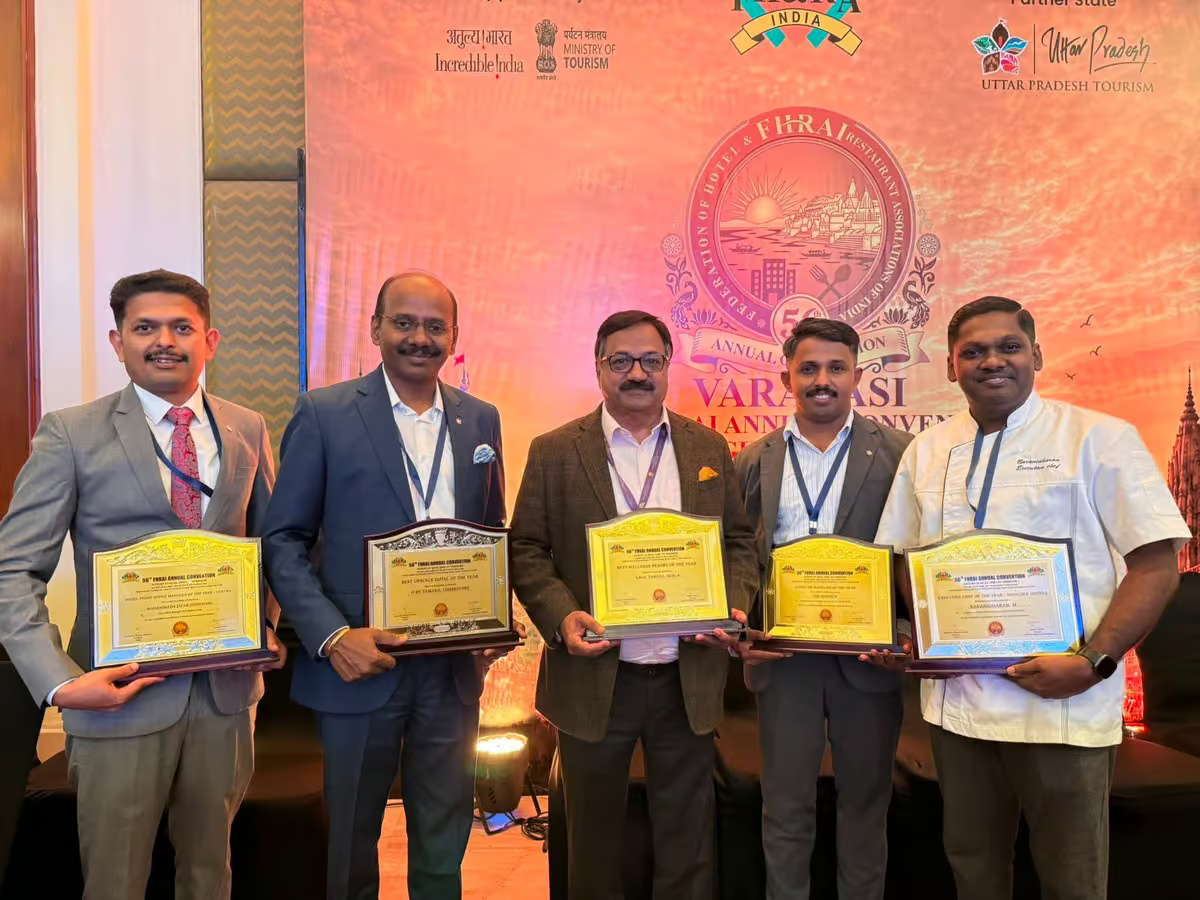
Tamara Leisure Experiences (TLE) has written another chapter in its success story by winning five key awards at the FHRAI 56th Annual Convention. The awards are a testimony of TLE’s focus on leadership, innovation in food and beverage, engagement of employees, performance of properties and social wellness. The awards appreciate TLE for providing experiences with a ‘people’ and a ‘purpose’ touch and incorporating ‘place’ through real time experiences offered during their stays.

The awards reflect the diverse strengths of TLE’s hospitality portfolio. At The Tamara Coorg, Mohd Jafar was honoured as Hotel Front Office Manager of the Year – Luxury Hotels (Male), recognising his contribution to delivering exceptional guest service. Chef Baranidharan M from O by Tamara Coimbatore received the title of Executive Chef of the Year – Midscale Hotels (Male) for his culinary leadership and innovation. Jijo Mathew from O by Tamara Thiruvananthapuram was recognised as Human Resources Manager of the Year – Upscale Hotels (Male), highlighting the group’s strong focus on talent development and workplace excellence.

Further strengthening TLE’s achievement, O by Tamara Coimbatore was awarded Best Upscale Hotel of the Year, while Amal Tamara received the award for Best Wellness Resort. The recognition celebrates Amal Tamara’s unique approach to holistic Ayurvedic wellness and its efforts to provide transformative wellbeing experiences. Together, these accolades underline TLE’s continued pursuit of excellence across its properties and its dedication to redefining contemporary hospitality.

Speaking on the recognition, Samir M.C., CEO, Tamara Leisure Experiences, said, “These recognitions are particularly meaningful because they reflect the different elements that come together to define Tamara – our people, our destinations and the experiences we create. We have always believed that responsible and memorable hospitality is built through authentic engagement with our guests, our teams and the places in which we operate. To see this philosophy recognised across both individual and property categories is a strong affirmation of the work our teams do every day.”

The FHRAI 56th Annual Convention, hosted from August 21 to 23, 2026, at Taj Ganges, welcomed over 1,000 delegates from India and international markets, including policymakers, hospitality leaders and key stakeholders from across the  tourism and hospitality sector. The event provided a significant platform for discussions, partnerships and industry collaboration, focusing on the changing priorities and future direction of Indian hospitality.

The recognition highlights TLE’s core belief that hospitality should extend beyond delivering memorable guest stays and create a positive impact on people, communities and the destinations where its properties operate. This commitment is reflected through its strong focus on local employment, with nearly half of its workforce recruited from surrounding communities. By generating employment opportunities and supporting local livelihoods, TLE ensures its properties remain deeply connected with regional traditions, cultural identity and the natural landscapes that define each destination.

With modern travellers increasingly searching for authentic experiences, cultural connections and meaningful journeys, TLE continues to develop hospitality concepts that celebrate a strong sense of place. From the nature-inspired luxury of The Tamara Coorg and stylish urban experiences at O by Tamara to the personalised Ayurvedic wellness offerings at Amal Tamara, each property reflects a unique interpretation of responsible hospitality. Through its philosophy of Responsible and Memorable Hospitality, TLE focuses on preserving local heritage, strengthening communities and creating experiences that deliver lasting value for guests and the destinations they visit.

source: http://www.travelandtourworld.com / Travel andTour World (TTW) Home> Hotel News / by Benny Mehera / August 25th, 2026

How Climate Change Is Brewing Trouble For India’s Coffee Industry

India’s coffee growth is being affected by unpredictable weather patterns, including insufficient rainfall, temperature fluctuations, drought, and heavy flooding.

While Baba Budan, the Sufi monk, planted the smuggled seven coffee beans in the bountiful hills of Chikmagalur, little did he know that India, one day, would be the 6th largest coffee producer, with Karnataka contributing 71 per cent of coffee production to the world. Though the coffee culture has evolved through the years, and there has been a significant boom globally for coffee, the threat for your morning cup is real and is right there knocking on the doors–climate change!

Unpredictable weather patterns are affecting most parts of the world, including India. The country grows a lot of Robusta and Arabica, and both these varieties suffer prolonged periods of inadequate rainfall, temperature rise, drought and heavy flooding.

The Case With Arabica And Robusta
Samia Subhani, a fourth-generation coffee planter and the founder of “The Kaimara Belt Coffee,” sounded distressed. Her family has been into coffee growing and trading for over 150 years, and their estate in the Baba Budangiri hills grows Arabica, the most demanding variety. Subhani’s estate has 50-80 farmers working on the plantation daily, all dependent entirely on coffee farming. But with the ongoing effects of climate change, coffee is going through a difficult phase putting all their lives at risk.

Arabica is the most demanding variety of coffee when it comes to cultivation. Photo Credit: Shutterstock

“Climate change causes leaf shedding, reduced coffee plant productivity, and increased vulnerability to pests. Extreme cold delays plant flowering and lowers berry quality. Heavy rains at irregular times cause cherries to burst and drop prematurely. Continuous heavy rains before harvest prevent drying, leading to crop spoilage,” Subhani explained.

But like they say, every solution has a problem. Subhani mentioned that we must dig deeper into our pockets and follow some mitigation measures to maintain the yield and deliver quality coffee to patrons. “So, we provide artificial rains during droughts, maintain proper irrigation in the system, avoid using harmful pesticides to control soil erosion and use only soil-friendly organic fertilisers.”

While this is the situation in an Arabica coffee plantation at Chikmagalur, Coorg, popularly known as the “Scotland of India,” is known to grow more of Robusta.

“Climate change is certain to impact coffee yields due to temperature changes. Coorg is experiencing water scarcity, affecting coffee production. Coffee plants require water, nutrients, rainfall, and sunshine for healthy growth and harvest. Fluctuations in yield have increased, with lower yields in recent years. Delayed monsoons in Coorg will further reduce usable berry production,” said Shruti Shibulal, CEO and Director of Tamara Leisure Experiences.

Though these climatic impacts are less friendly to coffee crops, Shibulal believes they have the advantage of scientific studies to inform how we can prepare for this impending change. Collaboration and knowledge sharing between those with high knowledge of the crop and those with research-driven and technological expertise is vital to assess, test and implement viable solutions.

Robusta is grown extensively in Coorg. Photo Credit: Shutterstock

“The Tamara Coorg is a 100 per cent organic plantation. Therefore, our irrigation is entirely dependent on rainfall. Rainwater harvesting tanks here facilitate the annual reuse of 90 lakh litres of rainwater. These reserves do marginally help us contend with unpredictable weather patterns. However, the coffee trees depend on rain and sunshine in balanced intervals to yield the greatest number of healthy berries,” she added.

According to Shibulal, instead of using measures like industrial fans or increased labour to speed up the drying process of coffee berries, they focus on protecting and nourishing their coffee trees using organic fertilisers and natural supplements. They also prioritise sustainable practices like reusing rainwater for irrigation and actively monitoring soil health. She further emphasised the importance of maintaining a tree canopy structure, which creates a favourable micro-climate for coffee plants and supports biodiversity.

“I would turn my support to local and regional producers or individual plantations (whenever possible). Smaller establishments will face greater challenges during times such as these. As consumers, we must lend our loyalty to those actively pursuing practices that combat climate change in the long run,” Shibulal concluded.

Climate Change Affecting Coffee Planters All Over
Tapaswini Purnesh, a fifth generation coffee planter and Director–Marketing & Promotions of Classic Coffee, mentioned that other coffee planters, including the Harley Estate at Sakleshpur in Karnataka, are also battling climate change.

“The worst scenario is the last 4 to 5 years, where we have been experiencing heavy rains during harvest season, i.e., November to February, which normally is a complete dry spell. India is unique to the sun drying of coffee. However, due to unseasonal rains during harvest, plantations are now installing mechanical dryers to avoid quality deterioration,” Purnesh said.

She also stated that coffee production is highly labour-dependent. In the long run, finding labour may become increasingly challenging, an evident trend. As the cost of implementing adaptive measures rises and the arduousness of growing quality coffee amidst climatic pressures is considered, customers must acknowledge that good coffee comes with a price tag. “The coffee growers will be motivated to enhance and refine their coffee cultivation practices if they receive adequate remuneration from the price realisation.”

Meanwhile, the latest estimates warn that climate change may mean that as much as half of the land used for coffee production worldwide may no longer be suitable for it by the middle of the century if global warming continues at this rate. So, as all these coffee planters suggest, every citizen must be more responsible towards our environment, travel responsibly, and follow more sustainable practices to save our environment and the most loved, coffee.

source: http://www.outlookindia.com / Outlook Traveller / Home> Explore> Story / by Deepa Shri Rajan / June 25th, 2023