A soldier from Kodagu, who was serving in Central Industrial Security Force (CISF) at Jharkhand in Ranchi, passed away yesterday following a brief illness.
The deceased soldier is K.K. Shiju (48), son of Rajamma and a resident of Kadagadalu. He was serving in CISF since 23 years. He took ill about two days ago and passed away yesterday.
He leaves behind his mother, wife, two daughters and a host of relatives and friends.
His body is expected to arrive at his native place today evening and the last rites will be held at Kadagadalu.
source: http://www.starofmysore.com / Star of Mysore / Home> News / December 09th, 2022
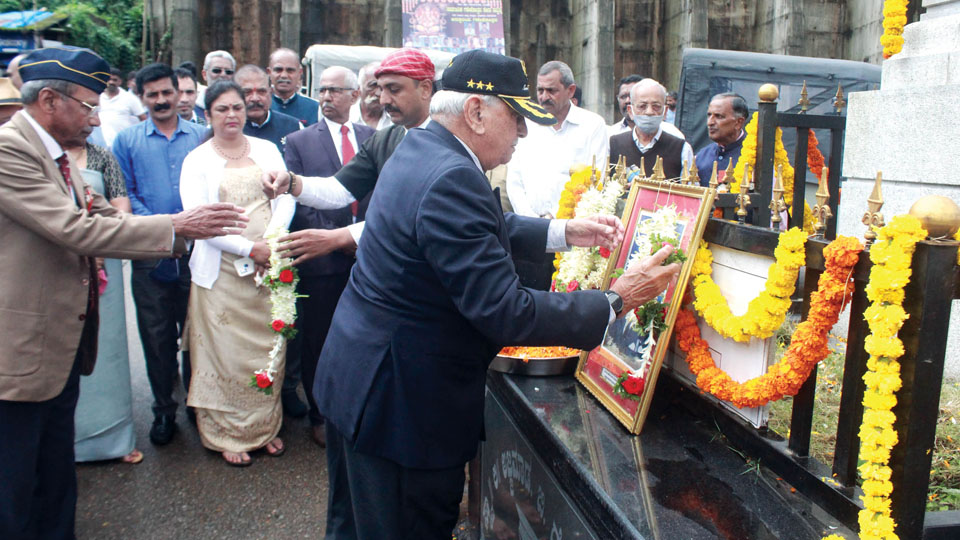
The Armed Forces Flag Day was observed in Madikeri in Kodagu on Wednesday. | Photo Credit: Special Arrangement
The Kodagu district administration and Department of Sainik Welfare and Resettlement observed the Armed Forces Flag Day at General Thimmaiah Memorial Bhavan in Madikeri on Wednesday.
Lieutenant Colonel (Retd) Mahaveer Chakra P.S. Ganapathy, Deputy Commissioner B.C. Satish, Superintendent of Police Capt M.A. Aiyappa, Air Marshal (Retd) Cariappa, Lieutenant Colonel Chacko, Kodagu Zilla Panchayat CEO S. Akash and other dignitaries were present on the occasion.
Every year, December 7 is observed as Armed Forces Flag Day throughout the country to honour martyrs and men in uniform, who valiantly fought and continue to fight on the country’s borders.
source: http://www.thehindu.com / The Hindu / Home> News> India> Karnataka / by The Hindu Bureau / December 07th, 2022
Large populations of wild elephants moved freely between Kodagu and Kerala states even as the Bramhagiri-Nagarahole-Wayanad forest was known to be an age-old elephant corridor.
Elephant image used for representational purpose only. (Photo | Special Arrangement)
Madikeri :
Elephants are migratory beings and tigers are known to be territorial. However, with forests depleting to make way for human-centric development, wildlife conflict is peaking, as is evident in Kodagu. Nevertheless, experts opine that the conflict can be addressed scientifically by not just establishing conflict-mitigation projects, but by connecting fragmented forest areas.
While humans are confined to district, state, national and international borders, the wildlife, especially elephants, migrate without borders. Similarly, a large population of wild elephants moved freely between Kodagu and Kerala states even as Bramhagiri-Nagarahole-Wayanad forest was known to be an age-old elephant corridor.
However, this corridor has now been fragmented and the Kodagu division of the Forest Department is keen on connecting the fragmented forest area to make way for the free movement of the elephants. This in turn will also create a large undisturbed forest area for the territorial tigers too.
“Over 150 acres of two private coffee estates has disconnected the elephant corridor and is disrupting free movement of the elephants. The department is in talks with estate owners to purchase the land and establish an elephant corridor,” said B N Niranjan Murthy, Chief Conservator of Forests of Kodagu division.
A huge gap between Bramhagiri and Wayanad forest area has forced the elephants to tread through villages and on roads to continue their migration. An estimate of Rs 25 crore has been drawn to procure private lands even as the department holds a vision to invest on a flyover in an area for vehicle movement.
source: http://www.newindianexpress.com / The New Indian Express / Home> States> Karnataka / by Prajna GR, Express News Service / December 07th, 2022
Coorg Coffee Festival and Expo will held at Raja Seat, Madikeri on December 10 and 11.
Kodagu as a whole is known for the wonderful nature accomplished with rains and mist, besides a galaxy of wild animals. The nature here is praised all over for the exciting seasons throughout the year and is even coined as the “Scotland of India”
Kodagu produces one of the finest Coffees under Western Ghats hot spots. which are marked as living ecosystems and ecologically sensitive areas, marching sustainably along with flora and fauna. Coffee growers in this region have imprinted world coffee lovers and engraved an image of best coffees in the Western Ghats.
To strengthen further and to make world to aware the instinct note of Coorg Coffee and Indian Lovers in particular, the District administration is organizing a “Coorg Coffee Festival and Expo” first of its kind on 10 and 11 at Raja Seat, Madikeri
The main objectives of the festival are to bring all the coffee stakeholders under one umbrella and to promote Coorg Coffee extensively among the Coffee lovers, tourists visiting Coorg from across the country and world also.
Disteict administration stated in a press release “private entities who are involved in the Coffee Value Chain are requested to take part in the festival and exhibit their products. In this regard, the Coffee Board and the Department of Horticulture will be the facilitating entities to carry out the above programme”.
All the communications related to exhibition stall including registration and remittance of stall charges will be on the coorgcoffee-coorgcoffeefestival2022@gmail.com
The PG department of Big Data Analytics at St Agnes College (Autonomous) Mangaluru organized an intercollegiate technical fest, CIFRA, on November 28. The fest was held in celebration of Big Data day and brought together a community of students and technologists. The fest was inaugurated by the principal Sr Dr M Venissa A C and the PG co-ordinator Sr Dr M Vinora A C.
Students from various colleges in Karnataka enthusiastically participated in the fest. The technical fest included three major events and each comprising three rounds.
The first event was based on the fundamentals of Computer Science and Data Science, the second event was a programming language-based event, and the third event was a technical quiz.
The participants had the choice of selecting a programming language for the event. The judges for the events were C G Thomas, Senior Software Engineer, Novigo Solutions, Mangaluru, and Akanksha Jadhav, Analytics Engineer, Riskonnect Services Pvt. Ltd.
The observers for the events were Seementhini Fernandes and Nelson Fernandes, assistant professors at St Agnes College.
The valedictory programme included felicitating the winners and the participants.
The first prize was won by the team from Field Marshal K M Cariappa College, Madikeri, the second prize by the team from Vivekananda Degree College, Puttur and the third place was secured by Vijaya College, Mulki.
source: http://www.daijiworld.com /Daijiworld.com / Home> Campus Beat / by Media Release / December 01st, 2022
Apart from these conflict mitigation projects, the department is releasing special packages to help farmers located in conflict areas.
Madikeri :
The pandemic situation had affected the maintenance works and sanction of projects from the forest department across Kodagu leading to a peak in the wildlife conflict. Alongside the perpetual problem of wild elephants, the tiger menace had claimed the lives of humans and an increased number of cattle. However, the department has assured to provide a permanent solution to the man-animal conflict and grand plans are in place to address the issue.
Improved conflict-mitigating projects including the deployment of static surveillance teams in heavy conflict areas are underway in the district. An annual budget between Rs 30-40 crore will likely focus on developing conflict mitigation methods to fight man-elephant conflicts.
This year, the department has received approval to install railway barricades for a 22 km stretch across Nagarahole, a 20 km stretch across Madikeri limits and a 2 km stretch across Madikeri Wildlife limits. In 2023-24, solar fences will play a crucial role in addressing the conflict and improved double tentacle solar fences will be installed across a 25 km stretch of the Nagarahole forest area and a 20 km stretch of the Madikeri forest division. In addition to this, the several dysfunctional solar fences (spread across 60 km in different areas) will witness relief and maintenance works.
Apart from these conflict mitigation projects, the department is releasing special packages to help farmers located in conflict areas.
“The farmers can install solar fences across their estates and 50% of the cost will be borne by the department. A one-kilometre solar fence will cost approximately Rs 2,30,000 and the department will release Rs 1,15,000 as a subsidy for the fence. Any farmer or grower is eligible to avail the subsidy,” confirmed BN Niranjan Murthy, Kodagu division CCF. As of this year, funds are ready to be distributed as subsidies for up to 50 to 60 km stretch of solar fence installation by the farmers themselves.
Meanwhile, to address the tiger menace across the estates of Kodagu, the department will provide a 50% subsidy for the construction of cattle sheds to eligible farmers in conflict areas.
“The construction of a cattle shed is estimated at Rs 2 lakh per unit and the department will bear 50% of this cost. The department is ready to extend subsidies to 50 farmers this year. The farmers who own less than four acres of farmland or estate and possess a BPL card are eligible for this subsidy,” confirmed Murthy.
Further, the compensation for death due to wildlife attacks has been increased from the previous Rs 7.5 lakh to the current Rs 15 lakh. Similarly, the crop compensation to all crops will be doubled shortly. Meanwhile, the department has arranged school van facilities for students located in conflict areas and currently, four vans are functioning in severe conflict areas.
“In case of additional requirements, more vans can be engaged by the department,” he confirmed.
The Indian Institution of Sciences is undertaking a scientific study on the steel rope fences to address the man-elephant conflict and the institution is involved in a few modifications to make this a foolproof initiative.
“Once the steel rope fences go through a few design changes, they can be installed instead of railway barricades as the rope fences are extensively cost-effective,” he said.
Deployment of surveillance cameras and solar street lights in conflict areas are also among the projects that have received a green signal to address the conflict in the district.
source: http://www.newindianexpress.com / The New Indian Express / Home> States> Karnataka / by Pragna GR, Express News Service / December 01st, 2022
Climate change-induced weather events are impacting Karnataka’s coffee farms, testing the resilience of farmers.
Karnataka coffee farmers keep meticulous rainfall records that are helping individual and organisational attempts at studying climate change.
Farmers are trying to adapt to changes in rainfall patterns, first investing in sprinklers and now in coffee driers.
At his 38-acre coffee estate at 3,800 metres above sea level, overlooking the pristine Baba Budan giri (hill) in Chikmagalur district of Karnataka, I.S. Umeshchandra is working on creating a database of rainfall records in the region. Crowdsourced from fellow coffee farmers across the district, the exercise struck gold when a farmer shared a rainfall record from 1887.
“I was amazed to see it, though it is unverified. The verified ones date back to 1933,” he told Mongabay-India. His son Navneeth, a data analyst, is helping him crunch the numbers. Coffee farmers in Karnataka keep a record of rainfall in their estates, a practice dating back to colonial times.
A climate change report in 2014, Transitioning towards climate-resilient development in Karnataka, prepared by 26 experts, said that Karnataka would be hit harder by climate change than other states in the country. As rainfall patterns in the state change, the rainfall records of farmers are coming in handy for various individual and organisational attempts at understanding climate change, climate resilience and adaptation in Karnataka.
I.S. Umeshchandra with his rainfall records at his house. Photo by Abhishek N. Chinnappa.
In 2011, the College of Forestry in Kodagu district, India’s largest coffee-producing district, participated in an international project, Coffee Agroforestry Network (CAFNET) Project, to study the ecosystem services of agroforestry systems in the district. Rainfall patterns too were studied as a part of the project, where rainfall data of over 60 years from 116 coffee farms was sourced and analysed. The study pointed to a strong fluctuation in annual rainfall every 12 to 14 years and a reduction in the length of the rainy season by 14 days.
Umeshchandra (not associated with CAFNET) has observed some patterns from the initial analysis, though he has yet to find a strong one. “Fluctuations in annual rainfall are noticed every 10-12 years,” he shared. Records from 1887 show an average annual rainfall of 4826 mm (190 inches) in Chikmagalur, which suggests heavy rainfall is not new in this region, which receives an average annual rainfall of around 2500 mm (80-100 inches). “But heavy spells of rain for a few days as against it being spread out is making a difference,” he observed based on his experience.
Ramachandra K.S., a coffee farmer from Shanthalli in Somwarpet taluk of Kodagu, agrees. Flipping through the pages of his handwritten rainfall records dating back to the 1960s, he says there was over 5000 mm (200 inches) of average annual rainfall in 1960-1962, which fell to around 3800 mm (150 inches) in 1970. However, most farmers agree that the rainfall pattern has become unpredictable and daunting in the last five years because unpredictable rains make planning farming events difficult. They say they are constantly stressed.
J. Srinivasan, a professor at the Divecha Centre for Climate Change at the Indian Institute of Science (IISc), told Mongabay-India that these long-term rainfall records that the coffee farmers of the Malnad region of Karnataka (including Chikmagalur and Kodagu) keep are invaluable.
However, he said that the farmers need to compare their records with local IMD (India Meteorological Department) station records to verify them. “A single rain gauge cannot give accurate results,” he said, adding that the Malnad region, which is hilly, experiences microclimates and that one farmer’s rainfall records will be different from that of their neighbour’s.
Ramachandra’s rainfall records. Photo by Abhishek N. Chinnappa.
More rains lead to landslides, infections and pests in plants
Chikmagalur has a special place in the coffee history of the country. Legend has it that a 17th-century Sufi saint Baba Budan secretly transported seven coffee cherries from Mocha in Yemen and planted them in front of his hermitage, which later came to be called Baba Budan giri (hills) in Chikmagalur, marking the origin of coffee cultivation in India.
From Umeshchandra’s estate situated on a slope, Baba Budan giri provides a breathtaking view. But these days, it fills him with dread. While erratic rainfall hasn’t affected the productivity of his estate adversely, he fears physical damage by way of landslides. More wet days and increased daily rains saturate the soil and can damage hills, leading to landslides. Studies have shown a correlation between extreme rainfall and landslide events.
At Attigundi village, about 13 km from Umeshchandra’s estate in Hosapura is his friend Kiran M.R’s 45-acre estate of Arabica coffee. He is focused on phasing out silver oak trees (Grevillea robusta) in his estate and planting more native ones. Karnataka is known for shade-grown coffee, and its agroforestry system encourages an abundance of native trees alongside the cash crop.
Leaf rust infestation on coffee plants. Photo by Abhishek N. Chinnappa.
Plantation economics and public policies, however, drove the farmers to opt for exotic shade trees like silver oak, which grows fast and can be easily traded as timber. Many farmers are switching back to native trees for various reasons, one of them being the leaf litter of silver oak lacks nutrients and doesn’t decompose as fast as native ones, said C.G. Kushalappa, dean of the College of Forestry. There is also the realisation that a good canopy cover provided by native trees can prevent soil damage during extreme rainfall.
“This July, I got 101.6 mm (four inches) of rain every day for 20 days. Some places nearby recorded around 150-200 mm (6 to 8 inches). This was followed by 1000-1300 mm (40-50 inches) of rain in 10 days in June. “We used to get seven to 10 days of monsoon break in June-August which is crucial for coffee. But no such break in the last three to five years,” said Kiran.
More wet days and little sunshine — a perfect setting for pests and fungal infections — is bad news for coffee. Black rot fungus (coffee thread blight) or Koleroga and coffee white stem borer (Xylotrechus quadripes), a pest, are decimating Arabica plants that were once this coffee belt’s pride. Coffee leaf rust, another fungal disease, is also high among coffee, informs Kiran. “I faced 20-30 percent loss last year,” he said with dismay. He had to shell out Rs. 5000 an acre to remove the black rot infestation at his 60-acre farm in Magundi in Chikmagalur.
Robusta, as the name suggests, is more robust and pest resistant to an extent, said J.S. Nagaraj, joint director of Central Coffee Research Institute at Balehonnur in Chikmagalur. In the last 15 years, there has been a clear shift towards Robusta in Kodagu and Chikmagalur. “While it was 50-50 earlier, it is now 80 percent Robusta in Kodagu,” said Kushalappa. Labour shortage and the high cost of cultivation of Arabica have also tipped the scale in favour of Robusta.
Coffee farmer Kiran points to the infestation. Photo by Abhishek N. Chinnappa
Farmers devise ways to adapt
Coffee farmers here are constantly trying to adapt to a changing climate. “Coffee farming depends on two important rainfall events, blossom shower and backing shower,” explained farmer Jammada Ganesh Ayyanna of Kaikeri village in Gonikoppal in Kodagu. “Blossom showers in the summer months of February to March ensure the blossoming of coffee plants. This must be backed by the backing showers within two weeks for the cherries to set,” he said. In the last three decades, the changes in shower patterns began to affect largely rain-fed agriculture, prompting farmers to invest in irrigation by way of sprinklers. “More than 90 percent of farmers rely on sprinklers now,” Ayyanna told us.
While the northeast monsoon and cyclonic events had little effect on coffee farming in these parts earlier, isolated showers during coffee-picking months (December-February) are working against the industry. Showers during picking months make the cherries drop. The dropped cherries, called “cleanings”, are often picked and sold. While cleanings filled 100 bags (one bag is 50kg) at Ramachandra’s farm last year, Kiran had to let go of the cleanings due to rains. “The cleanings were damaged; damaged cherries don’t fetch a good price,” he said. Picked cherries need at least two months to dry, said Ramachandra.
“No rains and good sunshine are ideal.” Since that hasn’t been the case in the last few years, more farmers, mostly large landholders, have begun to invest in driers.
Coffee cherries at Kiran MR’s estate. Photo by Abhishek N. Chinnappa.
“I didn’t want to worry about unexpected rains,” said Gerrard Perreira from Coove Village in Mudigere taluk in Chikmagalur, who has 200 acres of Arabica and Robusta coffee. “For the coffee to dry properly, we need uninterrupted sunshine for a minimum of five days. But that’s hardly been the case in the last few years,” he said. He bought a drier eight years ago when signs of climate change had begun to show.
It has a 4000-litre capacity that can dry 35 bags of coffee at one time at an optimal temperature of 35-40 degrees Celsius for 18-22 hours. “The drying has to be uninterrupted. Since the power supply is unreliable, we use firewood. But a power generator for backup is a must,” he shared.
There are other advantages too. Using driers is more hygienic, quicker, and cuts labour costs, said farmers. Small and medium landholders, however, can’t afford the driers that cost about Rs 12-15 lakhs and are suggesting setting up community-owned driers. Kushalappa has his suspicions since cooperatives have not worked well in the region in the past. Coffee Board is now giving subsidies for driers, informed Nagaraj. “It is not affordable for everyone. But if climate change continues to affect coffee farming, driers are the future,” he said.
source: http://www.india.mongabay.com / Mongabay / Home> Mongabay Saves Climate / by Arathi Menon / December 01st, 2022
These microbial mats in a Lake Huron sinkhole have finger-like protrusions caused by a buildup of methane gas in small pockets beneath them. Image: Thunder Bay Marine Sanctuary
By Daniel Schoenherr
Special microbial mat systems in Alpena, Michigan, are helping scientists search for extraterrestrial life.
“It’s so different, and feels otherworldly,” said Stephanie Gandulla, a diver with the National Oceanic and Atmospheric Administration’s Thunder Bay Marine Sanctuary. She has sampled the mats near the sinkholes on the lake’s bottom.
You may have seen a microbial mat before — the green algae on wet rocks at the beach is an example.
Algae’s green color comes from chlorophyll — a substance that uses sunlight to turn carbon dioxide into energy. Carbon dioxide and oxygen support most of life on Earth.
But under special conditions, like those at three sinkholes just 2½ miles east of Alpena, primitive forms of microbes called cyanobacteria can survive without either of them.
These are white, not green, and they get energy from chemicals in the water.
“They are everywhere, but they are incredibly hard to find,” said Bopaiah Biddanda, a biologist with Grand Valley State University’s Annis Water Research Institute, who has been studying them for 20 years.
Such mats are normally found in ocean waters over 32,000 feet deep, but they can be found only 80 feet below the surface of what is known as Lake Huron’s Middle Island Sinkhole.
The sinkhole’s biologically extreme environment can help simulate sample collection in extraterrestrial worlds where life is based on similar chemicals. A new study by Biddanda models scenarios where robots could analyze material beneath the water of other planets. It’s based on the work in Lake Huron.
The study focuses on two methods: suction devices for soft mats and coring devices for hard mats.
Click on the photo below to watch a video about these mats:
The sinkholes near Alpena provide sulfuric, oxygenless groundwater that creates the conditions needed for the mats to grow. Filaments of cyanobacteria drift together, creating a wispy white-purple flow.
“It almost looks like a mirage,” Gandulla said.
It could be a long time before the experience from sinkholes in Lake Huron will be used to explore the potential of life on planets elsewhere, but Biddanda’s exploration is yielding other finds now.
Recently, for example, his team found an explanation for the mats’ mysterious ability to change colors overnight.
The purple and white cyanobacteria travel upwards to capture energy from the top of the mat, according to the study. During the day, microbes with color capture the small amount of sunlight reaching the seafloor with chlorophyll.
As the sun sets, the white microbes move to the surface of the mat to absorb chemicals in the sulfuric water for their energy. This continuous, vertical shift in microbes causes patches of the mat to change between purple and white in a daily cycle.
The microbial mats thrive off a special soup of chemicals in the groundwater, but changes in land use could disrupt it in the future.
The Thunder Bay sanctuary is constantly combating such threats to coastal ecosystems such as the one near Alpena.
“Development might choke off the water supply,” Biddanda said.
The marine sanctuary offers educational programs and tours to K-12 students and operates a welcome center year-round.
“We work together to protect it as a community,” Gandulla said.
Scientists hope to sample the oceans of Europa, a moon of Jupiter, for microbes with robots pioneered in Lake Huron. Image: NASA
The characteristics of Middle Island Sinkhole’s cyanobacteria could hold the key to much more than planetary exploration. They could lead to advances in other scientific fields, such as evolutionary biology and medicine.
“We have a library of pharmaceutical value here,” Biddanda said “This could help us down the road.”
And, he noted that they look cool: “There is something fascinating and mesmerizing about these colorful mats.”
A unique eco-certification initiative in Kodagu’s famous coffee estates offers fresh hope for preserving native rainforests of the Western Ghats.
Growing coffee in the shade of evergreen trees in Kodagu. | Gopikrishna Warrier
There was a time in the not-too-distant past when coffee farmers in Kodagu district of Karnataka grew their plants only under the canopy of evergreen forests they had inherited. Now they prefer to grow it under the sun, which has serious implications for the Western Ghats and on the waters of the Kaveri River.
More and more farmers are now letting trees such as Dadup (Erythrina subumbrans), Arecanut (Areca catechu), Balanji (Acrocarpus fraxnifolius) and Jackfruit (Acrocarpus heterophyllus) die so that the canopy can be opened up and they can grow sun-loving coffee varieties that produce more berries and beans, resulting in higher returns.
Instead of the big trees, they are now planting exotic Silver Oaks (Grevillea robusta), whose pole-like trunk can be used as a support for the climbing pepper vines, which help boosting incomes. The proliferation of Silver Oaks has made it one of the more common trees in some parts of the area.
This transition has a larger ecosystem cost. Kodagu, earlier known as Coorg, is located on the western edge of the Mysore Plateau, at an average altitude of 800 metres, as it lifts up to the crest of the Western Ghats ridge (altitude above 1,500 m) and then falls sharply westwards into Kerala. The plateau mainly slopes eastwards, with the streams and rivers joining to form the Kaveri River, which is the lifeline for millions of people in Karnataka, Tamil Nadu and Puducherry.
With insufficient rains over the Western Ghats during this year’s southwest monsoon, there is a shortage of water in the reservoirs across the Kaveri in Karnataka. This has led to the flaring of the water-sharing dispute with the lower riparian state of Tamil Nadu in recent days.
While this acrimony continues, payment for ecosystem services measures are being worked out in Kodagu district so that coffee farmers protect the forests under which they grow their crop, thereby preserving the water flow into the Cauvery. These measures also help to maintain the climate resilience in the river’s catchment and command areas.
With the forest-like mixed-tree canopy in coffee plantations disappearing, the torrential rains of the southwest monsoon flows quickly down the streams, carrying valuable topsoil away and causing floods followed by long dry periods downstream.
Paying for ecosystem services
The Kodagu farmers are being encouraged through payment for ecosystem services, in the form of eco-certification, to continue with their traditional coffee cultivation under the shade of mixed species of trees. This will help strengthen the ecosystem services they receive from the unique landscape of Kodagu, and also strengthen similar services and climate resilience of all those relying on the waters of the Kaveri downstream.
The concept of eco-certified coffee, whose certification process ensures that coffee is grown under mixed-species trees, has gained popularity in the district in the past five years. Close to 900 coffee farmers have converted to eco-certified coffee. Even with a conservative estimate of 10 acre per farmer, this means nearly 10,000 acres of eco-certified coffee. In addition, with Tata Coffee getting all of its 13 estates eco-certified, Kodagu district has at least 20,000 acres under coffee cultivation that aims to minimise damage to the environment.
As an incentive for protecting the environment, the coffee farmers get a premium above the market price for their coffee beans. Coffee is the major agricultural produce from Kodagu, with 33% of the district landscape under its cultivation. About 38% of India’s coffee production comes from the district.
Ecologically, Kodagu district has been identified as a micro hotspot of biodiversity under the larger Western Ghats region. Rightly so, since the western crest of the mountainous district is in the direct path of the southwest monsoon. The dark clouds heavy with rain dump much water over the district. While the western edge of the district receives above 5,000 mm of rainfall on an average, it reduces to around 1,200 mm in the east. Most of the water feeds into the Kaveri.
According to a reportby the College of Forestry at Ponnampet in Kodagu, natural forested ecosystems cover an area of 46% of the total area of the district. These include evergreen, semi evergreen, moist deciduous, dry deciduous and scrub forest types, and even the high-altitude shola-grassland ecosystem.
Traditionally, coffee is grown in the shade of these forests. Coffee estates in Kogadu have on an average 350 trees per hectare, compared with 270 in degraded groves and 640 trees per hectare in the nearby Brahagiri Wildlife Sanctuary, making these estates amongst the densest agro-forestry systems in the world.
“Very few landscapes across the world grow coffee in the way in which Kodagu does,” said C.G. Kushalappa, university head for forestry and environment sciences at the College of Forestry, Ponnampet in Kodagu. “We grow both Arabica and Robusta coffee under the shade of the trees. Our shade-grown Robusta fetch a premium price. When grown under the shade, the berries mature slowly and fill out better. They have good cupping (taste) quality.”
Coffee plants are increasing being cultivated under exotic Silver Oak trees. (Photo by S. Gopikrishna Warrier)
However, he needed scientific data to convince the coffee farmers and the district administration that there was strong ecosystem benefit in maintaining the traditional shade-growing methods. The opportunity for doing this research emerged when the College of Forestry was chosen as the lead institute in India to carry out the Coffee Agro-Forestry Network, or CAFNET study to understand the environmental services from this unique landscape.
Financed by the European Commission, the study was jointly conducted by the College of Forestry, the Coffee Board, the French Institute at Puducherry, CIRAD (the French national agricultural research system) and Bangor University from the United Kingdom between 2007 and 2011.
Rich local knowledge
The study noted that the multi-storeyed coffee agro-forestry system developed and sustained by the farmers based on their local knowledge is one of the most diverse production systems in the world. The traditional coffee agro-forestry system sustains diverse animal, bird, plant and microorganisms, and provide biodiversity, carbon sequestration and water-related ecosystem services. Since multiple crops such as pepper, mandarin oranges, vanilla and timber is also grown in these systems, they help provide resilience to farmers when they are hit by coffee price volatility.
The CAFNET report recommended that coffee farmers growing Arabica and Robusta under shade trees should be paid for the ecosystem services that their farms provide, so that they can protect biodiversity and therefore water in the Cauvery. Two methodologies for payment for ecosystem services suggested was eco-certification and geographical indications protection for Kodagu coffee.
Eco-certification of coffee farms in Kodagu started as a follow-up to this recommendation. Coffee farmer BB Thammaiah says his interest was piqued when students from the College of Forestry came to his farm to carry out biodiversity studies. “After the studies I was told about the uniqueness of the method in which I grow coffee, and I went in for eco-certification,” he said.
The two eco-certifications that have been popularly accepted are from the Rainforest Alliance and Utz. Coffee grower KK Naren in Kunda village near Ponnampet said the main benefit of the eco-certification process is that farmers are trained in good practices that have good environmental benefits and improve the working and living conditions for the workers.
“The economic benefit is not much,” he said. “It is more of training for us, which will be beneficial in the long run. The eco-certification process educates the coffee farmers about the environment.”
Importance of native trees
The most important lesson from the training relating to the eco-certification, according to Narenm was the understanding on the importance of native trees. “It is not that we didn’t know about native trees but we were not that keen on maintaining them,” he said. “The native trees do not give good financial returns, so we gave importance to silver oak.”
According to Naren, the Rainforest Alliance eco-certification process looks at whether native shade trees are present. The certifiers and auditors also look at labour management, whether the minimum labour wage is paid and the cleanliness around the labour quarters. They are very strict about not using child labour. “They also look at the way chemicals are used,” he said. “They are not saying no to chemicals but there are restrictions to some chemicals and the way the rest are used. They are keen that we should not use pesticides of chemicals near the rivers or tanks. They give importance to maintain local environment.”
Individual planters like Thammaiah and Naren got an opportunity, through the eco-certificaion process, to access the international market through a Swiss procurement agency that buys higher quality coffee. Both of them sell their eco-certified coffee to Ecom Gill, who procures the eco-certified produce for supply to Nespresso.
BB Thammaiah in his coffee farm where the plants are grown under the shade of native evergreen trees. (Photo by S. Gopikrishna Warrier)
For Tata Global Beverages Ltd and its production subsidiary Tata Coffee Ltd, the move to eco-certification of all of its 13 estates in Kodagu was an important step in the process to make its supply chain sustainable. According to Anurag Priyadarshi, global sustainability manager for Tata Global Beverages, one of the guiding principles that the group has adopted is to source sustainability. For this, all their estates in Kodagu have been eco-certified by Rainforest Alliance and Utz.
“Through the eco-certification process we are trying to ensure good management practices for the ecosystem, energy, water, waste, soil and agro-chemicals. We ensure the safety of the produce and also occupational health of the workers. Ultimately we want to prevent the impacts of climate change,” he said.
MB Ganapathy, head of plantations for Tata Coffee, said the company is aware about the fact that they are growing coffee in Kodagu, which is a biodiversity hotspot in the Western Ghats. “We have recognised this fact and that is the reason that our vision is to enhance the ecological wealth we have inherited. The eco-certification helps us safeguard the environment.”
Challenges remain
However, the rapid spread of the eco-certification process has also raised some hiccups which need to be overcome, states TR Shankar Raman, scientist at the Nature Conservation Foundation, whose organisation was involved with helping Rainforest Alliance with the certification in the initial years. The three points of concern, according to him, is the very rapid pace at which certification is being done; the relative absence of biologists and social scientists in the auditing process; and the dilution of conservation standards (like the requisite number of native species and canopy cover) in subsequent versions of the certification guidelines.
“While the rapid certification has more and more farmers being eco-certified, we hope the rigour of the process continues to be maintained, so that the end result of conserving the native vegetation is not compromised,” Raman observed.
With more farmers opting for eco-certification, there is a movement towards the protection of the traditional methods of coffee cultivation under the shade of mixed-tree species. For the process to strengthen the farmers should continue to get good economic benefit for their eco-certified produce.
According to Naren, if there is at least 10% more returns from the eco-certified coffee remains constant then there will be an incentive for the opting for opting for the process. At present the price at which procurement agencies such as Ecom Gill buy is linked to the international market price, plus a premium of Rs 60 to Rs 80 for a 50 kg bag of sun-dried cherries. The international prices fluctuate in relation to the local market prices, and as with the current situation can go below the domestic price.
However, Kushalappa says that in addition to the premium, there are other incentives and bonuses for producing good quality coffee beans. The average increase in price above the local market price was around 15% last year, which is well worth the effort.
If additional income for coffee farmers from eco-certification can help conserve unique agro-forestry ecosystem of Kodagu, then it will be the water flow into the Cauvery that would be conserved. Millions of people downstream, including the residents of Bengaluru and other parts of peninsular India, will thank the coffee farmers upstream for their drinking water and climate resilience.
Rs one crore proposal has been forwarded to the state to improve the musical fountain in the area alongside establishing a rain shelter – with nearly 500 seating capacity – across the fountain.
Madikeri:
The Harangi Reservoir in Kodagu will soon witness beautification work to attract more tourists. The reservoir, meanwhile, wears a colourful look as the crest gates have now been equipped with LED lights.
Harangi Reservoir near Kushalnagar is one of the popular tourist destinations in the district and is visited by over two lakh tourists annually. A minimum entry fee of Rs 10 is being currently collected from the visitors. However, steps are now being taken to improve the reservoir to make it aesthetically appealing.
“The LED lights to the crest gates have been fixed using the Annual Maintenance Funds. More beautification works will commence shortly as several proposals have been readied for the development of the reservoir,” confirmed Chennakeshava, the system engineer of Harangi Reservoir.
Meanwhile, the newly appointed Executive Engineer, Puttaswamy confirmed, “Two proposals for the beautification of the reservoir premises have received approval and the work for the same will begin shortly.”
He explained that a Rs 98 lakh project has been approved to fix lighting across the reservoir area. “The garden, drainage gallery, crest gates and the surrounding areas of the dam will be fitted with improved lighting under the project,” he added.
Further, a chain link fencing will be installed across the musical fountain area in the reservoir “A conflict wild elephant had entered the reservoir premises a couple of times. To avoid this in future, Rs 90 lakh has been approved for the establishment of chain link fencing. The funds will also be used to equip the fountain with a diesel generator,” he explained.
Apart from the approved projects, Rs one crore proposal has been forwarded to the state to improve the musical fountain in the area alongside establishing a rain shelter – with nearly 500 seating capacity – across the fountain.
source: http://www.newindianexpress.com / The New Indian Express / Home> States> Karnataka / by Prajna GR, Express News Service / August 25th, 2022
WELCOME. If you like what you see "SUBSCRIBE via EMAIL" to receive FREE regular UPDATES.
Read More »