Tag Archives: Coorg

Dr. Maletira Machayya

Obituary : 1937 – 2026

Maletira “Mac” Machayya died January 17, 2026, at Eventide in Fargo, ND. There will be a celebration of life Friday, January 30, from 1 pm to 3 pm at West Funeral Home, West Fargo, ND.

A private inurnment ceremony will take place at Gethsemane Episcopal Cathedral, Fargo.

Maletira Ganapathy Machayya, the son of Dr. Maletira and Bollamma Ganapathy Machayya, was born February 10, 1937, in Madikeri, India.

He earned his medical degree from Madras Medical College, India, in 1960. He completed a General Surgery Residency at Furness General Hospital, Barrow-in-Furness, England, in 1969, and Urology Residency at Preston Royal Infirmary, Preston, England, in 1971.

While in England, he became a Fellow of the Royal College of Surgeons. He completed a rotating internship at Illinois General Hospital in Chicago, Illinois, in 1972.

Mac married Margaret “Maggie” Burns in 1971 in Barrow-in-Furness, England.

In 1972, Mac, Maggie, and newborn son Mark moved to Valley City, North Dakota, where Mac began a distinguished career as a general surgeon. There, they raised their family and made lifelong friends. Mac served the community for many years at Mercy Hospital and Meritcare Clinic, which later became Sanford Clinic. His dedication to patient care earned him the respect and gratitude of countless individuals and families throughout the region.

In his free time, you would find Mac working on a new project around the house, woodworking and creating stained glass art. Mac was also a member of The Lions Club in Valley City. Many memorable summers were spent with family and friends at the cabin on Lake Eunice in Minnesota. Maggie passed away in 2005. In 2013, Mac moved to Fargo to be closer to his family.

He is survived by his three sons, Mark (Katie) with grandchildren Makayla, Dakota, and Memphis, Bemidji, MN; Kevin (Jamie) with grandchildren Josie and Gaby, West Fargo; and Jon (Jill) with grandchildren Ellie, Lincoln, and Vera, West Fargo; sister-in-law June Burns, Barrow-in-Furness, England; and extended family in England and India.

He was preceded in death by his wife; his parents; Maggie’s parents, Edward and Frances Burns; brother Devaiah Ganapathy; sister Maletira Sushiela; and brother-in-law Antony Burns.

Mac’s family is appreciative of the care received from Eventide and HIA Hospice.

In lieu of flowers memorials preferred to Sanford Health Foundation or CHI Mercy Health Foundation Valley City.

Arrangements by West Funeral Home, West Fargo.

To plant trees in memory, please visit the Sympathy Store.

source: http://www.legacy.com/ Machayya

Field Marshal K.M. Cariappa’s 127th birth anniversary celebrated

Mysore/Mysuru:

Kodava Samaja, Mysuru, along with the Field Marshal Kodandera M. Cariappa Fans’ Association, Mysuru, celebrated the 127th birth anniversary of Field Marshal K.M. Cariappa.

The programme was organised in front of the statue of Field Marshal Cariappa at the Field Marshal K.M. Cariappa Circle (Metropole Circle) on Vinoba Road this morning.

Former MP Prathap Simha offered floral tributes to the statue and said that celebrating the 127th birth anniversary of Field Marshal Cariappa is a matter of great pride for society. His contributions and valour have earned him immense respect across the nation. Kodagu’s contribution to the country is unparalleled.

He added that no other land could produce patriots and warriors like those from Kodagu. “Patriotism has grown there as a tradition. Though the Kodava community is small, its service to the Armed Forces is immense. It is a privilege for our land to cherish the memory of a leader like Field Marshal Cariappa, born in such a tradition,” he said.

World War II, freedom struggle

Field Marshal Cariappa’s service during World War II and the freedom struggle was exemplary to the world. The rank of Field Marshal is the highest in the Indian Army and it is a matter of pride not only for the Kodava community but also for Karnataka.

“He may not have received the Bharat Ratna, but he was honoured with the rank of Field Marshal,” Simha remarked. He further noted that Cariappa, along with General Kodandera S. Thimayya, gave democratic India a strong shape and direction.

“Even today, the Kodava community has contributed more than 30 Lieutenant Colonels to the Indian Army, five captains to Indian hockey and over 60 players to the sport. “For this, the community must feel proud and continue to grow. As the community grows, so will the nation and  patriotism,” he said.

Former MLA L. Nagendra noted that it was Field Marshal Cariappa who made the entire world turn its attention towards India.

“He must be remembered every single day. When his statue was to be installed at Metropole Circle, many obstacles arose, but all were overcome and today the statue stands tall, and this is a matter of immense pride. In the coming years, thousands from the community should gather together to celebrate Cariappa’s birth anniversary on a grand scale,” Nagendra said.

The event was attended by former Mayors M.J. Ravikumar & H.N. Srikantaiah, former Corporators Pramila Bharath & Maletira U. Subbaiah, Mysuru Kodava Samaja President Ponjanda A. Ganapathy, Kodava Samaja Cultural and Sports Club President Mukkatira C. Ashok and Field Marshal K.M. Cariappa Fans’ Association President Nayakanda Thimmaiah among others.

source: http://www.starofmysore.com / Star of Mysore / Home> News / January 28th, 2026

127th birth anniversary of Field Marshal K.M. Cariappa tomorrow

Kodava Samaja, Mysuru and Field Marshal K.M. Cariappa Fans Club, Mysuru, will celebrate the 127th birth anniversary of Field Marshal K.M. Cariappa at Field Marshal K.M. Cariappa Circle (Metropole Circle) in city on Jan. 28 at 8.30 am.

Mysuru-Kodagu MP Yaduveer Wadiyar, MLAs K. Harishgowda, G.T. Devegowda, T.S. Srivatsa and G.D. Harish Gowda, MLCs C.N. Manjegowda and K.Vivekananda, former MP Prathap Simha, former MLA L. Nagendra, former Mayors M.J. Ravikumar and H.N. Srikantaiah, former Corporators Maletira U. Subbaiah and Pramila Bharath will be the chief guests.

Kodava Samaja President Ponjanda A. Ganapathy, Kodava Samaja Cultural and Sports Club President Mukkatira C. Ashok, Field Marshal K.M. Cariappa Fans Club President Nayakanda Thimmaiah and others will  be present on the occasion.

source: http://www.starofmysore.com / Star of Mysore / Home> In Briefs / January 27th, 2026

Lavender bloom transforms Kushalnagar’s Thavarekere

Madikeri:  

The blooming lavender to pink flowers at Thavarekere in Kushalnagar have become a captivating attraction, drawing travellers, tourists and locals alike. Nestled quietly among forest shrubs along the Highway, the lake has suddenly amplified its natural charm.

Typically adorned with lotus flowers, the lake is now blanketed in a striking expanse of lavender blossoms. This breathtaking transformation, stretching across the waters, offers a stunning visual spectacle. For the first time, such vibrant blooms have appeared here, leaving visitors both surprised and enchanted.

Residents of Kushalnagar recall that the lake was once abundant with lotus flowers, which earned it the name Thavarekere (Thavare means lotus in Kannada). However, over time, the unchecked inflow of sewage into the lake has allowed invasive water hyacinth — a free-floating perennial aquatic plant — to take over and now bloom in full.

The lake’s new-found allure is drawing crowds who pause along the roadside to soak in the surreal scenery. The surge in visitors has even prompted Police deployment to regulate traffic and maintain order in the area.

source: http://www.starofmysore.com / Star of Mysore / Home> News / June 30th, 202

Stay the Raho way: A new blueprint for India’s homestays

From a single Coorg cottage to a growing cluster-based model, Simona Mohan is reshaping the mass-premium homestay market with curated stays and local experiences.

Simona Mohan, Co-founder, Raho Hospitalities / Photo by Mexy Xavier /

Simona Mohan (28)
Co-founder, Raho Hospitalities

As with every 20-something, Simona Mohan and her friends were on a hunt for a New Year’s escape a few Decembers ago. A holiday in Coorg, dealing with subpar accommodation, planted the seed that eventually became Raho Hospitalities—an experience-led, mass-premium homestay brand that offers curated, end-to-end holiday experiences in non-urban leisure destinations.

Mohan, along with family friends Sidharth and Gautham Somana, twin brothers aged 35, started a pilot project two years ago with a single, family-owned, two-bedroom cottage in Coorg. “We did some simple decor, changed the bedsheets, added some paintings, and spent less than ₹5,000 on the project,” Mohan says. “We listed it on Airbnb to test it out, and we saw high occupancies of about 85 percent.”

At the time, Mohan was working in politics, drafting election manifestos, writing papers for MPs, and tracking parliamentary sessions. Sidharth, who was on a gap year from university, focussed on Raho, while Gautham was studying in the US. Mohan was helping with operations and on-ground guest service part-time. Sidharth had to return to university in the US the following year, and Mohan took charge.

“That’s when I started to enjoy the process. I quit the policy space completely and started doing it full-time,” she says.

Raho operates via a hub-and-spoke model: It sets up clusters of 40 to 100 rooms within a 30-minute radius to create micro-tourism hubs. This allows them to easily access and manage these properties from a central location within that zone.

Raho’s tagline says that it begins where Airbnb ends. “Airbnb and other OTA platforms like MakeMyTrip or Booking.com will only provide a listing; they won’t manage the property,” says Mohan. Raho partners with property owners, redesigns and standardises homes, and operates them end-to-end to deliver holiday experiences. “This includes not just the stay, but everything from the food to experiences on the ground, including shopping, taxis, local experiences, and even a personal host throughout your stay.”

An average booking with Raho can cost between ₹3,000 and ₹5,000 for a three-bedroom cottage in Coorg for one night. Their target audience is people between the ages of 25 and 40, who are looking for affordable but valuable experiences.

Raho currently has 50 operational rooms in Coorg and is focussed on expanding within the region before moving on to target markets, including Chikmagalur and Wayanad; its goal is to have 100 operational rooms by April.

The company raised a pre-seed round of ₹2.6 crore from Campus Fund and angel investors in April 2025. It operates a multi-channel, asset-light revenue model: Profit-sharing for rooms, 60 percent of which goes to property owners; Raho earns 15 percent commission on direct bookings. Beyond rooms, it earns about 30 percent margins on food and beverage, and 30 percent on curated experiences, services and in-property product sales.

“This blended model maximises guest value, strengthens unit economics at scale, and allows us to reinvest in brand consistency, guest experience, and operational excellence across clusters,” Mohan says.

Raho’s revenue for FY25 was ₹65 lakh; the company’s projected revenue for FY26 is ₹3 crore. It hopes to break even by April.

“Raho adopts a smart model, bridging design and homestay operations. It’s strong on structure, asset-light scalability and consistency. However, to elevate further, it could focus on curated luxury differentiation and stronger brand storytelling,” says Kapil Chopra, founder of EazyDiner and The Postcard Hotel, and 30 Under 30 jury for the hospitality category.

(This story appears in the Jan 09, 2026 issue of Forbes India. To visit our Archives, Click here

source: http://www.forbesindia.com / Forbes India / Home / by Pankti Mehta Kadakia / January 14th, 2026

Explained: Coorg’s unique land record system that prompted Karnataka government to amend its land law

Karnataka’s Kodagu district has a unique system of land ownership called Jamma Bane where the land records contain the names of original grantees even when bequeathed to new generations. The absence of officially recognised land ownership documents has created issues for current owners.

The amendment is aimed at modernising the land records in Coorg, which is in Kodagu district. Wikimedia Commons

The Karnataka government has amended its land revenue law to modernise an age-old system of land records in the scenic Coorg region, home to the indigenous Kodava community.

Karnataka Governor Thawarchand Gehlot gave his assent to the Karnataka Land Revenue (Second Amendment) Act, 2025 on January 7, and the state government issued a gazette notification the following day.

The amendment is aimed at modernising the land records for the unique Jamma Bane land holdings in Coorg, which is now in Kodagu district.

In this region, families have passed down land grants from the time of the British and Kodava kings for generations. But the records contained the names of original grantees (pattedars) even when bequeathed to new generations.

The absence of officially recognised land ownership documents made it difficult for current owners to buy or sell land or to secure bank loans.

What exactly are Jamma Bane lands, and how does the new law plan to address the issues arising out of this unique system of records? The Indian Express explains.

What are Jamma Bane lands of Kodagu or Coorg?

The Jamma Bane tenure is a form of land holding prevalent in Kodagu district which is distinctly different from other classes of land holdings in the state. The word Jamma means hereditary.

These Jamma lands were originally granted by erstwhile kings of Coorg and the British — between 1600 and 1800 — to local communities in return for military service.

The Jamma lands comprise both wetlands, used for paddy cultivation, and forested highlands, which have transformed into the now-famous coffee estates of Coorg.

The Jamma Bane land ownership is registered in the name of the original pattedar from a family. Over generations, the names of the new owners are added alongside the name of the pattedar. The land ownership name could not be changed to reflect new owners.

The Coorg Land Revenue and Regulations Act, 1899 was in place to govern land ownership in the region till the introduction of the Karnataka Land Revenue Act, 1964. However, some provisions of the 1899 Act were continued in Kodagu despite the absence of these provisions in the Karnataka Land Revenue Act of 1964.

A S Ponnana, the Congress MLA from Virajpet, said during a debate in the Karnataka Assembly: “The name of the family head (pattedar) continues in the land records even after death and even after 40 to 50 years of change (of owners). This has been continued as a tradition. This has continued despite the lack of provisions in the Karnataka Land Revenue Act.”

The ownership rights of the people of Kodagu over the Jamma Bane lands in the region was recognised by a full bench of the Karnataka HC in 1993 in Chekkera Poovaiah vs State of Karnataka.

In 2024, the Karnataka HC upheld the Karnataka Land Revenue (Third Amendment) Act, 2011 which gave full ownership rights over Jamma Bane lands in Kodagu to Kodava families.

“It is clear that by way of the amendment what is achieved is to grant full ownership of the land to the Kodava family, including all division holders i.e., all members of the family, in a land which earlier had stood vested in the government and the government was the owner thereof,” the Karnataka HC ruled in a plea where it was argued that amendments made in 2011 would violate the land traditions and customs of the Kodava community.

Why was the Karnataka Land Revenue (Second Amendment) Bill, 2025 introduced?

“Historically, these lands have been held and enjoyed on the basis of customary rights by members of joint families, often without clear entries in the Record of Rights. With the passage of time, complications have arisen in maintaining accurate records of ownership, inheritance, survivorship and alienations pertaining to Jamma Bane holdings,” says the statement of objects and reasons for the draft of the Bill that was tabled in the August 2025 monsoon session of the Karnataka Assembly.

“In particular, the absence of explicit provisions in the Karnataka Land Revenue Act, 1964 (Karnataka Act 12 of 1964), to record the rights of joint family members in such holdings has led to difficulties in mutation, registration, inheritance and maintenance of revenue records,” stated the draft Bill.

This led to numerous disputes regarding succession, alienation and privileges attached to Jamma Bane lands. “It has therefore become necessary to provide statutory recognition of the peculiar nature of Jamma Bane tenure in Kodagu District and to ensure that the rights of all members of a joint family are duly recorded in the mutation and revenue registers,” the Bill stated.

The modified version of the Bill which was tabled and passed by the legislature last month — after incorporating the recommendations of a sub-committee of state legislature — states that changes introduced in the land records of Kodagu district were not consistent with the Karnataka Land Revenue Act, 1964.

The Bill says that changes made to land record on the basis of a circular dated 14.09.2000 had “resulted in anomalies in the classification and maintenance of land records, including entries in the Record of Rights (RTC), which are legally unsustainable and not in conformity with the prescribed procedure under the Act.”

“In view of the ongoing digitization and standardization of land records under the Bhoomi Project, and in light of various judicial pronouncements upholding the need for accuracy, uniformity and legality in maintaining revenue records, it has become necessary to empower the Tahsildars of Kodagu District to correct such inconsistencies in the land records following the due process of law,” the Bill has stated.

What does the new amendment do?

The new amendment to the law essentially empowers tahsildars (assistant commissioners of the revenue departments) in Kodagu to make necessary corrections in land records to bring them in conformity with the Karnataka Land Revenue Act, 1964 for Record of Rights containing “the names of persons who are holders, occupants, owners, mortgagees, landlords or tenants of the land or assignees of the rent or revenue…”

“This amendment will bring the land records of Kodagu District in conformity with law and ensure consistency with the rest of the State,” states the amended new law.

The state revenue minister, Krishna Byre Gowda, said during the debate on the new law in the state Assembly that local tahsildars would hold adalats to address objections before land records are modernised and finalised in the region to give land rights to owners.

The initial draft of the bill sought to amend sections 127, 128, 129 and 130 of the Karnataka Land Revenue Act, 1964 to allow inclusion of particulars of joint family members in the Register of Mutations in respect of Jamma Bane holdings; reporting of acquisition of rights as members of a joint family; empower revenue officers in Kodagu to recognize rights; registration of rights in land records and “ensure that relevant information relating to family tree, survivorship, inheritance and privileges is furnished”.

The final Bill, which has now been enacted, has only amended Section 127 of the Karnataka Land Revenue Act, 1964 by adding a subsection.

Subsection 4 states: “Notwithstanding anything contained in the preceding sub-sections, the Tahsildars of Kodagu District shall, on receipt of an application or otherwise, after following the procedure prescribed, and after conduct of enquiry as he deems fit, make necessary corrections or deletions in the land records pertaining to entries that were transferred from Column 3 of Jamabandi Register to Column 9 and 12 of RTC and consequential entries made due to such transfer thereof, to bring them in conformity with the provisions of clause (a) of sub-section (1) of this section.”

The bill adds a caveat that “any such order passed by the Tahsildar under this subsection shall be appealable as per the procedure prescribed under this Act”.

source: http://www.indianexpress.com / The Indian Express / Home> News> Explained> Explained Law / by Johnson T A / January 15th, 2026

Millet dishes take centre-stage at traditional food revival competition in Madikeri

Millet dishes take centre-stage at traditional food revival competition in Madikeri.

Dishes prepared from millets grabbed the attention at a cooking competition organised in Madikeri to revive forgotten culinary traditions. | Photo Credit: Special Arrangement

Traditional dishes prepared with millets emerged as the highlight of a cooking competition organised in Madikeri, in Kodagu district of Karnataka, to revive forgotten culinary traditions.

Over 60 teams participated in the district-level competition, organized by the Kodagu district administration, Zilla Panchayat, and the Department of Agriculture. | Photo Credit: Special Arrangement

Over 60 teams participated in the district-level competition, organized by the Kodagu district administration, Zilla Panchayat, and the Department of Agriculture at the office of the Joint Director of Agriculture in Madikeri earlier this week.

The exhibition showcased an impressive variety of snacks and dishes prepared using diverse millets, including jowar, ragi, foxtail millet, pearl millet, kodo millet, barnyard millet, and little millet.

Among the creative entries were ragi dosa, nippattu, chakli, kodu bale, kajjaya, millet payasa, millet pulao, ragi biscuits, white jowar biscuits, millet cake, millet paddu, millet laddu, brinjal cutlet, and foxtail millet dosa.

Separate prizes were awarded across three categories: spicy dishes, sweet dishes, and forgotten traditional dishes. | Photo Credit: Special Arrangement

Other notable dishes were jackfruit cutlet, buki kajjaya, ragi laddu, gulige payasa, sajje nadu, foxtail millet cutlet, papaya halwa, pearl millet halwa, millet vade, and fenugreek leaf vade.

Separate prizes were awarded across three categories: spicy dishes, sweet dishes, and forgotten traditional dishes. First prize winners received ₹5,000, second prize ₹3,000, and third prize ₹2,000.

Speaking at the event, Joint Director of Agriculture Chandrashekar emphasized the nutritional benefits of millets, and encouraged people to incorporate them in their daily diet. He highlighted that millet consumption strengthens bones and provides essential calcium.

Awareness rally

Prior to the competition, an awareness rally on the importance of millets was flagged off by Kodagu Zilla Panchayat Chief Executive Officer Anand Prakash Meena.

NCC students, farmers, and officials from the Agriculture and Horticulture departments participated in the rally, which began from the fort premises in Madikeri and concluded at Gandhi Maidan.

Addressing participants at the fort premises, Mr. Meena stressed that millets are nutrient-rich. He called for greater awareness about their benefits. He opined that incorporating millets helps maintain a balanced diet, and can aid in managing diabetes and blood pressure.

source: http://www.thehindu.com / The Hindu / Home> News> India> Karnataka / by The Hindu Bureau / January 16th, 2026

US honour for Kodagu researcher

Mysore/Mysuru:

Theetharamada Dr. Devaki (Kollimada) has completed a prestigious Post-Doctoral Research Degree in Commerce from an institution in YUVA University Florida, USA.

She is the only lady from Kodagu to receive this honour in the field of Commerce.

Her post-doctoral study, titled ‘Impact of Yoga Practice on Stress Management Among Higher Secondary School Students in Mysore District,’ explored the effectiveness of structured yoga interventions in reducing stress levels among adolescents.

The research offers valuable insights for educators, policymakers and wellness practitioners, highlighting yoga as a powerful tool for enhancing student well-being.

source: http://www.starofmysore.com / Star of Mysore / Home> News / January 13th, 2025

Military Digest | When Nehru chided General Cariappa for publicly praising his Government

With Chief of Army Staff General Upendra Dwivedi slated to hold an annual press conference ahead of Army Day, a look back at certain events that took place soon after General K M Cariappa took over as the Army chief.

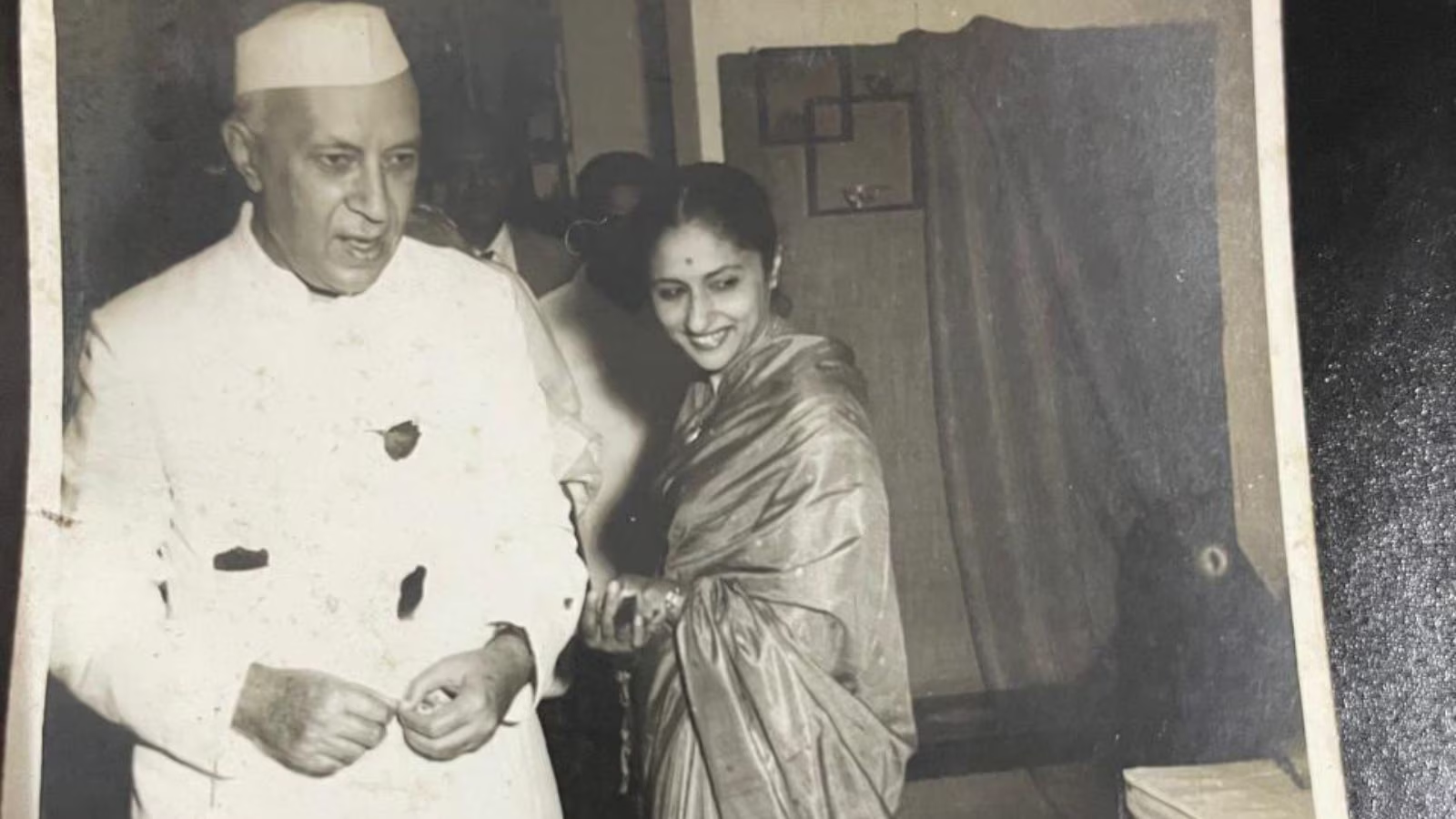
General KM Cariappa and Jawaharlal Nehru

Chief of Army Staff General Upendra Dwivedi will hold an annual press conference on January 13 ahead of Army Day, January 15. It was on January 15, 1949, that General K M Cariappa (later Field Marshal) took over as the commander-in-chief and chief of army staff of the Indian Army—the first Indian to do so.

It is an apt occasion to look back at certain events that took place soon after General Cariappa took over as the Army chief, setting the tone for an apolitical Army in Independent India. The then prime minister, Jawaharlal Nehru, chided General Cariappa for having publicly praised the Government saying that it should have been avoided and that military officers should not broach political subjects in public. A letter that he wrote to General Cariappa on May 24, 1949, forms part of the Nehru Archives.

In an interview at Dehradun on May 2, 1949, Cariappa remarked, “The achievement made by the country under Pandit Nehru’s leadership in so short a period has no parallel in history.” He added that “the last Commonwealth Conference in London, when seen in clear perspective, will be found to have been a great triumph for the prime minister”. He also said that the people had not clearly appreciated the all-round progress made by the leadership.

Nehru was not pleased about these remarks made by the Army chief and conveyed his displeasure to him in no uncertain terms. “About three weeks ago, you made a statement to the press in the course of which you congratulated me for my work at the Commonwealth Conference in London. You further drew attention to the all-round progress made by the present leadership in the country. I am grateful to you for what you said. But this raises an important point, and indeed the press has drawn attention to this. Should our officers, civil or military, even including the head of the Army, express any opinion in regard to political subjects in public,” he said.

Nehru questioned whether senior officers should speak in praise of the work of the Government.

“Indeed should they deliver public speeches at all except on matters strictly confined to their own work or some social or cultural subjects? What you said was harmless enough, but there is always a danger in touching upon political questions. Obviously, it would be highly improper for an officer to criticise Government, more especially on a political issue. If this is so, then praise of Government should also be avoided,” said Nehru.

‘Avoid public statements completely’

The then prime minister said he was drawing the Army chief’s attention to this matter as Cariappa set the tone for the Army, and Nehru did not want the Army to get mixed up in any way with politics. “You yourself have made this clear on many occasions. In the past I did not like the activities of some Sikh officers who indulged in communal politics. The safest course, therefore, is for all officers to avoid public speaking or public statements completely except on strictly limited topics. Sometimes an officer may not even know the exact political significance of some issue or some remarks he might inadvertently make,” he said.

Nehru noted that the Government had the largest political party and organisation at its back.

Nevertheless, there are other parties and groups, and they might object to the Army doing or saying something in praise or in criticism of political parties or ideologies, he said.

Nehru said Field Marshal Bernard Law Montgomery, a noted British military personality of World War II, is apt to let himself go in public. “He has been repeatedly asked by the British Government not to do so. Recently, I was in Switzerland, and some members of the Swiss Federal Government told me how they had been greatly embarrassed at a rather casual remark of Montgomery in Switzerland,” he said.

In fact, Nehru and Cariappa continued to spar on various issues even after the retirement of the latter as Army Chief.

Cariappa’s unhappiness over Himachal L-G appointment

In a letter written to the prime minister in 1958, General Cariappa expressed unhappiness over the report regarding the appointment of J K Bhonsle, who had been a member of the Indian National Army, as the Lieutenant Governor of Himachal Pradesh. Cariappa had written that Bhonsle, by serving in the INA, had shown disloyalty to the then Government and had also been disloyal to the traditions of the Army.

Cariappa had also expressed his disagreement with the military guard firing a ‘feu-de-joie’ (ceremonial rifle volley), sounding of the Last Post on bugles, and so on, as is done at military funerals, at Rajghat, the samadhi of Mahatma Gandhi, on January 30. He said he found it “out of place” in that atmosphere of “sanctity, purity and solemnity”.

Nehru responded by saying that the military honours at Rajghat were decided upon after careful consideration. On the issue of Bhonsle, Nehru said that whether he did right or not when he joined the INA under very peculiar circumstances in Malaya was a subject on which there might be differences of opinion.

“You know that we have not criticised our present army officers or men because they served the then British Government in India loyally. We have spoken highly of our army. But it is another matter for us to condemn for ever a person who, in a peculiar set of circumstances, thought it his duty to serve his country in another way. I do not know what I would have done if I had been in such a position,” he said.

Nehru commented that British army officers functioned with neither ability nor courage in Malaya. “Ultimately, they meekly surrendered, having made a mess of things. In India, conditions were very peculiar, and the country generally was opposed to the British. If a young Indian was affected by this widespread sentiment in India, I certainly am not prepared to blame him,” he said.

source: http://www.indianexpress.com / The Indian Express / Home> News> Cities> Chandigarh / by Man Aman Singh Chhina / January 11th, 2026

Karnataka MP writes to Centre seeking fund allocation for Cauvery conservation

The MP highlighted the immediate need to prevent pollution to the river and sought fund allocation in the union budget for conservation, sanitation, waste management and riverbank protection works.

Cauvery River image used for representation purposes only.(File Photo | Express

Madikeri :

Mysuru–Kodagu MP Yaduveer Wadiyar has written to the Union Minister of Jal Shakti seeking central government support for the conservation of the River Cauvery in Kodagu.

The MP highlighted the immediate need to prevent pollution to the river and sought fund allocation in the union budget for Cauvery river conservation, sanitation, waste management and riverbank protection works.

The letter stressed on the immediate need for conservation and development of the riverbanks of Cauvery across the district. The MP also pointed out that the river has become a victim of increased pollution due to the flow of untreated wastewater from houses and commercial setups and from encroachments alongside the riverbanks.

“These issues are affecting water quality, public health, river ecology and the livelihoods of people dependent on the river,” the MP noted.

He urged the union minister to order a comprehensive survey of the boundaries of the River Cauvery in the district to enable eviction of the encroachments, followed by rehabilitation and systematic riverbank development in a planned manner.

The MP also highlighted the need to regulate activities along riverbanks in Madikeri, Virajpet and Kushalnagar taluks while also requesting the establishment of scientific sanitation and drainage facilities.

Wadiyar also sought a focused intervention to regulate tourist activities along the riverbanks and address recurring flood issues. He urged the need for eco-friendly riverfront development.

Mentioning the interstate importance of the River Cauvery, he urged the minister to formulate a central government-supported phased action plan for conservation and development of the Cauvery.

He has requested funds in the forthcoming budget for Cauvery river conservation, sanitation, waste management and riverbank protection works.

source: http://www.newindianexpress.com / The New Indian Express / Home> Karnataka / by Express News Service / January 09th, 2026