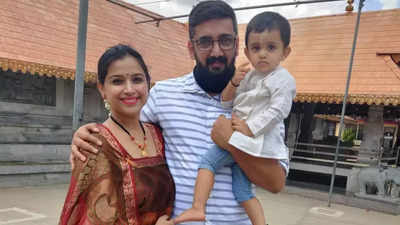
Actress-host Shwetha Changappa is celebrating the festival of Kailpodh with her son Jiyaan Aiyappa. She shared a video on social media where she is seen dressed in a traditional Kodava-style saree and wishing the Kodava community a happy and prosperous Kailpodh.
Actress-host Shwetha Changappa is celebrating ‘Kailpodh’ with full enthusiasm. Draped in a traditional Kodava-style saree, the proud Kodavati recently took to her social media handle and shared an adorable video, where she is seen posing along with her little munchkin, Jiyaan Aiyappa.
The Kodavati’s wish
Shwetha in the video is seen wishing all the Kodava community people a very happy and a prosperous Kailpodh.
She is seen wishing in the native language and talks about the importance of celebrating the festival.
Swetha’s baby boy is also seen in the video and wishing everyone on the occasion in his cutest way possible.
The Kailpodh festival
For the uninitiated, September 3rd marks the festival of Kailpodh, in Coorg. While in Kodagu the festival is celebrated on different days, elsewhere Kail-Podh is observed at homes on the third of September.
The Kail Podh day begins with the youngsters touching the feet of their parents.
Traditional and household weapons, such as guns, war knives, swords, spears, bows, and arrows, are cleaned and placed near the thook bolcha (hanging prayer lamp) in the house.
On a work front Swetha Changappa is currently seen hosting kids-based reality game show, Chota Champion, which returned to the Kannada small screens after a long gap.
The doting mommy
Talking about Swetha’s three-year-old son, Jiyaan has indeed become the latest sensation. The baby is quite popular on social media as mommy Swetha’s Instagram handle is filled with videos and pictures of Jiyaan. The actress indeed seems to be enjoying her motherhood to the fullest.
source: http://www.timesofindia.indiatimes.com / The Times of India / Home> News> TV> Kannada / etimes.in / September 03rd, 2023
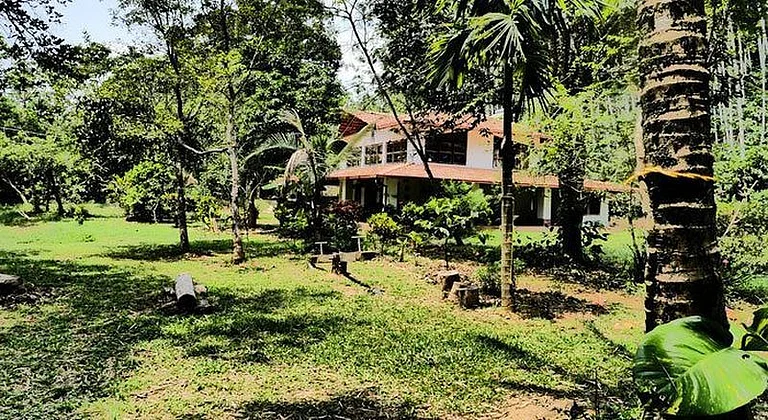
Tucked in a hidden valley down a winding clay road some 5 kilometres from Karnataka’s town of Madikeri (in the Coorg district) lies the Garden Farm. On the fringes of the valley is where the bungalow is placed, marking the beginning of a dense forest shading coffee plants. It is here a close-knit family has set up a sanctuary for fellow nature lovers, giving them a place where they can truly enjoy the beauty of the Coorg landscape without obtrusive power-lines and the cacophony of buses blaring Top Forty Kannada music. And if you don’t love nature, well, they don’t want you to find their guesthouse.
Off The Beaten Track
Even after we drove our Enfields down a long, winding forest trail with steep inclines (only jeeps and bikes can make the journey during monsoon season) and crossed a wide green valley, we could barely make out the large guest house standing 25 meters away as the view of the facade is obscured by a beautiful line of flowering trees and bushes. Basically, this valley villa could be a Pablo Escobar Bungalow, just substitute the cocaine and machine guns with a sense of true tranquility.
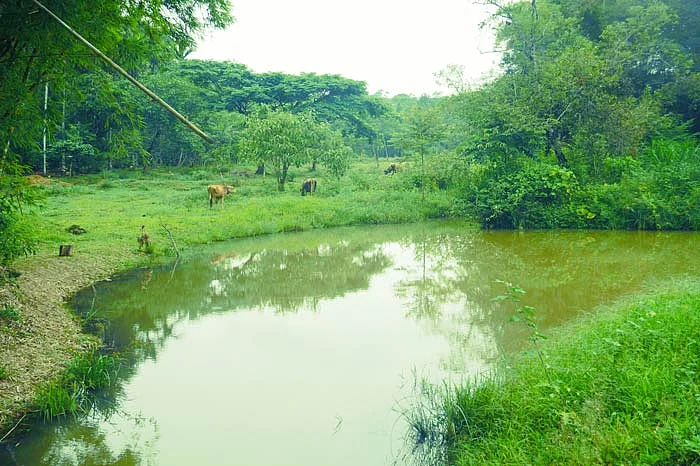
A personal pond right outside our doorstep.
Nourishing Yourself In Nature
Everything we ate and drank at the Garden Farm was locally sourced and organic, even the water. Yes, the hill station home boasted fresh mineral water from a well. At first we were skeptical, but the water was completely safe and had a naturally sweetness that is absent in packaged mineral water.
Moreover, on the property the family behind the Garden Farm grow fresh coffee, pepper, cardamom, pineapples, bananas, rice, mangosteens, jackfruit, various types of mangoes, oranges, a type of plum among myriad other plants and trees the author is clueless about.
The farm is home to a large grove of pineapples.
The caretaker of the guesthouse trotted across the valley every morning, brewed a pot of lovely coffee and was happy to take us around the many forest paths on the property, encouraging us to pluck whatever fruit struck our fancy on the stroll. However, the best part was that all our meals were delicious and straight from the farm – their pork fry was to die for.
Also, as a someone who frequently abuses beetroot for being a useless and unappetising vegetable, I devoured three portions of the cooked veggie. To sum up the experience of eating at Garden farm, our tastebuds were more than content.
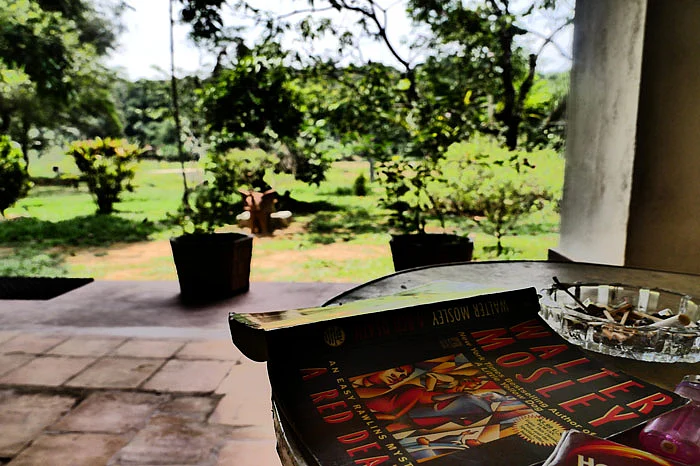
The Garden Farm was made for lazily turning the pages of novels, going on forest walks, bonding over bonfires, playing a boardgame or a bit of carrom, and fishing in the pond or stream. Not to come off as poetically pedantic, but each breath taken at the Garden Farm filled our lungs with an at ease contentment that is rarity for urban dwellers.
Leaning back with a good book and an even better view.
We saw the caretaker of the guesthouse climb to the top of a 40 foot tree with no rope that was covered in fire ants. When he came down later and crossed the valley he just beamed us his ordinary smile. It is important to say his smile is like that of a child who has secret, and I have a funny feeling each day we marvelled at that man’s life, he very politely marvelled back at ours.
The choice he made to live out his days on farm was simple and smart. To live in the midst of beauty. Our decision to live in plaster cubes with a view of an army of other plastic cubes is perhaps not the most beautiful of choices. It is not safer either. Even though we thought he was insane for climbing the tree with zero protection, the chances of him falling is most likely equal to the chance a city person will get hit by a delivery driver. Rest was not the only thing gained at the Garden Farm, a bit of perspective was also an added bonus.
Hill station happiness (The caretaker and his lovely son Kavin).
Interiors Of The Hidden Garden Cabin
Sleep at the Garden Farm meant silence took on a whole new meaning. The top part of the house was open air which meant we got a refreshing hill breeze; however, this of course meant the mosquito nets were essential.
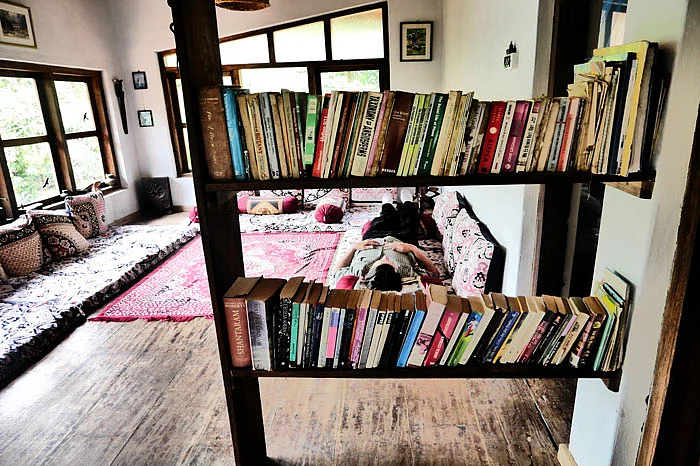
The wooden flooring and staircase made the bungalow take on a homey cabin feel. Moreover, the second floor hosted several cushioned floor mats which were perfect for afternoon naps. Also, we got to dig into a wonderful and comprehensive selection of good reads!
Afternoon nap upstairs.
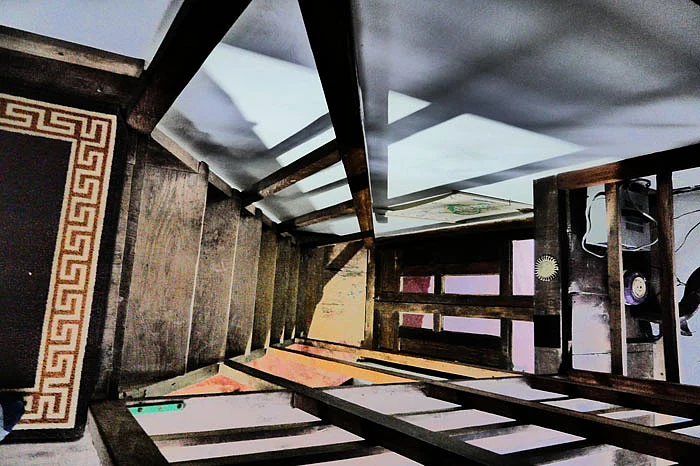
Wooden staircase.
A Final Look Back
If you love nature or feel like you need some time to take in the great outdoors, the Garden Farm beckons.
Crouching amoung the bushes to try and capture a full frontal view of the home.
source: http://www.homegrown.co.in / Homegrown / Home> #HGExplore / by Julian Manning / June 08th, 2021
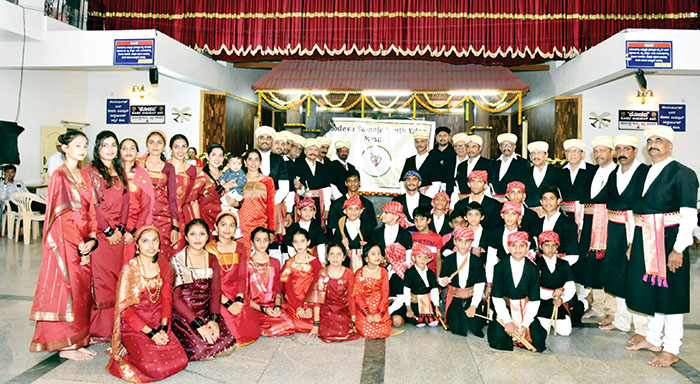
‘Puthari Namme,’ the harvest festival of Kodagu, symbolising the first harvest of the paddy crop, was celebrated in a grand and traditional manner last evening at the Kodava Samaja in Vijayanagar First Stage here.
The festivities showcased a diverse array of Kodava cultural events, eliciting enthusiastic applause from the gathered audience.
Hundreds of Kodava community members including men, women and children had gathered at the Kodava Samaja and took home the paddy crop (kadiru), chanting “Poli Poli Deva” and prayed to Lord Igguthappa and Goddess Cauvery and welcomed the Dhanya Lakshmi to their homes.
The highlight of the event was the cultural performances by young community members who have spent hours and days learning the traditional Kodava dances and songs. Their performance received loud applause from the community members and the boys and girls have been saddled with continuing the tradition of this small community that is facing the onslaught of modernisation.
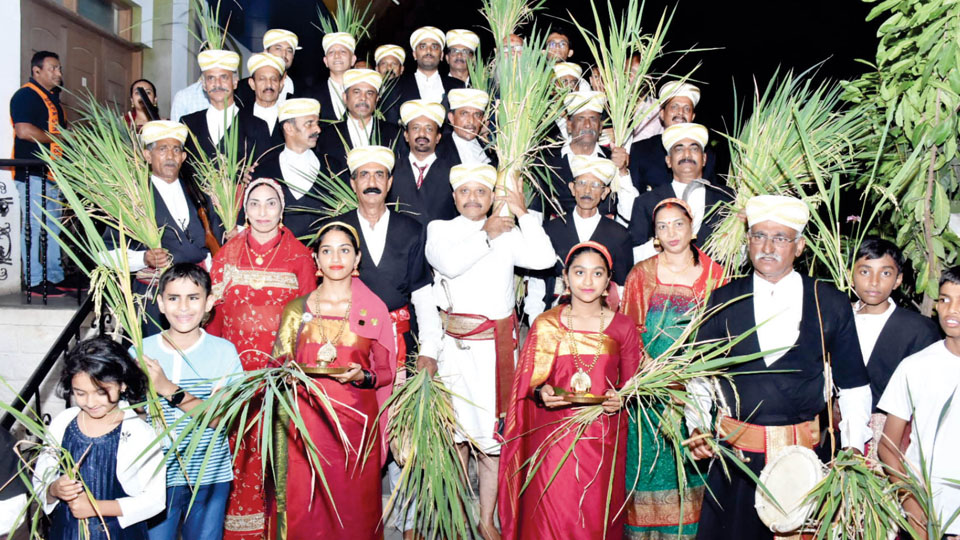
The members of Kodagu Gowda Samaja in Vijayanagar Railway Layout, Mysuru, during the celebrations.
The performances featured captivating dances like ‘Ummathaat’, ‘Bolakaat’, ‘Puthari Kolata,’ ‘Kathiyaat,’ ‘Baalopaat,’ ‘Pareyakali’ and ‘Taalipaat’.
Notably, a new Youth Wing of the Mysuru Kodava Samaja was inaugurated and Katera Vedik Uthaiah has been nominated as its President. The other members of the team will be announced soon.
Commencing with a puja dedicated to the deities Lord Igguthappa and Goddess Cauvery, the festival progressed with a symbolic harvesting of the paddy crop (kadiru) and ceremonial firing into the air.
Kodava men donned their traditional attire of ‘kupya-chele,’ ‘peechekathi,’ and ‘mande-tuni,’ while women adorned themselves in the customary red sarees and ‘vasthra.’
As an integral part of the festivities, special ‘tambittu’ made from fried ‘kusubalakki’ mixed with ripe banana, was distributed to all the members.
Mysuru Kodava Samaja teams that have won various prizes in hockey matches and other cultural performances at Federation of Kodava Samajas, Balugodu, were honoured.
Mysuru Kodava Samaja President Ponjanda A. Ganapathy, Vice-President Machimada P. Nanaiah, Hon. Secretary Ketolira Ravi Belliappa, Treasurer Ittira Kashiappa, Joint Secretary Ajjikuttira Diana Poovaiah, Kodava Samaja Cultural and Sports Club President Kuttimada D. Muthappa, office-bearers and committee members were present on the occasion.
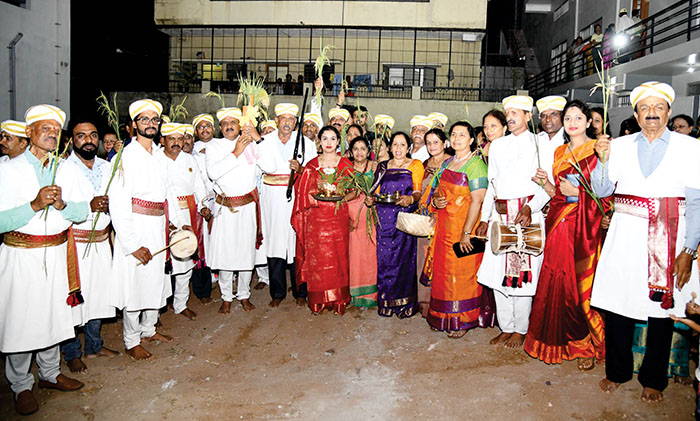
A group photo of the members of the newly constituted Youth Wing of Mysuru Kodava Samaja with Samaja President Ponjanda A. Ganapathy and others.
The harvest festival was also celebrated at Kodagu Gowda Samaja in Vijayanagar Railway Layout, Mysuru.
Simultaneously, ‘Puthari Namme’ was celebrated in grandeur across Kodagu district yesterday.
The festival commenced with the ‘Nere Kattu’ performance at Kakkabbe’s Paadi Sri Igguthappa Temple at 7.30 pm. Subsequent celebrations were held across Kodagu district.
Though the festival concluded yesterday, the celebrations are set to continue for a week in rural areas of Kodagu and during this extended period, traditional ‘Puthari Kolata’ will take centre stage, accompanied by various other dance forms at the designated ‘Mandh’ in villages.
source: http://www.starofmysore.com / Star of Mysore / Home> News> Top Stories / November 28th, 2023
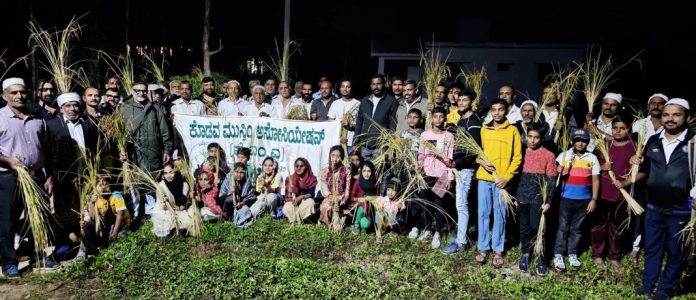
The Kodava Muslim Association (KMA) illuminated the night with joy as they celebrated the ancient custom of removing the traditional Kadiru (New Rice Crop) on the auspicious occasion of Puttari festival. The festivities took place on Monday night, drawing the spirited participation of hundreds of members from the Kodava Muslim community, marking the Harvest Festival of Kodavas.
At the striking hour of 8:30 PM, the Kadiru removal ceremony unfolded in the Jamma Gadde of the Kolumanda family in Aimangal village, Gonikoppa. Led by KMA President Duddiyanda H. and Sufi Haji, the event saw elders from Aimangala village, KMA members, and Kootambattira Hussain coming together to share in the holy Swalat. Boiled rice milk, a symbol of abundance, was distributed to all attendees, fostering a sense of unity and community spirit.
Key figures in the program included KMA Vice President Akkalatanda S. Moidu, General Secretary Italathanda Rafiq Tuchamakeri, Treasurer Harishchandra A. Hamsa, Joint Secretary Karatorera K Mustafa, Organizing Secretary Meetalathanda M. Ismail, and Senior Director Chimmichira K. Ibrahim (Ummani).
The presence of local Jamaat presidents, such as the head of Kondangeri Jamaat and K.M.A. Director Kuppandir K. Yusuf Haji, and the President of Katrakolli Jamaat, Alira M., added a distinguished touch to the celebration. Residents from various areas, including Kottamudi, Cheriyaparambu, Kunjila, Kolakeri, Kondangeri, Chamiyala, Gundikere, Nalvathoklu, Ambatti Kandangala, Katrakolli, Halligattu, and Begur, joined the festivities alongside children from Aimangal. The program, hosted by Kolumanda Rafeek, extended its warmth with a traditional Tambittu-Puttari sweet potato breakfast and dinner, showcasing the rich cultural heritage of the Kodava Muslim community. The Kadiru, symbolizing the new rice crop, was then respectfully taken to households, marking the culmination of a joyous and culturally significant event.
source: http://www.thehindustangazette.com / The Hindustan Gazette / Home> News> Latest News / by The Hindustan Gazette / November 28th, 2023
Virajpet MLA A.S. Ponnanna emphasises community representation in democracy
Dubai:
A Puthari get-together was organised recently in Dubai by the UAE Kodava Committee. The event not only featured cultural festivities but also offered valuable insights from Virajpet MLA Ajjikuttira S. Ponnanna who was the chief guest.
Ponnanna underscored the importance of community representation in a democratic system. “It’s crucial to have representation in democracy for our community.” Stressing the role of the ‘Connecting Kodavas’ initiative, he highlighted its relevance and the necessity for systematic participation in the democratic process.
Ponnanna, along with Palengada Amit from ‘Connecting Kodavas,’ encouraged a collective mindset towards sustaining the Kodava community, irrespective of geographical locations. They also urged attendees to support such initiatives, emphasising a systematic thought process about the community’s survival.
“Regardless of our activities and locations, our thought process should be directed towards sustaining our Kodava community. We should all come together and contemplate the survival of our community,” remarked Ponnanna.
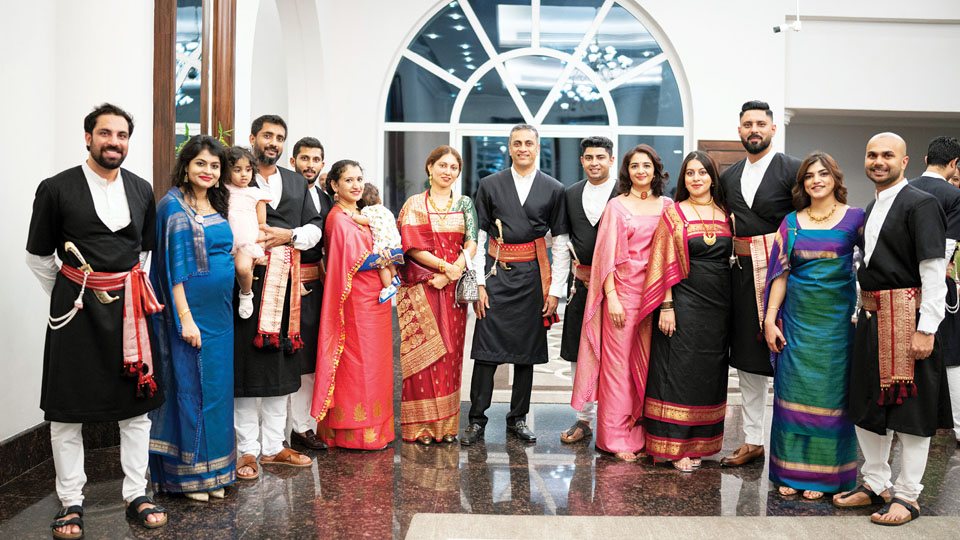
The event also featured engaging activities, including a quiz focused on Kodagu, providing a fun way for attendees to reconnect with the rich heritage and traditions of Kodava culture. Dressed in Kodava attire, participants underscored the sense of community and unity.
Beyond its celebratory nature, the Puthari get-together served as a platform to discuss pressing community issues and lay the groundwork for a brighter future. Delegates from ‘Connecting Kodavas’ also highlighted the importance of events like the upcoming Global Kodava Summit in 2023.
source: http://www.starofmysore.com / Star of Mysore / Home> News / November 27th, 2023
Perianda C. Appaji (80), a native of Kaikad village in Kodagu and a resident of Bengaluru, passed away yesterday in Bengaluru. He was the youngest son of late Chengappa, who had written ‘Kodava Andolat Paat.’
Appaji, who started his career as a journalist at Kodagu Press, later served in Samyukta Karnataka and Prajavani. He became popular for his special reports on horse racing in Prajavani.
Last rites were held this morning at Sumanahalli Crematorium in Bengaluru.
source: http://www.starofmysore.com / Star of Mysore / Home> Obituary / November 22nd, 2023
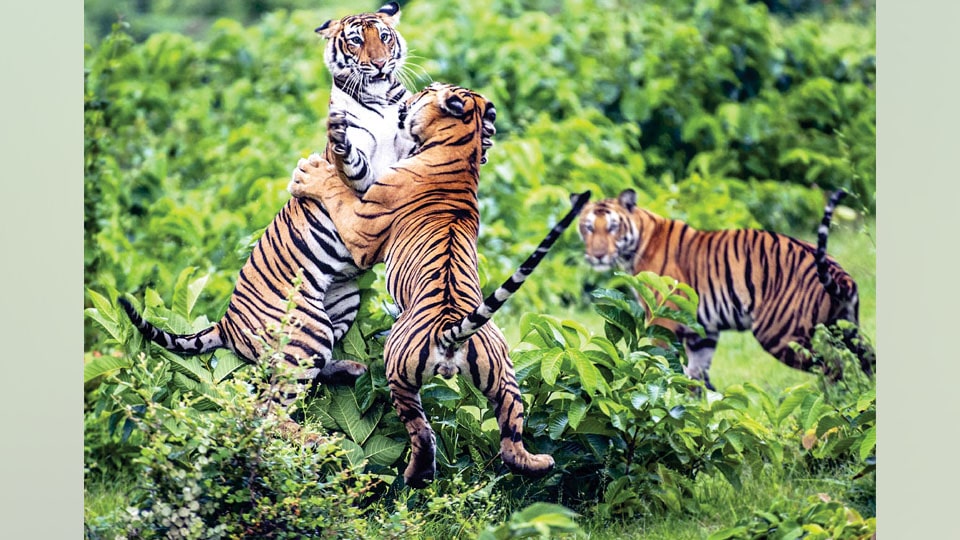
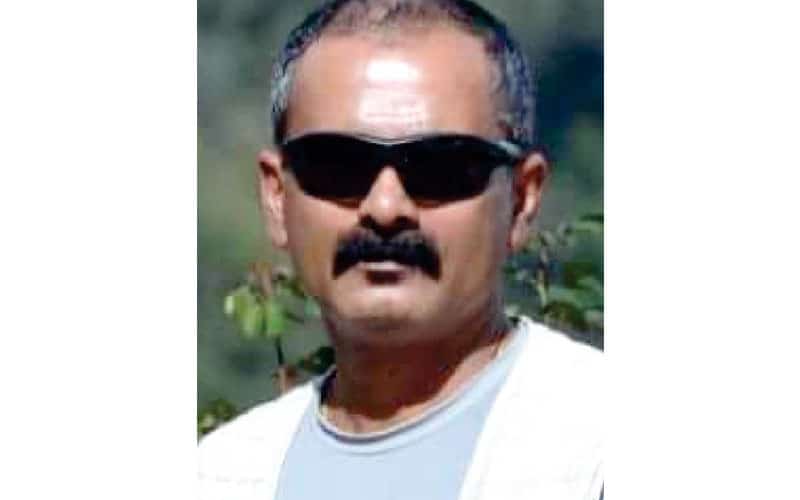
Amateur photographer Kunjiyanda Machaiah (Machu) from Kodagu District has bagged World Wildlife Week 2017 Award and Certificate of Merit for his photograph of three tigers shot at Kabini Forest Range.
Every year the first week of October is celebrated as World Wildlife Week all over the world. As part of the Week, Sri Chamarajendra Zoological Gardens, well-known as the Mysuru Zoo, had organised State-level wildlife photography competition, in October 2017, where over 200 photographers from across Karnataka had participated.
Kunjiyanda Machaiah
Kunjiyanda Machaiah bagged the award for the photo where a tigress at Kabini forests (part of Nagarahole National Park) is seen playing with her sub-adult cub while another cub stares at them.
In 2016, Machaiah had bagged the second prize at the similar photography exhibition where he had displayed an eagle attacking a bumble beehive.
Machaiah has been an amateur wildlife photographer since the last seven years and has been trained by the Forest Department to be an eco-tourism volunteer. Two months ago, he participated as a photographer in the Rain Forest Challenge in Malaysia that is considered as one of the world’s most 10 difficult and treacherous rallies.
He is the son of Kunjiyanda late Capt. Appaiah and Gowramma, residents of Ammathi village. Every month he goes on a trekking and safari trips to Brahmagiri Forest Ranges, Pushpagiri, and Thadiyandamol in Kodagu to pursue his passion for photography. He is a regular visitor to Nagarahole and Bandipur Tiger Reserve.
“Creating awareness on wildlife — both flora and fauna — is my sole intention. We must preserve plant and animal life for our own survival,” he says.
source: http://www.starofmysore.com / Star of Mysore / Home> News / January 24th, 2018
Here is a heart-rending case, where a woman, wife of a gallant jawan, is waiting for the return of her husband, who has gone missing for nearly two decades.
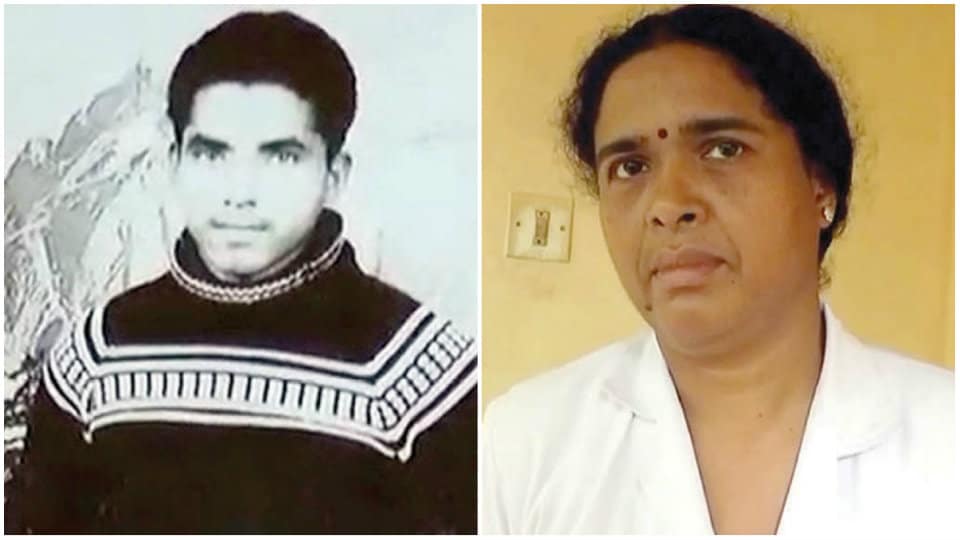
This is the tragic story of Parvathi, a native of Ammathi in Virajpet taluk of Kodagu district.
Pudiyokkada Uthaiah, also of Ammathi, joined the Indian Army in 1985 and later married Parvathi. Uthaiah, who came to Ammathi on leave in 1999, left home after completion of his leave. But Uthaiah neither reported for duty nor returned home and his whereabouts could not be traced until now.
The Army, which took up Uthaiah’s case, initially said that Uthaiah has gone missing in action. But months later, the Army told Parvathi that Uthaiah was dead, which Parvathi is not willing to believe.
Uthaiah, who was serving as an Army Lance Naik with the Signal Battalion in Uttar Pradesh, came to his native Ammathi on a 20-day leave in 1999. After completion of the leave, he left behind his pregnant wife Parvathi and went to Allahabad, UP, to report again for duty.
Uthaiah called his wife on Nov.21, 1999 to say that he was not well. But Parvathi has not heard of him since then, which has left her family shattered.
The Army sent a telegram to Uthaiah’s family on Dec.4, 1999 which asked the family members to send back Uthaiah to the Army Unit, where he was working.
Upon receiving the telegram, a pregnant Parvathi went into a state of shock and some days later, delivered a baby which died a few days later.
But later on, Parvathi regained her composure and went to the Army Unit where Uthaiah was working. However, she could not find any clues about her husband.
As days passed, the Army wrote a letter to Parvathi stating that Uthaiah had died on June 14, 2000. The Army, after declaring Uthaiah dead, began paying meagre pension to Parvathi from 2010. Even as the Army confirmed Uthaiah’s death, it has failed to trace his body or even explain to the family on how he died.
Now Parvathi, who is left alone, is running from pillar to post in Army circles, appealing the Army Officers to trace her missing husband. Not the one to give up, Parvathi is waiting alone, just as Shabari in the epic Ramayana, for her husband Uthaiah to return home, even after 20-long-years he went missing.
source: http://www.starofmysore.com / Star of Mysore / Home> News / June 12th, 2019
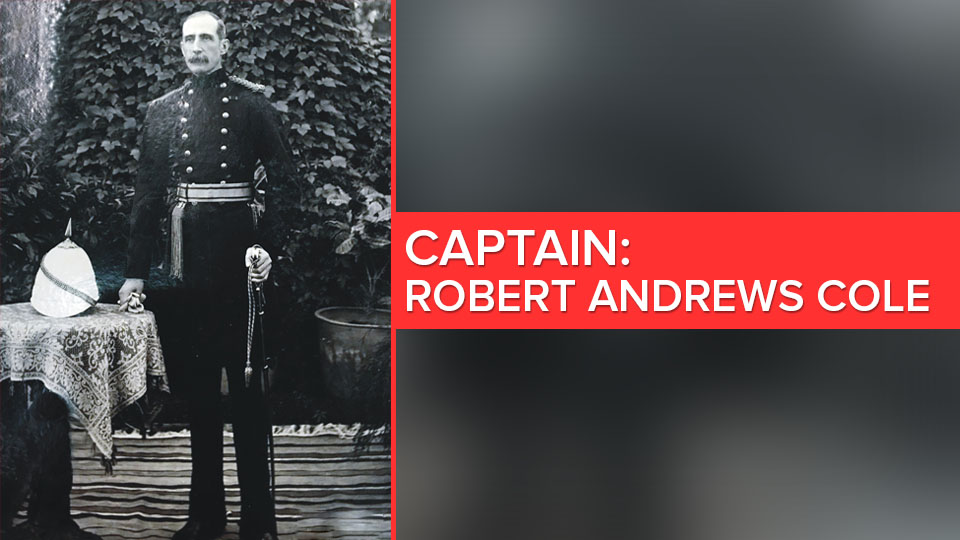
I was pleasantly surprised by an e-mail a few months ago from Mr. Nigel Cole, a great-grandson of Captain Robert Andrews Cole, who had three stints in Coorg as the Superintendent: March 1865 to October 1865, February 1866 to July 1869, and October 1869 to December 1869. Mr. Nigel Cole, who lives in Wales, wanted to know if I could enlighten him about his ancestor. We later exchanged notes, and Nigel shared personal details and a photograph of his great-grandfather.
Captain Robert Cole was born and educated in Madras, where his father Maj. Gen Robert Cole Sr., was a doctor in the army. Captain Cole’s first posting in Coorg was in March 1865 to step-in when the incumbent, William Hobart Kerr, took ill. Captain Cole was a young officer with a flair for languages. He was fluent in Tamil, Telugu, and Kannada. On his arrival in Coorg, he took an instant liking to the place and the people.
Astonishingly, Captain Cole found that Coorgs living in remote villages could not understand Kannada! In order to effectively communicate with them, he started learning Kodava language. His knowledge of South Indian languages helped him pick up the nuances of Coorg dialect, and soon he was able to interact with Kodavas in their own lingua franca. He then went about learning the language in-depth. His task was quite tough since none had codified the language and put it in writing. Since the language had no script, the job was even more challenging. Captain Cole continued his pet project even during intervals when he was posted outside Coorg.
His extensive interaction with the Coorgs finally resulted in his seminal 136-page book ‘An Elementary Grammar of the Coorg Language’ published by the Wesleyan Mission Press in 1867. In the Preface to the book, he recounts his impression of Coorg, and Coorgs. He was fascinated by the bracing weather of the place. Here’s an excerpt of his rather poetic observations:
“…The thunderstorms during this season are often magnificent. The war of the elements is carried on here in grander style than in the low country. Banks and mountains of clouds move against each other with the order of armies. The sound of heavy cannon is heard from a distance, solitary discharges of the electric fluid shoot through the gloom. Now whole batteries are brought into action, deafening thunders roll over your head, and your eye shuts involuntarily against the dazzling brilliancy of the fire bolts. At last both hosts engage in close combat. The roar of artillery is heard at greater intervals, the lightnings lose their intense and fearful glare, and the rain pours down in torrents…”
In order to help him, his colleagues and successors to communicate with locals, he made extensive tables – Travel Talk – translating English sentences to Kannada (Canarese), Telugu, Tamil and Coorg language.
Captain Cole mentions the help he received from department clerk Belliappah, in compiling the book. My guess is that this gentleman was most likely Maneypanda Belliappa, one of the early batches of educated Kodavas, who later became the Assistant Commissioner of Coorg. Captain Cole dedicated this book to Lewin Bentham Bowring Esq., who was the then Commissioner of Mysore and Coorg. Captain Cole endeared himself to the people of Coorg. He also wrote another important book titled, A Manual of Coorg Civil Law. During his tenure, he tried to unravel the secrets of the Dolmens found in some parts of Coorg. In appreciation of Captain Cole’s yeomen services, an emerging town at the time in South Kodagu was named after him as Colepet. However, over the years, Colepet got merged with present day Ammathi.
Captain Coles’s wife, Pauline McCally, sadly died during his posting in Coorg. She was buried in St. Mark’s Church, Fort, Madikeri. On promotion as a Major, he was appointed Superintendent, Inam Settlement, Mysore. As a Colonel, he was with the Madras Staff Corps. He rose to the rank of Major General by the time he retired and returned to England. He died in 1907.
An e-book version of ‘An Elementary Grammar of the Coorg Language’ can be accessed on the internet at: www.books.google.co.in.
About the author: C. P. Belliappa, born in 1946, is a Chemical Engineer. He is currently settled in Coorg. He is known for his writings on issues pertaining to Coorg. Four of his books — Tale of A Tiger’s Tail & other Yarns from Coorg, Nuggets from Coorg History, Victoria Gowramma: The Lost Princess of Coorg, and Tongue of the Slip, have been published by Rupa Publications. He currently serves as President, Coorg Institute of Technology, Ponnampet, Coorg.
source: http://www.starofmysore.com / Star of Mysore / Home> Feature Articles / by C.P. Belliappa / February 16th, 2017