Category Archives: World Opinion

Brewing Prosperity: “India’s Coffee Story from Farm to Global Fame”

Introduction

Legend has it that India’s coffee journey began around 1600 AD when Sufi Saint Baba Budan planted seven coffee seeds brought from Mocha port in Yemen in the Baba Budan Giri hills of Chikkamangaluru, Karnataka. Initially grown as a garden crop, coffee cultivation gradually expanded, leading to the establishment of commercial plantations in the 18th century. Since then, Indian coffee has evolved into a thriving industry with a distinct global identity on the world coffee map. Indian coffee is cultivated under a unique two-tier shade system of evergreen and leguminous trees, with nearly 50 varieties enhancing soil health and biodiversity. Grown across 4.91 lakh hectares in the Western and Eastern Ghats and the North Eastern region, coffee serves as both an environmentally sustainable and economically vital plantation crop. The coffee sector sustains the livelihoods of over two million people, who are engaged in cultivation, processing, and trade. Dominated by smallholder farmers, who account for nearly 99 percent of holdings and 70 percent of the country’s overall production, it stands as a vital pillar of India’s rural economy.

Coffee plantations also serve as vibrant spice gardens, cultivating a variety of spices alongside coffee, including pepper, cardamom, vanilla, orange, and banana. The Western Ghats, which form one of the 25 biodiversity hotspots in the world and Eastern Ghats, provide ideal conditions, with Arabica thriving in the cooler highlands and Robusta in the warmer, humid regions. India’s Robusta commands top premiums globally, while its Arabica is prized for its superior quality and distinct flavour. India is now one of the world’s leading coffee producers, ranking as the seventh-largest producer of coffee and contributing about 3.5 percent to global coffee production, according to the Coffee Board of India. India produces approximately 3.6 lakh tonnes of coffee annually, with nearly 70 percent exported to 128 countries, underscoring the growing global demand for Indian coffee.

Overview of India’s Coffee Sector

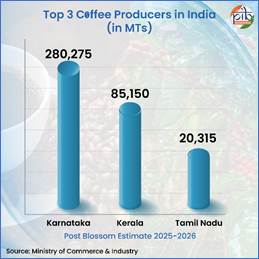
The coffee industry in India is primarily concentrated in the major coffee-growing states of Karnataka, Kerala, and Tamil Nadu, which collectively account for nearly 96 percent of the country’s total coffee production. Among these, Karnataka leads with a production of 2,80,275 metric tonnes (Post Blossom Estimate for 2025–26), followed by Kerala and Tamil Nadu.
India’s coffee-growing landscape is divided into 13 distinct agro-climatic zones, each with a unique identity and recognition for its coffees in global markets. These zones are categorized into three broad groups: a) traditional regions comprising Karnataka, Kerala, and Tamil Nadu; b) non-traditional regions–Andhra Pradesh and Odisha; and c) the North Eastern regions, including Assam, Arunachal Pradesh, Manipur, Meghalaya, Mizoram, Nagaland and Tripura. Coffee plays a vital socio-economic role in the tribal belts of Andhra Pradesh, Odisha, and the North-Eastern states, offering sustainable livelihoods while promoting rural development and ecological balance. The recognised coffee regions include Anamalais (Tamil Nadu), Araku Valley (Andhra Pradesh), Bababudangiris (Karnataka), Chikkamagaluru (Karnataka), Coorg (Karnataka), Nilgiris (Tamil Nadu), Sheveroys (Tamil Nadu), Travancore (Kerala), and Wayanad (Kerala).

Regional recognition of Coffees from India

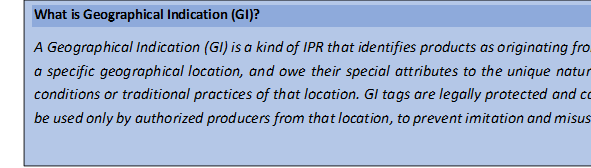
India holds Geographical Indication (GI) tags for five regional and two specialty coffees, a recognition that enhances their premium value in international trade. The country’s varied elevations, rainfall patterns, and soils conditions, contribute to the rich diversity and exceptional quality that define Indian coffee. The Department for Promotion of Industry and Internal Trade (DPIIT), Ministry of Commerce and Industry, Government of India, has granted Geographical Indication (GI) tags to five Indian regional coffee varieties: Coorg Arabica Coffee, Wayanad Robusta Coffee, Chikmagalur Arabica Coffee, Araku Valley Arabica Coffee, and Bababudangiris Arabica Coffee. Additionally, Monsooned Malabar Robusta Coffee, a unique specialty coffee from India, has also received GI certification.
Specialty coffees represent the finest quality beans, distinguished by their exceptional flavor, aroma, and appearance. These coffees are produced through careful cultivation, selective plucking, and meticulous processing, resulting in distinctive flavours that cater to discerning consumers worldwide. Owing to their uniqueness and craftsmanship, specialty coffees fetch premium prices and form an increasingly dynamic segment of India’s coffee sector. Indian planters have mastered the art of producing globally acclaimed specialty coffees, including:

  • Monsooned Malabar AA – Known for its smooth, mellow flavour and low acidity, developed through a unique monsooning process along India’s western coast.
  • Mysore Nuggets Extra Bold – One of India’s finest Arabica coffees with large beans, rich aroma, and full-bodied flavour.
  • Robusta Kaapi Royale – A superior Robusta variety known for its bold flavor, excellent crema, and ideal for espresso blends.

This recognition has empowered Indian coffee producers to preserve the unique characteristics of region-specific coffees, elevate the global profile of Indian coffee, and secure better prices for their premium varieties. Collectively, these distinguished coffees reflect India’s harmony of tradition, innovation, and excellence, establishing the country as a significant player in the global coffee industry.

Establishment of the Coffee Board

In the 1940s, India’s coffee industry faced a severe crisis, caused by World War II, declining prices, and widespread infestations of pests and diseases.  To safeguard and revive the sector, the Government of India enacted the “Coffee Act VII of 1942”, leading to the establishment of the Coffee Board of India under the administrative control of the Ministry of Commerce and Industry. The Board comprises 33 members, including the Chairman, and the Secretary, & the Chief Executive Officer along with representatives of coffee growers, traders, curing units, labor, consumers, state governments of major coffee-producing regions, and Members of Parliament. The Coffee Board’s primary mandate is to support and develop the entire coffee value chain through research and development. Technical and financial assistance, promotion in domestic and international markets. It works to improve production, productivity, and quality, expand exports for higher value realization, and strengthen infrastructure, such as drying yards and pulper units under the Integrated Coffee Development Project (ICDP).

Role of Coffee Board

The Research Department of the Coffee Board, headquartered at the Central Coffee Research Institute (CCRI) with five regional research stations, is dedicated to developing high-yielding, disease-resistant varieties and standardizing modern cultivation technologies to enhance productivity and quality. The Promotion Department focuses on expanding India’s footprint in global markets while stimulating domestic coffee consumption.

Under the Export Promotion Scheme, transit / freight assistance are provided for value-added coffees exported in retail packs as “India Brand” and for export of high-value green Coffees to far off destinations such as the USA, Japan, Canada, Australia, and New Zealand, South Korea, Finland, Norway and Denmark while maintaining strong trade ties with the European Union, Russia, and the Gulf Cooperation Council (GCC) countries. The Board actively represents Indian coffee at major international trade fairs and organizes the Flavour of India – The Fine Cup Competition, to identify premium coffees and connect them to global buyers. Domestically, to boost coffee awareness and culture, the board operates a network of 12 India Coffee Houses across major cities and participates in national exhibitions and trade fairs, promoting Indian coffee and highlighting its health benefits to consumers.

Export of Coffee

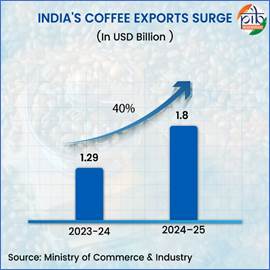
India has emerged as a significant player in the global coffee trade, ranking as the fifth-largest exporter of coffee among coffee-producing nations and contributing around 5 percent of total coffee exports from Coffee producing countries worldwide. Over the past four years, India’s coffee exports have consistently exceeded USD 1 billion, reaching a record USD 1.8 billion in FY 2024–25, reflecting an impressive 40 percent growth from USD 1.29 billion in the previous year. Despite global geopolitical challenges, exports during April–September 2025 stood at USD 1.07 billion, registering a 15.5% increase over the same period in 2024. India is one of the major hubs for instant coffee production and exports, with value-added products accounting for nearly 38 percent of total coffee exports.
As one of the world’s most widely traded and consumed commodities, coffee continues to hold immense economic and cultural significance. The top 5 export destinations for Indian coffee are Italy (18.09percent), Germany (11.01percent), Belgium (7.47percent), the Russian Federation (5.28percent), and the United Arab Emirates (5.09percent). The recent surge in India’s coffee exports has strengthened the global reputation of Indian coffee and improved income realisation for growers, particularly in the key coffee-producing states.

Policy and Trade Reforms Boosting the Coffee Sector

GST Reduction on Coffee Products

The reduction of GST from 18 percent to 5 percent on coffee extracts, essences, and instant coffee is a major fiscal step for the sector. This change is expected to lower retail prices by 11–12 percent, encourage domestic consumption, and enhance profitability for small processors. The initiative will also strengthen the domestic market base and enhance India’s per capita coffee consumption.

India–United Kingdom Comprehensive Economic and Trade Agreement (CETA)

The recently concluded India–UK Comprehensive Economic and Trade Agreement (CETA) marks a key milestone in bilateral trade relations. The pact offers tariff advantages for Indian value-added coffees, particularly instant coffee. The United Kingdom, which already accounts for 1.7 percent of India’s coffee exports, will now provide duty-free access for Roast & Ground and instant coffee, enabling Indian exporters to compete more effectively with suppliers from Germany, Spain, and the Netherlands. The agreement establishes a robust foundation for increasing exports of value-added coffee products to the UK.

India–EFTA Trade and Economic Partnership Agreement (TEPA)

The India–European Free Trade Association (EFTA) Trade and Economic Partnership Agreement (TEPA), signed on 10 March 2024 and effective from 1 October 2025, is the first Free Trade Agreement (FTA) by India to link investment with job creation. Under TEPA, Switzerland, Norway, and Iceland will offer zero percent duty on all coffee imports from India. TEPA provides the most favorable market access to Indian Coffees in the EFTA market. TEPA may help coffee exporters access premium markets in Switzerland, Norway, and Iceland, providing an opportunity to position India’s high-quality, shade-grown, handpicked, and sun-dried coffees in the EFTA market. The agreement enhances export opportunities for value-added coffee, such as roasted and instant coffees.

Fine Cup Awards: Showcasing India’s Finest Coffees

The Flavour of India – The Fine Cup Award, instituted in 2002 by the Coffee Board of India, celebrates excellence in Indian coffee and aims to place the country’s finest brews on the global map. As part of this initiative, the Coffee Board launched the Know Your Kaapi (KYK) programme in 2022–23, a specialised cup quality evaluation platform to assess and reward exceptional coffees across six categories.

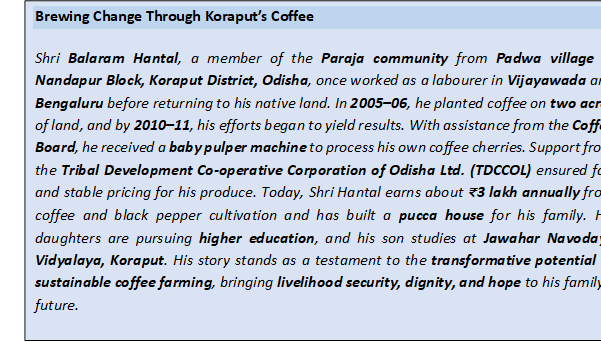
In a remarkable achievement, Koraput Coffee won two Fine Cup Awards during KYK 2024, one each for the washed process and natural process categories. This recognition has enhanced he brand’s prestige and firmly positioned Koraput Coffee on India’s specialty coffee map, reflecting the rising prominence of tribal and high-altitude coffees from Odisha.
Involvement of TDCCOL in Coffee Procurement and Marketing

The Tribal Development Co-operative Corporation of Odisha Ltd. (TDCCOL), established in 1967 under the ST & SC Development Department, Government of Odisha, serves as the state’s apex cooperative institution for tribal welfare. It plays a vital role in safeguarding the economic interests of tribal communities by ensuring fair prices for Minor Forest Produce (MFP) and Surplus Agricultural Produce (SAP), while promoting sustainable livelihoods across Odisha.

Since 2019–20, TDCCOL has taken a pioneering role in coffee procurement in Koraput district, known for its ideal conditions for high-quality Arabica coffee. The organisation transitioned from centralised mandis to doorstep procurement, ensuring fair pricing and promoting financial inclusion for tribal farmers.

Key highlights:

  • End-to-end management: Managing the entire value chain, from procurement to drying, grading, and marketing.
  • Fair pricing: Annual procurement rates aligned with ICTA market prices, with direct payments to farmers’ bank accounts.
  • Socio-economic impact: The initiative has reduced distress migration and improved rural livelihoods.
  • Value addition: Launch of the “Koraput Coffee” brand on 11 September 2019, offering sustainably sourced, rich-flavored coffee now recognized nationally.

TDCCOL has established eight “Koraput Coffee” cafés across Odisha – four in Bhubaneswar, one in Puri, two in Koraput, and one at Odisha Bhavan, New Delhi, further promoting the brand’s unique identity and sustainable origins.

The Coffee Board of India also supports TDCCOL through the Integrated Coffee Development Project (ICDP), providing technical and financial assistance for infrastructure such as drying yards and coffee pulpers.

Future Outlook: Scaling New Heights in Coffee Production

India’s coffee industry is poised for robust growth, with the overall market projected to expand at a compound annual growth rate (CAGR) of 8.9 percent by 2028. The out-of-home coffee segment is witnessing even faster growth, expected to rise at a CAGR of 15 to 20 percent, reaching a value between US$2.6 billion and US$3.2 billion by 2028. Furthermore, the Coffee Board of India has set an ambitious goal to scale up national coffee production to 9 lakh tonnes by 2047, reinforcing India’s emergence as a leading global coffee producer.

Conclusion

India’s coffee story is one of resilience, innovation, and transformation. From the humble beginnings in the Baba Budan Giri hills to earning global acclaim, Indian coffee has evolved into a symbol of quality, sustainability, and inclusive growth. The country’s unique ecological diversity, coupled with the commitment of millions of smallholder farmers, has created a coffee landscape that blends tradition with modern enterprise. The Coffee Board of India, through its ongoing support for research, development, export promotion, and domestic market expansion, has played a pivotal role in driving this transformation.

The emergence of specialty coffees such as Monsooned Malabar, Mysore Nuggets, and Koraput Coffee has strengthened India’s reputation as a producer of premium, globally competitive varieties. The success of tribal cooperatives like TDCCOL in Odisha has exemplified how coffee can be an instrument of socio-economic empowerment and sustainable livelihood creation. Furthermore, policy measures, such as the GST reduction and free trade agreements, including the India–UK CETA and India–EFTA TEPA, have further expanded opportunities for value-added coffee exports, marking India’s growing influence in the global coffee industry.

As the industry moves forward with a clear vision to enhance production to 9 lakh tonnes by 2047, India’s coffee sector stands at the threshold of a new era. With its focus on quality, sustainability, and equitable growth, India continues to brew a success story that is deeply rooted in its soil yet celebrated worldwide.

References

PM India

https://www.pmindia.gov.in/en/news_updates/pms-address-in-the-127th-episode-of-mann-ki-baat

Ministry of Commerce and Industry

Niryat

https://niryat.gov.in/#?start_date=202404&end_date=202503&sort_table=export_achieved-sort-desc&commodity_group_id=1&commodity_id=2

Coffee Board of India

https://coffeeboard.gov.in/index.aspx

https://coffeeboard.gov.in/RTI/Annual%20Report2023_2024_Hindi_Eng.pdf

https://coffeeboard.gov.in/coffee-regions-india.html?page=CoffeeRegionsIndia#int

https://coffeeboard.gov.in/RTI/CB%20Eng-AR_2022_23%20Final.pdf

https://coffeeboard.gov.in/coffee-statistics.html

https://coffeeboard.gov.in/Specialitycoffee.aspx

https://coffeeboard.gov.in/coffee-regions-india.html

https://coffeeboard.gov.in/aboutus.aspx

https://coffeeboard.gov.in/Publications/July14/Cover%20Story_pg18_23.pdf

Indian Brand Equity Foundation

https://ibef.org/exports/coffee-industry-in-india

https://ibef.org/giofindia

PIB Press Release

https://www.pib.gov.in/PressReleasePage.aspx?PRID=2182006

https://www.pib.gov.in/Pressreleaseshare.aspx?PRID=1569831&ref=finshots.in

https://www.pib.gov.in/PressReleasePage.aspx?PRID=2182006

https://www.pib.gov.in/PressNoteDetails.aspx?NoteId=154945&ModuleId=3

https://www.pib.gov.in/PressReleasePage.aspx?PRID=2173138

Click here to download PDF

*******

source: http://www.pib.gov.in / PIB Head Quarters / by PIB Delhi / November 29th, 2025

I would like to see more players with me from Karnataka: Poovanna CB

Ahead of the India hockey team’s Australia tour, Poovanna CB, a first-time player from Karnataka, reflects on aspirations for the 2026 World Cup.

Poovanna CB

Bengaluru boy Poovanna CB, a 22-year-old hockey player, originally from Kodagu, has been included in the 24-member national team for the first time. “A couple of years ago, my goal was to be here in the core team. Now that I’m here, I’m just happy to play alongside those I’ve always wanted to play with,” he says, sharing his excitement. “All these players have a lot of experience in the game and I’m learning a lot. I admire Manpreet’s energy, seeing him play like that, Harmanpreet’s consistency and attitude towards the game, Hardik and how hard he plays, and Abhishek and Sukhjeet, who have made a lot of difference for the team in the last couple of years,” he adds, speaking to CE on the hockey field at the Sports Authority of India (SAI) grounds, ahead of his departure with the team to Australia for a four-match series.

The lead-up to the Australia tour has meant rigorous practice for Poovanna, with his days starting early and involving two training sessions before wrapping up in the evenings. He explains, “I get up at 6.30am, freshen up, have breakfast and mentally prepare for the intensity of the day’s training, which starts at 8.30am. Red days are high intensity, orange is a little intensive, and on green days we focus on technicalities and concentration.” In between practice sessions, the youngster has also been pursuing higher studies, “I’ve also been attending online seminars and classes for my MBA and try to read a few chapters of books in between,” he says.

Hailing from Kodagu and being surrounded by a rich hockey culture as a child was how Poovanna first got introduced to the sport. Recalling those early days, he credits his mother with pushing him to pursue the sport further, saying, “As a Kodava, we have huge hockey festivals and my dream as a kid was to play for the family team. I started in Class 5 and would play whenever I got some free time.” He adds, “It was my mom who really wanted to make me something of player. I got selected for one of the first batches in Ashwini Nachappa’s academy. Those three years really helped me grow. The coaches there taught me a lot in terms of my fitness and physicality – I think that’s when I grew up.”

Players from Karnataka and particularly Kodagu, were once a common sight in hockey teams but that hasn’t been the case for the last few years. Poovanna comments, “A few years ago, we had a lot of Karnataka players like Raghunath, SK Uthappa, SV Sunil, in the team which was really nice to see. It is sad that it’s just me now; I would like to see more players with me from Karnataka.” He speculates that the reason may be a lack of opportunities to compete. “We need more exposure tournaments where more players can play and talents can be found. There are hundreds of players and one tournament cannot accommodate them all. In Punjab, things have improved a lot, and there are many opportunities for kids to compete in and showcase their talents,” he says.

source: http://www.newindianexpress.com / The New Indian Express / Home> Bengaluru / by Mahima Nagaraju / August 12th, 2025

Dr. U.T. Uthappa of Kodagu among ‘Top 2% Scientists in World’

Mysore/Mysuru:

Dr. Uluvangada T. Uthappa (Sanju), a native of Kodagu, has been recognised among the ‘Top 2% Scientists in the World (2025 Survey)’ compiled by Stanford University, USA.

The annual list, prepared by Prof. John P.A. Ioannidis of Stanford in collaboration with Elsevier and Scopus, identifies the world’s most influential scientific researchers representing about 2% of all scientists globally. The rankings are based on standardised citation metrics and composite indicators of scientific impact.

Dr. Uthappa is currently serving as a Post-Doctoral Researcher/Scientist at the College of Chemistry and Environmental Engineering, Shenzhen University, China. Earlier, he worked as a Post-Doctoral Fellow at Chonnam National University (2021-2022) and as a Research Professor at Yeungnam Univer-sity (2022-2023) in South Korea. He obtained his Ph.D in Chemistry from Jain University, Bengaluru, in 2021. His research focuses on addressing global challenges in environment, health, food and agriculture sectors.

He has published over 50 articles in reputed international peer-reviewed journals, with more than 2,300 citations and an H-index of 25. He has also filed two patents in South Korea and one in China.

An extraordinary achiever, Dr. Uthappa is the son of Uluvangada Sabu Thammaiah and Meena, residents of T. Shettigeri, Ponnampet Taluk, Kodagu.

source: http://www.starofmysore.com / Star of Mysore / Home> News / October 17th, 2025

Indian coffee brews global success story

Indian‍‌‍‍‌‍‌‍‍‌ coffee of different varieties grown in diverse regions was the theme of a “Mann Ki Baat” address by Prime Minister Narendra Modi. Besides the traditional areas like Karnataka (Chikmagalur, Coorg, Hassan), Tamil Nadu, and Kerala, he talked about the North-East as the new frontier of coffee cultivation.

Prime Minister also talked about the revolutionary effect of coffee plantation on the living of the people, especially tribal farmers and women, by giving the example of Koraput coffee which not only revived the degraded forest but also ensured the income of the people. The Ministry of Commerce and Industry added that Indian coffee is a highly export-oriented product, as 70% of the production is going to more than 120 countries, resulting in a $1.80 billion revenue in 2024-25.

Indian coffee exports have been on a dramatic rise over the last three years, in fact, the value of exports has gone up from $1.29 billion in 2023-24 to $1.81 billion in 2024-25. The increase is more than 40%, and it is solely due to the increased global demand for both raw and value-added coffee products like roasted and instant coffee. India is the seventh-largest coffee producer, and the coffee plantations cover 4.9 lakh hectares while the production is 3.63 lakh metric tonnes.

Demand for the Indian coffee in the international markets is primarily due to the introduction of specialty tribal coffees like Koraput and Araku, which have started to command premium prices. These coffees attract highly selective international markets that put quality, sustainability, and traceability at the forefront.

The Coffee Board’s intervention in the form of support to farmers and new market linkages has not only raised the farmer’s income but also their living standards, especially in the tribal communities. In India, the culture of coffee consumption has grown significantly in the last 4-5 years. Average coffee consumption increased step by step from 1,180 thousand 60-kg bags in 2020 to roughly 1,235 thousand bags in 2022.

The change in consumer behaviour, caused mainly by millennials and GenZ, has made the coffee consumption gradually comparable with the traditionally dominant tea consumption. The demographic change combined with the advent of specialty coffee chains like Blue Tokai, Third Wave Coffee, and the extension of internationally recognised brands such as Costa Coffee and Starbucks is driving a dynamic coffee market growth that is expected to continue for the next 10 years at a CAGR of around 7.5%.Merchants and startups in the Indian coffee industry have created a culture around specialty coffee focusing on domestic bean sourcing and the generation of higher consumer awareness.

Specialty coffee brands in India have attracted a substantial amount of funding from global investors such as Verlinvest, who sees India becoming not only a major coffee-consuming country but also a hub for coffee exports. In addition to ready-to-drink coffee beverages and urban café culture, the Indian coffee market has deepened in terms of variety and has more potential consumers to target.

Beyond economic metrics, the coffee sector has delivered significant environmental benefits. Koraput coffee has helped restore degraded forest land, reduced soil erosion, and provided tribal farmers with steady cash income in place of subsistence farming. This sustainable approach aligns with global trends favoring environmentally responsible sourcing, further enhancing Indian coffee’s international appeal.

In conclusion, the points of Prime Minister Modi about Indian coffee going global are supported by solid facts: the rapidly growing and diversifying coffee farming landscape, robust export performance, changing domestic consumption pattern, and the rise of new premium coffee brands. With the backing of government schemes, eco-friendly farming methods, and rising foreign demand, Indian coffee is set to realise further market penetration, higher farmer incomes, and improved global standing over the next ten ‍‌‍‍‌‍‌‍‍‌years.

source: http://www.thepamphlet.in / The Pamphlet / Home> Economy> Opinion / by Surabhi Singh / October 28th, 2025

Genetic study traces origin of Coorgis to three ancestral populations spanning millennia

The Kodavas, while a socio-culturally homogenous community, have evoked considerable interest among anthropologists as their origins and demographic history are much debated.

The Coorgi, or Kodava, community in Karnataka can trace its origins to at least three different ancestral populations, including as geographically diverse as the Palliyar, a tribe from the South Western Ghats, to north Indian Sikh-Jat. The oldest of these can be traced to roughly 3,000 years ago, and the most recent, to about 330 years, reports a first-of-its-kind study analysing genetic data from native Coorgis.

The study, published in the latest edition of the peer-reviewed Communications Biology, underlines that the several ethnic communities in India are not homogenous and are a result of the mixing of diverse ethnic groups over millennia.

The Coorgis, while a socio-culturally homogenous community, have evoked considerable interest among anthropologists whose origins and demographic history are much debated “due to their stark socio-cultural contrast with surrounding populations”, the study notes.

Their population comprises around 3,00,000 individuals, with 1,200 extended families.

Based on studying the genetic history from 144 individuals, the authors, comprising those from the University of Delhi, South Campus, and the Centre for Cellular and Molecular Biology, Hyderabad, have found that the oldest — called Coorg 3 — had a shared genetic history with the Palliyar population and this lineage came into being about 98 generations before present (GBP).

One GBP is about 25 to 30 years, thus dating them to about 3,000 years ago. Then the Coorg-1 branched away 64 generations, or around 1,900 years ago. The third group, Coorg-2, is relatively recent — about 330 years ago — from the admixture of Coorg-1 and Coorg-3.

The authors came to their conclusions by comparing the frequency of certain genes in the Kodavas to the database of the genetic structure of other caste groups and tribes. The frequency distributions of variations in certain genes enable educated guesses at the times during which certain populations combined, or whether the individuals of a group were largely isolated from surrounding populations.

Traditionally a group of agriculturists with martial customs interlacing their day-to-day lives, the Coorgis practise family exogamy and caste endogamy, the paper notes.

However, the community’s various customs prevalent among the Coorgis “notably deviate from the Hindu way of life” and their cultural origin stories trace them to the Indus Valley during the Mohenjodaro period as well as migratory groups such as the Indo-Greek army of Alexander’s India chapter, pre-Muslim Kurds or pre-Christian Georgian, and an off-shoot of the Indo-Scythian Sakas.

“These being entirely anecdotal or from the early population dating, scientific evidence is lacking,” the authors B.K. Thelma, K. Thangaraj, Anirban Mukhopadhyay, Loumos Kumar, and Kiran Sran note.

“These insights into ancient and diverse genealogies among Coorgis not only explain their unique status in the Indian diaspora but also encourage further research to identify unknown migrations to the Indian subcontinent and thus further unravel its unique demography,” the authors note.

India’s population groups, several of whom maintain distinct physical and cultural practices, trace their ancestry to two large population groups: Ancestral South Indian (ASI) and Ancestral North Indian (ANI). The former trace their lineage to a hunter-gatherer Ancient Ancestral South Indian (AASI) group from 65,000 years and the lineages from the Indus Valley Civilisation. The latter, or the ANI, are a mix of IVC and late Bronze Age Steppe culture (of Central Asian origin).

The mixing of ASI and ANI intermixing between 1,900 and 4,200 years make up the main caste and tribe groups of North and South India.

source: http://www.thehindu.com / The Hindu / Home> News> Cities> Bengaluru / by Jacob Koshy / May 20th, 2025

Squash: Joshna Chinappa wins Japan Open 2025

New Delhi (UNI) :

Two- time Asian champion Joshna Chinappa continued her remarkable comeback by winning the women’s singles title at the Japan Open 2025 squash tournament at Yokohama in Japan yesterday.

The 39-year-old Indian squash player, 117th in the women’s singles rankings and unseeded in Japan, defeated third seed and world No. 53 Haya Ali of Egypt 11-5, 11-9, 6-11, 11-8 to cap off an impressive run at the PSA Challenger event.

This triumph marked Joshna’s 11th career PSA title and her first since returning to full fitness after undergoing knee surgery after the Asian Games 2023 in Hangzhou, where she was also part of India’s bronze-winning women’s team.

Joshna teamed up with teenage prodigy Anahat Singh earlier this year to win the women’s doubles title at the Asian Championships in June and also reached the semi-finals of the Indian Open, where she lost to eventual champion Anahat.

At the Japan Open, Joshna displayed dominant form throughout the tournament. She defeated Malaysia’s Anrie Goh 11-6, 11-6, 11-6 in her tournament opener, followed by a straight game win over French fifth seed Lauren Baltayan 11-7, 11-4, 11-9 in the second round.

In the quarter finals, she overcame Egypt’s second seed Nardine Garas 11-8, 15-13, 11-9 and then overwhelmed fourth-seeded Egyptian Rana Ismail 11-7, 11-1, 11-5 in the semi-finals.

Squash will make its Olympic debut at the LA 2028 Games.

source: http://www.starofmysore.com / Star of Mysore / Home> Sports / October 15th, 2025

Rohan Bopanna Scripts History By Smashing Leander Paes’ Record, Becomes Oldest…

Bopanna surpassed Paes’s record and stands only behind the legendary McEnroe on the list of oldest players to reach a men’s doubles finals.

Indian tennis ace Rohan Bopanna added another feather to his illustrious cap as he became the oldest player to reach the final of an ATP 500 event with his run alongside doubles partner Takeru Yuzuki to the final of the Japan Open 2025.

Bopanna and Yusuki, who eventually surrendered the final to Moncao’s Hugo Nys and France’s Edouard Roger-Vasselin 5-7, 5-7, Bopanna better compatriot Leander Paes’s record of being the oldest player to reach the summit clash of the ATP category event.

Bopanna, at the age of 45 years, 6 months shattered Paes’ record of having made the final in the men’s doubles of a ATP 500 final at the age of 44 years, 9 months when the latter reached the summit clash of the Dubai Tennis Championships in the year 2018. Paes, who partnered along with American James Carretani went down to Jean-Julien Rojer and Horia Tecau.

Bopanna stands as the second-oldest player after the legendary John McEnroe to reach the final of a men’s doubles event of an ATP-level competition.

McEnroe accomplished the feat at the ripe old age of 47 years, when he won the 2006 San Jose, an ATP International Series event, a category which was replaced by an ATP 250 event in 2009, crown with Jonas Bjorkman. The event marked one of the two events McEnroe took part in after coming out of retirement. Bopanna also joined McEnroe a the only players to play a men’s doubles event after turning 45.

Bopanna also stands as the oldest player to win a Men’s doubles Grand Slam with his victory at the Australian Open in 2024 and the ATP 1000 Title in Miami Open 2024 en route to becoming the oldest first-time World No.1 ranked player last year.

source: http://www.news18.com / News 18 / Home> English Edition / by Vivek Ganapathy / October 01st, 2025

WEST MOUNT COFFEE-From the Western Ghats to the World

India’s coffee industry is experiencing rapid expansion, with an expected Compound Annual Growth Rate (CAGR) of 5-7% over the next few years, reflecting its growing significance both domestically and internationally.

India, the 7th largest producer of coffee in the world, contributes approximately 4% of the global coffee supply, with the southern states of Kerala, Karnataka and Tamil Nadu leading the charge. With increasing demand for high-quality coffee, the Indian coffee industry is poised for exponential growth, driven by rising domestic consumption and expanding export markets.

In this vibrant and expanding sector, West Mount Coffee stands as a proud representative of Indian coffee’s journey from local farms to international markets.

The Western Ghats – Nature’s Coffee Garden

Every bean of West Mount Coffee begins its journey in the Western Ghats, one of the world’s most biodiverse regions and a UNESCO World Heritage Site. Nestled in Wayanad, Kerala, this land offers the perfect combination of high-altitude terrain, cool climate and fertile soil-conditions that create exceptional, carbon-neutral coffee.

Beyond cultivation, Wayanad is also fast emerging as a hub for coffee tourism, attracting travelers eager to explore plantations and traditions, with the Coffee Village in Chundale standing out as a destination that brings the story of coffee alive from bean to brew. Here, visitors connect with the culture and heritage of the land, making Wayanad not just a producer but also a custodian of India’s coffee legacy.

A Story Rooted in Passion

When you sip West Mount Coffee, you are tasting more than a beverage-you are experiencing a legacy of heritage and sustainability rooted in India’s timeless connection to the Western Ghats. Founded in 2017 by Ajai Ravi, an engineer and MBA graduate who chose to dedicate his life to building a world-class Indian coffee brand, West Mount has grown from a small grading centre in Kerala into a multinational company with a presence across continents. What began with a vision has now evolved into a movement dedicated to showcasing India’s coffee culture to the world while empowering local farmers and communities.

 A Cup That Cares

At the heart of West Mount Coffee lies a deep commitment to sustainability and ethics. The beans are grown in eco-friendly, carbon-neutral farms where biodiversity is carefully protected and farmers are supported through fair practices, modern training and livelihood development.

West Mount sources and celebrates both Robusta and Arabica varieties, grown across the rich coffee belts of Wayanad and Coorg, known for their distinctive aroma and taste.

From harvesting to roasting, the brand follows a zero-waste policy and uses eco-friendly packaging, while every bean is micro-roasted for quality and traceability, ensuring that each cup delivers an authentic and flavourful experience.

From Kerala to the World

Today, West Mount Coffee operates its global headquarters in Dubai under the name West Mount Arabia, serving coffee lovers across the Middle East, Africa and Europe. Dubai acts as a strategic hub for exports, giving Indian coffee a strong international platform. Yet despite its global expansion, West Mount remains proudly Indian at its core, echoing the ethos of Make in India and Atmanirbhar Bharat.

Recognised for Excellence

West Mount Coffee’s journey is also a shining example of the strength of India’s MSME sector. From humble beginnings, the brand has achieved recognition at multiple levels for its quality and sustainability. It holds ISO 9001 and ISO 22000 certifications, the prestigious Zero Defect Zero Effect certificate and a Bronze Certificate under the MSME Sustainable (ZED)

Certification Scheme

 It is also officially recognised by the Coffee Board of India, FSSAI, DPIIT Start-Up India, and other government bodies. These accolades underline the credibility and resilience of the brand, showcasing it as not just a coffee company but an MSME success story that reflects India’s entrepreneurial spirit on the global stage.

West Mount is not only about great coffee but also about reimagining how people connect with it. The brand has ventured into roasting and grading, brewing gadgets and even coffee tourism, offering consumers new ways to engage with their favourite beverage. With a fully digital platform catering to retail and corporate clients, premium Indian coffee has become more accessible than ever, reaching homes, cafés and offices across the world.

Empowering Communities

What truly sets West Mount Coffee apart is its people-first model. The company takes pride in being the only coffee factory in India with such inclusive representation where 100% of its blue-collar workforce comes from tribal communities and 95% of its administrative staff belong to Scheduled Castes and Scheduled Tribes.

Women Empowerment

Women form a vital part of West Mount Coffee’s journey, taking leadership both on the factory floor and in administration. This approach makes every cup of West Mount Coffee not only special but also socially transformative, truly reflecting women empowerment through coffee.

A Vision for Tomorrow

Looking ahead, the journey promises even greater milestones. With support from the Coffee Board of India’s Integrated Coffee Development Programme and the Government of Kerala’s Mission 1000, West Mount is investing in advanced roasting and curing facilities to strengthen its export competitiveness. Its long-term vision is to position Indian coffee as a gourmet global product, celebrated by coffee lovers everywhere, while continuing to empower farmers, preserve biodiversity and promote sustainable practices.

Celebrating Coffee, Celebrating India

This International Coffee Day, West Mount Coffee invites you to celebrate more than just a drink. It is an invitation to celebrate the heritage of the Western Ghats, the dedication of farmers who pour their heart into every bean and the resilience of the MSME spirit that powers India’s entrepreneurial journey.

WEST MOUNT COFFEE

Kinfra Industrial Park, Wayanad, Kerala, Mob: +91 9744 321 001  +971 558 631001

www.westmountcaffe.com  E-mail: sales@westmountcaffe.com

“This article is part of sponsored content programme.”

source: http://www.thehindubusinessline.com / Business Line / Home> Sponsored Content (BrandHub) / October 01st, 2025

Poonacha Machaiah

Hello, I’m
Poonacha Machaiah

SOCIAL ENTREPRENEUR

Poonacha Machaiah has over 20 years of global experience as a successful serial entrepreneur and business leader in Fortune 100 companies.

Poonacha is among the new breed of emerging social entrepreneurs who are using approaches from the commercial world and employing technology to tackle social and environmental problems. Today he is levering his vast global experience and technology domain expertise to bring to communities transformative educational solutions and ubiquitous access to the masses via mobility.

Poonacha has co-founded “Jiyo” a wellbeing platform along with internationally renowned physician and author Deepak Chopra M.D. He is founder the founder and CEO of ‘ABOVE – A Bunch of Versatile Entrepreneurs’, a company he had founded in 2008. ABOVE is a company that has delivered industry-leading solutions in the Education, Mobility, Media and Entertainment segments. ABOVE has launched one of the pioneering Social TV/collaboration platforms TangoFX and recently launched ABOVE Learning Platform.

Poonacha is also the co-founder of the social enterprise ‘WeightLess Project’, a global movement to address the challenges that plague our communities i.e. lifestyle disorders related to obesity/overweight and hunger/malnutrition.

He was instrumental in the founding of India’s leading social media startup along with internationally acclaimed film director Shekhar Kapur and Oscar award winning music composer AR Rahman.

During his tenure as CEO, Qyuki was been voted as one of India’s coolest startups (Business Today) and also featured in Fortune (India) and Fast Company.

Through the majority of his career, he has held senior leadership positions in Global Sales & Business Development with leading MNC’s like Sasken, Motorola, Visionael, Iridium, and Dimension Enterprises – a leading Internet Data Center services startup in the Washington DC area, which was then acquired by Nortel Networks in 2000.

He is on the advisory board of Chopra Foundation and International mentor at XMedia Lab, an internationally acclaimed digital media think tank.

Prior to his return to India in 2007, he has been an active member of the Vienna Volunteer Fire Department and Joy of Sports in the Washington DC area.

Poonacha holds an MBA from the College of William and Mary in Virginia and a Bachelor of Science in Computer Science and Engineering from the B.M.S. College of Engineering in Bangalore, India.

source: http://www.worldbrainmapping.org

India’s coffee output poised to hit 4.03 Lakh Tonnes in 2025-26, powered by Karnataka’s 9.5% jump

According to Coffee Statistics, Coffee Board, Government of India, India’s coffee production is projected to touch 4.03 lakh metric tonnes in 2025-26, a strong 10.9 per cent rise from the 3.63 lakh tonnes harvested in 2024-25. The surge is anchored by Karnataka, which alone contributes nearly 70 per cent of India’s coffee, with its output climbing to 2.80 lakh tonnes, up from 2.56 lakh tonnes last year.

Within Karnataka, Chikkamagaluru’s production leapt to 1.04 lakh tonnes, Kodagu delivered 1.30 lakh tonnes, and Hassan clocked 45,175 tonnes, collectively powering the state’s robust growth. Kerala followed with 85,150 tonnes, a sharp rebound over last year’s 72,950 tonnes as robusta yields strengthened, while Tamil Nadu posted 20,315 tonnes, consolidating its steady trajectory.

Production from non-traditional areas also recorded healthy gains, with Andhra Pradesh breaching the 16,500-tonne mark and Odisha improving to 500 tonnes, signaling diversification beyond the Western Ghats. The North-Eastern Region added 210 tonnes, underscoring the Coffee Board’s efforts to promote cultivation in new geographies.

Arabica production is forecast at 1.18 lakh tonnes, while robusta — India’s export mainstay — is projected at 2.85 lakh tonnes, reinforcing the country’s positioning as a leading supplier of premium washed robusta to global markets.

India’s coffee economy now spans 3.79 lakh holdings, with over 1.75 lakh farms concentrated in traditional belts and nearly 1.97 lakh holdings emerging in non-traditional regions, reflecting the crop’s widening footprint.

With domestic consumption consistently crossing 1 lakh tonnes and global demand for traceable, sustainably grown coffee surging, the Coffee Board emphasized the need for continued investment in quality upgradation, post-harvest infrastructure, and climate-resilient agronomy. This record output could help India strengthen its share in specialty and value-added coffee exports, provided supply chain modernization and price discovery keep pace with production growth.

source: http://www.agrospectrumindia.com / Agro Spectrum / Home> Agribusiness / September 19th, 2025