She sits inside a cage, goes down 25-feet deep well to bring back the feline after darting
Mysore/Mysuru:
One of the most challenging and dramatic animal rescue missions has been accomplished by a Kodagu-born veterinarian Dr. Pandikanda Meghana Pemmaiah, now settled in Mangaluru.
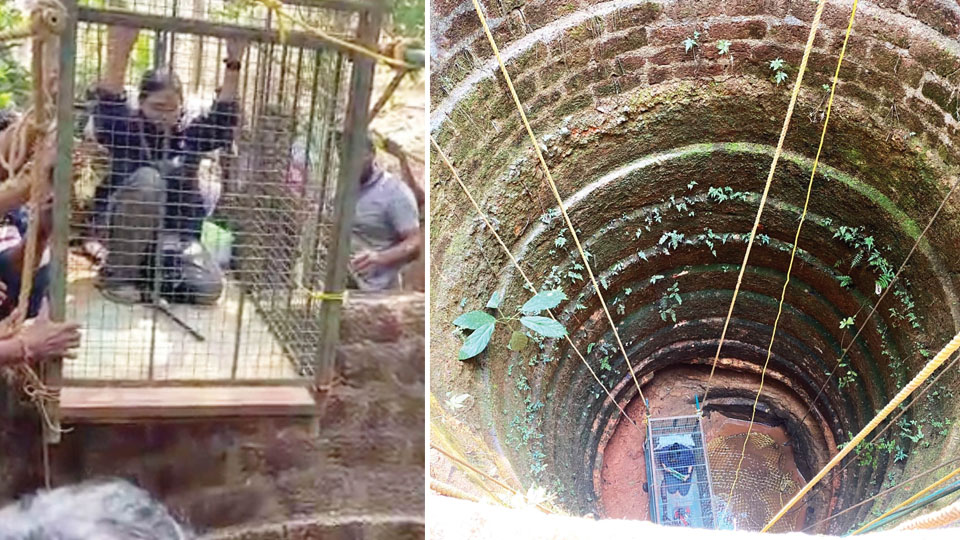
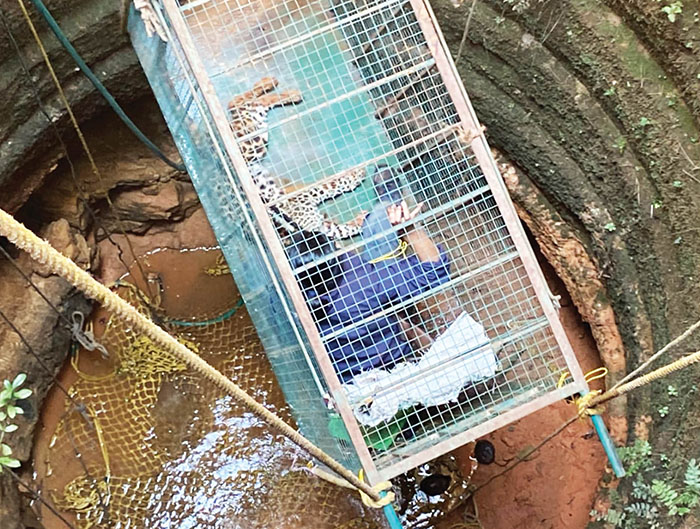
She recently saved a leopard that had fallen inside a 25-feet deep well and performed the act by sitting inside a cage that was lowered into the well to sedate the leopard that was stuck there and starving for 36 hours. She was able to pull the one-year-old feline into the same cage in a tense and dare-devil two-hour rescue operation. Her husband Dr. Yashaswi Naravi too was a part of the rescue mission.
In fact, it was 31-year-old Dr. Meghana, who volunteered to go down the well. She told Star of Mysore that though she was scared as it was deep inside the well and the leopard was not visible from the top, the adrenaline rush to save the starving and stuck animal overcame the fear.
The incident took place near a house in Niddodi near Kateel in Dakshina Kannada, about 35 km from Mangaluru. “We got a call at 9 am on Feb. 12 from the Forest Department. We are a team from Chitte Pilli, a Wildlife Rescue and Research Centre in Mangaluru and the team comprises me, my husband and experts Dr. Prithvi Salian and Dr. Nafisa Kousar. We reached the place at 11 am with some necessary equipment for the rescue,” she said.
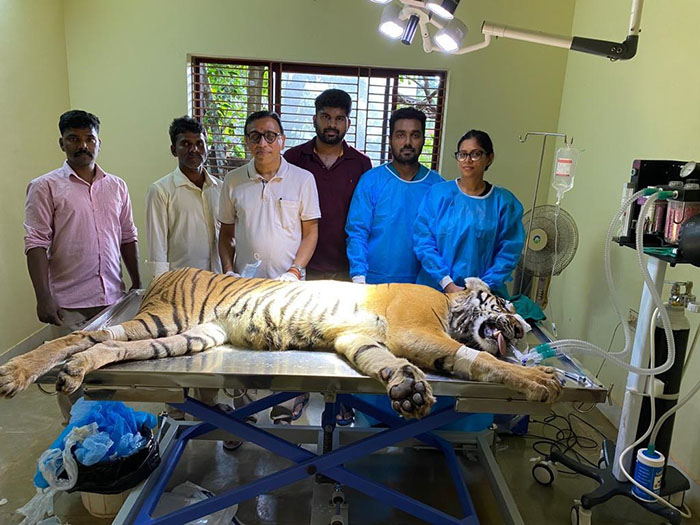
After successfully tranquillising the big wild cat, Dr. Meghana being pulled up along with the tranquillised leopard inside the cage.
Failed attempts
The Forest Department had tried to rescue the feline with a ladder and a cage, as in other instances the trapped leopard had walked into the cage when it was lowered inside a well. However, this leopard was unwilling to move, she added.
The leopard was not visible from the top and it had taken shelter at a cosy spot that was shaped like a cave-like cavity — to avoid falling into the water — inside the sturdy well that was built with stones. The leopard was aggressive when attempts were made by the Department to drain the well water.
“Later, a different strategy was adopted and it was decided to lower a cage carrying a person to tranquillise the leopard and bring it back. We had no other choice and someone had to do it. I volunteered despite the dangers involved,” Dr. Meghana revealed.
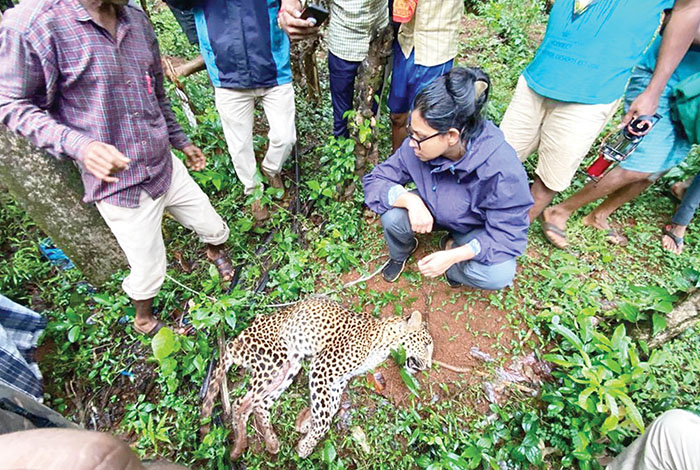
The leopard being treated after capturing in Mangaluru.
A risky mission
The cage was lowered by villagers, volunteers and the Forest Department staff in a coordinated action and with Dr. Meghana holding the tranquilliser gun. “We did not have a visual of the leopard and as such, it was a risky mission as no one had a clue as to how the leopard would react,” she said.
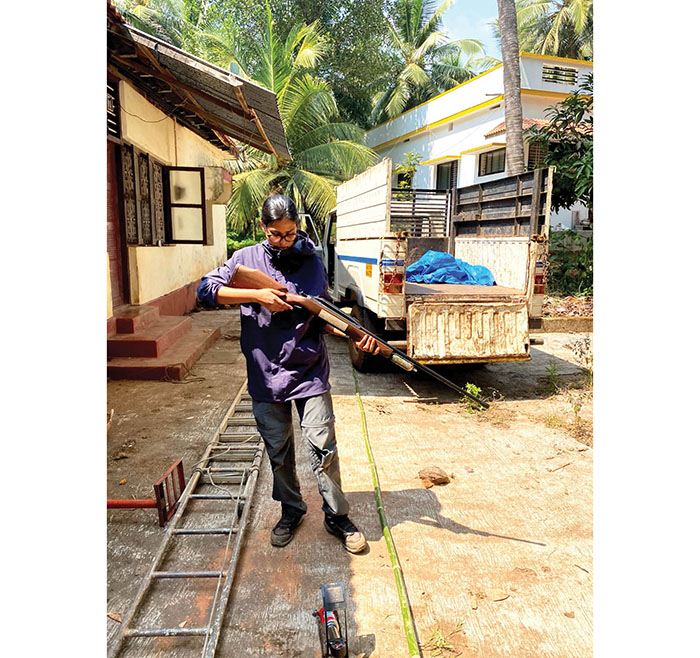
“I waited patiently for a sight of the leopard as the cage was lowered gradually and finally I could spot the animal around 10 to 15 feet inside the well and it was growling at me though it looked exhausted without food and water. I had very little time and hence aimed the dart at the animal and shot at it. Luckily, it was a precision shot and the dart hit the feline’s thigh in the first attempt itself,” Dr. Meghana said.
Meghana had carried about three to four syringes containing the sedating medicine as she did not know about its weight, size, health and other parameters for darting it. If she missed the aim the first time, she could well refill the tranquilliser gun with the second shot but the leopard could have moved away from the initial close proximity and there was more probability of her missing the shot.
Growling leopard
“In fact, I had to sit inside the cage for over 15 minutes for the dart to take effect and the leopard was right in front of me. It was growling and looking at me. Slowly, the sedation process began and I tried to pull it to the cage but could not. Another youth got inside the well and helped me and we both put the 25-kg leopard inside the cage. It was a leopardess. Now when I look back, sometimes I fear what could have happened if something had gone wrong,” she said.
So tense was the situation after the dart was fired that Dr. Meghana sat motionless inside the cage as any movement or noise would disturb the leopard and it would take a long time for the animal to get sedated. Finally, the feline fell unconscious after over 15 minutes. After the leopard was lifted back to the ground, it was checked and the vets found no external injury marks.
“It was a healthy leopard but was exhausted. After administering the required medicines for the feline to rejuvenate and get back its strength so that it has the capacity to hunt on its own, it was handed over to the Forest Department that released it back to the wild,” Dr. Meghana said.
Passion for wildlife keeps her going
Wildlife rescue operations are nothing new for Meghana and she has been a part of many rescue operations in the last six years in Karnataka. She has been a part of many missions where she has rescued and treated tigers, owls, star tortoises, pariah kites, crows, pigeons, birds and even pythons.
“Passion about wildlife, increasing human-animal conflicts and the resulting rescue mission keeps me going. I dread to see an animal suffering due to injuries,” she said.
Every year, she does almost 10 darting procedures after following the scientific process and protocols. But this was the first time she had to get down into a well, sitting inside a cage to rescue a leopard. She hails from Halugunda village near Virajpet in Kodagu district and studied in Bengaluru.
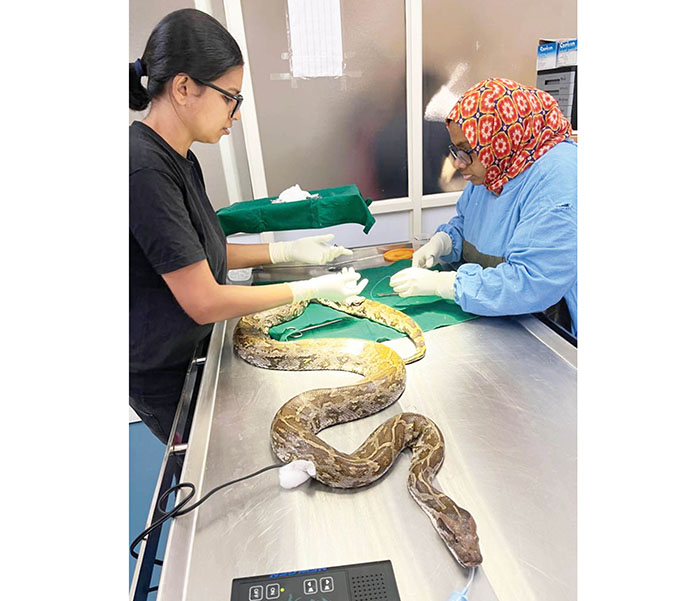
Dr. Meghana treating a python.
After completing her PUC from Christ College, Dr. Meghana did her BVSc followed by MVSc in Wildlife and Surgery from Veterinary College, Bengaluru. The next four years, she worked in People For Animals (PFA) as a senior veterinarian and this gave her on-hand exposure to animal rescue and medication.
Her father late Pandikanda M. Pemmaiah was a retired Superintendent of Police and her mother P.P. Sarasu and rest of the family live in Bengaluru. She married veterinarian Dr. Yashaswi Naravi of Mangaluru and both have been working at Chitte Pilli — a Wildlife Rescue and Research Centre.
source: http://www.starofmysore.com / Star of Mysore / Home> News> Top Stories / February 21st, 2023
Hosts Appachettolanda family expecting participation of more than 350 teams
Madikeri:
The Kodava Family Hockey or ‘Hockey Namme’ is back with a bang after a gap of four years. This time, the tournament will be hosted by the Appachettolanda family from March 20 to April 10, 2023 at Napoklu village in Kodagu.
“After 2018, the hockey festival did not see the light of the day due to natural disasters and the COVID-19 pandemic. We will be organising the 23rd annual ‘Hockey Namme’ in 2023 in a grand manner. The fest will be held at Napoklu General Thimayya Ground and more than 350 Kodava families are likely to take part in the tournament,” said Appachettolanda Manu Muthappa, the President of the Hockey Festival Committee.
Addressing a press conference in Madikeri recently, he said that in the last hockey tournament held in 2018, a total of 333 Kodava families participated in the Kulletria Cup Hockey and this time, they were expecting the participation of more than 350 families.
The festival is being conducted under the aegis of Kodava Hockey Academy.
It may be mentioned here that to prepare the family teams for the upcoming hockey festival, the Kodava Hockey Academy had organised the first Pandanda M. Kuttappa Memorial Cup rink hockey festival, in memory of the founder of the Academy and the hockey festival. It was organised from Oct. 27 to Nov. 6 at Ponnampet Turf Ground and a total of 114 teams had participated.
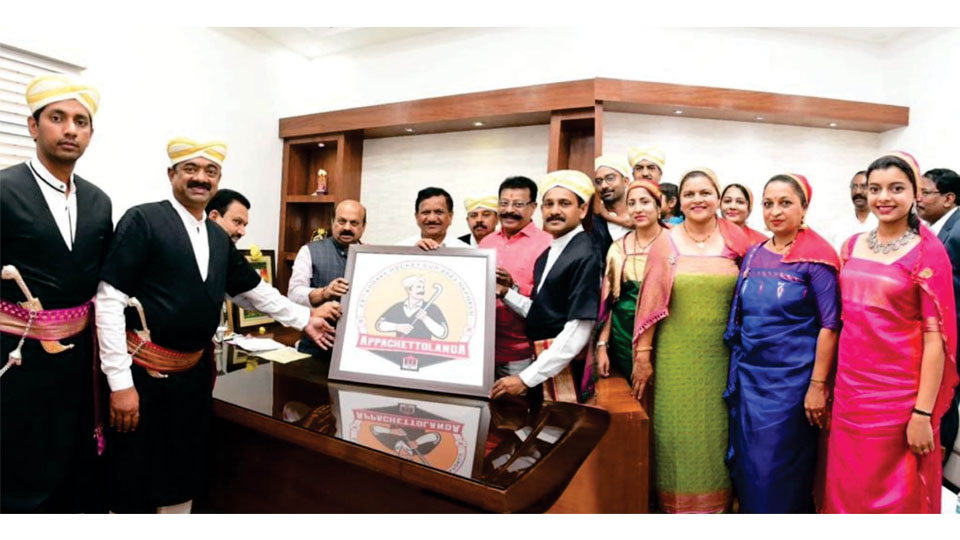
The logo of the Appachettolanda Cup family tournament was unveiled in Bengaluru recently by Chief Minister Basavaraj Bommai where a delegation of the family had called on the CM. Virajpet MLA K.G. Bopaiah, MLC Suja Kushalappa and the tournament-organising family members were present.
“The CM has assured us that a Rs. 1 crore grant will be released for the hockey festival for the first time and the CM has consented to inaugurate the tournament on March 20. In all, Rs. 1.50 crore will be spent for the festival and the remaining Rs. 50 lakh will be pooled-in by the family members and collected from donors. We are planning to invite and felicitate a host of national and international hockey players who have made the Kodagu district proud and hockey champions from all communities will be honoured,” Manu Muthappa said.
In all, three grounds will be utilised for the hockey festival and they will be also used as a back-up in case it rains. Kodava Hockey Academy President Pandanda Bopanna, who is the son of late Pandanda Kuttappa, will be one of the guests in the inaugural event. “It was his father who launched the first Kodava Family Hockey Tournament in 1997 and was organised by the Pandanda family, Manu Muthappa noted.
Secretary of the Hockey Festival Committee Appachettolanda Vasanth Muthappa, members Appachettolanda Harish Somaiah, Appachettolanda Ravi Monnappa, Appachettolanda Janath Kumar and others were present.
source: http://www.starofmysore.com / Star of Mysore / Home> News / December 13th, 2022
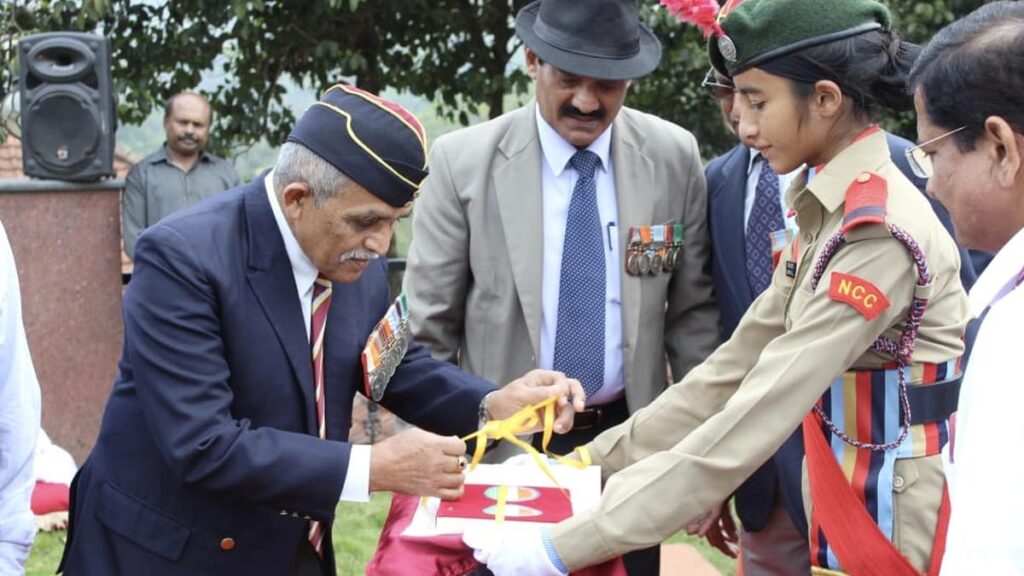
The Armed Forces Flag Day was observed in Madikeri in Kodagu on Wednesday. | Photo Credit: Special Arrangement
The Kodagu district administration and Department of Sainik Welfare and Resettlement observed the Armed Forces Flag Day at General Thimmaiah Memorial Bhavan in Madikeri on Wednesday.
Lieutenant Colonel (Retd) Mahaveer Chakra P.S. Ganapathy, Deputy Commissioner B.C. Satish, Superintendent of Police Capt M.A. Aiyappa, Air Marshal (Retd) Cariappa, Lieutenant Colonel Chacko, Kodagu Zilla Panchayat CEO S. Akash and other dignitaries were present on the occasion.
Every year, December 7 is observed as Armed Forces Flag Day throughout the country to honour martyrs and men in uniform, who valiantly fought and continue to fight on the country’s borders.
source: http://www.thehindu.com / The Hindu / Home> News> India> Karnataka / by The Hindu Bureau / December 07th, 2022
A unique eco-certification initiative in Kodagu’s famous coffee estates offers fresh hope for preserving native rainforests of the Western Ghats.
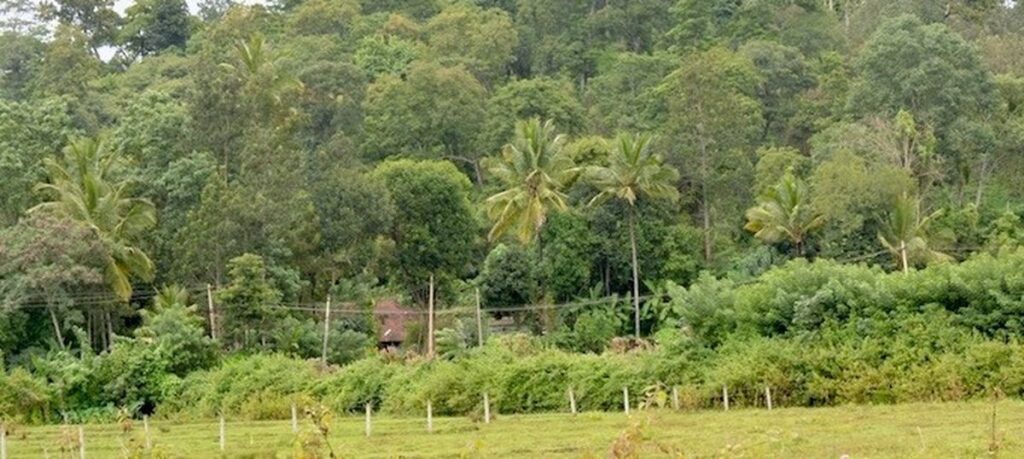
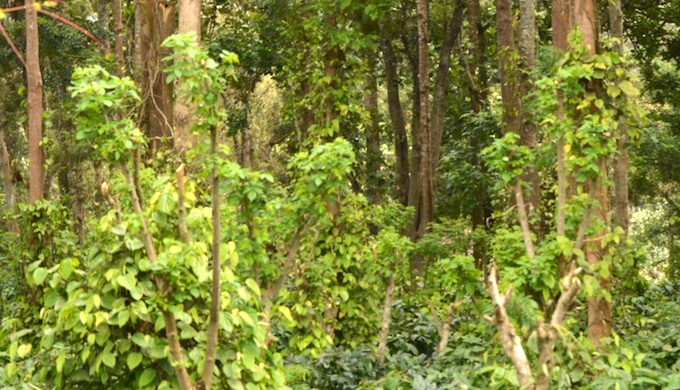
Growing coffee in the shade of evergreen trees in Kodagu. | Gopikrishna Warrier
There was a time in the not-too-distant past when coffee farmers in Kodagu district of Karnataka grew their plants only under the canopy of evergreen forests they had inherited. Now they prefer to grow it under the sun, which has serious implications for the Western Ghats and on the waters of the Kaveri River.
More and more farmers are now letting trees such as Dadup (Erythrina subumbrans), Arecanut (Areca catechu), Balanji (Acrocarpus fraxnifolius) and Jackfruit (Acrocarpus heterophyllus) die so that the canopy can be opened up and they can grow sun-loving coffee varieties that produce more berries and beans, resulting in higher returns.
Instead of the big trees, they are now planting exotic Silver Oaks (Grevillea robusta), whose pole-like trunk can be used as a support for the climbing pepper vines, which help boosting incomes. The proliferation of Silver Oaks has made it one of the more common trees in some parts of the area.
This transition has a larger ecosystem cost. Kodagu, earlier known as Coorg, is located on the western edge of the Mysore Plateau, at an average altitude of 800 metres, as it lifts up to the crest of the Western Ghats ridge (altitude above 1,500 m) and then falls sharply westwards into Kerala. The plateau mainly slopes eastwards, with the streams and rivers joining to form the Kaveri River, which is the lifeline for millions of people in Karnataka, Tamil Nadu and Puducherry.
With insufficient rains over the Western Ghats during this year’s southwest monsoon, there is a shortage of water in the reservoirs across the Kaveri in Karnataka. This has led to the flaring of the water-sharing dispute with the lower riparian state of Tamil Nadu in recent days.
While this acrimony continues, payment for ecosystem services measures are being worked out in Kodagu district so that coffee farmers protect the forests under which they grow their crop, thereby preserving the water flow into the Cauvery. These measures also help to maintain the climate resilience in the river’s catchment and command areas.
With the forest-like mixed-tree canopy in coffee plantations disappearing, the torrential rains of the southwest monsoon flows quickly down the streams, carrying valuable topsoil away and causing floods followed by long dry periods downstream.
Paying for ecosystem services
The Kodagu farmers are being encouraged through payment for ecosystem services, in the form of eco-certification, to continue with their traditional coffee cultivation under the shade of mixed species of trees. This will help strengthen the ecosystem services they receive from the unique landscape of Kodagu, and also strengthen similar services and climate resilience of all those relying on the waters of the Kaveri downstream.
The concept of eco-certified coffee, whose certification process ensures that coffee is grown under mixed-species trees, has gained popularity in the district in the past five years. Close to 900 coffee farmers have converted to eco-certified coffee. Even with a conservative estimate of 10 acre per farmer, this means nearly 10,000 acres of eco-certified coffee. In addition, with Tata Coffee getting all of its 13 estates eco-certified, Kodagu district has at least 20,000 acres under coffee cultivation that aims to minimise damage to the environment.
As an incentive for protecting the environment, the coffee farmers get a premium above the market price for their coffee beans. Coffee is the major agricultural produce from Kodagu, with 33% of the district landscape under its cultivation. About 38% of India’s coffee production comes from the district.
Ecologically, Kodagu district has been identified as a micro hotspot of biodiversity under the larger Western Ghats region. Rightly so, since the western crest of the mountainous district is in the direct path of the southwest monsoon. The dark clouds heavy with rain dump much water over the district. While the western edge of the district receives above 5,000 mm of rainfall on an average, it reduces to around 1,200 mm in the east. Most of the water feeds into the Kaveri.
According to a reportby the College of Forestry at Ponnampet in Kodagu, natural forested ecosystems cover an area of 46% of the total area of the district. These include evergreen, semi evergreen, moist deciduous, dry deciduous and scrub forest types, and even the high-altitude shola-grassland ecosystem.
Traditionally, coffee is grown in the shade of these forests. Coffee estates in Kogadu have on an average 350 trees per hectare, compared with 270 in degraded groves and 640 trees per hectare in the nearby Brahagiri Wildlife Sanctuary, making these estates amongst the densest agro-forestry systems in the world.
“Very few landscapes across the world grow coffee in the way in which Kodagu does,” said C.G. Kushalappa, university head for forestry and environment sciences at the College of Forestry, Ponnampet in Kodagu. “We grow both Arabica and Robusta coffee under the shade of the trees. Our shade-grown Robusta fetch a premium price. When grown under the shade, the berries mature slowly and fill out better. They have good cupping (taste) quality.”
Coffee plants are increasing being cultivated under exotic Silver Oak trees. (Photo by S. Gopikrishna Warrier)
However, he needed scientific data to convince the coffee farmers and the district administration that there was strong ecosystem benefit in maintaining the traditional shade-growing methods. The opportunity for doing this research emerged when the College of Forestry was chosen as the lead institute in India to carry out the Coffee Agro-Forestry Network, or CAFNET study to understand the environmental services from this unique landscape.
Financed by the European Commission, the study was jointly conducted by the College of Forestry, the Coffee Board, the French Institute at Puducherry, CIRAD (the French national agricultural research system) and Bangor University from the United Kingdom between 2007 and 2011.
Rich local knowledge
The study noted that the multi-storeyed coffee agro-forestry system developed and sustained by the farmers based on their local knowledge is one of the most diverse production systems in the world. The traditional coffee agro-forestry system sustains diverse animal, bird, plant and microorganisms, and provide biodiversity, carbon sequestration and water-related ecosystem services. Since multiple crops such as pepper, mandarin oranges, vanilla and timber is also grown in these systems, they help provide resilience to farmers when they are hit by coffee price volatility.
The CAFNET report recommended that coffee farmers growing Arabica and Robusta under shade trees should be paid for the ecosystem services that their farms provide, so that they can protect biodiversity and therefore water in the Cauvery. Two methodologies for payment for ecosystem services suggested was eco-certification and geographical indications protection for Kodagu coffee.
Eco-certification of coffee farms in Kodagu started as a follow-up to this recommendation. Coffee farmer BB Thammaiah says his interest was piqued when students from the College of Forestry came to his farm to carry out biodiversity studies. “After the studies I was told about the uniqueness of the method in which I grow coffee, and I went in for eco-certification,” he said.
The two eco-certifications that have been popularly accepted are from the Rainforest Alliance and Utz. Coffee grower KK Naren in Kunda village near Ponnampet said the main benefit of the eco-certification process is that farmers are trained in good practices that have good environmental benefits and improve the working and living conditions for the workers.
“The economic benefit is not much,” he said. “It is more of training for us, which will be beneficial in the long run. The eco-certification process educates the coffee farmers about the environment.”
Importance of native trees
The most important lesson from the training relating to the eco-certification, according to Narenm was the understanding on the importance of native trees. “It is not that we didn’t know about native trees but we were not that keen on maintaining them,” he said. “The native trees do not give good financial returns, so we gave importance to silver oak.”
According to Naren, the Rainforest Alliance eco-certification process looks at whether native shade trees are present. The certifiers and auditors also look at labour management, whether the minimum labour wage is paid and the cleanliness around the labour quarters. They are very strict about not using child labour. “They also look at the way chemicals are used,” he said. “They are not saying no to chemicals but there are restrictions to some chemicals and the way the rest are used. They are keen that we should not use pesticides of chemicals near the rivers or tanks. They give importance to maintain local environment.”
Individual planters like Thammaiah and Naren got an opportunity, through the eco-certificaion process, to access the international market through a Swiss procurement agency that buys higher quality coffee. Both of them sell their eco-certified coffee to Ecom Gill, who procures the eco-certified produce for supply to Nespresso.
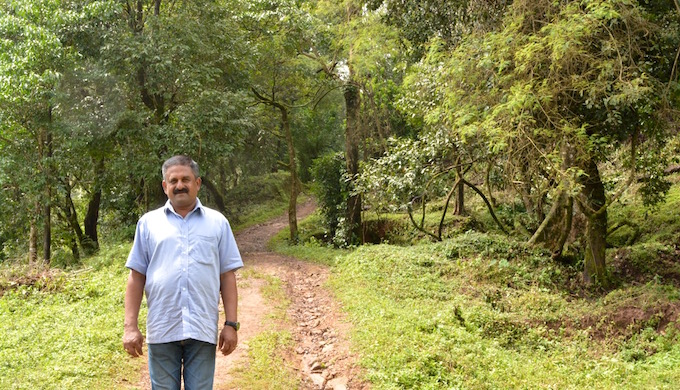
BB Thammaiah in his coffee farm where the plants are grown under the shade of native evergreen trees. (Photo by S. Gopikrishna Warrier)
For Tata Global Beverages Ltd and its production subsidiary Tata Coffee Ltd, the move to eco-certification of all of its 13 estates in Kodagu was an important step in the process to make its supply chain sustainable. According to Anurag Priyadarshi, global sustainability manager for Tata Global Beverages, one of the guiding principles that the group has adopted is to source sustainability. For this, all their estates in Kodagu have been eco-certified by Rainforest Alliance and Utz.
“Through the eco-certification process we are trying to ensure good management practices for the ecosystem, energy, water, waste, soil and agro-chemicals. We ensure the safety of the produce and also occupational health of the workers. Ultimately we want to prevent the impacts of climate change,” he said.
MB Ganapathy, head of plantations for Tata Coffee, said the company is aware about the fact that they are growing coffee in Kodagu, which is a biodiversity hotspot in the Western Ghats. “We have recognised this fact and that is the reason that our vision is to enhance the ecological wealth we have inherited. The eco-certification helps us safeguard the environment.”
Challenges remain
However, the rapid spread of the eco-certification process has also raised some hiccups which need to be overcome, states TR Shankar Raman, scientist at the Nature Conservation Foundation, whose organisation was involved with helping Rainforest Alliance with the certification in the initial years. The three points of concern, according to him, is the very rapid pace at which certification is being done; the relative absence of biologists and social scientists in the auditing process; and the dilution of conservation standards (like the requisite number of native species and canopy cover) in subsequent versions of the certification guidelines.
“While the rapid certification has more and more farmers being eco-certified, we hope the rigour of the process continues to be maintained, so that the end result of conserving the native vegetation is not compromised,” Raman observed.
With more farmers opting for eco-certification, there is a movement towards the protection of the traditional methods of coffee cultivation under the shade of mixed-tree species. For the process to strengthen the farmers should continue to get good economic benefit for their eco-certified produce.
According to Naren, if there is at least 10% more returns from the eco-certified coffee remains constant then there will be an incentive for the opting for opting for the process. At present the price at which procurement agencies such as Ecom Gill buy is linked to the international market price, plus a premium of Rs 60 to Rs 80 for a 50 kg bag of sun-dried cherries. The international prices fluctuate in relation to the local market prices, and as with the current situation can go below the domestic price.
However, Kushalappa says that in addition to the premium, there are other incentives and bonuses for producing good quality coffee beans. The average increase in price above the local market price was around 15% last year, which is well worth the effort.
If additional income for coffee farmers from eco-certification can help conserve unique agro-forestry ecosystem of Kodagu, then it will be the water flow into the Cauvery that would be conserved. Millions of people downstream, including the residents of Bengaluru and other parts of peninsular India, will thank the coffee farmers upstream for their drinking water and climate resilience.
‘Kodava Namme,’ the annual cultural and sports festival organised by the Federation of Kodava Samajas will be held from Nov. 18 to 20 at Balugodu in Virajpet, Kodagu.
The three-day festival will begin with the inauguration of the hockey tournament tomorrow morning while the cultural programmes will be inaugurated at 10 am on Nov. 20.
The finals of hockey match will be held at 2 pm followed by prize distribution, according to a press release from the Federation President.
source: http://www.starofmysore.com / Star of Mysore / Home> In Briefs / November 19th, 2022
Kodagu Mathu Dakshina Kannada Jilla Gowda Mahila Samaja, Mysuru, will be holding its Silver Jubilee celebration programme at its premises in Vijayanagar tomorrow (Nov. 6) at 10.30 am. Pradhan Mantri Poshan Shakti Nirman Scheme, Bengaluru, Assistant Director P.S. Leelavathi will inaugurate while Income Tax Department, Bengaluru, Additional Commissioner K.M. Sulochana will release the souvenir on the occasion.
SAADHYA Trust for Social Development Founder – Head Achuda Arathi Harish will be the chief guest. Samaja President Devajana Geetha Montadka will preside.
source: http://www.starofmysore.com / Star of Mysore / Home> In Briefs / November 05th, 2022
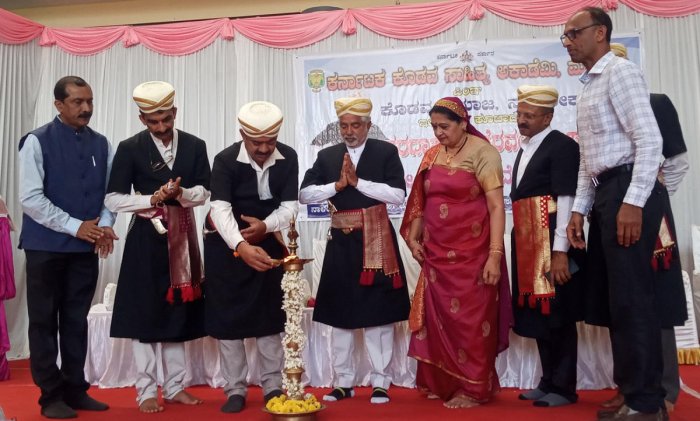
Kodava Samaja, Napoklu, president Appachettolanda Manu Muttappa inaugurates the 153rd birth anniversary celebrations of Appacha Kavi, organised at Appacha Kavi auditorium in Kodava Samaja, Napoklu.
The Ainmane, traditional house of Haradasa Appacha Kavi, the first poet of Kodagu, should be developed into a memorial, said Appachettolanda Manu Muttappa, president of Napoklu Kodava Samaja.
He was speaking during the 153rd birth anniversary celebrations of Appacha Kavi, organised by Karnataka Kodava Sahitya Academy and Napoklu Kodava Samaja, at Appacha Kavi auditorium, on Tuesday.
Manu Muttappa said that along with the residences of great poets and writers, their native places should also be developed.
“There is a need to introduce Appacha Kavi’s works to the present generation. Appacha Kavi had great knowledge of Kannada and Sanskrit. An education officer called Raghunatha Raya inspired Appacha Kavi to create literary works in the Kodava language, he said.
Speaking on Appacha Kavi, Rangayana, Mysuru, director Addanda Cariappa said that Appacha Kavi should be awarded the ‘Karnataka Ratna’ award.
Karnataka Kodava Sahitya Academy chairperson Dr Ammatanda Parvathi Appaiah, Academy registrar Ajjikuttira Girish, Appaneravanda Ainmane Development Committee president Appaneravanda Chummi Devaiah, Appaneravanda Ramu and Dr Manoj were present.
‘Ummattat’ and other cultural programmes were held on the occasion.
Folklore scholar Bottolanda Kashi Achaiah sang songs composed by Appacha Kavi.
source: http://www.deccanherald.com / Deccan Herald / Home> State> Mangaluru / by DHNS, Napoklu / September 21st, 2022
Rohan Bopanna (left) and Mahesh Bhupathi at Bombay Gymkhana / DNA
Mahesh Bhupathi and Rohan Bopanna talk to Mihir Vasavda about their new partnership and Olympic dreams
Mahesh, at the start of 2011, did you think your reunion with Leander Paes will end so soon?
At that time, none of us thought that way. We were looking forward to getting positive results and hoping for the best. Unfortunately, it didn’t work out that way. But I feel good at the position I am in right now. Rohan (Bopanna) has been doing very well for the last couple of years. He is on this really amazing upward curve in his career. Doubles is getting competitive and we rely heavily on power. And Rohan brings a lot of power in our team. So, I am happy that we got this opportunity and hopefully, we will make the most of it.
How do you look at this new partnership?
Rohan Bopanna: It’s always a big challenge to play with a new partner. But the experience that Mahesh brings with him will mean a lot. He has been around for more than a decade. So it’s going to help me a lot.
Mahesh Bhupathi: When you start something new, there are always going to be some nerves. Fortunately for me, I have always been able to make my partnerships work and I know Rohan for a long time. I know his strengths, weaknesses. We’ve been training hard for the last few weeks and hope to get things right when the new season starts.
What’s the key to make a new partnership work?
MB: The key thing is we are willing to work together. I think that’s the biggest strength. As doubles players, we have proved ourselves individually. As long as we can work together and believe in each other’s abilities, which we do, then it’s half the battle won.
Rohan, it’s a big step because you have had plenty of success with Aisam-Ul-Haq Qureshi.
RB: It was a tough choice for me to make but an extremely important one. The main reason behind my decision was Olympics. I couldn’t have played (in the Olympics) with Aisam. So I had to think of something new. That’s when Mahesh and I decided to pair up and see how things go.
Was there any particular point last season when you and Leander felt the time was up?
MB: Not really. I was informed Leander doesn’t want to play with me anymore. That’s when I called Rohan.
Was the fact that you and Leander haven’t managed an Olympic medal so far taken into consideration when you decided to split again?
MB: I would like to believe so. I and Leander have represented India in four Olympics and each time we have fallen short. Something wasn’t working out, though I don’t know what. So, logically, we decided to form a new team.
Rohan, there have been reports that you had an option to partner Leander. Was it comfortable for you to be in this position where you had to choose between Leander and Mahesh?
RB: I really wish it was the case. But it wasn’t like that. There are a lot of things involved. You have to take a look at rankings and other such things. I think I can learn a lot from Mahesh. Obviously, we have to work on the rankings aspect so that we can be eligible to qualify for the Olympics but there are still around six months in our hands to get it sorted and we are really looking forward for that.
Top seeds at the Aircell Chennai Open, Paes partnering Tipsarevic…How do you look at the whole thing?
MB: For us, it’s a new partnership, so seeding really doesn’t matter. We would really like to win four matches but we will take it one match at a time. It’s a preparation for us for the Australian Open where we would like to do well. It’s always special to play in Chennai.
RB: Lifting the trophy would be the ideal beginning for us. That would bring in a lot of confidence and satisfaction.
Pushpanath ‘Push’ Krishnamurthy is tired. A campaigner with Oxfam, UK, he is just back from a fortnight-long, 540-km walk across Karnataka for what he calls “climate justice”. “After walking 30-40 km every day for half a month, it’s tiring to not walk anymore,” he says, leaning back in his chair at the office of the Centre for Social Markets, a Bangalore-based non-profit that promotes climate change dialogue and socially sustainable entrepreneurship, where he is currently on an externship.
In a white chikankari kurta and jeans, his face framed by a cloud of unruly salt-and-pepper hair, Krishnamurthy looks every bit the eccentric Gandhian. He is brimming with stories from his journey, timed to coincide with the UN climate conference in Durban, South Africa.
“I met 30,000 people in 16 days. Hordes of people joined me on various legs of the walk, welcomed me into their homes, shared their stories, fed me and garlanded me. I felt like Bono without the sunglasses,” he says, laughing. Krishnamurthy began his walk, backed by CSM and the Karnataka Growers’ Federation, on November 25 in the hills of Chikmagalur, descending two thousand feet in the next few days to pass through Hassan, Coorg and Hunsur and finally arrive at Mysore. Along the way, farmers and coffee growers filled him in on the climatic variance of the past few years and how it was affecting their crops. He visited villages ravaged by unseasonable bouts of rain and explained in chaste Kannada the correlation between human activity and climate change. He blogged every day and gave interviews to radio and local papers, attracting a posse of supporters aged seven to 80. “Most of them hadn’t heard of the Durban talks. They thought I was a crazy old man. Some called me a parisara vaadi, a climatologist. I told them I am just a regular guy with irregular hair,” he says, lightheartedly.
source: http://www.indianexpress.com / IE> Story / by V Shoba / December 18th, 2011
The RCGC Cup amateur golf championship, sixth leg of the Indian amateur tour calendar, will tee off here on Tuesday. The four-day championship will be played over par-72, Royal Calcutta Golf Club. The meet is being organised by the Indian Golf Union.
No. 1 in India, S. Chikkarangappa, will lead a strong field of about 90 golfers from all over the country. He will look to win back-to-back titles on the amateur circuit, while Chandigarh’s Abhijit Chadha is set to provide the challenge to the Bangalore-based golfer.
Others who are likely to be in contention for the top honours are Khalin Joshi, Udayan Mane, local lad Raja Sardar, experienced Gagan Verma from Delhi and Vikram Rana.
The first 26 amateur golfers of the country, as per the IGU’s merit list, qualify automatically for this tournament; around 60 players have made the grade through a qualifier held at the Beldih & Golmuri Golf Club, Jamshedpur, last week and four are nominees of the RCGC.
The cut, for the RCGC Cup, will be applied after the first two days of play (36 holes) and the first 45 players will compete for top honours by playing another 36 holes. The tournament will be played in stroke play format
http: www://www.thehindu.com / Sports> Other Sports / by Special Correspondent / Kolkata, December 13th, 2011
WELCOME. If you like what you see "SUBSCRIBE via EMAIL" to receive FREE regular UPDATES.
Read More »