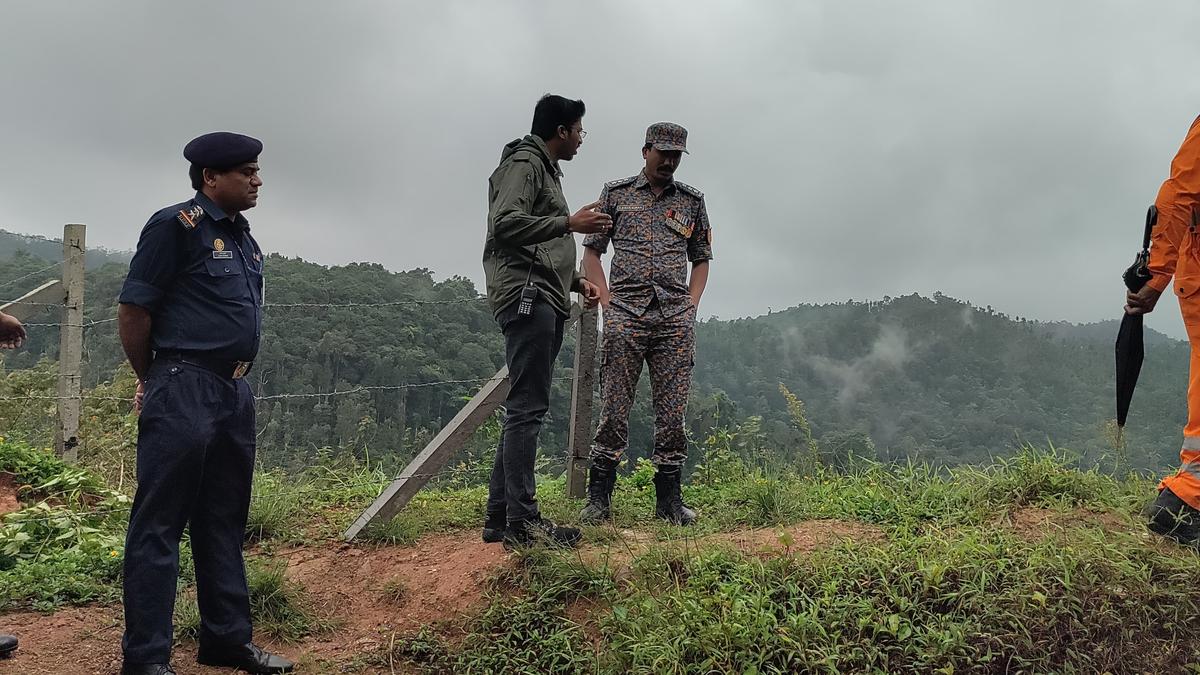
SIR exercise: In Kodagu plantation belt, BLOs struggle to map workers from tribal communities

Largely from Adivasi communities, many neither remember their earlier place of enrolment nor possess documents to establish it .
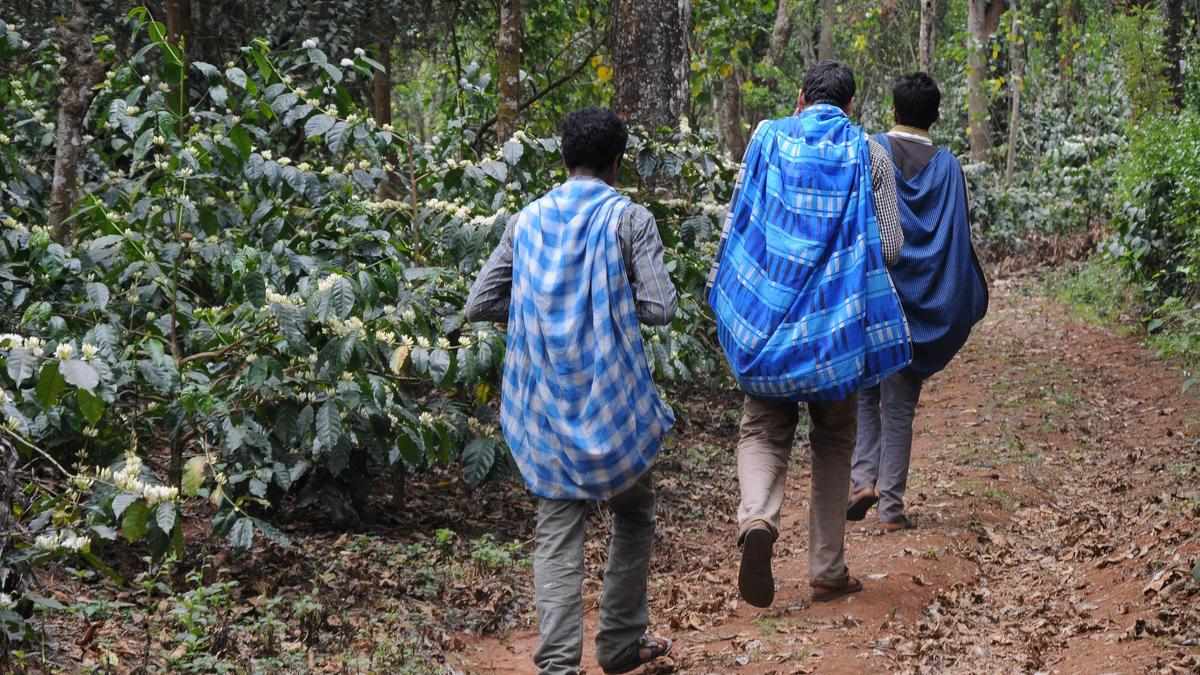
Residents have, over the years, moved across more than 20 plantation belts in the region. | Photo Credit: File photo

In Kedamulur, a village in Virajpet taluk of Kodagu district, Booth Level Officers (BLOs) have not been able to map even a single resident to the 2002 electoral rolls, a key requirement ahead of the Special Intensive Revision (SIR) expected to begin in Karnataka in April. 

This is because residents here have, over the years, moved across more than 20 plantation belts in the region. Largely from Adivasi communities such as the Paniya Yerava, Jenu Kuruba, and Yerava, people told The Hindu that they neither remember their earlier place of enrolment nor possess documents to establish it. 

Most families said they have worked across plantations in areas such as Kutta, Ponnampet, Kaarekadu and Ammatti, among others, shifting every few years depending on work. With no records of earlier addresses, they are unable to show where they were living in 2002. In many cases, even recalling details needed to locate their names or those of their parents or grandparents in the electoral rolls has been difficult. 

“No one in Kedamulur could be matched during the mapping exercise,” a BLO associated with the Tomara Booth said, adding that similar conditions exist across plantation areas in Virajpet and Ponnampet taluks, apart from parts of Chikkamagaluru and Sakleshpur. 

Under the SIR process, if a person cannot be linked to the 2002 electoral rolls during the enumeration phase, their name is likely to be left out of the draft rolls that follow. It is only after this stage that individuals are issued notices asking them to submit one of 11 specified documents as proof.

No proof of address

For many families here, accessing those documents itself is a challenge. Gauri, from Adivasi Sangharsh Morcha, said it is common for workers’ documents such as voter ID cards and ration cards to be held by employers, and not returned when they leave plantations. With families shifting every few years, most also do not have proof of permanent residence. Even Aadhaar, which is accepted only as proof of identity and not citizenship for SIR, is not possessed by many in these settlements. 

The SIR guidelines also require people to produce documents based on their age. Those born before 1987 must submit their own documents, those born between 1987 and 2004 must provide documents for themselves and one parent, and those born after 2004 must provide documents for both parents. In communities where older generations themselves lack documents, this requirement, Ms. Gauri argued, is impossible to meet. 
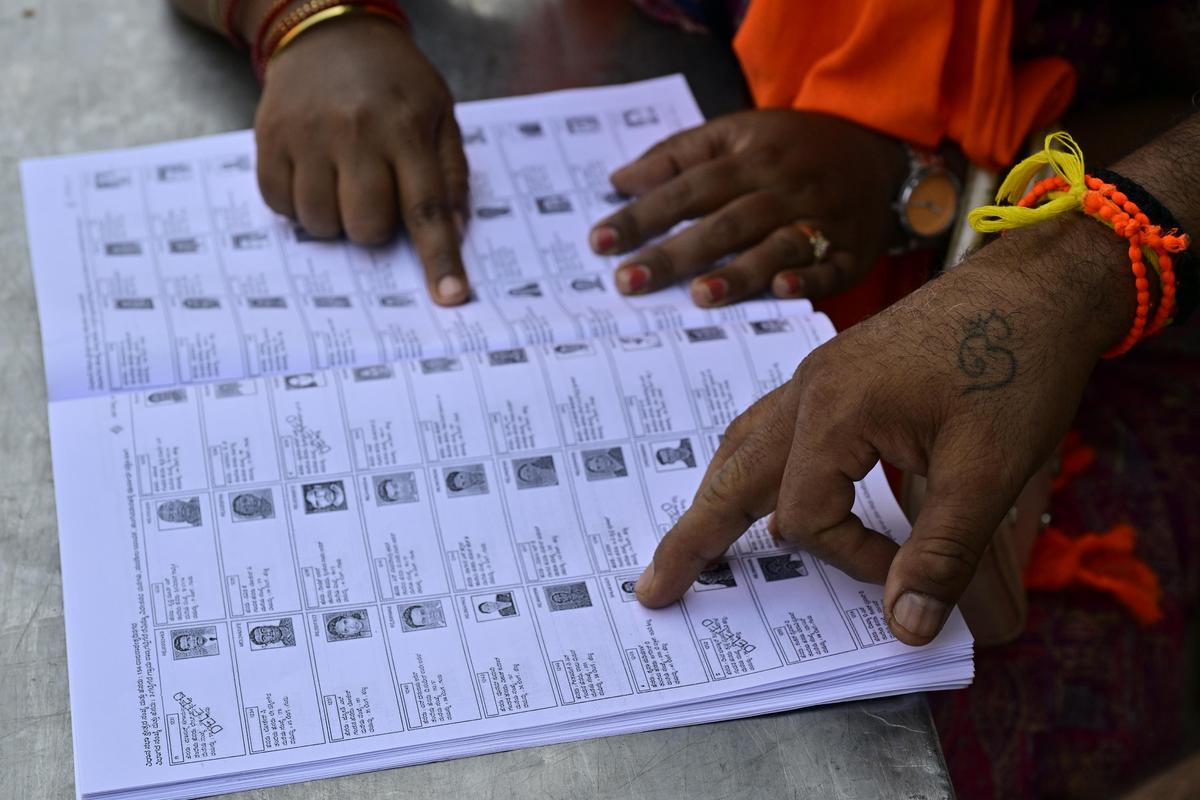
Under the SIR process, if a person cannot be linked to the 2002 electoral rolls during the enumeration phase, their name is likely to be left out of the draft rolls that follow. | Photo Credit: File photo

Discrepancies galore

Even among those who do have documents, discrepancies are common, with differences in spelling, variations in names, and inconsistencies across records.  In several cases, it was common that two documents of the same person had different names. BLOs explained that this can happen for multiple reasons — sometimes, names are changed by employers or recorded along with the name of the community, and in other instances, spellings differ across languages or records.

In one case, a person’s Aadhaar card carried the name “Manju”, while the voter ID recorded it as “Paniya Yerava Manju”. In another, the same individual’s name appeared as “Chubba” in one document and “Subba” in another. BLOs acknowledged that such variations are required to be proven during the SIR and will only make it difficult to establish identity under the SIR, even for those who possess documents.

Adivasi Sangharsh Morcha has called for a survey in Adivasi settlements to identify gaps in documentation and address discrepancies in names across records.

BLOs struggle to reach

For BLOs, the exercise itself has been difficult to carry out. These settlements are located inside plantations with no bus connectivity, requiring them to walk long distances. Even then, workers and their families were always away in estates during the day. Officials said there is little awareness among residents about the exercise, even as they are expected to complete the work within deadlines and adapt to new rules.

source: http://www.thehindu.com / The Hindu / Home> News> Cities> Bengaluru / by Rishita Khanna / April 01st, 2026
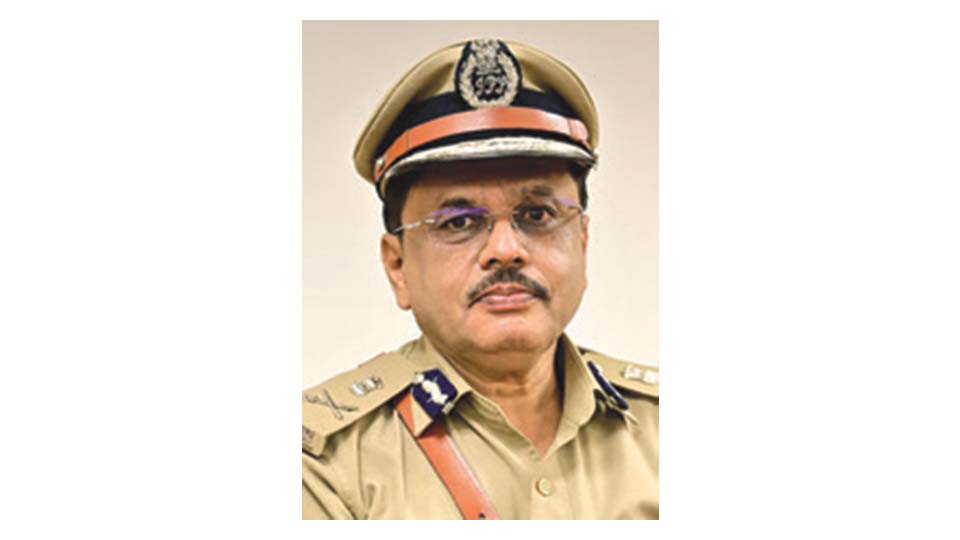
DG&IGP Dr. M.A. Saleem to visit Mysuru, Kodagu

Mysuru:

DG&IGP Dr. M.A. Saleem will be on a two-day visit to Mysuru and Kodagu districts today and tomorrow.

Dr. Saleem, who will be arriving in Mysuru by road at 5 pm today, will visit KARP Mounted Coy and stay overnight in city.

He will attend the Passing Out Parade of 46th Batch of Probationary PSIs (Civil) at Karnataka Police Academy (KPA) Grounds at 8 am tomorrow (Mar. 29).

Following this, Dr. Saleem will leave for Kodagu at 11 am to hold a review meeting of Kodagu District Police. He will visit Police Stations and Police Lines before leaving Kodagu at 6 pm to reach Bengaluru by 10 pm.

source: http://www.starofmysore.com / Star of Mysore / Home> News / March 28th, 2026

Tropical creeper vine systems may hold key to framing good green legislation, says IFP research

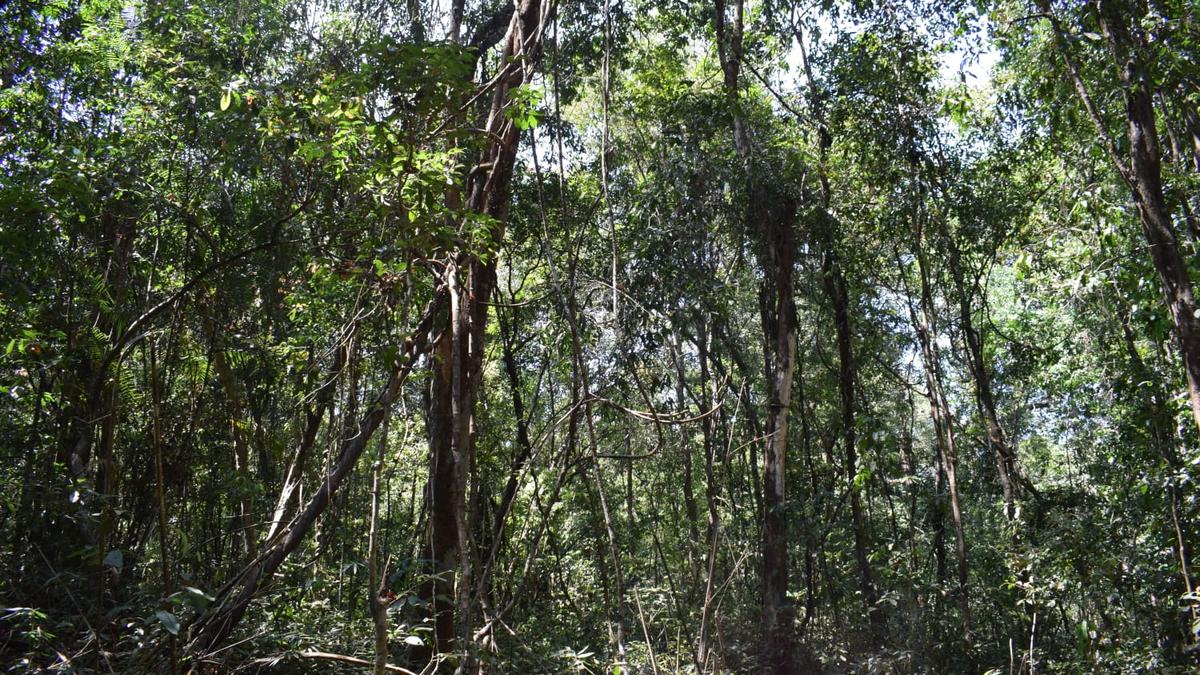
A study by researchers of the French Institute of Pondicherry at the Uppangala forest in Kodagu, Karnataka, showed how lianas, or creeper vines, hold key to framing green legislation. | Photo Credit: Special Arrangement

With their knack for piggybacking towering trees in evergreen forest ecosystems to access sunlight and nutrients, the lianas, a type of creeper vines, may appear to have patented a survival guide to grow and thrive inside the deep jungles.

Research at the French Institute of Pondicherry (IFP) offers new insights on the “intelligence” of this flora species and the dynamics at play in the liana–host interaction networks that could be crucial determinants of conservation strategies and for robust green legislation.

The study, set in the Uppangala evergreen forest in central Western Ghats of Kodagu district, Karnataka, led by Vincy K. Wilson, IFP associate researcher and researcher N. Ayyappan, delved into the survival traits and adaptive tricks of lianas, from minimalist sustenance to extroversion in networking with other tree species.

According to the researchers, despite the increasing number of liana studies in India, few have examined the distribution and association of hosts with lianas, or liana–host interaction networks to determine their functional significance and conservational value.

“Our objective was to fill the knowledge gap about the diversity, abundance, and network structure of liana–host interactions in response to logging disturbance in a typical wet evergreen forest”, said Ms. Wilson.

The study focused on lianas spread in an area demarcated into six one ha plots — four plots that had been selectively logged and two unlogged compartments. Before the 1988 ban on logging, specifically in the 1974-83 period, the site was subjected to extensive manual logging of trees, predominantly the dipterocarpus species.

Presenting a comparative investigation of the biodiversity variation of regeneration in the logged and unlogged sites in the Western Ghats, the IFP research found that the total regeneration density was 1,860 individuals, and species richness was 98 species representing 31 families. Logged sites had higher Shannon and Simpson diversity indices. Five species, namely Humboldtia brunonis, Vateria indica, Knema attenuata, Dipterocarpus indicus, and Psychotria nigra, collectively accounted for 36% of the overall density and exhibited a greater important value index.

While approximately 40% of the adult tree species at the logged site and 46% of the unlogged site were not represented in the regenerating species, the occurrence of ten species that are considered rare in unlogged plots was found to be more prevalent in logged sites.

Liana-tree interactions are a good indicator of nestedness (high frequency of interactions) and a sign of a robust system that allows species replacement. On the contrary, anti-nestedness points to fragility, where the removal of a single element in the network can potentially lead to a system collapse.

A striking aspect of the lianas is how they achieved the goal of height, instead of breadth, by willingly sacrificing supporting tissue, said Ms. Wilson, who had a few months ago, shared some research findings at a presentation, “Green Genius: Nature’s Amazing Tricks to Survive and Thrive”, at the Alliance Francaise.

“Their aim is to reach the canopy where they will get light… so they do not invest in lateral branches unlike trees”, she noted.

A significant takeaway from the IFP study was that a higher density and diversity in the logged sites may only signify robustness at a superficial level, as a deeper probing of modularity and nestedness, showed that logged systems exhibited anti-nestedness, low connectors, high modularity, high specificity — all clear signs of a fragile system.

“This understanding is important for implementing good laws. We need to continuously monitor the system to know the forest dynamics and the network properties in order to evolve appropriate and robust conservation laws and interventions”, said Ms. Wilson.

source: http://www.thehindu.com / The Hindu / Home> News> Cities> Puducherry / by Dinesh Varma / March 30th, 2026

Our waste, our responsibility: A Kodagu school is teaching its students garbology

Deviah Memorial Preparatory (DMP) School is one of the few schools in Karnataka to teach garbology, the study of a community or culture by analysing its waste.

Our waste, our responsibility: A Kodagu school is teaching its students garbology

Multiple hands shoot up in the air, almost instinctively, when the teacher asks the question, “What are the ten categories of waste?”

Subaiah, a scrawny Class 4 student, begins answering the question even before he is prompted. “Paper waste, plastic waste, glass waste, metal waste, construction waste, mixed waste, recyclable waste…”

At this point, Shavari, a Class 5 student standing next to him, cuts in to add, “Hazardous waste, organic waste and e-waste,” to the dismay of the boy.

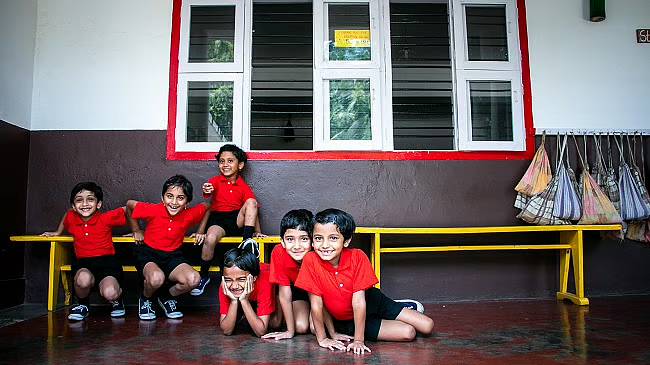
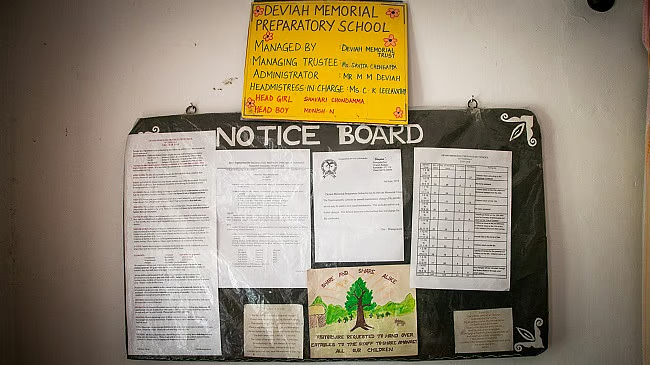
Inside the Deviah Memorial Preparatory (DMP) School in Kodagu district of Karnataka, this is now a routine after the school introduced Garbology lessons for the students of classes four and five in 2017.

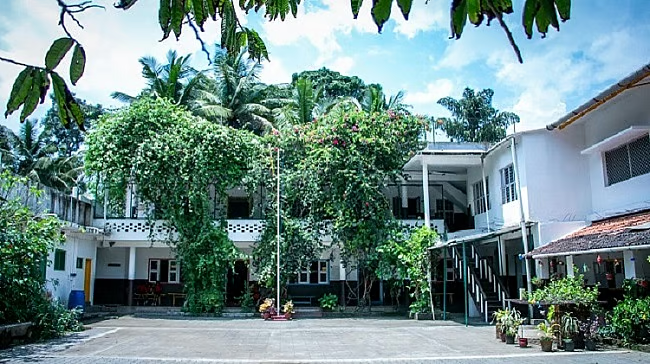
Tucked away just off the Mysuru-Virajpet road in Bittangala village, DMP is one of the few schools in Karnataka to teach garbology – the study of a community or culture by analysing its waste.

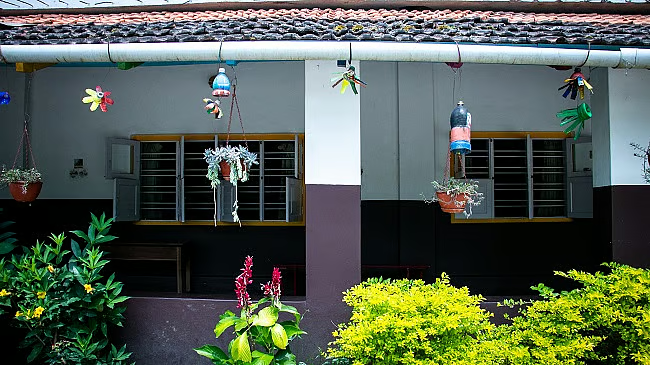
Crafts made out of recycled materials hanging in the school premises

The school was founded by Mundachadira Gangu Deviah in 1981 and is one of the oldest residential schools in Kodagu district. According to MM Deviah, the administrator of the school, the staff has always placed importance on protecting the environment. In the school, there is an almost zero-tolerance policy towards plastic.

“We don’t even allow parents to send items to their children in plastic covers. There have been times when we have returned parcels sent to the school which contain chocolates wrapped in plastic,” Deviah says.

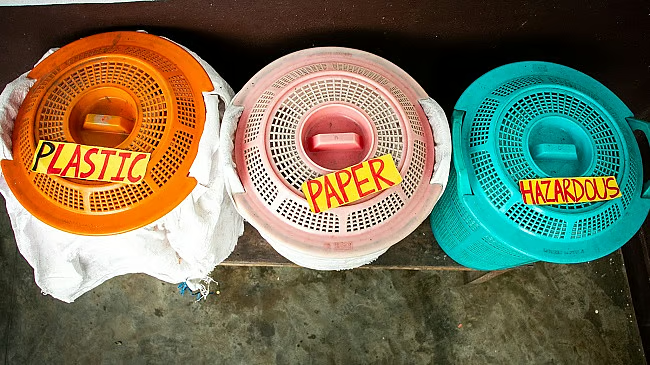
Separate dustbins at the school

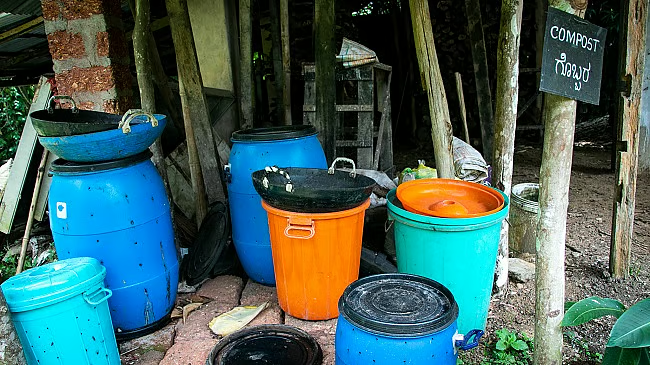
The school hopes to set an example to its students by managing the waste created in its own premises effectively. The school building is filled crafts made out of upcycled and recycled plastic. The school maintains separate dustbins for plastic, paper and hazardous waste. The students and teachers grow fruits and vegetables in a field close to the school which is used to cook most of the food prepared by the school. A soapnut liquid is used in place of handwash while natural loofahs are used to scrub the body instead of plastic ones. Kitchen waste generated in the school is also turned into compost and the school is planning to make invitations for their annual day programme using recycled newspaper.

“Even before we began garbology lessons, students were introduced to the idea of reducing and managing waste,” explains Nina Chengappa, a teacher at the school.

Deviah Memorial Preparatory School, Kodagu

In 2017, garbology was introduced in the class 4 and 5 syllabus. The classes for the subject are held every Tuesday and they are based on material provided by Wasteless, non-profit social enterprise that focuses on innovative education for sustainable waste management. Students are taught about waste management, the different grades of plastic, how much waste is generated in the production of paper, among other topics.

Composting at the school

“We conduct the sessions in such a way that the theory and practical classes go hand in hand. For instance, we teach the students about a land dump and then we take them to a land dump the following week so that they can actually see it. It is not enough that the students visualise it, they need to experience it. But, they are not asked to handle the waste, of course,” says Pavan Aiyappa, the garbology teacher at the school.

According to Pavan, the lessons are designed to create a sense of responsibility among students about managing waste. “The idea is that if the students understand the harmful effects of not managing waste, they will understand it is their responsibility to manage it. We want to teach them that garbage is their own responsibility,” says Pavan.

The lessons are not only changing the attitude of students towards waste but it is also giving the teachers plenty to think about. “One of the students suggested to us that the school should stop serving biscuits wrapped in plastic during tea break and instead give fresh fruits since it creates less waste. We realised then that the message is reaching the students,” says Nina.

The students in the school are also changing the attitudes of their family members. They have also enacted plays and recited songs in other schools in the district about managing waste responsibly. “The students are telling their family members not to litter, people listen when children tell them something and that becomes a habit over time and this leads to right choices. The students also perform plays in other schools to spread the word of reducing waste. They have performed in six government schools so far reaching an audience of around 800 students,” adds Pavan.

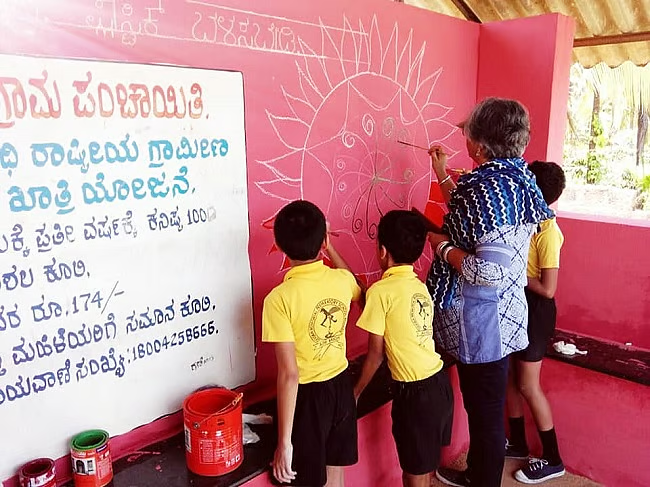
The students cleaned and re-painted a bus-stand on the main road in Bittangala on September 15, World Clean-up Day. They hope to lead by example and spread the message of taking responsibility for the waste created.

“We want to tell students that the waste we create is our responsibility,” says Deviah, before adding, “Even before we started garbology lessons, we used to teach the students here to love nature because we don’t destroy what we love.”

Photographs by: Dhruv Khanna

source: http://www.thenewsminute.com / The NEWS Minute / Home> Karnataka / by Prajwal Bhat / Photos by Dhruv Khanna / October 05th, 2018

Former VP Naidu leaves for Madikeri in helicopter from Mysuru

Mysore/Mysuru:

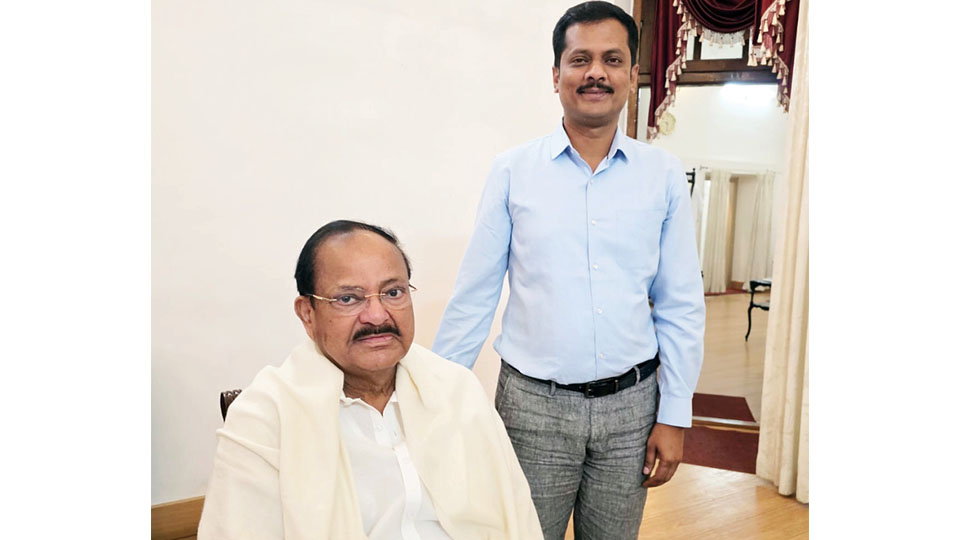
Former Vice-President of India M. Venkaiah Naidu, who arrived in the city last evening, left for Madikeri this morning.

Venkaiah Naidu, accompanied by his wife M. Usha, landed at Mysore Airport from Chennai at 6.45 pm last evening and drove straight to Government Guest House at Nazarbad, where he stayed overnight. During his stay, the jurisdictional Nazarbad Police provided security as per protocol. 

He left for Madikeri by a helicopter from Mysore Airport today  at 10.15 am and landed at the helipad at Timbertales, Kedakal, Modur Post, Madikeri,  at 11 am, from where he will travel by road to Madikeri & stay at Green Park.

Later, he will take part in Coorg Cultural Programmes at Green Park and stay for the night. Tomorrow (Feb. 15), he will take part in 90th birthday celebrations of Atluri Purnachandra Rao at Green Park, followed by Karnatak Cultural programmes.

He will stay at Green Park, Madikeri, till Feb. 18. He will depart Madikeri by a helicopter at 11 am on Feb. 18 and land at Mysore Airport at 11.50 am, from where he will travel to Government Guest House in Nazarbad.

Later, Naidu will depart Mysuru for Bengaluru by Shatabdi Express train at 2.15 pm on Feb. 18. Upon reaching Bengaluru, Naidu will stay at Loka Bhavan (formerly Raj Bhavan), till Feb. 21.

source: http://www.starofmysore.com / Star of Mysore / February 14th, 2026

Exhibition to Honour Legacy of C.M. Poonacha, Constituent Assembly Member at the Constitution Museum in JGU

Sonipat :

As a part of its commitment in honouring the legacy of the framers of the Constitution of India, The Constitution Museum & The Rights and Freedoms Academy, O.P. Jindal Global University commemorates the 115th Birth Anniversary of Shri C.M. Poonacha by curating an exhibition in his memory. Shri Poonacha, a Member of the Constituent Assembly, served independent India as the Chief Minister of Coorg, the Union Minister of Railways and as the Governor of Madhya Pradesh and later Odisha.

The exhibition displays original photographs capturing various moments of Shri Poonacha’s life, epistles, books, constitutional and other official documents, and other memorabilia belonging to Shri Poonacha. The exhibition also features a historically significant ampoule containing the ashes of Mahatma Gandhi, which Shri Poonacha received and kept in reverence throughout his life.

In the Constituent Assembly Shri Poonacha made impactful contributions in the Provincial Constitution Committee and the Committee on Chief Commissioners’ Provinces. In the Assembly Debates, Sri Poonacha articulated the significance of the Coorg Province in the emerging federal structure of India. He also advocated for a measured degree of autonomy to the provinces, emphasizing the importance of preserving the cultural and political identity of Coorg while remaining firmly anchored in the unity of India.

Inaugurating the exhibition, Prof. (Dr.) C. Raj Kumar, Vice Chancellor, O.P. Jindal Global University stated that, “The Constitution Museum and the Rights and Freedoms Academy—India’s first museum dedicated to the constitution—remain deeply committed to honouring the legacies of each of the 300 members of the Constituent Assembly. Entering the fourth quarter of the century leading up to 100 years of Indian Independence, we carry a moral responsibility to contribute to nation-building. Through these exhibitions, we strive to continually remind the people of India about the dreams of a bygone generation—their unwavering dedication to the nation and profound commitment to justice and liberty. In doing so, the Constitution Museum at JGU fulfils its purpose as vital educational space for cultivating constitutional morality”. In April 2025, the Museum hosted a similar exhibition in memory of Shri R. Sankar, the member of the Constituent Assembly from Travancore-Cochin. The present exhibition will remain open for the public from 15th to 18th October 2025.

The exhibition commenced, with an engaging panel discussion titled “C.M. Poonacha: A Constitutional Exemplar: In the Words of His Children” which set the tone for an insightful exploration of Shri Poonacha’s legacy.

Speaking in the panel discussion inaugurating the exhibition, and remembering their father’s legacy, Mr. C.P. Belliappa, son of Shri Poonacha, and Mrs. Vijaya Muthanna and Dr. Kaveri Nambisan, daughters of Shri Poonacha, observed that “Our father upheld constitutional values in all aspects of life. He was a man of principles who never compromised his ethics for his personal gains—he left his education to participate in the national movement heeding to Mahatma Gandhi’s call. Throughout his life he remained a true Gandhian—he believed in the power of satyagraha, ahimsa, and social upliftment of masses. He held Coorg close to his heart yet not forgetting his primary allegiance to the nation”.

The exhibition will close on the 18th October 2025.

(Disclaimer: The above press release comes to you under an arrangement with O.P. Jindal Global University and PTI takes no editorial responsibility for the same.). PTI PWR

This is an auto-published feed from PTI with no editorial input from The Wire.

source: http://www.thewire.in / The Wire / Home> English / by PTI PRNEWS / October 16th,2025

Karnataka rain: Landslip in Kodagu in region bereft of human habitation

On being alerted by residents of Palangala village, officials from the Departments of Mines and Geology, Revenue and Forest reached the spot on August 1 for an on-site inspection.

A representational photo of officials inspecting a landslide-prone area in Kodagu district of Karnataka. | Photo Credit: SPECIAL ARRANGEMENT

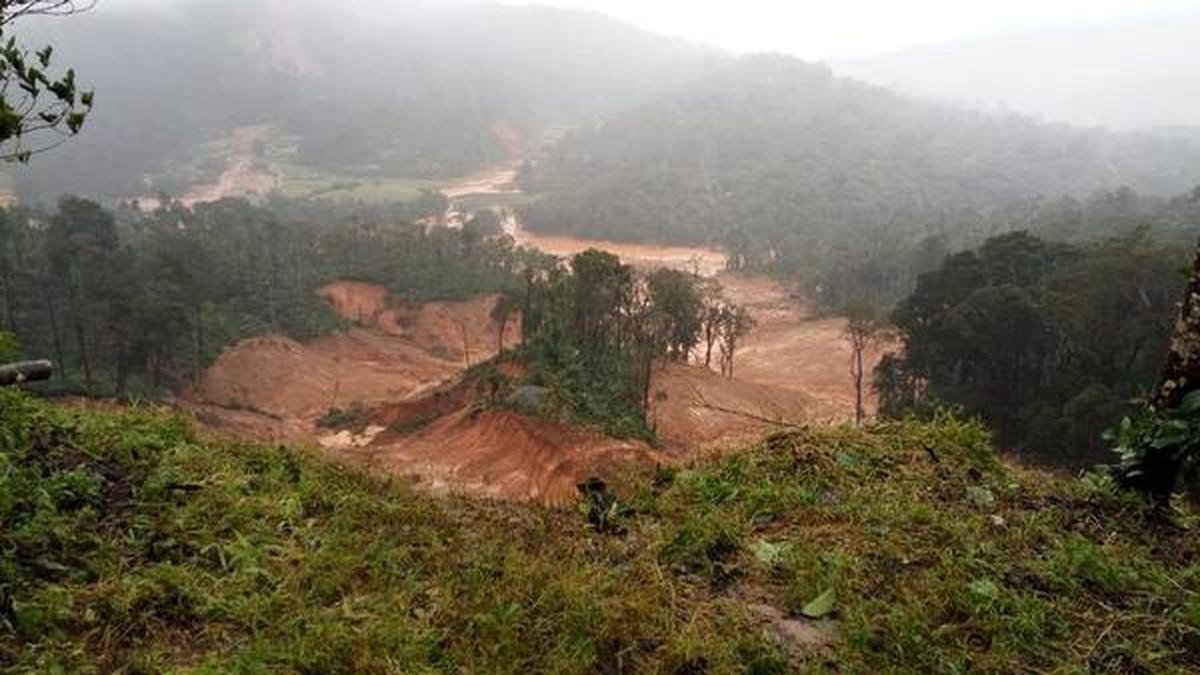
A landslip was reported to have taken place about five days ago at Palangala village in Virajpet taluk of Kodagu district in Karnataka. The area is bereft of human habitation.

According to a statement by the tahsildar of Virajpet taluk, no humans, houses or public property was affected by the landslip, while adding that there is no reason for people to panic.

On being alerted by residents of Palangala village, officials from the Departments of Mines and Geology, Revenue and Forest reached the spot on August 1 for an on-site inspection.

According to their preliminary observation, the landslip occurred from the hills of the forest in Makutta Matri range of the Western Ghats, in Palangala village. The soil, rocks and trees that had slid due the landslip reached the government-owned land in Palangala village that is spread across 341 acres.

The villagers as well as the officials estimate that the landslip might have occurred about five days ago.

Kodagu is among a few districts in Karnataka that had reported sustained rainfall in July.

source: http://www.thehindu.com / The Hindu / Home> News> India> Karnataka / The Hindu Bureau / August 0nd, 2025

Survivors in Kodagu search for a village that no longer exists

“Paddy fields have disappeared, there is a flat land devoid of trees for nearly 2 km, we cannot identify the spots we were so familiar with, and roads have simply vanished for long stretches. A few houses have survived.”

This is what one batch of 12 survivors from Makkandur in Kodagu district had to say on Tuesday as they retraced the steps to what was once their home. For them, the weary trudge was as excruciating as the ordeal of landslips and floods they had faced on Friday.

The walk to Makkandur from their relief camps near Madikeri took them almost half a day; normally, it would have taken a few minutes by car.

“The road to Makkandur no longer exists. For every few steps that we took forward and climbed what was once a familiar terrain, we were forced to turn round and rework our route,” said Jagdeep, a coffee plantation owner who was among the first batch of residents to be evacuated when disaster hit the village.

Along with a few others, he set out to assess the damage on Tuesday and returned shocked by the trail of destruction.

The group was greeted by yawning gaps in the road that had deep crevices, to circumvent which they had to climb adjoining hills that were still slippery and wet. Meanwhile, there was no let-up in the slush sliding down the hillocks.

Every step the group took was dangerous. They walked, stunned to find out that farms and plantations had given way to vast puddles of slush. “The adjoining government land which had 120 to 150 houses, accommodating plantation workers, have completely disappeared,” said a sombre Mr. Jagdeep.

Though a few houses have survived, they are surrounded by hillocks that no longer appeared stable. The walk back from Makkandur to their relief camp was even more treacherous. “Our mind was numb as we were convinced that the village we knew no longer existed; reconstruction was a long haul ahead.”

With the rains having ebbed a little, more and more people staying in relief camps are embarking on journeys to ascertain first-hand the damage to their villages.

source: http://www.thehindu.com / The Hindu / Home> News> India> Karnataka / by Special Correspondent The Hindu / August 22nd, 2022

Retired KSRP SP B.D. Mandappa passes away at 78

Virajpet (Kodagu):

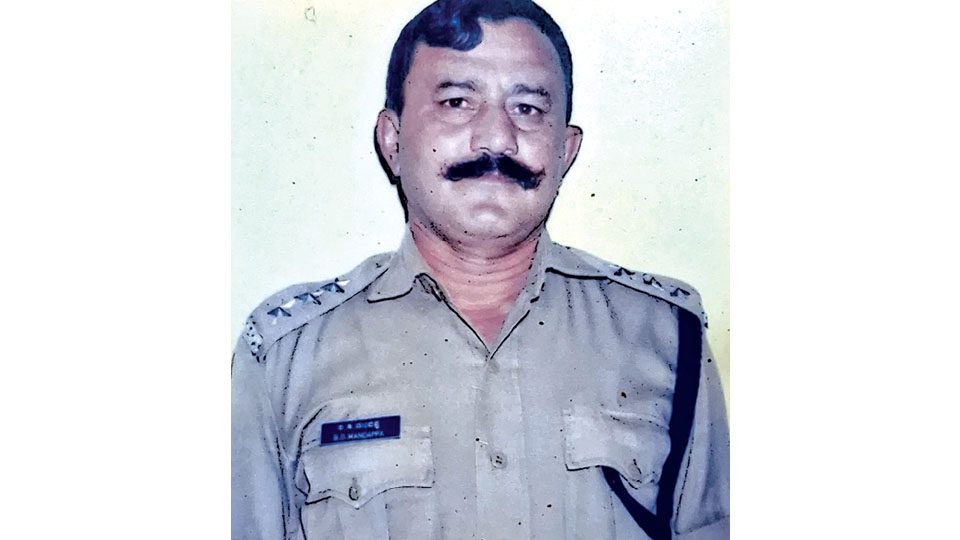
Buttiyanda D. Mandappa (Prabhu), retired Karnataka State Reserve Police (KSRP) Superintendent of Police (SP), Mysuru District and a resident of Nangala village, Bittangala Post in Virajpet taluk of Kodagu district, passed away yesterday. He was 78.

He leaves behind his wife Vimala (Poodrimada), daughter Allumada Swagi Naveen and a host of relatives and friends.

Mandappa was a prominent officer in the Special Task Force (STF), which was formed to eliminate forest brigand Veerappan. He had sustained injuries in the shootout which took place on Aug. 14, 1992, in which SP Harkrishna and Sub-Inspector Shakeel Ahmed were martyred.

Mandappa was a recipient of the President and Chief Minister’s Medal for his meritorious service. Last rites were held at Nangala village this afternoon, according to family sources. 

source: http://www.starofmysore.com / Star of Mysore / Home>News / December 01st, 2025