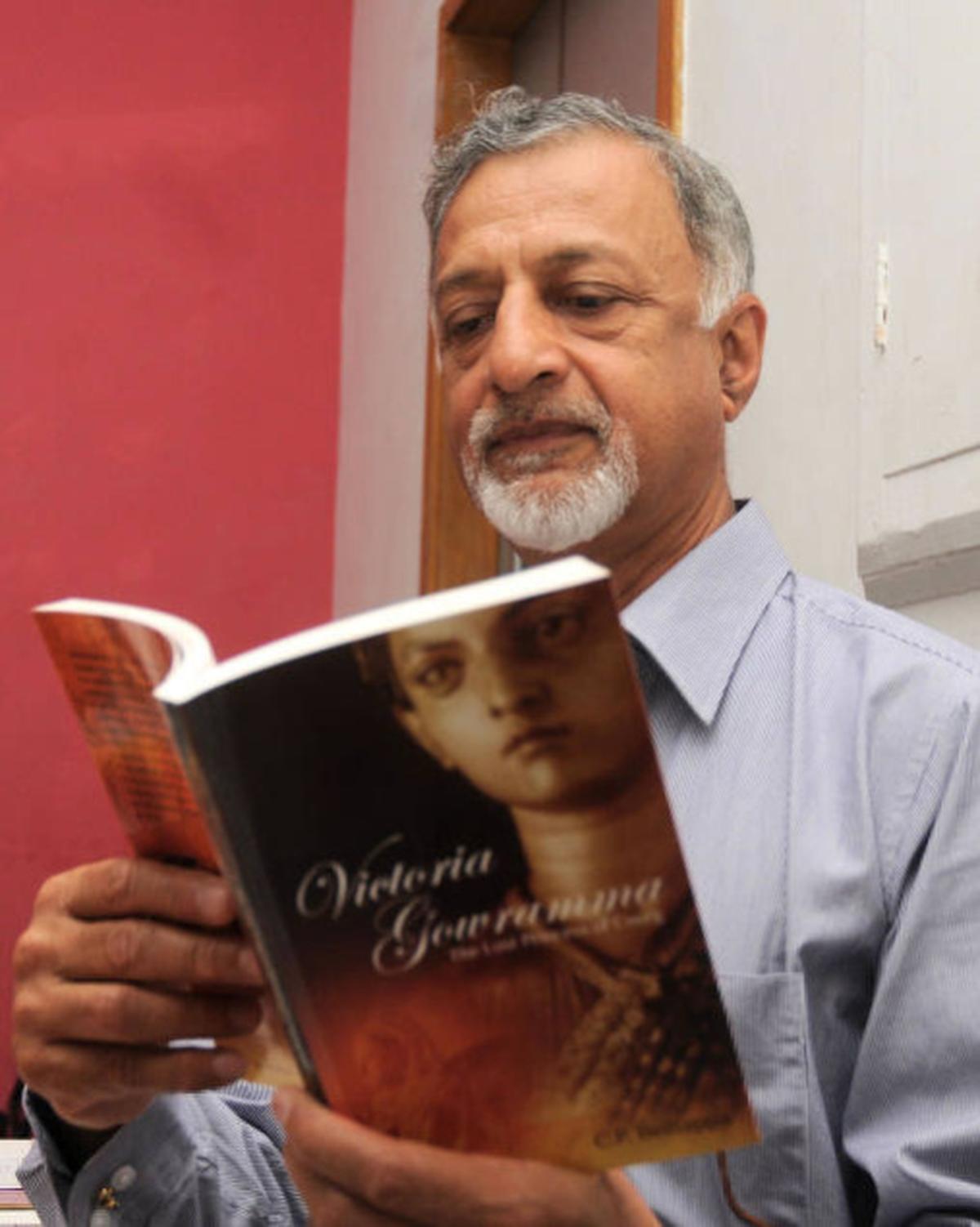
C.P. Belliappa’s A Slice of History: `Victoria Gowramma : The Lost Princess of Coorg’, brings to life the tragic tale of the princess from Coorg
A Slice of History: C.P.Belliappa’s `Victoria Gowramma : The Lost Princess of Coorg’. Photo: M. Vedhan
In a quiet corner of the Brompton Cemetery in London lies a 19th Century grave partially covered by undergrowth. The graceful stone cross above it is slightly broken, but the epitaph composed by Queen Victoria can still be read: “Sacred to the memory of the Princess Victoria Gouramma (sic), daughter of the ex-Raja of Coorg…”
That’s where the strange and tragic tale of Victoria Gowramma, the princess from Coorg who was raised Christian and became Queen Victoria’s goddaughter, ended in 1864. But, her story has come to light again in all its fascinating detail, thanks to C.P. Belliappa’s rigorously researched book “Victoria Gowramma: The Lost Princess of Coorg”, which was recently launched in the city.
“Historical writings on Coorg — mostly gazetteers by the British who lived there during the 19th Century — mention the story of Gowramma and her father, the exiled Raja Veerarajendra, in a paragraph or two,” says Belliappa, author of “Tale of a Tiger’s Tail & Other Yarns from Coorg” and “Nuggets from Coorg History”. “But the details were never there, and I got more and more inquisitive.”
Accidental discovery
His big break came when he accidentally stumbled upon three books written in the 19th Century by people who knew both the Raja and his daughter.
“I was able to download them — for free! — from www.archive.org, where old books are digitised and uploaded,” he says. “They were authentic, first-hand accounts, and comprised 75 per cent of the information I needed.”
The rest he found from the digital archives of The Times, London — reports of court functions and events that contained all sorts of interesting titbits of information. .
“Victoria Gowramma…” traces the intriguing series of events surrounding the princess’ journey to England with her father in 1852, and her difficult and often lonely life there subsequently. The various threads include the exiled Raja’s attempts to reclaim the wealth the British took from him (his reason for taking Gowramma to England in the first place), and the grand plans by Queen Victoria to match-make between Gowramma and another young royal convert to Christianity, Maharaja Duleep Singh of Punjab.
“Queen Victoria believed that if two royals converted to Christianity were married, and their children were born Christian, it would encourage more of their subjects to convert,” says Belliappa. “What’s interesting is that although the plan didn’t work, the Queen continued to be fond of Gowramma to the very end.”
Power dynamics
The book, then, is more than just a portrait of a princess; it gives you a glimpse into the political and religious power dynamics of the time. With its wealth of primary sources, it’s a solid historical work, though Belliappa admits that he was very tempted to go the historical fiction route. “I gave it a lot of thought, and decided finally that the facts themselves were so sensational that they didn’t need fictionalising,” he says.
Since the book’s release in England last year, the author has uncovered even more interesting nuggets of information — for instance, after a bit of detective work, he’s discovered that direct descendants of Gowramma live on to this day in Australia. “I have enough material to add at least an epilogue in future editions of the book,” he says. “It’s been a very exciting time.”
source: http://www.thehindu.com / The Hindu / Home> Books / by Divya Kumari / March 04th, 2011
As a part of its commitment in honouring the legacy of the framers of the Constitution of India, The Constitution Museum & The Rights and Freedoms Academy, O.P. Jindal Global University commemorates the 115th Birth Anniversary of Shri C.M. Poonacha by curating an exhibition in his memory. Shri Poonacha, a Member of the Constituent Assembly, served independent India as the Chief Minister of Coorg, the Union Minister of Railways and as the Governor of Madhya Pradesh and later Odisha.
The exhibition displays original photographs capturing various moments of Shri Poonacha’s life, epistles, books, constitutional and other official documents, and other memorabilia belonging to Shri Poonacha. The exhibition also features a historically significant ampoule containing the ashes of Mahatma Gandhi, which Shri Poonacha received and kept in reverence throughout his life.
In the Constituent Assembly Shri Poonacha made impactful contributions in the Provincial Constitution Committee and the Committee on Chief Commissioners’ Provinces. In the Assembly Debates, Sri Poonacha articulated the significance of the Coorg Province in the emerging federal structure of India. He also advocated for a measured degree of autonomy to the provinces, emphasizing the importance of preserving the cultural and political identity of Coorg while remaining firmly anchored in the unity of India.
Inaugurating the exhibition, Prof. (Dr.) C. Raj Kumar, Vice Chancellor, O.P. Jindal Global University stated that, “The Constitution Museum and the Rights and Freedoms Academy—India’s first museum dedicated to the constitution—remain deeply committed to honouring the legacies of each of the 300 members of the Constituent Assembly. Entering the fourth quarter of the century leading up to 100 years of Indian Independence, we carry a moral responsibility to contribute to nation-building. Through these exhibitions, we strive to continually remind the people of India about the dreams of a bygone generation—their unwavering dedication to the nation and profound commitment to justice and liberty. In doing so, the Constitution Museum at JGU fulfils its purpose as vital educational space for cultivating constitutional morality”. In April 2025, the Museum hosted a similar exhibition in memory of Shri R. Sankar, the member of the Constituent Assembly from Travancore-Cochin. The present exhibition will remain open for the public from 15th to 18th October 2025.
The exhibition commenced, with an engaging panel discussion titled “C.M. Poonacha: A Constitutional Exemplar: In the Words of His Children” which set the tone for an insightful exploration of Shri Poonacha’s legacy.
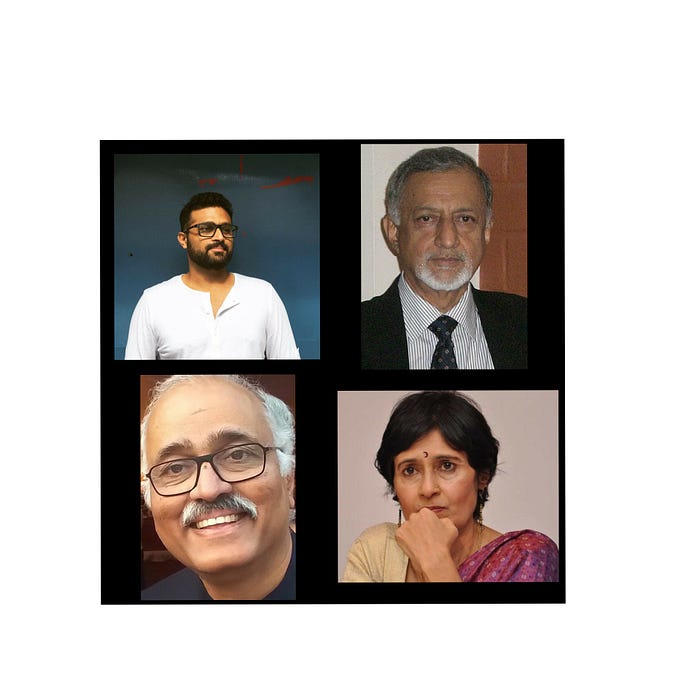
Speaking in the panel discussion inaugurating the exhibition, and remembering their father’s legacy, Mr. C.P. Belliappa, son of Shri Poonacha, and Mrs. Vijaya Muthanna and Dr. Kaveri Nambisan, daughters of Shri Poonacha, observed that “Our father upheld constitutional values in all aspects of life. He was a man of principles who never compromised his ethics for his personal gains—he left his education to participate in the national movement heeding to Mahatma Gandhi’s call. Throughout his life he remained a true Gandhian—he believed in the power of satyagraha, ahimsa, and social upliftment of masses. He held Coorg close to his heart yet not forgetting his primary allegiance to the nation”.
The exhibition will close on the 18th October 2025.
(Disclaimer: The above press release comes to you under an arrangement with O.P. Jindal Global University and PTI takes no editorial responsibility for the same.). PTI PWR
This is an auto-published feed from PTI with no editorial input from The Wire.
source: http://www.thewire.in / The Wire / Home> English / by PTI PRNEWS / October 16th,2025
It’s well-known that the British morphed Kodagu into Coorg and Madikeri into Mercara. The origin of the original name Kodagu is not very clear. It is said that Kodagu is a derivative of the ancient name Krodadesha. It could well be that the name Kodagu came from the word ‘Kodi’ denoting its high perch on the Western Ghats.
Madikeri, which was founded by Mudduraja in 1681, was named after the founder as Muddurajakeri. We are also told that Madikeri might have derived from the word ‘madi’, meaning clean. The place was once known for being neat and tidy. Recently Madikeri was ranked fifth in the country for having the best air quality.
There was a time in Coorg’s history when Ammathi was known as Colepet. This was sometime in the 1860s. The present-day Ammathi was part of Ammathinad, and this area was slowly developing from a ‘vonti-angadi’ (one shop) to a ‘multi-angadi.’
The name Colepet was given in honour of one of the popular British Superintendents of Coorg — Captain Robert A. Cole, known for his book ‘An Elementary Grammar of the Coorg Language’. Somewhere along the line, Colepet got named Ammathi.
At the time of the British takeover of Coorg, there was a busy hamlet in the southern part of Coorg known as Balelesanthe. Banana leaf was an important commodity then and Balelesanthe was the centre of this trade.
In 1866, Chepudira Madayya used his influence and renamed Balelesanthe as Ponnampet in honour of his illustrious father, Dewan Chepudira Ponnappa (my great-great-great grandfather). Ponnampet is now a busy hub of commerce and higher education. Recently, this erstwhile hamlet got elevated as a Taluk.
Santhe or the weekly market day, was very important during those bygone days. Quite a few places in Coorg got their name after the weekly ‘shandy day.’ So, we have Shanivarasanthe and Somwarpet. There existed a Sukravarasanthe, which was the present-day marketplace in Madikeri. The name Sukravarasanthe is no longer in vogue, but Madikeri continues to have its shandy day on Fridays.
The ruling family of the Lingayat Rajas named a few of the places. Virajpet, as we know, is the town founded by Dodda Veerarajendra in 1792. He also named Mahadevapet in Mercara after one of his favourite queens Mahadevamma.
Nanjarayapatna is another place named after a member of the ruling family. The Triveni Sangama at Bhagamandala got its name after the deity Bhagandeswara. The southernmost town, Kutta, is named after the forest goddess Kuttadamma. The closest settlement to Siddeshwara betta got the name Siddapur, a bustling town now.
Present-day Kushalnagar was apparently named by Hyder Ali. It was while he camped here that he received news of his son Tipu’s first military victory in another battle zone. However, Kushalnagar was renamed Frazerpet in honour of Lt. Col. J.A. Frazer who successfully secured Coorg for the British East India Company in 1834.
Stewart (Stuart) Hill near Raja’s Seat in Madikeri is named after Col. Stewart, one of the leading British officers who took part in the annexation of Coorg.
Murnad got its name from being the meeting place of three ‘naads’ and Nalknad is a conglomeration of four ‘naads’. Likewise, Nalkeri is the centre of four villages. Murkal has a landmark of three boulders. And Arvathokkalu is a hamlet of sixty ‘okkas’ or families. Likewise, there is Nalvathokkalu and Napoklu.
Sometime during the 1870s, the British administration opened a new housing colony named Ranipet near the rapidly growing town of Mercara. The name Ranipet was in honour of Queen Victoria.
Quite a few places in Coorg derived their name after the commodities they were famous for. We thus have Sunti-coppal (Ginger village), Goni-coppal (Goni is woven hessian used for making sacks), Balele (Banana leaf), Chettalli (village famous for beans) and Meenpet (fish market near Virajpet). Incidentally, Chettalli used to be popularly known as ‘Tenth Mile’ during British days since it was 10 miles from Madikeri.
We have a place named Bavali, which probably had a large rookery of bats. The place Kadanga is named after the famous defensive ‘kadangas’ (trenches) dug by the nayakas who ruled Kodagu before the Haleri dynasty.
However, I am not quite sure if the place Kurchi is known for making chairs. And then, if one had an axe to grind, I guess they went to Kodlipet!
During Tipu Sultan’s occupation of Madikeri, he rebuilt the Fort and renamed the area Jaffarabad. Dodda Veerarajendra recaptured the town in 1790, and mercifully, the fair name of Madikeri was restored.
‘Coorg’ has become an attractive and highly recognisable brand name. So, we have schools, colleges, homestays and resorts that retain the name Coorg. There are several local products such as coffee, spices, honey and wine prefixing the name Coorg.
I wish the town closest to where I live — Gonikoppal — had a better name. Several years ago, a young nephew of mine who was visiting us for the first time thought the name was ‘Gopigopal’. Now, ‘Gopigopal’ would be a much better-sounding name for a swaggering town that has the exaggerated moniker — Texas of Coorg.
[This anecdote is an updated version of the one in my book “Tale of A Tiger’s Tail & Other Yarns from Coorg”]
source: http://www.starofmysore.com / Star of Mysore / Home> Feature Articles> Top Stories / by C.P. Belliappa / February 17th, 2025
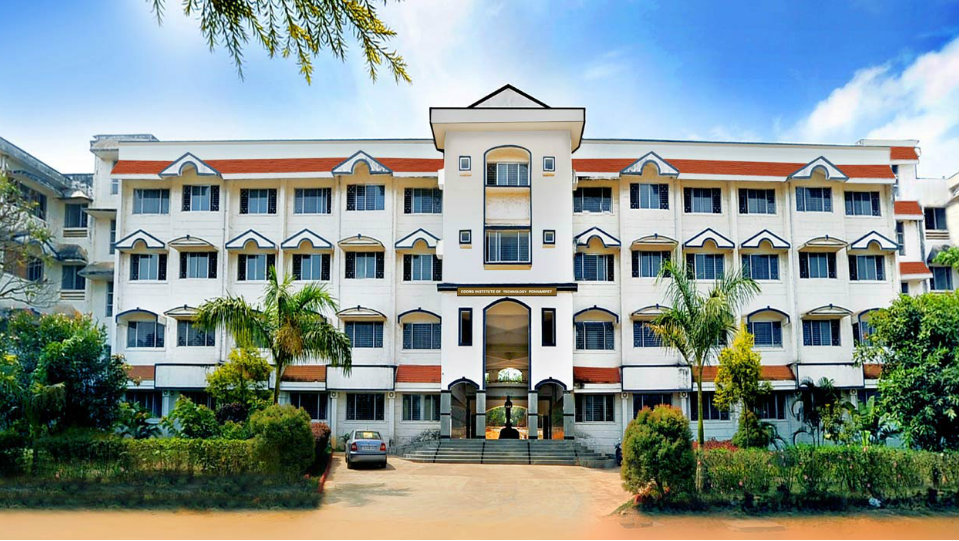
‘Enclave,’ the 18th College Day celebration of Coorg Institute of Technology (CIT), run by Kodava Education Society (KES), will be held at its campus in Halligattu, Ponnampet, South Kodagu, on May 13 at 10.30 am.
MP Pratap Simha and Maj. Gen. (retd.) K. Arjun Muthanna, SM, will be the chief guests. Dr. Deepak Poola Chandrashekar, Cloud Solution architect, IBM, Bengaluru and B. Akshaya Bojamma, Data Quality Analyst, Apple Care, Victoria, Melbourne, Australia, will be the guests of honour. The event will be presided over by C.P. Belliappa, Hon. President, KES.
International Conference
CIT has also organised an ‘International Conference on Emerging Trends in Science and Engineering (ICETSE-2017)’ on May 11 and 12 at its campus in Ponnampet. The Conference will be inaugurated on May 11 at 10 am. KES Co-opted Director Dr. J. Ponnamma Machaiah will be the guest of honour. KES President C.P. Belliappa will preside. Bhandari Srinivas Institute of Technology (Telangana) Principal Dr. V.S. Giridhar Akula will deliver the keynote address.
The valedictory will be held on May 12 at 2 pm. Dr. D.H. Manjaiah, Department of Computer Science, Mangalore University, Dr. C.P. Rakesh Poovaiah, Secretary, KES and C.M. Raja Nanjappa, Jt. Secretary, KES will be the special guests. Dr. M.C. Kariappa, Vice-President, KES, will preside. Dr. P. Mahabaleshwarappa, Principal, CIT, will be the Conference Convenor. C. Nanjan Biddappa, Asst. Professor, Dept. of Mechanical Engineering, CIT, will be the Conference Co-ordinator.
source: http://www.starofmysore.com / Star of Mysore / Home> News / May 08th, 2017
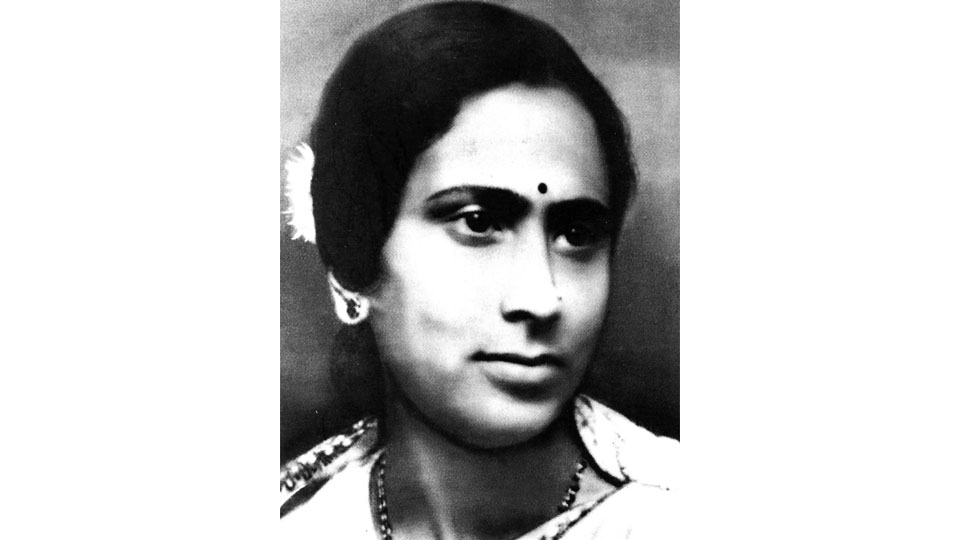
A well-known short story writer, leading feminist and freedom fighter, who met her tragic end at the young age of 27 .
Ramaiah couple in Madikeri, Kodagu, welcomed their youngest girl child Gowramma, on 5th March 1912 (not to be mistaken with Victoria Gowramma of Coorg, who was born in 1841). The little bundle of joy immediately became the family favourite, what with elder sisters too playing mother to the baby.
Pampered by the family, Gowramma soon displayed a mind of her own and would not stop until she got what she demanded. What was striking was her intelligence. She surprised everyone with her precocious self-confidence, which in her adult life led to Gowramma emerging as a well-known short story writer with strong emphasis on feminine issues.
When Gowramma was six years old, her parents decided to make the arduous pilgrimage to Kashi. Arrangements were made for Gowramma to stay with her sisters since the journey to Kashi and back would take more than a month. When Gowramma got wind of her parent’s plan, she threw a massive tantrum. She insisted on being taken to Kashi. All the cajoling failed and her doting father had to relent.
However, this pilgrimage turned out to be a huge tragedy. Gowramma’s mother, Nanjakka, took ill during the train journey and by the time they reached Kashi she was critical. There was very little Ramaiah could do and within days, his wife died. Grief-stricken Ramaiah performed the last rites on the banks of the Ganges.
He now had the sole responsibility of looking after Gowramma who did not grasp the full import of the event. Ramaiah took the little girl for shanti pujas at various temples. In the hustle and bustle of Kashi, Gowramma got separated from her father. Ramaiah was despondent searching for the little girl.
The sun was about to set and as a last resort, Ramaiah located the Police Station to seek their help. When he stepped into the Police Station, he was aghast to find Gowramma seated on the table chatting with the Constables. Relieved, he took her to Kashi Viswanath Temple to thank the Lord.
Several months passed before Ramaiah could come to terms with the tragedy. It was time for him to start planning Gowramma’s education. When Ramaiah mentioned a government school, Gowramma vehemently insisted on being admitted to the elite St. Joseph’s Convent in Madikeri.
Ramaiah, as a vakil, had good earnings and he agreed to Gowramma’s preference. Once in school, Gowramma blossomed. As her education progressed, she became increasingly inquisitive and bombarded her teachers and elders with queries.
However, society functioned differently. By the time Gowramma was 12 years old, her father and the rest of the family started looking for a suitable groom. They identified a young man named G.T. Gopalakrishna. She still had another year to complete her matriculation. While accepting the man chosen for her, Gowramma told her father that she would move to her future husband’s home only after completing matriculation. Knowing how recalcitrant she could be, Ramaiah accepted her decision.
Gowramma’s wedding at young age of 13
Thirteen-year-old Gowramma tied the knot with Gopalakrishna in 1925 and moved to Sunticoppa where Gopalakrishna worked as a manager in the estate of a prominent and progressive coffee planter — Gundukutti Manjunathayya.
They had comfortable accommodation in the plantation and had access to several facilities including a tennis court and a natural swimming pool in the stream that flowed through the coffee estate. Gowramma took to playing tennis and learnt swimming much to the consternation of members of her conservative family.
The Navodaya Movement in Kannada literature was at its peak at the time. The movement initiated around the 1900s by B.M. Srikantaiah (BM Sri) encouraged original thoughts in Kannada literature and motivated writers to integrate the essence of English literature in exposing social evils in society.
This renaissance in Kannada literature gave Karnataka brilliant litterateurs such as Shivram Karanth, Da. Ra. Bendre, Panje Mangesh Rao, Kuvempu, D.V. Gundappa, Masti Venkatesha Iyengar and many others. Gowramma immersed herself in reading books, short stories, poetry and essays by these eminent writers.
Gowramma felt strongly about women getting raw deals at every level of society. She was troubled by the fact that women were not protesting, rather, were helpless, in the blatant patriarchy, discrimination, caste rigidity, and atrocities against them.
What bothered her the most was the plight of widows. She questioned child marriage, the dowry system, denying widow remarriage and treating them as outcastes; and lack of education for girls.
Gowramma’s very first short story written in 1931, when she was nineteen years old, was titled ‘Punarvivaha’ (Remarriage). It’s a powerful story about a 35-year-old widower wanting to marry an attractive 15-year-old girl not knowing the girl was a child widow. When the girl reveals this to him, he is angry and disgusted.
After a long dialogue, she holds up the mirror to the man of the double standards in society. Finally, ashamed of himself he falls at the feet of the young widow and dedicates his life fighting misogyny in society.
In another story ‘Aparadi Yaru?’ (Who is Guilty?), Gowramma portrays the sad story of a young widow with a child who is excommunicated and is helpless and destitute. She had no recourse but to convert to another faith. In some of her stories, young widows, betrayed women, jilted lovers and abandoned women are driven to extreme despair and suicide.
There are also stories by Gowramma, such as ‘Paapana Maduve’, ‘Kausalanandana’, ‘Sanyasi Ratna’, that are playful and have happy endings.
Mahatma Gandhi in Kodagu and freedom movement
Gowramma was an ardent admirer of Gandhiji and actively supported the freedom movement. During a brief sojourn of Mahatma Gandhi in Kodagu in 1934, Manjunathayya drove the Mahatma in his car to various places in Kodagu. Gandhiji visited Manjunathayya’s estate for a break and met leading freedom fighters.
Many women in Kodagu came forward to donate their jewellery to Gandhiji towards his charitable deeds. Gowramma decided to part with all her jewellery but wanted Gandhiji to personally visit her house. However, she was told to meet the Mahatma at Manjunathayya’s residence. Gowramma vehemently insisted Gandhiji visit her humble abode and went on a hunger strike!
When Gandhiji heard about this he sent word for Gowramma to first come to Manjunathayya’s bungalow to break her fast and promised to visit her house.
Gowramma received an orange from Gandhiji who then accompanied her to her home. Gowramma gave away all her valuables except for her mangalsutra, earrings and nose stud. Gandhiji was most touched by this noble gesture.
By 1939, Gowramma had written 21 short stories, and these were published in periodicals such as ‘Prajamatha’, ‘Jaya Karnataka’, ‘Rastrabhandu’ and ‘Jayantha’. Her writings were well-received by the public and were appreciated by well-known writers of the time such as Da.Ra. Bendre, Shivram Karanth, D.V. Gundappa, Muliya Thimmappaya et al.
Interaction with eminent writers
Gundukutti Manjunathayya’s estate attracted these eminent writers, and this allowed Gowramma to interact with them. Gowramma received support and encouragement from contemporary feminist writers such as Nanjangudu Tirumalamba and R. Kalyanamma.
Da. Ra. Bendre mentored Gowramma and advised her to publish an anthology of her stories. Gowramma selected 12 of her stories and titled the book ‘Chiguru’ (tender shoot). She requested Bendre to write a foreword for the collection, which he readily agreed.
A month before the manuscript was to be sent to the publishers, Gowramma, for reasons unknown, changed the title of the book from ‘Chiguru’ to ‘Kambani’ (tears). Bendre was intrigued and was to make a few changes in his foreword.
It was a salubrious sunny day on April 13, 1939. Gowramma, her husband Gopalakrishna and a nephew were to accompany Manjunathayya for a swim in the stream. Gopalakrishna had urgent work and was to join them later. Gowramma walked to the stream where Manjunathayya and her nephew were already in the water.
As usual, she climbed onto a branch overhanging the stream and dived into the deep end of the natural pool. When Gowramma did not resurface, Manjunathayya and her nephew were concerned and raised an alarm. Estate workers rushed to the spot to help but to no avail.
Divers retrieve her body later in the day. It was the most tragic day for her husband and eight-year-old son Vasanthrao, as well as the world of Kannada literature.
The literary world lost one of its most promising writers. Bendre, who used to refer to Gowramma as ‘nanna thangi Gowramma’ was heartbroken. He not only wrote a touching foreword for ‘Kambani’ but also penned a tearful poem eulogising Gowramma. She has left a lasting legacy as a writer, a leading feminist and a freedom fighter.
An English translation by Deepa Bhasthi, of Gowramma’s 21 stories, titled ‘Fate’s Game and Other Stories’ has been published recently.
I am thankful to Advocate S.R. Jagadeesh, a grand nephew of Gowramma, for sharing details of Gowramma’s life and for gifting her biography ‘Kodagina Gowramma’ by H. Nagaveni.
source: http://www.starofmysore.com / Star of Mysore / Home> Feature Articles / by C.P. Belliappa / February 18th, 2024
A land known as the nursery of Indian Hockey, Kodagu (Coorg) in Karnataka State has been a cradle for sports and Army.
However, located down south of Kodagu, Athur village near Gonikoppal town has been a mini nursery for writers! The village is home to four popular writers in English – C.P Belliappa and his sister, Kaveri Nambisan, P.T. Bopanna and his son Devaiah Bopanna.
It does look like Athur village has given birth to these Kodavas with a talent to be ‘pen-tastic’ not just at an amateur level, but at a professional one.
Growing up, I listened to stories of Princess Victoria Gowramma and Narimangala. My childhood days spun into a web of stories from different Kodava writers narrated to me by my mother. Sometimes, with a tale of a tiger’s tail by C.P. Belliappa.
As a teenager, I pondered over P.T Bopanna’s question, “Are Kodavas Hindus?” and sneaked a laugh at (AIB) All India Bakchod’s comic stories whose head writer was Devaiah Bopanna.
Chepudira P. Belliappa or popularly called as C.P Belliappa pursued a career in engineering. However, settling down in Coorg as a planter, he has been promoting technical education in Coorg. He has also penned many articles and is famous for his books, “Victoria Gowramma: The Lost Princess of Coorg”, “Nuggets from Coorg History”, “Tale of a Tiger’s Tail and other Yarns from Coorg.”
His sister, Kaveri Nambisan has a unique style of writing. Her popular books like “The Scent of Pepper” can take you on a ride to Scotland of India, Kodagu with vibes of ethnicity. Her other books like “Mango-Coloured Fish” and “The Hills of Angheri” showcase stories derived from personal experiences. She is a doctor by profession. Kaveri started off as a writer for children’s magazines. She was recognized as the Coorg Person of the Year in 2005.
A leading author and a journalist, Palanganda T. Bopanna has been writing books about Kodavas and Kodagu. He has promoted several websites, including coorgnews.in, dedicated to Kodagu news. Bopanna is a recipient of the Gourmand international award for his book ‘The Romance of Indian Coffee.’
His son, Devaiah Bopanna, has co-founded a media company called ‘All Things Small’ which concentrates on writing true stories by giving a unique, modern touch to journalism. A Mumbai-based writer, Devaiah adds a tinge of comical approach to his writings.
These writers have touched many hearts with their writings. The root to their writing stems from Athur village and it is my dear hope that more writing talents mushroom from the Kodava land.
source: http://www.medium.com / Medium / Home / by Shrividya Somanna / February 05th, 2021
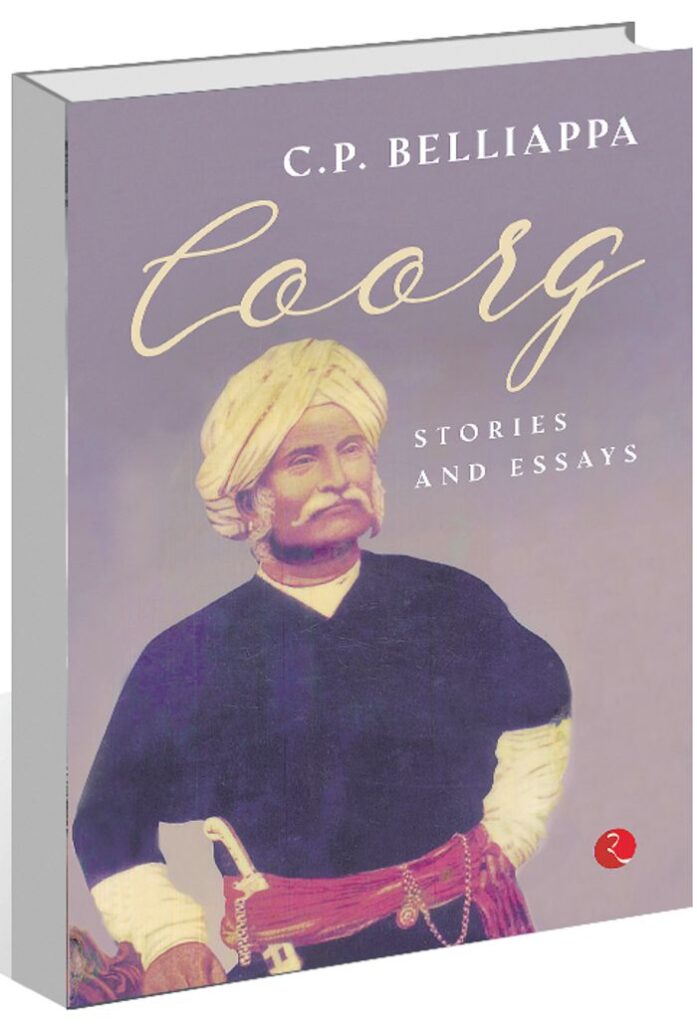
Coorg: Stories and Essays by CP Belliappa. Rupa. Pages 264. Rs 395
‘Coorg: Stories and Essays’ draws from and builds on CP Belliappa’s earlier works on Coorg (officially known as Kodagu).
The book begins by tracing the progress of the land and its people during the rule of the Haleri rajas; the British annexation and their administration of the territory and the events that culminated in Coorg becoming a part of the Kannada-speaking state of Karnataka.
The essays and stories also offer the fascinating illustrated story of Princess Victoria Gowramma, the lost princess of Coorg.
Belliappa delves deep into antiquity, covering a wide range of topics relevant to understanding the ethos of Coorg.
source: http://www.tribuneindia.com / The Tribune / Home> Backflap> Book Reviews / April 23rd, 2023
WELCOME. If you like what you see "SUBSCRIBE via EMAIL" to receive FREE regular UPDATES.
Read More »