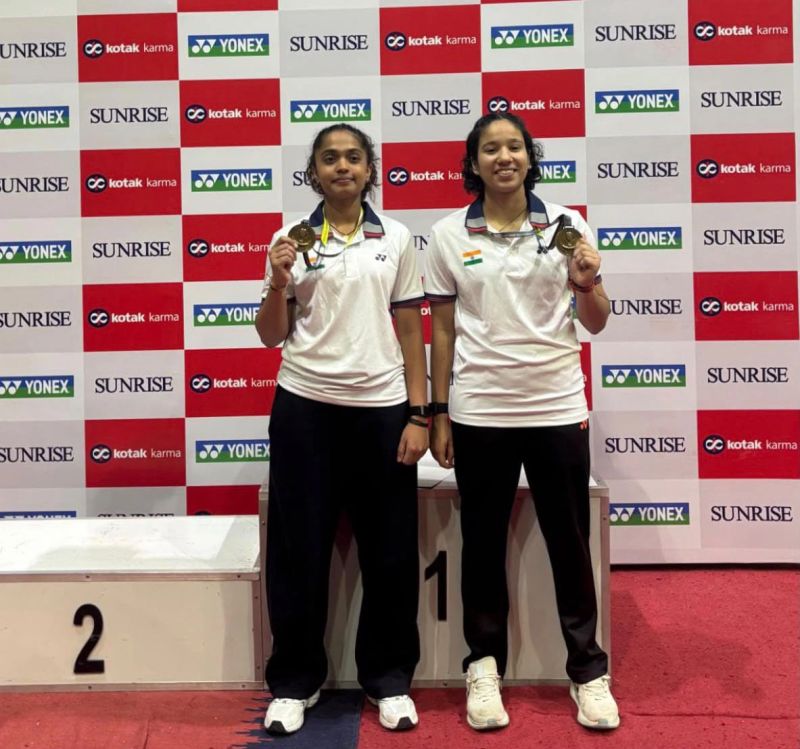
Second seeded pair Diya Bheemaiah and Baruni Parshwal won the Girls’ Doubles title at the Kotak Junior International Badminton Tournament in Hyderabad, defeating third seeds Lakshmi Devineni and Ananya Manikandan in a closely contested final.
Diya and Baruni won the match 21-18, 14-21, 22-20. After taking the opening game, they lost the second as Devineni and Manikandan levelled the contest. The deciding game went down to the wire, with Diya and Baruni eventually prevailing 22-20 to secure the title.
The victory marks another achievement for Diya on the junior badminton circuit as she continues her competitive journey. She currently is training at the prestigious National Centre of Excellence (NCoE) in Guwahati, Assam, under the tutelage of former All England champion and coach Ivan Sozonov.
Diya is the daughter of Boppanda P Bheemaiah and Kusuma K K (Thamane Kambiranda).
source: http://www.clnnews.in / CoffeeLandNews /Home> Sports / by CLN Newsdesk / August 24th, 2026
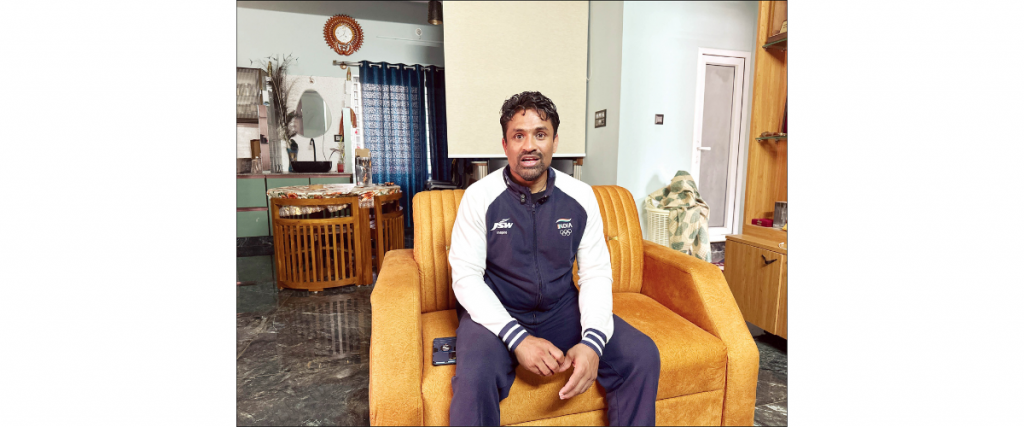
Boxing needs a bigger push in South India, says Indian men’s boxing head coach C.A. Kuttappa.
Hailing from Kokeri village in Napoklu, Kodagu, the land known for producing Olympians and brave hearts, Chenanda Achaiah Kuttappa (C.A. Kuttappa) is an internationally known boxing coach who has been credited with shaping some of the best Indian boxers, including Olympic medallist Vijender Singh, Suranjoy Singh, Shiva Thapa and Amit Panghal, among others..
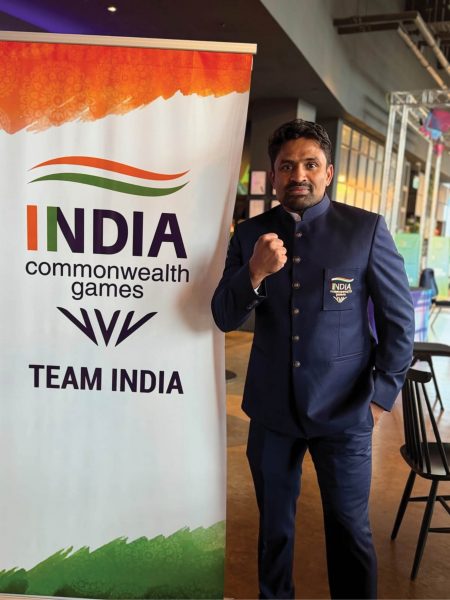
An ex-serviceman, Kuttappa, who retired as a Subedar from the Madras Engineering Group (MEG) earlier this year, is currently the head coach of the Indian men’s boxing team that won two gold and two silver medals at the recently held Commonwealth Games in Glasgow, Scotland.
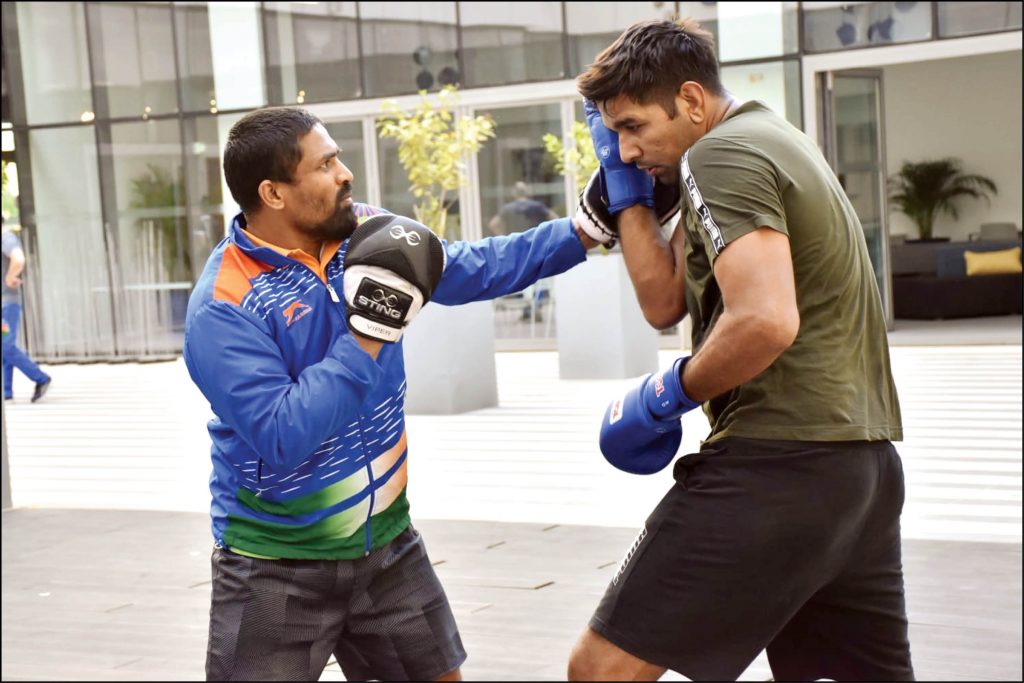
Kuttappa training one of the boxers during the preparatory camp for Commonwealth Games-2026 which concluded recently.
A Dronacharya Awardee (2018), Kuttappa previously worked with the Indian men’s boxing team as head coach from 2018 to 2021, during which an Indian boxer won a silver medal at the 2019 World Championships.
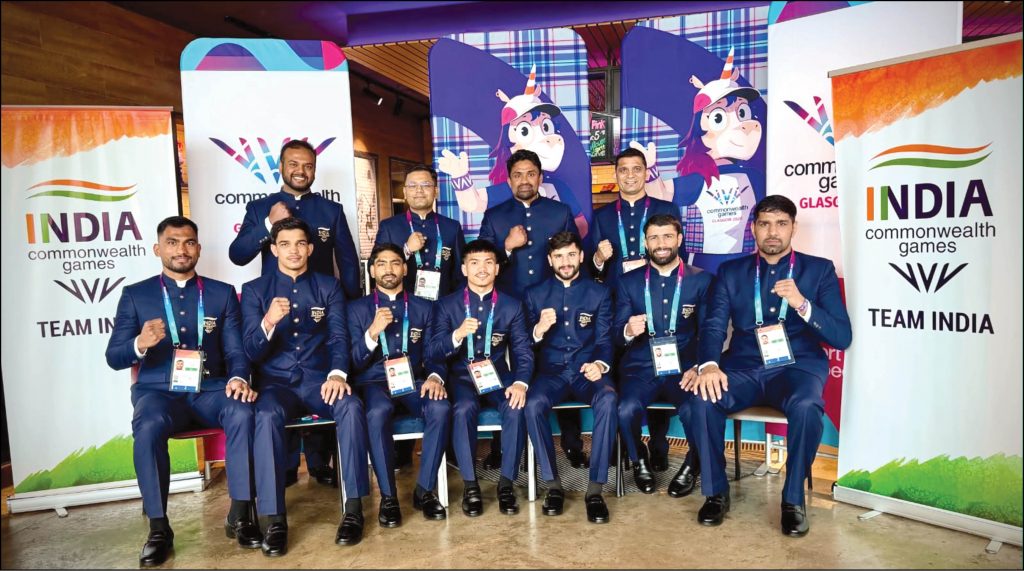
Kuttappa (standing second from right) seen with the Indian men boxers at Glasgow, Scotland.
Kuttappa was also part of the Indian boxing support staff during the 2008 Beijing Olympics, when Vijender Singh won a bronze medal. He was also the head coach during the Paris 2024 Olympics.
After a break of a year, the Boxing Federation of India (BFI) re-appointed him as the head coach of the Indian men’s boxing team ahead of the 2026 Commonwealth Games and Asian Games.
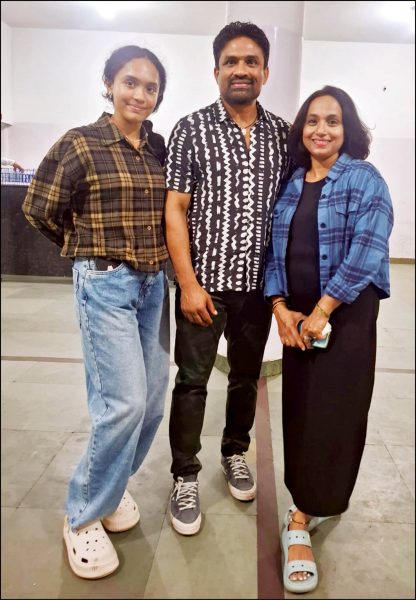
Kuttappa flanked by his wife P.U. Ashwini (right) and daughter C.K. Yudhi.
A resident of Gokulam 1st Stage in Mysuru city, Kuttappa is married to P.U. Ashwini and the couple has a daughter, C.K. Yudhi
Star of Mysore caught up with C.A. Kuttappa during his recent visit to Mysuru following the heroics of the Indian boxing team at the Commonwealth Games 2026. Excerpts:
Star of Mysore (SOM): Sir, firstly, thank you for talking to Star of Mysore. The recent achievements in boxing at the Commonwealth Games-2026 have been spectacular compared to previous Games. What do you have to say about that?
C.A. Kuttappa: The achievements have been remarkable. We have been able to achieve success because of our hard work and the efforts of the coaches and supporting staff, including doctors, physiotherapists, psychologists, nutritionists and others.
SOM: How was the preparation for the Commonwealth Games? Winning seven gold medals in boxing is a great achievement.
Kuttappa: After the Nationals, we went for build-up competitions in Spain and the Czech Republic, where we won a lot of medals. Later, we got good opportunities to participate in other international boxing events in which our top boxers selected for the Commonwealth Games took part. We also keep track of the progress being made by lower-ranked boxers who are in the No. 2 and No. 3 positions.
They play a crucial role as backups in case the top-ranked players miss the main event due to injuries or other reasons. We have been able to achieve good results because of the Sports Authority of India (SAI) and the Boxing Federation of India (BFI), as they provided us with the much-needed exposure and opportunities to prove our potential, which we did at the Commonwealth Games.
SOM: Compared to previous years, the Government of India has been encouraging sports. How do you think it has helped sportspersons?
Kuttappa: Yes, we are getting a good budget for boxing as well. People always compare other sports with cricket. It is a different sport. They have done extremely well and we cannot be compared with them.
We also need to do well at the international level. If we want to be considered at the same level as cricket, we need to work hard, plan well and execute those plans to win more medals at the international level.
SOM: What was the feeling when the boxers you coached were winning gold medals at Glasgow?
Kuttappa: As a coach, it is a completely different feeling. We always plan before the bouts. Watching videos of the opponents and discussing their styles, attacks and movements are some of the things we do. It is important as it helps our boxers understand the strengths and weaknesses of their opponents.
There are times when we change our strategies and tactics during the bout. When our execution goes according to our plans, the results will be satisfactory, just like at the Commonwealth Games.
SOM: With the Commonwealth Games mission accomplished, the next target is the Asian Games. How are the preparations?
Kuttappa: Yes, we are now preparing for the Asian Games to be held in Japan from Sept. 19 to Oct. 4. Compared to the Commonwealth Games, the Asian Games is a tougher competition. Countries like Uzbekistan and Kazakhstan, which are among the top-ranked boxing countries in the world, will be competing as well.
They are really good in terms of technique and tactics. The intensity of the bouts will be high and mentally demanding. Come what may, we are confident of doing well in the Asian Games, similar to what we achieved in the Commonwealth Games.
SOM: Talking about boxing, most of our boxers are either from North or Northeast India. Where is South India lacking?
Kuttappa: Most of our boxers are indeed from the North or Northeast. People there think of boxing as a sport, but here it is considered fighting. I always tell my boxers not to take the punch but to hit the punch. We need to educate parents and children about boxing as a sport in South India.
In the North or Northeast, the situation is entirely different. People take up boxing as a profession. There are boxers earning a good Rs. 15 lakh to Rs. 20 lakh every month. The State Governments have been extending all necessary help, with sponsors also coming forward to support top-ranked and high-performing boxers.
In the South, importance is given to very few sports and people insist on getting their children educated rather than allowing them to pursue sports as a profession.
SOM: Speaking about yourself, you come from Kodagu, which is famous for hockey and producing soldiers for the Indian Army. How did boxing happen to you?
Kuttappa: I started my boxing career in 1992. Before that, there was a selection process for only three sports disciplines: Swimming, volleyball and boxing. Since I was good at athletics and sports, I passed the physical fitness test and they asked me to choose between the three games. I asked them for some time and told them I would like to try all three sports before making a choice. I tried all three and finally selected boxing.
In fact, one of my father’s cousins, C.C. Machaiah, who is an Arjuna Awardee in boxing, had also told me about how boxing as a profession would be useful and help me financially.
In the first year, there were no results as I was still in the learning process. In the next two years, I won the sub-junior and junior titles for Karnataka and the junior national championship. After joining the Indian Army, I represented Karnataka in many national-level competitions and also won a bronze medal at the National Games held in 1997.
After I was injured and stopped boxing, I was thinking about what to do next when my senior officers advised me to continue with boxing. So, I completed my diploma in boxing and joined the national camp as a coach. I have trained Olympic medallist Vijender Singh, Akhil and other top boxers and continue to train boxers even today.
SOM: How does it feel to be awarded the prestigious Dronacharya Award at a young age?
Kuttappa: It is satisfying. I believe it is a result of hard work and sacrifice. You should ask my wife and my mother. They both know the amount of time I have dedicated to my profession.
I only get to spend one or two months at home. Most of the time, I am travelling with the team, preparing them for competitions. I have taken up the responsibility of the national team and it is my duty to ensure they do well and bring laurels to the country.
SOM: Sir, thank you so much for your time and all the best for the Asian Games and the 2028 Summer Olympics.
Kuttappa: Thank you.
source: http://www.starofmysore.com / Star of Mysore / Home> Columns> Special Interview / by S.N. Venkatnag Sobers / August 12th, 2026
Kruti Coffee has opened its first UK cafe on Tooting High Street in south London. The launch signals the Odisha brand’s global push and a wider showcase for Indian speciality coffee.
Kruti Coffee, a speciality coffee brand that began with tribal coffee farms in Odisha, has launched its first UK cafe in south London, marking the start of its global expansion. The company opened the outlet on Tooting High Street this week after receiving its first coffee consignment from Kolkata following the India-UK Comprehensive Economic and Trade Agreement last month.
The cafe is designed to offer a full speciality coffee experience, with manual brewing methods and espresso-based drinks made using Kruti Coffee’s signature 100 per cent Arabica house blend. The company said the outlet is meant to introduce the diversity and quality of Indian speciality coffee to an international audience.
“What began as an effort to revive a forgotten coffee plantation in Koraput has grown into a journey of showcasing the incredible potential of Indian specialty coffee to the world,” co-founder Jeeta Mona said. “Opening our first international cafe in London is a proud milestone-not just for Kruti Coffee, but for the farmers and communities whose dedication makes every cup possible. We look forward to sharing the richness, diversity, and story of Indian coffee with coffee lovers from across the globe,” she said.
Founded in 2013 as an impact initiative to revive a neglected coffee plantation in the remote hills of Koraput in Odisha, Kruti Coffee describes itself as a farm-to-cup speciality coffee venture focused on quality, sustainability and social impact. Over the past decade, the company said it has partnered with some of India’s finest coffee producers while continuing to champion coffees from its home region.
The company said its coffees are roasted at the Select by Kruti Coffee roastery in Bhubaneswar, following standards set by the Specialty Coffee Association. Among its best-known offerings is Kindiriguda Naturals, which was recognised as Best Arabica Naturals at the Fine Cup Award during the World Coffee Conference. “Visitors to the new London cafe will now have the opportunity to experience this award-winning coffee alongside an extensive selection of Indian single-origin coffees, carefully crafted blends, and seasonal microlots,” the company said in a statement.
Mona said London was chosen for the brand’s first international store because of the city’s global influence, strong cafe culture and growing interest in speciality coffee. “The new outlet marks the beginning of the brand’s global expansion and its mission to establish Indian specialty coffee among the world’s finest coffee origins,” she added.
At a launch event attended by British Indian parliamentarians and community leaders on Thursday, Mona was joined by Kruti Coffee’s Head Roaster and Barista Pabitra Sahoo, who presented a series of speciality manual brews. With the opening of the London cafe, the Odisha-founded brand has taken its first step in showcasing Indian speciality coffee to a wider global market.
With PTI Inputs
source: http://www.indiatoday.in / India Today / Home> News> World / by India Today World Desk / with PTI Inputs / August 21st, 2026
The third edition of IICF will bring together growers, roasters, café brands, baristas, equipment manufacturers, and coffee consumers on a farm-to-cup platform.
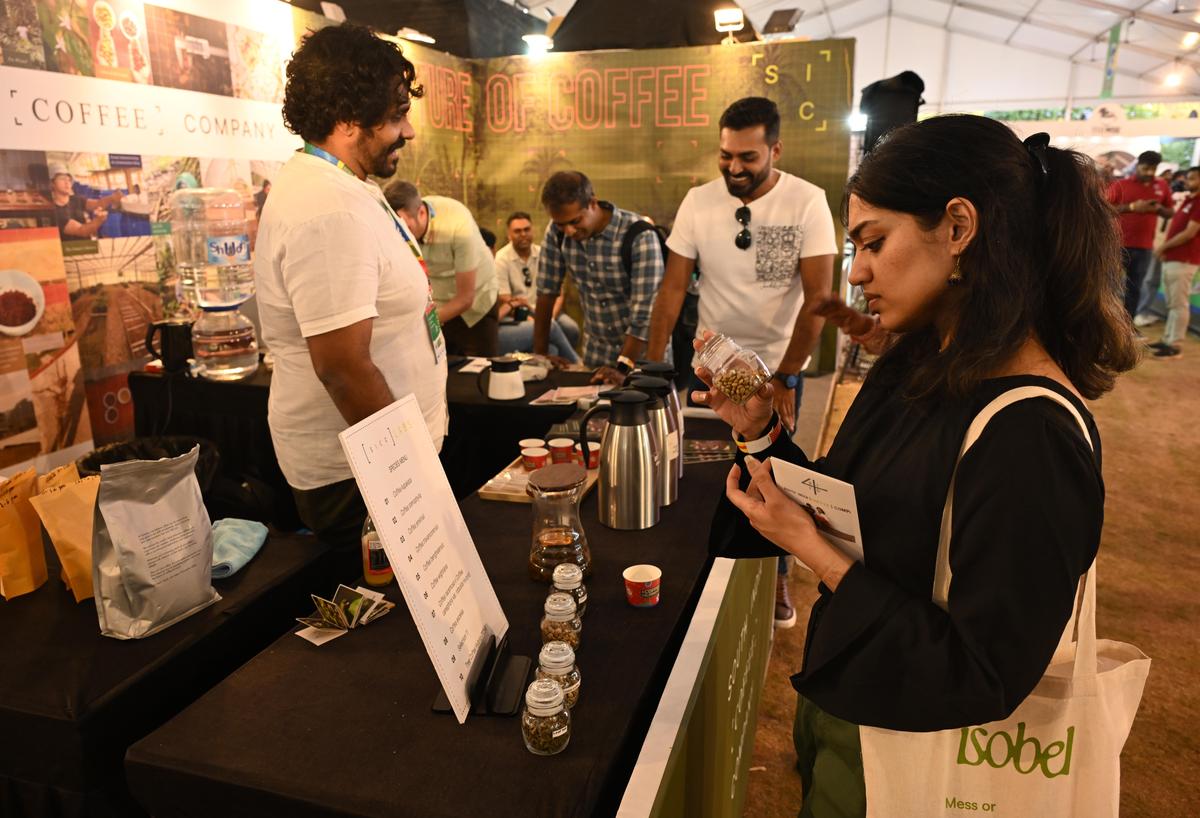
Visitors check varieties of coffee during the India International Coffee Festival (IICF) 2026 in Bengaluru on February 12, 2026. | Photo Credit: ALLEN EGENUSE J
Organised by the Coffee Board of India in association with the Specialty Coffee Association of India (SCAI), the third edition of IICF will bring together growers, roasters, café brands, baristas, equipment manufacturers, and coffee consumers on a farm-to-cup platform.
The event comes as domestic coffee consumption shows significant room for expansion. While cities account for nearly 70% of consumption and southern India contributes 75-80% of the country’s coffee consumption, coffee is gaining popularity in northern, western and eastern markets. India’s per-capita coffee consumption remains at just 0.07 kg annually, compared with the global average of 1.3 kg.
“IICF has become an important platform for India’s coffee community at a time of remarkable growth,” said Kurma Rao M., CEO & Secretary, Coffee Board of India. “As café culture spreads across India and a new generation embraces coffee, the home market holds enormous potential, even as Indian coffee earns its place on the world stage.”
“India has grown some of the finest coffee on Earth for generations, and now, at last, India is drinking it,” said Hamsini Appadurai, President, SCAI and organiser, IICF.
A key attraction at the conference will be the National Coffee Championships, including the 26th National Barista Championship, Brewers Cup, Indian Filter Coffee Championship, Latte Art Championship, and, for the first time, Coffee in Good Spirits. Winners will represent India at corresponding World Coffee Championships.
The championship qualifiers will be held in Bengaluru, Delhi and Navi Mumbai between August and October 2026, ahead of the national finals in Bengaluru.
source: http://www.thehindu.com / The Hindu / Home> News>India> Karnataka /by The Hindu Bureau / August 20th, 2026
Sri Kavery Kodava Association, Mysore East, celebrates 25th anniversary.
Mysuru:
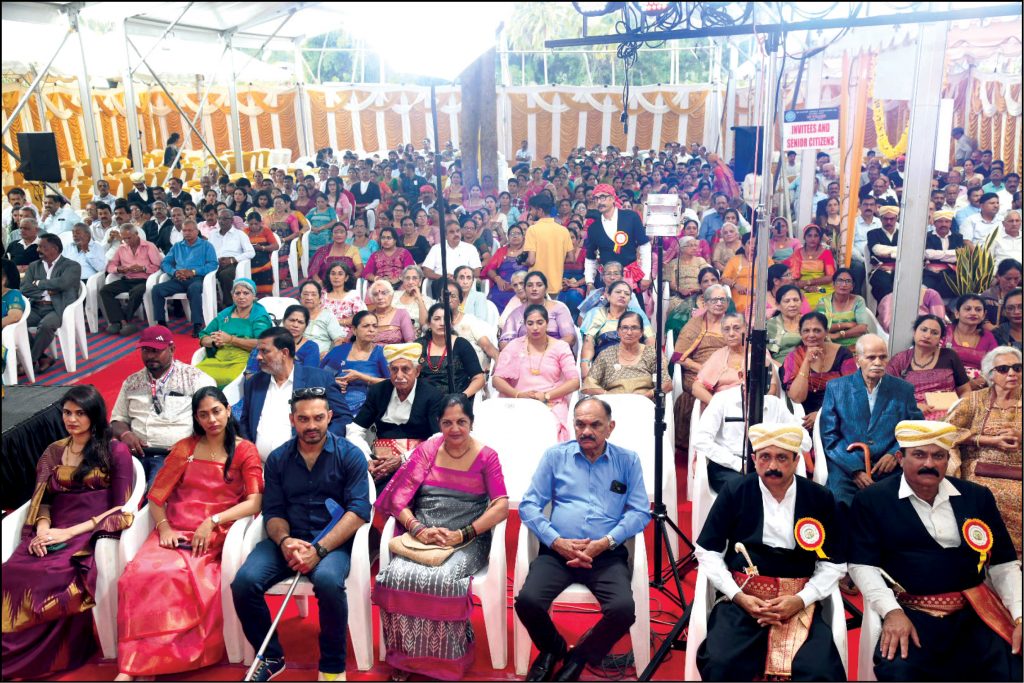
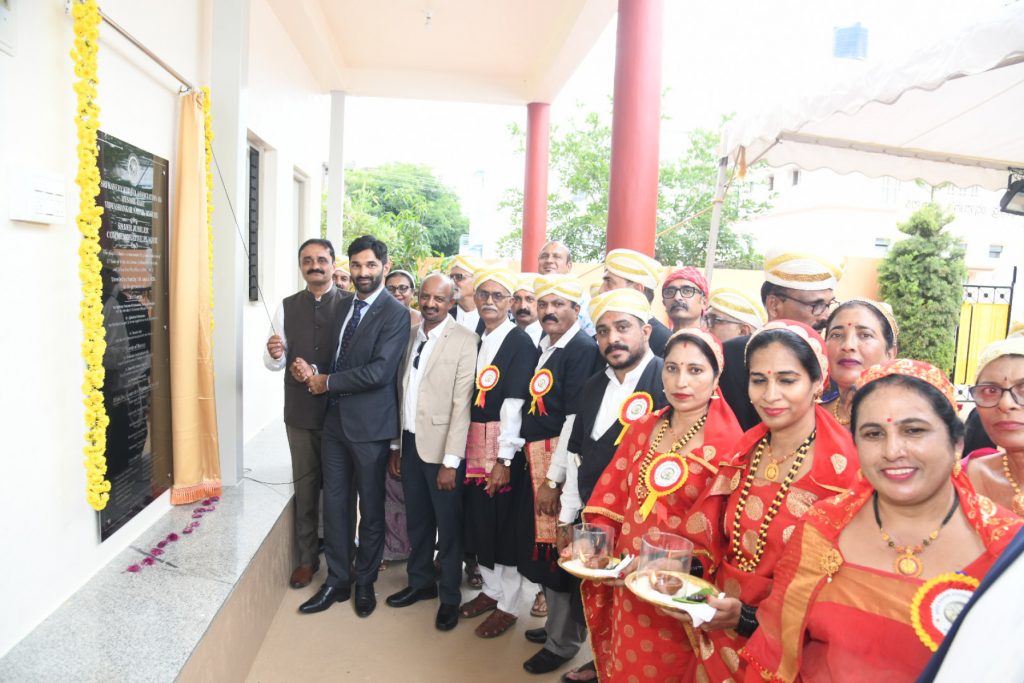
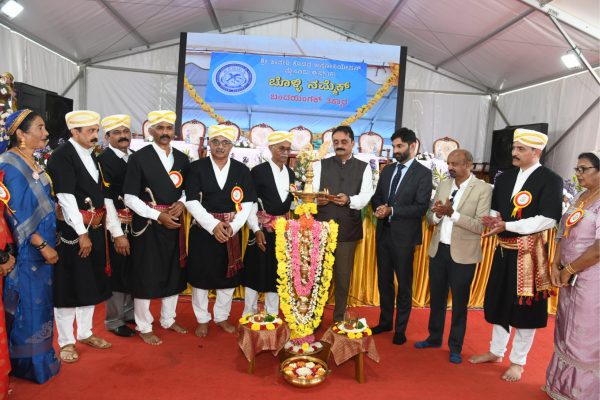
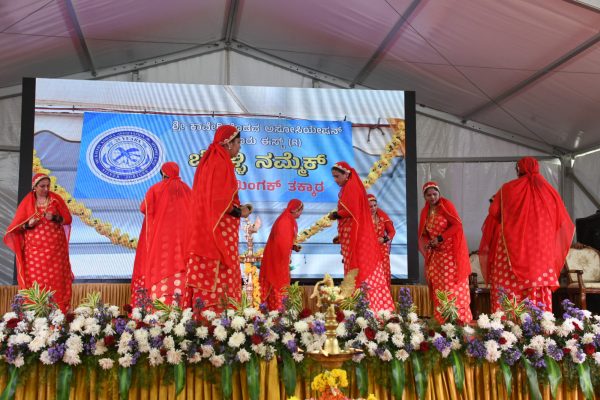
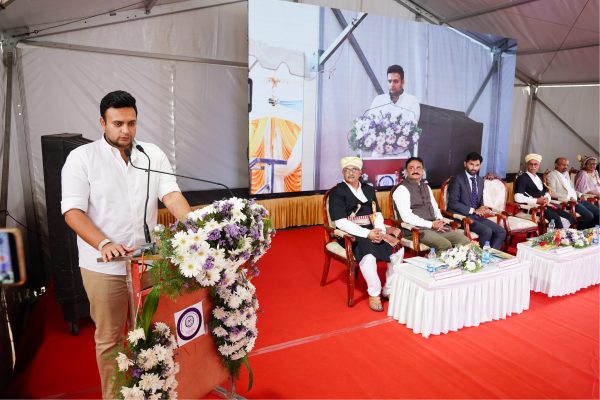
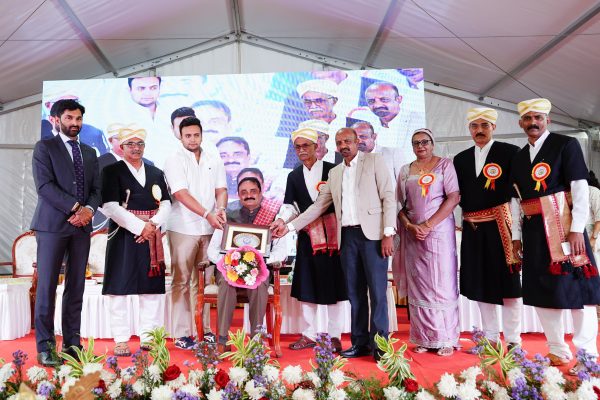
Sri Kavery Kodava Association, Mysore East, celebrated its 25th anniversary with traditional fervour at its Kodagu Model School premises in Vidyashankar Layout, Sathagalli, yesterday.
Mukkatira Punit Kuttayya, Deputy Commissioner of Income Tax, Hyderabad; Dr. Thithira Roshan Appachu, Chief Electrical Inspector, Government of Karnataka and Ex-Officio Additional Secretary (Licensing), Energy Department and Ponjanda Ganapathy, President, Kodava Samaja, Mysuru, were the guests of honour. Kademada Jaya Belliappa, President of Sri Kavery Kodava Association, Mysore East, presided.
A section of audience
As part of the silver jubilee celebrations, cultural programmes were held from morning till evening, featuring traditional Kodava dances and other performances. Association members and their families participated in large numbers. A short documentary tracing the 25-year journey of the Association was also screened. Members showcased Kodava heritage through various traditional and cultural activities, highlighting the community’s customs and traditions.
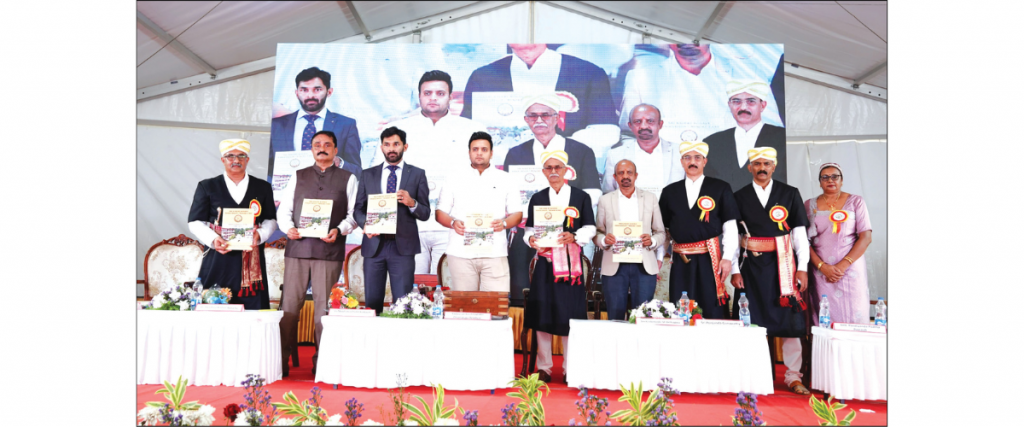
Mysuru-Kodagu MP Yaduveer Krishnadatta Chamaraja Wadiyar released the Association’s silver jubilee souvenir. Addressing the gathering, he praised the Kodava community for its unique culture and customs, describing them as exemplary.
He said Kodagu, nestled in nature’s lap, was not only a premier tourist destination but also a region of immense cultural significance. He appreciated the Association for preserving Kodava traditions over the past 25 years and passing them on to younger generations. He also commended the efforts of senior members and office-bearers.
Prizes were distributed to participants of the cultural events. The celebrations concluded with a variety of performances. Pandiyanda Padma, Vice-President; Pattada Sachin Devaiah, Secretary; Neravanda Sunil Muthappa, Joint Secretary; Pattamada Arun Cheramanna, Treasurer and others were present.
source: http://www.starofmysore.com / Star of Mysore / Home> News / August 10th, 2026
Jammada Preeth Appaiah, a resident of Bannimantap and a member of the Mysuru Sports Shooting Academy (MSSA), won two gold medals at the 14th Karnataka State Shooting Competition and Championship 2026, organised by the Karnataka State Rifle Association (KSRA).
The championship was held at the Sports Authority of India (SAI) and Bangalore University shooting ranges in Bengaluru from June 10 to 30.
Preeth struck gold in the .177 Open Sight 10M Air Rifle Senior Master Women (National Records), .177 Open Sight 10M Air Rifle Women (National Records) and .177 Open Sight 10m Air Rifle Master Women (National Records), further strengthening her credentials in the sport. She has been training under coach H.S. Vivek since taking up shooting in 2024. Her recent success adds to an impressive run this year.
Earlier, she won two gold medals at the Nagraj Rao Jagdale Shooting Contest and Championship held at the KSRA range in Bengaluru.
She is now preparing to compete in Air Pistol events to qualify for the South Zone competitions. Preeth is also the only Kodavathi competing in the Open Sight Air Rifle category.
Apart from shooting, Preeth has distinguished herself as a mountaineer. She scaled Mount Kilimanjaro in 2023 and Mount Elbrus in 2024, adding two of the world’s highest peaks to her list of achievements. She is married to Advocate Jammada M. Aiyanna.
source: http://www.starofmysore.com / Star of Mysore / Home> Sports / June 28th, 2026
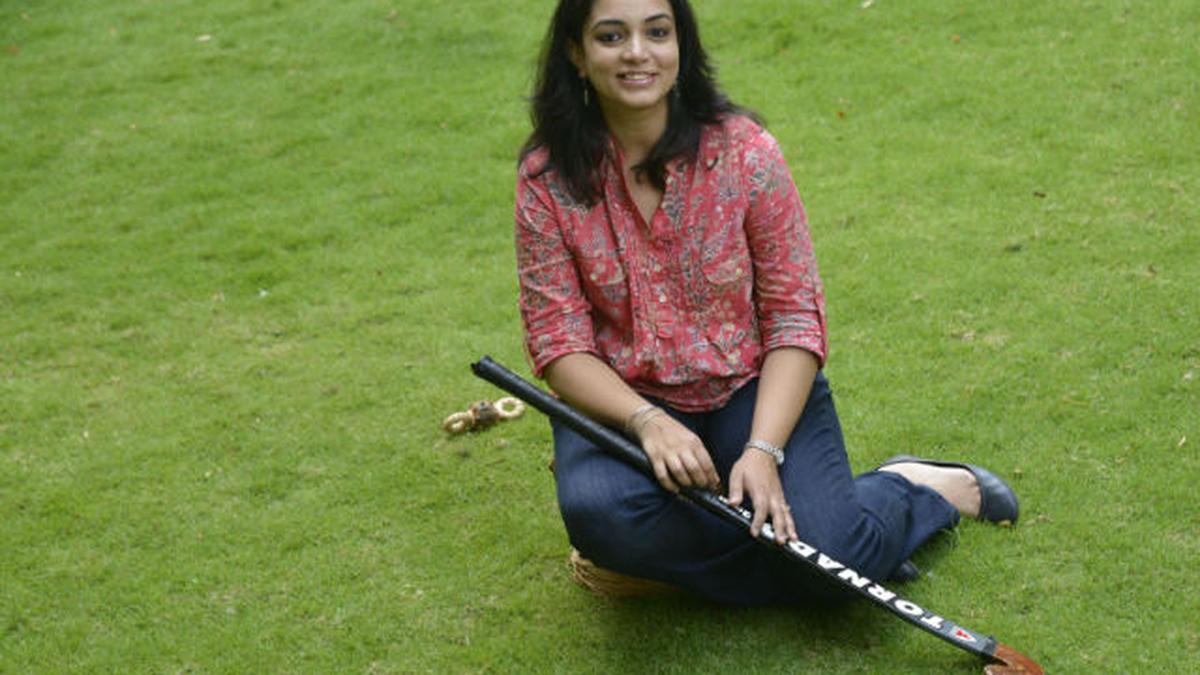
Sandhya Kumar’s documentary ‘Hockey In My Blood’ tells the story of the Kodava community’s passion for the game.
Sandhya Kumar
Over 3,000 players — men, women, and children — of the Kodava community from Coorg gather annually for the family hockey tournament in the midst of coffee plantations, summer vacations and the wedding season.
It’s regarded as the world’s largest field-hockey tournament. Curious about this sociological phenomenon and their passionate love for the game that forms the glue, binding generations, Bengaluru-based documentary filmmaker Sandhya Kumar decided to make a film.
After two years of research, several visits to Coorg, interviewing players and hosting families, crowd-funding, and filming the 2013 tournament, her film Hockey In My Blood is ready to be aired at this year’s tournament.
The 52-minute film is in English and Kodava-takk (with English subtitles). The 19th edition of the Kuppanda Cup Kodava Hockey Namme 2015 is currently underway at Virajpet (Coorg) and Sandhya’s film will be screened at the festival on May 7, two days before the finale.
The tournament is played over a month, with a series of about 250 knockout matches, played by anywhere between 220 to 260 teams — each team being one family. Many of the players have played for the State and National teams; some are even former Olympians. Every year, one family hosts the tournament.
“It’s the coming together of people that fascinated me. It’s a family tournament, with no big money or stakes involved. The Kodavas are a sports-obsessed community. Most of the people don’t live in Coorg — they live and work mostly in Bangalore, Mangalore, and Mysore — but have an estate and family to go back to in Coorg. When you have to put together a team of 11, contacting third and fourth cousins you’re otherwise not really in touch with, it is something. Within the clan there are classes — a carpenter may be playing alongside a banker — but the point is every one comes together for this,” explains Sandhya.
Armed with an MFA in Film from the San Francisco Art Institute, and an MA in Mass Communication from Jamia Millia Islamia University, Sandhya has been making documentaries since 2007. She won the President’s National Film Award of India (2013) for her documentary O Friend, This Waiting! After she moved to Bangalore three years ago when she married, she missed her close-knit film community in Delhi; so, along with fellow filmmakers, Sandhya helped revive Vikalp Bengaluru, a forum that regularly screens the best of documentary films from all over the world.
The story of Hockey In My Blood started when a Kodava friend of Sandhya’s was talking about the tournament, and suggested “Why don’t you make a film on it?” “There were no books on the subject, very few people in Bangalore knew about it. I only had newspaper articles to fall back on and I hadn’t been to Coorg before that. Later, when I was in Coorg for a wedding, I became interested in the community sociologically, and their passion for hockey when the rest of the country was obsessed with cricket.”
Her friend Deepthi Bopaiah offered help and introduced her to the host family for 2013 — the Madanda family, and the tournament’s coordinator Thimmaiah Madanda.
There were initial apprehensions about her making the film. But when they met up, they were pleased that someone was interested in this phenomenon, adds Sandhya.
Through the organiser, she identified players she wanted to interview and film. While she started filming impulsively with her own funds, film grants were few to come by. She soon found a need to crowdfund the film — in about five months, she raised Rs. 7 lakhs from family and friends through the Orange Street platform. “I met this young boy called Prajwal. He and his family lived on a small estate, and along with his brother he practised hockey in the coffee-drying yard in front of their home. We filmed him extensively. The film was shot in Balugodu, Virajpet, Palangala, Murnad, and the Karnataka State Hockey Association. Participants start practising just about a week before the tournament, because most live far off; some players have even come in from Dubai to participate.”
Sandhya also met Pandanda Kuttanni, who is well into his 70s, and the founder of the concept of this tournament. “He said he was in Delhi during the 1982 Asiad cup and felt Coorg needed a tournament like this to bring together a people who were moving away from home,” recalls Sandhya.
At the end of it all, Sandhya says: “It’s the commitment of the players to their families, the extent they will go to, to give up whatever they are doing to go back home to Coorg, and play for family — that was my best takeaway from the film.”
source: http://www.thehindu.com / The Hindu / Home> Features> Metroplus / by Bhumika K / April 24th, 2015
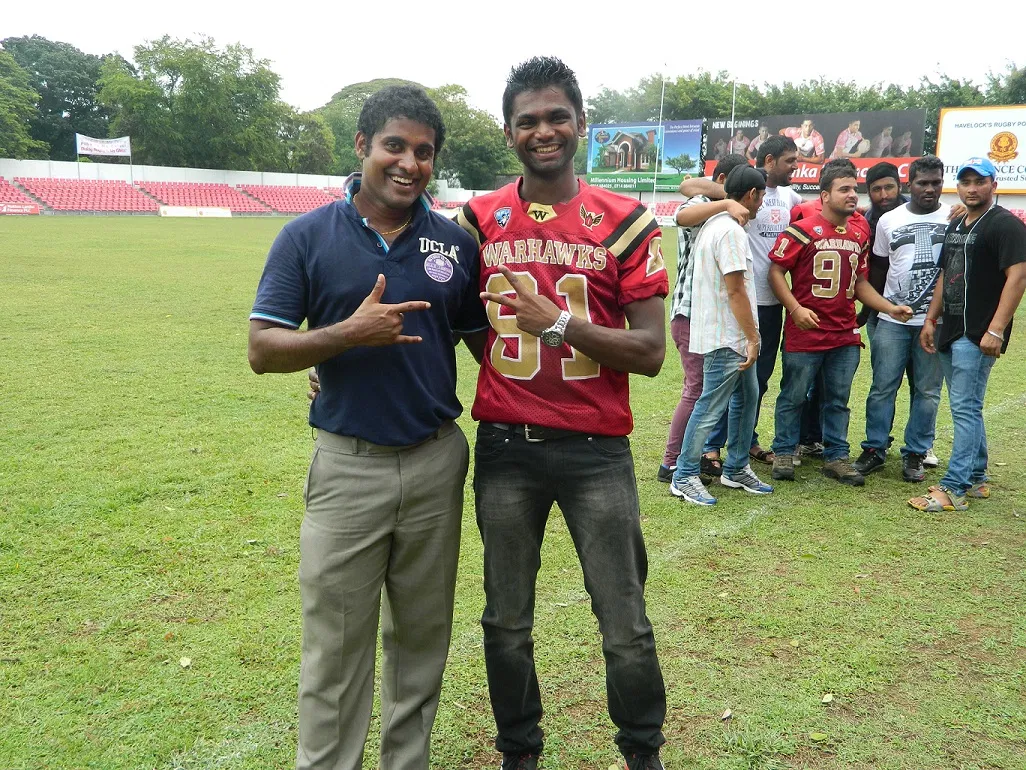
Thimmaiah Madanda is a decorated rugby union player for the Indian national team who has since 2011 taken the plunge into American football as the Head Coach of the Bangalore Warhawks outfit.
His players and his contemporaries hold Thimmaiah in high regard, both as a player and a coach. His Bangalore team was one of the best performers in the inaugural season of the Elite Football League of India (EFLI). Their run came to an end in the semi-finals, but not before impressing a large number of people with their exciting brand of football.
A heap of praise for that can be placed at the feet of Thimmaiah, who happens to be one of the first persons to join the EFLI bandwagon. Sportskeeda caught up with him for a brief chat on his experiences playing rugby and American football.
What were you engaged with before EFLI? And how did you come into contact with American football and EFLI?
I was working for Indian Rugby Union as Rugby Development Officer in Bangalore region. I was contacted by Mr Sandeep and Mr Richard to work with EFLI.
You have a rugby background; how do you think that helped you out? Was it easier for you because of that?
I was anyways following American Football and i knew the sport. I had to just go in depth after I joined EFLI to know more about American Football.
How long have you been a rugby player and how long have you been a coach?
I started playing Rugby Union in the year 2006 and been coaching kids and adults from NGO and schools from then onward. I thought by volunteer coaching i will spread the sport (rugby) and also learn more about Rugby which helped me while playing different levels of rugby i.e. domestic and international.
So keeping that in mind, American football is a new game. How did you attract athletes to come and try out for this game?
In India there is always a craze for a new sport and also when its Western sports we get more followers. It was a great opportunity and also a challenge to explore. I had to travel to lot of places to invite athletes for tryouts. and assure them that it was a great opportunity. Also many people in our state were already following me while playing rugby union for our nation and it was easy to approach them.
American football is a physical game. How are you taking care of the safety of the players?
All the players are insured before they start training. We don’t play with too much contact during training sessions so that we can avoid injuries.
Did you have any issues with convincing the parents of the youngsters in making them join American football?
Yes with some parents. There were kids with real talent, but whose parents didn’t want them to play this sport. So I had to speak to them and convince them.
You were one of the star teams in season 1. You had lots of success. How did your team take lesser time to adapt and start playing well so quickly?
Any team sport has to have right player in the right position in the team and with that instil some confidence in the players and respect the players. When it came to playing, we had some real great training sessions in Bangalore.
How is the American football scene in India in general and in Bangalore & Karnataka in particular?
American Football is a new sport. And it’s a western sport as well. In Bangalore there is a trend to follow western sport.
While growing up, there are lot of sports and games that we play in school, like cricket, football (soccer), tennis, volleyball, athletics, hockey, basketball, etc. but American football is something that is very, very rare, even in colleges. So how do you think the game can be introduced to children and youngsters?
Yes American Football is a rare sport. But if we introduce a great program for each region we can excel in promoting the sport.
In India these athletes must have been very new to the game. So yourself and the American coaches, what were the aspects that you asked the players to work on first?
American Football is a sport which can be played anywhere and by anybody. We only worked on basics which helped us to play a good level of sport.
What are the basic types of drills that you put the players through?
We improved their hand-eye coordination, strength, speed and some ball drills.
Also, there must be specific drills for each position. So can you tell us about what drills are there for each position, like Running Back, Quarter Back, Wide Receiver, Lineman, Tight End, etc.?
This sport is position oriented. So when we have specific training for positions we have different drills which we work on with the players.
What is the current size of the Bangalore roster?
We have 35 players.
What are the locations from which you have scouted and recruited players?
Bangalore Urban, Bangalore Rural, Mangalore, Mysore and Kodagu (Coorg).
Do you have a team of any assistant coaches or junior coaches helping you?
Yes I have 2 assistant coaches helping me.
How often do you conduct camps for the players?
That depends on the schedule of our season.
Your players have heaped a lot of praise on you and have even said that Bangalore has the best coach of all the teams. What do you have to say about that?
It’s their personal thought ! I have done my job with great respect.
What was the main strength of the Bangalore team according to you?
Bangalore players are smart and technically prepared.
Do you see American football growing as a sport in India in the long run?
Yes I do.
Coming to Bangalore team, you had very good first season and some star players emerged from your team. Is there added pressure going into season 2? And what are your expectations from season 2?
I am happy that we have some class players going forward to season 2.
source: http://www.sportskeeda.com / SportsKeeda / Home> Giridiron / by SportsKeeda Desk / April 17th, 2014
In a major boost to road infrastructure in tourism-dependent Kodagu district, the Centre has sanctioned ₹22 crore under the Central Road and Infrastructure Fund (CRF) for the development of three key State highways.
Announcing the allocation on Wednesday, Mysuru-Kodagu MP Yaduveer Krishnadatta Chamaraja Wadiyar said the funding would improve connectivity across important stretches in Somwarpet, Madikeri and Virajpet taluks, benefiting residents, farmers, students, businesses and tourists.
Mr. Wadiyar thanked Union Minister for Road Transport and Highways Nitin Gadkari and the Government of India for responding to Kodagu’s long-pending infrastructure requirements.
Of the total allocation, ₹10 crore has been earmarked for the improvement of selected stretches of the Madikeri-Kutta State Highway (SH-89). Another ₹6 crore has been sanctioned for the development of the Kodlipet-Hebbale Road (SH-244) in Somwarpet taluk, while ₹6 crore will be used to upgrade portions of the Talacauvery Road (SH-90) in Virajpet taluk.
According to the sanctioned proposal, works on SH-244 will cover selected stretches between 16.70 km and 30.00 km, connecting Gopalapura, Banavara Hebbale, Mullur and Malambi villages. On SH-89, improvements will be undertaken along different stretches. The Talacauvery Road project will cover selected portions between 51.00 km and 61.00 km.
Mr. Wadiyar said the projects would improve road safety and travel comfort and increase transport efficiency across the district. Better road infrastructure would also support tourism, facilitate the movement of agricultural produce and strengthen local economic activity, he added.
In the recent years, there was a growing demand from the people for improved road connectivity in Kodagu, one of Karnataka’s premier tourist destinations and a major producer of coffee and spices. The Central funding is expected to upgrade several road stretches that have long awaited improvement.
Mr. Wadiyar reiterated his commitment to securing additional infrastructure investments for the Mysuru-Kodagu constituency and added that efforts would continue to bring more development projects to the region.
source: http://www.thehindu.com / The Hindu / Home> News> India> Karnataka / by The Hindu Bureau / June 10th, 2026
Journalists play a crucial role as the eyes and ears of society by bringing truth to the forefront and serving as a bridge between the public and those in authority, said social worker and entrepreneur Edikeri Prasanna, Director of Leading Edge Advertising India Private Limited.
He was speaking after inaugurating the annual awards presentation ceremony of the Kodagu Press Club held at the Press Bhavan in Madikeri on Sunday.
Addressing the gathering, Prasanna lauded the efforts of journalists who spend their days chasing stories and informing society. He said it was commendable that media professionals took time once a year to celebrate their contributions and achievements.
“Journalists not only uphold truth but also help wipe the tears of society through responsive and people-centric reporting. Their role in highlighting public issues and bringing relief through media intervention is highly appreciable,” he said.
Prasanna emphasized that social service should be carried out selflessly without expecting rewards. “God always observes the good work we do. Sooner or later, every sincere effort receives its due recognition,” he remarked.
Speaking on the occasion, Ajjamada Ramesh Kuttappa, President of Souharda Sahakari Niyamita and Vice-President of the Karnataka Working Journalists Association (KUWJ), said human beings are social creatures and cannot live in isolation. He noted that the Kodagu Press Club had established a cooperative institution to help journalists lead self-reliant lives.
Recalling the COVID-19 pandemic, he said journalists were among the few professionals who continued working despite widespread restrictions. “During that difficult period, journalists dedicated themselves to safeguarding public welfare and launched media response initiatives to assist people in distress,” he said.
B.R. Savitha Rai, Director of the Karnataka Working Journalists Association, said awards help society recognize the contribution of journalists and at the same time increase their sense of responsibility.
Presiding over the function, Kodagu Press Club President Bollajira B. Ayyappa urged journalists to focus more on issues affecting society. He pointed out that Kodagu district continues to face significant challenges in the fields of education and healthcare and called upon the media to produce more reports that contribute to addressing these concerns.
Bacharaniyanda Anukaryappa, President of the Kodagu District Working Journalists Association, also addressed the gathering.
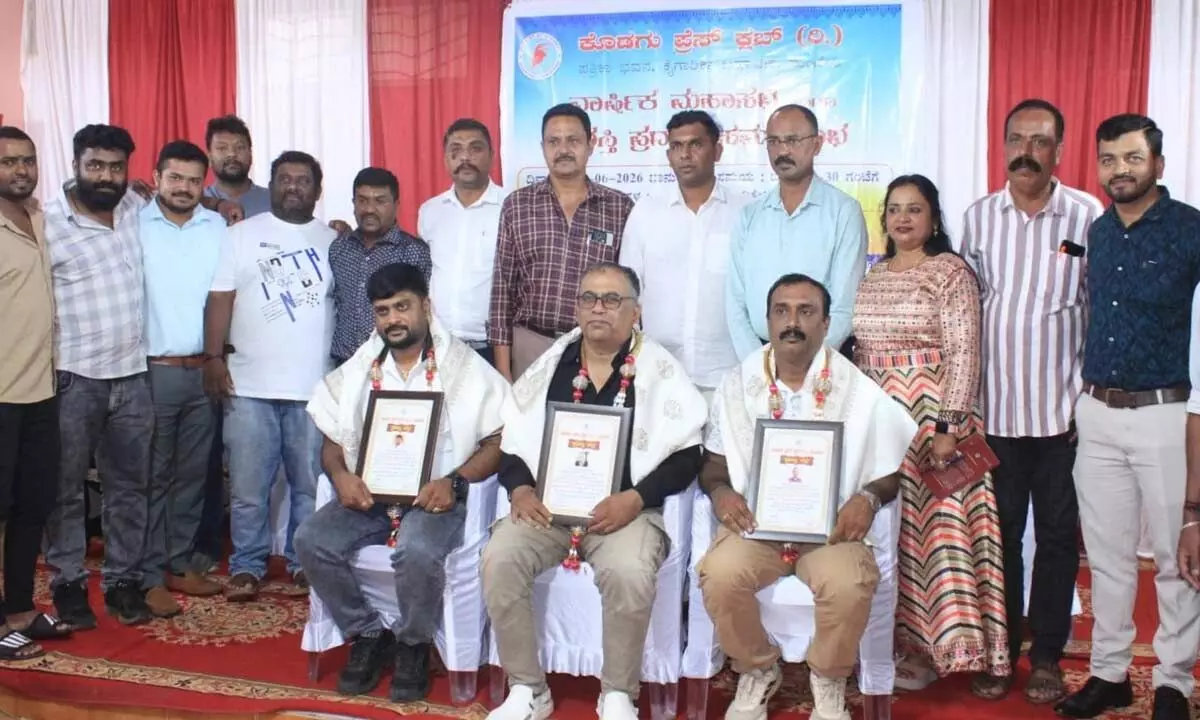
During the event, several journalists were honoured with annual awards instituted by the Kodagu Press Club. The Coovercolly Pushpalatha Chandrashekar Award was presented to journalist Santosh Rai, while the Annual Press Club Award was conferred on journalist Bacharaniyanda Anukaryappa. The Chandramohan Award was presented to journalist Hirikara Ravi in recognition of his contributions to the field.
In addition, journalists Naveen D’Souza and Hirikara Ravi, recipients of the endowment award instituted by the Kasaragod District Kannada Journalists Welfare Association, were felicitated. Ismail Kandakere, who received a KUWJ award, was also honoured during the programme.
The gathering also felicitated Ajjamada Ramesh Kuttappa on his unanimous election as Vice-President of the state journalists’ association, Bacharaniyanda Anukaryappa on becoming the new district association president, B.R. Savitha Rai for her role as state association director, and entrepreneur Edikeri Prasanna for his contributions to society.
The ceremony witnessed the participation of journalists, media professionals, social workers, and dignitaries from across Kodagu district.
source: http://www.thehansindia.com / The Hans India / Home> News> State> Karnataka/ by The Hans India / June 08th, 2026
WELCOME. If you like what you see "SUBSCRIBE via EMAIL" to receive FREE regular UPDATES.
Read More »