Tag Archives: Kodagu First

Kodagu Sahakara Sangha election

Kodagu Sahakara Sangha, Mysuru, will be holding its election to Managing Committee for a five-year term at its premises in Jayalakshmipuram on Feb. 22 from 9 am to 4 pm, according to Returning Officer K.L. Savitha.

source: http://www.starofmysore.com / Star of Mysore / Home> In Briefs / February 17th, 2025

In a lighter vein… How towns in Kodagu got their names

It’s well-known that the British morphed Kodagu into Coorg and Madikeri into Mercara. The origin of the original name Kodagu is not very clear. It is said that Kodagu is a derivative of the ancient name Krodadesha. It could well be that the name Kodagu came from the word ‘Kodi’ denoting its high perch on the Western Ghats. 

Madikeri, which was founded by Mudduraja in 1681, was named after the founder as Muddurajakeri. We are also told that Madikeri might have derived from the word ‘madi’, meaning clean. The place was once known for being neat and tidy. Recently Madikeri was ranked fifth in the country for having the best air quality.

There was a time in Coorg’s history when Ammathi was known as Colepet. This was sometime in the 1860s. The present-day Ammathi was part of Ammathinad, and this area was slowly developing from a ‘vonti-angadi’ (one shop) to a ‘multi-angadi.’

The name Colepet was given in honour of one of the popular British Superintendents of Coorg — Captain Robert A. Cole, known for his book ‘An Elementary Grammar of the Coorg Language’. Somewhere along the line, Colepet got named Ammathi.

At the time of the British takeover of Coorg, there was a busy hamlet in the southern part of Coorg known as Balelesanthe. Banana leaf was an important commodity then and Balelesanthe was the centre of this trade.

In 1866, Chepudira Madayya used his influence and renamed Balelesanthe as Ponnampet in honour of his illustrious father, Dewan Chepudira Ponnappa (my great-great-great grandfather). Ponnampet is now a busy hub of commerce and higher education. Recently, this erstwhile hamlet got elevated as a Taluk.

Santhe or the weekly market day, was very important during those bygone days. Quite a few places in Coorg got their name after the weekly ‘shandy day.’  So, we have Shanivarasanthe and Somwarpet. There existed a Sukravarasanthe, which was the present-day marketplace in Madikeri. The name Sukravarasanthe is no longer in vogue, but Madikeri continues to have its shandy day on Fridays.

The ruling family of the Lingayat Rajas named a few of the places. Virajpet, as we know, is the town founded by Dodda Veerarajendra in 1792. He also named Mahadevapet in Mercara after one of his favourite queens Mahadevamma.

Nanjarayapatna is another place named after a member of the ruling family. The Triveni Sangama at Bhagamandala got its name after the deity Bhagandeswara. The southernmost town, Kutta, is named after the forest goddess Kuttadamma. The closest settlement to Siddeshwara betta got the name Siddapur, a bustling town now.

Present-day Kushalnagar was apparently named by Hyder Ali. It was while he camped here that he received news of his son Tipu’s first military victory in another battle zone. However, Kushalnagar was renamed Frazerpet in honour of Lt. Col. J.A. Frazer who successfully secured Coorg for the British East India Company in 1834. 

Stewart (Stuart) Hill near Raja’s Seat in Madikeri is named after Col. Stewart, one of the leading British officers who took part in the annexation of Coorg.

Murnad got its name from being the meeting place of three ‘naads’ and Nalknad is a conglomeration of four ‘naads’. Likewise, Nalkeri is the centre of four villages. Murkal has a landmark of three boulders. And Arvathokkalu is a hamlet of sixty ‘okkas’ or families.  Likewise, there is Nalvathokkalu and Napoklu.

Sometime during the 1870s, the British administration opened a new housing colony named Ranipet near the rapidly growing town of Mercara. The name Ranipet was in honour of Queen Victoria.

Quite a few places in Coorg derived their name after the commodities they were famous for.  We thus have Sunti-coppal (Ginger village), Goni-coppal (Goni is woven hessian used for making sacks), Balele (Banana leaf), Chettalli (village famous for beans) and Meenpet (fish market near Virajpet). Incidentally, Chettalli used to be popularly known as ‘Tenth Mile’ during British days since it was 10 miles from Madikeri.

We have a place named Bavali, which probably had a large rookery of bats. The place Kadanga is named after the famous defensive ‘kadangas’ (trenches) dug by the nayakas who ruled Kodagu before the Haleri dynasty. 

However, I am not quite sure if the place Kurchi is known for making chairs. And then, if one had an axe to grind, I guess they went to Kodlipet!

During Tipu Sultan’s occupation of Madikeri, he rebuilt the Fort and renamed the area Jaffarabad. Dodda Veerarajendra recaptured the town in 1790, and mercifully, the fair name of Madikeri was restored.

‘Coorg’ has become an attractive and highly recognisable brand name. So, we have schools, colleges, homestays and resorts that retain the name Coorg. There are several local products such as coffee, spices, honey and wine prefixing the name Coorg.

I wish the town closest to where I live — Gonikoppal — had a better name. Several years ago, a young nephew of mine who was visiting us for the first time thought the name was ‘Gopigopal’. Now, ‘Gopigopal’ would be a much better-sounding name for a swaggering town that has the exaggerated moniker — Texas of Coorg. 

[This anecdote is an updated version of the one in my book “Tale of A Tiger’s Tail & Other Yarns from Coorg”]

source: http://www.starofmysore.com / Star of Mysore / Home> Feature Articles> Top Stories / by C.P. Belliappa / February 17th, 2025

Temple entry row: It is Kodavas vs Arebhashe Gowdas in Kodagu

Kodavas and the Arebhashe Gowdas are two prominent communities in Kodagu, Karnataka.

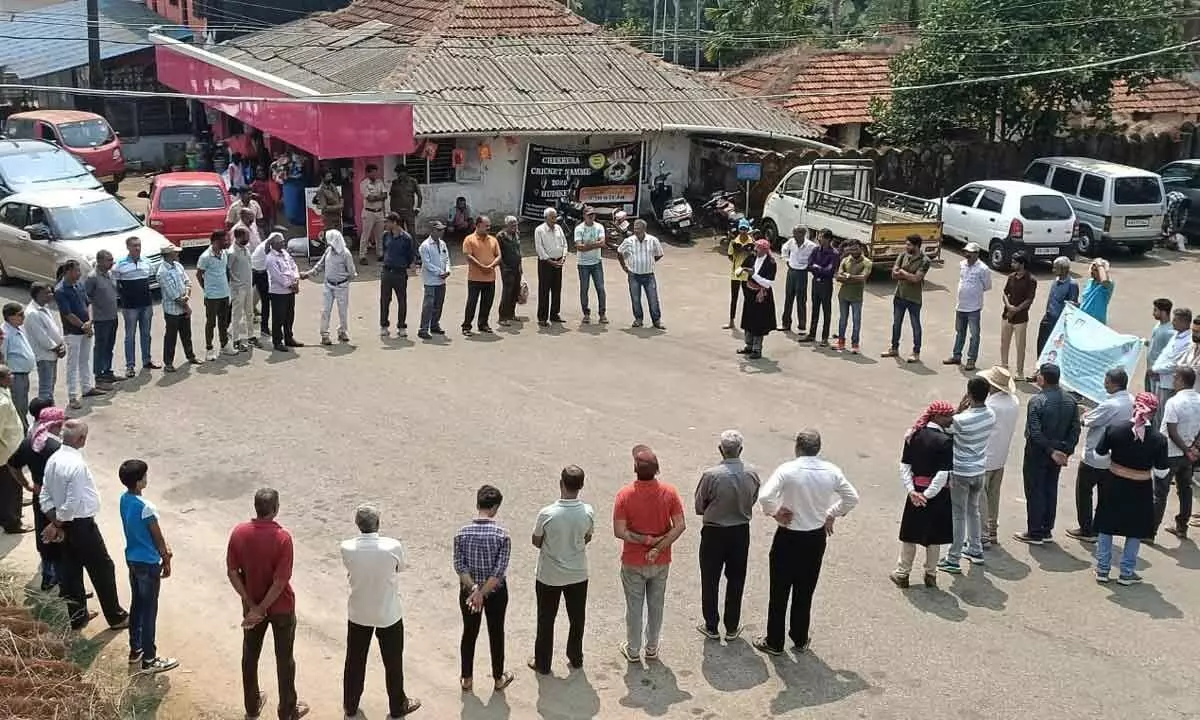
On February 2,  thousands of Kodava men and women in traditional attire took out ‘Kodavaame Baalo’, an 82km, six-day peace march led by the Akhila Kodava Samaja (AKS) in Kodagu, Karnataka. They did so to reassert their distinct identity and to draw attention to the social, religious and political challenges their community faces.

The trigger for the march was a temple entry row that has pitted two prominent communities in Kodagu―the Kodavas and the Arebhashe Gowdas―against each other.

The newly built Sri Mrutyunjaya (Shiva) temple, in Kattemadu village near Madikeri town, is the epicentre of the dispute. On December 27, when some Kodavas turned up for the annual festival in their traditional attire, some Arebhashe Gowdas stopped them from entering the temple. The “common dress code” as per the bylaw did not allow Kodava attire.

The situation escalated with both sides sticking to their guns. They filed separate complaints and announced massive jaathras (marches) in protest, forcing the district administration to intervene and impose prohibitory orders around the temple. The Arebhashe Gowdas held a massive rally in Madikeri, which the Kodavas followed up with their march from Kutta to Madikeri. The run-up to the two marches was marked by a social media war with both sides uploading provocative videos and posts.

“The Kodava community will not take part in any peace process initiated by the district administration till the police identify and arrest those who attacked Kodavas and attempted to restrict their cultural attire at the temple,” said the memorandum submitted by the AKS to Kodagu Deputy Commissioner Venkat Raja.

Said AKS member J. Ganesh Aiyanna: “A few years before the Mrutyunjaya temple incident, we were prevented from entering Talacauvery during ‘Teerthodbhava’ (annual sacred event at the place where the Cauvery is believed to originate) for wearing our traditional attire. We will not tolerate the assault on our tradition and cultural identity.”

Harsha Kodagana, member of the Arebhashe Samaja, said they were just following the rules. “The temple was built at a cost of around 06 crore, which was collected from devotees belonging to all communities. The 43-member temple committee (which includes nine Kodava members) passed a bylaw with 13 points, including the common dress code. This is meant to build a sense of equality among all communities. Some committee members stopped those wearing the Kodava attire as it violated the bylaw. The temple priest was attacked. We want the police to take suo motu action against people posting derogatory posts on social media and making casteist slurs.”

The Kodavas, however, claim that this is not an isolated case. “Some people from a particular community have belittled our icons Field Marshal K.M. Cariappa and General K.S. Thimayya, who are India’s war heroes,” said Aiyanna. “The Kodava community has a long tradition of serving the Indian armed forces. People have also petitioned the courts to curb our gun rights but the court has restored it till 2029. The gun is revered in a Kodava family as it is an integral part of all our customs. We announce the birth of a baby boy with gunshots, and baby girl by beating brass plates. We have never used these weapons for violent purposes. We are nature and ancestor worshippers and are not involved in any politics. But the assault on our culture is growing.”

The memorandum submitted to the deputy commissioner said that the government must ensure a safe atmosphere for Kodavas to practise their traditions on their own land. It also urged the government to take steps to facilitate Kodava community participation in the Talacauvery rituals, extend constitutional protection for Kodava land, culture, traditions, religious practices and social security, and to curb “political oppression” by dominant communities.

The district administration has sought a report from the temple committee, but notably, the elected representatives―Congress MLAs A.S. Ponnanna (Virajpet) and Mantar Gowda (Madikeri), and BJP MP from Mysore-Kodagu Yaduveer Wadiyar―have kept a safe distance from the controversy.

Interestingly, when it comes to elections, the two communities have supported candidates without caste considerations. Previously, BJP leader Appachu Ranjan, a Kodava, had won the Gowda-dominated Madikeri assembly seat three times, while fellow party member K.G. Bopaiah, a Gowda, had won the Kodava-dominated Virajpet assembly seat thrice.

The temple entry episode is the latest incident that could galvanise the Kodavas, who for long have feared losing their identity. The 1.5 lakh-strong population has been dwindling; there has been fragmentation of families because of migration for education and employment, and inter-caste marriages. The community, under the banner of the Codava National Council, has been resisting the change in demography, loss of land and the alienation of the younger Kodavas from their language and culture. The long list of the council’s demands includes geo-political autonomy, inclusion in the scheduled tribe list, exemption from the Arms Act, inclusion of Kodava language in the Eighth Schedule of the Constitution, recognition of river Cauvery as a living entity, UNESCO’s intangible cultural heritage tag, inner line permit system to prevent demographic changes, and greater representation of Kodavas in Parliament.

The influx of people from outside, commercial exploitation of forests for tourism and massive infrastructure projects have resulted in water scarcity, landslides and floods, say locals. The people of Kodagu include Kodava, Arebhashe Gowda and 21 other Kodava-speaking communities who have lived in harmony despite the many challenges.

“After the backlash by Kodavas over Tipu Jayanti celebrations, the Congress government was forced to stop it,” said a local leader who did not want to be named. “But now, some vested interest groups are playing mischief to divide the Hindu community.”

source: http://www.theweek.in / The Week / Home> The Week / by Prathima Nandakumar / February 16th, 2025

IBNII, Coorg Unveils Aarogyaa by IBNII: A Sanctuary for Ayurvedic Healing

The IBNII Coorg, an eco-luxury nature resort where sustainable living meets luxury, as the luxury of tomorrow, has announced the opening of Aarogyaa by The IBNII, an exclusive Ayurvedic healing sanctuary within its premises. Offering guests a transformative wellness experience, rooted in ancient Ayurvedic principles and eco-sustainability, Aarogyaa by The IBNII is designed to rejuvenate the mind, body, and soul through a multi-faceted approach to holistic well-being.

Aarogyaa by The IBNII is spread over 15 acres within The IBNII, which sits over a 125-acre lush premise. This dedicated Ayurveda sanctuary is located amidst three water bodies, with a dedicated kitchen and restaurant for preparing diet-based food according to each patient’s satvik requirements, a large yoga deck overlooking one of the natural ponds, an in-house Ayurvedic doctor with six male and female therapists, and dedicated eight new Ayurveda cottages.

Dr. Sherry SebastianManaging Director, The IBNII Coorg, said, “Opening an Ayurvedic Sanctuary was always part of our plan. Our approach integrates the wisdom of Ayurveda with the serenity of nature, ensuring a unique and rejuvenating experience for every guest to balance their doshas. This area also boasts of herbal trees, for the guest to heal through the herb-infused fresh air. At Aarogyaa, we invite our guests to embark on a journey of self-discovery, relaxation, and inner balance.”

An Ayurvedic wellness retreat, Aarogyaa by The IBNII Coorg integrates Ayurveda, Yoga, Pranayama, and therapeutic activities, providing guests with a well-rounded, immersive experience. By combining traditional healing techniques with modern relaxation therapies, the luxury retreat fosters a deep sense of inner balance and rejuvenation.

  • Ayurvedic Rituals: Drawing from India’s rich heritage, Ayurvedic therapies at Aarogyaa include specialized massages, herbal treatments, and personalized wellness programs aimed at restoring harmony between the body and mind.
  • Yoga and Pranayama: Guests can engage in guided yoga sessions to improve mobility and strength, while breath-control techniques (pranayama) enhance focus, reduce stress, and declutter the mind.
  • Therapeutic Activities: The retreat offers various therapeutic engagements, including painting, pottery, baking, and gardening—activities that stimulate the senses and promote mental well-being.
  • Eco-Sustainability Commitment: Consistent with The IBNII Coorg’s commitment to eco-conscious hospitality, Aarogyaa integrates sustainable practices to minimize environmental impact while enhancing the guest experience.

Muddappa Kuppanda, General Manager, The IBNII Coorg, said, “At The Ibnii, wellness is not just about personal health—it’s about creating a holistic, balanced connection with the environment.  Aarogyaa, our signature wellness program is designed to rejuvenate the body, mind, and spirit and integrates all traditional wellness practices like Yoga, Meditation, and Ayurveda with modern healing therapies.” 

At a driving distance of 5.5 hours from Bangalore Airport and 2.5 hours from Mysuru railway station, the IBNII Coorg is nestled amidst the lush landscapes of Madikeri.

source: http://www.voyagersworld.in / Voyagers World / Home> Wellness / by VW Bureau / February 11th, 2025

Commending Culinary Excellence: Shangri-La Eros New Delhi Brings Coorg’s Rich Flavours to Life

New Delhi : 

Shangri-La Eros New Delhi welcomes guests to an exceptional Chef Pin pop-up featuring the authentic Kodava cuisine crafted by Home Chef Smitha Kuttayya Boppanda from February 6 to 8, 2025.

The culinary showcase at the hotel’s international restaurant, Tamra presents cherished family recipes passed down through generations, offering diners a genuine taste of Coorg’s rich heritage. Home Chef Smitha, a classical dancer, published author, and storyteller, brings her multifaceted expertise to this unique dining experience that celebrates the traditional flavors of Kodava households.

Home Chef Smitha Kuttayya Boppanda brings to Shangri-La Eros New Delhi the culmination of a remarkable 15-year culinary journey. From her initial venture ‘Limited Overs’ to the establishment of Baked Delights and now Global Theeni, she has consistently delivered flavors that reflect her Kodagu roots. Her impressive track record of curating food festivals at renowned hotels like Taj Fisherman’s Cove and Hyatt showcases her dedication to sharing personal, memory-laden interpretations of Coorg’s rich culinary heritage.

The Chef Pin pop-up captures the essence of Coorg’s culinary heritage with a carefully curated menu showcasing the region’s bold and earthy flavors. The experience begins with starters like Nugge Elayithkande, a flavorful drumstick and potato preparation, Kumm Barthad with crispy fried mushrooms, Balekai featuring golden fried raw plantains, and the richly spiced Erchi Barthad, a mutton fry.

The mains celebrate both vegetarian and non-vegetarian specialties, including Kumbala Curry with vibrant pumpkin, Baimbale Curry with bamboo shoots, and Kaad Maange Curry with wild mango. Meat lovers can savor Kaima Curry, Erchi Curry, and the iconic Pandi Curry with succulent pork.

Accompaniments like Kadambutt, Nooputtu, and Tarkari Pulav perfectly complement the meal, which ends on a sweet note with Kaskase Payasa and Madd Kool. Paired with Coorg’s celebrated coffee, this pop-up promises a memorable journey through Kodava cuisine.

The exclusive Chef Pin pop-up at Tamra promises an intimate dining experience where each dish shares a story from the heart of Kodagu. Guests can enjoy the Lunch Buffet at INR 3,200 plus taxes per person or the Dinner Buffet at INR 3,500 plus taxes per person, making it a truly memorable experience.

source: http://www.contentmediasolution.com / Content Media Solution / Home> Business / February 05th, 2025

Bopanna conducts tennis trials for ‘Bhoomi’ programme in J&K, meets LG

Indian Tennis player Rohan Bopanna with young players during ‘Bhoomi’ programme for under privileged an initiative of Rohan Bopanna Tennis Academy at MA Stadium in Jammu.

Jammu :

In a major step towards promoting tennis among underprivileged children, the Rohan Bopanna Tennis Academy, in collaboration with the J&K Lawn Tennis Association and J&K Sports Council, conducted selection trials for its “Bhoomi” Programme in Jammu and Kashmir.

The trials, held in Jammu and Srinagar, aimed at identifying talented young players aged 8 to 10 years who come from underprivileged backgrounds.


The initiative, supported by the Kamal India Foundation, focuses on providing free tennis training, education, and overall development to deserving children.

Around 70-80 children participated in the trials in Jammu, showcasing their talent and enthusiasm for tennis.


BS Jaggi, General Secretary of the J&K Lawn Tennis Association, praised the event’s success and emphasized its significance in identifying and nurturing young talent. He also mentioned that Rohan Bopanna himself visited Srinagar and Jammu to personally oversee the selection process.


The selected children will receive free boarding, lodging, and education, following the CBSE syllabus up to the 10th standard, at the Sports School in Bengaluru, home to the Rohan Bopanna Tennis Academy. In addition to the education, these children will undergo world-class tennis training to enhance their skills and prepare them for competitive play.


Meanwhile, Indian tennis star Rohan Bopanna also met with Lieutenant Governor Manoj Sinha to discuss the programme.

The Lt Governor lauded Bopanna’s efforts, appreciating the academy’s dedication to providing educational and sporting opportunities to underprivileged youth from Jammu and Kashmir. He further assured full support for the initiative, emphasizing the importance of sports as a vehicle for empowering youth and promoting holistic development.

source: http://www.dailyexcelsior.com / DailyExcelsior.com / Home> Sports News / by Daily Excelsior / February 02nd, 2025

At the Golden Temple in Coorg: Where I learned the grammar of silence

The Golden Temple at Coorg, better known as Namdroling Monastery, is a centre of Tibetan culture in South India.

The Namdroling Monastery Golden Temple at Coorg | Nitin SJ Asariparambil

When I first got to know about solo travelling, I was just a college student pursuing my higher studies in English literature. Back then, travelling alone to my college, 30 kilometres away from my house, was, in itself, a big leap; there was no scope for solo travel to an unknown place.

So I quietly and shamelessly brooded over the very romantic and challenging idea of solo travel for the time being, keeping my fingers crossed. But solo travel was always on my bucket list of wishes.

And I finally got to travel solo! The destination was the Golden Temple at Coorg, in Karnataka, better known as Namdroling Monastery, where I could find and feel the vibrant tapestry of Tibetan culture.

A few months after my marriage, my husband and I headed to Coorg. From Mysore to the resort at Coorg, we enjoyed the lush greenery of coffee plantations and sandalwood forests. As I sipped on a hot cup of Madikeri special coffee served in the evening at the resort garden, I hesitantly revealed my hidden desire for solo travel to my husband.

After listening to me, we discussed and came to a consensus. He suggested I head to the Golden temple situated nearby, where I can reach safely, spend time, relax my inner self and reflect on the spiritual and metaphysical absurdities and enigmatic realities of human life. Oh, that sounded crazy and philosophically heavy, but I somehow managed to reach there the early morning the next day.

While travelling in the taxi to the Golden Temple, I did not forget to research and arm myself with some information regarding its history and cultural significance. His Holiness the 3rd Drubwang Pema Norbu Rinpoche laid the foundation stone of the monastery in the year 1963.

His Holiness Dalai Lama visited there to consecrate it and bestowed the name Namdroling. Located in Bylakuppe of the Mysore district of Karnataka, it is the largest teaching centre of the Nyingma lineage of Tibetan Buddhism in the world. Wow! What a perfect place to go solo.

At the gate of the monastery, I stood like another statue, excited and embarrassed. I never expected such a divine radiance and silence lingering there. A well-maintained, well-landscaped place. It had a kind of special emotional connect even to the first visitors, I felt.

While standing at the gate, I got a feeling that the real world had ended outside the gate, and inside, it was another surreal world. The celebration of colours was evident in the paintings and architecture, and I was allured by its charm. There, I noticed the big picture of His Highness Penor Rinpoche, who is said to be an incarnation of Vimalamitra, an 8th-century.

The centre of attraction was the calmness in the surroundings. Though there were visitors wandering here and there, all were keeping silent, or better yet, they might be talking to themselves like they had never done before.

The Smiling Buddha statue warmly greets us, and we human beings feel so small in front of this 60-foot statue. At a glance, we get a bitter self-realisation that we are only this much, ripped of our petty ego and superiority complex.

The tranquillity entraps you, making you wonder if reached some kind of enlightenment. The beautiful interiors of the temple, with its shimmering gold and dark red colour palates, par excellence, and the meditative silence, were infectious.

I remember the curios and wall hangings were there for sale in the outlet; though not cheap, it was a worthy buy for its uniqueness. I still have with me an antique wind chime I bought from a monk, safely hung on the balcony of my flat. Every time I listen to its delicate musical notes, an ancient silence touches me, and I breathe in a kind of pristineness.

The memories of my first solo trip still remain fresh in my mind, and the Golden Temple was an ideal choice, with no regret. Yes, there are certain places where we can experience loneliness and estrangement. Being alone in a crowd is enough to get that absolute feeling, because the true communication between the self and the universe finds its grammar only in loneliness, I feel…

Riya Joy, the writer, works at the Malayala Manorama in Kochi.

source: http://www.theweek.in / The Week / Home> News> Tourism / by Riya Joy / February 02nd, 2025

Record prices bring joy to coffee farmers

On Friday, the farm gate price of raw Robusta coffee berries in Wayanad market rises to a record ₹251 a kg, a significant increase from ₹171 a kg during the same period last year.

A farmer at Meenangadi in Wayanad district drying coffee berries. | Photo Credit: Special Arrangement

Robusta coffee farmers in south India are celebrating a bountiful harvest season, with prices reaching new heights. On Friday, the farm gate price of raw Robusta coffee berries in Wayanad market soared to a record ₹251 a kg, a significant increase from ₹171 a kg during the same period last year. This time in 2022, the price was even lower at ₹80 a kg.

Though the harvest is almost over, a shortfall in supply has contributed to the surge in prices, according to market sources. Many farmers are opting to hold onto their produce, anticipating even higher prices in the coming days. Concurrently, the spot price for Robusta coffee beans has risen to ₹450 a kg.

Sources say a sharp decline in Robusta coffee production in Brazil, a leading coffee producer, due to drought-like conditions is also driving up the prices. Reports indicate that Brazil’s coffee stock has plummeted to below two million bags (60 kg each) this year, down from nearly 5.5 million bags last year.

Additionally, the coffee market in Vietnam, another key Robusta producer, has been temporarily closed due to lunar holidays, further tightening supply.

The dearth of rainfall is the major concern of farmers now, especially small-scale coffee farmers, as irrigation facilities are out of their reach. Many farmers living on forest fringes are also grappling with increased wildlife crop raids, posing additional challenges.

In a related development, the price of Arabica coffee seeds has also reached an all-time high at an auction held in Bengaluru, fetching ₹605 a kg, up from ₹456 a kg during the same period last year.

According to the Coffee Board of India’s Post Blossom Estimate, the total coffee production in India for the 2023-2024 fiscal is projected at 3,74,200 tonnes, including 2,61,200 tonnes of Robusta coffee, of which Wayanad contributes 61,050 tonnes.

source: http://www.thehindu.com / The Hindu / Home> News> India> Kerala / by E M Manoj, Kalpeta / January 31st, 2025

Sky Force: Kodava people condemn misrepresentation of Squadron Leader A B Devayya in Hindi movie

Some section of Kodava community have also urged the state government to ban the movie in Karnataka.

The bronze statue of Squadron Leader Ajjamada B Devayya

Madikeri:

The issue of portraying the character of Maha Vir Chakra awardee Squadron Leader Ajjamada B Devayya, as a Tamilian in the Hindi movie ‘Sky Force’, directed by Sandeep Kewlani has drawn the ire of people from Kodagu.

The move by the filmmakers has been criticised on social media. Tweeting about Ajjamada B Devayya, the people opined that even though the movie is based on him, his character has been misrepresented. 

Some have also urged the state government to ban the movie in Karnataka.

The film was released on January 24 and is said to be inspired by the life of Ajjamada B Devayya and by his role in destroying a Pak aircraft during the Indo-Pak war in 1965. He was martyred during the fight. 

Speaking to DH, Codava Makkada Coota president and publisher Bollajira B Aiyappa said that the real name of the patriot should have been used for the lead character in the film. Even though the character’s name is changed, the identity of him being Kodava should have been shown. The change of his identity as a Tamilian has hurt the sentiments of Kodavas. Kodagu has given Field Marshals, Generals and Squadron leaders to the country, he said.

Ajjamada  B Devayya./ File Photo

“The movie makers had come to Kodagu to collect information about A B Devayya. The opening and closing credits of the movie have made a mention about the story being based on A B Devayya’s life, he said.

He further stated that a book has been published about Ajjamada B Devayya – ‘1965 ra Yuddha Hagu Kodagina Mahavira’.

The Coota has been observing his commemoration on September 7 every year at A B Devayya Circle in Madikeri where the statue is situated. The statue is erected and is being maintained by Codava Makkada Coota, Aiyappa added.

source: http://www.deccanherald.com / Deccan Herald / Home> India> Karnataka / by Ashwani Kumar N K R / January 30th, 2025

Madikeri commemorates Sarvodaya Day with solemn tribute to Mahatma Gandhi’s ashes

Madikeri :

Sarvodaya Day was observed in Madikeri by the district administration, Kannada and Culture Department, Municipal Council, and Sarvodaya Samiti on Thursday.

The ashes of Mahatma Gandhi, which were kept in the district treasury of the city’s District Administration Building, were taken out to allow people to pay their homage.

Led by the district administration and Sarvodaya Samiti members, the ashes of Gandhi were taken out through the main road of Mangeria Muthanna and General Thimayya Circle and placed at Gandhi Mantapa in the Gandhi Maidan.

The reserve police force also paid tribute to Gandhi by firing three rounds and observing silence.

A religious prayer was part of the event where messages were read by heads of different religions.

After the state tributes and a moment of silence, Gandhi’s ashes were taken back to the district treasury in a procession.

DC Venkat Raja, SP K Ramarajan, and Sarvodaya Samiti President Ambekallu Kushalappa were present.

source: http://www.timesofindia.indiatimes.com / The Times of India / Home> News> City News> Mysuru News / by G Rajendra / TNN / January 30th, 2025