Tag Archives: Madikeri

Programme on legal regulations and cyber security for cooperative societies held in Madikeri

A special programme on the theme “legal regulations and cyber security in the management of cooperative societies“ was held at Madikeri on Monday.

The event was jointly organised by Karnataka State Cooperative Federation and Kodagu District Co-operative Union. Presidents of various cooperative societies in Kodagu district took part in the event.

Retired assistant registrar of cooperative societies H.S. Nagarajaiah delivered a lecture on legal regulations essential for the management of cooperative societies, including board elections.

Development trainer R.K. Balachandra, with a background in the banking sector, provided insights into cyber security threats and preventive measures.

Director of Kodagu District Cooperative Union Umesh Uthappa and others were present on the occasion.

source: http://www.thehindu.com / The Hindu / Home> News> India> Karnataka / by The Hindu Bureau / March 10th, 2025

District-level job fair in Madikeri on March 8

The Kodagu Zilla Panchayat will hold a district-level job fair at Madikeri near here by under the Sanjeevini – Karnataka State Rural Livelihood Promotion Society’s (KSRLPS) Deen Dayal Upadhyay (DDU) – Grameena Kaushalya Yojane (GKY) scheme on March 8.

According to an official statement here, the district-level job fair scheduled to begin at 10 a.m. at District Government Industrial Training Institute (ITI) in Madikeri is expected to offer employment opportunities to at least 800 candidates in various companies.

Several reputed companies are scheduled to participate in the fair and offer on-the-spot job opportunities and select candidates for training programmes, a statement said.

Chief Executive Officer of Kodagu Zilla Panchayat Anand Prakash Meena has urged unemployed youth between 18 and 35 years of age, to make use of the opportunity.

source: http://www.thehindu.com / The Hindu / Home> News> India> Karnataka / by The Hindu Bureau, Mysuru / March 05th, 2025

Spike in coffee prices in K’taka markets due to severe crop losses in Brazil, Vietnam: Expert

The sharp rise on February 11 was attributed to severe crop losses in Brazil and Vietnam — world’s leading coffee producers — due to adverse weather conditions.

The sharp rise on February 11 was attributed to severe crop losses in Brazil and Vietnam — world’s leading coffee producers — due to adverse weather conditions. (Shutterstock)

Bengaluru:

Coffee prices in Karnataka’s Kodagu and Chikkamagaluru markets that recently surged to historic levels was driven by a global supply crunch, according to officials familiar with the matter. Arabica Parchment, a premium coffee variety, soared to ₹29,600 per 50 kg bag in Chikkamagaluru, while Kodagu recorded an even higher price of ₹29,800, marking an unprecedented peak.

The sharp rise on February 11 was attributed to severe crop losses in Brazil and Vietnam — world’s leading coffee producers — due to adverse weather conditions. Experts predicted that recovery will take at least five to eight years, as new coffee plants require time to mature and yield produce.

“Coffee prices are heavily influenced by weather conditions, and it’s impossible to assume that current prices will remain steady,” Coffee Board president Dinesh Devavrinda told HT. He advised growers, particularly those with outstanding bank loans, to capitalise on the price surge by opting for the One-Time Settlement (OTS) scheme, which covers the principal amount up to ₹5 lakh.

India produces approximately 365,000 tonnes of coffee annually, with 70% of the yield exported to European markets. Karnataka is the country’s largest coffee producer, accounting for 70% of national output, with Kodagu alone contributing 32%. The state has 246,000 hectares of coffee estates, yielding 220,000 tonnes annually, while Kodagu, spanning 4,102 square kilometers, produces around 120,000 tonnes from 110,000 hectares of estates.

At the beginning of the year, coffee prices were volatile, but a steep upward trend emerged over the past 10 days, with daily price hikes ranging between ₹500 and ₹1,000 per bag. On January 1, Arabica Parchment was priced at ₹17,000 per 50 kg bag but by the end of the month, it rose to ₹23,500. Other coffee varieties also saw significant increases: Robusta Parchment reached ₹24,500, Arabica Cherry was sold at ₹17,000, and Robusta Cherry hit ₹13,500 in Kodagu markets.

According to market analysts, the absence of buffer stock this year has further aggravated the supply shortage, pushing prices to record highs.

Rajiv Kushalappa, managing director of Leonflix Fintech Ventures Pvt Ltd, a Bengaluru-based coffee export firm, pointed to the impact of global shortages. “Thousands of coffee estates have been destroyed in Brazil and Vietnam, leading to a severe supply crunch in the international market. With no buffer stock available this year, prices have skyrocketed and are likely to remain high for some time,” he said.

For coffee growers, the soaring prices offer much-needed financial relief. “This is the first time I am getting such record prices. Growers have long struggled with high production costs, disease outbreaks, and labour shortages. Arabica coffee estates require significant manpower, and labor costs have risen due to shortages. These higher prices will help growers maintain their estates,” Sannuvanda Kaverappa, a grower from Napoklu in Madikeri, said.

Kodagu, nestled in the Western Ghats of Karnataka, is India’s largest coffee-producing region, contributing nearly 32% of the country’s total output. The district, spanning 4,102 square kilometers, is home to vast coffee estates spread across 1.1 lakh hectares. Known for its rich biodiversity and hilly terrain, Kodagu primarily cultivates Arabica and Robusta coffee varieties. Coffee farming, introduced by British planters in the 19th century, remains the backbone of the local economy, with thousands of small and large growers dependent on it. The region’s coffee is highly sought after in international markets, with 70% of India’s coffee production being exported.

source: http://www.hindustantimes.com / Hindustan Times / Home / by Coovercolly Indresh / February 18th, 2025

In a lighter vein… How towns in Kodagu got their names

It’s well-known that the British morphed Kodagu into Coorg and Madikeri into Mercara. The origin of the original name Kodagu is not very clear. It is said that Kodagu is a derivative of the ancient name Krodadesha. It could well be that the name Kodagu came from the word ‘Kodi’ denoting its high perch on the Western Ghats. 

Madikeri, which was founded by Mudduraja in 1681, was named after the founder as Muddurajakeri. We are also told that Madikeri might have derived from the word ‘madi’, meaning clean. The place was once known for being neat and tidy. Recently Madikeri was ranked fifth in the country for having the best air quality.

There was a time in Coorg’s history when Ammathi was known as Colepet. This was sometime in the 1860s. The present-day Ammathi was part of Ammathinad, and this area was slowly developing from a ‘vonti-angadi’ (one shop) to a ‘multi-angadi.’

The name Colepet was given in honour of one of the popular British Superintendents of Coorg — Captain Robert A. Cole, known for his book ‘An Elementary Grammar of the Coorg Language’. Somewhere along the line, Colepet got named Ammathi.

At the time of the British takeover of Coorg, there was a busy hamlet in the southern part of Coorg known as Balelesanthe. Banana leaf was an important commodity then and Balelesanthe was the centre of this trade.

In 1866, Chepudira Madayya used his influence and renamed Balelesanthe as Ponnampet in honour of his illustrious father, Dewan Chepudira Ponnappa (my great-great-great grandfather). Ponnampet is now a busy hub of commerce and higher education. Recently, this erstwhile hamlet got elevated as a Taluk.

Santhe or the weekly market day, was very important during those bygone days. Quite a few places in Coorg got their name after the weekly ‘shandy day.’  So, we have Shanivarasanthe and Somwarpet. There existed a Sukravarasanthe, which was the present-day marketplace in Madikeri. The name Sukravarasanthe is no longer in vogue, but Madikeri continues to have its shandy day on Fridays.

The ruling family of the Lingayat Rajas named a few of the places. Virajpet, as we know, is the town founded by Dodda Veerarajendra in 1792. He also named Mahadevapet in Mercara after one of his favourite queens Mahadevamma.

Nanjarayapatna is another place named after a member of the ruling family. The Triveni Sangama at Bhagamandala got its name after the deity Bhagandeswara. The southernmost town, Kutta, is named after the forest goddess Kuttadamma. The closest settlement to Siddeshwara betta got the name Siddapur, a bustling town now.

Present-day Kushalnagar was apparently named by Hyder Ali. It was while he camped here that he received news of his son Tipu’s first military victory in another battle zone. However, Kushalnagar was renamed Frazerpet in honour of Lt. Col. J.A. Frazer who successfully secured Coorg for the British East India Company in 1834. 

Stewart (Stuart) Hill near Raja’s Seat in Madikeri is named after Col. Stewart, one of the leading British officers who took part in the annexation of Coorg.

Murnad got its name from being the meeting place of three ‘naads’ and Nalknad is a conglomeration of four ‘naads’. Likewise, Nalkeri is the centre of four villages. Murkal has a landmark of three boulders. And Arvathokkalu is a hamlet of sixty ‘okkas’ or families.  Likewise, there is Nalvathokkalu and Napoklu.

Sometime during the 1870s, the British administration opened a new housing colony named Ranipet near the rapidly growing town of Mercara. The name Ranipet was in honour of Queen Victoria.

Quite a few places in Coorg derived their name after the commodities they were famous for.  We thus have Sunti-coppal (Ginger village), Goni-coppal (Goni is woven hessian used for making sacks), Balele (Banana leaf), Chettalli (village famous for beans) and Meenpet (fish market near Virajpet). Incidentally, Chettalli used to be popularly known as ‘Tenth Mile’ during British days since it was 10 miles from Madikeri.

We have a place named Bavali, which probably had a large rookery of bats. The place Kadanga is named after the famous defensive ‘kadangas’ (trenches) dug by the nayakas who ruled Kodagu before the Haleri dynasty. 

However, I am not quite sure if the place Kurchi is known for making chairs. And then, if one had an axe to grind, I guess they went to Kodlipet!

During Tipu Sultan’s occupation of Madikeri, he rebuilt the Fort and renamed the area Jaffarabad. Dodda Veerarajendra recaptured the town in 1790, and mercifully, the fair name of Madikeri was restored.

‘Coorg’ has become an attractive and highly recognisable brand name. So, we have schools, colleges, homestays and resorts that retain the name Coorg. There are several local products such as coffee, spices, honey and wine prefixing the name Coorg.

I wish the town closest to where I live — Gonikoppal — had a better name. Several years ago, a young nephew of mine who was visiting us for the first time thought the name was ‘Gopigopal’. Now, ‘Gopigopal’ would be a much better-sounding name for a swaggering town that has the exaggerated moniker — Texas of Coorg. 

[This anecdote is an updated version of the one in my book “Tale of A Tiger’s Tail & Other Yarns from Coorg”]

source: http://www.starofmysore.com / Star of Mysore / Home> Feature Articles> Top Stories / by C.P. Belliappa / February 17th, 2025

Temple entry row: It is Kodavas vs Arebhashe Gowdas in Kodagu

Kodavas and the Arebhashe Gowdas are two prominent communities in Kodagu, Karnataka.

On February 2,  thousands of Kodava men and women in traditional attire took out ‘Kodavaame Baalo’, an 82km, six-day peace march led by the Akhila Kodava Samaja (AKS) in Kodagu, Karnataka. They did so to reassert their distinct identity and to draw attention to the social, religious and political challenges their community faces.

The trigger for the march was a temple entry row that has pitted two prominent communities in Kodagu―the Kodavas and the Arebhashe Gowdas―against each other.

The newly built Sri Mrutyunjaya (Shiva) temple, in Kattemadu village near Madikeri town, is the epicentre of the dispute. On December 27, when some Kodavas turned up for the annual festival in their traditional attire, some Arebhashe Gowdas stopped them from entering the temple. The “common dress code” as per the bylaw did not allow Kodava attire.

The situation escalated with both sides sticking to their guns. They filed separate complaints and announced massive jaathras (marches) in protest, forcing the district administration to intervene and impose prohibitory orders around the temple. The Arebhashe Gowdas held a massive rally in Madikeri, which the Kodavas followed up with their march from Kutta to Madikeri. The run-up to the two marches was marked by a social media war with both sides uploading provocative videos and posts.

“The Kodava community will not take part in any peace process initiated by the district administration till the police identify and arrest those who attacked Kodavas and attempted to restrict their cultural attire at the temple,” said the memorandum submitted by the AKS to Kodagu Deputy Commissioner Venkat Raja.

Said AKS member J. Ganesh Aiyanna: “A few years before the Mrutyunjaya temple incident, we were prevented from entering Talacauvery during ‘Teerthodbhava’ (annual sacred event at the place where the Cauvery is believed to originate) for wearing our traditional attire. We will not tolerate the assault on our tradition and cultural identity.”

Harsha Kodagana, member of the Arebhashe Samaja, said they were just following the rules. “The temple was built at a cost of around 06 crore, which was collected from devotees belonging to all communities. The 43-member temple committee (which includes nine Kodava members) passed a bylaw with 13 points, including the common dress code. This is meant to build a sense of equality among all communities. Some committee members stopped those wearing the Kodava attire as it violated the bylaw. The temple priest was attacked. We want the police to take suo motu action against people posting derogatory posts on social media and making casteist slurs.”

The Kodavas, however, claim that this is not an isolated case. “Some people from a particular community have belittled our icons Field Marshal K.M. Cariappa and General K.S. Thimayya, who are India’s war heroes,” said Aiyanna. “The Kodava community has a long tradition of serving the Indian armed forces. People have also petitioned the courts to curb our gun rights but the court has restored it till 2029. The gun is revered in a Kodava family as it is an integral part of all our customs. We announce the birth of a baby boy with gunshots, and baby girl by beating brass plates. We have never used these weapons for violent purposes. We are nature and ancestor worshippers and are not involved in any politics. But the assault on our culture is growing.”

The memorandum submitted to the deputy commissioner said that the government must ensure a safe atmosphere for Kodavas to practise their traditions on their own land. It also urged the government to take steps to facilitate Kodava community participation in the Talacauvery rituals, extend constitutional protection for Kodava land, culture, traditions, religious practices and social security, and to curb “political oppression” by dominant communities.

The district administration has sought a report from the temple committee, but notably, the elected representatives―Congress MLAs A.S. Ponnanna (Virajpet) and Mantar Gowda (Madikeri), and BJP MP from Mysore-Kodagu Yaduveer Wadiyar―have kept a safe distance from the controversy.

Interestingly, when it comes to elections, the two communities have supported candidates without caste considerations. Previously, BJP leader Appachu Ranjan, a Kodava, had won the Gowda-dominated Madikeri assembly seat three times, while fellow party member K.G. Bopaiah, a Gowda, had won the Kodava-dominated Virajpet assembly seat thrice.

The temple entry episode is the latest incident that could galvanise the Kodavas, who for long have feared losing their identity. The 1.5 lakh-strong population has been dwindling; there has been fragmentation of families because of migration for education and employment, and inter-caste marriages. The community, under the banner of the Codava National Council, has been resisting the change in demography, loss of land and the alienation of the younger Kodavas from their language and culture. The long list of the council’s demands includes geo-political autonomy, inclusion in the scheduled tribe list, exemption from the Arms Act, inclusion of Kodava language in the Eighth Schedule of the Constitution, recognition of river Cauvery as a living entity, UNESCO’s intangible cultural heritage tag, inner line permit system to prevent demographic changes, and greater representation of Kodavas in Parliament.

The influx of people from outside, commercial exploitation of forests for tourism and massive infrastructure projects have resulted in water scarcity, landslides and floods, say locals. The people of Kodagu include Kodava, Arebhashe Gowda and 21 other Kodava-speaking communities who have lived in harmony despite the many challenges.

“After the backlash by Kodavas over Tipu Jayanti celebrations, the Congress government was forced to stop it,” said a local leader who did not want to be named. “But now, some vested interest groups are playing mischief to divide the Hindu community.”

source: http://www.theweek.in / The Week / Home> The Week / by Prathima Nandakumar / February 16th, 2025

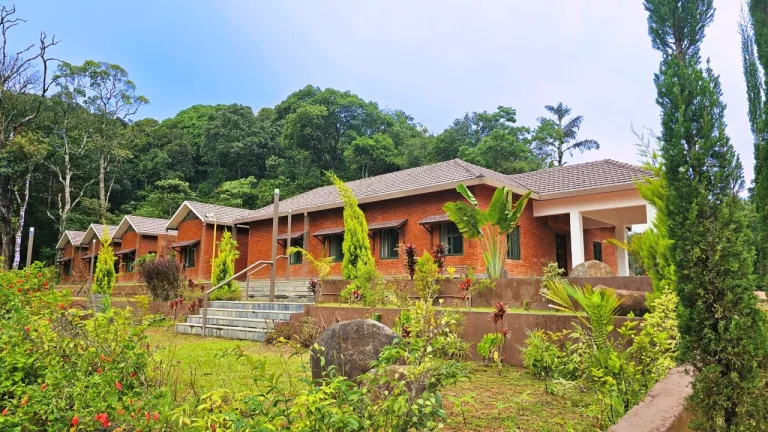
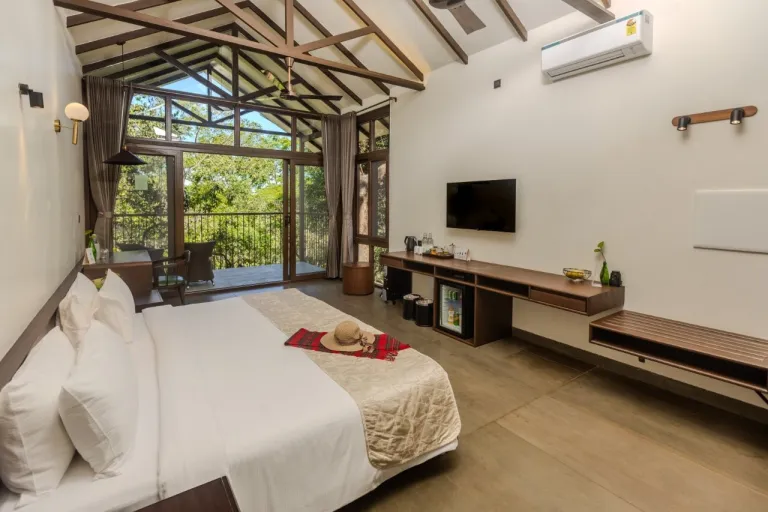
IBNII, Coorg Unveils Aarogyaa by IBNII: A Sanctuary for Ayurvedic Healing

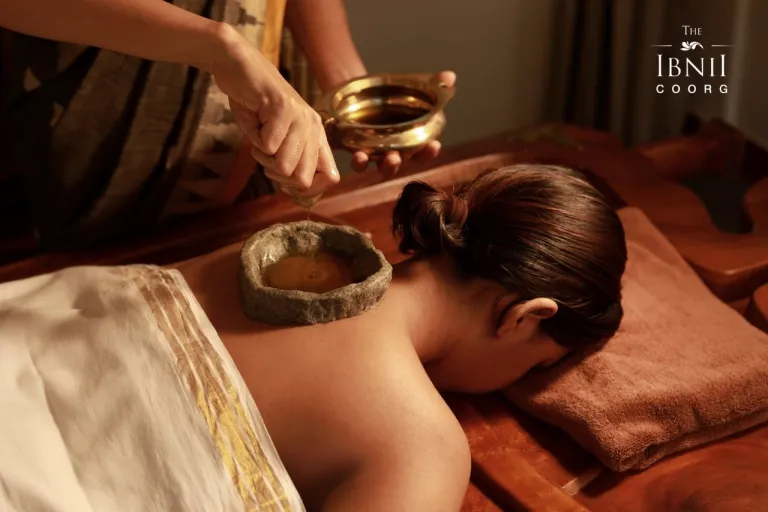
The IBNII Coorg, an eco-luxury nature resort where sustainable living meets luxury, as the luxury of tomorrow, has announced the opening of Aarogyaa by The IBNII, an exclusive Ayurvedic healing sanctuary within its premises. Offering guests a transformative wellness experience, rooted in ancient Ayurvedic principles and eco-sustainability, Aarogyaa by The IBNII is designed to rejuvenate the mind, body, and soul through a multi-faceted approach to holistic well-being.

Aarogyaa by The IBNII is spread over 15 acres within The IBNII, which sits over a 125-acre lush premise. This dedicated Ayurveda sanctuary is located amidst three water bodies, with a dedicated kitchen and restaurant for preparing diet-based food according to each patient’s satvik requirements, a large yoga deck overlooking one of the natural ponds, an in-house Ayurvedic doctor with six male and female therapists, and dedicated eight new Ayurveda cottages.

Dr. Sherry SebastianManaging Director, The IBNII Coorg, said, “Opening an Ayurvedic Sanctuary was always part of our plan. Our approach integrates the wisdom of Ayurveda with the serenity of nature, ensuring a unique and rejuvenating experience for every guest to balance their doshas. This area also boasts of herbal trees, for the guest to heal through the herb-infused fresh air. At Aarogyaa, we invite our guests to embark on a journey of self-discovery, relaxation, and inner balance.”

An Ayurvedic wellness retreat, Aarogyaa by The IBNII Coorg integrates Ayurveda, Yoga, Pranayama, and therapeutic activities, providing guests with a well-rounded, immersive experience. By combining traditional healing techniques with modern relaxation therapies, the luxury retreat fosters a deep sense of inner balance and rejuvenation.

  • Ayurvedic Rituals: Drawing from India’s rich heritage, Ayurvedic therapies at Aarogyaa include specialized massages, herbal treatments, and personalized wellness programs aimed at restoring harmony between the body and mind.
  • Yoga and Pranayama: Guests can engage in guided yoga sessions to improve mobility and strength, while breath-control techniques (pranayama) enhance focus, reduce stress, and declutter the mind.
  • Therapeutic Activities: The retreat offers various therapeutic engagements, including painting, pottery, baking, and gardening—activities that stimulate the senses and promote mental well-being.
  • Eco-Sustainability Commitment: Consistent with The IBNII Coorg’s commitment to eco-conscious hospitality, Aarogyaa integrates sustainable practices to minimize environmental impact while enhancing the guest experience.

Muddappa Kuppanda, General Manager, The IBNII Coorg, said, “At The Ibnii, wellness is not just about personal health—it’s about creating a holistic, balanced connection with the environment.  Aarogyaa, our signature wellness program is designed to rejuvenate the body, mind, and spirit and integrates all traditional wellness practices like Yoga, Meditation, and Ayurveda with modern healing therapies.” 

At a driving distance of 5.5 hours from Bangalore Airport and 2.5 hours from Mysuru railway station, the IBNII Coorg is nestled amidst the lush landscapes of Madikeri.

source: http://www.voyagersworld.in / Voyagers World / Home> Wellness / by VW Bureau / February 11th, 2025

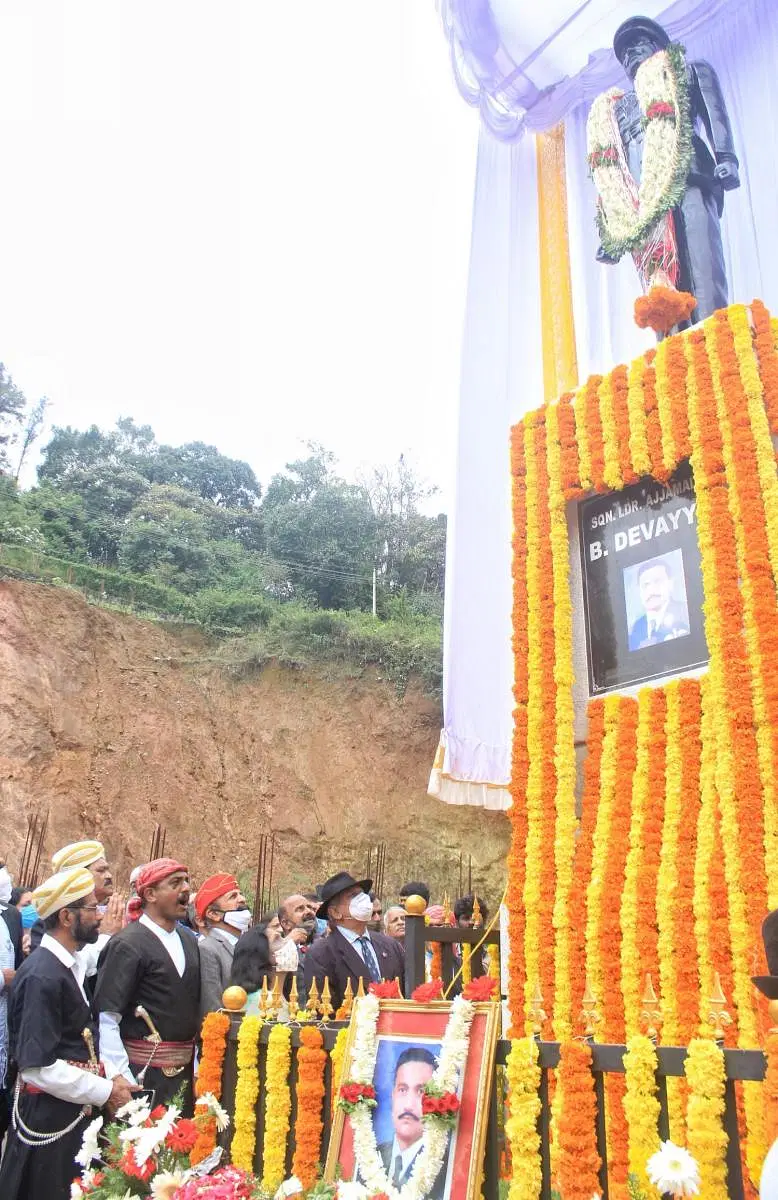
Sky Force: Kodava people condemn misrepresentation of Squadron Leader A B Devayya in Hindi movie

Some section of Kodava community have also urged the state government to ban the movie in Karnataka.

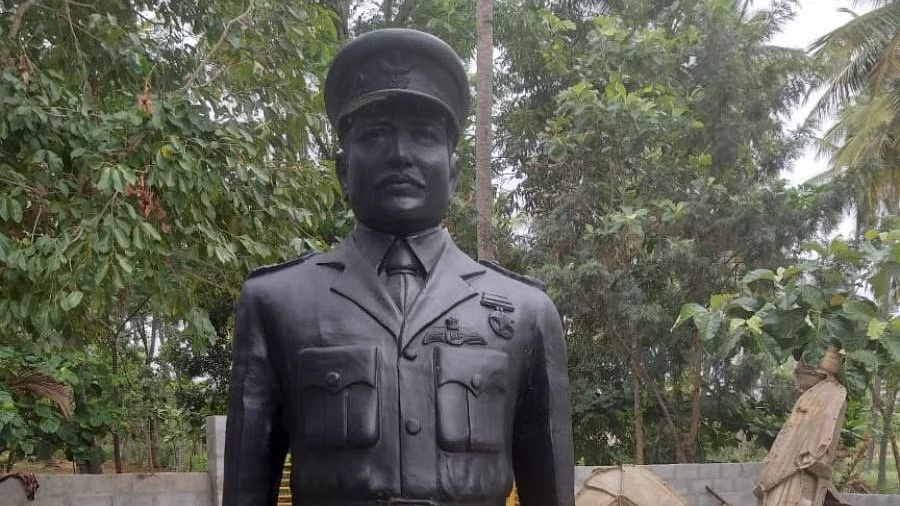
The bronze statue of Squadron Leader Ajjamada B Devayya

Madikeri:

The issue of portraying the character of Maha Vir Chakra awardee Squadron Leader Ajjamada B Devayya, as a Tamilian in the Hindi movie ‘Sky Force’, directed by Sandeep Kewlani has drawn the ire of people from Kodagu.

The move by the filmmakers has been criticised on social media. Tweeting about Ajjamada B Devayya, the people opined that even though the movie is based on him, his character has been misrepresented. 

Some have also urged the state government to ban the movie in Karnataka.

The film was released on January 24 and is said to be inspired by the life of Ajjamada B Devayya and by his role in destroying a Pak aircraft during the Indo-Pak war in 1965. He was martyred during the fight. 

Speaking to DH, Codava Makkada Coota president and publisher Bollajira B Aiyappa said that the real name of the patriot should have been used for the lead character in the film. Even though the character’s name is changed, the identity of him being Kodava should have been shown. The change of his identity as a Tamilian has hurt the sentiments of Kodavas. Kodagu has given Field Marshals, Generals and Squadron leaders to the country, he said.

Ajjamada  B Devayya./ File Photo

“The movie makers had come to Kodagu to collect information about A B Devayya. The opening and closing credits of the movie have made a mention about the story being based on A B Devayya’s life, he said.

He further stated that a book has been published about Ajjamada B Devayya – ‘1965 ra Yuddha Hagu Kodagina Mahavira’.

The Coota has been observing his commemoration on September 7 every year at A B Devayya Circle in Madikeri where the statue is situated. The statue is erected and is being maintained by Codava Makkada Coota, Aiyappa added.

source: http://www.deccanherald.com / Deccan Herald / Home> India> Karnataka / by Ashwani Kumar N K R / January 30th, 2025

Madikeri commemorates Sarvodaya Day with solemn tribute to Mahatma Gandhi’s ashes

Madikeri :

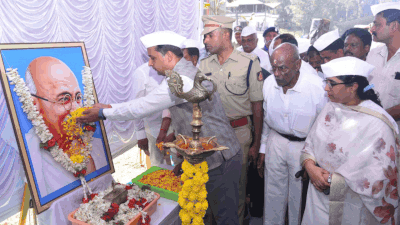
Sarvodaya Day was observed in Madikeri by the district administration, Kannada and Culture Department, Municipal Council, and Sarvodaya Samiti on Thursday.

The ashes of Mahatma Gandhi, which were kept in the district treasury of the city’s District Administration Building, were taken out to allow people to pay their homage.

Led by the district administration and Sarvodaya Samiti members, the ashes of Gandhi were taken out through the main road of Mangeria Muthanna and General Thimayya Circle and placed at Gandhi Mantapa in the Gandhi Maidan.

The reserve police force also paid tribute to Gandhi by firing three rounds and observing silence.

A religious prayer was part of the event where messages were read by heads of different religions.

After the state tributes and a moment of silence, Gandhi’s ashes were taken back to the district treasury in a procession.

DC Venkat Raja, SP K Ramarajan, and Sarvodaya Samiti President Ambekallu Kushalappa were present.

source: http://www.timesofindia.indiatimes.com / The Times of India / Home> News> City News> Mysuru News / by G Rajendra / TNN / January 30th, 2025

Kodava Community Plans 80-Km Peace March to Protect Cultural Identity

HIGHLIGHTS

The Kodava community in Karnataka will hold an 80-km peace march to highlight cultural erosion, identity concerns, and ecological challenges in  Kodagu.

Kodava Community Plans 80-Km Peace March to Protect Cultural Identity

The Kodava community, an indigenous group in Karnataka known for its unique traditions and martial heritage, has announced an 80-kilometer peace march from February 2 to 7. Organized by the Federation of Kodava Samajas, the march will begin in Kutta, near the Kerala border, and conclude in Madikeri, Kodagu’s district headquarters.

The initiative aims to draw attention to the community’s dwindling population and threats to its cultural identity. According to reports, the Kodava community has been raising concerns over cultural erosion, socio-political neglect, and restrictions on traditional practices.

The Kodava population, once estimated at 300,000, has declined to approximately 125,000. Speaking to The Times of India, Chandapanda Prajwal Poovanna, a real estate professional, highlighted the demographic shift. “Only 40% of Kodavas continue to reside in Kodagu, leading to a loss of political representation and influence,” he said.

The community has also voiced concerns about the increasing sale of ancestral land to outsiders. Wealthy buyers, including politicians and businesspeople from Karnataka and neighboring states, are reportedly converting plantations into commercial establishments.

“Many Kodavas are forced to sell their properties and migrate due to economic pressures. This not only threatens our cultural roots but also disrupts Kodagu’s ecological balance,” Theethramada Satish Bopanna told The Times of India.

Despite their small numbers, the Kodavas have made significant contributions to India’s armed forces and sports. Field Marshal K M Cariappa and General K S Thimayya are among the community’s most celebrated military leaders. Sports icons like hockey player M P Ganesh, cricketer Robin Uthappa, badminton star Ashwini Ponnappa, and tennis player Rohan Bopanna also hail from the region.

“Even with such contributions, the state and central governments often overlook our concerns because we are a small community that does not significantly impact vote banks,” cultural expert Poyyatira Raj Chengappa told The Times of India.

The Kodava community has been advocating for special status to protect their cultural and ecological heritage.

Bayavanda Sharath Kushalapoa, secretary of SVG Kodava Sangha, highlighted the importance of such measures. “Special status would prevent outsiders from purchasing land for commercial purposes and help conserve Kodagu’s distinct culture and environment,” he said.

Organizers have called for widespread participation to highlight the urgency of their cause. Kodava Community Plans 80-Km Peace March to Protect Cultural Identity

source: http://www.thehansindia.com / The Hans India / Home> News> State> Karnataka / by Sowmya Sangam / Hans News Service / January 28th, 2025

When Field Marshal KM Cariappa ticked off Nehru for not replying to his letters

On the 125th birth anniversary of K M Cariappa, here’s a look at one of his letters to Jawaharlal Nehru.

After his retirement, Field Marshal (then General) Cariappa served as the high commissioner of India to Australia and New Zealand from 1953 to 1956 and after completing this tenure he settled in Madikeri in Coorg. (Source: Express Archives)

Field Marshal K M Cariappa , the first Indian Commander-in-Chief of the Army, wrote a series of letters to then Prime Minister Jawaharlal Nehru with several suggestions — from the Kashmir issue to the setting up of a National Defence College.

After his retirement, Field Marshal (then General) Cariappa served as the high commissioner of India to Australia and New Zealand from 1953 to 1956 and after completing this tenure he settled in Madikeri in Coorg.

On the 125th birth anniversary of K M Cariappa on January 28, here is a look at one of his letters to Jawaharlal Nehru.

In his letter dated April 14, 1960, a plain-speaking Cariappa expressed his annoyance to Nehru for not replying to two of his letters. “Since we last met on 16th January at Bangalore I have written to you two letters on matters which I thought and still think are of some importance. Taking you at your own word I have always written and talked to you quite frankly, without beating around the bush with no ulterior motives or political ambitions of any kind whatsoever. I know what a very busy person you are. But I did expect at least a line or two In reply to those letters. Have I said anything, traitorous or unpatriotic? At any time that you should so totally ignore the matters. I have written to you. Panditji, I never expected this of you. This is indeed a sad and tragic ‘discovery’ for me. I am afraid, I cause and create unhappiness to myself By being too much of an idealist,” wrote Cariappa.

Cariappa then went on to raise three issues in his letter which he had mentioned on previous occasions to Nehru. He referred to the urgent need to look into the morale of officers in the Army, and also opposed the setting up of a National Defence College citing expenses and administrative issues about it.

Field Marshal Cariappa also emphasised to Nehru the need to reach out to the then president of Pakistan Ayub Khan and solve the Kashmir issue, saying that it should not be left pending for future generations. “Panditji please do this in your lifetime. We cannot live forever and we cannot hold office forever. Ayub will be prepared to discuss things with you if you show your desire to thrash out the matter between you two. Please let India and Pakistan settle the 12-year-old matter between themselves. This will then secure a more permanent feeling of goodwill between the two countries than if it were left to someone else — third party to settle it for us,” he said.

Urging Nehru to give “a kind and charitable thought” to his suggestions, Cariappa ended the letter by asking Nehru not to dismiss his suggestions by saying “yet another irresponsible thing from one who is mental”.

source: http://www.indianexpress.com / The Indian Express / Home> News> Cities> Chandigarh / by Man Aman Singh Chhina / January 28th, 2025