Pioneering steps

Perceptive vision Kodagina Gouramma

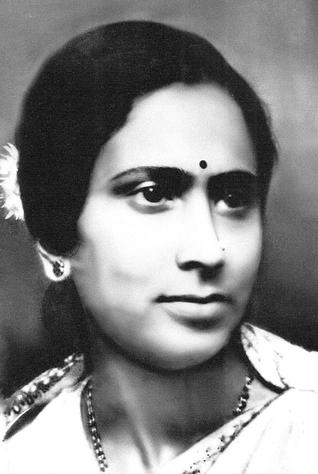
Kodagina Gowramma was a significant writer with a modern and progressive vision. As we remember this writer on her 100th birth anniversary, it is with pride that we recall her efforts to forge a meaningful artistic destiny for herself

It is hard to believe that one hundred years have passed since the birth of Kodagina Gowramma, that is Ms. B.T.G. Krishna (1912-1939). The remarkable woman, who was all of 27, when she passed away, grappled with the issues of modernity that are relevant even today. She could empathise with the angst of the individual, while probing deeply into the socio-political aetiology of the same. She represents the positive effects of the much denigrated western education system. The fact that she lived in Coorg which was relatively free from the shackles of Indian orthodoxy must have abetted her intellectual development and social attitudes. Her ideology was truly feminist, at a time when feminism was in its infancy even in the West.

Gowramma, has two collections of short stories to her credit, “Kambani” (Tears) and “Chiguru” (Blossoms), both of which were published posthumously. The response of her contemporary writers and literary critics was appropriately laden with emotion and appreciation, even though she did not get the critical and analytical tributes that were rightfully due to her. This fact is exemplified in the elegiac poem composed by Bendre, one of the foremost poets of Kannada. A pen portrait by Da. Baa. Kulkarni, who had fraternal feelings for Gowramma, was more about her persona than her work. Gowramma refers to such writings as “hollow compassion”. Gowramma was truly a product of the turbulent times that she lived in. She studied in a convent, played tennis and indulged in swimming even after her wedding, learnt Hindi in a remote town, corresponded with the important writers of her times, women as well as men, and she was deeply influenced by the independence movement. She went to the extent of inviting Mahatma Gandhi to her place and donated all her ornaments. Actually, she was much more emancipated than most of the characters that inhabit her stories. This, however, did not transform her into a firebrand revolutionary, out of tune with the ground realities of her times.

Her oeuvre is more concerned with the unsaid and unattainable, rather than idealistic portrayals. Hers was a nascent universe that contained the seeds of change, which later sprouted in the novels of Triveni, decades later. Most of her stories deal with the problems faced by young women on the verge of marriage or in the immediate aftermath of that event which is often cataclysmic for many of them. Any act of rebellion or protest results in tragic consequences.

However, the author succeeds in puncturing the male ego and creating a sense of guilt. Her stories transgress the boundaries of caste and religion and cast aspersions on the fundamentalist agenda as early as the first few decades of the previous century. The story “Aparaadhi Yaaru” (Who is the criminal) which delineates the angst of a young woman ostracised by the orthodox Hindu society and saved by a Muslim girl and her family, concludes with a newspaper report: “The fact that a Hindu woman has embraced Islam, has caused lots of anguish to the Hindus of the town. A meeting of the prominent Hindus of the town, presided over by Mr. Nagesha Rao, has resolved to take care, that such an event does not recur .” The ultimate irony is that it was this Nagesha Rao, who seduced Parvathi the protagonist of the story and drove her to the brink of suicide before she was saved.

Stories such as “Vaaniya Samasye”, “Aahuthi”, “Manuvina Raani” et al, focus on similar problems and try to offer solutions that are modern and progressive. The author is aware of the fact that some of them may be impractical for her own times, and does not shy away from portraying the aredevilry of her characters.

Gowramma displays excellent control over the modes of narration. She adopts many techniques such as narrating a story through letters, non-linear structuring of events, a balanced outlook which does not indulge in brash criticism of men and a keen interest in facets of life other than the plight of women. Her style is neither verbose nor unduly sentimental. She does not indulge in overt philosophising even though her stories are illuminated by a progressive social vision. Kannada writer Vaidehi, takes cognition of Gowramma’s balanced worldview and the multiple ways in which her artistic vision combines with emotional and the intellectual, in a perceptive preface that she has written for the volume of Gowramma’s stories in Mareyalagada Kathegalu series..

These stories are more enduring than the fiction of some of her senior, male contemporaries. Her world is peopled by young adolescent girls who are enraptured in their dreams as manifest in their innocent prattle which is often shattered by harsh realities. Gowramma is relevant by the intrinsic merits of her stories rather than their historical significance. Of course, the latter is undisputed. A competent translation of these stories into English and other Indian languages would be a fitting tribute to this great writer who transcended the constraints of her context and forged a meaningful artistic destiny for herself.

source: http://www.thehindu.com / The Hindu / Home> Books / by H.S.Raghavendra Rao / March 01st, 2012
Kodagina Gowramma

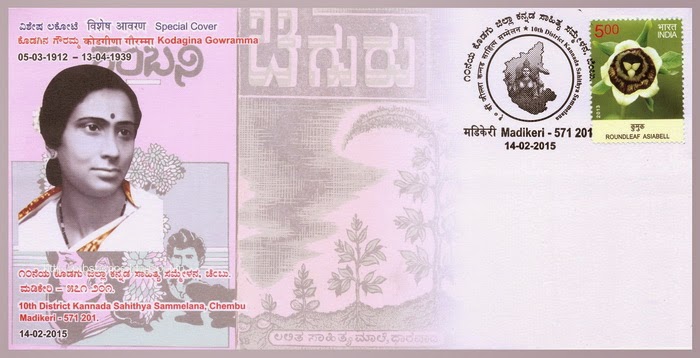
A special cover was released on Kodagina Gowramma on 14th February 2015 at the 10th District Kannada Sahithya Sammelana at Chembu, Madikeri.

Born on 5th March 1912, was a social worker and disciple of Mahatma Gandhi.

PhilatelyKodaginaGowrammaKF26jul2016

Cover Code: KTK/27/2015
Courtesy: Suresh Rao, Bengaluru.

source: http://www.mbstamps.blogspot.in / MB’s Stamps of India / March 21st, 2015

The roots of Kannada in Kodagu…

KannadaKodaguKF26jul2016

The coffee land is all set to witness the 80th Kannada literary meet scheduled to begin on January 7, after a long gap of 32 years. Earlier, Madikeri has witnessed two literary meets – the 18th literary meet in 1932 under the leadership of D V Gundappa and the 54th literary meet in 1982 under the leadership of Dr Shambha Joshi.

Interestingly, despite being one of the smallest districts in Karnataka, it has a wide variety of culture as well as languages that include Kodava, Arebashe Gowda and Malayalam, yet the region has managed to retain the flavour of State language.

If one goes down the pages of history, the little district with unique weather and culture has contributed immensely for the development of Kannada language. The Ganga – Kongwala – Hoysala and Haleri dynasties, perhaps laid the strong foundation for Kannada through inscriptions way back in the 9th century. In the 10th century, Nagaverma had created ‘Chandombudi’ and ‘Punyashrava,’ according to the reference available at ‘Kodagu Sahithya – Sanskrithi Darshana,’ published by Kodagu District Kannada Sahithya Parishat.

During the Chengalva dynasty, the third Mangarasa had published ‘Jayanrupa Kavya’ and ‘Samyukta Kaumudi’ (1508), while his cousin Nanjunda had written ‘Kumara Ramana Kathe.’

There are documents to prove that the first epic ‘Rama Vijaya Kavya’ was written by Devappa, a Jain poet in 1540. Similarly, Dodda Veera Rajendra, who ruled Kodagu between 1789 and 1809, has the credit of documenting history titled ‘Rajendra Name’ in Kannada. The II Linga Rajendra, who ruled Kodagu between 1810 and 1820 had written a book pertaining to land in Kodagu entitled ‘Lingarajana Shisthu.’

The 19th century

The leading name of 19th century pertaining to literature is that of Panje Mangesh Rao, who served as a teacher in Kodagu in 1920s. He had penned poems pertaining to Hutthari festivities among other literary works. In fact, he was the president of All India Kannada literary meet held in Raichur in 1934.

Haradasa Appacchha Kavi, popularly known as the Adi Kavi of Kodagu had penned many plays including ‘Savithri,’ ‘Yayathi,’ ‘Kaveri’ and ‘Subramanya’ in Kodava language. The same were translated to Kannada language by Dr I M Muttanna, who also hailed from Kodagu.

Kodagina Gowramma

The first woman story writer in Kannada literary field, Gowramma, hailed from Kodagu and she is known as ‘Kodagina Gowramma.’ Born in Madikeri in 1912, she did her early schooling in Madikeri and married to B T Gopalakrishna in 1928.

From 1931, she wrote a number of articles and stories in the name of ‘Mrs G T G Krishna’. Most of her stories were based on the theme of women’s problems. However, she passed away in 1940 when she was just 28 years old. When Mahathma Gandiji arrived at Kodagu, she had invited Gandhiji to her home and she had donated her jewellery for the cause of freedom.

Bharathisutha

A teacher by profession, ‘Bharathisutha’ was the pen name of S R Narayana Rao. Based on the life story of Kodagu ruler Siribai Dodda Veerappa, he had written ‘Huliya Haalina Mevu,’ which was later made into a film by the same name.

His other stories too have been made into films and they include ‘Girikanye,’ ‘Edakallu Guddada Mele’ and ‘Bayalu Daari’ among others. His work on ‘Solle Haraduva Rogagalu’ (Diseases transmitted by mosquitoes) and ‘Giliyu Panjaradolilla’ (The parrot is not in the cage) earned him Central government award and Karnataka Sahithya Academy award respectively.

Kittel’s footsteps

Rev Fr Ferdinand Kittel, who contributed immensely to the field of Kannada literature has left indelible marks in Kodagu, prominent among them include the Kannada – English dictionary.

A German missionary, who served in Kodagu church (presently knownn as Shanthi church) between 1871 and 1876, was the first parish priest of the church. Rev Kittel started learning Kannada after going around the coffee land, says the present parish priest of the church.

DH News Service

source: http://www.deccanherald.com / Deccan Herald / Home> District / by Srikanth Kallammanavar / Madikeri – DHNS, January 05th, 2014

Cream of the cuppa: From Coorg to Seattle

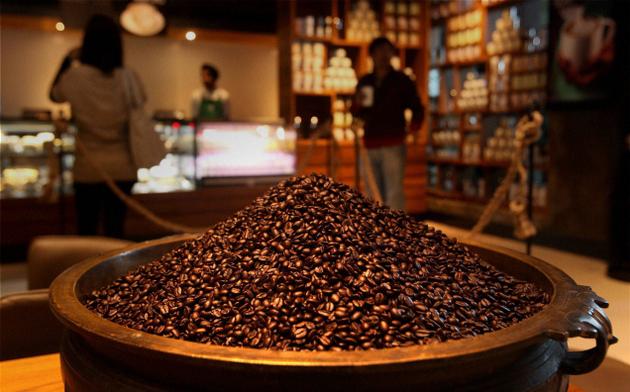
Single-origin Indian coffee will be available for the first time in Starbucks, Seattle, as a limited edition Photo: PTI

Americans, who thrive on Starbucks, will get a taste of a single-origin coffee from India’s Coorg region for the first time. BHUMIKA K. gives you a peek into what the cup holds

A small lot of speciality coffee from Karnataka’s famed Coorg region is getting ready to make its limited edition and exclusive debut later this year at the Starbucks Reserve Roastery and Tasting Room in Seattle, America, considered a shrine almost in the world of high-end coffee.

It is for the first time that the leading American coffee company will offer a single-origin coffee from India in the U.S.

While the formal deal has been inked between Starbucks and Tata Coffee Ltd recently, here is looking deeper into what that cuppa might hold, right from where it was grown. For starters, it is said to be intensely fragrant and aromatic, “with notes of caramel, citrus, toasted nuts, and milk chocolate”.

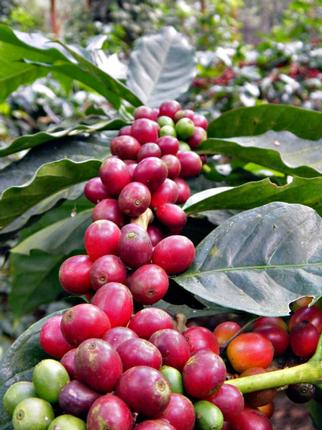
Grown in two-tier shade, the Nullore Estate coffee is a microlot / Photo: Special arrangement

The coffee comes, not surprisingly, from the largest Arabica plantation (394 hectares) in Coorg district, from the Nullore estate owned by Tata Coffee Limited, close to Madikeri. These Arabicas are grown under a two-tier shade system (under local and fruit bearing trees). The shade is carefully managed, which helps the coffee bean mature slowly, absorbing the natural “organoleptic” characteristics within – which gives it the final smell and taste. Coorg is considered to have the perfect agro-climate and soil suitable for coffee cultivation.

Coorg is known for its coffee and Nullore Estate, that belongs to Tata Coffee, is one of the largest Arabica plantations in the district Photo: AFP

“When we cupped the Tata Nullore Estates coffee we noticed this coffee was different from other Indian coffees. The flavour of this rare coffee exemplified the types of unusual coffees we want to deliver under our Starbucks Reserve Programme,” says Andrew Linnemann, Vice President, global coffee quality and engagement at Starbucks Coffee Company. The Starbucks Reserve Programme is an ongoing series of the rarest and most exotic coffees — unique, small-lot coffees that the company creates, roasting them in Seattle. “Each coffee is one-of-a-kind — sourced from small coffee-growing regions in Latin America, Africa and Asia, Pacific Islands. All Starbucks Reserve coffees are roasted with care, at our Starbucks Reserve Roastery and Tasting Room in Seattle, to bring out their peak flavour expression,” adds Linnemann.

“Nullore Estate coffee was a microlot,” points out Sanjiv Sarin, Managing Director and CEO, Tata Coffee Ltd. Microlots are generally considered the “cream of the crop” from an estate, and of course come with a unique taste and a story behind it; they are usually sold in small quantities, mostly only a few kilos. Therefore, they are pricier. “We have been working on premium differentiated coffees for some months now and set up a process to identify potential blocks in our estates whose coffees will qualify. Nullore passed our assessment. A small batch of carefully-cultivated coffee was isolated from the regular farm produce, handpicked and sun dried. Producing quality microlots is a meticulous and tedious process,” reiterates Sarin.

It is technology driven too, including using light-sensitive spectrometers to ensure that the coffee beans mature slowly but uniformly. The shade also means that there is natural mulching from the leaves that fall onto the ground, which in turn helps avoid the use of strong fertilizers and pesticides. Sustainable cultivation practices and an endeavour to maintain the ecological balance were also the focus. The Nullore Estate coffee will be available at the Seattle tasting room later this year, and only for a limited period. The pricing has not yet been decided.

The first Indian coffee to be available through Starbucks was introduced in 2013, to celebrate the Tata-Starbucks first anniversary in the India market. Starbucks created a special India-sourced coffee, called ‘India Estates Blend’, as a tribute to its customers, partners, coffee producers, and roasters. But it was sourced, roasted, packaged, and sold in India. Explaining the difference between a blend and single-origin coffee, Sarin describes how a coffee blend is a combination of coffees from different origins that, when put together, create an experience or flavour profile that does not exist by itself.

“A single-origin coffee comes from one, geographic place (country, region, town, community, estate, mill or farm). This gets to a coffee’s very specific provenance. They represent a ‘taste of place’.”

source: http://www.thehindu.com / The Hindu / Home> Features> Metroplus / Bhumika K / Bengaluru – July 25th, 2016

Govt may withdraw Coffee Act, come out with new Bill

New Delhi :

The government is considering withdrawal of the Coffee Act, 1942, as it “no longer serves the purpose”, Commerce and Industry Minister Nirmala Sitharaman said in the Lok Sabha on Monday.

The Minister was replying to a supplementary during Question Hour on the role of the Coffee Board, especially with regard to small growers, and why it was headless for the past two years.

“Over the years, the role of the Coffee Board has changed and many provisions of the existing Act have become redundant, especially after abolition of the Coffee Pooling System in 1996,” she said, adding that it had been proposed to repeal the Act which was enacted more than 70 years back and enact a new Coffee Bill, 2016.

The suggestions received on the Bill were “regarding the control of the coffee industry, definition of coffee and coffee estate, cognisance of offence under the Act, etc, which are being examined,” she added.

Output decline

In reply to a question from Prathap Simha from Coorg, the Minister said domestic coffee production was likely to fall by 8 per cent in the current fiscal, due mainly to lack of timely rains.

“It has been estimated that there is a likelihood of a decline in coffee production in 2016-17 by 8 per cent compared with 2015-16 due to lack of timely rains and high temperature during the crucial flowering stage,” Sitharaman said.

On another supplementary on whether the government would mandate international coffee chains in India to buy Indian coffee, Sitharaman said the country was home to 2 per cent of the world’s coffee growing area, but produced 4 per cent of global production and had a share of 5 per cent of world coffee exports, worth over Rs. 5,000 crore a year. So, even though international coffee chains have set up shop in India, they do buy coffee locally, she said.

The main buyers of Indian coffee are Italy, Russian Federation, Germany, Belgium and Turkey, which account for over 50 per cent of coffee exports from India, she added.

Duncan tea gardens

On another supplementary by Trinamool’s Saugata Roy who wanted to know how many closed tea gardens’ belonging to the Duncan group in West Bengal had been taken over by the Centre “as promised four months ago”, Sitharaman said the government had moved to take over some tea gardens, but there was litigation by the Duncan group. The Minister said the process to identify new agencies to take over the management of these tea gardens was on, in consultation with the state government.

source: http://www.thehindubusinessline.com / Business Line / Home> Economy> AgriBusiness / The Hindu Bureau / New Delhi – July 25th, 2016

Mysore Medical College alumnus Dr.Dechu Ponnappa gets global recognition

Dr.DechuPonnappaKF24ul2016

Mysuru :

The Leading Physicians of the World (LPW) has recognised Dr. Dechu Ponnappa Puliyanda, MD, an alumnus of Mysore Medical College (MMC), as a top Paediatric Nephrologist in California by including her name in its 2016 edition.

LPW, which began as a yearly publication, selecting and documenting the biographies of medicines brightest minds, has over time evolved into the largest international exclusive medical organisation, representing first rate doctors in over 100 different medical specialties in all major markets across the globe.

Profile: Dechu Puliyanda is an astute clinician with a special interest in Pediatric Nephrology and kidney transplantation. After finishing her Fellowship in Nephrology and Transplantation from Harvard, she joined the prestigious Cedars Sinai Medical Centre in Beverly Hills California, where she currently serves as the Director of the Pediatric Nephrology programme. She is a professor of Pediatrics at Cedars Sinai Medical Centre as well as Professor of Pediatrics at the UCLA-David Geffen School of Medicine at Los Angeles, California.

Her research has focused on viral infections in the post transplant period, and surrogate markers for renal transplant rejection. She is a world-renowned speaker and has presented at a number of national and international conferences. She is an author of many peer-reviewed publications in prestigious medical journals. In addition, she has a very strong commitment to providing comprehensive care to children and adolescents with chronic kidney disease.

Dr. Dechu Puliyanda is is a member of the American Society of Transplantation, International Pediatric Transplantation Association, American Society of Nephrology, American Society of Pediatric Nephrology, International Pediatric Nephrology Association to name a few.

A gold medallist from Mysore Medical College (MMC), Dr. Dechu Puliyanda completed her internship and residency at the Rush Presbyterian St.Luke’s Medical Centre in Chicago. She then completed her Fellowship in Nephrology and Transplantation at the Children’s Hospital, Harvard Medical School, Boston.

She is the daughter of late Dr. Kokkalera Ponnappa and Machie Ponnappa (nee Pandanda), who is a resident of Mittal Panorama on Lalitha Mahal Road in Mysuru. She is married to Subbaiah Puliyanda and the couple have two children, Siddarth and Sitara.

Dechu’s brother Uthaiah Kokkalera is a Robotic Laparascopic Surgeon in Los Angeles, California.

source: http://www.starofmysore.com / Star of Mysore / Home> General News / July 18th, 2016

Coffee Board sees new high in big coffee brew for Nagaland

CoffeeNagalandKF24jul2016

Kohima :

A coffee plantation in the range of 50, 000 hectares of land by 2030 is being envisaged by a collaboration of the department of Land Resources and the Coffee Board of India.

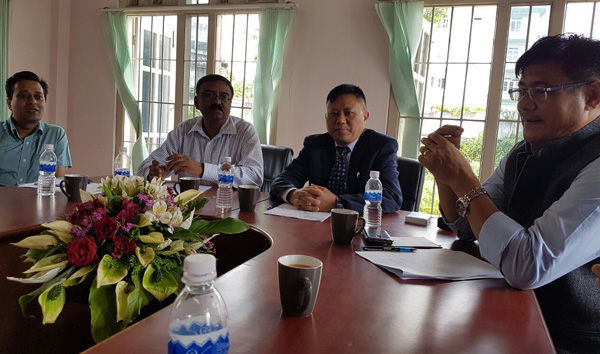
This was revealed by a secretary to the Government of Nagaland, Y Kikheto Sema, during a joint meeting of the department’s officials with the officials of the Coffee Board of India, under the Union Ministry of Commerce & Industry. The central team was led by Joint Secretary AP Anantha Kumar. The meeting was conducted at the Land Resources directorate in Kohima town Wednesday.

Joint Secretary Kumar said during the meeting that support would be given to the state government in its undertaking production for coffee. While assuring all possible support to the state government in its ‘massive coffee plantation drive,’ he however asked the Land Resource department to make proposals toward setting up an office of the board in Kohima. Likewise, he suggested that the state seek enhancement of coffee seed allocation.

Also, according to Kikheto Sema, the department and other line departments would be undertaking a massive ‘coffee plantation drive’ in every district of Nagaland as the state has been declared geographically and topographically suitable for coffee by the coffee board.

The officials has requested the board’s officials to enhance the allocation of coffee seeds for the state and also to provide technical support and training of trainers and officials, who in turn would be able to train villagers in ‘achieving the target.’

Saying that the department had been encouraging local farmers to give up ‘jhum’ cultivation to engage in coffee plantation, Sema said that the slash-and-burn cultivation method does not offer ‘much dividend.’ However, coffee plantation, he said, will help in uplifting the rural economy besides improving the living standard of the rural people.

Further, maintaining that there was no scope in large and medium scale industries in the state, Sema expressed optimism in agro-based industries. The Land Resources department is undertaking only a few commercial crops such as coffee and rubber but they are crops feasible for the state, he said.

The official also said that the church being the ‘main institution’ in Nagaland, the department was contemplating involving the church in coffee plantation by providing them technical support.

Sema opined that the Coffee Board and any investors willing to come to the state should not have the ‘excuse’ of law and order situations as the state, he claimed, was ‘very peaceful.’

source: http://www.easternmirrornagaland.com / Eastern Mirror / Home> News> Nagaland> State> Current Article / by Eastern Mirror Correspondent / July 21st, 2016

Rohan Bopanna

Rohan Bopanna will partner with Leander Paes in men’s doubles and with Sania Mirza in mixed doubles at Rio Olympics.

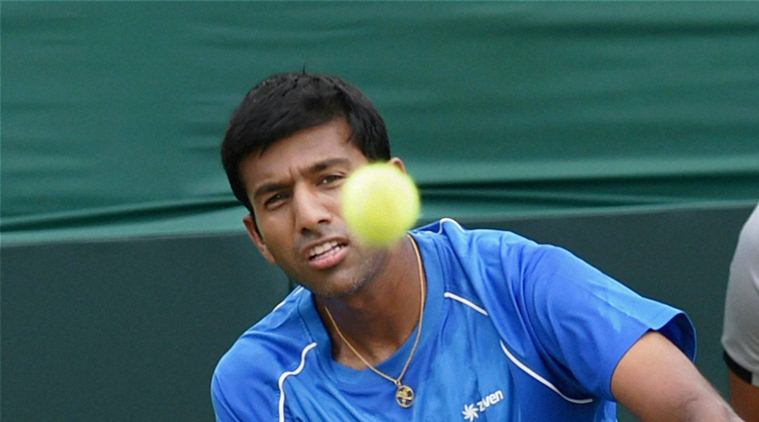
Chandigarh: Rohan Bopanna plays against Korea's Hong Chung in the Asia/ Oceania Group I 2nd Round of Davis Cup in Chandigarh on Sunday. Bopanna won the match 3-6, 6-4, 6-4. PTI Photo by Atul Yadav
Chandigarh: Rohan Bopanna plays against Korea’s Hong Chung in the Asia/ Oceania Group I 2nd Round of Davis Cup in Chandigarh on Sunday. Bopanna won the match 3-6, 6-4, 6-4. PTI Photo by Atul Yadav

Rohan Bopanna, 36

Event: Tennis (Men’s doubles and mixed doubles)

Event date: August 6

Qualifying Event: Qualified for Rio Olympics on account of 10th rank on the cutoff date of June 6

Records: Rohan Bopanna has participated in just one Olympics before this (2012) exited in the second round in men’s doubles.

Career highlights (in last two years): Won Madrid Masters 1000 event (2015), Runner-up at World Tour Finals (2015)

Bio: Rohan Bopanna is India’s mainstay in the men’s doubles department on tour with his Romanian partner Florin Mergea. Bopanna trained with Mahesh Bhupathi’s father – Bopanna’s partner at London Olympics (his only other Olympic participation) – and now travels full time with his own team and physios.

He finished in the top 10 of 2015 – a first in his career – and maintained his foothold in the top 20 for fifth time in six years.

source: http://www.indianexpress.com / Indian Express / Home> Express Sports> Sports / by Express Web Desk / July 19th, 2016

Sport – Peta

Bopanna urges fans to shun cockfighting in Peta Ad

BopannaKF24jul2016

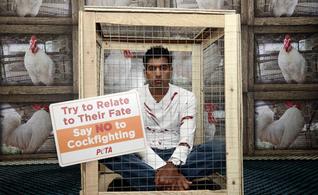
As part of an ad campaign for PETA, tennis star Rohan Bopanna has urged his fans to stay away from cockfighting, a blood sport in which roosters are placed in a ring and forced to fight to death.

Posing with rescued rooster Smack, he appears next to the words ‘Tennis Is a Sport — Cockfighting Is Not’.
The visual for the campaign was shot by ace photographer Sam Mohan.

In December 2014, Bopanna had caged himself holding a sign that proclaims ‘Try to Relate to Their Fate.

Say No to Cockfighting’, as part of a similar ad campaign.PTI

source: http://www.thehindu.com / The Hindu / Home> In School /PTI / New Delhi – July 20th, 2016

Indian Davis Cup Team Dancing After 4-1 Win Over Korea On Sunday

Not used to playing singles anymore, India’s Rohan Bopanna found rhythm in nick of time to edge past Hong Chung before Yong-Kyu Lim prevented a Korean whitewash with a gritty win over Ramkumar Ramanathan in the Davis Cup Asia\Oceania Group I tie on Sunday.

Asked to take court in place of Saketh Myneni, who is still recovering from his gruelling match on Friday, Bopanna laboured to a 3-6 6-4 6-4 win

source: http://www.youtube.com / Indian Express Online / published July 17th, 2016