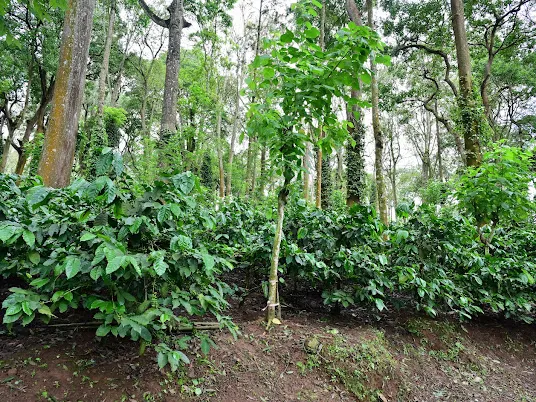
Over 2,000 coffee plants, 250 pepper vines cut down at Kalakooru village
Madikeri:
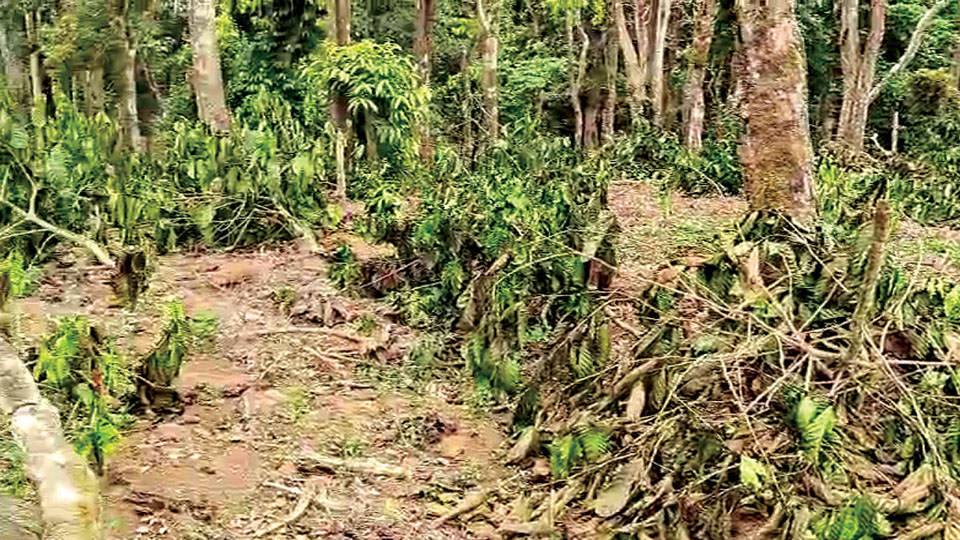
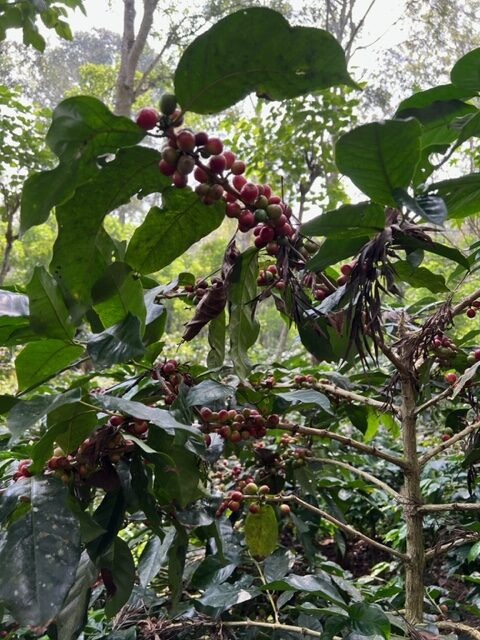
In a shocking incident of large-scale vandalism, unidentified miscreants entered a coffee plantation at Kalakooru village near Birunani in Ponnampet taluk of Kodagu district and destroyed more than 2,000 coffee plants and 250 pepper vines, causing losses estimated to run into several lakhs of rupees.
The plantation belongs to Kuppanamada Gautham, who had carefully developed the four-acre estate over the years with seven-year-old coffee plants and pepper vines. The estate was equipped with modern surveillance measures, including CCTV cameras installed at strategic locations.
The incident took place while Gautam and his family were away in Mysuru to attend a wedding ceremony. Taking advantage of their absence, miscreants trespassed into the plantation and carried out widespread destruction.
In addition to cutting down the crops, the perpetrators disconnected and took away the CCTV cameras in an attempt to erase evidence.
The destruction was extensive, with coffee plants and pepper vines cut at ground level, leaving no scope for regrowth. Gautham now faces the difficult and expensive task of re-establishing the plantation from scratch.
Villagers described the act as deliberate and well-planned. They pointed out that the scale of destruction indicated the involvement of at least eight to ten persons.
The incident triggered outrage among villagers and members of the local farming community, who strongly condemned the destruction of crops and demanded immediate action against those responsible.
Hudikeri Revenue Inspector Santhosh visited the spot and inspected the damaged estate. Srimangala Police Station Inspector A.S. Ravindra, along with his team, also visited the plantation. Police deployed a dog squad to gather clues.
source: http://www.starofmysore.com / Star of Mysore / Home> News / May 08th, 2026
A new climate analysis finds India’s coffee farms absorbed 30 extra days of harmful heat annually because of carbon pollution. Researchers are racing to find alternatives before Arabica and Robusta run out of room.
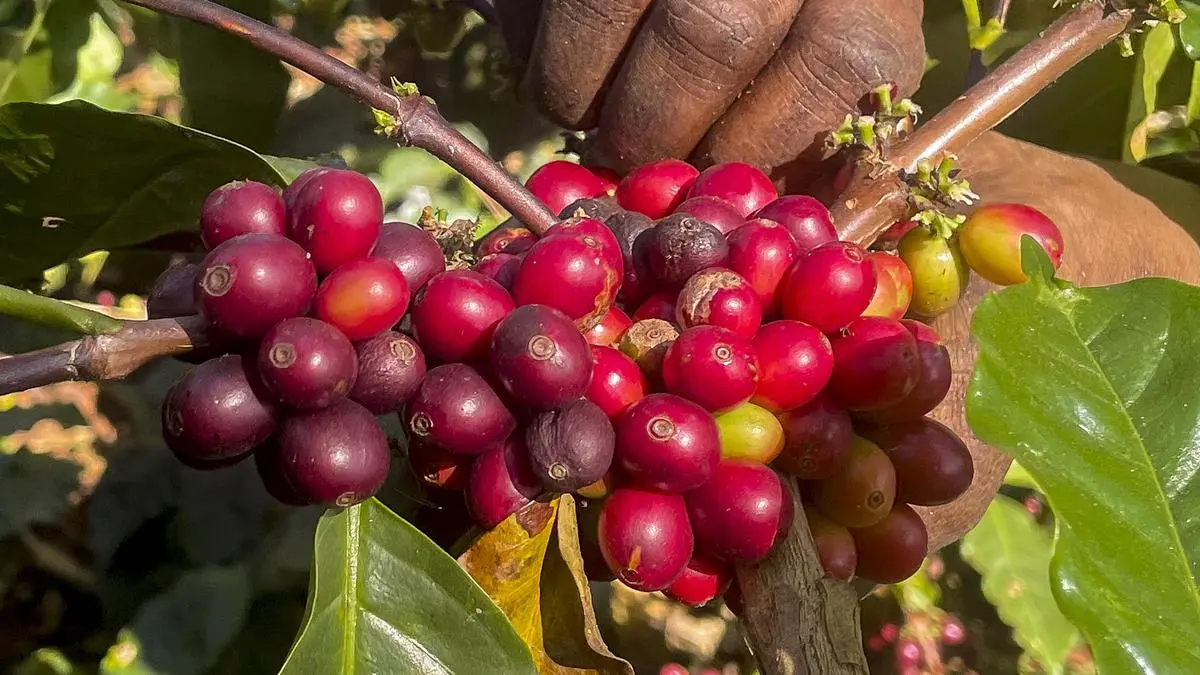
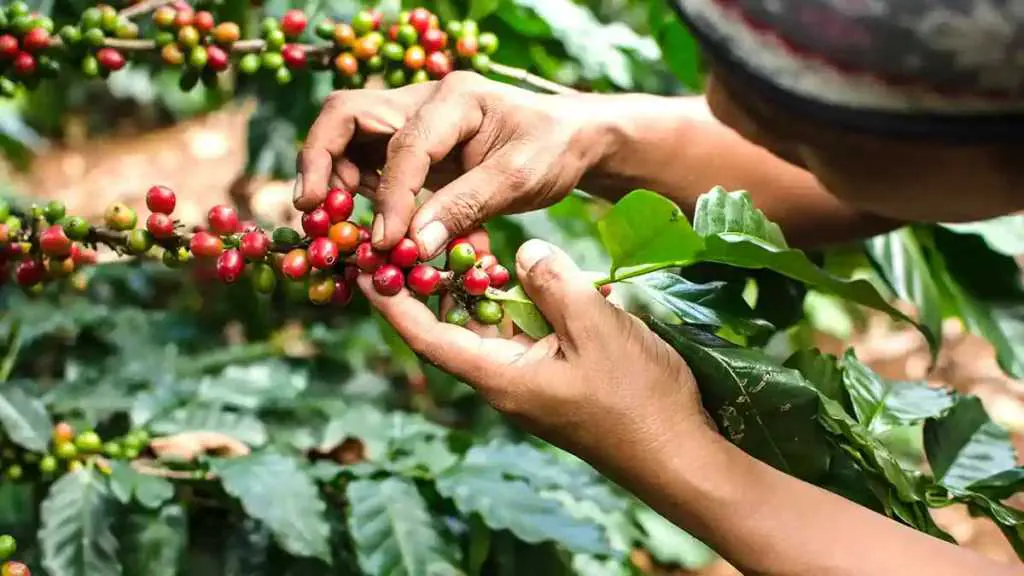
A worker picks ripe coffee cherries at Kelachandra Coffee Estate, in Chikkamagaluru district, Karnataka, on January 10, 2026. | Photo Credit: Laxmi Devi Aere/PTI
More than two billion cups of coffee are consumed every day, and for several years now, surging prices and falling production have marked the global coffee trade. Farmers in the world’s top five coffee-producing countries have faced mounting losses because of a warming planet, and India’s coffee sector is not immune. A new analysis by Climate Central, an independent group of scientists and communicators who research the changing climate, finds that 25 coffee-growing countries together accounting for about 97 per cent of global production all experienced more coffee-harming heat over the past five years.
Kristina Dahl, Climate Central’s Vice President for Science, explained to Frontline in an email interview why coffee was chosen as the subject. “Coffee is one of the most popular beverages in the world and a daily staple for billions of people,” she said. “It also provides a very direct and tangible link between climate change and everyday life. Any climate-driven disruption to coffee production has global ripple effects—from farmers in the ‘bean belt’ to consumers worldwide.”
Coffee plants are highly sensitive to temperature. When maximum temperatures regularly exceed 30°C, the quality and quantity of bean harvests decline. Reduced harvests and lower-quality beans tighten global supplies, contributing to price volatility—as seen in December 2024 and again in February 2025, when global coffee prices reached record highs, Dahl said. For farmers, many of them smallholders, lower yields, crop losses, and the cost of adapting to new conditions strain already thin profit margins.
The analysis, which examined daily temperatures between 2021 and 2025 across 25 major producing countries, is the first to directly attribute the increase in coffee-harming heat days—defined as days when maximum temperatures exceeded 30°C—to climate change using attribution science, she said. Climate Central drew on its Climate Shift Index, which compares observed temperatures to modelled estimates of temperatures in a hypothetical world without carbon pollution. Last year, the organisation conducted a similar attribution analysis on cocoa, another climate-sensitive crop.
Heat is already impacting harvests
The top five coffee-growing countries—Brazil (roughly 37 per cent of global production), Vietnam (17 per cent), Colombia (8 per cent), and Ethiopia and Indonesia (6 per cent each)—together are responsible for 75 per cent of world’s supply, experienced an average of 57 extra coffee-harming heat days per year because of climate change. Brazil averaged 70 additional harmful heat days annually; Indonesia 73; Vietnam 59; Colombia 48; and Ethiopia 34.
The situation is particularly acute in Asia, Dahl pointed out. Thailand recorded an average of about 75 additional harmful heat days a year. India, which contributes approximately 3.5 per cent of global coffee production, experienced an average of 118 coffee-harming heat days per year between 2021 and 2025, of which 30 were attributable to climate change. In a world without carbon pollution, India would have had roughly 88 such days instead of 118. Kerala recorded 65 additional heat days linked to climate change annually; Tamil Nadu 43; and Karnataka, India’s largest coffee-producing State, 32.
These impacts are not theoretical. “In practical terms, rising heat is already affecting harvests in major coffee-producing countries, threatening both quantity and quality,” Dahl said. She pointed out that while earlier studies had linked rising temperatures, drought, and shifting rainfall to reduced yields and shrinking suitable growing areas, the Climate Central analysis adds a new dimension: it quantifies precisely how many additional harmful heat days can be attributed to carbon pollution.
Beyond heat, the analysis notes that climate impacts are worse for Arabica plants, which account for about 60–70 per cent of global supply, since they are more sensitive than Robusta varieties to temperatures above 30°C. Pests and diseases—coffee leaf rust and the coffee berry borer in particular—also intensify with climate change. Without significant reductions in carbon emissions, suitable land for coffee farming could decline by up to 50 per cent by 2050, according to earlier research cited by Dahl. “Adaptation and resilience can only take farmers so far,” she said.
Wild species and the search for alternatives
India is the world’s fifth-largest Robusta producer, and about 80 per cent of its coffee is grown by smallholders, according to World Coffee Research. The country’s coffee exports earned approximately $1.28 billion in fiscal year 2023–24, making it a significant agricultural earner.
Akshay Dashrath, co-founder of the South India Coffee Company (SICC), which he set up in 2017 with his wife Komal Sable as a sourcing and logistics platform, has been researching Excelsa (Coffea dewevrei) since 2019. He found a market initially difficult to reach, but publications by the Royal Botanic Gardens, Kew, on Excelsa and related species accelerated demand. He has been working with Kew for three to four years on climate-resilient coffee species, running trials of Excelsa, Stenophylla, and four coffee species native to India—Coffea bengalensis (found from Chikmagalur to Thailand), Coffea travancorensis, neobridsoniae, and wightiana—on his family’s Mooleh Manay Estate in North Coorg, Karnataka. For the past two years, he has also been breeding Excelsa for better cup quality and commercial viability.
“A hotter environment means coffee is under stress: production per plant reduces, cup quality drops, and the plant weakens. It is happening in specific blocks—those with less shade are more susceptible to disease, and once the plant is weak, it becomes prone to fungal infection,” Dashrath said. He described a severe leaf rust outbreak on his farm: the heavily shaded plants survived, but those under direct sunlight lost their foliage.
Rising heat is not the only problem. He pointed out that for Robusta—and for Arabica—dry air matters as much as temperature. “Heat with dry air is more damaging to certain species,” he said. Excelsa, native to Central Africa, tolerates heat, dry air, and drier soils better than Arabica or Robusta because its root system goes considerably deeper, giving it access to soil moisture that shallower-rooted varieties cannot reach. Dashrath puts Excelsa’s root depth at 4.5 to possibly 7–8 feet, compared with Robusta at 2.5 feet and pure Arabica at around 3 feet.
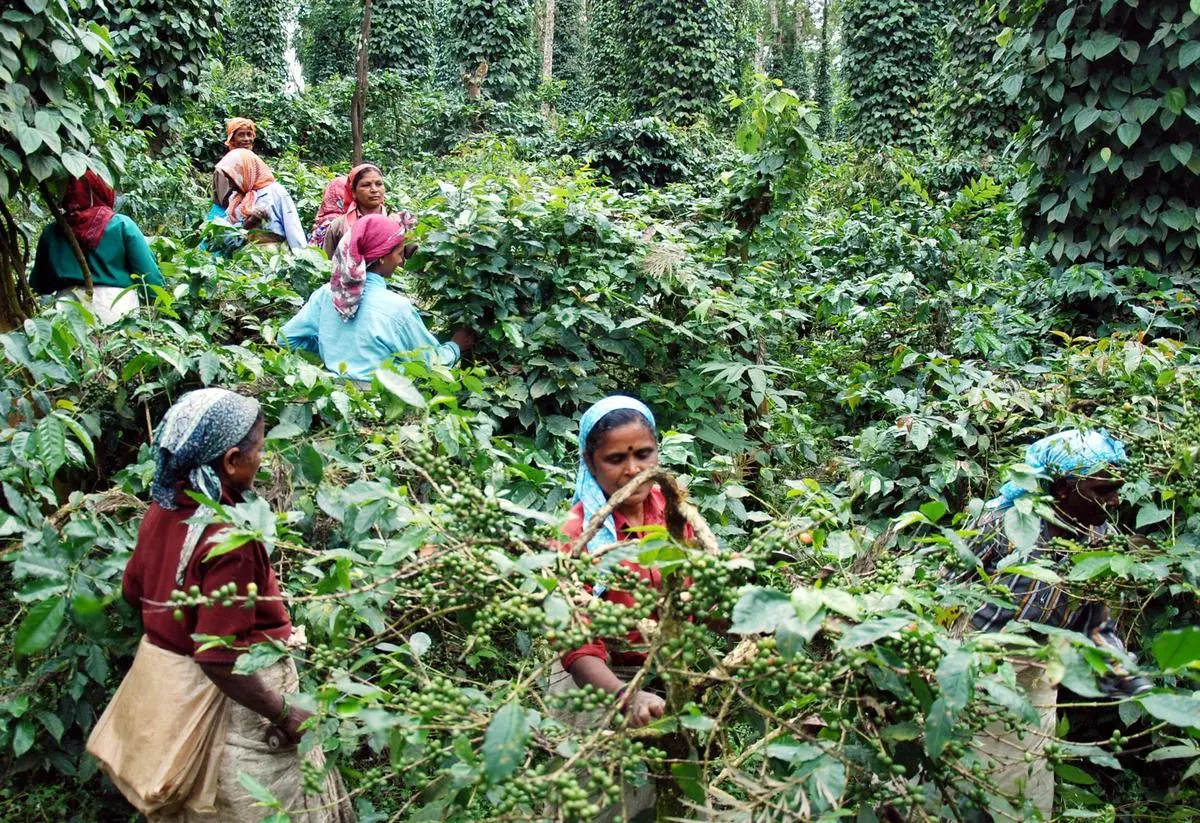
Coffee plants are highly sensitive to temperature. When maximum temperatures regularly exceed 30°C, the quality and quantity of bean harvests decline. | Photo Credit: Prakash Hassan
Indian coffee has been grown under shade since the 1850s, making canopy management central to the crop’s culture. However, Dashrath notes that many growing belts are now thinning their canopy to increase yields by admitting more sunlight, and supplementing Robusta with external irrigation—a trend that could leave farms more exposed to heat and moisture stress.
India also carries a legacy of genetic limitations. “Historically, we had access to diverse germplasm, including hybrids of Arabica, Liberica, and Excelsa,” Dashrath said. “But in the 1940s, the research focus shifted towards developing Arabica–Robusta hybrids for leaf rust tolerance.” The result is that the country’s commercial varieties remain concentrated in two species highly sensitive to warming. The Central Coffee Research Institute, founded in 1925, is conducting research on climate-resilient coffee, though its director did not respond to a request for comment.
The case for Excelsa as a climate buffer became clearer to Dashrath in July 2024, when 33 inches of rain fell on his farm in a single month—far more than the typical annual average of 58 inches. Arabica and Robusta could not withstand the waterlogging, but Excelsa’s deeper root system held. “When we talk of climate-resilient coffee, we need species that can handle not only heat but also climate variability,” he said.
Stenophylla (Coffea stenophylla), a wild species from West Africa, offers another avenue. Rediscovered in Sierra Leone in 2018 after not being seen in the wild since 1954, Stenophylla has been found to tolerate temperatures significantly higher than Arabica while producing a comparable flavour profile, according to research published in Nature Plants in 2021 by scientists from the Royal Botanic Gardens, Kew, the University of Greenwich, CIRAD, and researchers in Sierra Leone. It is currently on the IUCN Red List as “Vulnerable.”
Excelsa currently accounts for about 1 per cent of the global coffee market and is grown commercially in small quantities in Chikmagalur and Coorg. SICC received a grant from Coffee Circle last year to grow Excelsa on trial plots across six different sites; the data from those trials has been shared with Kew, which is mapping climate conditions from Uganda to India and parts of South-East Asia. The trials are informing a broader picture of which plant material performs under changing conditions.
Still, Dashrath is candid about the timeline. Arabica has been bred for around 600 years; Robusta for 150. Excelsa is a wild species with considerable variation from plant to plant, and no consistency in yields. Getting it to a standard where it can compete in commodity markets is a 20–25-year project, he said. “The market is there, but it needs more breeding, standardised seeds, and testing before it can be deployed at scale. Currently it is a niche product, priced rather high.”
There are over 120 recognised coffee species, according to Kew researchers, though most are either inedible or commercially unviable. Coffea racemosa, from Mozambique, has also attracted attention for its claimed heat tolerance, though published data on its upper temperature threshold remain limited. Dashrath is blunt about the bottom line: “If the world gets warmer, coffee-growing areas may shift, or alternatives like Excelsa may need to move to centre stage. To sustain coffee, we need to start looking outside the realm of Arabica and Robusta.”
Concerns about Arabica’s future are felt most acutely in Ethiopia, the crop’s birthplace. Dejene Dadi, General Manager of the Oromia Coffee Farmers Cooperatives Union (OCFCU), one of Ethiopia’s largest smallholder coffee cooperatives and exporters, put the stakes plainly: “Coffee farmers in Ethiopia are already seeing the impact of extreme heat. Ethiopian Arabica is particularly sensitive to direct sunlight. Without sufficient shade, coffee trees produce fewer beans and become more vulnerable to disease.” He called for governments to act on climate change and invest in smallholder organisations capable of scaling up adaptation. “Coffee farming is part of our cultural heritage, and coffee trees are symbols of continuity and pride,” he added. “Ethiopia is the birthplace of coffee, and Ethiopian coffee farmers are key to safeguarding its future.”
Research at the Royal Botanic Gardens, Kew—through a project focused on Excelsa and Liberica coffee and related species, with field and farm trials across Africa and Asia—offers some grounds for cautious optimism. The work is designed to identify which species combinations can sustain coffee cultivation in warming conditions and provide farmers with alternatives to the two varieties that currently dominate.
For India’s approximately 3.6 lakh coffee farmers, most of them dependent on Robusta for their livelihoods, and for the country’s coffee export sector—worth close to $1.3 billion in FY2023–24 and significantly more since—the challenge from climate change is not distant. It is measured, now, in 30 extra days of harmful heat each year, and rising.
Meena Menon is a freelance journalist and visiting postdoctoral fellow at Leeds Arts and Humanities Research Institute, University of Leeds.
____________
Summary
A Climate Central analysis reveals that 25 major coffee-producing countries, including India, are experiencing increased ‘coffee-harming heat’ due to climate change, impacting global production and prices. India faces an average of 118 such days annually, with 30 directly attributable to climate change. This heat stress reduces yields and quality, particularly for sensitive Arabica plants. Researchers are exploring climate-resilient coffee species like Excelsa and Stenophylla, which exhibit better tolerance to heat and variable weather conditions. While these alternatives offer hope, their widespread commercial adoption requires significant research and development, highlighting the urgent need for climate action and adaptation strategies to safeguard the future of coffee.
Key Questions & Insights(AIⓘ)
What is the primary finding of Climate Central’s analysis regarding global coffee production?
Why was coffee chosen as the subject for Climate Central’s analysis?
How does high temperature affect coffee plants and global coffee prices?
What is ‘coffee-harming heat’ as defined by Climate Central?
How many additional coffee-harming heat days did India experience annually due to climate change between 2021 and 2025?
Which Indian states were most affected by climate change-linked heat days for coffee production?
Why are Arabica plants more vulnerable to climate change than Robusta varieties?
What is the potential impact of climate change on suitable land for coffee farming by 2050?
What is the significance of Excelsa coffee in the context of climate change?
What is the current status of Excelsa in the global coffee market?
What is Stenophylla and why is it considered a promising alternative coffee species?
What is the main challenge for India’s coffee sector due to climate change?
_____________
source: http://www.frontline.thehindu.com / Frontline / Home> India> Environment> Digital Exclusive / by Meena Menon / February 25th, 2026
I learnt to appreciate coffee at the age of thirty-seven and since then I have been tasting coffee at speciality coffee shops in and out of Singapore. The more types of coffee I tried, the more I want to try. From just drinking coffee made by others, I ventured into brewing coffee on my own and soon I became the owner of many coffee gadgets and accessories.
When I was in Papua New Guinea for ten days, I was drinking one of the best coffees from the Eastern Highlands. I did not stop at that. I visited coffee plantations in countries like Indonesia, Sri Lanka, Vietnam, Mexico, Thailand, and India. Within India, I have visited coffee plantations in the states of Odisha, Kerala and most recently Karnataka.
Karnataka produces about 71% of India’s coffee and Coorg in Karnataka produces 33% of India’s coffee! Coorg, a beautiful hill town is covered with acres of green, lush coffee plantations. I had to the pleasure of not just touring but also roasting and grinding my own coffee blend when I visited @fivefarms.in coffee plantation in Coorg.
I have not been exposed to Indian coffee much except when I am travelling in India. I became much more enlightened after my visit to @fivefarms.in and my meeting with Subbaiah and Ashith, partner and founders of @fivefarms.in.
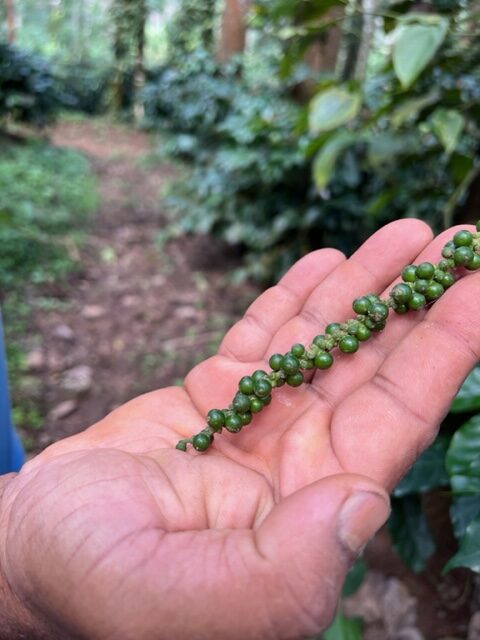
Subbaiah and Ashith stay in a 75-year-old bungalow surrounded by the Malcode coffee estate in Chetthalli Village, Coorg, Karnataka. This coffee estate produces Arabica and Robusta coffee beans and the popular #Indianblackpepper — Paniyoor black Pepper.
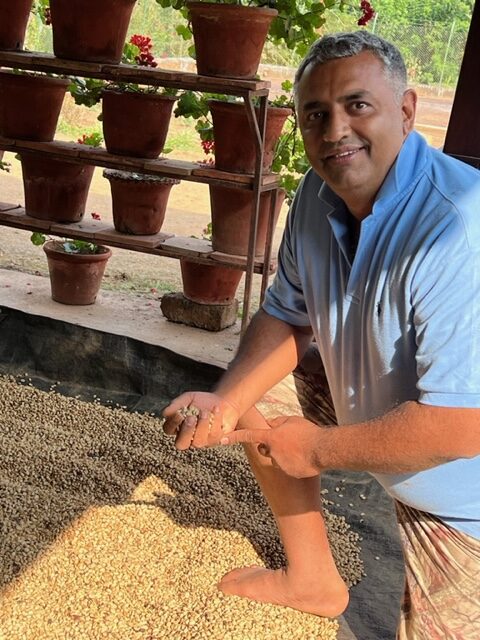
The husband-wife team are third generation coffee farmers and founders of fivefarms.in – one of India’s premium single estate coffee stores. Subbaiah told me that they believe in very traditional plantation skills but ensure that they apply only modern roasting and grinding techniques to their coffee beans.
They conduct Seed to Cup tours of the coffee estate. I learnt the history of how coffee was discovered and brought to India, its culture, farming techniques including harvesting, inspection of the coffee plants, and production process from its raw state.
After the tour, I had the pleasure of sampling a sumptuous lunch prepared by Ashith and her mother-in-law, ending with a cup of freshly brewed coffee!
I left the farm with about a kilogram of freshly roasted and ground coffee!! Thank you @fivefarms.in
__________________
Devagi Sanmugam
As a chef, spice curator, and author of over 20 cookbooks, my life revolves around the exquisite world of food. I am deeply passionate about experiencing food in all its forms—I love to see, touch, smell, hear, and feel the ingredients that create culinary magic. Each spice tells a story, every herb evokes a memory, and the textures of food bring joy to my senses. Traveling is not just a pastime for me; it is an essential part of my journey as a culinary educator. Exploring diverse cuisines around the world allows me to expand my knowledge and understanding of food, enriching both my cooking and teaching. I revel in discovering new flavors and techniques that I can share with others, igniting their own passion for cooking. This blog is a heartfelt expression of my love for food—a platform where I can share my culinary adventures, insights, and recipes. Join me as we explore global cuisine, celebrating the beautiful and delicious experiences that food offers.
There’s more to Coorg than the coffee plantations, resorts and mountains shrouded in mist.
There are no Café Coffee Days or Baristas in the coffee county. Instead, vistas of stumped coffee plants growing in the shade of benevolent native trees stretch through silence broken by whistling wind and falling yet uplifting waterfalls. Wild elephants meander in the plantations in the day and fireflies fly in the plantations at night. Coorg is a country painted on a canvas and brought to life.
When you travel within India, you feel the truth of the cliché you’ve heard since childhood — India is many countries into one. How different are the people, their attires, aspirations, lives and even histories and humanities.
The bumpy, washed out road from Mangalore to Coorg changes its rough character drastically the moment it enters the Coorg district.
Perched on the Western Ghats of Karnataka, Coorg or Kodagu has gained its popularity in India in the recent years. She has claimed her place as a coffee plantation hill station, like her near and distant tea plantation cousins Kodaikanal, Ooty and Darjeeling. And with this claim numerous new resorts in the region have burgeoned, many of them located inside the coffee estates.
According to popular belief, coffee in India is rooted in a mystical beginning in the 17th century. The Muslim saint Baba Budan, returning from a pilgrimage, clandestinely brought along seven coffee seeds from Yemen (from where it was forbidden to take coffee seeds) and planted them in Chandragiri hills in Karnataka. These hills are now known as Baba Budan Giri. Like the seven skies and the seven rounds of Kabaa, the holy significance of number seven led him to carry seven seeds.
Kodavas are the main ethnic group of Coorg, carrying a rich farming and militia history. It is a culture that thrives on Nature, not industry. Paddy fields in the foothills and coffee plantations on the slopes, mainly around the district headquarter Madikeri, are the traditional and main source of livelihood.
What is different about the coffee country is not just the coffee, but guns. The Kodavas, being warriors in ancient times, worship arms. Guns are an important part of the festivals of this region. “Most families carry two or three guns,” says Biju, the co-owner of a coffee plantation that spreads over 400 acres. He continues with a glint in his eyes, talking about his passion, i.e., guns. “And yet it is one of the safest places to live in. The crime against women is quite rare and they are the main decision makers in many families.”
That is indeed reflected in the sex ratio where the number of females exceeds the number of males.
There are other ethnic communities and forest-dwelling hunter and gatherer tribes as well. Water is aplenty and the main river of the region is Cauvery. Coffee makes Coorg one of the richest districts of India. Sunil, the co-owner of a coffee plantation and The Porcupine Castle resort answers with a knowing grunt, when we inquire where we can find good coffee, “The coffee that you’re used to , is a mixture of different varieties of coffees.
And each one has a secret formulation, which the company doesn’t disclose. They just buy the raw coffee variety from us like Robusta and Arabica and process and mix it themselves.”
Nonetheless, the Indian coffee is supposed to be one of the finest in the world, grown fully in the shade of eucalyptus, vanilla and native evergreen and leguminous trees. The shade giving trees not only protect the coffee plants but also enrich the soil and prevent erosion. The exotic, full-bodied taste and aroma finds its way to your cup through intense labour and extraordinary care.
The coffee plantations are as multicultural and inclusive as the medley that is India. Pepper, cardamom, vanilla, a local variety of orange and bananas share the same home, drawing their daily supply of nutrients from the shared pool of coffee plantations.
The homesick British, who once inhabited the cool climes of Coorg, named it the Scotland of India. British architecture still stands strong in Madikeri and many tourists visit the same. Around 5 km away from Madikeri is Abbey Falls, a sight to behold, provided it’s not a public holiday.
There is Iruppu Falls too where you can actually go inside the water. An elephant camp of the forest department at Dubare is another tourist attraction and so is Nisargadhama, an island in Cauvery. For the religious, there is Talacauvery, the origin of Cauvery, with a Lord Brahma temple on the bank. For the adventurous, there are the Nagarhole National Park, and Brahmagiri, Talacauvery and Pushpagiri Wildlife Sanctuaries. You can hope to catch a glimpse of a tiger, gaur, dhole (wild dog), leopard or elephant that magnanimously let you pass through the privacy of their living space.
Ever wondered what we would do if a tiger or a guar or a dhole or a leopard enters the privacy of our home or our garden or our street or even our city?
But the Kodavas and the other ethnic groups and tribals of Coorg don’t mind them coming in to their plantations and passing by their villages.
They know better than us that the mountains and fields belong as much to a lonely elephant or a pack of dholes. If I were to settle in the coffee country, it won’t be only for the lush landscape or healthy sex ratio or rich culture; it will be for the forgotten pleasures of experiencing synergy with nature.
source: http://www.thehindu.com / The Hindu / Home> Todays Pages> Features> Metroplus / by Arefa Tehsin / May 18th, 2016
“Trace the Cup” new film-led series follows the journey from estate to cup, spotlighting sourcing and flavour.
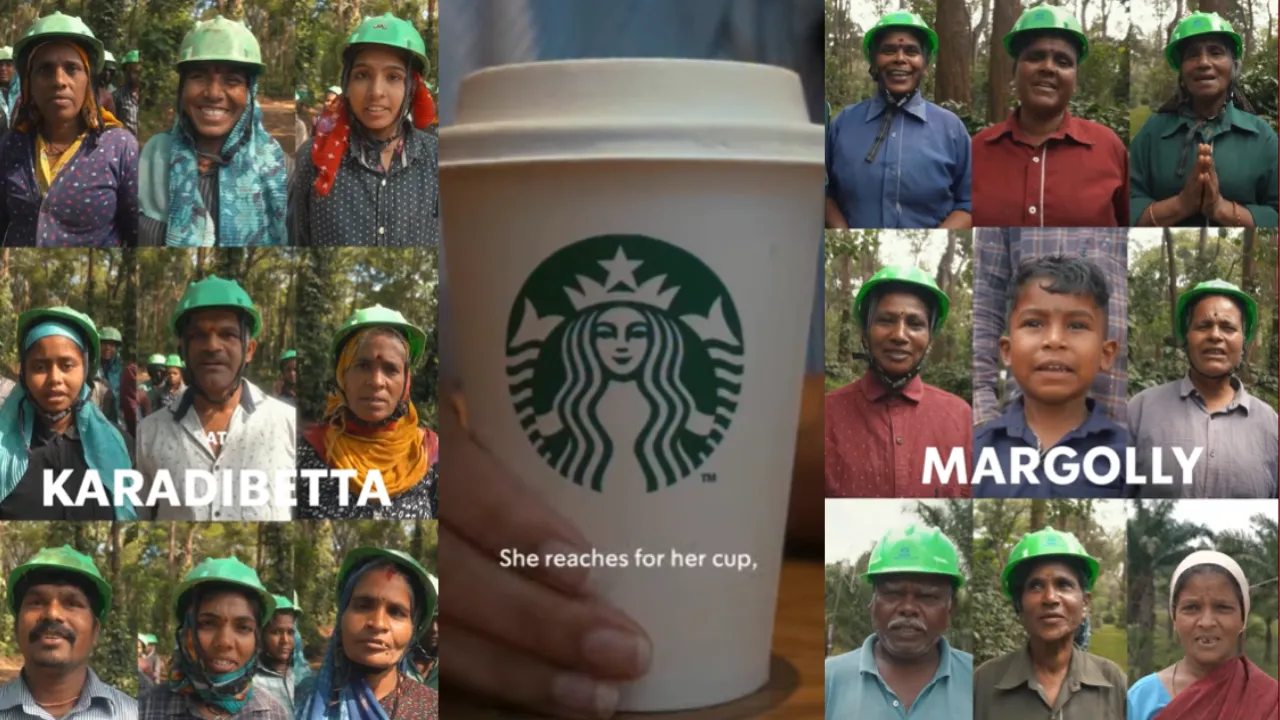
Tata Starbucks is turning the focus to India’s coffee-growing regions with a new film centred on its first estate-specific single-origin offerings.
Sourced from the Nullore, Margolly, and Karadibetta estates in Coorg, Karnataka, the launch marks the brand’s first move into estate-exclusive coffees in India. The initiative puts a spotlight on how factors like origin, altitude, and farming practices influence flavour — elements often discussed in global coffee conversations but less visible to everyday consumers in India.
As part of this, the brand has introduced “Trace the Cup”, a content series that follows the journey of coffee from estate to cup. The idea is to make the sourcing and production process more transparent, while building awareness around Indian coffee and the people behind it.
“Indian single-origin coffees have a distinct identity shaped by their origin and more than that, the people who grow them. ‘Trace the Cup’ helps us bring that story to the forefront, allowing customers to better understand where their coffee comes from, what makes each origin unique and how it all contributes to the signature Starbucks experience, in our stores,” said Mitali Maheshwari, Head of Product & Marketing, Tata Starbucks.
source: http://www.afaqs.com / afaqs! / Home> Advertisins> News / by afaqs! news bureau / April 02nd, 2026
In this photo essay, we showcase more exhibitors at IICF 2026, along with expert insights.
Bengaluru recently hosted the 2026 edition of the India International Coffee Festival (IICF) at Chamara Vajra, Jayamahal Road. See our earlier coverage of the World Coffee Conference in 2023 here.
“We estimate that 20,000 visitors attended the three-day IICF event. The energy on the floor was indicative of strong commercial engagement,” Hamsini Appadurai, President of the Specialty Coffee Association of India (SCAI), tells YourStory.
The festival featured India’s geo-tagged coffee varieties such as Coorg Arabica Coffee, Wayanad Robusta Coffee, Chikmagalur Arabica Coffee, Araku Valley Arabica Coffee, and Bababudangiris Arabica Coffee. There were also international brands such as MilkLab (Australia), Astoria Coffee Machines (Italy), and Probat Coffee Roasters (Germany).
IICF had parallel workshops on Farm to Cup: Post-Harvest Processing 101; Robusta Tasting: Processing Methods; Roasting Fundamentals: Profile Building & Tasting; Coffee Species Showcase & Guided Tasting; Manual Brewing and Espresso Brewing; and Marketing Specialty Coffee: Storytelling & Tasting;
There were panel discussions on a range of provocative topics: Why Biodiversity Is the Foundation of Coffee’s Future; and The New Coffee Farmer: Balancing Yield, Quality, and Profit in a Changing Market.
Many visitors said they appreciated the opportunity to learn about coffee trends and network with coffee lovers and industry professionals. “Exhibitors were pleased with the promotion of the shared vision and passion of the industry,” Appadurai adds.
She explains that the Australia delegation places IICF right up there along with other global events such as World of Coffee Dubai, World of Coffee Indonesia, World of Coffee Bangkok, FHA Singapore, and Melbourne International Coffee Expo.
“The festival was a rich source of inspiration and strategic thinking. One initiative already taking shape for the next edition is a dedicated micro-lot auction for roasters, an exciting development that we believe will add significant value to the specialty coffee ecosystem,” Appadurai says.
Last year, Nestlé India strengthened its premium at-home offering by bringing Nespresso to the country. “With this, we cater to consumers seeking super premium coffee experiences at home,” says Sunayan Mitra, Director – Coffee and Beverages, Nestlé India.
It has expanded its NESCAFÉ Ready-to-Drink cold coffee portfolio, and developed NESCAFÉ Ice Roast. At IIFC, it showcased Duo Gusto, a pioneering solution that dispenses both hot and cold beverages from a single machine. “Innovation in cold beverages is equally central to Nestlé’s out-of-home strategy,” he adds.
Next year’s IICF will have more stalls. “We would like to secure a larger venue, and significantly increase our international visitor footprint. The vision is to position IICF as a truly world-class destination event for the global specialty coffee industry,” Appadurai describes.
“Coffee is an experience, not merely a beverage We are witnessing a meaningful shift from coffee as a functional caffeine fix to coffee as a lifestyle and cultural statement,” observes Komal Sable, Co-Founder, South India Coffee Company.
Gen Z is driving experimentation and discovery. “Younger consumers are far more open to exploring new formats and alternative milk pairings,” she adds.
Sustainability and ethical sourcing are now baseline expectations. “But they must coexist with convenience. Today’s consumer demands transparency and responsibility, delivered in formats that fit seamlessly into a fast-paced lifestyle,” Sable explains.
Coffee makers are responding to these trends and shifts. “They need to be agile, transparent, and have stronger storytelling. Responsibility must begin at the origin,” she affirms.
Producers also bear a responsibility to better educate roasters, buyers and end consumers about the expertise, risk and dedication involved in cultivating quality coffee. “When that story travels clearly through the value chain, it builds a deeper, more authentic respect for origin,” Sable suggests.
Coffee thus lends itself well to purpose-led enterprise. “It brings together agriculture, branding, community, and commerce in a deeply meaningful way. The growth of specialty coffee and direct-to-consumer models has also lowered the barriers to entry,” she says.
More women are stepping into roles that were historically male-dominated. “These include estate leadership, green buying, roasting, and supply chain management,” she observes, citing diverse examples from Kaveri Coffee, Coromandel Coast, Sangameshwar Coffee, and Coffee Mechanics.
“Creating intentional platforms that spotlight women in coffee is essential not only for representation but also for building lasting confidence, access and opportunity within the ecosystem,” Sable emphasises.
Coffee today is not simply about selling a beverage. “It is about shaping culture. And women are trailblazing that shift in remarkable ways across every level of the industry,” she says with pride.
However, the coffee industry is facing challenges like unpredictable rainfall, rising temperatures, and shifting crop cycles that directly affect quality, yields and costs at origin. “Supporting producers and investing in long-term ecosystem partnerships is not a choice — it is essential to the future of coffee,” she cautions.
SCAI and the Coffee Board of India are committed to driving knowledge transfer within the industry. “We will have expanded workshops, masterclasses and curated learning experiences. The best is very much yet to come,” Appadurai signs off.
Now what have you done today to pause in your busy schedule and harness your creative side for a better world?
(All photographs taken by Madanmohan Rao on location at IICF 2026.)
source: http://www.yourstory.com / Your Story / Home> Food & Beverages / by Madanmohan Rao / March 08th, 2026
India’s rich coffee heritage took center stage at the AI Impact Summit 2026 in New Delhi, where global leaders and tech CEOs sampled the country’s GI-tagged coffees.
At the India AI Impact Summit 2026 in New Delhi, alongside discussions on artificial intelligence and global collaboration, another distinctly Indian story brewed quietly but powerfully. The Commerce Ministry unveiled the Bharat GI Coffee Lounge, showcasing India’s exclusive Geographical Indication (GI)-tagged coffees.
Leaders including Google’s Sundar Pichai and OpenAI’s Sam Altman sampled these varieties, with Pichai himself praising the Malabar Arabica.
The showcase highlighted how India’s coffee heritage, rooted in specific regions and traditions, is now being positioned as a global brand.
Chikmagalur Coffee: Often called the birthplace of coffee in India, Chikmagalur in Karnataka is where the first coffee beans were planted centuries ago. The GI tag recognizes its unique flavour profile – smooth, mildly acidic, and aromatic. Chikmagalur coffee is prized for its balanced taste, making it a favorite among connoisseurs who prefer a class
Bababudangiris Coffee: Named after the revered Sufi saint Baba Budan, who is said to have introduced coffee to India, this variety comes from the Baba Budangiri hills in Karnataka. It is known for its full-bodied flavour, with notes of chocolate and spice. The GI tag ensures that this historic and culturally significant coffee is protected and celebrated worldwide.
Coorg Coffee: Coorg, also in Karnataka, is famous for its lush plantations and distinctive coffee. Coorg coffee is rich, bold, and slightly bitter, often described as earthy with a lingering finish. The GI tag highlights its regional authenticity, and it remains one of the most exported Indian coffees.
Wayanad Coffee: From Kerala’s Wayanad district comes a coffee that thrives in the Western Ghats’ biodiversity. Wayanad coffee is smooth, with fruity undertones and a gentle acidity. The GI tag emphasizes its eco-friendly cultivation practices, often grown alongside spices, which add subtle complexity to its flavour.
Araku Valley Coffee: Produced by tribal farmers in Andhra Pradesh’s Araku Valley, this coffee is celebrated for its organic cultivation and social impact. Araku coffee is mild, with floral notes and a clean finish. The GI tag not only protects its identity but also supports the livelihoods of indigenous communities, making it a symbol of sustainable agriculture.
Monsooned Malabar Coffee: Though not always listed among the original five, Monsooned Malabar from Kerala and Karnataka has become iconic. Beans are exposed to monsoon winds, swelling and mellowing to produce a unique, low-acid, heavy-bodied coffee with a distinctive flavor. Sundar Pichai’s approving sip at the AI Summit brought this variety into the global spotlight.
source: http://www.news18.com / News18 / Home> Showsha> English edition / curated by Sujata Singh / eidted by Priyanka Das / February 20th, 2026
Coffee Board of India CEO and Secretary M Kurma Rao on Monday said coffee exports for the year 2024-25 stood at $1.8billion.
Till February 1, 2026, coffee exports for 2025-26 were at $1.72billion.(File Photo)
Bengaluru :
The Coffee Board is leaving no stone unturned in tapping the domestic and international sector to make profits, and is looking to cross last fiscal’s export target and change market trends.
Coffee Board of India CEO and Secretary M Kurma Rao on Monday said coffee exports for the year 2024-25 stood at $1.8billion. Till February 1, 2026, exports for 2025-26 were at $1.72billion. “We are expecting to cross last year’s export figure. This will be achieved in the last few days, before end of March 2026,” he said.
Board data showed exports from January-December 2025 at $2billion. Coffee production for the year 2024-25 was 3.63 lakh tonnes. Of the total coffee produced, 70 per cent is exported and 30 per cent is for domestic consumption. A slow rise in domestic consumption is being noted. Data also showed Bengaluru gradually becoming the coffee capital of India and Asia.
Rao said all efforts are being made to increase export, production, productivity and coffee quality. Different strategies are being adopted, including water augmentation, special irrigation schemes and replacement and consolidation plantation. He was speaking to the media after announcing the second edition of the three-day India International Coffee Festival (IICF) from February 12 in Bengaluru.
Rao said Indian coffee is gaining recognition for its quality and diversity. The event will provide a platform to showcase the importance of Indian coffee and help build connections with producers, markets and encourage best practices.
“Our USP is two-tier shade grown coffee and crop diversification. We have ecologically sustainable models. Last December, two new Arabica coffee varieties were launched — Suraksha and Shatabdi. They are pest-resilient and high-yielding varieties. This brings the total to 18 Indian coffee varieties. We are also working on creating a unique coffee gene pool by getting species and varieties from across the globe. We are also working with Indian embassies and diaspora to increase our reach,” Rao said.
source: http://www.newindianexpress.com / The New Indian Express / Home> Karnataka / by Express News Service / February 10th, 2026
India International Coffee Festival 2026 in Bengaluru from Feb 12. Showcasing India”s coffee ecosystem, quality, and diversity.
pix
Bengaluru, (PTI) :
The India International Coffee Festival beginning from February 12 is expected to attract over 20,000 visitors, officials said on Monday.
The three-day festival will be held at Chamara Vajra, Jayamahal here with the support of the Specialty Coffee Association of India (SCAI), Coffee Board of India and presented by NESCAFA, Nestle India, they said.
The festival brings together the entire spectrum of India’s coffee ecosystem on a single platform, officials said.
Addressing a press conference here, Kurma Rao M, CEO and Secretary, Coffee Board of India termed the India International Coffee Festival (IICF) as the country’s only dedicated coffee festival.
He said IICF 2026 will convene coffee growers, processors, exporters, roasters, equipment manufacturers, cafe brands, baristas, and consumers.
Positioned as an industry-led forum, the festival focuses on collaboration, knowledge exchange, innovation, and market access at a time when India’s coffee sector is transitioning towards quality-led growth, he added.
“Indian coffee is gaining recognition for its quality and diversity. Platforms such as IICF play an important role in connecting producers with markets, encouraging best practices, and supporting the long-term growth of both domestic consumption and exports,” Rao told reporters here.
IICF organiser and SCAI president Hamsini Appadurai said, “India’s coffee sector is steadily moving from a commodity-led approach to a quality and experience-driven market.”
“This edition of IICF reflects that shift with greater scale, deeper business engagement, and a strong focus on showcasing the diversity and potential of Indian coffee across domestic and global markets,” she said.
According to a statement, the festival, which is structured around a farm-to-cup framework, offers insights into production, processing, roasting, and brewing through curated tastings, workshops, and cupping sessions.
These experiences highlight regional coffee profiles, processing techniques, and flavour development, encouraging informed consumption and a deeper appreciation for quality and traceability, it said.
The 2026 edition will also host the National Coffee Championships, where winners from regional rounds will earn the opportunity to represent India at international competitions, reinforcing India’s presence on the global coffee stage, Rao said.
Source: PTI By Rediff Money Desk, Bengaluru
DISCLAIMER – This article is from a syndicated feed. The original source is responsible for accuracy, views & content ownership. Views expressed may not reflect those of rediff.com India Limited.
source: http://www.money.rediff.com / rediff / Home> Market News / by Rediff Money Desk, Bengaluru / by PTI / February 09th, 2026
My love affair with coffee started during the lockdown; trying new flavours and textures became an escape for me in those tough times, which has now developed into a regular morning comforting ritual with my coworkers. As I sit here penning down a love story to coffee, my colleagues can spot me sipping on a big tumbler of iced coffee. I had the chance to experience a rich story of coffee-making firsthand, one that had me appreciating this beverage even more. A 6-hour drive from Bengaluru brought me to the Tata Consumer’s plantation on the beautiful slopes of Coorg, which gave me an opportunity to discover and learn all about coffee beans.
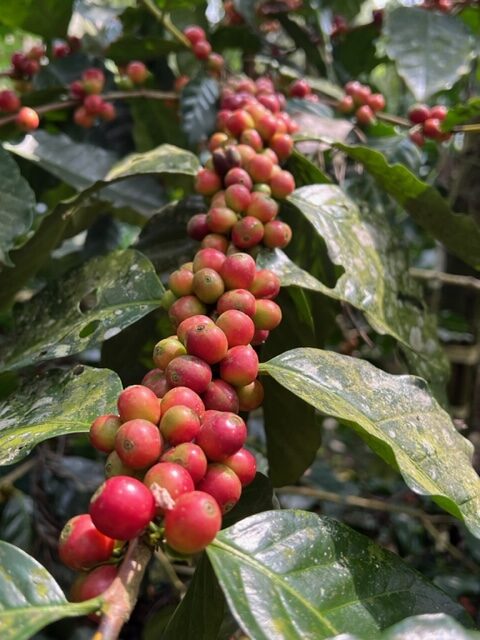
Coorg is more than a famous hill station; it is also India’s coffee-growing region. For a coffee-lover like me, this trip became a one-of-a-kind core memory. With tiny droplets of rain and stunning natural visuals, I was transported to a rain-soaked fantasy with the fragrant rustling from the coffee plants. Here I saw the labour and commitment that go into each cup. I was lulled into feeling of calmness, one of nature’s offerings that’s impossible to replicate. Strolling down the road that goes through the plantation with miles of trees and coffee plantations in either direction, I was drawn into the story of coffee. The coffee plants are laden with a green and maroon coloured beans which hang thickly from the branches.
The plantation slopes are renowned for their Arabica and Robusta brews and are surrounded by several lakes, verdant hills, and a diverse range of flora and animals. November is considered to be the best time to pick up the berries and witness the harvest. But when a coffee enthusiast like me is roaming around so much coffee, you can’t help but crave the brown beverage. So, while explaining the foundation and motives of their campaigns and crop, the brand served to cure our coffee craving with steaming hot sips of their best-selling filter kaapis.
A 150-Year-Old Legacy
You might wonder what makes Tata Consumer Products different from its competitors. Tata’s association with the beverage dates back more than 150 years when some tenacious planters from the then-state of Mysore in South India planted the first seeds of the estates and brought coffee to the Coorg Hills. These are some of world’s best coffees, produced by the land and most importantly the local people living there.
source: http://www.elle.in / Elle / Home> Food / by Ekta Sinha / October 09th, 2023
WELCOME. If you like what you see "SUBSCRIBE via EMAIL" to receive FREE regular UPDATES.
Read More »