Karnataka district has India’s highest concentration of home-stays, according to HolidayIQ study
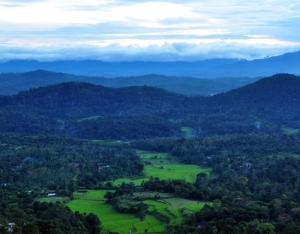
The picturesque scenery of Coorg
The Kodagu district of Karnataka, also known as Coorg, offers the largest amount home-stay accommodation in India, according a new study.
HolidayIQ, the Indian online travel site, has revealed a series of trends relating to the country’s home-stay sector. And according to its listings, 13% of Indian home-stays are located in Coorg, followed by Kochi with 9%. Located in the Western Ghats, Coorg is famous for its mountainous jungles and its native Kodava residents.
In total, HolidayIQ found a total of 1,663 Indian home-stay options distributed among 207 destinations. And many are concentrated in the same areas; destinations with 10 or more home-stays accounted for 76% of the entire market.
Home-stays in Coorg and Kochi, plus the Kerala destinations of Alleppey, Wayanad and Munnar, were found to offer better value-for-money than other types of accommodation.
“With the growth of the online travel industry, in all its different guises, people now have a lot more information at their fingertips and the research has become a larger, richer part of holiday planning. At the same time, travel industry providers have grown exponentially in India, so travellers now have more options than ever,” HolidayIQ said in its report.
“The diversity of India is legendary presenting travellers with endless opportunities to sell its charms. Home-stays in India are now becoming the popular new concept of tourism. In the recent years Home-stays and the trend of offering budget accommodation is picking up. Homes are the new hotels,” it added.
source: http://www.traveldailymedia.com / Travel Daily India / Home> Hote & Spa / by Mark Elliot / July 24th, 2015
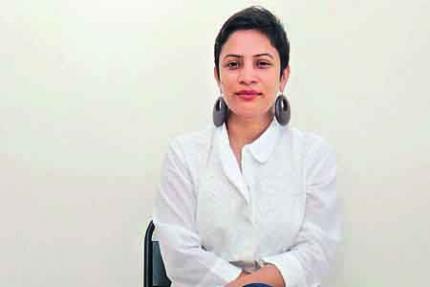
This shoe designer’s blog has a huge fan following in India and she has even won an award for her creative efforts
In 2011, Chondamma Cariappa founded the popular blog The Sole Sisters, where women (and men) who love their shoes, and have a penchant for picking up the quirkiest of footwear, could share images of their prized possessions. Today, Chondamma has quit her job at an advertising agency to design her own line of shoes with her venture The Sole Sisters. A year since its launch, she has also won an award at Grazia Young Fashion Awards this year.
A travel buff, Chondamma’s experiences were incomplete without her posting pictures of shoes she recently acquired or stumbled upon from various parts of the world on Facebook. Her album soon got her friends’ attention where they got into lengthy details about her collection. What she didn’t anticipate was the interest from women all over the world. She says, “Since I saw genuine interest among women, who share the same interest as me about shoes, I started this venture. Soon the world spread, and I started receiving emails from women to feature their shoes.” Today, her blog boasts of more than 400 contributors from across the globe with more than 70 percent of the contribution from India. The blog features women shoes ranging from pump, wedges, high heels and knitted ballerinas.
The entrepreneur tells us that the decision to start her eponymous shoe company last year was a clear step ahead. “I was exploring avenues about how to make this blog bigger but I never thought I’d end up becoming a shoe designer. I realised that women were looking up for unconventional, interesting shoes.”
Chondamma doesn’t have a formal education in designing, but she tells us her experience the advertising industry came in handy. “Advertising helped me develop an eye for detailing. The promotion and marketing strategies I learnt during my advertising years now help me with my brand,” she states. Chondamma reveals that Indian women often choose style over comfort and this is where she wants to bridge the gap. “You can’t blame them. If you see a pretty pair of shoes, you do want to buy them even if it means staying uncomfortable for a few hours. This is where I am trying to strike a balance with my venture,” she adds.
With The Sole Sisters, meeting with clients are now replaced by meeting with fabric-sellers, suppliers and karigars. She admits that there are roadblocks, but it is nothing that has overwhelmed her as yet. She says, “The shoemaking business is an unorganised market. There are times when the end-result is not what you expected; but I make sure it doesn’t affect me for long. I start working on the next samples.”
Her self-taught approach has actually helped her look at design in a new light: She mixes fabrics like ikat, khadi and chikkankari with leather. She says, “I don’t try restricting myself to a colour palette. As a creative person, I like more options. I let inspiration come to me when I get down to working.” Today, she delivers her shoes to America and Europe. In fact, her latest khadi collection is currently being retailed in Europe and will make an entry in India only in the next one or two months.
Chondamma quit her job as a creative director this year to focus on her venture.
Currently, she has been doing everything from accounts to couriering to marketing and promoting. As an entrepreneur, she realises that she has taken up a huge responsibility. She says, “Since I do not have any training in business or this industry, I feel the need to learn everything by myself. I want to get a hands-on approach in this business and learn as much as I can. I have loved the process so far.” And how is she enjoying her stint as the boss? “It’s just been six months and I have realised it is so important to remain self-motivated.
Being an employee means a scheduled, monthly salary; but being an entrepreneur is an entirely different ball game. You can’t afford to slack off. But I am not complaining; so far, so good.”
source: http://www.asianage.com / The Asian Age / Home> Life & Style / by Julie Sam / July 24th, 2015
‘Classical languages are embedded with culture, literature and tradition of the people’
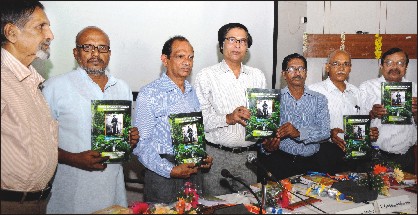
‘Hindi-English-Kodava,’ trilingual dictionary compiled by Dr. C.V. Sivaramakrishna, was released during a symposium on ‘Kannada Classical Language and other Classical Languages of India’ held at Central Institute of Indian Languages (CIIL) in city this morning. Seen in the picture are (from left) CIIL Academic Secretary (retd) Prof. Kikkeri Narayana; Head of Linguistics, Malayalam University, Thiroor, Kerala, Prof. M. Sreenatham; Former Kuvempu Institute of Kannada Studies Director Prof. R. V. S. Sundaram; CIIL Director Prof. Awadesh Kumar Mishra; former CIIL Mysuru Deputy Director Prof. V. Gnanasundaram; Deccan College, Pune, retired Prof. K.S. Nagaraja and KSOU retired Prof. Radha Krishna Bhat.
Mysuru :
The Classical Language Studies Centre will be shifted from the Central Institute of Indian Languages (CIIL) premises in Mysuru to Bengaluru University campus soon, said CIIL Director Awadesh Kumar Mishra, here today.
Inaugurating a symposium on ‘Kannada Classical Language and other Classical Languages of India’ at CIIL premises, he said the Classical Language Studies Centre was being shifted to the State capital as it will have necessary infrastructure such as library and other required facilities.
Mishra pointed out that preservation of classical languages is important as they were embedded with culture, literature and tradition of the people and added that language and script were interlinked. “A language undergoes changes due to change in geographical location.”
Four years ago, the Tamil Classical Language Studies Centre was shifted to Chennai and the Telugu Classical Language Studies Centre may also be shifted in due course of time, once the location is confirmed, said Mishra. Since 2008-09, CIIL is facing staff crunch due to retirement of personnel, he added.
On the occasion, ‘Udaya Adityalanakar,’ translated from Sanskrit to English by Dr. R.V.S. Sundaram and Gill Ben-Heruth; ‘Mahakavya Lakshana,’ of T.V. Venkatachala Shastry translated into English by Dr. H.V. Nagaraja Rao; ‘Moulya Nirdharana Parabashika Padapraveshike,’ edited by Dr. M. Balakumar; ‘Hindi-English-Kodava,’ trilingual dictionary by Dr. C.V. Sivaramakrishna and ‘The Nihali Language,’ by Dr. K.S. Nagaraja were released.
source: http://www.starofmysore.com / Star of Mysore / Home> General News / Friday – July 17th, 2015
To represent India at World Skills-2015 competitions at Brazil in August
Mysuru :
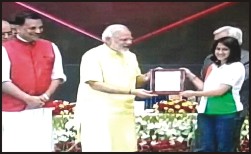
Tulsi Ponnappa (Biddatanda), a student of Bachelor of Culinary Arts, WGSHA, Manipal, was felicitated by Prime Minister Narendra Modi at the World Youth Skills Day ceremony at Vigyan Bhavan, Delhi on July 15, for receiving Silver medal at Oceana- 2015, New Zealand.
Tulsi was selected by the National Skills Development Corporation (NSDC) in the course of taking part and winning Inter-college, Zonal and National competitions and is being monitored and trained under the aegis of NSDC. She was a part of the contingent that represented India at Oceana-2015 at New Zealand in the Patisserie and Confectionary Category.
She now will continue to train under one of the top Patisserie Chefs at Oberoi Trident, Mumbai and will head to Sao Paulo, Brazil, in August for the World Skills 2015 competitions to represent India again. Tulsi did her schooling at Delhi Public School, Doha and undergraduate studies at St. Aloysious, Mangaluru, before joining WGSHA Manipal, to obtain her Culinary Arts Degree.
She is the daughter of Biddatanda Ashok and Bhavya Ponnappa and grand-daughter of retired Principal Biddatanda Ponnappa and Kamalu Ponnappa of Napoklu, Kodagu and late Machianda Thammayya and Shashi Thammaya.
source: http://www.starofmysore.com / Star of Mysore / Home> General News / Friday – July 17th, 2015
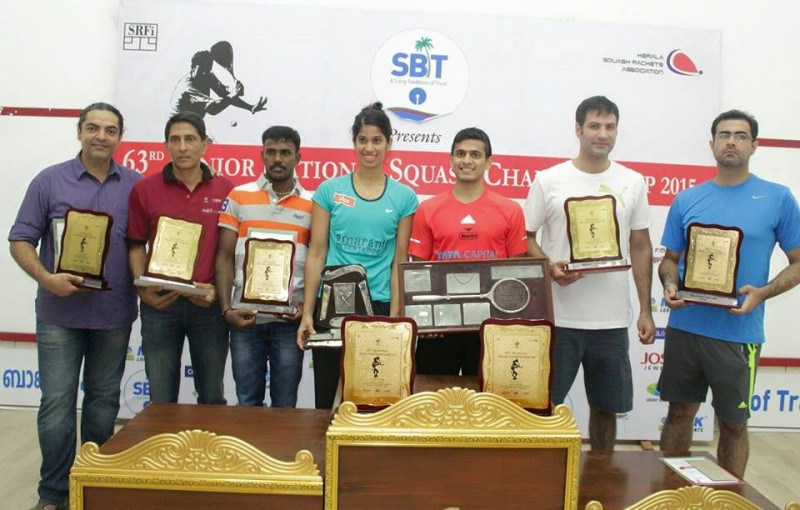
All the winners from the 63rd National Squash Championship in Kerala
Saurav was the more experienced when it came to crunch moments
Time was not ripe for the old order to change. This much was clear after the senior national proceedings at the squash’s brand new venue in India, the Kerala capital Thiruvananthapuram.
Two senior pros Saurav Ghosal and Joshna Chinappa helped themselves to one more title each. Saurav’s tenth title meant he had equalled Narpat Singh’s tally to be joint number one in terms of titles won in the history of squash in India while Joshna is three titles away from beating Bhuvaneswari Kumari’s record of 16.
Having said that, it must be mentioned that the two seniors must be wondering if the journey ahead would be just as kind to them. Keen observers of the sport still believe that the days of the two remaining at helm are not over yet, based on the way things panned out in Thiruvananthapuram. But it must be said both Harinder Pal Sandhu and Harshit Kaur, two respective runners up made deep impressions on the two winners.
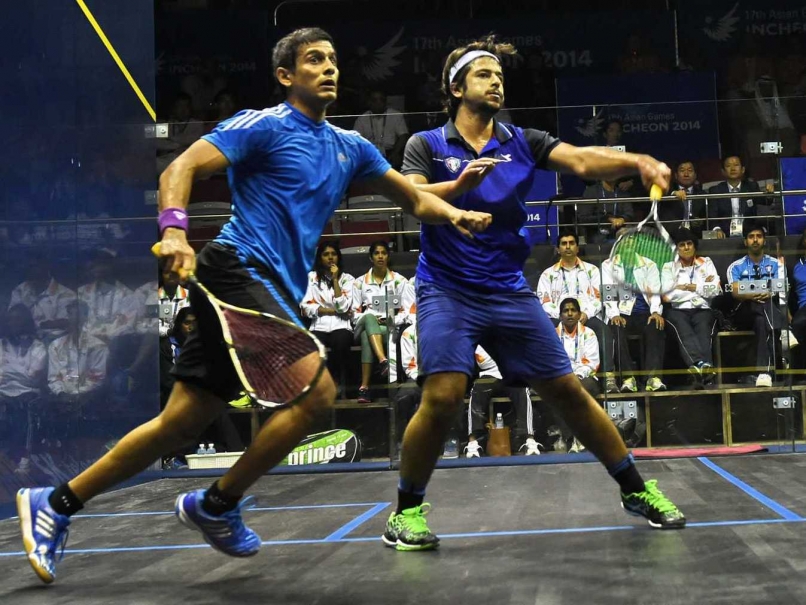
The only difference was the factor ‘experience’. True, Harinder had beaten Saurav in Mumbai for his maiden title in what was part of the winning streak the young Sardar had gone through in 2014. Much has been written on those historic moments of which he was part of but when it came to the crux as it did this time, Harinder showed he still needed to fine tune certain aspects of his approach to rightfully renew the lease on the national title.
Harinder threw away the advantage
He fell just when it seemed he had Saurav at his mercy. Leading two games to nil and then conceding a game and still gaining a 6-2 lead in the fourth game, the Chennai lad appeared to get that dream touch. “His aggression and his ability to score winners not to mention his speedy movements, everything made it look as though there was little to choose between him and Saurav,” said national coach Cyrus Poncha without hiding his happiness over his ward’s wonderful progress in his career.
And yet Harinder forgot the cardinal principle in a sporting tussle that a win or loss is decided only after the last point is played. Experience was the key and a hardened pro now, Saurav has been through tough battles to know that all he needed was a single opening. Sure enough he found it to unsettle Harinder and the rest is now history.
Young players are coming through
Saurav admitted after the match that he thought Harinder played far better than what he did in Mumbai last year. And that adds to the poignancy for Harinder. Not so dramatic though was the women’s encounter but Joshna obviously had not bargained for the tough fight that junior champion Harshit produced, even if briefly. But those brief moments brought to fore the possibilities ahead as this Delhi player, who has shifted to Chennai to train at the ISA, is bound to gallop in confidence and experience.
Joshna may still have the ammunition required to keep her single-minded goal intact but one thing is sure with the bubbling enthusiasm building around, it could be a demanding task ahead. What impressed many in this year’s national championship was the way some of the players waiting to make a breakthrough in the senior ranks exhibited their talent.
Velavan Senthilkumar was one and Vijaykumar was another. The left handed Velavan, a product of ISA, is a cool but sound player with strong basics. What came to fore was the way he played to situations, like the way he wore down senior Sandeep Jangra in a show of complete control. Vijaykumar similarly outclassed Gaurav Nandrajog, once a strong force at the national level.
Both these young players have given sufficient indications of having come of age and that is good news for Indian squash. Add to that the continuing rise of Kush Kumar, who has the will to fight and does so admirably. In Thiruvananthapuram, Kush grabbed a game off Saurav in the semi-final and this is the first time he is achieving that against a senior professional.
There is more to come from this young man who like in his junior days, is keen to take on a dominant role and maybe he would not need to wait too long. In a way then the sport is now flux with good talents who, and that is significant, will serve the country long. They are young, eager and have come up through a tough competitive programme. The results of this has begun to show and Thiruvananthapuram was but just the beginning.
source: http://www.sportskeeda.com / SportsKeeda / Home> Squash> National Championship – Squash / by Sharikal Raman / July 22nd, 2015
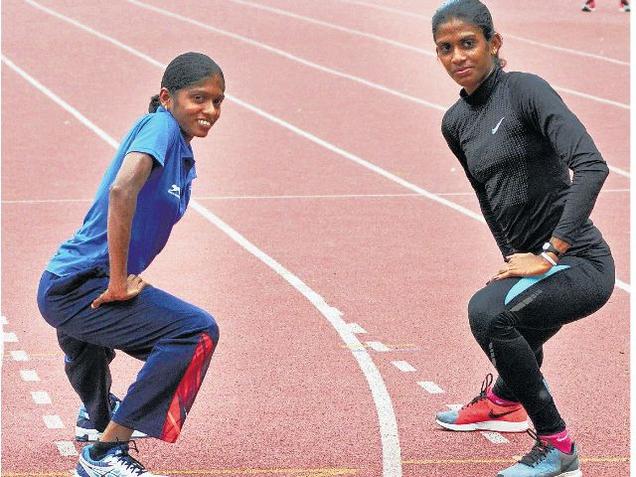
GEARING UP: Tintu Luka (left) and M.R. Poovamma warm up during a practice session on the eve of the 55th National inter-State athletic meet on Thursday. Photo: R. Ragu / The Hindu
To pick walkers for the Worlds would be the most difficult task for selectors
The moment M.R. Poovamma and Tintu Luka came together to exchange pleasantries, the national media was quick to seize the opportunity to capture it. The two, who were part of the 4x400m relay women’s team which won a historic gold in the 2014 Asian Games in Incheon, posed for photographs to whet the media’s appetite.
For Poovamma and Tintu — the Senior National inter-State athletics meet beginning on Friday which is touted as the final opportunity for aspirants wishing to make the cut for the upcoming World championships in Beijing from August 22 to 30 — it will not be make or break event as they have sets their eyes on the 2016 Rio Olympics. While Poovamma hasn’t yet qualified for the worlds in 400m, Tintu (800m) has already booked a ticket to Beijing.
“My focus is on Rio, and I am concentrating completely on that,” said the 25-year-old from Karnataka. “I am getting better with every race. I am fit and ready.” Tintu echoed Poovamma’s statements.
Tamil Nadu’s Arokia Rajiv, a bronze medallist in the 400m event at the 2014 Asian Games, is keen to put his best foot forward. He, too like others, is not looking at the Worlds, but Rio. “It’s a long travel, and I will have time to prepare to my full potential for Rio,” he said.
It is not sure if the shot putter Inderjeet Singh of Haryana, who won gold in the Asian championship in Wuhan, China, will be able to make it on time for the National meet.
Kerala’s Jinson Johnson, won silver in 800m in the Asian championship and bagged gold in three back to back Asian Grand Prix in Thailand, will be the one to watch out for. The 24-year-old admitted he is tired after participating in Asian championship and three Grand Prix. “June has been hectic and tiring, but I am confident of doing well here,” he said.
To pick walkers for the Worlds would be the most difficult task for selectors as 13 of them have already made the cut. “The best three would be picked,” said C.K. Valson, Secretary, Athletics Federation of India. “We’ll have to see how many does well there, and fitness also matters.”
W.I. Davaram, President, Tamil Nadu Athletics Association, said he wasn’t sure till the last minute that the meet would be held at the Nehru Stadium. “Till three days back, we were really worried whether he would host it in the main stadium and whether we would be able pull it off at the Nehru ‘B’ practice ground.”
Now that the meet is finally on, the focus will be entirely on the athletes.
source:http://www.thehindu.com / The Hindu / Home> Sport> Other Sports / by K. Keerthivasan / Chennai – July 10th, 2015
The Secretary of Kodagu Sahakara Sangha has, in a press release, requested all its members to register under the Yeshasvini Health Scheme for which the last date has been extended to July 31.
For details, contact Ph: 0821-2511987.
source: http://www.starofmysore.com / Star of Mysore / Home> In Brief / Wednesday – July 08th, 2015
Club Mahindra, Virajpet: A view of the main building.
Making an excuse of my attending a friend’s daughter’s wedding at Virajpet, Kodagu (Coorg), I decided to spend the night at Club Mahindra, about 12 kms from Virajpet proper. Located in a valley, apparently a paddy field earlier, surrounded by coffee plantation in sharp contrast to Taj Vivanta in Madikeri (Mercara), located atop a hill, Club Mahindra is good for young couples with children for a holiday. As for me and my wife Ralie, it was like being in an OCU — Oxygen Care Unit. After all, towns in Kodagu are crowded with people and tourist vehicles spewing toxic fumes and raising dust that do not disappear into atmosphere because of the veil of mist and cold air.
My experience as a guest says that the success of any hospitality industry, specially this kind of holiday resorts, depends on facility and food with courteous, prompt service. How a guest is attended to on arrival and when the guest leaves is also equally important. Actually I was discouraged to choose Club Mahindra by a member of Round Table, who had stayed here last month, for the reason of delay in checking in, goof-ups in allotting rooms and in room service.
It is here the need for efficient human resource arises — from a sweeper to the master chef. Happily, I had no problem — except once when I called for a buggy to take us for the dining hall and it was drizzling. I was told ‘Buggy is only for the old.’ I was flattered that I must have sounded like an youngster to the person at the reception. At the massive dining hall, all was well for us — service, food and personal attention from Executive Chef – Kitchen, Nitten G. Chughh.
Be that as it may, this wedding afforded me an opportunity to meet my old friends and college-mates. One was M.C. Nanaiah, former Law Minister. Many imagine, not without truth, that being a Kodava (Coorg) is to be hard-drinking and pork-eating. Nanaiah as a Kodava and an unemployed politician was a pleasant company for me. Of course, with age we have sobered and are wise to be moderate, both in drinking and eating. However, I confess [and am sure Nanaiah will agree] that the mind is willing to indulge but alas the flesh is weak!
These days it has become a fashion among Kodavas and even among other original inhabitants of Kodagu, to discuss about the onslaught of tourists to Kodagu and the climate change. The damage caused to the district as a result of mushrooming of Home Stays and Holiday Resorts has become a matter of serious concern. I am reminded of the English man’s reaction to the London climate. Everybody complains about the climate, but nobody does anything about it. So it is with Kodagu at present. Nobody seems to be able to do anything to save Kodagu from the impending danger to its land and eco-system as a result of heavy influx of tourists and tourist-related infrastructure — roads, holiday resort buildings, etc. There is another area that poses threat to Kodagu — deforestation, mining of granite and sand.
According to M.C. Nanaiah, Prof. Madhav Gadgil’s Report on Eco Sensitive Zone (ESZ) of Western Ghats is the most acceptable than the second one by Dr. Kasturirangan because the first report would have prevented the proliferation of Holiday Resorts that leads to deforestation and imbalance in ecosystem.
I did not venture to react for I knew that the report, even if accepted, would not have stopped the establishment of Holiday Resorts of all India repute like Club Mahindra, Taj Vivanta or The Tamara Coorg and more, simply because Gadgil Report had merely mentioned 53 villages as out-of-bounds for these activities but what about the remaining 246 villages? Resort hunters could always go in here. If this is under Red category of the two categories created by Gadgil Committee, under its Yellow category you are prevented from using chemical fertilisers for the coffee estate and for other agricultural crops. As agriculture is a gamble, to allow only organic farming will only increase the number of farmer suicides!
The general opinion in Kodagu is that the difference between these two Reports is cosmetic — a difference between tweedledum and tweedledee. Whatever it is, there is an urgent need to bring in special laws relating to land use in Kodagu to save Kodagu from the land sharks and vandals.
And finally, what is a holiday for the fun-loving if there is no booze at an affordable price? Reports say the Excise Department has banned sale of liquors and even home-made wines at the Home Stays. Good Luck bootleggers.
Tailpiece: For the record, according to Excise Department about one crore litres of liquor and 25 lakh litres of beer was sold in Kodagu during the financial year 2014-2015. Hic!
e-mail: kbg@starofmysore.com
source: http://www.starofmysore.com / Star of Mysore / Home> Abracadabra…..Abracadabra / by K.B. Ganapathy / Wednesday – July 08th, 2015
Two games up and again 6-2 in the fourth game, defending champion Harinder Pal Singh Sandhu seemed to have got into the groove for another tilt at the title, but the wily Ghosal came up with an outstanding fight back and pushed the match into the decisive fifth which he won comfortably for his 10th national title.
Saurav Ghosal regained the men’s title while Joshna Chinappa took the women’s crown in the 63rd Senior National Squash Championship here on Sunday.
Two games up and again 6-2 in the fourth game, defending champion Harinder Pal Singh Sandhu seemed to have got into the groove for another tilt at the title, but the wily Ghosal came up with an outstanding fight back and pushed the match into the decisive fifth which he won comfortably for his 10th national title.
The women’s final too was well contested though the score line would not suggest that. Chinappa showed experience mattered while dousing the challenge of national junior champion Harshit Kaur Jawanda in three games.
It was Chinappa’s 14th national title as she is well on way to reach that magical number of 16, which is the number of titles that Bhuveneswari Kumari had won for a record total.
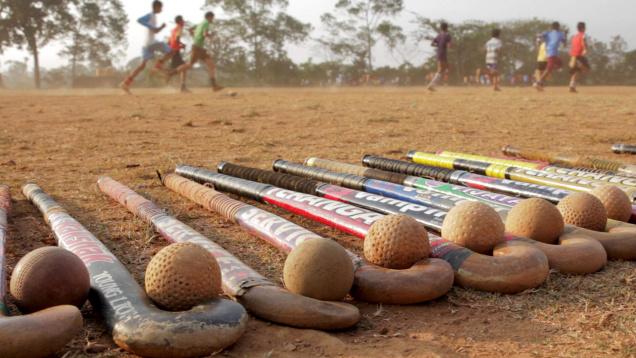
The Kodava community keeps its pride in hockey alive through an annual tournament
Long ago hockey was considered as the alpha game of the country. With India’s domination at the world stage coming to an end one can only reminisce about the times when the world watched our players in awe. So when Sandhya Kumar’s Hockey In My Blood in English and Kodava-takk (with English sub-titles) was screened last week at India International Centre, one was curious to know how much of hockey is left in our connective tissue.
The 52-minute film is about hockey in Coorg narrated through the story of Kodava Hockey Festival (KHF), the world’s largest hockey tournament played between the families there. The subject was suggested to the director by a Kodava acquaintance. “The theme of how such a big hockey event was being organised, especially in the midst of all the cricket mania, caught my interest,” reveals Sandhya. Attending a friend’s wedding in Coorg she was fascinated by the Kodava customs, traditions and the role of the family and elders even in the ceremony. “The decision to make the film was quite impulsive after that,” she explains. Incidentally, considered as one of India’s hockey nurseries, Coorg has sent over 50 players to the national team.
Hosted by one family every year it sees players from over 200 families belonging to the martial-tribal community Kodava come together to play. There is no bar on age or gender and the only rule applicable for forming the team is that all the members must be from the same family. Hence, you watch young boys and girls, fathers, uncles, mothers, professionals and even former Olympic heroes, wielding the stick. Sandhya says her intention was to find an answer or rather portray an answer as to what made all these people gather to play the game.
Started in 1997 by Pandanda Kuttappa, who, in the film discloses witnessing the Asian Games in New Delhi, set him thinking of organising a tournament to keep the fire of hockey burning in Coorg as well reignite Kodava family pride by bringing the people together. Viewed as a serious event ever since, there have been instances when players have quit their jobs and missed their examinations to participate.
The film uses the Madanda Hockey Fest-2013 (hosted by Madanda family) in its narrative to highlight the stories of the players, families and the preparations and the matches. “It has converted little boys and girls who were once in the audience into players and players into professionals,” comments Sandhya. A beaming mother discloses in the film that even though initially she was ignorant about the game, she picked it up and feels proud to see her husband and two sons playing.
Acquainting herself about the film’s subject and the people in it, the director took some time to understand the game and learn about the community and the background of the tournament. “One of the biggest challenges for the research of this film was that unlike say a film on national hockey or on Coorg culture, there were no books or scholarly articles analysing the Kodava hockey festival from either a sociological or historical perspective. There were a few newspaper articles covering past tournaments, but most of the information, including how to find characters for the film had to be built only through meetings and more meetings,” says Sandhya.
Assisted by her friend Deepthi Bopaiah, she made multiple trips to Coorg to capture the thinking, preparation and all the work that went into holding the event. She met participating players and their families in Bangalore and Coorg besides visiting junior hockey camps and coffee estates.
Former Olympians A. B. Subbaiah, goal keeper and C.S. Poonacha have been interviewed in the short film with the former fondly recalling days when around 80 people would gather in Coorg grounds to play the game. He says he had to play in the family tournament to inspire young players and encourage hockey in Coorg.
Initially the Kodava community seniors were slightly tentative about the documentary and asked Sandhya to write a letter explaining as to why she was interested and what the film would be about. “But once we met they were very pleased to hear that the film was going to be about family and sport, looking at the hockey tournament and also Kodava society. I think they felt quite proud that they had built something that an outsider like me would find worth making a film on,” she says.
Besides KHF the film brings to fore the culture and some of the prayer rituals of the community while depicting women with differently pleated saris and covered heads and men in black robes, cummerbunds and turbans.
It is heartening to realise through Hockey In My Blood that the Kodavas have not allowed the regret for what hockey used to be to become a lament and have not consigned it to the past. “They still value and enjoy it as a sport of the present times,” remarks Sandhya.
source: http://www.thehindu.com / The Hindu / Home> Features> MetroPlus> Society / by S. Ravi / July 10th, 2015
WELCOME. If you like what you see "SUBSCRIBE via EMAIL" to receive FREE regular UPDATES.
Read More »