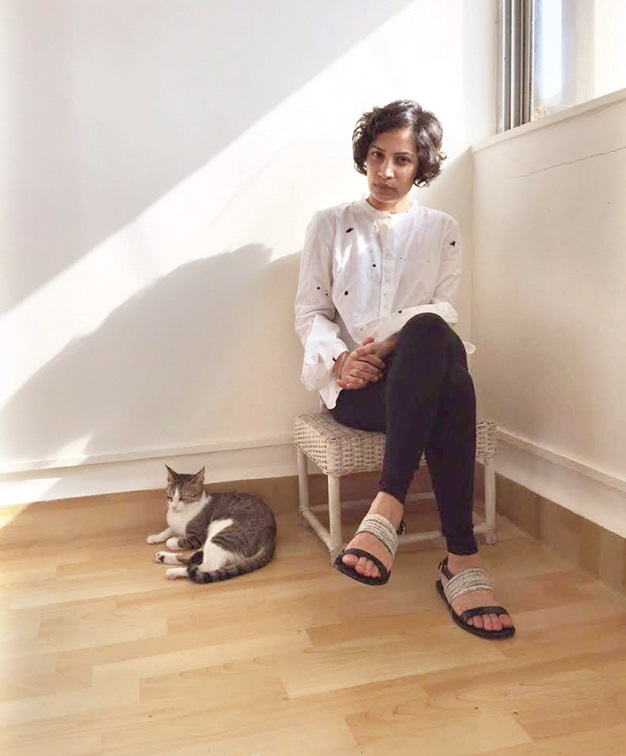
Mumbai-based designer Chondamma Cariappa
Sole Sisters has launched its latest collection in khadi and kolhapuri at Amethyst Room. The one-year-old brand, founded by Mumbai-based Chondamma Cariappa, is showcasing its latest line that combines earth-friendly khadi and leather, and the contemporary versions of the traditional kolhapuris.
Talking to CE, a self-taught shoe designer, Chondamma says, “The collection comprises khadi in its earth-friendly avatar, combined with leather. The line will also offer a contemporary twist to Kolhapuris that are often seen in a traditional form,” she says.
Sole Sisters, which won the Grazia Young Fashion Awards 2015, was launched more than a year ago by Chondamma, who maintained a blog with pictures about different kinds of footwear. The blog later grew as a community with a large network of women across boundaries sharing their pictures of footwear, with the brand and price details.
The advertising professional eventually began her own footwear line, the first collection in ikat. The debut collection turned out to be a huge hit and sold fast among a range of consumers.
Chondamma says that she doesn’t have customers who belong to a specific age-group. “I have had youngsters picking up the footwear and even women in their 40s going for the same,” she says.
Sole Sisters is showcasing its latest range at The Amethyst Room, New #106, Old #79, Chamiers Road. The collection is priced from Rs 3000.The exhibition will continue till June 2.
source: http://www.newindianexpress.com / The New Indian Express / Home> Cities> Chennai / by Express Features / May 28th, 2015
The Corporation Bank recently opened its Self Employment Training Institute (COBSETI) in Kudige village of Kodagu district.
The institute provides skill-based training and two-year post-training support to unemployed youth.
Bank Chairman and Managing Director S.R. Bansal inaugurated the institute in the presence of MLAs K.G. Bopaiah and Appachu Ranjan.
The institute has come up on 0.85 acres provided by the State government. The bank has invested Rs. 2.22 crore on the building and other infrastructure.
The youth will also be provided free boarding and lodging facilities during the training period.
The trainees are provided with post training “hand-holding” support for a period of two years, so as to provide requisite guidance and facilitation towards enabling them to settle independently. Speaking on the occasion, Mr. Bansal remembered that Corporation Bank was the first scheduled bank to commence commercial banking operations in Kodagu district.
The bank would further expand its presence in the district, which is rich in natural resources, he said.
The institute aims not only to help resolve unemployment, but also pull down the migration of youth to urban areas in search of livelihood, Mr. Bansal said.
The institute will offer soft skills training to the youth to take up self-employment or set up their own business unit.
The two legislators urged the local youth to make the best use of the institute and lauded the bank’s service in the district.
The bank has invested Rs. 2.22 cr. in infrastructure
source: htttp://www.thehindu.com / The Hindu / Home> Cities> Mangaluru / by Special Correspondent / Mangaluru – May 25th, 2015
Around The World Holidays will host a German delegation in Coorg, Karnataka this July.
According to Siddalingappa S, Managing Partner, Around The World Holidays and Vice President, ETAA South India Chapter, “This is the first time that we are hosting a huge delegation from Germany for a four-day conference at Orange County Coorg. We will be hosting 46 pax.”
Established six years ago, Around The World Holidays began operations in the India and Bangkok travel markets, informed Siddalingappa.
The company now provides honeymoon tours to destinations like Bali, Turkey, and Spain, and also offers packages to Jordan, and Philippines, among others. It also promotes domestic destinations, offers student visa services to the UK, Canada, and Italy, and helps students studying abroad in many ways like co-ordinating with universities.
According to Siddalingappa, Outbound Tourism has increased 15-20 per cent in the last year to destinations like Spain and Bali. Inbound Tourism is also on the rise to places like Kerala, Karnataka, and Goa.
Around The World Holidays has been an ETAA member for three-and-a-half years. Siddalingappa said that the Association serves as a learning platform, as many travel agents meet and share their knowledge about the industry.
source: http://www.travelbizmonitor.com / Travel Biz Monitor.com / Home> Top Stories> Details / TBA Staff, Bengaluru /Saturday – May 23rd, 2015
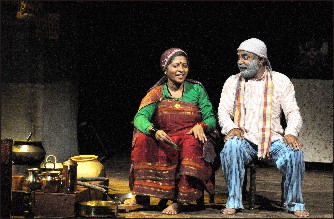
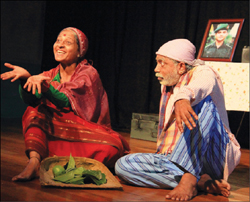
Addanda Cariappa and his wife Anitha Cariappa in the Kodava play ‘Baduk’ at Bhoomigeetha in city.
Kodavas of Kodagu district in Karnataka are a small ethnic community. The name of the district, smallest in Karnataka, is eponymous with the native Kodava people who live in their land of thick rainforest with hills and valleys. These hardy Kodava people speak a distinct dialect of a language which has no script and have a culture of their own. For centuries, they have been living here ruled by Nayakas, some of whom are Kodavas, with each having his own territory and later ruled by Lingayat kings for about 250 years till British took over in 1834.
The claim to fame for this small community, present population 1,20,000 in Kodagu, is as warriors, hunters and agriculturists. The iconic figures among the warriors in the British army and later in the Indian army from among the Kodavas (known by the British as Coorgs and the land as Coorg) are Field Marshall K.M. Cariappa, the only C-in-C of Indian Defence forces and General K.S. Thimayya. Pandit Jawaharlal Nehru when he came to Coorg had famously described Kodagu as a ‘Land of beautiful women, oranges and Generals.’
The Kodavas are ancestor and nature worshippers which is evident from their daily practice of praying and folk songs remembering the lives and achievements of their ancestors annually observed by each clan with a distinct name. They have only two festivals of their own celebrated with gusto — special hunting expeditions, non-vegetarian food-fare, community singing and dancing — Kailmuhurta (transplantation of paddy fields) and Huthri, harvest festival. The influence of Brahminical Hinduism is of later intrusion. Let it be.
However, the point of concern is the stagnating of Kodava culture to its ancient mores to the total exclusion of culture of other majority communities that include theatre, music (other than folk), dance, fine arts etc. that would further showcase Kodava ethnic life and culture. It is here that I found the two-hour play in Kodava language called ‘Baduk’ meaning simply ‘Life’ in english, meaningful as much as enjoyable. The Kodava language being an admixture of words from the languages of neighbouring districts, the drama can be understood even by non-Kodavas. After all, in theatre body-language too contributes in enabling the spectators to understand the play. Happily, it was so with the play I saw last evening at Bhoomigeetha in Rangayana.
The play is all about an old couple, with their sons and daughters away in pursuit of their own life and career. This couple live in Kodagu all by themselves in the sunset years of their life, fending for themselves, fighting among themselves, negotiating peace, calling for cease-fire; but all the same living a life in their own private space and on their own terms. Poignant and also humorous at times as the play unfolds. That’s life. Finding happiness in contentment. No complaint against children who are not able to be with them in Kodagu, but not wanting to sacrifice their own way of life — in the matter of food they take and the manner of activities they engage themselves in daily — by staying with their children in rotation, as happens in many cases.
The beauty of the play is in the way the playwright has delineated the life of Kodava people as lived in the dim past and could be seen even today in some houses tucked away in remote areas. As for me, being a Kodava myself, I spent the two hours of the play rather vicariously living my days spent in Kodagu till the age of 19. I had seen it all as depicted so honestly in the play, except for the theatrical exaggeration inevitable in a play. The ambience of the Kodava household, the existential love of every Kodava and Kodavathi for food — non-vegetarian — being vainglorious about the ancestry of each one, the domestic bickerings and the reconciliation etc. The play will tell you about the kind of vegetables that are grown in Kodagu, the medicinal value of some of them etc. The words and verses of Kodagu’s Haridasa Appacha Kavi, a legendary writer of many great plays in Kodava language of the last century, are liberally used here to good effect. In fact, the play tells the viewer that it is possible to make life a real celebration even if it is only between an 80-plus husband and a 75-plus wife.
The play is highly nuanced in some scenes — one where they receive a letter from their son, a Major in the Army at J&K; the collapse of the tamarind tree planted by this son soon after receiving his letter, the death of the protagonist of the play and the widow not forgetting to plant a tree in her late husband’s name etc.
The play was originally written in Telugu language under the title ‘Mithuna’ by Sri Ramana. It was adapted to the life and times of a typical aged Kodava couple under the title ‘Baduk’ by Addanda Cariappa so creatively that only he could have done being the son of the Kodava clan and Kodava soil.
Addanda Cariappa is a big name in Kodava language theatre and that stamp of excellence is seen here in this play, where he himself plays the lead role ably supported by his wife Anitha Cariappa with Chediyanda Medappa in a minor but significant role. This real life husband and wife, in a sense I guess, replay their real life many years in advance in this play. And what a performance. Their training in theatre at the famous Ninasam, Heggodu, of legendary K.V. Subanna, has not gone in vain. It has done a miracle for this couple so deeply steeped in the art and craft of theatre. Probably after Haridasa Appacha Kavi, Addanda Cariappa is the only person who has distinguished himself so brilliantly as a playwright, director and an actor.
It is comforting to know, in this world of pride and prejudice, he has been recognised and honoured with a number of rewards — Karnataka Nataka Academy Award; Kodava Sahitya Academy Award; Kannada Rajyotsava Award and the prestigious Bhasha Samman Award by the Central Sahitya Academy of Government of India. In my humble opinion, probably, he was the only person who justifiably occupied the office of the President of Karnataka Kodava Sahitya Academy. However, it is not to deny the service of other Presidents.
This is one play all Kodavas must see, specially those old couples living together all by themselves and Kodava youngsters who have lived only in cities, never experienced or heard of life in the Kodava household in Kodagu.
There is one more show today at 6.30 pm at Sriranga auditorium in Rangayana.
Tailpiece: A suggestion to Karnataka Kodava Sahitya Academy: Institute a prestigious Haridasa Appacha Kavi Award (like Dadasaheb Phalke award) with a money component of Rs. 1 lakh plus and give away the first award to Addanda Cariappa at a grand function presided over by either the Governor or the Chief Minister of the State.
e-mail: kbg@starofmysore.com
source: http://www.starofmysore.com / Star of Mysore / Home> Abracadabra….Abracadabra / Saturday – June 06th, 2015
Tata Global Beverages is planning to make its acquired coffee brand from Australia, Map, a power brand in its portfolio. After almost a year since the acquisition, it intends taking Map to New Zealand and Indonesia, but launching it in India remains a distant possibility.
“India is still not a big market for branded coffee. Even the big brands like Nestle and Bru do not have adequate size. We will take Map to New Zealand and Indonesia and it will be a power brand like Tetley and Tata Tea,” said Ajoy Misra, Managing Director & CEO, Tata Global Beverages.
While the beverage company is ruling out a branded play in India and insists on being a B2B player with its subsidiary Tata Coffee, it has tried to sample a few brands in the past. “We did have a few branded packs under Mr. Bean and Coorg Coffee, but it has not been a major attempt at branded play,” said Misra.
However, the company might extend Map into the food services segment in India, catering to the corporate and institution segments. “There could be a chance for Map to enter the food service business in India as it has corporate accounts in Australia. There could be further possibilities for the brand here as the market gets more organised in the food services segment,” said Misra. Map is present in roast, ground coffee, single serve coffee pods and machines in the food service industry.
The market leader in tea with a volume share of 24 per cent, Tata Global Beverages is now looking forward to the high growth green tea segment to shore up its profitability. “The price per cup is higher in green tea compared to black tea and we expect greater profitability from this segment,” he said. It has also dropped price points by 20 per cent with a new variant of green tea for the masses under ‘Acti Green’. “We are getting 30 to 40per cent growth from the green tea segment and it is a growth engine for the company,” he said.
Meanwhile, profitability is elusive for its acquired brands like Himalayan from Mount Everest Mineral Water and coffee retail business under the JV with Starbucks. “Starbucks has completed two years, but it takes time to get profitable in the QSR segment. While we have 75 Starbuck stores, it has to cross the critical level of over 100 stores before we can think of making money in this segment,” observed Misra.
However, the beverage major is still looking at inorganic growth opportunities to build its portfolio. “We gave not stopped looking at opportunities and we seek both organic and inorganic growth,” he added. Tea comprises 75 per cent of the company’s turnover while coffee contributes about 18 per cent while the balance incomes is from smaller categories like water and plantations business.
source: http://www.thehindubusinessline.com / Business Line / Home> Companies / by Purvita Chatterjee / Mumbai – June 01st, 2015
Over 50 Kodavas have represented India in international hockey. Photo: Abhilash Mandappa
Every summer, about 250 families from Kodagu go back home with an agenda: to compete against each other for a prized hockey cup
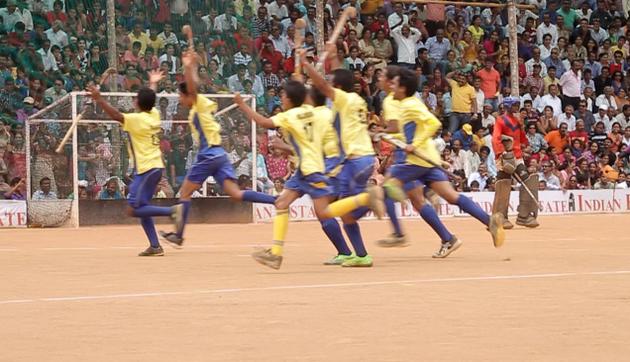
It’s a sultry Saturday in Virajpet, and the stands around the college grounds are packed with spectators. The teams in action, Chendanda and Palanganda, in orange and yellow respectively, pass, block, and swing their way to a tie, followed by a tense penalty shootout. After four failed attempts on either side, Palanganda’s Muthanna scores. The crowd erupts with wild cheering. It’s official: the Palanganda family has reclaimed victory at the 2015 Kodava Hockey Festival.
At a time when cricket monopolises our sporting imagination, the Kodava community commits itself to India’s national game with renewed vigour every summer. The annual Kodava Hockey Festival in Kodagu (also called Coorg) is now touted as the world’s largest field hockey tournament, with about 250 family-clans (okkas) participating every year.
Pandanda Kuttappa was inspired to start this tournament in his hometown after attending the 1982 Asian Games. The Indian hockey team then had many Kodava players and had already won eight Olympic gold medals, but the people in Kodagu could only hear about their players’ skill, techniques and wins over radio. “I wanted to create a hockey festival that would bring the Olympians to Kodagu. So people from all over Coorg or anyone interested could come, watch and observe their skills,” he says.
The festival started off in the 1990s in the village of Karada, with 60 family-clans competing. Over the next decade, at least 10 more teams would join in each year. “Often, the organisers would cook for the teams and dine with them, helping them rediscover lost family connections,” says Sandhya Kumar, who has made a documentary, Hockey in my Blood, on this unique tournament.
Now in its 19th year, the tournament is seeing a drop in turnout, particularly for the initial matches, says Kumar. “The stands are usually only around 30 per cent full until the quarterfinals, when things really start to heat up. After that it is packed with close to 10,000 people. It seems the tradition of families cooking and sharing food has died down over the years, but the competition seems to be getting fiercer,” she says.
Why do the Kodavas love hockey so much? Over the years, more than 50 Kodavas have represented India in international hockey, earning their district the title ‘Cradle of Indian hockey.’ The festival is clearly an extension of this love. “It isn’t clear why the love for hockey is so ingrained in Kodavas,” confesses Kumar. “When I explored the subject for the film, I realised it could be anything from colonial influences to the fact that the Kodavas are a very active and physically-fit clan.” Shot over two years in Kodagu and screened at this year’s hockey festival, the documentary chronicles the history of the tournament and the popular contenders.
The Palanganda family, which features prominently in the film, has won the cup five times and been runner-up twice. Spoiler alert: the winner in Hockey in my Blood is Anjaparavanda, which is a rare team with a woman player, Vishma Appaiah. Another woman player, Amulya Akkamma captained her Kongetira family team to reach the quarterfinals this year. “When the game is on, there is no question of special treatment because I am a girl. I push, shove, get pushed and shoved just like anyone else,” she says. “One of my biggest supporters is our goalkeeper, Harish Appanna. People like him are the reason young players like me are getting interested in hockey again. I hope a lot more young people play for their families in the future.”
It seems to be more than just love for hockey that draws these families to compete. Every year, different family-clans submit detailed proposals to the Kodava Hockey Academy to host the tournament.
Over time, it has become a matter of pride and honour to be the host. “I was on my toes all of last year,” says Rajiv Cariappa, convenor and treasurer at this year’s tournament. “With the contributions from the members of the Kuppanda clan, including women who married into other families, we raised a sizeable amount. We were able to put up LED TV walls for the matches and even played the ads of our sponsors, adding a new dimension of professionalism to the festival. With the leftover money, we are making contributions towards hockey training camps to encourage young players. Over the past three years, I have seen a surge in interest among the younger audience, which is great. This year, I heard, vehicles were parked up to a kilometre radius around the grounds. The stands and food stalls were packed, there was so much excitement in the air,” he adds.
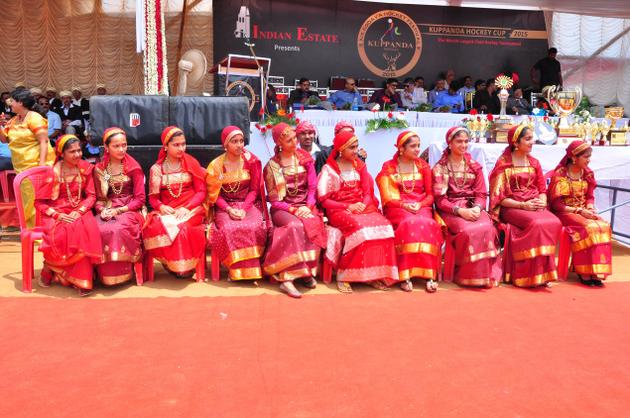
Scenes from the Kodava Hockey Festival – 2015 at Kodagu. Photo: Abhilash Mandappa
In a lifetime, a Kodava will only get to see his or her family host the cup once — there are 800-odd family-clans in Kodagu — and this seems reason enough for family members to drop jobs, request extended leave at IT companies and even arrive from overseas to organise and participate in the games. The winning team gets a cash prize of ₹2 lakh, while the runners-up get one lakh.
The tournament is also ideal for talent spotting. Scouts from Sports Authority of India arrive here to select men and women players, some of whom can barely afford jerseys and equipment, and provide them training. Quite a few of them have gone on to become state and national players.
So is the festival finally about serious hockey or a family reunion? “It is primarily a reunion,” says BP Govinda, chief selector, Indian hockey team and former Olympian and Asian Games player. “The teams consist of people aged 12 to 40. Some are professional players, some are old-timers, and some are just playing their first competition. In my opinion, there may not be much serious hockey there, but it’s a lot of good fun.”
The documentary declares, “It is said that if a Kodava is not working on a coffee plantation, he is likely to be either in the Indian army, or playing field hockey.” Hockey’s popularity may be fading in much of India, but in the coffee-growing cradle of Kodagu, the sport is nurtured and loved.
Hockey in my Blood (a documentary in English and Koda-thak) will be screened in Bengaluru next month.
Tara Rachel Thomas is a Bengaluru-based writer
source: http://www.thehindubusinessline.com / Business Line / Home> Watch / by Tar Rachel Thomas / May 29th, 2015
Rangayana, as part of its Annual State-level Amateur Theatre Festival, has organised staging of a Kodava play ‘Badk’ at Bhoomigeetha in Rangayana premises here on May 31 at 6.30 pm.
The play, brought out by Addanda C. Kariappa, will be enacted by the Kodagu theatre troupe. The play has already been staged in Bengaluru and Delhi, well-acclaimed by critics and theatre buffs. Kariappa has scripted the play based on the story ‘Mithuna’ by Vasudendra. The play is a classic example of Kodava culture and projects the art of theatre in Kodagu.
Kariappa is well-supported by senior theatre artiste Anita Kariappa and budding artiste Santosh Medappa with direction by Malatheesh Badigera.
The play will be staged at Sriranga in Rangayana premises again on June 1 at 6.30 pm.
Tickets are available at Rangayana office. For online booking, visit www.bookmyshow.com
For more information contact Mob: 94484-22343.
source: http://www.starofmysore.com / Star of Mysore / Home> General News / May 29th, 2015
Anila Madappa is seen lighting the lamp to inaugurate the workshop ‘Spoorthi’ at Kodava Samaja in city this morning as (from left) Secretary of Deenabandhu Charitable Trust (DCT) Pattada A. Jayakumar, Dechu Karumbaya, Reena Jayakumar, Shanthi Ganapathy, Wing Commander C. G. Madappa (retired) and President of DCT Kattera A. Kariappa look on. Mysuru :
The three-day motivational workshop ‘Spoorthi’ conducted by Deenabandhu Charitable Trust (DCT), Mysuru, for its beneficiaries, was inaugurated at the Mini Hall of Kodava Samaja in Vijayanagar here this morning by Chendrimada Anila Madappa by lighting the lamp.
Eminent speakers from SVYM, RUDSETI, Infosys, Defence, Police, Bank, prominent doctors and educationists will be addressing around 40 students from Kodagu, focusing on topics like motivation, self-confidence, leadership and counselling. The workshop concludes on May 27.
Maj. Gen. (Retd.) Codanda K. Karumbaya, who delivered the inaugural address, called for unity among youth to protect themselves and said that there will be strength only when there is unity.
He urged the youth to fight for their rights and be conscious of the nature and environment around them.
Reminiscing his days as a NCC cadet, Karumbaya said that he learnt the importance of unity at the NCC camps and added that it was unity that made them repair an entire stretch of road around Bhagamandala.
A yoga demonstration was organised by Maneyapanda Ganapathy and team early this morning.
Senior Advocate Pandanda D. Medappa delivered a motivational talk while Pattamada G. Ponnappa spoke about goals and aspirations.
Trust President Kattera A. Kariappa encouraged the students to join the army. Secretary Pattada A. Jayakumar, Dechu Karumbaya, Reena Jayakumar, Shanthi Ganapathy, Wing Commander C. G. Madappa (retd.) and others were present.
source: http://www.starofmysore.com / Star of Mysore / Home> General News / May 25th, 2015
Kodagu Gowda Samaja, which proposes to release a booklet containing details about Kodagu Gowdas residing in city has called upon those who have not given their details to the Samaja for inclusion in the booklet to provide the same before May 30.
This apart, the Samaja also plans to accept advertisements from people of the community to be printed in the booklet, which is in finishing stages, according to a press release.
source: http://www.starofmysore.com / Star of Mysore / Home> In Brief / Saturday – May 23rd, 2015
The scope for bringing Hasanur in the list of coffee regions has been explored successfully at Hasanur in a plantation spread over 30 to 40 acres.
Traditionally, the farming community in Hasanur area have been growing vegetables. It is, perhaps, due to the smallness of the holdings, according to Horticulture Department officials.
Hasanur is at an elevation of 1,100 metres above sea level, an altitude considered ideal for coffee cultivation. More or less, the climatic conditions are the same as in Gudalur where coffee is a dominant crop.
According to Coffee Board, Government of India, Ministry of Commerce and Industry, regions with high elevations are ideally suited for growing Arabicas of mild quality while those with warm humid conditions are best suited for Robustas. The climatic condition augurs well with regard to blossom showers and backing showers between February and April.
source: http://www.thehindu.com / The Hindu / Home> News> National> Tamil Nadu / by Special Corrrespondent / Erode – May 21st, 2015
WELCOME. If you like what you see "SUBSCRIBE via EMAIL" to receive FREE regular UPDATES.
Read More »