Olympian BP Govinda was on Friday named chairman of Hockey India’s nine-member selection committee, which will start working from July 1.
The panel, which will be in office for a one-year tenure, was picked in the Hockey India Executive Board meeting held here. The selection committee will work jointly with the HI’s High Performance and Development Committee to identify fresh talent in the country.
Govinda represented the country twice in Olympics (1972 & 1976), two World Cups (1973 & 1975) and three Asian Games (1970, 1974 & 1978).
Olympian BP Govinda was named chairman of Hockey India’s nine-member selection committee, which will start working from July 1.
“The other members in the Selection Committee are Olympian Mr. Syed Ali (1964 Olympics), former international player Dr. R P Singh (World Cup in1986 & 1990), former Captain Mr. Gagan Ajit Singh (Olympics in 2000 & 2004), former Captain Mr. Arjun Halappa (Olympics in 2004 & Commonwealth Games in 2010), former Captain Ms. Savitri Purty (Asian Games in 1986), former Captain Ms. Mamta Kharab (Commonwealth Games in 2002 & 2006, Asia Cup in 2004), former Captain Ms. Surinder Kaur (Asia Cup in 2004) and former Captain Ms. Saba Anjum (Commonwealth Games 2002 & 2006, Asia Cup 2004 and Asian Games in 2002),” the HI said in a statement.
The newly-appointed Selection Committee will come into effect from July 1.
source: http://www.ibnlive.in.com / IBN Live / Home> Sports> Hockey / Press Trust of India / May 31st, 2013
Domestic tourist arrivals may go up this festive season if the inquiries and bookings for touring Mysore and Kodagu are any indication.
Surprisingly, there have been bulk bookings from non-traditional markets. Travellers hailing from Telangana and Andhra Pradesh have planned their itinerary this Dasara, according to travel and tour operators. Like every Dasara, tourist arrivals from Tamil Nadu and Kerala are expected to be on the higher side.
“Generally, tourists from some parts of south India tour up north. But with the floods recently, tourists were perhaps looking for alternative tourist spots like Mysore. The inquiries and bookings have picked up,” explains B.S. Prashanth, president, Mysore Tour and Travel Operators’ Association. He told The Hindu that tourists were planning combined trips to Mysore and Kodagu. Home-stays in Kodagu were reaching full occupancy, he said. Tourists prefer Mysore and Kodagu packages as they get the best of holiday over there, Mr. Prashanth said. “We have confirmed bookings from foreign tourists, who had booked six months in advance,” he said.
Some tour operators in Mysore were promising to facilitate watching of the Jamboo Savari. “This way, the operators were attracting tourists,” a tour operator told The Hindu. Deputy Director of Tourism Husseni told The Hindu his department had been getting calls from inter-State travellers to know more about the festivities. “Besides explaining the events, we also guide them to visit websites to know more about the events,” he added.
The Karnataka State Tourism Development Corporation and the Karnataka State Road Transport Corporation will launch tour packages.
KSTDC Managing Director Harsha said tourists booking at the KSTDC’s properties in Mysore, KRS, Madikeri and Srirangapatna can avail themselves of packages. KSRTC Divisional Controller (Urban) Mahesh said the corporation was launching special package tours called ‘Darshini’, with packages like Giri Darshini, Jala Darshini, Deva Darshini, and Nagara Darshini. The tickets are available on the corporation’s website or at the reservation counter in the mofussil bus-stand here, he said.
source: http://www.thehindu.com / The Hindu / Home> National> Karnataka / by Shankar Bennur / Mysore – September 24th, 2014
Coffee planters in Karnataka’s Kodagu district are an apprehensive lot. They believe the acceptance of the Kasturirangan report to conserve Western Ghats will make them helplessly watch their disease-afflicted crop wither away for it bans the use of pesticides in their area.
They feel they may not be able to cut down trees on their plantation in times of distress as that too would be prohibited.
The very mention of Kasturirangan report sparks off angry reactions in Kodagu district. “One cannot force small-time agriculturists to convert to organic farming and not use pesticides – it must happen gradually and voluntarily. Implementation of any report should create a win-win situation for all,” says Col CP Muthanna, president of the Coorg Wildlife Society.
A cocktail of apprehensions and genuine fears has stirred up a massive resistance to Kasturirangan report along the Western Ghats. “Forests are the lifeline of Kodagu and a huge per centage of people are dependent on them. It is therefore important to initiate a dialogue with locals before taking far-reaching decisions,” says Air Marshal (Retd) Nanda Cariappa, a resident of Kodagu.
Some experts admit some of the fears are genuine. “People still dependent on forest produce are opposing the implementation. Quite rightfully so as all this while no one raised an issue each time they went to the forest, gathered berries etc and sold them off for a livelihood. But with this classification they will not be able to do so,” said environmentalist Suresh Heblikar.
Locals are knowledgeable and have a fair idea of the topography of the place. It would be unfair to remove them from the system altogether when they have been an inclusive partner of the ecosystem for centuries together, he said.
But experts say a “deliberate campaign of misinformation” has made the Kasturirangan committee report unimplementable. They allege people with vested interests are at work and misleading the locals.
“There is a common fear among people of losing their lands with 37% of Western Ghats earmarked to be notified as Ecologically Sensitive Area (ESA). These directions have been issued under Section 5 of the Environment (Protection) Act, 1986 and related Rules which does not empower the government to acquire any land. Therefore the question of people losing their legally owned lands located either in the identified villages or outside does not arise at all,” said Wildlife First trustee Praveen Bhargav.
Environmentalists even doubt the government’s commitment to implement it as it means existing policies will have to be withdrawn. “These reports are in the interest of the common man and in favour of ecology. According to scientific findings, hilly regions should have 66% forest cover but what remains in Western Ghats is a mere 10%, which is also under attack by vested interests,” said environmentalist Panduranga Hegde, who heralded the Appiko movement to protect trees in Western Ghats.
source://www.timesofindia.indiatimes.com / The Times of India / Home> Environment> Development Issues / by Saswati Mukherjee B, TNN / January 20th, 2014
While she was still studying surgery at the University of Liverpool in England, Kavery Nambisan was informed by her friend that a mission hospital in Bihar was in desperate need of a surgeon, and asked if she would be interested in the offer. She took it up as a challenge and landed in the town of Mokama, a dacoit infested area, where she went on to treat patients who had faced several degrees of violence.
After Mokama, she worked at rural hospitals in Uttar Pradesh, Tamil Nadu and Karnataka, where she presently works in the Coorg district. But in the meanwhile, Kavery found time to write seven novels in the last two decades.
Her last book, The Story That Must Not Be Told was shortlisted for the DSC Prize for South Asian Literature as well as the Man Asian Literary Prize. “I started writing once I had become a doctor; initially it was few flippant pieces here and there, and then I ended up writing two children’s novels. It was a revelation for me, because I don’t have a literary background,” she says.
Kavery soon ventured into writing adult novels because she felt there was more to her imagination that she could put down on paper. Her recently released seventh book A Town Like Ours, chronicles the growth of Pingakshipura, a village that has now become a town. It is a place where the water runs a poisonous black and the hair on every child’s head is white. And all of this is through the eyes of an ageing prostitute who resides at a temple premises.
The central character is borrowed from one of Kavery’s childhood memories. “When my father was transferred to Delhi, there was a temple we used to visit often. Right next to the temple, in a room, I found this scantily clad elderly lady who was smoking a hookah and had several men huddled around her. She had a loud voice, and as a young girl, I was mystified and yet disgusted by her appearance,” she adds. But do most of her memories, or her medical experience find place in her books?
“Not constantly, but since I am a writer, I do observe. I listen to my patients intently when they confide in me about their family problems. Any inclusion is not always intentional but I guess once you have the seed of something, you can always create,” she says.
Kavery, who writes early in the mornings and during weekends, says that she never had a problem juggling her professional expertise with her passion for writing. “Since I have always had it this way, I never have really seen it as a problem. Apart from medicine and writing, I don’t feel the need to socialise because I meet so many people anyway. However, I have discovered that I can write an awful lot in hotel rooms when I am travelling, because there I have no other responsibilities,” she adds.
In the present times, when bookstores are stocked with new authors writing about college romances and urban life, there are barely a handful of voices which document the rural facets of our country. The author adds, “It’s not their fault that most of these young authors did not have any rural experience to write about. On my part, I am deeply saddened by injustice which plagues our society. When I have the opportunity of education and upbringing, someone else is continuously being denied it. I constantly think of it, but I haven’t been able to come up with an answer. But instead of feeling helpless, we must realise that we can’t do everything to resolve the situation, but can continue to do what we do best.”
And Kavery’s decision to spend her life writing about and aiding the rural folk in villages, where healthcare is deemed a luxury, is a clear example of that. “It was partly the influence of my father and my teachers, who instilled in me the sense of purpose, of why you do something. And being born and brought up in a village, I realised this is what I should do, because this is what I do best,” she says.
source: http://www.deccanchronicle.com / Deccan Chronicle / Home> LifeStyle> Books/Art / DC / Amrita Paul / August 30th, 2014
India’s doubles exponent in women’s badminton, Ashwini Ponnappa was left without a partner here after Jwala Gutta pulled out and Tarun Kona’s name was not cleared by the Sports Ministry. Though she has resigned to this quirk of fate, after the Asian Games, she is set to try out a new partner to win medals in mixed doubles on the international circuit.
Ashwini is looking abroad for a partner in mixed doubles. She has decided to team up with Russia’s Vladimir Ivanov and the two would be playing from next month’s Denmark Super Series. However, the arrangement will be evaluated and future course sorted out after three more tournaments.
Ivanov has not played with the Indian but is a European champion in doubles. He plays for the Mumbai team in the Indian Badminton League, where they chalked out the plan to forge a partnership.
Ashwini was confident this would boost her chances of winning more medals in international events. With the aim of putting her mixed doubles career on track, she has the backing of the Badminton Association of India. “I’m pretty excited and hoping that the combination works out for us. I have been doing well in India but want to win bigger tournament like the All England and world championships.”
Ashwini has been partnering Tarun in the mixed and the combination’s ranking isNo 40 in the world. Their performances, however, have been under the scanner after they failed to do much on the biggest stage. Tarun’s name was not cleared for the Commonwealth Games in Glasgow before this one.
Semifinal Setback
Indian women lost 1-3 to South Korea in the team semifinals to settle for their maiden bronze medal. This was India’s first badminton medal since the men’s team bronze in 1986. Saina Nehwal beat World No 4 Sung Jihyun before PV Sindhu lost to No 6 Bae Yeonju. Pradnya Gadre-N Sikki Reddy and PC Thulasi were no match thereafter.
source: http://www.newindianexpress.com / The New Indian Express / Home> Sport / by Indraneel Das / September 22nd, 2014
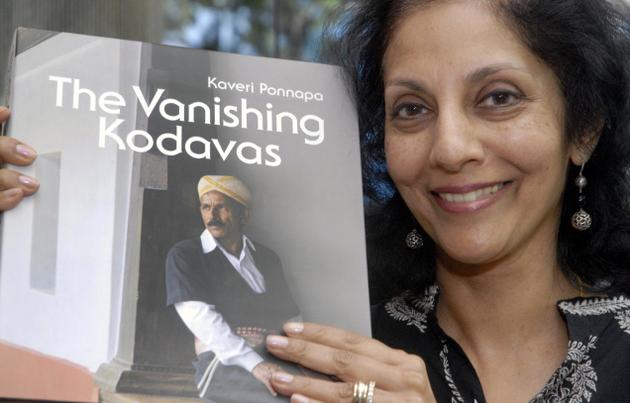
Author Kaveri Ponnapa stresses how we’re all becoming a monoculture. Photo: V. Sreenivasa Murthy / The Hindu
Kaveri Ponnapa worries that her small community of Kodavas are slowly getting dissolved in the monoculture that the world is morphing into. She tells her book The Vanishing Kodavas could be the starting point to explore the people from the hills of Kodagu
So we sing.
Singing this song/ What do we gain?
If we sing with faith…
Planted vegetables will thrive/
And the baby in the cradle will live
This excerpt from a song of the Kodavas exemplifies the simplicity and beauty of the life of the Kodava community. It offers a whiff of the essence of the community — establishing its agrarian roots, its oral tradition, the questioning of what one gains in continuing a tradition, of the hope that its warrior people will flourish…
The song is one of the many lesser-known aspects of the Kodava people, that author Kaveri Ponnapa has recorded in her book, The Vanishing Kodavas. In popular culture, knowledge of the community is limited to facts such as they are good-looking people, valiant warriors with a phenomenal presence in the country’s armed forces and the place is home to beautiful hill stations, is where pandhi curry and bamboo-shoot pickle comes from.
Born and brought up outside Coorg, and having lived a large part of her life overseas, Kaveri was mesmerised by how “the presence of Coorg within me has been a constant part of my interior landscape”. That presence drew her back to her homeland, where right through childhood, she spent two months a year during summer vacation. “We all shift cities, countries, continents. We should look at ways to internalise culture and pass it on, carrying it within us,” is Kaveri’s hope for her people. Painstakingly researched over 15 years, the book goes deep into the community’s history, its grand houses, laws of the land, customs, worship, songs of the warriors, the forests and sacred landscapes, coffee, stories of its people.
Kaveri holds a masters in social anthropology from the School of Oriental and African Studies (SOAS) London. Even her thesis was on the culture of the Kodavas.
“After I shifted to Bangalore 16 years ago, I started visiting Coorg more often. It was a search to find what hold this place had on me. It became a quest for identity, exploring the unarticulated parts of you.” Slowly she started documenting festivals, ancestor propitiation ceremonies, whatever she witnessed in the villages of Coorg, and what came out of conversations with people on the rural areas. “I became conscious that the culture was vanishing and dwindling away.”
As she kept going back year after year, fewer people were attending annual celebrations with each passing year, older people in the community pointed out how youngsters weren’t learning their songs; how young men don’t know the ritual dances. “When I titled the book as ‘vanishing’, people from within the community too questioned me. It’s such irony that though numerically we are larger than we ever were, we are becoming like everybody else. Monoculture is a global problem. Just as there is a need for biodiversity for survival, so is it with people. Now with borders being porous, how are we going to continue looking at ourselves in new circumstances…that is the question,” she elaborates. The culture, which has been maintained in the living culture of the villages of Coorg, says Kaveri — “even there an erosion has taken place, with economics in play, and people moving away…”.
“Small cultures are well balanced with the environment. The link to land and agriculture anchored us to our culture. Now you have a dominance of the economy and tourism. While we were the prominent community in Coorg, we maintained equilibrium with other communities. There was great foresight among our forefathers to acknowledge that we can’t survive on our own,” says a passionate Kaveri.
The research that went into the book took Kaveri on a search for records. Official records, correspondence, colonial accounts, recorded history of the Rajahs of Kodagu… she sifted through them all. The book also has a detailed account of the Lingayat Rajahs and their council of Kodava chieftains and the role they played in the rise of the East India company in south India.
Finding archives was not easy, she admits. There were a few books from the early 20th century and gazetteers written by Missionaries from the then Britishadministered Coorg.
“The thing that really struck me is that the history of my people from manuals and gazetteers spans about the last 200 years, but we’ve been around 2,000 years. But the people had a definite sense of history that comes out in folk histories. I’ve interwoven these micro-histories into the book. Just because it wasn’t in a book doesn’t mean those events didn’t happen.”
She travelled alone into the villages, introduced herself, having the advantage of being an ‘insider’ to participate in ceremonies, got invited into ain manes (ancestral homes).
Some events, she went back to every year, sometimes seven years running! “It possessed me and sucked me in…I was no longer the writer,” observes Kaveri, who, incidentally chronicles oracles and spirit mediums in the Kodava community. At the end of it all, she had developed a great network.
Elders were forthcoming and gave permission to photograph intimate ceremonies related to everything from birth to death.
“Despite the photography being intrusive, I’m grateful to my community that they placed trust. Not one door was closed on me…so in that sense it’s not my book really.” So when the book was published in September this year, she launched it in Madikeri, Coorg, where 250 people from the villages turned up to look at the book they had made together. “What struck me was the great sense of dignity in their lives, the beauty of their lives and how they balanced between the hard times they have had. Despite being a warlike people, there was a tremendous sense of justice and fairness.”
“The book was a personal journey; despite both our families (hers and husband’s) being rooted in Coorg, we knew very few people in the villages…with education and going away, you tend to lose links,” she points out.
You definitely can’t dismiss it as a coffee table book laden with fantabulous pictures, though it can also be seen that way. “For the non-reader who would want to just look at the pictures, we put in detailed captions that should make you go back to the text. This is to bring in the younger generation, yet retain the depth of the work.”
You can find details on the book, of more than 350 pages and 300 images, and place orders from www.thevanishingkodavas. com or www.coorg.com.
Proceeds from the sale of the book, priced at Rs. 7,500 will be donated to the Coorg Education Fund.
source: http://www.thehindu.com / The Hindu / Home> Books> Authors / by Bhumika K / December 19th, 2014
To bring back the glory of honey production in Kodagu, the State government has come forward to set up a honey park in Bhagamandala. The State government has already released Rs 60 lakh and primary preparations are in progress.
The Honey Park would act as a comprehensive centre for honey production and related activities. It would also endeavour to provide marketing facilities for the product in the entire State. The park will come up in Apiculture Training Centre at Bhagamandala. The Park will be maintained by food processing division of Agriculture department.
The Park will be set up to promote apiculture, which will supplement the income of the farmers. Agriculture department in-charge Secretary and Director of Horticulture department have already held talks with farmers on the structure of the Honey Park, and a proposal has been sent to the government. There are more than 10,000 farmers engaged in apiculture in Kodagu district. Apiculture has spread to Chikmagalur, Shimoga, Dakshina Kannada, Uttara Kannada, Mysore and Chamarajanagara. Owing to diseases affecting honey bees, apiculture had seen a set back in the recent years.
Apiculture was ruling the roost in Kodagu two decades ago. There were bee hives in each and every plantation. Apiculturists were getting 10 to 15 kg of honey from one bee hive. However, now it has reduced to six to seven kg honey, said Apiculturist C Madappa.
“With diseases affecting honey bees, apiculture saw a set back in the district. In the first phase, honey bees will be nurtured in the Park. Later, a research unit, museum on apiculture, honey processing unit, and an export unit will be set up.”
Along with Honey Park, a training centre will also be set up. Tribals and farmers will be trained in apiculture. The tribals will be trained in collecting honey in forests. This in turn will help in improving the economic condition, said Horticulture Department Deputy Director (in charge) S N Sudheendra Kumar.
source: http://www.deccanherald.com / Deccan Herald / Home> District / by Shrikanth Kallammanavar / Madikeri, DHNS – February 04th, 2014
Indian Immunologicals Limited (IIL) has launched a vaccine for Blue Tongue disease that affects domestic animals such as goats, sheep, cattle and camels. India is among the top victims of this disease. The mortality rate is quite high at 30 per cent.
The penta-valent vaccine Raksha-Blu protects all the five virus strains that cause the disease in India. It is priced at Rs. 5 a dose.
An arm of the National Dairy Development Board (NDDB), the IIL claims that it is the first vaccine developed indigenously for the disease.
“There are 24 viral strains prevalent in the world. In India, about five strains are predominant. Besides high level of mortality, it causes morbidity too. There has been no vaccine developed so far to protect the animals from the disease,” a company statement said here on Wednesday.
The Indian Council of Agricultural Research (ICAR) and Tamil Nadu University of Veterinary and Animal Sciences too have taken part in the development of the vaccine.
source: http://www.thehindubusinessline.com / Business Line / Home> Agri-Biz / by K. V. Kurmanath / Hyderabad – September 24th, 2014
The Board of Directors of Tata Coffee Ltd at its meeting held on November 07, 2013, have reappointed Mr. Hameed Huq as Managing Director on the expiry of his present tenure of office viz from January 03, 2014 to March 31, 2015.
Shares of Tata Coffee Ltd was last trading in BSE at Rs.1054.65, down by Rs.78.40 or 6.92%. The stock hit an intraday high of Rs.1154.95 and low of Rs.1020.
The total traded quantity was 1.69 lakhs as compared to 2 week average of 0.42 lakhs.
Local Congress leader and former Kodagu ZP Vice-President Iqbal Hassan (46), was shot dead in broad daylight by unidentified assailants at Virajpet town in Kodagu district on Wednesday.
Iqbal was taking his seat for having lunch at a hotel in the busy Gadiyara Kamba area of the town at about 2 pm, when one of the two miscreants who came in a maroon coloured Maruti Alto car shot him in the chest, killing him instantly.
The miscreant reportedly fired another round which hit another person by name Chandrasekhar, a resident of Shivakeri, who was having lunch in the hotel, injuring him on his leg and chest. He was immediately rushed to Virajpet Government Hospital, from where he was shifted to Madikeri Hospital for advanced treatment. The miscreants managed to flee in the car in which they had come.
It is said that Hassan was reportedly involved in a dispute over a property with one Moosa, his neighbour, which had resulted in a clash between the two rival groups a few days ago, with both the groups complaining to the Virajpet Police.
Following the complaint and counter complaint, the Police had summoned both the groups to the Police Station yesterday and had succeeded in making both the groups arrive at a compromise, it is learnt.
The deceased Hassan is survived by wife and two sons aged 15 and 12. On hearing the news, residents of Virajpet town and surrounding areas streamed into the hospital and demanded arrest of the culprits.
Iqbal Hassan, who was associated with the Congress was serving as on office-bearer of the party’s Kodagu District Minority Cell.
He was elected to Kodagu ZP from Kadanur Constituency in Virajpet Taluk and served as ZP Vice-President from July 12, 2000 to March 12, 2002. He had also been ZP incharge-President for some time.
IGP (Southern Range) B.K. Singh, Kodagu SP Varthika Katiyar and other senior officials rushed to the spot. The Police have stepped up security in Virajpet Town following the murder.
source: http://www.starofmysore.com / Star of Mysore / Home> General News / September 18th, 2014
WELCOME. If you like what you see "SUBSCRIBE via EMAIL" to receive FREE regular UPDATES.
Read More »