Coffee Board to offer coffee courses to increase local coffee demand

SUMMARY
Indian Coffee Board is set to launch a program to train people to be coffee makers or baristas.

______________________________________________________________________________________________

Indian Coffee Board is set to launch a program to train people to be coffee makers or baristas. (Thinkstock)

In an effort to make coffee available and more popular across the country, especially in tea dominated northern India, the Indian Coffee Board is set to launch a program to train people around the country to be coffee makers or baristas. The ‘Barista training program’ of the Indian Coffee Board, involving a specially crafted syllabus will guide aspirants interested in coffee on the various aspects of coffee making, and will be launched in July according to the chairman of the Coffee Board Jawaid Akhtar.

Trainees will study the different types of coffee seeds, the right temperatures for roasting them, the best ways of grinding, and the right chemistry for a good coffee, says Akhtar who is also Chairman of the International Coffee Council. Trainees will be taken on a study tour to research centers of the coffee board, its coffee estates and will be given an internship opening at coffee chains. When they graduate from the program the coffee board with certify its trainees as qualified coffee makers, the Coffee Board chief said.

“Youngsters, especially those who have stayed abroad and have imbibed the global work culture are drawn to coffee in a significant way. Many see coffee making as a trendy thing to do. With coffee being affordable we want to create more interest in coffee making at home,” Akhtar said. In offering coffee courses for amateurs the coffee board is following in the footsteps of similar initiatives seen in emerging markets like China, Brazil, Russia and South Korea where coffee drinking has received huge impetus in recent times including home brewing.

The Indian Coffee Board’s Barista training program will allow aspiring coffee makers to train at its headquarters in Bangalore or the coffee board will depute its staff to conduct group classes in any part of the country, the head of quality control at the coffee board K Basavaraj said.
While the fee for the four-week training program has not been fixed the coffee board claims that it will run the program on a not-for-profit basis aimed purely at skill development and employment generation. “A similar program in a private institution will cost nothing less than a lakh,” a member of the coffee board faculty for the program said

“Indian coffee beans like Robusta and Arabica have earned fame the world over but very little is known about it in the Indian market. Consumers in cities like Mumbai, Delhi, Chandigarh and other parts.

source: http://www.financialexpress.com / The Financial Express / Home> Commodities / by Harsha Raj Gatty, Bangalore / June 17th, 2014

How love turned Robin into batsman

Tennis player girlfriend Sheetal Goutham was key to Robin Uthappa’s return to the top.

by Akshay Sawai

One day Robin Uthappa called up his girlfriend, former tennis player Sheetal Goutham, and asked her about her workout. She said she did 3,000 squats. “3,000 squats. Wow.

That sort of stuff inspires athletes,” Uthappa tells ETPanache at the Mumbai Cricket Association Recreation Centre, Bandra Kurla Complex. The 28-year-old had just finished net practice with Ajinkya Rahane, under the supervision of coach Pravin Amre. Uthappa was the top-scorer in the IPL for Kolkata Knight Riders and earned a recall in the Indian ODI side. Among the people he credits for his revival are Amre, his personal coach, and Sheetal, who he has known for almost eight years. ,”If not for her, I wouldn’t be playing cricket,” he says.

Uthappa was one of the stars of India’s stirring victory in the inaugural World T20 in 2007. Fame and riches followed. At the first IPL, Mumbai Indians bought him for $800,000 ( Rs 4.75 crore). At the 2011 IPL, Pune Warriors paid him an eye-popping $2.1 million ( Rs 12.45 crore. But soon he lost his form and desire. And though financially secure, he was not happy.

“I turned into a bitter person who did not enjoy other people’s success,” Uthappa says. “That did not sit too well with me. I thought I’d go abroad and do something different.” He discussed this with Sheetal, who spoke sense into him. “First, she put me onto a nutritionist. I was 95kg, in the worst shape of my life. Once I lost weight, I felt better emotionally and physically.”

Two years later, Uthappa is IPL champion, IPL topscorer and in the Indian team. While material things do not define his relationship with Sheetal, he has been generous with gifts to one of the people who made it all possible. “It was her birthday on June 6. I bought her summer dresses. Then there was a DKNY watch she wanted. Some of us got together and bought her that.

RobinKF19JUN2014

During the IPL, I got her an iPad mini.” Nutrition was key to Uthappa’s return to form. It also inspired his first foray into business. Last October, Uthappa and a few friends started ITiBSE 0.48 % f fin, a healthy meal service for professionals and school children. Uthappa invested `1.5 crore in the operation. A senior employee of a major financial institution is a minority stakeholder.

“I lost 20 kilos in a year-andhalf and know the difference healthy eating made to me,” Uthappa says. “Professionals sit at their desks for long hours doing stressful jobs. In India, there are so many people with diabetes and hypertension. We offer cultural food calculated to meet an individual’s requirement and prepared with fresh and natural ingredients. We are providing meals to 300 professionals on a daily basis, and 500-600 school kids per day.”

ITiffin’s target is 15 lakh customers per day across India. “We want to scale up a bit and are looking for investors,” Uthappa says. As far as scaling up his relationship with Sheetal, meaning marriage, he says, “The world will know when it happens. No fixed plans, but it will be soon.”

source: http://www.economictimes.indiatimes.com / The Economic Times / Home> Panache / by ET Bureau / June 12th, 2014

Coffee connoisseurs help drive Benugo sales

The hunt for the perfect cup of coffee drove sales at Benugo, the upmarket delicatessen that serves visitors to London’s V&A museum, the BFI Southbank and Edinburgh Castle in Scotland, 24 per cent higher in the year to December.

The company, which started as a bar in the capital’s fashionable Clerkenwell district in 1998, has 15 cafés in London railway stations and high streets in addition to its concessions in museums, galleries and historic buildings.

It has plans to expand further, opening six more of its New York-style delicatessens on the high street each year in London, Edinburgh and Oxford. It is also bidding for more museum and art gallery contracts, looking to sell its sandwiches throughout the UK and Europe.

Alastair Storey, chief executive and chairman of Westbury Street Holdings, the parent company of Benugo, said that the business was doing well from rare, “single-sourced bespoke coffee blends” in an increasingly competitive café market. The company’s emphasis on locally sourced food has also helped, he added.

“We’re seeing people looking for a simpler, less complicated dining experience. Five years ago 25 per cent of sales were sandwiches, and 15 per cent were salads and wraps,” he said. “Now that has completely reversed. People are wanting to eat less bread; fewer carbohydrates.”

The growth helped WSH to hire at its fastest rate since it was formed in 2000. The company created 1,800 new jobs, taking total employment at the company, which runs an extensive range of training and apprenticeship schemes, to nearly 14,400 staff.

Sales at Benugo grew from £56.5m to £70m in the year to December. WSH also owns catering brands Baxter Storey, Caterlink, Holroyd Howe and Portico. This week the company will report that operating profits rose 36 per cent from £18.2m to £24.6m on sales that grew 15 per cent to £530m in the year ended 27 December. Pre-tax profits fell from £6.2m to £2m due to an exceptional charge of £15m as a result of a debt restructuring in November.

WSH is the third biggest player by sales in the British catering league table, behind Compass and Sodexo.

Caterlink, its state schools catering division, which accounts for 12.5 per cent of WSH revenues, saw sales rise 20 per cent in the past year, as take-up of school meals became more popular amid a renewed focus on health.

The British government is committed to spending £600m a year on free school meals from September – increasing the market from 3.5m school meals a day to 5m a day – and Mr Storey said he expected to “mop up” some of this growth in business.

Sales at its main Baxter Storey contract catering brand, which accounts for nearly three-fifths of sales grew 12 per cent underpinned by 44 new client wins, including Reed Smith, Shell UK, Verizon and BAE Systems. But Mr Storey added that the corporate hospitality market had not yet recovered to pre-recession levels.

“It’s interesting just how severe the reduction in corporate hospitality has been,” he said. “It’s improved but its still not back to precession levels.”

Mr Storey set up the company in 2000 after 25 years at Sutcliffe Catering, later part of Granada Food Services. Since going it alone, he has expanded his business rapidly, acquiring independent rivals including Halliday Catering, BaxterSmith and Holroyd Howe.

http://www.ft.com/cms/s/0/d9548a5c-f173-11e3-9fb0-00144feabdc0.html#ixzz36WQGfjgB

http://www.ft.com/cms/s/0/d9548a5c-f173-11e3-9fb0-00144feabdc0.html#axzz36WQBxLCi

source: http://www.ft.com / Financial Times / Home / ft.com> Companies> Retail & Consumer> Food & Beverage / by Gill Plimmer / June 11th, 2014

Biddu: From making music to penning stories

BidduKF19jun2014
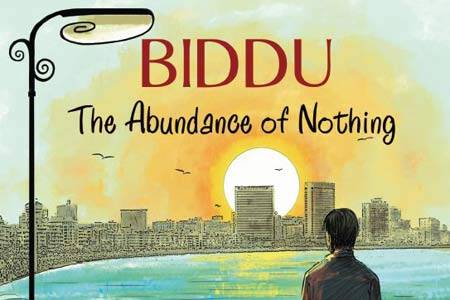
Book title: The Abundance of Nothing

Author: Biddu

Publisher: Times Group Books

Pages: 304

Biddu ventured into Bollywood with the sensational composition ‘Aap Jaisa Koi’ for ‘Qurbani’ and popularised Indie-pop in India with another best-selling album, ‘Disco Deewane’. He later produced the 3 million-selling album, ‘Made in India’ that kicked off Alisha Chenoy’s career. From this connoisseur of music and the receiver of a ‘Lifetime Achievement Award’ by Rolling Stone magazine comes a spellbinding tale of a young rag picker.

Set against the backdrop of Mumbai in the 90s, the novel takes you through a journey of a young man who comes to terms with life when he’s suddenly left alone in a big bad world. The rise and fall of the vagabond kid amalgamated with the impeccable use of metaphors captures the heart and makes you realign your perception about materialism.

How did the transition from music to writing come about?
I decided that at my stage, and dare I say age, I should walk away quietly from the music scene. Creating pop music is for the young, not for the young at heart. Anyway, I was sitting in my house in Spain, watching the sunset and the surf washing the shoreline and I thought what next? I did not want to go through life with just one experience, one career. The idea of opening a restaurant was tempting, but everyone said ‘You crazy’, you’ll be tied to the restaurant 20 hours a day. So then I thought about writing a novel. Since I had always written my own lyrics (in English), I thought I’d go down that avenue.

Did you hear from your fans after publishing books? How have they taken to your literary abilities?
Almost everyone has been impressed by the stories and my grasp of the language. But then I was brought up in Bangalore, where Hindi was a foreign tongue and English was the lingua franca of the middle class.

What according to you killed Indie-pop in India? As one of the pioneers of Indie-pop, do you feel saddened by the same?
A lack of talent and a plethora of sub standard music killed the Indie-pop industry. Also for a while Indie-pop ruled the waves, because Hindi film music was stuck in a time warp. But they listened to Indie-pop, got the ideas, and sounds among others , plus they had the Moola. A music video of Shah Rukh Khan fronting a song from a major film with the attendant heavyweight promo and publicity is going to have more impact than some unknown doing the same in a pop video.

What inspired you to pen down a story detailing the journey of a young rag picker on the streets of Mumbai?
I had already written my first novel ‘Curse of the Godman’ which was set in Darjeeling circa 1951, when the British had left India. So, I decided to bring my next novel to the present times and set it in Bombay as it’s the city which gave me my fondest memories as a youth in India.

The novel provides a perfect description of Mumbai’s subculture. How did you manage to delve so well into this part of the city despite moving to England long ago?
Writing is all in one’s mind. That and the Internet. The first novel ‘Curse of the Godman’ was set in Darjeeling. A lot of people emailed and wrote to me saying I had captured Darjeeling perfectly. I had to lie and say I spent time there. Why kill the illusion. You can travel the world sitting in front of your computer. But coming back to Mumbai’s sub culture, I lived there for four years and visit it every year. So, in many ways, I used to think of Mumbai as my home in India.

From where do you draw inspiration for your characters?
Inspiration is usually from perspiration. You let your mind wander, sometimes ideas come when you’re swimming, sometimes when you’re walking along the beach and sometimes when you wake up in the middle of the night and can’t go back to sleep. The mind wanders, ideas spring up, you filter them, the good ones from the bad and in the morning you rush to your lap-top and hit the keys.

What has been the biggest surprise or learning experience while writing the book?
The biggest surprise is when you read back a few chapters of what’s been written and if it’s impressive, you ask yourself ‘Did I really write that?’ and a smile percolates through and you get a warm all over feeling and the confidence and adrenalin pumps through your body. It was the same feeling I got when I used to compose a song and it felt like a winner and you knew it would be a hit.

As a child, what did you want to do when you grew up?
As a child of 12, I want to be a 13! But seriously, from a kid, I either wanted to be a film star or a singer. I couldn’t act out of a paper bag (like a lot of stars today!), so I became a singer. When I went to London, I took up writing, arranging and producing because I couldn’t get any work or gigs. So, I made my own records. Which on reflection was a far more lucrative way of doing things.

A literary figure who has inspired you in your life
Shakespeare for sure. I’m not a guy who has heroes. There are people I admire like Mother Teresa and Mahatma Gandhi. But the truth is, even in the world of music, I had no heroes or people I looked up to. You put people on a pedestal only to be disillusioned or disappointed when you actually meet them. Then you bring them down.

Readers interested can order their own copy of the book here tgb.indiatimes.com.

(Originally published on June 09, 2014)

source: http://www.timesofindia.indiatimes.com / The Times of India / Home> Life & Style> Books / by Pallavi Bansal, TNN / June 28th, 2014

The much-awaited return of Robin Uthappa

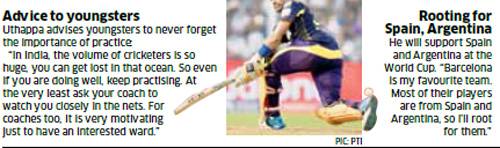
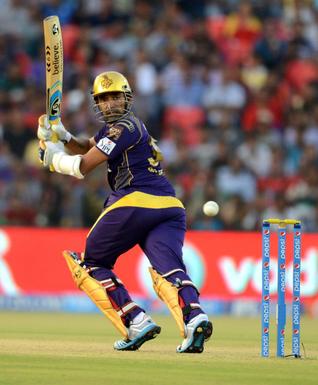
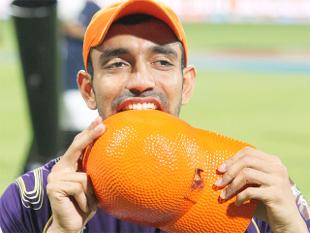
Smash hit: Robin Uthappa in action for the Kolkata Knight Riders./  Photo: Bhagya Prakash K. / The Hindu
Smash hit: Robin Uthappa in action for the Kolkata Knight Riders./ Photo: Bhagya Prakash K. / The Hindu

A prolific season culminating in an unforgettable IPL outing has helped Robin Uthappa join the Men in Blue

A blistering bat and an inner scrutiny, have constantly defined Robin Uthappa. The wide range of his shots has often matched the depth of his introspective bouts and after every such encounter with the ‘man in the mirror’; Uthappa has emerged stronger as an individual and hungrier as a batsman.

In a roller-coaster life that has belied its 28 summers, Uthappa is now riding a wave. The Karnataka opener’s excellent show with the champion – Kolkata Knight Riders – in this season’s IPL, helped him wrest the ‘Orange Cap’ for being the highest run-getter (660). The rewards were instantaneous as even before KKR took on the Kings XI Punjab in the final, Uthappa was already picked for the Indian squad that will play three ODIs in Bangladesh, this month. An elated Uthappa said: “I always knew I had the ability and game to make the comeback. I worked hard towards refining my game, plugged the gaps in my technique. There is a sense of determination and a sense of belief now.”

Uthappa, who first played for India in 2006, has been an intermittent presence with the national team. A truth reflected in a mere 38 ODIs and 11 Twenty20 internationals played over an eight year period that had long absences away from M.S. Dhoni’s team. The latest return though is a tribute to his constant endeavour to improve both as a player and as a person while also drawing enormous strength from his inner circle of pals in which girlfriend and former tennis player Sheethl Gautham, played a prominent role.

Just like his latest evolutionary phase shaped by having a personal batting coach in former India player Pravin Amre, Uthappa has forever questioned himself and refused to back down even when some of the answers were not flattering. As a school kid, slightly on the heavier side, Uthappa donned the wicket-keeping gloves besides having a biff with the bat while representing St. Josephs. Adolescence and acne also ushered in hard queries about his self-image and the Coorgi lad cut shot on his traditional cuisine that hinged a lot on pork.

He lost weight, sharpened his shots and it was just a matter of time before he noticed by former India captain Dilip Vengsarkar, who was then heading the BCCI’s talent resource development wing. Uthappa was fast-tracked into the Indian limited overs’ squad and he did make an early impression.

Uthappa was part of the Indian team that won the inaugural ICC World Twenty20 at South Africa in 2007. Somehow the start was frittered away while Virender Sehwag and Gautam Gambhir reiterated their credentials atop the batting order. But there was more to it than meets the eye as parental discord back home, scalded Uthappa.

He continued to do well for Karnataka, even briefly donned the skipper’s mantle, a designation he sought for himself.

“I walked up to Brijesh (Patel, KSCA secretary) and said that I wanted to lead the side,” Uthappa once said. And while personal issues bogged him down, he found refuge in his belief in Jesus Christ.

Later, he again grappled with the stigma of being over-weight.

He consulted Sheethl, roped in a dietician, monitored what he ate, worked out, cut the flab, got Amre as his personal coach and just focussed on excelling for whichever team he played for, be it Karnataka or KKR. He also found a balance between his innate aggression and the extreme caution that Amre drilled into him as part of a bid to stay long at the crease.

Karnataka’s winning streak in domestic cricket that helped nail the Ranji Trophy, Zal Irani Cup and Deodhar Trophy, also offered more opportunities for Uthappa to catch the selectors’ eye. The runs with KKR further vindicated what Sandeep Patil and company felt about the opener. The ticket to Dhaka, seems another start for Uthappa and from the looks of it, he wants to hold onto it with his dear life.

source: http://www.thehindu.com / The Hindu / Home> Features> MetroPlus / by K.C. Vijaya Kumar / Bangalore – June 08th, 2014

How Starbucks and Cafe Coffee Day are squaring up for control of India’s coffee retailing market

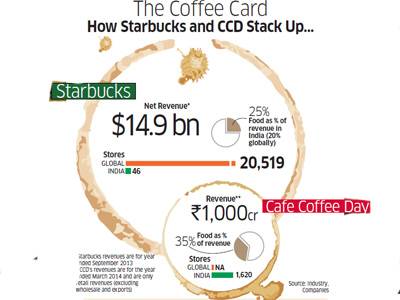
It is 5 pm on a weekday evening and the line at Starbucks in Indiabulls Finance Centre, a swish business complex in south Mumbai, is teeming with executives looking for their caffeine fix. With ties loosened and jackets casually slung over their arms, these men and women from the financial services, consumer goods and media firms housed in the towers of the complex are an ideal target audience for a range of beverages and snacks sold by Starbucks, the world’s largest coffee retailer; in 20 months of its inception in India — via a 50-50 joint venture with Tata Global Beverages — Starbucks has set up 46 such stores nationwide and has plans for dozens more.

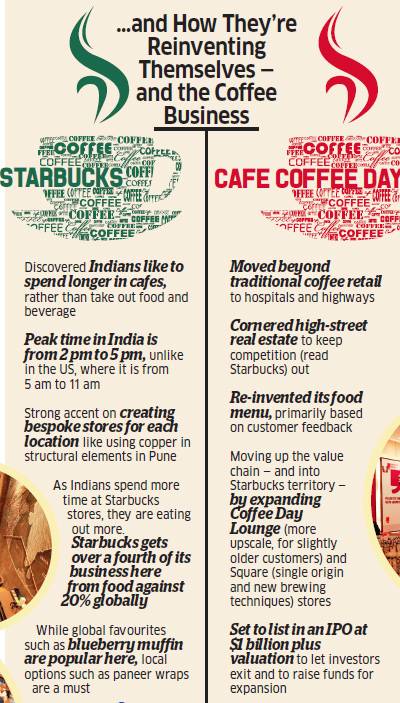
Cut to Ulundurpet, far removed from the urbane chatter at Indiabulls. This town of some 400,000 people in southern Tamil Nadu is best known for being halfway between Chennai and Tiruchirappalli, an industrial and temple town some 320 km to the south. If Starbucks has embarked on its fastest-ever expansion globally in India, the homegrown leader Cafe Coffee Day (CCD) isn’t easily intimidated. India’s largest coffee retailer has launched some 150 stores in the past 12 months and plans a similar number in the next year. What’s more, it isn’t sticking to one format. In a bid to firm up its position, CCD has launched formats for malls, highways, an upscale offering called Lounge and a single-origin coffee destination called Square.
The world’s largest chain and India’s No. 1 retailer are squaring up for control of the country’s coffee retailing market.

VG Siddhartha, the reticent founder of CCD, is all beans when he speaks to ET Magazine. “Our dream is to be among the top three retail coffee brands in the world,” he says. Already, CCD is present in some 200 towns across the country (it is often the first and only coffee retailer in many locations) and is aggressively expanding its footprint. “We hope to grow our retail business at about 20% in 2014-15 [and] we hope to do a revenue of Rs 1,200 crore from retail sales and another Rs 350 crore from the wholesale and export business this year.”

Siddhartha is firmly stepping on the gas with CCD. “We want to have around 2,500 Cafe and Express outlets in three years…we will set them up wherever there are opportunities, including at educational institutions, hospitals, expressways and high streets.”


Bean There, Done That

Siddhartha, who pioneered the bean-to-cup concept in the coffee industry — his Amalgamated Bean Coffee owns the plantations where coffee is grown and processed and later served at CCD outlets — is now set to take his next big step. According to reports, CCD has initiated plans for an initial public offering, which may value the chain at $1 billion and provide PE investors such as KKR an exit. CCD and its investors declined comment on the possibility of such an IPO.

A war chest from such an IPO will help Siddhartha finance what is quickly evolving into a two-horse race for India’s coffee cafe mart. India’s No. 1 chain, which has spent the past two decades building up its business — and has been predominately unchallenged — will face up to its strongest challenge yet. The $15-billion Starbucks is preparing to raid its citadel, digging its heels in for a long, bruising brawl.
Coffecard01KF09jun2014


Coffee, Anyone?

India is predominately a nation of tea drinkers, with most chains struggling to keep business afloat. Siddhartha opened the first CCD in 1996 on Bangalore’s Brigade Road, initially to serve pricey cups of coffee and let customers experience internet, then a novelty. While he opened the first store based on visiting a similar store in Singapore, the internet novelty wore off and CCD gradually became a beverage and food retailer.

Over the past two decades, CCD and other chains have been trying to persuade more people to visit their outlets and drink coffee. For all the coffee drinking claims, India remains a relative lightweight. Scandinavians throw back, by far, the most amounts of coffee and, across the world, several other countries such as the US and China swill vastly more coffee than India (see A Tea Country Still).

Since inception, CCD (and several other chains) have scaled up the coffee drinking experience from crowded non-airconditioned cafes to far more luxurious outlets, offering clean cutlery, a refined ambience and, increasingly, a growing assortment of food. Indians have willingly signed up, with industry estimates pegging this segment’s growth at about 20% annually.

The advent of CCD and later a plethora of chains targeting this free-spending consumer catalyzed coffee sales. “Domestic consumption of coffee, which was almost stagnant in the 1980s and 1990s, picked up an impressive pace in the past 7-8 years,” says Jawaid Akhtar, chairman, Coffee Board. “We estimate the domestic consumption at about 115,000 metric tonnes a year now which is growing at about 5% a year…driven largely by consumption through branded coffee chains.”

CCD and Starbucks are both wrestling for a share of this fast-growing market — and elbowing out the strugglers in their slugfest.


Risky Business

CCD’s Siddhartha will be the first to admit that running a cafe chain can be a bruising business. For starters, real estate costs have hobbled and humbled many of CCD’s rivals, who’ve struggled to make costly stores in central districts viable.

According to industry estimates, rentals can account for 15-25% of the cost of running a cafe chain. Then, there’s the investment in making a store appealing to customers with its interiors, finding people to run them and building a food and beverage menu that’s hip enough to keep 18-24-year-olds — the target market for coffee chains — coming back for more. CCD has tried to find a way around this problem by entering into a revenue-sharing deal, paying 10-20% of a unit’s proceeds as a fee. “Store location is a prime factor to consider for these chains,” says Reteesh Shukla, associate director, food and agriculture, with Technopak, a business consultancy. “Retail space is becoming very expensive, but you need to balance the ever-increasing costs of this prime real estate by being in [relatively less expensive] areas frequented by the youth.”

CCD has been successful in India because of its beanto-cup business strategy, which gives it control over bean production and processing and greater efficiency from its back-end set up. While Starbucks does have similar strengths thanks to its Tata tie-up, industry watchers say its relative lack of size in India means it’s at a disadvantage in squeezing out similar economies of scale. Opening a new store isn’t just about finding a good location and dressing it up for a brand-conscious a u d i -ence. Instead coffee chains need to figure out a tricky supply chain — how to get food and beverage to these outlets quickly, while keeping quality high.

The others, who don’t have this backward linkage, have predictably struggled.

While the opportunity may be tempting, food and beverage outlets are dealing with a soft market, where consumers are cutting down on how often they eat out and reducing how much they order when they do. For cafes such as CCD or Starbucks, this is a blessing in disguise — consumers are reducing their spend on full-scale restaurant meals and instead scaling it down to a coffee and a snack.

Starbucks’ Advent

Since he started his coffee chain, Siddhartha is facing up to perhaps his biggest challenge. Starbucks, which opened its first store in 1971 in Seattle’s Pike Market, today operates 20,519 stores globally. In the US, the chain has become a byword for a quick, upscale cuppa (not just coffee, but increasingly tea too, with Teavana Oprah Chai launched with talk show host Oprah Winfrey), with Alist celebs and executives all having their personal favourites. Starbucks has attracted thousands of loyal customers to its My Starbucks loyalty programme and has even worked with tech start-up Square to pilot cashless transactions at its stores.

While Starbucks has till recently focused on its home market, it has changed tack in the past few years. For example, it announced ambitious plans to scale up its presence in China — it will open 700-odd stores this year — even as it looked to manage tough economic headwinds. In October 2012, the firm announced a JV with the Tata Group to launch some 50 stores in India. While Starbucks thought of initially going it alone in India (foreign direct investments in single brand retailing are kosher) it decided to lean on Tata Global Beverages’ experience in the coffee industry supply chain to give it additional leverage here.

Expanding faster in China and then India is financially prudent for Starbucks. Starbucks’ operating margin for the second quarter of financial year 2014 (ended March) was 32.8% for the China Asia-Pacific segment, 21.6% for the Americas and 5.7% for Europe, the Middle East and Africa.

While CCD had to build its brand from scratch in India, Starbucks hopes to leverage a globally familiar label with its target audience. When its first store opened in each city, winding queues were formed well before opening time. Familiar with its offerings in tall, grande and venti sizes, thanks to consumers who’d travelled overseas, either in real life or virtually, Starbucks’ India business got off to a rousing start.

Chinese Inspiration
ChineseKF19jun2014

Starbucks has shown some gumption going after opportunities overseas. For example, it has made a splash in the Chinese market, says Elizabeth Friend, an analyst with Euromonitor, a research and analysis firm. “Starbucks has done very well in a number of emerging markets…much of this has had to do with the brand’s very strong global reputation, which helped it to gain more immediate traction than other lesser-known chains,” she says.

“They’ve also done a really great job tailoring their brand — through store design, menu innovation and even learning how local stores are operated — to best suit each individual market.” In China, this has included leaning toward larger store footprints that offer space to relax with coffee in the afternoon. The addition of beverages such as the red-bean
frapuccino and a broader tea-based menu have helped Starbucks make strong inroads into the Chinese market, says Friend.

Starbucks’ rise in China may provide many lessons for its India business. In a large country Starbucks has had to localize its menu to keep customers coming in — something it has done quickly in India too, with dishes such as chicken tikka panini. Starbucks had cornered over two-thirds of the coffee cafe market in China until 2010, estimates Euromonitor, even if aggressive domestic rivals have more recently cut its market share to 60%.

Friend of Euromonitor says Starbucks has been able to replicate some of this success in India, too. “Some of India’s new outlet launches have been among Starbucks’ most successful in its history,” she claims. “Starbucks has been steadily gaining on local leader Cafe Coffee Day, though the chain will continue to pose a significant threat.”

Slow Brew

Starting with its first store in Elphinstone Building in south Mumbai — the Tata’s iconic Bombay House headquarters is just a stone’s throw away — Starbucks has built its business steadily in India. In fact, the chain is behind its initial target of 50 stores — it has 46 operational currently — but has expanded to the National Capital Region, Bangalore and Pune as it seeks to take on CCD.

According to analysts, Starbucks has firmed up its presence as a premium coffee retailer, with some malls even using it as a carrot to attract free-spending consumers to its premises. “Having a Starbucks outlet is a guarantee to attract upscale customers to a mall and this in turn helps convince international labels to rent space there,” says Anand Sundaram, CEO of PPZ, a mall management firm which operates malls nationwide; RCity in Mumbai’s Ghatkopar suburb, for instance, houses a Starbucks store.

A 34-year-old Tata Administrative Services graduate is piloting Starbucks’ business in India. Avani Davda went from being an executive assistant to Tata Group veteran Krishna Kumar to helming the joint venture with Starbucks for India. Having tasted her first Starbucks Coffee in Seattle in 2011 (she counts Sumatra and India Estate Blends as her favourites), Davda thinks the chain has plenty of scope for growth. “India is one of the most exciting markets in the world…we believe we have a unique opportunity to deliver an unparalleled coffeehouse experience to Indian consumers,” she says.

“We firmly believe in our ability to build and grow the Starbucks brand in India and are confident in the opportunities that the Indian market offers for it to become one of the top five markets for Starbucks globally.”

Heady Growth India provides a fertile market opportunity for CCD and Starbucks. According to company executives and analysts, there is plenty of opportunity for growth. Euromonitor says the Indian coffee cafe market will grow from Rs 1,683 crore in 2012 to Rs 2,276 core in 2017.

“Growth of cafes in India is driven by many factors, including favourable demographics, rising income levels, graduation from mid-sized towns [to large metros] and the advent of global chains,” says Sunitha Barlota, a research analyst at Euromonitor International. “Cafes in India are considered a perfect place to socialize among college goers and working professionals.”

Others such as Asitava Sen, head of the food, agriculture research and advisory team at Rabobank Group in India, believe there is plenty of headroom for growth in this space, with cafes just starting out on a sharp growth curve. Sen estimates that there are around 2,000 coffee cafes across India and there is room for 5,000 or more nationwide. “The Indian market

is very different from the West … here a visit to a cafe is more a social occasion and less a quick visit…the opportunity for cafe owners is to try and get a greater share of wallet from these consumers,” he adds.

Starbucks has discovered over the past few months how different it is doing business in India. According to Manmeet Vohra, the Indian operation’s marketing and category chief, they discovered that peak hours in India were 2 pm to 6 pm (compared to 5 am to 11 am in the US, for example) and takeout orders accounted for barely a fifth of their business in India (compared to 80% in the US).

What’s more, as customers spend time in the cafes, they needed to design them differently. So the cookie cutter design gave way to customized spaces in each city — for example its store in Pune uses copper elements, in a nod to the heritage of the city. “After office and home, we want to be the firm favourite as a third place to hang out,” Vohra adds.

According to brand consultant Harish Bijoor, consumers have made their preferences clear — Starbucks is the more upscale hangout, while CCD is a budget option. “Both these brands have strongly defined identities and consumers identify with them,” says Bijoor, who worked for eight years at Tata Coffee (a subsidiary of Tata Global) between 1993 and 2001. By his estimates there are currently 2,350 cafes, while the potential is for as many as 6,440 such outlets.

Success Potion

According to analysts such as Euromonitor’s Barlota, there are three or four key ingredients that determine the success of a coffee cafe. Other than location — CCD’s success to date is determined by being located close to colleges, business complexes, high streets and malls — pricing can be a make or break factor. This is particularly crucial at the lower end of the market where budget-conscious buyers are wary of shifting from cheap restaurants (sometimes called Darshinis) to a CCD or Starbucks. Those that do make the shift and pay the premium can be demanding on quality of service and product.

As consumers make their choices known, there seem to be strong indications that India’s coffee cafe market is going to consolidate. According to analysts, while CCD may be the mass market leader, Starbucks has occupied a strong position in the premium space, with plans to slowly but surely expand its presence. This means others in the market, including Costa Coffee, Baritsa and Gloria Jean’s, will struggle to attract and retain loyal custo mers. As the market gets polarized, CCD and Starbucks are expected to soon dominate the coffee cafe sweepstakes.

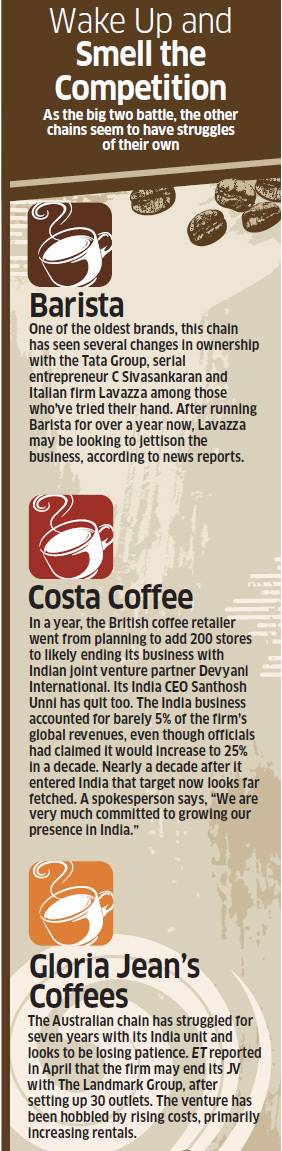
Some of these signs of strife are already visible. For example, Barista, the second organized retail chain in India after CCD, is on the market for a third time . While Ravi Deol, the chain’s first CEO, was tipped as a leading takeover candidate, his interest has faded in the past few weeks. Deol couldn’t be reached for comment. Italian owner Lavazza also declined comment.

Then, Costa Coffee, brought into India by Devyani International, is the subject of much wrangling between partners. Devyani, which runs the India business for the likes of KFC and Pizza Hut, has struggled for years with the Costa Coffee business. Virag Joshi, the CEO of Devyani, wasn’t available on the phone and didn’t respond to an email seeking comment.

Costa Coffee, however, doesn’t seem to have given up on India. “Costa is the world’s second largest coffee shop brand and is growing rapidly in its domestic UK market and globally adding over 300 stores a year,” says Kate Manning, a spokesperson for the chain. “We are very much committed to growing our presence in India.” While Costa has some 120 stores in India, she declined to enumerate the firm’s future plans. Costa’s India head, Santhosh Unni, has recently quit.

Third, Gloria Jean’s is also dealing with its own dose of bitter beans, with its joint venture with The Landmark Group on the rocks. Both sides didn’t respond to emails seeking comments, but real estate analysts said the chain was scaling back its presence in costly high-street locations to salvage the business.

However, CCD’s Siddhartha isn’t getting distracted by the woes of the competition. “All foreign coffee brands are looking at the top 5% of the Indian market — i.e. high income group consumers,” he says. “But we are focusing on the dynamic youth population. Roughly 70% of Indians today are below 35, and our goal is to reach out to them.”

Focus Matters
CompetitionKF19jun2014Experts argue that as a scale player, CCD has been able to escape much of the tumult in the sector because it has focused on its core proposition of affordable coffee, with comfortable surroundings, and steered clear of trying to tinker too much with a winning formula.

This is not to say that it has stood still in an evolving market. CCD, for example, gets around 35% of its business from food — an area it only focused on in the past 12-18 months.

“What stands out about Siddh artha and CCD is their ability to make strategic changes in response to customer demand and competition — expanding the food offerings or rationalizing store count to sustain growth and profitability are great examples,” says Sanjay Nayar, MD and CEO of KKR India.

“There is a great opportunity for CCD to leverage its large network to drive growth in a new direction,” he adds. In March 2010, KKR invested $210 million in Coffee Day Resorts, the holding firm which includes the coffee retailing business.

Venu Madhav, who has been with CCD since day one and got promoted as chief executive over a month ago, says the coffee retailer is streets ahead of the competition in understanding the Indian consumers’ needs.

“Cafes are social hubs, where coffee and conversation play a key role in the success of an outlet,” he says. “India is a value-conscious market and we see ourselves in the affordable luxury category of coffee retail.”

Madhav is keen to expand the reasons consumers stroll into a CCD — not just for a relaxed cuppa but for breakfast, lunch and dinner, too. It’s no surprise that CCDs on many highways are popular rest stops and the chain is focused on expanding its presence in the space.

Brand Battles

CCD is acutely aware that it takes little for consumers to switch loyalties — however good the coffee may be. To try to keep pace, CCD’s interiors are periodically updated to prevent its ambience from looking dated and jaded. “The look of our stores changes completely every couple of years,” avers Madhav.

While CCD continues on its rapid expansion path, Starbucks isn’t rushing to keep pace. According to industry sources, Starbucks could add a dozen or more outlets in the next year in India and is looking to expand its presence in the cities it is present in and consider going to second-tier metros, too.

“Each market comes with its own set of opportunities and challenges and our guiding principle across all markets continues to remain the same: to inspire and nurture the human spirit — one person, one cup and one neighbourhood at a time,” says Davda. And in the process she’d be hoping Starbucks coffee becomes most Indians’ cup of tea.

source: http://www.articles.economictimes.indiatimes.com / The Economic Times / Home> Industry> Services> Retail / by Rahul Sachitananad & K R Balasubramanyam, ET Bureau / June 08th, 2014

Sarajevo art museum gets boost from Italian coffeemaker

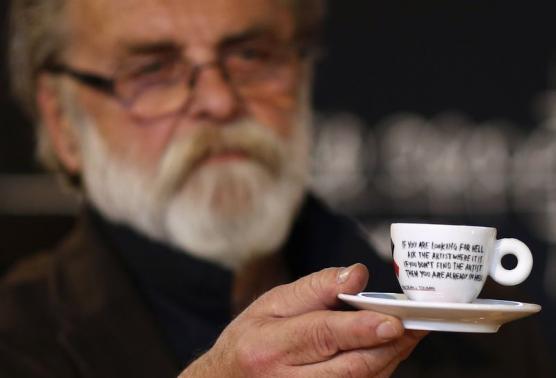
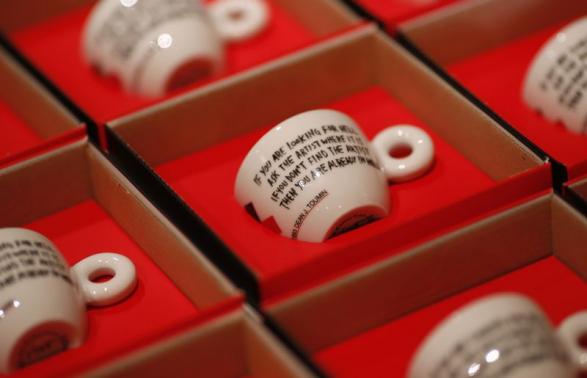
Sarajevo-born artist Dean Jokanovic Toumin, designer of a special edition illy coffee cup, holds up one of the cups, in the ARS AEVI museum of contemporary art in Sarajevo, June 4, 2014.  CREDIT: REUTERS/DADO RUVIC
Sarajevo-born artist Dean Jokanovic Toumin, designer of a special edition illy coffee cup, holds up one of the cups, in the ARS AEVI museum of contemporary art in Sarajevo, June 4, 2014.
CREDIT: REUTERS/DADO RUVIC

( Reuters) – It is hard finding a bright side to the museum scene in the Bosnian capital Sarajevo, where the Olympic Museum burned down during a 1992-95 siege by Serbian forces and the main national museum closed in 2012 for lack of funds.

But thanks to a grant from the Italian government and a plan by Italian coffeemaker illycaffe to sell designer coffee cups to support the project, there is hope for one man’s vision of creating a modern art museum for a city still suffering the aftershocks of the ethnic conflict of the 1990s.

“That night when the museum was burned down, a spontaneous idea emerged as a reaction to all those religious and ethnic divisions,” said Enver Hadziomerspahic, who directed the 1984 Sarajevo Winter Olympics opening and closing ceremonies.

The idea was “to invite world artists to form a collection of their own future museum of contemporary art which would become a symbol of a new Europe and an expression of international collective will”, he told Reuters in an interview.

Hadziomerspahic lobbied European museums and galleries to take part in the project even while the war, pitting Muslim Bosniaks against Orthodox Christian Serbs and marked by the longest siege in modern history, still raged in Bosnia.

Museums in Milan, Prato, Venice – all in Italy – and Ljubljana and Vienna became partners of his ARS AEVI collection. That helped persuade world-renowned artists such as Michelangelo Pistoletto, Marina Abramovic, Joseph Beuys and Janis Kounelis to donate works for a collection estimated to be worth around 20 million euros ($27 million).

Twenty-two years on, the collection of around 150 works is still homeless because of political bickering in the Balkan country, where rival ethnic elites cannot agree on any nation-wide cultural project.

But a temporary ARS AEVI exhibition depot was opened in Sarajevo in February after the Italian government contributed $1 million through UNESCO.

Special edition illy coffee cups are pictured in the ARS AEVI museum of contemporary art in Sarajevo June 4, 2014.  CREDIT: REUTERS/DADO RUVIC
Special edition illy coffee cups are pictured in the ARS AEVI museum of contemporary art in Sarajevo June 4, 2014.
CREDIT: REUTERS/DADO RUVIC

LIMITED EDITION CUPS

Last Thursday, Trieste-based illycaffe launched a limited edition of its art cups designed for ARS AEVI by Sarajevo-born artist Dean Jokanovic Toumin. The unique lines of cups, designed by top contemporary artists, have been sold around the world.

“The idea is magical, we think we can be the catalyst to bring other people,” Giacomo Biviano, illycaffe’s deputy general manager, told Reuters. “Through this cup we can let other countries know there is this museum in Sarajevo.”

A quotation written on the cups from an 18th century writer, Avigdor Pawsner, could very well apply to artists and cultural institutions in modern-day Sarajevo: “If you are looking for hell, ask the artist where it is. If you don’t find the artist, then you are already in hell.”

The arrival of the first private partner has raised hopes that the collection can find a permanent home in a museum building already designed – but not yet built – by prize-winning Italian architect Renzo Piano.

“We hope and we are working to get more private partners,” said Ruggero Corrias, the Italian ambassador to Bosnia who lured the Italian roaster into the ARS AEVI museum project.

“Our final goal remains to have a sustainable ARS AEVI so we can land into the Renzo Piano museum,” Corrias told Reuters.

With museums in Sarajevo barely surviving, Hadziomerspahic knows he is lucky. The National Museum closed in 2012 because of lack of support from any government institutions. It had survived two world wars and the Bosnian war in the 1990s.

“I am happy and sad at the same time, happy that we are moving forward but sad that Italy, and not our own politicians, should be behind the drive for promoting the project,” Hadziomerspahic said.

($1 = 0.7345 Euros)

(Reporting by Daria Sito-Sucic; Editing by Zoran Radosavljevic, Michael Roddy and Gareth Jones)

source: http://www.reuters.com / Reuters.com / Home / by Dario Sito-Sucic / Sarajevo, Monday – June 09th, 2014

Arpinder Singh jumps to glory

Arpinder Singh mocked the hot and humid conditions as he improved the National record in men’s triple jump with an effort of 17.17 metres on the final day of the 54th National inter-State athletics championship at the PAC Stadium here on Sunday.

The 23-year-old ONGC employee shocked the previous holder Renjith Maheshwary, who set it in 2010, by ten centimetres and added insult to injury by beating him to the gold by 63 centimetres.

Interestingly, Arpinder improved on his personal best of 16.84 metres, with one of his two valid jumps as he had no mark on four of his jumps. In the process, he also went past the Commonwealth Games qualification mark of 16.83 metres with ease. His first good jump on the third attempt measured 16.49 metres.

M.R. Poovamma outclassed a strong field that included Olympian Tintu Luka, in the women’s 400m with a new meet mark of 51.73 seconds that beat Mandeep Kaur’s 51.74 set in 2008.

It was easy to announce Arpinder Singh (1174 points) of Punjab and Poovamma (1141) of Karnataka as the best male and female athletes respectively. The men’s, women’s and overall team honours were bagged by Kerala ahead of Tamil Nadu.

The results: Men: 100m: 1. Krishnakumar Rane 10.32 (NMR, old 10.36); 2. Manikanta Raj 10.52; 3. Anirudh Gujar 10.63. 400m: 1.Arokia Rajiv 46.13; 2. Kunhu Muhammed 46.17; 3. Sachin Roby 46.79. 1,500m: 1. Sajeesh Joseph 3:48.16; 2. Anil Kumar 3:50.41; 3. Chandrakant Manwadkar 3:50.89. 10,000m: 1. Suresh Kumar Patel 30:00.03; 2. Rahul Kumar Pal 30:36.69; 3. Kheta Ram 30:50.95. 110m hurdles: 1. Siddhant Thingalaya 13.84; 2. Surendhar 13.97; 3. Prem Kumar 14.06. Triple jump: 1. Arpinder Singh 17.17 (NR, old 17.07); 2. Renjith Maheshwary 16.54; 3. Karthik 15.91. Hammer throw: 1. Charodaya Narain Singh 69.38 (NMR, old 68.98); 2. Kaushal Singh 65.31; 3. Neeraj Kumar 63.74. 4x400m relay: 1. Kerala 3:10.64; 2. Karnataka 3:11.39; 3. Tamil Nadu 3:16.82.

Women: 100m: 1. Saradha Narayanan 11.39 (NMR, old 11.48); 2. H.M. Jyothi 11.49; 3. Srabani Nanda 11.59. 400m: 1. M.R. Poovamma 51.73; 2. Tintu Luka 53.22; 3. Debashree Majumdar 53.54. 1,500m: 1. O.P. Jaisha 4:16.27; 2. Sini Markose 4:18.94; 3. Jhuma Khatoon 4:20.53. 10,000m: 1. Preeja Sridharan 34:34.98; 2. Suriya 35:26.75; 3. Monika Athare 38:19.93. 100m hurdles: 1. K.V. Sajitha 14.16; 2. Gayathri 14.21; 3. Hemashree 14.51. Discus: 1. Pramila 46.99; 2. Vasumathy 42.12; 3. Ankita Julka 41.03. Hammer throw: 1. Manju Bala 62.74 (NR, old 62.67); 2. Gunjan Singh 61.19; 3. Ritu Dhiman 59.96. Heptathlon: 1. Liksy Joseph 5386; 2. Niksy Joseph 5154; 3. Purnima Hembram 4932. 4x400m relay: 1. Kerala 3:38.40; 2. West Bengal 3:50.84; 3. Uttar Pradesh 3:57.82. 20km walk: 1. Rani Yadav 1:46:49.00; 2. Shanty Kumari 1:58:16.00; 3. Rajani 2:01:29.00.

source: http://www.thehindu.com / The Hindu / Home> Sport> Other Sports / by Kamesh Srinivasan / Lucknow – June 08th, 2014

Lush Places: The Scotland of India

Samyak Kaninde/Getty

India has become known for the congested traffic and crowds of the cities. To escape the madness, Indians head to Coorg, a land of lush beauty, traditional food, and—sigh—tranquility.

On a recent family visit to Delhi, with its acrid air and evil traffic, my mother suggested an escape—a long weekend in Coorg, some 1,400 miles away in a tiny corner of the southern Indian state of Karnataka, just north of Kerala. In spite of its unprepossessing size, Coorg, which the British called the Scotland of India, is a region of intense pride and history. Many Indians regard it as a quasi-mythical place, a land of lush hills, temperate climate, martial men, and handsome women. Its ample rain and still-thick forests, not to mention its low population density, make it one of the few remaining Shangri-Las in over-peopled India.

Tyrannical rajahs ruled Coorg until the British, who knew a promising escape from the heat when they saw one, annexed it to the East India Company’s territory in 1834. The British established farms there, recruited the famously valorous Coorg natives for their Imperial mission, and, in 1947, left behind tidy settlements of Victorian-influenced cottages in shades of lavender, rose, and mint, along with graceful plantations of Robusta and Arabica coffee. Coffee flowers smell something like jasmine, and from mid-March to early April, the white blossoms add their perfume to the other scents of the region—orange, pepper, cardamom, vanilla, honey.

While venerable hill stations in other parts of India are overrun with tourists, doughty little Coorg is still putting up a fight to retain its old essence, even as it welcomes visitors with courtly hospitality. Coorg is a fashionable destination for wealthy Indian travelers hungry for places cool and green—not merely in the literal sense, but also in keeping with the eco-alert, Indo-centric new ethos of the country’s intelligentsia. Coorg is not a hippy-strewn, land-locked Goa. Nor is it a more verdant Jaipur, overrun with Bloomingdale’s buyers. It’s a more understated and introspective sort of place that honors its roots. The locals worship their ancestors, and their attachment to family land is almost visceral. Coorg isn’t easy to get to from afar, for which we should be grateful. Bangalore is the nearest international airport, a six-hour drive away. The highway is smooth and hassle-free by Indian standards, until you get close to Coorg, when you hit sinuous roads that wind through hillsides: these can range from bumpy to bone-jarring, and are best tackled at a sedate pace, all the better to take in the landscape.

“India’s cities are so insistently provocative that, for a certain class of Indian, to be under-stimulated has become the ultimate luxury.”

India’s cities are so insistently provocative that, for a certain class of Indian, to be under-stimulated has become the ultimate luxury. For some time now, members of the Indian elite who have no family connection to the place have been quietly buying land in Coorg, building vacation houses in its remote hills and valleys. Once obsessed with gleaming hotel towers and swimming pools in the “foreign” mold, India’s domestic tourists have grown infinitely more sophisticated and, even, jaded. Indians who have “been there, done that” in Sri Lanka, Singapore, and the Swiss Alps want languid escapes from their overscheduled lives. And they are deeply nostalgic for the quiet India—so recently changed—that they remember from childhood vacations.

Enter the Taj Group, with its astute understanding of the needs of the well-heeled and the well-traveled. Their hotel in Coorg, situated near the region’s capital, Madikeri, is called “Vivanta by Taj,” and it is the company’s nimble response to travelers who clamor to get off the beaten track without collapsing from weariness and worry.

With its hotel outside Madikeri, Taj promises “a haven for the curious mind,” dotted with “interpretive nature trails” set in a “model of coexistence.” The Eden theme is coupled with a celebration of modesty that seems to reflect a wider backlash against modern Indian brashness. The property comprises 180 acres of rainforest, and each of the 60-odd cottages and villas offers views of woods, cloud, and vibrant green. The buildings are beautifully unobtrusive, designed to be in hushed harmony with the surroundings. In the evenings, the lighting is subdued, almost apologetic, and this deference to nature is apparent also in the materials used: wood and local stone, the architecture seeking to emulate the Coorg vernacular.

The hotel was built on land carefully surveyed to avoid displacing trees in a rainforest teeming with some 350 species of flora and fauna. Compressed soil from the site was used to make the bricks for the resort. Most of the stone used was sourced from within a 200-mile radius of the hotel’s premises. The interiors of the cottages resemble the sort of understated living room you might find in a gracious Indian home. The roof-tiles are handmade and repurposed from dismantled houses in Tamil

Nadu, Pondicherry, and Andhra Pradesh. “Revived craft” artifacts made by indigenous tribes—like light fixtures fashioned from old-style fish traps—are incorporated into the décor, providing both authentic ambience and employment for local craftsmen. The property’s architect, Pramod Ranjan, aimed for an unobtrusive, minimalist design that allows the organic landscape to outshine the manmade artifacts. That said, the manmade and the natural do converge in a setting of utter glory: the infinity pool in the hotel’s main building, where, immersed in warm water, one can gaze upon a lush green heaven that stretches for miles before the eye.

Traditional food is also “revived with love” at the hotel. Native Coorg cuisine is a delight to savor. It revolves around a few local ingredients, such as Kachampuli (a type of vinegar), pepper, chilies, rice flour, coconut, and Maddu Soppu, a medicinal leaf believed to confer 18 healthful properties, each especially effective if delivered on a particular day of the year. Succulent pork also figures centrally in the local cuisine, along with dishes made from bamboo shoots, wild mushrooms, banana stems, and jackfruit—flavors that have not yet been appropriated by the vacation-industrial complex.

Coorg also offers its share of picturesque anthropology. The Kodavas, the people of Coorg, revere weaponry and maintain a reputation as brave soldiers well represented in India’s wars. They are tall and light-skinned, when compared with other south Indians, and some attribute their appearance to Arab blood. Others contend that Greek mercenaries who came to India with Alexander the Great left their genetic mark in Coorg. At the hotel, however, the staff reflects the variety of modern India: our bartender, whom I tested with the making of a martini, was from Himachal Pradesh, in the far north; the cheerful chatterbox who waited on us at dinner was from Orissa, in the coastal east. But the unmistakable tenor of the place was that of a Coorg bastion, a hotel in the heart of a fabled region, bathed in mist in the morning and alive with the sounds of birds at dusk. A graceful, benign getaway it was, and we wrenched ourselves from it sorrowfully at the end, hating the horror of a return to Delhi.

source: http://www.thedailybeast.com / The Daily Beast / Home> Great Escapes / by Tunku Varadarajan / March 25th, 2014

College in the hills

In a bid to maintain the quality of education, Coorg Institute of Dental Science has limited its student intake to 40 a class.

Nestled in the womb of the Western Ghats in the hilly highlands of Coorg is the Coorg Institute of Dental Science (CIDS). As you reach the institute you begin to wonder if you have arrived at a holiday spot, for, so breathtaking is the panoramic view from the top. The aesthetic essence of the tile-roofed stone buildings amidst the greenery is hard to ignore. The buildings of the institute are built by cutting the slopes to tuck in the brick and mortar structures. The mist covered mountains, the rich foliage and the specks of the tiny town of Virajpet below is a sight befitting the Gods.

Built on a sprawling 35-acre space, the institute boasts of excellent infrastructure and well qualified and dedicated staff. The institute is run by a Trust and Managing Committee consisting of members of the Kanjithanda family. The management of the institute is by a group of professional doctors and the managing trustee, Dr Sunil Muddaiah is an orthodontist. The Institute is the dream project of the father son — duo, Dr Sunil and his father KK Aiyappa. In fact the campus is called ‘Kanjithanda Kushalappa Campus’ after the patriarch. The institute is recognised by the Dental Council of India and the Ministry of Health and Family Welfare, New Delhi.

The management believes that the quality of education can only be enhanced by a small class. Hence the intake of students is limited to 40. Monthly tests and a unique system of evaluation of students with the help of counsellors, who are senior members in the faculty has ensured good results.

The institute churns out nearly cent percent results since its inception in 1999. An interesting trend is that the girls outnumber the boys in a ratio of 85 per cent:15 per cent. Dr Sunil says this is probably due to the safety and security provided in the campus. Not to mention the ambience and climate.

The institute is affiliated to the Virajpet General Hospital and the Tata Hospital, Ammathi. There are 100 chair modern Dental Hospital with round the clock service. The dental hospital also has a modern major operation theatre with anesthesia facilities. Attached to the operation theatre is a 30 bed in-patient ward. Latest equipments in Dentistry like OPG and RVG units; Ceramic Laboratories and casting units, latest audio visual aids and Minor OT’s are available.

A Department of Implantology which is the third in the country under the Global Oral Implant Academy (GOIA) is fast developing. The management says a new special dental wing with state of the art facilities comparable to European standards and way above any similar existing facilities in the country is taking shape in the campus.

The department conducts frequent dental and screening camps. ‘Doorstep Dentistry Project’, is a unique programme where the staff and students go door-to-door in the far flung villages of Coorg and conduct basic dental check-ups and impart dental health education.

The number of patients treated through these camps touch 70,000.

While dental education is the focus, the all-round development of the students are also borne in mind. Facilities for a host of indoor and outdoor games are provided on campus. A full-fledged aerobic centre, gymnasium and a club for student activities is made available. There’s a film show twice a week and an auditorium with modern audio and visual aids are some of the other attractive amenities.

An internet kiosk with VSAT facility allows for easy communication. Hostel facilities are provided for all students in the campus.

The campus kitchen serves both vegetarian and non-vegetarian food. Fast food joints and coffee shops within the campus are popular with the students.

source: http://www.archive.deccanherald.com / DH Education / Home> DH Education / by Anjali Kariappa B / August 17th, 2006