The Bearded Bandit of Coorg!

The Bearded Bandit of Coorg!

Robber Fly, Coorg / Photographed by: Samyak Kaninde
Being mugged is every traveller’s nightmare. Being mugged and then consumed as the main course in a mugger’s banquet, is the stuff that makes it to the horror movie hall of fame. But being killed and converted into a Smoothie to be slurped at leisure, takes the (dis)honours and is certainly not something you’d like on your resume. That, however, is exactly what happens to unwary air-travellers in Coorg if they don’t keep a lookout for the most feared bogeyman of the area – the Robber Fly. This bearded brigand perches quite innocuously on a twig, and when a beetle, dragonfly or wasp is spotted approaching incautiously, smacks his hirsute lips and takes off on a roundabout flight, before veering back suddenly and grabbing the unsuspecting insect, mid-flight, with his powerful legs. A short jab with his rapier-sharp beak injects venomous saliva that paralyses the prey while liquefying the body matter. From there on it’s a smooth return flight to the home perch, where the Robber proceeds to slurp up his Insect Smoothie. If he’s particularly peckish, and feels like a larger serving, the Robber Fly doesn’t balk at taking on prey much bigger than himself, trusting to his well-honed predatory skills and the power of his proboscis.

Talking of skill-sets, the predatory career of this successful bandit begins quite early: the larval baby brigand hides in the soil and in decaying wood, and learns the ropes by preying on the larvae, eggs and pupae of other insects around him. While this is bad news for some, a healthy Robber Fly population is good for humans, as it is our first line of defence against destructive and disease-carrying insects. Much like the legend of Robin Hood, the Robber of Coorg has shown that a bandit for some could well be a saviour for others.

We at Orange County have loved sharing this story with you, and shall bring you one every fortnight, as part of our Responsible Tourism Initiatives to raise awareness about the nature and culture of the environments we operate in.

source: http://www.lifescapes.org.in / LIFESCAPES by Orange County / Home> Lifescapes Gallery / January 11th, 2012

The Bandipur-Brazil corridor

In Bandipur: dung sold at Rs 3,000 a lorry load.In Brazil: a ravaged coffee crop. Asks NITIN SETHI : what’s the relation?

Hangala was selling cow dung Auctioning
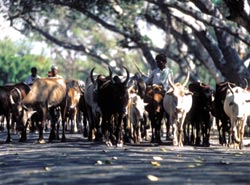
— (Credit: Photographs: M D Madhusudan

It’s hard to tell who was the first in the village to really strike upon the business idea. But very soon everyone in Hangala was part of it. The sleepy and dry village at the periphery of Bandipur National Park, Karnataka, had in a mere two year’s time, transformed itself into the nerve centre of a booming trade.

Hangala was selling cow dung. Auctioning it, quite literally, and making millions. The buyers came from other parts of Karnataka — from Tamil Nadu and Kerala, as well. Those were years of boom, the 1990s. It isn’t too bad, even today; though you are quite likely to get this wistful remark from the village’s residents today: “The high point of the trade lasted for about five years and we all made good”.

Hangala was not the only one to prosper from dung trade; the other 74 villages on the periphery of the park also thrived on it. And unknown to them, the trade was fuelled by happenings in Brazil.

Hangala, or any other village for that matter, never came to know how. They didn’t care to, or needed to, say villagers, they just wanted to make the best of it. For, the region was in dire straits then. Rains had failed Karnataka repeatedly. 60 per cent borewells had gone dry in Hangala and the village’s rainfall-dependent agriculture was on the verge of collapse.

The villagers, like most others in the region, grew low- yielding crops of millets and pulses. The average annual family income was as low as Rs 17,000. The money to be ploughed in to agriculture on the other hand was huge; labour, manure, fertilisers and seeds had to be bought before the monsoons. “Cash strapped, we perpetually ran to the local moneylenders,” says Kalappa. Interest rates ranged from 60-340 per cent annually. Even if drought spared them one year, there would always be the crop-depredating wild pigs and elephants to deal with. As an alternative some farmers opted for cash crops, cotton and castor. The crops were to some extent resistant to depradations by wild animals and brought them instant cash. But only so much.

Everyone in the region was looking for better opportunities. And, when coffee prices around the world shot up in the early 1990s, the villagers found a way out of their difficulties. These were the years when the flurry of activity at coffee markets across the world matched the fury with which the frost struck and destroyed Brazilian coffee.
High on coffee After crude oil and metals, coffee is the hottest selling commodity in the international market. The annual global exports exceed US$12 billion. About 60 countries trade in it, and Brazil, the largest grower contributes approximately 30 per cent of the global production.

Brazil’s annual coffee production is, however, prone to recurrent bouts of frosts and droughts. In fact, frosts have severely damaged Brazil’s coffee crop 31 times in the last 172 years. The frequency of the attacks have increased during the last few decades. And, in the mid-1960s and the mid-1990s Brazil suffered the worst, losing 50 per cent of its exports.

Each time the golden rule of the free market came into effect: when supply of goods reduces, prices shoot up. In fact, prices rose quite dramatically as coffee was (and continues to be) the centre of a international speculative trade, which keeps its prices volatile. The beneficiaries of this sudden rise were bound to be coffee farmers in minor producer countries, such as India (which produces 3-4 per cent of the coffee grown globally), with their produce steady in times of global slump.

But Indian growers were in no position to benefit in the 1960s. For, the farmers had to compulsorily sell their produce to the state-run Coffee Board at a fixed price. However, things were different in the 1990s: the Coffee Board had lost its control over the coffee growers. Now, the latter minted money.

And how?
The value of India’s average annual coffee export rose by 158 per cent between 1989-93 and 1994-98, although the corresponding increase in export volume was only 36 per cent. Profits soared by as much as 834 per cent, much of it shared between coffee farmers of three contiguous districts: Kodagu in Karnataka, Nilgiris in Tamil Nadu, and Wayanad in Kerala. For, about 45 per cent of India’s 3,467 square kilometres expanse of coffee-growing areas falls within these districts, which together produce 57.2 per cent of India’s coffee. While the going was good, farmers increased the land under coffee plantations. There was a problem though: manure. Indian coffee growers prefer organic manure, which gives their produce a distinct taste and value. The ever-increasing plantations now needed larger volumes of it. The obvious source: cattle. But coffee growers were loath to let cattle graze on fertile and valuable lands that could alternatively be brought under coffee, yielding even more profits.

Dung had to be managed from outside the plantation area.

Bright idea
If coffee growers couldn’t keep cattle on their highly priced land, couldn’t someone else? It is difficult to say who thought of it first; the fact remains that the entire region cottoned on fast. Coffee growers prospected and hit upon the well-connected villages around Bandipur. A good choice: livestock was abundant, agriculture was nominal, and land was not intensely used, and therefore very cheap. Here was a source for manure, loads of it.

What must have clinched the ‘deal’ was that most villages on the northern boundary of the national park had free access to the park forests. So fodder was not a problem. The pact struck, an inter-state trade in cow dung took off.

Villages such as Hangala began auctioning their dung for as high as Rs 3,000 a lorry load. Brazil’s ill luck and the vagaries of international commodity trade had brought the region unexpected riches. Hangala alone produced 39 tonnes of dung daily at the peak. Of this, it sold 16-24 tonnes — an average of 4 truckloads every day. Here was a business with no recurring costs; the fodder was ‘stolen’ from forests. “And the cattle were bought dirt cheap from Ooty. We didn’t need high milk-yield varieties, just ones which could amble through the adjoining forests and defecate” says Kalappa, a resident of Hangala.

Simple rules governing dung collection came into effect: all dung that fell in the cattle shed belonged to the cattle-owner; that deposited while cattle grazed in the forests was gathered by dung collectors (including women who found a formal occupation, finally). Dung collectors sprung up. So did agents, lorry managers, suppliers, brokers — a supply chain.

The village council in Hangala decided it should also get a share of the trade proceeds and began auctioning off streets and public places for dung collection. Exclusive collection rights were auctioned off at nine public locations — including the cattle pound and eight streets cattle used to reach grazing grounds. “We thought auctioning would bring money to the village for its development,” says H S Nanjappa, zilla panchayat member. After all, the annual trade from this village alone was worth about Rs 65 lakh.

The fact that much of the village manure was going out did not impact farming: the money earned helped purchase government-subsidised fertilisers.

Over time, villagers bought more cattle; the bovine population increased in all the villages participating in the trade; in some, by as much as 30 to 40 per cent over just five years. And in a few villages the growth rate of livestock shot up as high as 13-17 times greater than the national average livestock growth rate for the same time period.
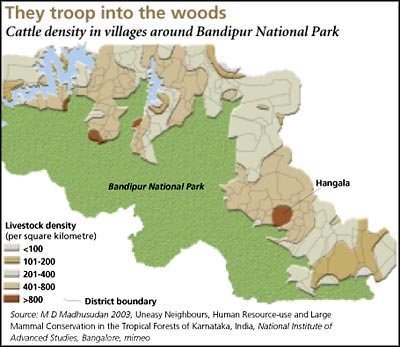
All this cattle grazed in the forest, with people following, avidly
collecting. The only alternative for grazing, common pasture lands, had anyway long disappeared. Additionally, most villages were now cropping marigold, turmeric, cotton and sunflower, which produce no consumable waste. “And even where ragi (finger millet) is grown, it’s a hybrid that produces very little hay,” says A Obireddy, principal scientist, National Dairy Research Institute, Bangalore. The forest was the cheapest, and at times the only, source of fodder for the thousands of cattle.

And today
Brazilian coffee is doing extremely well. Indian coffee growers face their worst crisis ever in 30 years. But the dung trade has acquired a steam of its own. “We now sell dung to Kerala for ginger, chilly, tea and many other crops. It’s not as voluminous as before, but prices have risen by almost Rs 1,000 in the last two years,” says M C Subbappa of Mangala village, which depends entirely upon dung trade (only about 10 of its 200-odd families own land). “What other options do we have?” he asks, as his 20-odd cattle rush home, tended by a labourer he pays Rs 5,500 annually. “I have had a daughter married off with this money. My son can work in the fields elsewhere because my future is secure.” “Our dependence on moneylenders has reduced considerably,” says Nagamma, a local tribal leader.

In Hangala too, the trade is flourishing. In the day, the village wears a desolate look: most men are out with their cattle. “Some are also trying for a few hybrid cows, for milk. The grass this side of the forest has been over-grazed. I tell them not to sell all their manure but what’s to stop them? Its not illegal,” says Nanjappa. Villagers recollect a local politician trying to stop the dung trade, even as his own henchmen made money off the trade.

It’s not illegal to sell cattle for meat either and there is a huge demand from across the border in Kerala. “Well, some do sell their cattle for a good price,” reluctantly accepts Kalappa. The village has more than 6000 cattle and nearly 5000 sheep and goats; there is enough meat to sell. A single cow can fetch up to Rs 8,000 for meat in Kerala. “Sometimes people who want to supposedly protect the cows from slaughter impound our cows at the Kerala border. But I guess they have to also fit into the business, right?” smirks Mallikarjun of Mangala village. He then goes right back to what he thinks is best for him: tending his cattle.

Inputs from E Vijaylakshmi
source: http://www.downtoearth.org.in/ Home> Features/ Issue October 31st, 2004

Govt move attracts more paddy growers

Madikeri:

The support price for paddy this year has attracted more farmers to sell their paddy production directly to the government agencies. Hence, this has increased the government’s paddy sock in Kodagu district.The state government has fixed the price per quintal of paddy at Rs 1,110 for ‘A’ grade variety, the government will add Rs 250 subsidy for this and the farmer will get Rs 1,360 per quintal.

The medium quality paddy will get price of Rs 1,080 plus Rs 250 and the aggregate amount of Rs 1,330. Farmers are selling their paddy production directly to agricultural produce marketing committees (APMC) in Madikeri, Gonikoppal and Kushalnagar. “The purchase started last month. So, for 882 quintals in Madikeri,1,192 quintals in Gonikoppal and 113 quintals in Kushalnagar, and in total 2187 quintals of paddy, is sold in APMC,” explained Jayadevaraje Urs, executive, District Food And Civil Supply Corporation Ltd.
Private buyers could not compete with the price, they cannot provide any subsidy and farmers are rushing towards APMC centres as the facility is scheduled till March-end. Later, there is no guarantee whether the same price will be continued by the government. The subsidy will be given to farmers on the basis of 18 to 20 quintals of production per acre and up to the maximum limit of 100 quintals only. The quality test is a compulsory process and moisture test will be done before the paddy is purchased from farmers.”The farmers should bring paddy in gunny bags and each bag should contain only 50 kg. They should also bring certification from the respective village accountants that the paddy is grown during 2011-12.

They should produce record of rights of property. The APMC will give acknowledgement for receiving the paddy and the cheque will be sent to the bank account of sellers within a week,” said Bellu Somaiah, president, APMC, Madikeri.Thalur Kishore Kumar, a farmer from Bettageri, expressed happiness over the government’s new support price. He said that he sold 25 quintals of paddy at Rs 1,300. “When I asked private dealers, they were willing to offer him only Rs 750 per quintal. The government’s new policy has provided the farmer an opportunity to make profit and has encouraged the cultivation of more paddy during next season,” he added.

source: http://www.articles.timesofindia.indiatimes.com / City> Mysore/ TNN / January 14th, 2012

Starbucks moving forward with MoU with Tata Coffee as government notifies 100 % FDI in single brand retail

New Delhi :
US-based coffee giant Starbucks today said it is moving forward with the memorandum of understanding (MoU) signed with Tata Coffee and hopes to make an announcement soon even as the government has notified 100 per cent FDI in single brand retail.

In an e-mailed response, John Culver, President, Starbucks (China and Asia Pacific) said: “We are moving forward with MoU (signed with Tata Coffee in 2011) discussions and planning, and hope to make an announcement soon”.

On January 10, the government allowed 100 per cent FDI in single-brand retail, paving way for global chains to have full ownership of their India operations.

The company had earlier signed an MoU with Tata Coffee for formation of a strategic alliance for sourcing of coffee beans. As per the MoU signed, the companies also agreed to explore the opportunities for opening coffee shops in India.

Culver further said: “We are excited about the great opportunities that India presents to Starbucks and look forward to offering high-quality coffee, handcrafted beverages, legendary service and the unique Starbucks experience to customers in India”.

However, the 100 per cent FDI in retail comes with a sourcing clause. It will be mandatory to source at least 30 per cent from the domestic small and cottage industries which have a maximum investment in plant and machinery of USD 1 million (over Rs 5 crore).

Starbucks said at this point the company does not have anything further to add.

Starbucks is the world’s biggest coffee chain, managing over 16,000 stores, and operates in more than 50 countries.

source: http://www.articles.economictimes.indiatimes.com / ECONOMIC TIMES/ News> News By Industry> Cons. Products / PTI / January 12th, 2012

Puttur: ‘Dharmashree’ Award Conferred on K J Yesudas

Puttur, Jan 12:

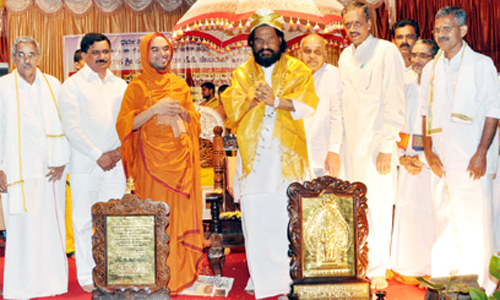
The annual ‘Dharmashree’ award being conferred to people with distinguished services to the society was this time, given to internationally renowned musical legend, Padma Vibhushan Dr K J Yesudas. The award is conferred annually by Dharmashree Foundation, Eshwaramangala, in the taluk.

The award function was held at Eshwaramangala on Wednesday January 11. State assembly speaker, K G Bopaiah, presided over the function. Speaking after conferring the award, Sri Raghaveshwara Bharati Swamiji of Hosanagar Sri Ramachandrapura Mutt, reasoned that India is a confluence of rhythms, emotions, and tunes, and that Indian music has the power to transcend boundaries of languages, religions, and sects. “Music delivers the message of happiness, and shows us the way how to lead life. No boundaries can confine music within their bounds,” he added. He also termed Yesudas as the most sublime personality in Indian music.

Yesudas, addressing the gathering after accepting the award, compared Hindustani music to river and Carnatic classical music to ocean. “Carnatic music is backed by 72 independent Raagas, and it is inspired by nature. It has the power to strengthen the roots of culture. Because of these qualities, this music has gained global recognition,” he reasoned.

In his congratulatory address, state primary and secondary education minister, Vishweshwar Hegde Kageri, felt that the award given to Yesudas in the bargain got its own prestige enhanced. He hailed Yesudas for working tirelessly for five decades as the ambassador of musical culture of India.

Hereditary priest of Kollur Goddess Mookambika Temple, Narshi Govind Adiga, president of felicitation committee, Muliya Shyam Bhat, chief patron of Dharmashree Foundation, G K Mahabaleshwar Bhat, trustee, Shviaprasad E, and many others were present.

Managing trustee of the foundation, Nanya Achuta Moodittaya, welcomed. Secretary of felicitation committee, Dr Varadaraj Chandragiri, proposed vote of thanks. Advocate, Mahesh Kaje, presented the programme.

source: http://www.DaijiWorld.com / DaijiWorld Media Network-Puttur (SP)/ Thursday, January 12th, 2012

Book on Cauvery


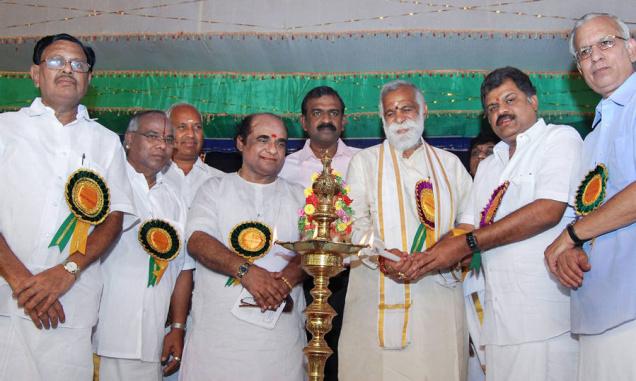
At the function: G.K.Vasan, Union minister of Shipping, (second right) and Kaumuri Bapi Raju, MP (third right), G. Rangaswamy Moopanar, president, Sri Thyagabrahma Mahotsava Sabha (left)and A.K. Palanivel at Thanjavur. Photo: B. Velankanni Raj


‘Mazhai,’ a book of verses on rain and Cauvery Delta, was released in Thanjavur recently.

The Union Minister for Shippping, G.K.Vasan, released a Tamil book titled ‘Mazhai,’ written by G. Srinivasan, at Thanjavur on Monday last (January 9). Kaumuri Babi Raju MP and chairman of Tirumala Tirupati Devasthanam received the first copy. Speaking on the occassion Vasan said that writing poetry is a difficult task.

“It is even more difficult to write poems that provide food for thought. When the poet makes people think and act with his poems, he achieves the goal.”

Quoting some poems from the book, Vasan said that one on Cauvery issue spoke of the reality on the issue. The poem says that the farmer of Cauvery delta wants rain to be copious in Coorg, so that his Kannada brethren can not store the water and open the dams. Thus the Delta farmer will get the rain. Vasan quipped by saying “It appears that only Lord Varuna can help the people in Tamil Nadu in the Cauvery issue.” He said that the book contained poems on spirituality, health, social issues like environment, poverty and poems on leaders like Mahatma Gandhi.

G. Rangaswamy Moopanar, president of the Thyagabrahma Mahotsava Sabha, presided over the function. Sintha Mohan, Tirupati MP, N.R. Rangarajan, Pattukottai MLA and S.P. Anthonisamy, chairman of Parisutham Institute of Science and Technology, received the copies of the book. A. Alagappan, former governor, Rotary Club, and director, Blossom School, Dr. Mohandos, Nephrologist, V. Jeevakumar from Tamil Nadu Murpokku Ezhuthalar and Kalaignargal Sangam and Kamaraj, Professor, Tamil University, offered felicitations. The book has been brought out by Mahavir Printers, Thanjavur.

source: http://www.TheHindu.com / Arts> Books / by G Srinivasan / January 12th, 2012

Commemorative Issue – General Thimayya

General Kodandera Subayya Thimayya was born in Madikeri, the district town of Kodagu (also known as Coorg), Karnataka, India. He was a graduate of the Royal Indian Military College in Dehra Dun. He served in the Indian Army from many posts.

He became Chief of Army Staff of the Indian Army in 1957. He was also awarded the Distinguised Service Order. After the Korean War, he headed an United Nations unit dealing with the repatriation of prisoners of war. After his retirement from the Indian Army, he was appointed as the Commander of UN Forces in Cyprus (UNFICYP) in July 1964.

While in Cyprus, he died of a heart attack, in 1965. The Republic of Cyprus, in addition to this stamp issue, honored him by renaming an avenue of the city of Larnaca after him.

Commemorative Issue General Thimayya

Cyprus
Date of Issue: 06 June 1966 /4/1966
Technical Information
Quantity: 292329
Designer: A. Tassos

source: http://www.philatelism.com
http://www.philatelism.com/details.php?issueid=24

GR Vishwanath to select CCL Team of KB

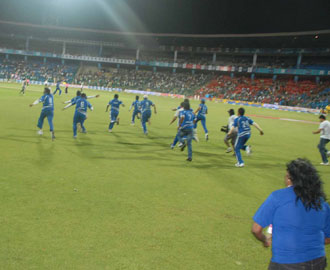
The yesteryears ace cricketer from Karnataka Gundappa Vishwanath will scrutinize this time for the selection of 16 players to the Karnataka Bulldozers Celebrity Cricket League season 2 that kick start on 15th of this month.

The key sponsor of the Karnataka Bulldozer team Ashok Kheney addressing the media said the runner up of team of last season Karnataka Bulldozers will definitely lift the cup this time because we have Kittur Rani Chennamma to our side. Ashok Kheney saying like this pointed towards Dr B Saroja Devi.

It is not possible for all students to get the rank. We were good students last time. This time we will be rank students promised Kichcha Sudeep addressing the media.

The little master of Indian Cricket team GR Vishwanath addressing the media stated that it was difficult task to select the team because all of them showed good ability.

The brand ambassadors for Karnataka Bulldozers for this season are Aindrita Ray and Nidhi Subbaiah plus Madhuri Bhattacharya.

The Kannada Cinema Artists Association President Ambarish was also present at the media briefing.

sourceZ: http://www.supergoodmovies.com/ Kannada Movie News / January 10th, 2012

Madikeri travels to bygone era with coins and currency notes


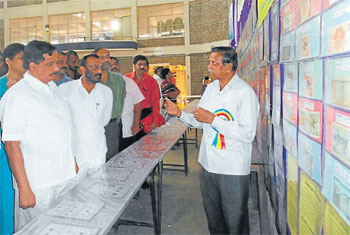
Collection and exhibition of old and new coins and currency notes is an art. We can improve our knowledge by observing coins and notes from different countries, said Legislative Assembly Speaker K G Bopaiah.

Madikeri:

He was speaking after inaugurating the three-day state level 125th exhibition of coins and currency notes at Field Marshal K M Kariappa Multipurpose Hall in Madikeri on Friday. The exhibition had been jointly organised by the Kannada and culture department, zilla panchayat, CMC, Kodagu Press Club, BSNL, Shakthi Prathishtana, Rotary Misty Hills, Corporation Bank, Sumukh Traders and others.

Bopaiah lauded the efforts of numismatist P K Keshavmurthy and called it an achievement to collect coins which were as old as 2,000 years.

“It is not an easy task to collect so many coins and notes. For the first time, I have got an opportunity to see notes and coins from India and other nations,” he said.

Zilla panchayat health standing committee president Kanthi Belliyappa said it requires unlimited patience and interest to collect and maintain coins and notes. ZP president Shanteyanda Ravi Kushalappa released a book on rare collection of coins and notes.

Numismatist Keshavmurthy said coins and note collection was a tedious task. “For the last 20 years, I have been visiting different parts of the state and exhibiting my collection,” he said.

CMC commissioner Shashi Kumar, assistant director for Kannada and culture Vinod Chandra and others were present. Keshavmurthy was felicitated on the occasion.

Varieties

The exhibition has several specialties, as rarest of rare coins too were on display. They include the first punchmark coin of India, coins from Greek, Roman kingdoms, coins that were circulated during Kushana, Gupta, Shathavahana, Kadamba, Chola, Pandya and other dynasties. The coins during the time of Mughal rulers like Akbar, Jehangir, Shahajahan, Aurangzeb, Vijayanagara rulers Krishnadevaraya, Achyutharaya, Prathapadevaraya, Mysore, Bijapur, Thiruvankoor, Hyderabad, Kach, Baroda, Mewar and other rulers.

The coins of pre-independence era, which were circulated during the rule of British, Portuguese, the coins and notes that have been withdrawn, coins and notes released on various occasion are on display.

source: http://www.DeccanHerald.com / Home> Districts / DHNS / Madikeri, January 08th, 2012

Landscape Garden at Madikeri Gaddige

Madikeri:

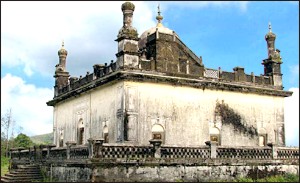
The Gaddige in the town here (mausoleums of the erstwhile rulers of Kodagu), which had been in the news for all the wrong reasons – vandals setting its main door on fire, encroachments, haven of illicit activities, etc – is finally being spruced up to attract tourists who are already making a beeline to Kodagu district.

The Madikeri Urban Development Authority (MUDA) has prepared a plan to develop four acres of land around the Gaddige into a landscape garden at a cost of Rs. 45 lakh, MUDA Chairman Shejil Krishnan told SOM yesterday. At present, 35 granite benches have been erected around the Gaddige area and a walkway has been created around the proposed garden, said Shejil, adding that after the famous Raja Seat, this will be the second botanical garden in the town. Ornamental plants have been planted, lawns have been laid and a lotus pond has also been created on the vacant land. The variety of ornamental plants have been brought from SNV Nursery in Rajamundry of Hyderabad. Landscaping for the garden is being done by Bangalore-based Green Stays Landscaping Company and the works are being supervised by the company’s Planning Officer M.S. Sudhir.

Plans are on the anvil to include a children’s play park too in the garden, said Shejil.

The land belonging to Gaddige has been fenced off and the main entrance has been renovated. Works are on to mount the stone statues of elephants on to concrete platforms.

Despite all these development works, it is an irony that the Department of Archaeology seems to be oblivious.

The Gaddige are protected monuments that come under the Karnataka Ancient & Historical Monuments & Archaeological Sites and Remains Act of 1961.

Gaddige has two identical square structures, which are the tombs of the kings and their queens. They are close to each other, built in Indo-sarcenic style. A small tomb by the side of these structures is of their Guru or royal priest Rudrappa. It was built in 1834.

source: http://www.StarofMysore.com / General News / January 09th, 2012