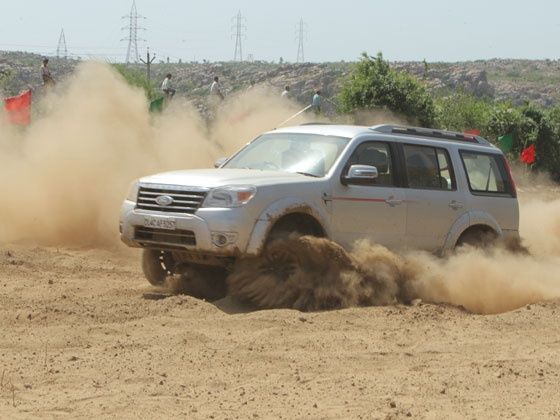
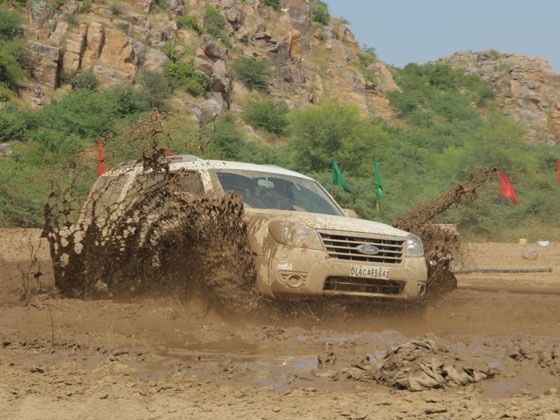
Ford shows Endeavour’s off-roading capabilities in Delhi

An SUV is a vehicle not just for the run of the mill office to home and back schedule. Its got a lot to do with the vehicle’s true nature. However, this is something we all know about. The Ford Endeavour is one off in the Sports Utility Vehicle Segment. With its long stance and right seat ergonomics, this vehicle is just right for off roading and a whole lot of fun.

On 2nd of this month, Ford organised The Great Ford Endeavour Drive, where in a remote location on the foot hills of the Aravali, Endeavour owners got the experience and exposure to what their Ford is really capable of. To help with getting the idea, Ford had called in Jagat Nanjappa, who needs no introduction to the world of rallying and off roading and has over thousands of kilometers clicked with his trusted vehicles..

Ford Endeavour off-roading

With Jagat in the driver’s seat, Endeavour owners got to know about what their SUV is capable of. A properly laid out track with a number of jumps, an open area for donuts, a slush patch and some man-made humps made out of sandbags and to add to this, Jagat made all this look like all in a days work. When asked, Jagat replied, “This is the perfect track for testing out the Endeavour. It has the right kind of obstacles which show the true capability of the vehicle.”

Add to this, ten points to keep in mind while off-roading, here is what he had to say.

Ford Endeavour off-roading

I Never go off-roading alone. One must have a rescue car or if nothing else, then another car.

II Carry as much as equipment like Winch, inflator, that you can

III Do not be embarrassed if your car is stuck. It is wise to get a little dirty.

IV Make sure your tires are in good shape.

V Trust your instincts. If you know you cannot do a task, back up.

VI If you are a first-timer, take an expert along who knows what has to be done in a difficult situation

source: http://www.zigwheels.com / Home>  News & Features / by Sukhpreet Singh / October 07th, 2011


Lot of rewards at stake for Indians at Asian Amateur golf

Singapore, Oct 2 (PTI) :

Young Honey Baisoya and national champion Seenappa Chikkrangappa finished as the best Indians in the 46th place with a total of seven-over 295 at the end of the Asian Amateur Golf Championships here today.

Baisoya carded 74 and Chikkra returned 73. The other Indians had a less than a happy day. Trishul Chinappa (74) ended tied 53rd at nine-over 297 and Angad Cheema, the only Indian to return a under-par card on any of the days, had a final round of 74. He finished at 10-over 298 and in 54th place.In the first, Cheema shot 71, the only time any of the six Indians had a sub-par round.

Khalin Joshi and Abhijit Chadha carded 76 each, but Joshi was tied 58th at 11-over and Chadha ended 61st at 15-over.Japan’s Hideki Matsuyama successfully defended his Asian Amateur Championship with a superb final round of 67 for a total of 18-under at The Singapore Island Country Club.

The 19-year-old defending champion, who won the title in Japan last year, was one shot clear of South Korea�s Lee Soo-min, who signed for the lowest score of the week after a birdie on the 18th hole secured a round of 64. The win means a return to the Masters Tournament in April for Matsuyama, where he made history last year by becoming the first Asian golfer to win the Silver Cup for low amateur.

Matsuyama finished T-27 at last year’s Masters to record the third best finish ever by an international amateur. Overnight leader Ben Campbell stayed in touch with the winner after recovering from a difficult start to shoot 70 and finish in third place at 16-under thanks to late birdies on holes 16 and 17. Although Lee missed out on the title, he, as runner-up, will join Matsuyama in International Final Qualifying for The Open Championship 2012.The fourth Asian Amateur Championship will be staged at Amata Spring Country Club in Chonburi, southeast of Thailand’s capital city of Bangkok, from November 1�4 next year

source: http://www.ibnlive.in.com/ PTI / September 28th, 2011

City game for ‘American league’

American football could become big in the country with a tournament being planned in the next two years
 

A lot of sports, most of which a majority of the average Indians aren’t aware of, are making inroads into our society. The latest being American football, the top US sport which has at least five per cent of American population earning through the game, apart from players, coaches and staff directly involved with the game.

History has it that only four players of Indian origin have played in the National Football League (NFL), a lucrative organisation that runs the sport in the US. One of the four, Brandon Chillar, who has his roots in Punjab, was convinced the game had something to offer for the Indian masses. He felt it could become big and give the average Indian a chance to excel in it.

TEAMS’ FORMATION
The Elite Football League of India (EFLI) was launched in India in August this year and the government of India and the Sports Authority of India decided to back the game. A custom-fit stadium is ready in Pune, where the inaugural EFLI will be held within the next two years between eight teams from different states.

Having already formed four teams, the EFLI concentrated on Karnataka. Thimmaiah Madanda, a former India rugby player, with a passion for contact sport, was brought in as coach of the state team. The Kodava took his job seriously. He scouted for talent in Kodagu, Shimoga, Devanahalli and Bangalore. “I went to all these places and mostly visited government colleges and finally invited 140 players. A first shortlist of 115 went through a four-day orientation programme last week,” he said.

Thimmaiah, Sailesh Devrukhkar, the chief coach of EFLI, and Jeff Whelan, EFLI coaching co-coordinator, watched the hopefuls through drills and games before settling on the final 44 who will represent Karnataka.

DECENT SALARY
EFLI is more unique than most associations in the country. It will pay players a salary rather than a match fee as does happen with most sporting disciplines. That too, a decent sum of Rs 15,000 per player. Jeff Whelan said, “This, we are offering till we sign a deal with Ten Sports to televise the league matches. Once we get everything in order, players will earn much more than what any coach earns.”

Does the average Indian have the physique or skill to compete in such a “ruthless sport”? All three men laugh it off and Thimmaiah says, “It is nothing like what the public imagine. Played with an elongated ball, the game offers 44 players the chance of being involved in a game (including substitutions). The game accommodates all physical attributes; athletes from any sport can take to this game. It calls for power, speed and agility. It does not need special skills,” he says.

The forwards and interiors do not even touch the ball, leave alone catch it. Their job is only to defend the quarter-backs… to stop the opposition from getting to the quarter-backs,” said Thimmaiah, adding: “You have a defending team, an attacking team and a kicking team. It is not about just 11 on field. Thirty players are used in each game, with the other 14 used for substitutions. So, it involves a lot of people and does not need any one qualification or requirement to play the game.”

TALENT APLENTY
The EFLI does have some convictions that other sports administrators mostly talk about. “We know that if we search enough, we could find the right guys. The right athletes are in the villages of India,” said Jeff. “The game does not need any special skill. It combines a lot of disciplines like cricket, football, baseball, rugby,” he added.

Having watched the NFL mess it up in England when it tried to introduce the game there, the EFLI is more focused. “We are planning a league for players born and brought up in India. Unlike the NFL, we will not allow foreigners. That way, we know the cities can relate to players and will stand up for the team,” he said.

CHALLENGING CRICKET
“India, with its masses, offers an opportunity for us (EFLI) to become a top sport in the country. India is a one sport country (cricket) and we believe we stand a good chance of becoming a top sport. Because we feel we can offer more opportunities for athletes and people of India,” said Jeff.

“We plan to have eight Indian teams and will invite two from Sri Lanka, one from Bangladesh, and each team will only be allowed proper citizens to represent them. No outsiders, guests or foreign players,” he said.

“At some point of time, we hope to invite a team from Pakistan to play a series against an Indian team. Because that is the ultimate battle in this part of the globe and we are sure millions will tune in to that game and the whole world will watch,” he said.

source: http://www.BangaloreMirror.com/ Home> News> City / by R Sathish Paul / Tuesday October 04th, 2011


India witnesses rise in coffee exports

The Coffee Board of India has revealed that the country’s coffee exports in the 2010-11 coffee year have increased by about 34% to 3.58 lakh tons, compared to 2.68 lakh tons in 2009-10 coffee year.

The board has attributed the jump in coffee exports to the rise in global demand. According to the data from the board, Coffee exports in value terms increased to $1.048bn from $577.98m on higher realizations.

The coffee shipments of the country rose by 30% to 2.92 lakh tons, compared to 2.24 lakh tons in the corresponding period last year in the first nine months of the current calender year, reported Press Trust of India.

The exports from the country in the April-September period of the current fiscal also rose by 25% to 1.92 lakh tons from 1.53 lakh tons in the year-ago period.

India, which largely exports coffee to Italy, Germany, Russia, Belgium and Spain, accounts for 4.5% of the global coffee output, but exports 70% to 80% of this.

source: http://www.markets.drinks-business-review.com / by DBR staff writer/ October 04thy, 2011


NCC air wing expansion awaits state nod

MANGALORE:

NCC Directorate, Karnataka and Goa is ready to allot more funds to increase the number of air wing cadets in institutions in the region under Mangalore Group Headquarters (GHQ), but it is yet to get state government’s nod to go ahead with the plans.

Mangalore GHQ can increase the number of cadets from existing 900 to 1,200 if the state education department agrees to bear 25% of the expenses. A proposal in this regard sent by the Mangalore GHQ to the department in June 2011 is still pending in Bangalore.

Only seven institutes in Dakshina Kannada, Udupi and Kodagu, which come under Mangalore GHQ, have NCC Air Wings. St Aloysius High School, Milagres High School and Kittel High School in Mangalore, St Philomena High School in Puttur, Jain PU College in Moodbidri, St Michael’s High School in Madikeri and St Anne’s School in Virajpet are the institutions, which have NCC Air Wing currently. Students in schools, where there is no NCC Air Wing, may join the open admission wing at St Aloysius School, but admission here is restricted to 200.

Meanwhile, NCC Army Wing has separate units for Dakshina Kannada, Udupi and Kodagu districts. The 18 Karnataka Battalion NCC of Dakshina Kannada district has 13 schools and 11 colleges with a total strength of 2,150 cadets.

Mangalore GHQ master warrant officer Suresh Atri told TOI that more students should be given opportunity to join NCC Air Wing. “We have submitted a proposal, but we have not received any communication from the government so far,” he added.

It is a fact that students are motivated towards Indian military through NCC activities in schools. At the same time, Indian Air Force (IAF) too agrees a fact that they find it very difficult to attract youth from South India towards the force. IAF has already launched massive campaigns in South India to create awareness and to attract young to choose airmen’s job.

source: http://www.articles.timesofindia.indiatimes.com / Home> Collection / by Vinobha KT / TNN


The Father of the Indian Army – Field Marshal K M Cariappa

Field Marshal Kodandera Madappa Cariappa, hailing from Kodagu district of Karnataka, is best known as the first Commander-In-Chief of the army of independent India. He has often been described as ‘The Father of the Indian Army’. He was born on the 28th of January 1899.

His Early Years

km-cariappaCariappa was one among the six children of Kodandera Madappa, who was an official in the revenue department. He completed his schoolingfrom Central High School at Madikeri in Kodagu. He later studied atPresidency College, Chennai.

Even at a young age, he was always up for challenges and he displayed tremendous determination in achieving whatever he put his mind to. As a student, he is known to have taken an active interest in academics, sports and debates.

Cariappa’s Military Exploits

At the age of 20, Cariappa was selected to be among the first batch of boys to be trained for commissioning in the British Indian Army. After a stint at Daly College, Indore, he was commissioned as an officer and posted to the second battalion of the 88th Carnatic Infantry in Bombay, to serve as a Second Lieutenant.

There was no looking back after that. He steadily rose among the ranks, and even had stints in places like Iraq, Iran and Syria.

During the period of Partition in 1947, Cariappa oversaw the division of the Indian army. During the Indo-Pak war of 1947-48, he led the Indian forces on the western front. Later in 1949, he became Commander-in-Chief of the Indian army.

Incidentally, it is a well-known fact that Cariappa had been nick-named ‘Kipper’ by his colleagues in the army. After serving in the Indian army for almost three decades, Cariappa went on to serve as High Commissioner to Australia and New Zealand.

Honors and Recognition

In 1949, Cariappa was conferred the Order of the Chief Commander of the Legion of Merit by Harry Truman who was the President of the United States at the time. In 1986, the government of India conferred him with the honorary rank of Field Marshal in recognition of the exemplary services rendered by him to the Indian army.

Personality Traits and Information

Cariappa was a tall man with a commanding personality, besides being a good conversationalist. He was admired for his dedication to his work, his courage and unwavering integrity and his strong sense of patriotism.

However, he was also a strict disciplinarian and had a quick temper.

His Final Years

Towards the end of his life, Cariappa spent much of his time in his estate Roshanara located in his native town of Coorg. He was involved in spreading awareness about pollution and environmental conservation.

He died in Bangalore in 1993, and he was 94 years old.

source: http://www.Karnataka.com / Home> Personalities


Heads-up: Thursday is National Coffee Day! (in the U.S)

Take note that Sept. 29 is National Coffee Day, a day when we should all get really wired on free coffee, skip work and participate in bicycle races and pony rides.

OK, so maybe the free coffee is enough. Here’s where you can get it:

1. 7-Eleven. The chain is giving away free medium cups of java from 7-11 a.m. in your time zone.

2. Krispy Kreme. The stores are offering a free 12 oz. cup of House Blend Coffee all day tomorrow. Get on it!

source: http://www.content.usatoday.com / by Whitney Matheson/ USA TODAY / September 28teh, 2011

Karagas take off in Madikeri

MADIKERI:

Madikeri Dasara commenced on Wednesday according to its tradition, with four historical karagas taking off in a procession after various poojas were performed near Pampinkere.

The festival is celebrated by the people as janothsava, which has a history of over 100 years. The nine-day celebrations is beautified by four karagas and 10 mantaps depicting the killing of demons by gods/goddess.

Each mantap comprises of idols with a height of eight to 15 feet, which is set up at the front of a lighting board. The cost of building a mantap may touch Rs 3 to 5 lakh.

The procession of these mantaps attracts lakh of devotees and viewers on the night on October 6, the Vijayadashami Day. Each of these mantap depicts historical stories from the Hindu mythology. The idols in the mantap are given movements to match the story.

From Wednesday four karagas from the four Mariamma temples in town will move in a procession in different areas accompanied by traditional dancers and visitors.

A team of Volaga, a type of band in Kodagu, also accompanies the karagas. The priests who take up the karagas are dressed in yellow coloured ‘kacche’ and have shaved heads. They also hold a knife in one hand and a wooden stick called the ‘bettha’ in the other.

The Dasara committee has organized cultural programmes on all nine days starting Wednesday. Programmes will be held at the Kaveri Kalakshetra on the first six days the festival, while programmes will be conducted at Gandhi Maidan for the other days.
On October 9, Vijayadashami Day, there will an orchestra from 9pm till 6am. The programme will conclude with a prize distribution ceremony for the three best mantaps. The state government has sanctioned Rs 50 lakh for Madikeri Dasara.

source: http://www.timesofindia.indiatimes.com / Home> City > Mysore / TNN / September 28th, 2011

BBTC’s outsourced coffee buying strategy pays off

BANGALORE :

Nusli Wadia owned Bombay Burmah Trading Company’s (BBTC) outsourced coffee buying strategy has paid rich dividends. Through outsourced coffee, the company’s sales volume is rose 58.82 per cent to touch 1,655 tonnes during 2010-11 as compared to previous year.

Outsourcing coffee is buying it from neighbouring estates/region and selling along with your own produce.

Pulping is a specialized activity and small and medium growers find it hard and economically unviable to do on their estates. Hence the big companies like BBTC steps in to buy coffee fruits at farm gate.

The company’s total sales in 2010-11 stood at 1,655 tonnes of which 891 tonnes was outsourced coffee. In 2009-10, total sales of the company stood at 1,042 tonnes of which, 998 were outsourced.

BBTC in its Director’s report and Management Discussion and Analysis to its shareholders said “Due to a shortfall in world production and relatively high prices, there has been an opportunity to increase volumes through outsourced procurement. Cost efficiency and consistent quality standards are ensuring a better foot prints worldwide for our coffees.”

“Due to failure of arabica crop in most producing countries, an aggressive strategy to procure outsource arabica is necessary and in progress,” it added.

A planter familiar with outsourced coffee buying said “It is mainly robustas which are sold at farm gate in south Coorg, where big companies which have required infrastructure to pulp coffees buy them in large quantities to market it abroad as washed robustas.”

“On the other hand, not much of arabica comes for outsourced buying for majority of arabica growers have their own pulpers to process on their estates,” he added.

PERFORMANCE

“Arabica, due to lower production worldwide, has done well throughout last year. The ICO prices are at a 34-year-high and we have achieved crop stability and are looking at an increased yield in the coming years. Indian robusta faced a crisis last calendar year due to increased production of washed coffees leading to erosion in premiums for the same. However, due to our consistent quality standards we have been able to sell all our produce and outsourced quantities above the average market prices.”

OUTLOOK

“Arabicas will continue to be strong in the coming year and with increased crops in our estates and a more assertive outsourcing programme should improve volumes. Robusta markets have been buoyant in the last quarter of 2010-11 and as long as quality standards are maintained we will be able to realise better prices in the coming year.”

source: http://www.thehindubusinessline.com / Kone> Agri-Biz / by Anil Urs / September 19th, 2011