Govt plans to popularize coffee cultivation in Himachal

Shimla :

Himachal Pradesh government is exploring the possibility of popularizing coffee cultivation in the state. Kangra district already is known for tea cultivation and now the state is planning to have coffee farming to boost the local economy as already a plan is afoot to increase the area under tea plantation.

Tea industry of Himachal Pradesh is 161 years old. While there were around 500 tea growers in Kangra district with average land holding of 25 hectares in 1947, now there are 5,800 tea growers with average land holdings of 10-15 kanals. Of this, only 15-20 planters fall in the category of big growers. Currently, 2,300 hectare area is under tea cultivation. After tea, now coffee is likely to be the new source of income for farmers of the state.

A senior government official said that a Coffee Board team has already surveyed prospective areas. “There is a potential for coffee cultivation in Kangra, Mandi, Una and Bilaspur districts. During 2014-15, coffee demonstration trials will be carried out in these districts under the technical guidance of Coffee Board,” he said.

Agriculture, being the mainstay of people of Himachal Pradesh, has an important role in the economy of farmers. Efforts are afoot to make the hill state self-sufficient in agriculture production and also to improve the economy of farmers, he added.

Agriculture and allied sectors accounts for 30% of the gross state domestic product. It provides direct employment to about 71% of the main working population. Rs 384 crore is being spent on agriculture sector this financial year, sources said.

Of the total geographical area of 55.67 lakh hectares, the area of operational holding is about 9.68 lakh hectares and is operated by 9.33 lakh farmers. The average holding size comes to 1.04 hectares. Distribution of land holdings according to 2005-06 agriculture census shows that 87.03% of the total holdings are of small and marginal farmers. About 12.54% of holdings are owned by semi-medium/medium farmers and only 0.43% by large farmers.

The diverse agro-climatic conditions of the state provide ample opportunities for crop diversification with high value crops. The state has great potential for producing off-season vegetables and has already gained reputation for cultivation of off-season vegetables and production of quality vegetable seeds, they added.

source: http://www.timesofindia.indiatimes.com / The Times of India / Home> City> Chandigarh / TNN / October 20th, 2014

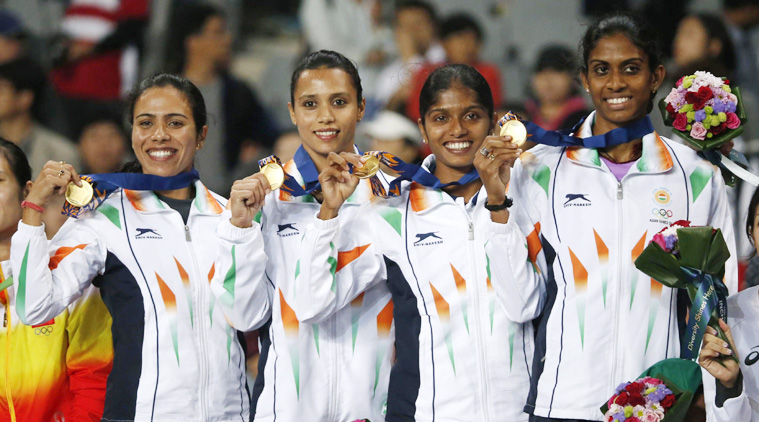
Crown stays with queens: India defend 4x400m title at Asian Games 2014

The Indian 4x400 women’s relay team gold medal winners -Priyanka Pawar, Mandeep Kaur, Tintu Lukka and Poovamma Raju. (Source: Reuters)
The Indian 4×400 women’s relay team gold medal winners -Priyanka Pawar, Mandeep Kaur, Tintu Lukka and Poovamma Raju. (Source: Reuters)

Just over a year ago at the Asian Athletics Championships in Pune, India won its most significant gold in athletics since the doping scandal of 2011. The 4×400 women’s relay team, a scratch combination that was running together for the first time, clocked 3:32.26 to finish atop the podium.

If the Indian team had registered a similar timing at Incheon they would have finished outside the top-three. Only two of those — Tintu Luka and MR Poovamma — who ran in Pune in July last year were fielded on Thursday. The other two were Mandeep Kaur and Priyanka Panwar, two runners who had been suspended following the doping violation.

The Indian 4×400 women’s relay team, gold medal winners in the previous three Asian Games, had a reputation to defend, while Mandeep and Priyanka, who ran the third and first leg respectively, had a point to prove. In three minutes and 28.68 seconds the Indian 4×400 quartet showed why they still remain a force in Asia. The timing clocked as a new Games record.

The earlier Games record of 3:29.02 was also in the name of the gold-winning Indian team from 2010. India’s second gold in athletics — Seema Antil’s in women’s discus being the first — meant that the women’s relay team held who continental titles simultaneously.

Japan won the silver in 3:30.80 while China bagged the bronze in 3:32.02. The first lapper, Panwar was, however, lagging behind her Japanese counterpart but Luka, who won a silver in 800m race, ran a brilliant race to recover the loss ground for India.

India took a small lead after two laps before Mandeep widened the gap in the third lap after holding out a strong challenge from her Japanese counterpart. Poovamma, who won a bronze in 400m race, then anchored India to gold by blasting her way to the finishing line.

Bronze for Inderjeet In shot put, Inderjeet struggled for most part of his event as he had 18.52m as his best throw from his first four attempts. But he came up with a 19.63m in his fifth and penultimate throw to fetch the bronze. His sixth and final attempt was a foul.

The other Indian in the fray, Om Prakash Karhana, who was cleared in the eleventh hour following an injury, finished a disappointing ninth with a best throw of 16.94m. The national record holder, who injured his ankle while warming up for a selection trial on September 15 before being cleared for the Games at the last minute, had 16.26 and 16.94 in his first two attempts while his third effort was a foul.

In men’s triple jump also, Renjith Maheshwary, who was cleared at the last minute after a selection trial, could come up with a best effort of just 15.67m while his season’s best is 16.54 and personal best score of 17.07. He also could not make it to the top eight after three rounds.

The men’s 4x400m relay quartet of Kunhu Mohammed, Joseph Abraham, Jithin Paul and Rajiv Arokia missed out on a bronze as they finished fourth in season’s best timing of 3:04.61.

source: http://www.indianexpress.com / The Indian Express / Home> Sports> Sports-Others / Asian Games 2014 / Express News Service / October 03rd, 2014

Children’s Dasara wins people’s hearts

For children it was a new experience of celebrating Dasara at Madikeri on Thursday. It was on the occasion of children’s Dasara, being organised by Madikeri Dasara cultural committee, for the third year.

Children themselves inaugurated the Children’s Dasara at Gandhi Maidan at 11 am. Besides participating in various competitions and cultural programmes, children honed their marketing skills too, by selling various items in the children’s market.

The market offered a wide range of items from vegetables to snacks.Fancy dress, makkala mantapa, children’s shandy market, quiz, drawing and various other competitions were conducted on the occasion.In Makkala Mantapa, the tableau competition, a group of recreated ‘Dasha Mantapa’s, which is a prominent feature of Madikeri Dasara.

Also, recreation of mythological scenes was part of the competition.

The children’s shandy market drew an overwhelming response with customers purchasing variety of items such as fruits, vegetables, snacks, coffee, juice, flower vases and so on.

Results

Children’s shandy market: Vinith Lobo and team – I, Hrithvik Anwekar and team – II and Samarth – IIIMantapa competition: Vidyavinayaka Makkala Sangha – I, Shivoham team – II, Bharath and team – IIIDrawing competition (5 to 8 years category): Rishika M A – I, Rakshith M B – II and U M Jeevith – III (9 to 12 years category): P R Arya – I, Shreyas – II and Havyas – III. Consolation prize – Dilan (13 to 16 years category): Shreyas S – I, Nuthan P N – II and Pritham H M – IIIQuiz on Indian Heritage and Culture: (2 to 7th standard category):G R Ashutosh – I, N M Dillan – II and I B Dinal – III (8 to 10th standard category): S S Gautham – I, H U Gurugovind – II and K M Karthik – IIIFancy dress competition (Below 5 years category): Dhruva Nanjappa – I, Anushka – II, G R Anuhya – III and Diya Vasanth – Consolation(6 to 8 years category): Brihat Bopaiah – I, Anchal Joshi – II, Shahnavi – III and Abhinaya Krishna – consolation(9 to 12 years category): Yavani – I, Vakya Dinesh – II, Victor Lobo – III and Apeksha Rai – consolation.DH News Service

source: http://www.deccanherald.com / Deccan Herald / Home> District / DHNS, Madikeri – October 05th, 2014

Dashamantapa procession enthrals devotees

The procession of Dashamantapas marked the conclusion of Madikeri Dasara celebrations on Saturday.

Thousands, including a large number of tourists from outside the district, lined up on either side of the main roads in Madikeri where the tableaux passed through— to get a glimpse of the Madikeri Dasara procession. The city was decked up with lightings.

As per the tradition, the procession was led by Pete Srirama Mandira mantapa. The tableaux on the theme of Mahishasura Mardhini attracted the spectators. The sound and light special effect was centre of attraction. After offering pooja at the temple, the Mantapa passed through College Road, Chowki, private bus stand, Town Hall to reach Gandhi Maidan.

Kundurumotte Sri Chowtti Mariyamma, Dandina Mariyamma, Kote Mariyamma, Kanchi Kamakshi, Kote Ganapathi, Chowdeshwari, Kodandarama Temple, Dechur Rama Mandir and Karavale Bhagavathi Temple tableaux also passed through streets of Madikeri. The procession that started on Saturday night went on till wee hours of Sunday.

A large number of people from outside the district had arrived Madikeri on Friday itself. All the hotels, home stays and resorts were full in Madikeri. After visiting tourist spots in Madikeri on Saturday morning, they arrived the city in the evening. Gandhi Maidan had turned into a mini bazar with eateries, stalls selling clothes. The stalls made brisk business during the night.

Traffic jam

The police had banned the entry of vehicles inside Madikeri town to check traffic congestion. The movement of vehicles on the streets where Dasha Mantapas passed through were banned. It had caused inconvenience to the vehicle users. The police had arranged parking of vehicles at APMC and Dairy.

Parking of vehicles in a haphazard manner caused inconvenience. To prevent the entry of additional vehicles inside the city, more than 100 buses from Mysore and other districts had to park their vehicles in Kushalnagar. The passengers from Kushalnagar were ferried to Madikeri in special buses. DH News Service
source: http://www.deccanherald.com / Deccan Herald / Home> District / DHNS, Madikeri – October 05th, 2014

Coffee: A crop with a lot of global history

Most people who think of crops think of corn, beans and wheat, but coffee is also one to consider.

For many of us, it’s the fuel that gets us out of bed and through the day. But as a new exhibit at a Florida museum shows, coffee has fueled history.

From straight black to cream and sugar, there are plenty of ways to have your coffee, and people have been doing brewing it for centuries. “There’s a whole history of it being a very influential aspect of the world,” said Matthew Woodside, chief curator of the South Florida Museum.

As Woodside tells it, the story of coffee is a long one and has a far reaching in scope. “It gave rise to the exploration and the colonization of all parts of the world, and even today, it’s second only to oil in its impact on the global economy,” he said.

Coffee has a rich history still celebrated with the coffee-making process in Ethiopia. “Its very ceremonial, very spiritual. It’s a little different than the way we go about it of putting some grounds in Mr. Coffee,” said Woodside.

Bruce Blowers visited the exhibit to see reminders of the 37 years he spent in Papua New Guinea, where java beans drive the highlands economy. “They saw that it was a viable crop, and so it just spread all around the islands,” said Blowers.

No matter how you drink it, the next you pour a cup of coffee, remember the whole world is in your cup.

Even though this exhibit is in Florida, Washington State actually has the most Starbucks stores per capita.

Watch this report on the Rural Evening News Thursday at 7:30 p.m. ET

http://www.rfdtv.com/story/25820866/coffee-a-crop-with-a-lot-of-global-history#.VFcnofmUcb0

source: http://www.rfdtv.com / RFD TV, Rural America’s Most Important Network / by RFD-TV News Staff / Brandenton, Fla / June 19th, 2014

Hockey India name women’s team for CWG

Hockey India (HI) Wednesday named its 16-member women’s team for the Commonwealth Games scheduled to take place in Glasgow from July 23 to Aug 3.

The squad was chosen by HI selectors B.P. Govinda, Harbinder Singh, Surinder Kaur along with high performance director Roelant Oltmans, chief coach Neil Hawgood and scientific advisor Matthew Tredrea during the selection trials conducted at National Institute of Sports (NIS) Patiala June 28-29.

Midfielder Ritu Rani (179 caps) will be the captain while defender Deepika (126 caps) will be the vice-captain of the team.

“It’s an honour to captain a team which is capable of beating any team on any given day. The entire team is looking forward to the upcoming tournament and we are confident that we will win and get back laurels. We are ready and excited for our first clash against Canada in our opening match,” Rani said.

The team recently whitewashed Malaysia 6-0 in an away series and is looking forward to the CWG challenge. The team will start their voyage in Scotland by taking on Canada in their first match July 24 followed by New Zealand (July 27), Trinidad and Tobago (July 28) and South Africa (July 30).

A preparatory camp is currently underway at NIS until the departure of the team July 9.

“The team showcased good play, team spirit and a go-getter spirit in the recently concluded Malaysian tour. Each one of them had performed remarkably under the proficient leadership of Ritu Rani and has earned their position to make it to the team for the all important Commonwealth Games,” said Hawgood.

“I hope the team continues its form and make themselves a team where the opponents feel the pressure of meeting them on the field.”

The squad:

Goalkeepers: Savita (79 Caps)

Defenders: Deep Grace Ekka (57 Caps), Deepika (126 Caps), Kirandeep Kaur (139 Caps), Namita Toppo (46 Caps), Jaspreet Kaur (57 Caps)

Midfielders: Ritu Rani (179 Caps), Sushila Chanu (71 Caps), Lilima Minz (28 Caps), Vandana Katariya (99 Caps), Navjot Kaur (22 Caps)

Forwards: Rani (111 Caps), Poonam Rani (113 Caps), Ritusha Arya (15 Caps), Anupa Barla (33 Caps), Anuradha Devi (62 Caps).

source: http://www.business-standard.com / Business Standard / Home> News-IANS> Sport / IANS / New Delhi – July 02nd, 2014

It’s booze time for Bhuvan Ponnanna, Andrea

Kannada actors Bhuvan Ponnanna and Andrea were caught sharing a light moment at The Boozy Griffin on Wednesday night. Andrea kept disappearing from the do.

So Ponnanna asked her in a light vein who she was hiding. He was a tad suspicious about the puffiness on her lips when she returned.

BhuvanKF29oct2014

Andrea responded by hitting him lightly, telling him not to joke.

source: http://www.timesofindia.indiatimes.com / The Times of India / Home> Entertainment> Kannada> Movies / by Bangalore Mirror Bureau / July 11th, 2014

Equestrian: Appachu rides to second place

Indians Ajai Appachu and Fouad Mirza of the Embassy International Riding School (EIRS) secured second and fourth place at the Hopetoun International horse trials in Scotland which launched the first Commonwealth cup in June.

According to an EIRS press release here Monday, Appachu finished second in the CCI event of the Commonwealth Cup with a cumulative score of 45.6 on Orleans II.

Mirza, who has been competing in the Junior National Equestrian Championships since 2002, won fourth place in the same event with a cumulative score of 49.2 on Penultimate Vision, the release added.

source: http://www.business-standard.com / Business Standard / Home> News-IANS> Sports / IANS / Bangalore – July 07th, 2014

Queen, The Godmother

Victoria: A Life by AN Wilson is a book that chronicles Queen Victoria’s life. An excerpt from the book essays her role as a godmother of an Indian princess named Gouramma

Ten days after they heard the news of the Charge of the Light Brigade, it was the Princess Royal’s fourteenth birthday….The Queen spent the day quietly with the children and’sketched Gouramma’. This was her god-daughter, the Princess Gouramma, now Victoria Gouramma, of Coorg. Her father, the deposed rajah, driven from his lands in Southern India, had for a while resided at Benares. In 1852, the rajah brought Gouramma, then aged eleven, to London and offered her to the Queen for adoption if the Queen would take charge of my daughter & treating her with honour and kindness grant her an education complete in every respect & suitable to her rank, and bring her up according to English customs in the Christian faith’. It was a tall order, but the Queen always felt sheepish about the deposed Indian maharajahs whose wealth had been seized by the East India Company. At first she replied to the rajah that ‘it would not be in accordance with the usages of this Country that Her Majesty should take the charge of his daughter’. The India Board offered to pay for the upbringing of the child and to pay him a stipend while she was in England. Prince Albert suggested giving the rajah £40 per month for the child, and the rajah’s response was that ‘your Majesty has been graciously pleased to grant me much more than I prayed for with regard to my little daughter’. It was suggested that the child be made a ward in chancery of Sir James West Hogg, baronet, chairman of the East India Company. This was not quite what the rajah had in mind. He felt that a ‘lady of rank’ should be found to look after the child. Moreover, the little girl was staying with her father in an hotel. The culture shock was mighty. He complained of’people lurking in the passages to see her’, and threatened that if she were further humiliated’, he would have no alternative but to put her to death.

The background was as painful as any colonial story could be. On the one hand, the Rajah of Coorg was getting a very poor deal from the East India Company. He had provided the British with’many thousands’ of his own subjects, to act as coolies for the Bombay army; he had supplied ‘upwards of 3,000 pack bullocks… 40,000 bottles of rice, 5 elephants, and 3,000 sheep. For all these supplies the Raja received no pecuniary indemnification.’

There could be no doubt that the rajah had been swindled by the Company. On the other hand, he was no saint. Evidence had been collected of atrocities perpetrated under his regime. Lord William Bentinck had decided, as far back as 1834, that’the interests of humanity’would be served by removing a man who, though open and friendly in his manner and a skilled horseman, performed such cruelties as forcing his subjects to act as human stockades around wild elephants during his hunting expeditions. Any who let the elephants escape were put to death….

The Queen agreed to stand godmother to the child, who was baptized by Sumner, the Crumpet, in the chapel at Buckingham Palace on 1 July 1852. It was no hole-in-corner affair. Lord John Russell’s clergyman half-brother, Lord Wriothsley Russell, and Dean Gerald Wellesley, the nephew of the Duke of Wellington, assisted. The princess was, in effect, adopted by an Indian army couple, Major and Mrs Drummond, who took her riding, read her Gulliver’s Travels and tried to make her have the enthusiasms of an upper-class Scottish aristocrat. To some extent they succeeded, but Princess Victoria Gouramma was neither a demure nor a healthy person. Coquettish from the moment of her arrival in Britain, by the time she was sixteen the Drummonds found her as interested in stable boys as in ponies, more than once finding her wrapped in the arms of a groom. At the Juvenile Ball held at Buckingham Palace in April 1856, Gouramma danced merrily with the boys, and clearly attracted the Prince of Wales, but this was the first time she began to cough blood.

The Queen…never lost her affection for the Indian princess, however much of a scamp she was. For a confirmation present, she gave her a coral and diamond necklace, hoping ‘that these ornaments, instead of gratifying the vanity of the young Princess, may serve, when she looks at them, to remind her of the high duties and responsibilities which she has taken upon her’. The hope was a little optimistic. Some time in 1859, her father gave her a bag of jewels, before expiring and being buried in Kensal Green. The Drummonds, slightly unable to cope with the princess’s latest attachment (to an under-butler), applied to the Queen, who was entirely unshocked by the girl’s amorous propensities and merely recommended that they take her on a continental tour.

Gouramma was not the only Indian child in whom the Queen took an interest. In 1854, the Maharajah Duleep Singh, the Lion of Punjab, had arrived in England. He was a charming boy, as Hardinge had observed when bringing the Kingdom of the Punjab to an end, at the close of the last Sikh wars in 1850, and appropriating Duleep Singh’s greatest treasure, the Koh-i-Noor, which means ‘Mountain of Light’….

The Queen’s hope was that Gouramma would marry her new protege?, but Duleep, at this stage at any rate, was too strait- laced for her, and when the pair were introduced, at Lord Normanby’s seat of Mulgrave Castle, it was not a success. At that house party, however, Singh introduced her to a Thackeravian roue?called Colonel John Campbell. Meanwhile, the diligent Drummonds pursued an unsuccessful legal case against the East India Company to restore the maharajah’s appropriated property. A child was born to the marriage, but it was not a happy union. Princess Gouramma died of consumption, in not very salubrious lodgings in Jermyn Street.

Colonel Campbell was seen slipping out of the house carrying a bag, presumably of the maharajah’s jewels. The Queen kept up with the daughter, whose name was Edith.
(Published with permission from the publishers)

source: http://www.dnaindia.com / DNA / Home> Lifestyle / Agency:DNA, Place:Mumbai / Sunday, October 19th, 2014

Gram Panchayat least bothered about basic facilities near Abbey falls

Abbey waterfalls in Kodagu district is one of the itinerary included in the list of tourists who visit the district.

Breathtaking waterfalls, its roaring sound and beautiful cascades spring back to life with the monsoon. A large number of tourists visit the waterfalls during weekends. Inspite of the fetching income from tourism, the gram panchayat has failed to provide basic facilities for the tourists near the waterfalls.

Abbey waterfalls is situated amidst coffee plantation. It cascades down 30 to 40 feet from a hillock. The land where Abbey falls is situated belongs to a private individual.

The land belongs to Neravanda Indira. To ensure that tourists are not disappointed, she has allowed them to walk in between her estate. However, the gram panchayats have not taken any measures to ensure that no harm is done to the estate.
Those who visit the waterfalls pluck coffee plants, throw plastic carry bags, cigarettes, beedi, gutka packets and liquor bottles, she said.

Indira said “the gram panchayat had promised to lay grills to the foot road that passes through estate. However, the promises have remained only on paper. The tourists damage the plants.”

“In protest against apathy of the gram panchayat, I had even locked the main gate. To ensure that no inconvenience is met to the tourists, I started opening the small gate to allow the tourists to enjoy the beauty of nature,” she said.

“The gram panchayat fetches income by collecting parking fee. However, they are least bothered to provide toilets, drinking water and cleanliness in the region,” said tourist Subrahmanya from Shimoga.

source: http://www.deccanherald.com / Deccan Herald / Home> District / by Srikanth Kallammanavar / DHNS, Madikeri – October 19th, 2014