Meet the brews beyond Chikmagalur on International Coffee Day

Non-traditional coffee growing regions in India are having a moment in the sun

(Nathan Dumlao, Unsplash)

There was a time when coffee beans in India were assumed to have come from the South of India and the lush, verdant hills of Baba BudanGiri (regarded as the birthplace of coffee in India), Nilgiris and Kodagu in Karnataka that are known to be the key coffee producing regions in the country. Increasingly, places like Araku Valley near Visakhapatnam, Koraput in Odisha and Northeastern states such as Meghalaya and Nagaland as newer areas from where your favourite roasters have sourced their beans.

While coffee has traditionally been grown in South India and a majority of well-known estates continue to supply the bulk of coffee beans to roasteries across the country, the rise of these so-called non-traditional areas has been some time in the making. The coffee world took notice of this when Araku Coffee, that sources its beans from the eponymous valley comprising highlands of the Eastern Ghats, won the Gold Medal for the best coffee pod in the Prix Epicures OR 2018 Award in Paris, France, a first for any Indian coffee brand. The next year, a GI tag followed for Araku Valley coffee, giving its identity a permanent market and the scope to demand better price for its coffee.

What comes as a surprise is that just two decades ago, there was no Araku coffee and no market selling these coffees even though the region has a century-old relation to coffee plantation. Instead, tribals grew cash crops while the region was part of the Red Corridor for Naxal insurgency. This writer’s visit to Araku Valley by train in 2009 was suspended after major Naxal activity was detected the previous night with a high possibility of the tracks being blown apart, the station superintendent at the time informed.

Cooperatives like Girijan Co-operative Corporation and NGOs like Naandi Foundation worked with tribals in the region and over the years, a collective group effort with 10,000 farmers from 520 villages joined Araku’s coffee cooperative to cultivate 12,300 acres of land with world-class coffee. It has been described as the largest bio-dynamic coffee cooperative in the world.

“We empowered tribals to give us the best coffee and that led to a revolution in quality. Around 12 years ago, most coffees scored around 60 but today the score is over 85,” Manoj Kumar, CEO of Naandi Foundation and co-founder of Araku Coffee says. The widely accepted definition of specialty coffee is coffee scoring 80 points or above on a 100-point scale by the Speciality Coffee Association of America (SCAA).

To qualify as a specialty coffee, the beans have to be graded by certified coffee tasters known as Q graders. Coffee scoring 80–84.99 is graded Very Good, coffee that scores 85–89.99 is graded Excellent while Coffee scoring from 90–100 is graded Outstanding.

Araku’s success on the global stage set the stage for other places to bring out their coffees. Koraput, a region bordering Araku that finds itself in Odisha with issues related to Naxalism, has seen its fortunes rise as tribals engage in producing coffee that are wowing coffee lovers with its nuanced flavour profiles. “Coffee grown in forests like Koraput are semi wild grown coffees compared to coffee estates, which are a deliberate attempt to grow coffee. This biodynamic form of coffee is one of the key reasons coffee drinkers will find hints of Indian gooseberry and pepper that are also grown in the forest. This attribute has made Koraput coffee much sought after,” Debu Mishra, who started Tribe-O Koraput coffee and retailed with Mumbai-based Dope Coffee Roasters last year before expanding to other roasters says. When I tried this coffee last year, there was a natural acidity to the beans that can sometimes be difficult to discern with estate-grown coffees in my collection.

For its part, Dope Coffee expanded and bought 600 kilos of coffee from Durgamadhab estate in Koraput early this year after working with Tribe-O Project, Koraput. As Riyaaz Amlani, CEO of Dope Coffee says, “Customers today care where their coffee comes from. As roasters, it’s exciting to experiment with these beans that have great texture and density. Next year, we’re planning to help the estate with harvesting and post-harvesting processes as well.”

The Northeast, too, has seen local coffee brands grow. Meghalaya’s Smoky Falls Tribe Coffee sources the bean from farmers in the Jaintia hills and Khasi hills. Nagaland’s Été gets its beans from farmers in the state. Vivito Yeptho, co-founder and managing director of Nagaland Coffee Pvt Ltd, has found takers in his home state and few repeat customers across the country who buy their beans. “If you taste coffees from South India, they have distinct notes which are familiar to most. Then again, not everyone will enjoy Nagaland coffee that has a different taste profile with spicy notes,” he says.

Subko Coffee Roasters co-founder Rahul Reddy says: “The quality of the cup of coffee and its traceability is gaining traction. At Subko, we go by Lot numbers (specific quantities of beans collected from specific areas/portions, usually nanolots or microlots, on a coffee farm instead of picking all the coffee grown on the estate at one go) because everything is variable in coffee. The way I see it, as a roaster you are a curator of nuance,” adding that Garo Hills coffee from Meghalaya is among their highest-selling coffee.

The rise of coffee in non-traditional areas is still too small compared to overall coffee production in India. For example, of the 3,34,000 MTs of coffee produced in India in 2020-2021, only 11,500 MT came from non-traditional areas (comprising of North East, Odisha and Andhra Pradesh), according to the Coffee Board of India. However, coffee from these areas is projected to grow to 12,870 MTs for the 2021-2022 harvest season.

India’s most well-known roasters Blue Tokai has still to source coffee beans from these regions. Matt Chitharanjan, co-founder of Blue Tokai says that he would only consider selling coffees from non-traditional places if the coffee score crosses 82, which it hasn’t so far. “A coffee score below 82 is not unique for us. Then you’re just selling the coffee on its story. Araku is an exception but when we worked two years ago to elevate coffee scores in Andhra Pradesh we only saw a marginal improvement from 76 to 78. The real challenge is crossing that barrier.”

The rise of coffee in non-traditional areas is still too small compared to overall coffee production in India. For example, of the 3,34,000 MTs of coffee produced in India in 2020-2021, only 11,500 MT came from non-traditional areas (comprising of North East, Odisha and Andhra Pradesh), according to the Coffee Board of India. However, coffee from these areas is projected to grow to 12,870 MTs for the 2021-2022 harvest season.

India’s most well-known roasters Blue Tokai has still to source coffee beans from these regions. Matt Chitharanjan, co-founder of Blue Tokai says that he would only consider selling coffees from non-traditional places if the coffee score crosses 82, which it hasn’t so far. “A coffee score below 82 is not unique for us. Then you’re just selling the coffee on its story. Araku is an exception but when we worked two years ago to elevate coffee scores in Andhra Pradesh we only saw a marginal improvement from 76 to 78. The real challenge is crossing that barrier.”

Sunalini Menon, President, Coffeelab, Bengaluru says that the rise of coffees outside Chikmagalur can be attributed to a few reasons. According to her, “Talking about involving indigenous communities to produce coffee makes for a good story. Araku Coffee paved the way and made people realise that. The coffee from these regions has also seen simultaneous improvement. I am impressed with the how far coffee from Koraput has come. Finally, new coffee entrepreneurs need to stand out and sourcing coffees from non-traditional places is one surefire way of doing that.”

Beginner’s guide to buying coffee beyond Chikmagalur
1. Khar Single Estate Coffee from Nagaland Coffee
2. Durgamadhab Estate from Dope Coffee
3. Tribe Koraput Naturals from Dope Coffee
4. Garo Hills Experience Lot #2 from Subko Coffee Roasters
5. Tribe-O Project Koraput coffee from Marcs Coffees

Priyanko Sarkar is a Mumbai-based journalist and writer covering the beverage industry.

source: http://www.lifestyle.livemint.com / Mint Lounge / Home> Food> Drink / by Priyanko Sarkar / October 01st, 2021
Post-pandemic boost to Kodagu as helicopter tourism kicks in

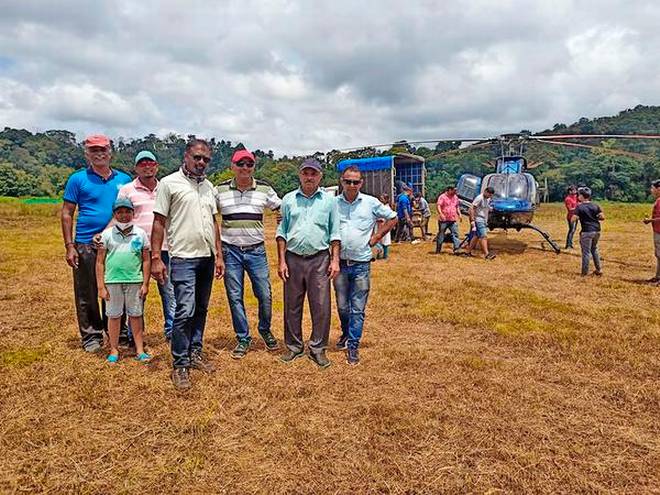
Locals gather to witness the heli-tourism initiative taking off, at Kakkabe in Kodagu. The chopper of a private operator that landed with three tourists can be seen in the backdrop. 

A private operator flies in tourists from Bengaluru to a village resort close to Tadiandamol

Even as successive governments continue to dilly-dally over launching heli-tourism for high-end tourists despite umpteen promises, Kodagu has taken the first step towards giving a start to the initiative post-pandemic with local stakeholders taking the lead and kick starting the much-talked-about initiative.

A group of tourists from Bengaluru landed in a chopper at a village to explore Coorg’s splendour, staying in a resort located close to one of the highest points in Kodagu – Tadiandamol. These tourists, instead of taking the 6-hour drive to Madikeri from the IT Hub, chose to fly by a chopper owned and run by a private operator to reach the hill station.

In fact, Kodagu was also identified along with Mysuru for developing heli-ports by the Tourism Department which did not take off. However, an entrepreneur in the hospitality sector in Kodagu, Apparanda Sagar Ganapathy, who runs a resort at Kakkabe, coordinated with the chopper operator to ferry guests to his property where a helicopter landing facility was established recently at the resort to facilitate heli-tourism.

Mr. Ganapathy, who is also the president of Association for Rural Tourism (ART), says the potential of rural tourism remains unexplored as corporates and well-heeled tourists are keen to explore the life and lifestyles in villages. Heli-tourism can bring tourists who can afford chopper rides to the remotest corners of Kodagu to experience the coffee land’s unmatched beauty and the Coorg villages.

Villagers turned up in large numbers to witness the heli-tourism initiative. Kakkabe Panchayat president Kaliyanda Sampan and other locals were present to greet tourists.

Corporate executives can have their meetings amidst nature instead of in multi-storied structures. They can fly in by chopper, have a meeting, spend some valuable time and head back to their destinations. Infrastructure can help promote such kinds of tourism, the stakeholders believe.

The stakeholders in the hotel and hospitality sector in Kodagu, including ART and Kodagu Tourism Association, are also in the process of identifying infrastructure where choppers could land, bringing tourists, and promoting heli-tourism in a big way. Another resort is also in the process establishing the chopper landing space, foreseeing its potential, he said.

Kodagu has many luxury resorts, which, according to the stakeholders, are getting back their clients with the opening of tourism post-pandemic. But the mid-range resorts are lacking clientele with corporates, particularly those from the IT industry, are yet to return to their offices and continue to work from their homes.

“Before COVID-19, we used to get groups of 25-30 coming and staying in resorts during weekends or holidays. Such trips have stopped for one and half years due to the pandemic. Until the offices start working like before and schools and colleges function normally, tourism recovery may prolong,” Mr. Sagar said.

Unlike other places, Kodagu is predominantly covered by undulating hills with thick forest cover. There is a need to establish a safe environment for the landing and taking off of the choppers. “If we provide infrastructure like heli ports or helipads, more operators can show interest in bringing tourists by choppers, thus driving the tourist economy and helping revive the sector,” the travel operators said.

source: http://www.thehindu.com / The Hindu / Home> News> States> Karnataka / by Shankar Bennur / Mysuru – September 29th, 2021

‘Short films should propagate social messages’

Short films ‘Kodi Mova’ and ‘Nambike’, which won the first and second prizes in the short film competition, organised by Karnataka Kodava Sahitya Academy, were screened at Patrika Bhavan in Madikeri recently.

The programme was held under the aegis of the Kodagu Press Club.

The short film ‘Kodi Mova’ is directed and produced by Gopal Somaiah and ‘Nambike’ is directed and produced by Bollajira B Ayyappa.

Actor Roopesh Nanaiah said that even though the short films are made with less budget and are of less duration, their message can be equally strong as those of the mainstream films.

“Generally, people watch movies for entertainment. However, most of the movies that we watch are eventually forgotten. The movies that we remember forever have a good social message in them,” he said and stressed that the short films too, should propagate social messages.

He appreciated both the award-winning short films and said more focus should be given to the technical aspects.

Actor Neravanda Umesh felt that all the entries to the short film festival should have been screened.

The competition should be held every year so that the talents get opportunities, he said.

Kodagu Press Club president Ajjamada Ramesh Kuttappa was present.

source: http://www.deccanherald.com / Deccan Herald / Home> State> Mangaluru / by DHNS, Madikeri / September 29th, 2021

Gulshan Devaiah on playing Neel in Blurr; actor to share screen with Taapsee Pannu

Gulshan Devaiah on playing Neel in Blurr; actor to share screen with Taapsee Pannu-SYT

Gulshan Devaiah will be seen in Blurr that also stars Rashmi Rocket star Taapsee Pannu; read more details.

It’s been quite some time for Gulshan Devaiah’s fans to see him ace a character on screen, but now the actor will be seen in a psychological thriller Blurr with one of the finest talents in our country Taapsee Pannu.

‘Blurr’ is the first film under Taapsee Pannu’s production banner, Outsider Films, associated with Zee Studios and directed by Ajay Bahl, starring Taapsee Pannu and Gulshan Devaiah. Gulshan Devaiah is one of the most talented actors we have and has a niche of his own for film choices. He is playing Taapsee’s husband in the psychological thriller. 

Gulshan calls it one of the most lovely experiences to be on the sets of Blurr. He also enjoyed working with Taapsee and could not wait for the audience to see the film. Talking about Neel’s character in the movie, Gulshan revealed that he plays Gayatri’s husband Neel, a very nice, understanding man, but he’s unhappy and not so content from the inside.

Adding further about the characteristics, he said that Neel loves his wife and is very supportive of her, but there is always a visible tension between the two. The film is shot extensively in the picturesque Nainital, Pawan Sony and Ajay Bahl has penned the story. It is a story of a girl caught up in an unavoidable circumstance, and the thrill and drama unfolds.

Zee Studios, Taapsee Pannu’s Outsider Films and Echelon Productions Blurr is scheduled to release in 2022.

source: http://www.newsable.asianetnews.com / Asianet Newsable / Home> English News> Entertainment / Team Newsable, Mumbai / September 24th, 2021

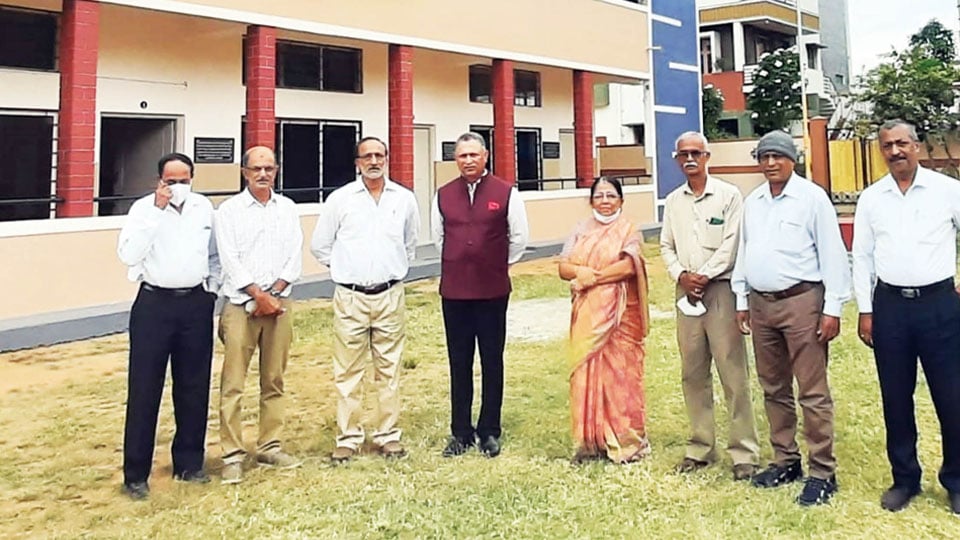
Lt. Gen. (Retd.) P.C. Thimmaiah Visits Kodagu Model School

Mysore/Mysuru: 

Lt. Gen. (retd.) Pattacheruvanda C. Thimmaiah visited Kodagu Model School at Vidyashankar Layout in Sathagalli here yesterday.

Lt. Gen. (retd.) Thimmaiah, now a resident of Mysuru, is also a member of Sri Kaveri Kodava Association, Mysuru East, which runs the School.

The former Army Officer was very much impressed by the progress of the school over the years. Expressing happiness about the infrastructural set up, he lauded the School’s achievements in a short period.

During his visit, Lt. Gen. (retd.) Thimmaiah discussed with the School authorities on what more was needed to be done for taking the Institution to greater heights and such other issues.

He suggested making Feeder Schools across the country as Sainik Schools, setting up of NCC units and increasing sporting activities in Schools. He also assured to come up with more useful suggestions whenever required on further development of Kodagu Model School.

The School Management members, staff and others accompanied him during his visit.

source: http://www.starofmysore.com / Star of Mysore / Home> News / September 28th, 2021

Jaina Kashi of Kodagu lacks basic amenities

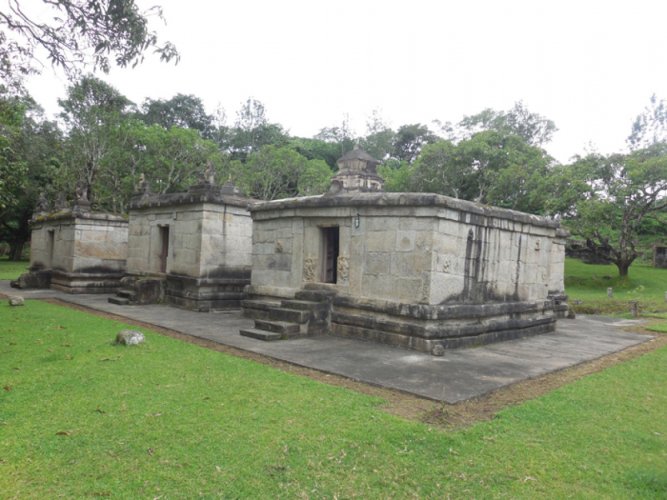
The three Jain Basadis at Mullur village near Shanivarasanthe.

Mullur village, which is known as the Jaina Kashi of Kodagu, with three Jain Basadis, lacks proper road connectivity and other basic amenities.

The village is situated just 6 km away from Shanivarasanthe. However, lacking the basic amenities, the beautiful surroundings of three Jain Basadis are losing their importance.

Even after three decades, there is a lack of road connectivity, drinking water facilities and toilets at the Basadi.

Owing to lack of connectivity, the three Basadis known for their architecture have remained out of the purview of the tourists.

Amid the mango groves in the village lies the Basadi, which has survived several centuries. Though the government has announced ‘Trivali Basadi’ as a tourist spot, it lacks basic amenities.

The Basadi of Parshwanatha, Chandranatha and Shanthinatha are made of stones. Over 20 inscriptions, Veeragallu and ‘Nishidhi Kallu’ situated behind the Basadi are also conserved. There is a Kalyani behind the Basadi as well.

It is believed that queen Pochakabbe, a follower of Jain seer Gunasena Pandita, had constructed these Basadis.

When Jeevijaya was the minister 33 years ago, the road leading to the Basadi had seen asphalting, said an elderly villager.

Over a period of time, the road has worn out and is now crying for the attention of authorities.

The villagers have urged the authorities to provide proper road connectivity to Jain Basadi, which in turn, will help in the growth of the economy in the village.

Though an action plan for Rs 2 crore was prepared for the development of the Basadi during the tenure of H D Kumaraswamy as chief minister, the proposal remained in cold storage during the tenure of B S Yediyurappa.

Even the Zilla Panchayat had prepared an action plan for Rs 1 crore for the development of roads, toilets and electricity connections. However, it failed to take off, over the years.

The Basadi comes under the archaeology department. The department has appointed a person named Nithin Kumar who is said to have no knowledge of Kannada to manage the Basadi. Another person named Lingaraju is engaged in cleaning the premises.

Though tourists visit the Basadi daily, owing to the poor condition of the road, the tourists have to walk to reach the spot.

The villagers said, “We have been submitting memorandums to elected representatives and officials to repair the road for the last several years. All our efforts have been in vain all these years.”

Government Higher Primary School, Mullur, teacher C S Sathish said, “There is a need to construct a fence around the Kalyani in the Basadi. A full-time supervisor should be appointed. Facilities should be arranged for the stay of the visitors near the Basadi. A beautiful garden should be laid in front of the Basadi.”

source: http://www.deccanherald.com / Deccan Herald / Home> State> Mangaluru / by DHNS, Shanivarasanthe / September 25th, 2021

8 Kodagu Soldiers In United Nations Peacekeeping Force

Madikeri:

Kodagu has the honour of having enriched our armed forces since ages. Now, eight soldiers from the district have been selected for the United Nation Peacekeeping Force in Lebanon. 

Soldiers who are currently serving in various regiments in the Army will join the camp soon.

Pemmanda S. Ravindra from Ponnampet, Karotira Lokesh from Pollibetta, Vinod Kalappa from Galibeedu; Ponnachettira Palangappa from Kalur village, Sathish. V. Doddaiah from Shanivarasanthe, Dinesh Pujari from Chamundeshwari Nagar in Madikeri, Deekshith Shetty from Bhagavathi Nagar and Bharath Pujari from Kaggodlu village.

The United Nations Peacekeeping Force is employed by the world organisation to maintain or re-establish peace in an area of armed conflict. More than 5,500 Indian military and Police personnel are serving in peace operations in Abyei, Cyprus, Democratic Republic of Congo, Lebanon, Middle East, Somalia, South Sudan and the Western Sahara. 

As of March 2021, a total of 19,075 personnel have been deployed in the UN mission in South Sudan.

Now the eight soldiers from Kodagu will take part in the UN Peacekeeping Forces camp in Lebanon.

source: http://www.starofmysore.com / Star of Mysore / Home> News / September 12th, 2021

Kodava Sahitya Academy Fellowship

Dr. D.C. Nanjunda, Associate Professor at the Centre for Social Exclusion and Inclusive Policy, University of Mysore, has been awarded Karnataka KodavaSahitya Academy’s Research Fellowship for the year 2021-22.

Today man-animal conflict has become a major issue in Kodagu district, claiming the lives of both humans and animals. In addition, wild animals are destroying crops of marginalised farmers.

Keeping this in mind, the Karnataka KodavaSahitya Academy has awarded the Fellowship to Dr.Nanjunda to study the “Man-wildlife Conflict.

Dr.Nanjunda is a recipient of eight Research Fellowships including ICMR (2008), ICSSR (2013), DHA (2014), Karnataka Balavikasa Academy Research Fellowship (2014), Karnataka SahityaAkademi Travel Fellowship (2016). He is a noted columnist also.

source: http://www.starofmysore.com / Star of Mysore / Home> In Briefs / September 24th, 2021

Fit India Freedom Run held in Madikeri

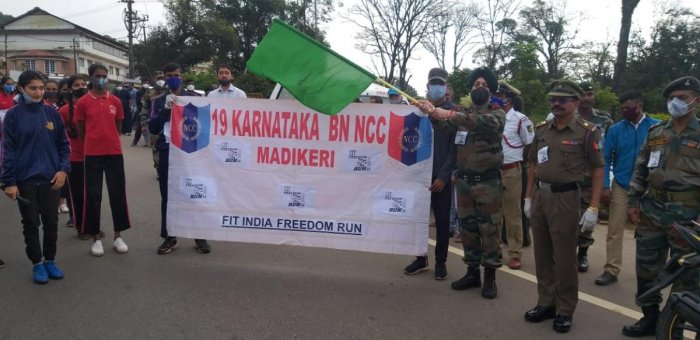
Lt Col Navdeep Singh Bedi flags off the Fit India Freedom Run in Madikeri.

The 19th Karnataka Battalion NCC Wing of Field Marshal K M Cariappa College, Madikeri CMC and the Green City Forum organised Fit India Freedom Run and cleanliness campaign on Saturday.

A cleanliness drive was carried out in front of the statue of Field Marshal K M Cariappa at Sudarshan Circle, General Thimayya Circle, Ajjamada Devaiah Circle, Chowki and State Bank Circle.

Lt Col Navdeep Singh Bedi said that there is a need to improve immunity to fight against Covid-19.

“Everyone should engage in exercise daily to maintain their health,” he added.

Field Marshal K M Cariappa College NCC officer Major Dr B Raghava also spoke on the occasion.

source: http://www.deccanherald.com / Deccan Herald / Home> State> Mangaluru / by DHNS, Madikeri / September 25th, 2021

Karnataka HC upholds Arms Act exemption for Kodavas: History behind community’s right to own guns without a licence

As per the exemption, continuing from the British-era rule, the people from the hill district of Kodagu can posses pistols, revolvers and double-barrelled shotguns without a licence.

Karnataka HC upholds Arms Act exemption for Kodavas: History behind community's right to own guns without a licence
The Kodavas are a small martial community in Kodagu (Coorg) district in Karnataka. Image Courtesy: @KodaguConnect/Twitter

The Karnataka High Court on Wednesday upheld the Arms Act exemption granted to every person of Coorg by race, and Jumma tenure landholders in Coorg (Kodagu district).

A division bench of acting Chief Justice Satish Chandra Sharma and Justice Sachin Shankar Magadum heard the matter which was first filed on 30 June by 41-year-old Captain Chethan YK (retired), also a resident of Kodagu, who sought to know why only one race was given this exemption.

The judges in the case said: “The Kodava community which is a marshal community is enjoying the benefit of exemption since pre-independence and Jumma tenure holders are enjoying the exemption since pre-independence period. They have rightly been granted exemption for a period of ten years, it is not the case they have been granted exemption indefinitely. Exemption granted is subject to certain terms and conditions. Therefore, the Constitutional validity of the notification is upheld in the petition.”

Take a look at who are the Kodavas and the story behind their right to bear arms without a licence.

Kodava people

They are a unique race of people who live in Kodagu (Coorg, as the British called it), the smallest district in Karnataka.

The history of Coorg and the Kodava people is one that is shrouded in a lot of mystery. There are a variety of theories as to the origin of the Kodava, including theories of them being either the indigenous inhabitants of their region, or of foreign origins prior to two thousand years ago.

As per the indigenous theory, the Kodava people were an ancient warlike tribe, who were indigenous inhabitants of Kodagu. This tribe learned and practiced agriculture in the area and over the centuries they got civilised and gained prosperity.

The foreign origin theory, which is more popular with the community itself, says they are descendants of the broad-headed (Brachycephalic) stock who entered into the Indus Valley during the Mohenjodaro period and later migrated down to Coorg.

However, the most popular theory among the Kodavas is that they are descendants of the Indo-Greek soldiers, who came into India with Alexander the Great.

Weapons in the Kodava culture

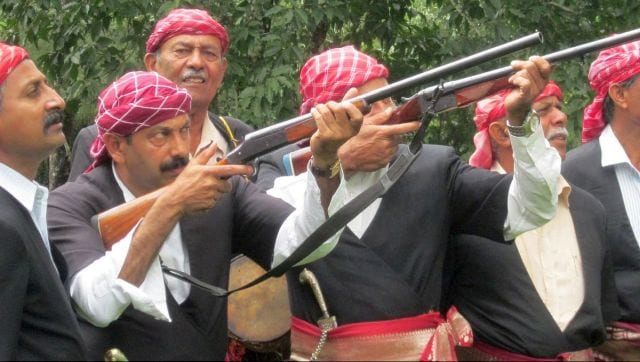
The Kodava community has a long history with guns, and historians say that their culture is intrinsically linked with firearms. There are festivals in which gunshots are fired in the air, and a gun salute is performed when a child is born or a person dies.

During the Kailpodh festival, celebrated each year on 3 September, all the weapons along with agricultural implements and vehicles are cleaned and decorated with flowers and worshipped.

The traditional sword and dagger also are a part of the Kodava attire, showcasing how intrinsically the arms are woven into their culture.

Exemptions from getting a gun licence

The British in recognition of their martial traditions granted the community a special privilege to own firearms without a licence in 1861.

One cultural reason for giving the exemption was that Kodava homes were far away from each other, in some cases could be as far as a kilometre.

“In older times when communication links were poor, a Kodava used to inform his neighbour by firing a single shot in the air about a newborn and two shots in case of any death in the family,” a prominent Kodava, who lives in Delhi, was quoted as saying to The Economic Times.

The exemption was then issued by the Union government in 1963 under the provisions of the Indian Arms Act, 1959.

The Centre had issued a notification exempting “every person of (the) Coorg race and every Jamma land tenure holder in Coorg” from the Indian Arms Act. There was no curb on the privilege even after Coorg, which was a separate state earlier, merged with Karnataka.

There are conditions, however, to the exemption. In a notification, the Ministry of Home Affairs, said, “The arms or ammunition carried or possessed by any person being from Kodagu by race and every Jamma tenure holder in Kodagu and herein exempted while residing or travelling outside the district of Kodagu shall not exceed one rifle with 100 rounds of ammunition for the same and one smooth bore breech or muzzle-loading gun with 500 cartridges or the equivalent in leaden shot and gunpowder.”

A home ministry official added that the exemption, valid till 2029, was given to the Kodavas as firearms were never misused in crimes or anti-national or anti-state activities.

According to reports, a proposal to do away with the privilege under the Arms Act was made in 1964 by the Centre. But the move was dropped, apparently, at the behest of Field Marshal K M Cariappa — the first Indian Commander-in-Chief of the Indian Army — and the then Union Minister C M Poonacha, who was also the former chief minister of Coorg state, before its merger with Karnataka.

‘Discriminatory’ exemption

In 2018, Captain Chethan (retired) filed a Writ Petition questioning the exemption granted by the Government of India to a certain class of people in the district in obtaining licence to possess firearms under Section 3 and 4 of the Indian Arms Act, 1959.

In his petition, Chethan, a resident of RT Nagar in Bengaluru, claimed that the continuation of the exemption, granted to some class of persons by the British Government in pre-Independent India in furtherance of their divide-and-rule policy, was unconstitutional, as it was based on irrational, fictitious and discriminatory grounds, such as race and ancestral land tenure.

The petitioner had claimed that the MHA did away with the scrutiny of persons before granting licence in respect of the people belonging to the ‘Coorg race’, adding that this itself is not only derogatory to the citizens of the entire nation other than the ‘Coorg race’, but also possess a threat to the life and liberty as the people exempted are permitted to hold arms and ammunition without any scrutiny of their antecedents or criminal records.

However, the petitioner’s concern was shot down by Additional Solicitor General M B Nargund appearing for the Union of India who said, “A kirpan is allowed to be used by the members of Sikh community and similarly, Gorkha community is permitted to use kukri.”

Senior Advocate Sajan Poovayya appearing for Respondents Kodagu Samaja Bangalore and Kodava Muslim Association also opposed the petition saying, “It is not like that if there are 100 people in a house they can have 200 firearms in the house, the quantity of arms and ammunition and the types of arms are all specified.”

Codava National Council president, Nandineravanda U Nachappa hailed the high court’s decision and speaking to Indianexpress.com said, “It is a historical judgment by the high court. Few people without any knowledge about the community had gone to court challenging exemption given to the Kodava community. We have received these rights under the customary law since Kodavas’ life revolves around the gun.”

source: http://www.firstpost.com / First Post / Home> India News / FP Staff / September 25th, 2021