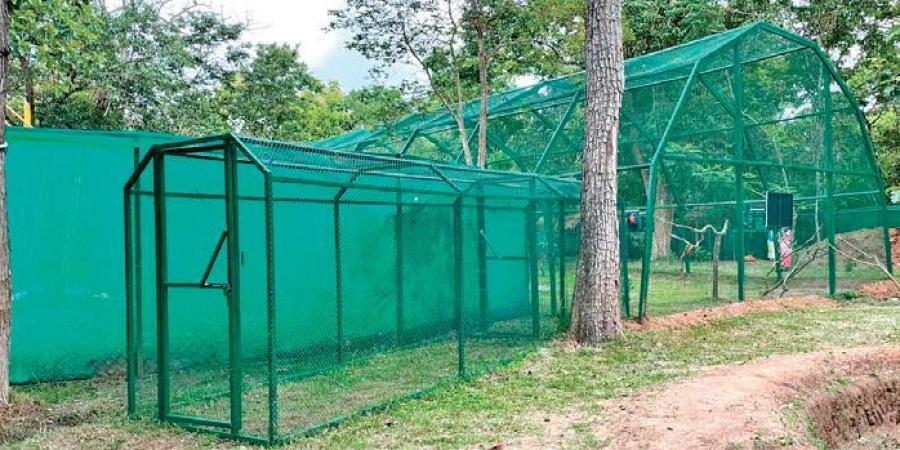
In a move to draw more tourists to the Scotland of Karnataka, the Forest Department and local administration have created a walk-in exotic bird aviary in Kodagu
The walk-in aviary created at Cauvery Nisargadhama, Kodagu district | EXPRESS
Bengaluru :
In a move to draw more tourists to the Scotland of Karnataka, the Forest Department and local administration have created a walk-in exotic bird aviary in Kodagu. Though it was inaugurated by Housing Minister V Sommanna on Friday, it will be opened to the public only after a month.
The aviary has been created in Cauvery Nisargadhama, where a dedicated area of around 2,000 sqft for an enclosure has been created. Visitors can walk in and feed the birds. Shivaram Babu, Deputy Conservator of Forests, Kodagu told The New Sunday Express that a metal structure has been erected with mesh so that peopl e and birds are not inconvenienced.
The list of birds being procured to be housed include, budgies, African lovebirds, cockatiel, Conure varieties, African grey parrot, macaw, pheasant, turkeys, geese and ducks.
A Koi fish pond and fish spa, housing Gurra rufa (doctor fish), is also being created, he said.
The concept is very popular in foreign countries, especially the island nations. Some conservationists and activists have questioned the need for such a project in Kodagu. “The area is known for its lush green forest patches, vegetation, biodiversity and wildlife. There is no need to bring in exotic birds and have such an aviary. Instead, a bird-watching site can be created,” an activist said.
source: http://www.newindianexpress.com / The New Indian Express / Home> Cities> Bengaluru / by Express News Service / June 13th, 2021
Growers agree not to bring workers to estates from other places until June 21 as a measure to control the spread of infection
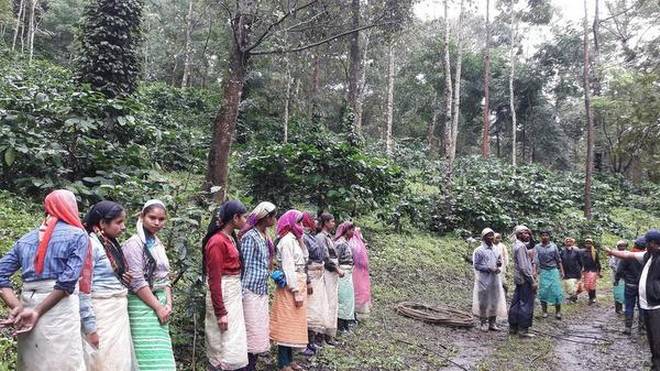
Coffee workers in Kodagu will soon get the jabs against COVID-19 with the authorities planning to launch vaccination drive in plantations for making the coffee land safe from the pandemic.
The support of large plantations and companies operating in the district has been sought for making it successful.
Former Speaker and MLA K.G. Bopaiah, who spoke about the vaccination plans, advised the owners of plantations not to use workers returning from COVID-19 Care Centres, after recovering from COVID-19, immediately for work in estates. They must be placed in quarantine for at least a week before redeployment.
“The owners must follow the guidelines and ensure control of the infection. Give priority for saving lives and health. The essential works in estates can be done using the locally available workers,” he said at a growers’ meeting in Madikeri on Thursday.
Various coffee growers’ associations in Kodagu have pledged support to the district administration for making Kodagu COVID-19 free even as the lockdown in the coffee land has been extended till June 21 based on its positivity rate.
The growers have resolved not to bring workers from other places for work in estates across Kodagu until June 21. It was decided to make use of the locally available workers.
Earlier, Mr .Bopaiah, who chaired the meeting, said COVID-19 was coming under control in Kodagu. However, there have been reports of infection being reported among workers coming here for work. “The estate owners must avoid bringing workers from other places for the time being. This measure can help us in fighting the pandemic effectively and preventing the spread,” he observed.
Mr. Bopaiah warned of seizing vehicles ferrying workers from other places.
The growers urged the former Speaker to take a delegation to New Delhi after the lockdown ends to highlight the plight of coffee growers and the difficulties faced by the industry.
source: http://www.thehindu.com / The Hindu / Home> News> States> Karnataka / by Special Correspondent / Mysuru – June 11th, 2021
Coffee growers find novel ways to protect their estates from herd raids
Kushalnagar:
Jackfruit is elephants’ favourite fruit and they can smell the ripe ones from miles away. Elephants are dead clever and determined. If the fruit is too high for them to reach they’ll shake the tree with their trunk until the fruit falls to the ground. And if there is an electric fence, they will break it down with a dry tree trunk and enter any plantation.
It is jackfruit season in Kodagu now and wild elephants raiding coffee estates in search of jackfruits is commonplace. They camp for days inside estates putting the lives of estate owners and also labourers in jeopardy as no one can venture into the estates till the herd or even a lone tusker leaves the property.
Wary of elephant raids, farmers and coffee growers have adopted newer ways and means to save their lives and property. They are plucking jackfruits from the trees and dumping them on the elephant path.
In fact, the Forest Department has to intervene in such elephant raids. But with no help forthcoming from the Department officers, who don’t even pay compensation to the loss of coffee plants, estate owners have taken this initiative and it has proved a success too. The elephants entering estates has minimised, if not totally prevented.
Wild elephant menace is rampant in Aiguru, Kandanakolli, Kodlipet, Shirangala Nakoor, Abyathmangala, Chettalli and Seventh Hoskote in the North of the district and Srimangala, Ammathi, Thithimathi, Ponnampet, Kutta and Balele in Virajpet and Ponnampet taluks.
Forests in these areas mostly comprise teak wood which is why elephants are falling short of food and in jackfruit season, they raid the estates. Repeated requests of the villagers to the Forest Department to chase elephants back to the forest have fallen on deaf ears.
Path identified and dumped
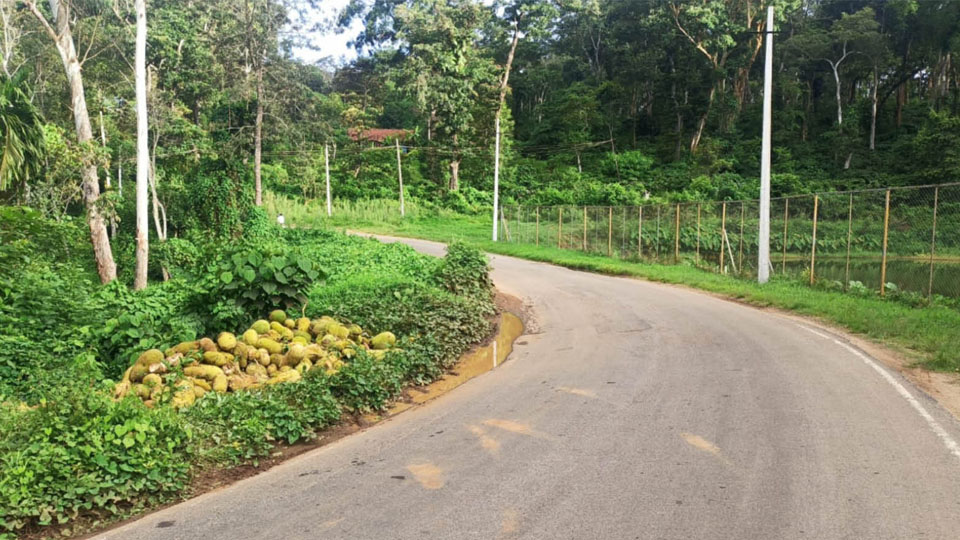
Now in this season, jackfruits are found piled up on the roadsides and growers hope the elephants hog these jackfruits instead of entering into their plantations. But the planters cannot cut the jackfruit trees inside their own estates as they do not have tree rights and have to seek permission from the Department — a tedious job, especially during COVID times.
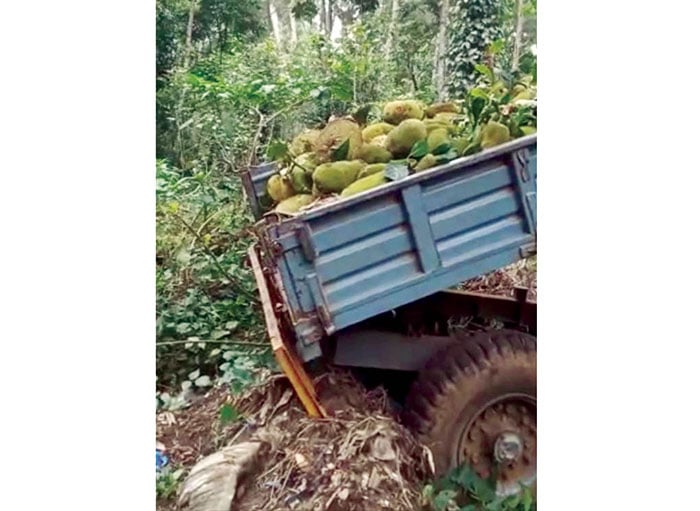
“We identify the path usually taken by elephants roaming around and dump tractor-loads of jackfruits on the way and also near lakes that are frequented by elephants. It is a big loss if a herd of 20 to 25 elephants enter an estate. We are not worried about them eating jackfruits but in the process, they destroy many coffee plants,” says Arun Kumar, an estate owner at Abyathmangala.
On an average, over 1,000 kgs of jackfruits are dumped on the roadsides in the vicinity of every major estate. “We spend extra money and pay the labourers who make time to cut jackfruits amidst the tree-topping work,” he added.
Villagers oppose move
However, the trend has been opposed by some villagers in Abyathmangala-Kushalnagar Range who fear for their safety. They claimed that some of the estate owners’ move is endangering their lives. Anil a, villager said that despite many pleas, the estate owners dump jackfruits by the side of the road and they can’t even go on the road fearing wild tuskers.
However, Ajith Kumar, an estate owner on the Siddapura Road said that he had asked his estate workers to dump the fruits by the side of a lake that is frequented by elephant herds. “By mistake they have dumped on a roadside near the village and next time we will dump fruits on elephant path. Last year, we faced severe losses as many coffee tree branches were broken as herds entered my estate. This is the only visible solution,” he said.
source: http://www.starofmysore.com / Star of Mysore / Home> News / June 05th, 2021
File picture of people from Assam working in a coffee estate near Arehalli in Belur taluk of Hassan district.
Workers from the north-east have not returned, affecting seasonal work ahead of the rainy days
Hundreds of plantation workers in Karnataka, who went to Assam to vote in the Assembly elections held in March-April this year, have not returned, affecting the seasonal work ahead of the rainy days.
Restrictions on public transport as part of the lockdown over the COVID-19 pandemic has not allowed them to travel, though they wish to come back.
Thousands of people from Assam and other neighbouring States in north-east India work in coffee estates of Hassan, Chikkamagaluru and Kodagu districts. They stay in the quarters provided by the planters and visit their native places once a year. Whenever elections are held, they take a break from work and travel to exercise their franchise.
Mahesh C.S., former president of Hassan District Planters’ Association, says many planters had not been able to complete tree pruning and plant pruning, mandatory seasonal work ahead of the rains. “Normally, we finish this work before June and keep the ground prepared with medicinal spray and manure. All these works have remained undone,” he said. Planters are forced to depend on local workers, who demand higher wages and work for fewer hours than the Assam workers do, he added. The wages for tree pruning, a skilled job, is around ₹700 to ₹800 a day. For other works, a worker gets around ₹300 to ₹350 in normal circumstances.
B.S. Jairam, former president of Karnataka Growers Federation, who has an estate in Mudigere Ttluk, is worried that the present situation could affect the production of coffee later this year. “The planters are already facing too many problems due to the pandemic. The payments are stuck due to restrictions on shipment and many have not recovered from the loss suffered in the floods in previous years. Only those who could retain workers in their quarters with sufficient supply of ration have completed the seasonal work”, he said.
Over the years local workers hardly stay in estate quarters. They reside in their villages and commute to estates daily by vehicles. But now they cannot do so as there are restrictions on vehicular movement “The police do not allow ferrying workers to estates. Only those settled in the nearby areas reach to the estates by walk and work,” he said.
Besides the people from Assam, many from the north Karnataka districts also work in the estates. They also return to their native places during March-April. This year they too could not return. Prasad Raxidi, a planter at Raxidi in Sakleshpur taluk, said the local workers were getting work and also good pay these days. “Only those who have returned from bigger cities after losing their jobs in the lockdown are not getting jobs that suit them,” he said.
source: http://www.thehindu.com / The Hindu / Home> News> States> Karnataka / by Sathish G T / Hassan – June 10th, 2021
Geographical Survey of India (GSI) has identified 85 places in Kodagu district, including areas in Madikeri and Virajpet towns, as vulnerable to floods and landslips.
Deputy Commissioner Charulatha Somal said necessary precautions are in place at those places following the GSI’s report. The officials had also prepared reports on places susceptible to rain emergencies based on previous years’ calamities.
The DC, while responding to Minister for Revenue R. Ashok on monsoon preparedness, gave details of the flood-prone areas and steps taken for the safety of people.
Mr. Ashok directed the DC to take steps to relocate those living in susceptible areas to safer places in view of monsoon. “Just issuing notices to the people to relocate will not serve the purpose. The administration has to persuade them to shift,” said the Minister, at a video conference on Monday with the DCs of some districts, including Kodagu, on Monsoon preparations.
Referring to last year’s landslip that took place at Talacauvery which claimed the lives of people, including the temple priest, the Minister said such instances should not recur. The people living in vulnerable areas must be shifted to relief/rescue centres which can be set up in schools or community halls, he suggested.
Ms. Somal urged the Minister to increase availability of kerosene to Kodagu since its demand goes up during monsoon. The Minister said he would speak to the Minister for Food and Civil Supplies.
source: http://www.thehindu.com / The Hindu / Home> States> Karnataka / by Special Correspondent / Mysuru – June 09th, 2021
Most of the 19.88-acre land encroached Survey ordered by High Court
Madikeri:
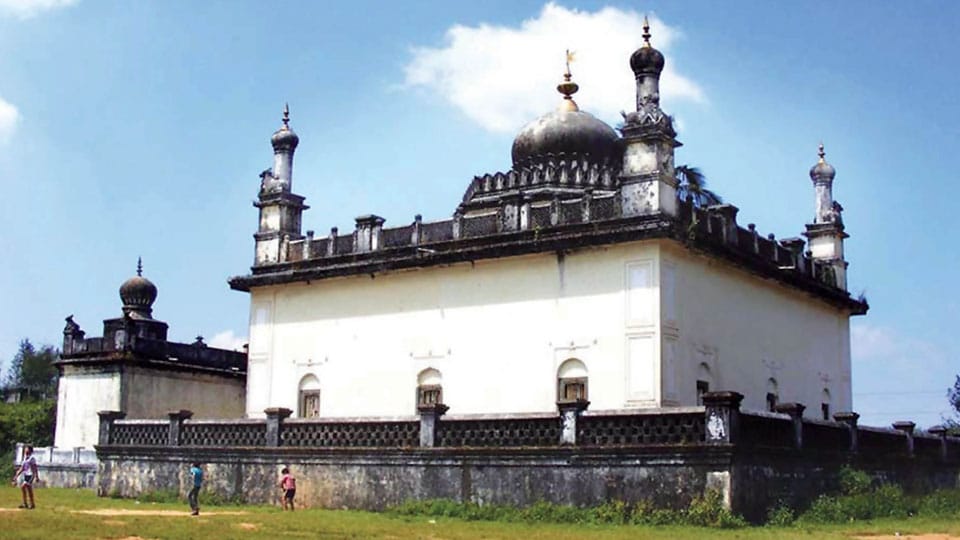
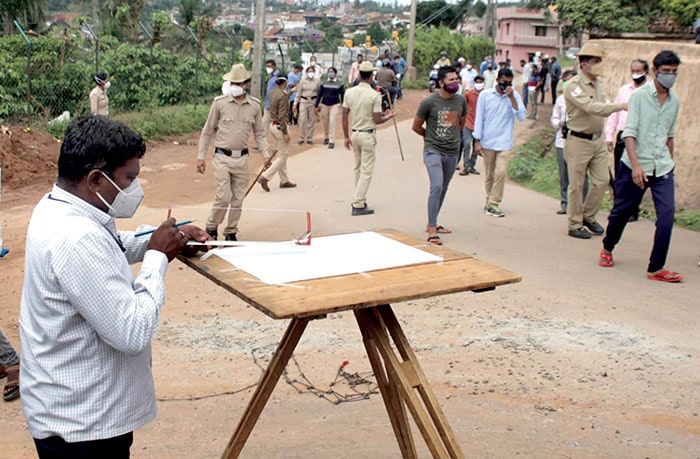
Following a directive from the Karnataka High Court to Madikeri Tahsildar to conduct a survey of 19.88 acres of the area where Raja’s Tomb (Rajara Gaddige) is situated at Mahadevpet near Madikeri, the officer began the survey yesterday along with his team and amidst tight Police security.
The survey was carried out under the leadership of Tahsildar Mahesh. In March this year, a Division Bench, headed by Chief Justice Abhay Shreeniwas Oka, while hearing a Public Interest Litigation (PIL) filed by J.S. Virupakshaiah, a former State Information Commissioner, had ordered the Tahsildar to conduct a detailed survey for the Government to reclaim the encroached land.
Virupakshaiah had alleged that there are several encroachments in the historical tomb area. Initially, the Gaddige had 19.88 acres of land. However, most of the land has been encroached and some have even built houses on the encroached land. Even a Government building has come up on the Gaddige land.
The PIL brought to the notice of the Court about 31 families residing in the encroached land. In spite of having no land documents, the Panchayat has provided water, electricity, road and other basic facilities, Virupakshaiah had said in the PIL.
Now the survey has begun with tight Police security. The Court will hear the PIL again on June 17 and the District Administration has to submit a report on the original land, encroached part and other details.
Before the survey team began work, Town Panchayat members Amin Mohisin, Basheer and Mansoor urged the Tahsildar to first demarcate the borders of the Gaddige as they said it is not possible to determine encroachment unless the borders are marked.
Speaking to reporters, Tahsildar Mahesh said that during the last hearing, the Bench had given six weeks for the submission of the report. “Due to COVID and Town Panchayat polls, the survey could not be taken up so far. Now the survey is being carried out as per the Court directions. The exact border of the Gaddige will be identified and demarcated. The land has been listed under the Archaeological Survey of India Survey Number 30/1 and there is 19.88 acres. The Bench has also directed us to prepare a sketch of the entire land and pin-point encroachments. We are trying to bring out the truth regarding encroachments,” Mahesh said.
There are three tombs built for the royal dynasty. The central tomb which is the largest among the three is of Kodava king Doddaveerarajendra and his wife Mahadeviamma. The right tomb is built by Chikkaveerarajendra for his father Lingarajendra in 1820.
The left tomb belongs to Veerarajendra’s guru Rudrappa built in 1834. Closer to the tombs is the burial place of the two brave royal officials Biddanda Bopu — Bopu Dandanayaka — and his son Biddanda Somaiah, who sacrificed their life fighting with Tipu Sultan. In fact, Doddaveerarajendra had erected a plaque in the memory his soldiers in 1779.
Encroachers have political clout
Rajara Gaddige is one of the tourist attractions in Kodagu and tourists who visit Abbey Falls will pass Rajara Gaddige en route. However, it is in deplorable condition owing to the negligence of the Government and encroachment of land by local residents and vested interests.
The Gaddige land became is controversial as the people who have encroached have the blessings of certain politicians who have consistently opposed any move of eviction and also development. Last year too, the Kodagu District Administration had attempted to conduct a survey of the land to determine the encroachment but the survey was withdrawn after protests from encroachers.
Years back Madikeri Urban Development Authority had tried to develop the Gaddige into a tourist attraction. But it could only reclaim 3.5 acres and the rest of the land remained with the encroachers who opposed any move to evict them. Surprisingly, with their clout, the encroachers have managed to obtain all municipal facilities including water, power and roads.
source: http://www.starofmysore.com / Star of Mysore / Home> News / June 06th, 2021
Once completed, free flow of oxygen supply is likely to be enabled to nearly 100 beds to treat COVID patients.
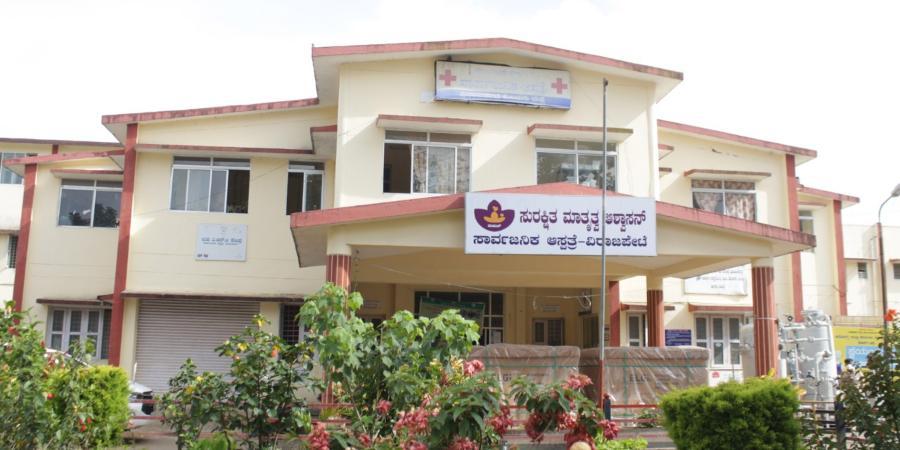
Virajpet Government Hospital
Madikeri :
Kodagu has become the first district in Karnataka to be sanctioned an oxygen converter plant. The plant is currently being installed at Virajpet Government Hospital. An oxygen converter generates oxygen from natural air.
The 1-tonne capacity oxygen converter plant is expected to be ready in the next 15 days. Once completed, there will be uninterrupted oxygen supply to nearly 100 beds to treat Covid patients. While the Madikeri Covid-19 Hospital was the only centre in the district that treated severe and moderate Covid patients, the administration opened dedicated Covid care centres (CCCs) in Virajpet and Somwarpet taluks.
However, due to shortage of availability of jumbo oxygen cylinders, the 50-bed capacity CCC in Virajpet Hospital remained shut. “The plant is being set up at a cost of Rs 1 crore. This is the first of its kind in the state and once installed, we do not have to worry about oxygen shortage,” said Dr Yatiraj, Virajpet taluk Health Officer. “We had placed a proposal for jumbo cylinders.
However, with the oxygen converter plant, we will not require any such cylinders,” Dr Yatiraj further said.
Meanwhile, the current 50 beds with oxygen units are now being expanded to 98 beds which will be connected to the oxygen converter plant. “Currently, no Covid-19 patient is being treated at the centre due to lack of oxygen cylinders. However, once the plant is ready, there will be no hurdle in treating patients,” he added.
US Surgeon Gen’s foundation donates supplies
Madikeri:
The Scope Foundation, headed by United States Surgeon General Dr Vivek Murthy, has donated medical supplies worth Rs 70 lakh to Kodagu. The supplies were handed over to Deputy Commissioner Charulatha Somal by senior advocate HS Chandramouli on Sunday.
Many advanced medical supplies, including 70 oxygen converters, 70 medical transformers, 5,000 face shields, Rs 1.30 lakh worth N95 masks, 50 oxygen tubes and 25 oximeters, were donated by Scope Foundation. Dr Vivek is a native of Mandya district.
The support from the foundation to Kodagu was made possible after Chandramauli, a native of the district, contacted Dr Vivek’s father Lakshmi Narasimha Murthy. The foundation has also donated similar supplies across Karnataka, including Mandya.
source: http://www.newindianexpress.com / The New Indian Express / Home> States> Karnataka / by Express News Service / June 06th, 2021
Kodagu, the second smallest district after Bengaluru Urban in the State, has reported 3,000 plus Covid positive cases among children in the second wave.
Madikeri:
Kodagu, the second smallest district after Bengaluru Urban in the State, has reported 3,000 plus Covid positive cases among children in the second wave. The district has an average positivity rate of 12.3 percent. Somwarpet taluk has a positivity rate of 14 percent followed by Madikeri (12 per cent) and Virajpet (11 percent). Out of nearly six lakh population, the district reported 21,976 positive cases as on Saturday. Among this the number children infected with corona is 3,611.
Speaking to The Hans India, District Health Officer (DHO) Mohan Kumar told that in the first wave, last year, 701 children were infected, now the infection among children in the second wave has crossed 2,910 so far. As many as 248 children contracted coronavirus between May 28 and June 4.
Mohan Kumar said parents are sole responsible for infections among children. They go out and come back home with viruses. “They don’t wash hand and face before touching their children. This is how they are spreading the infection.”
Madikeri MLA M P Appachu Ranjan told The Hans India that he would instruct officers to identify the villages where more number of children have been infected and warn parents not to send children outside.
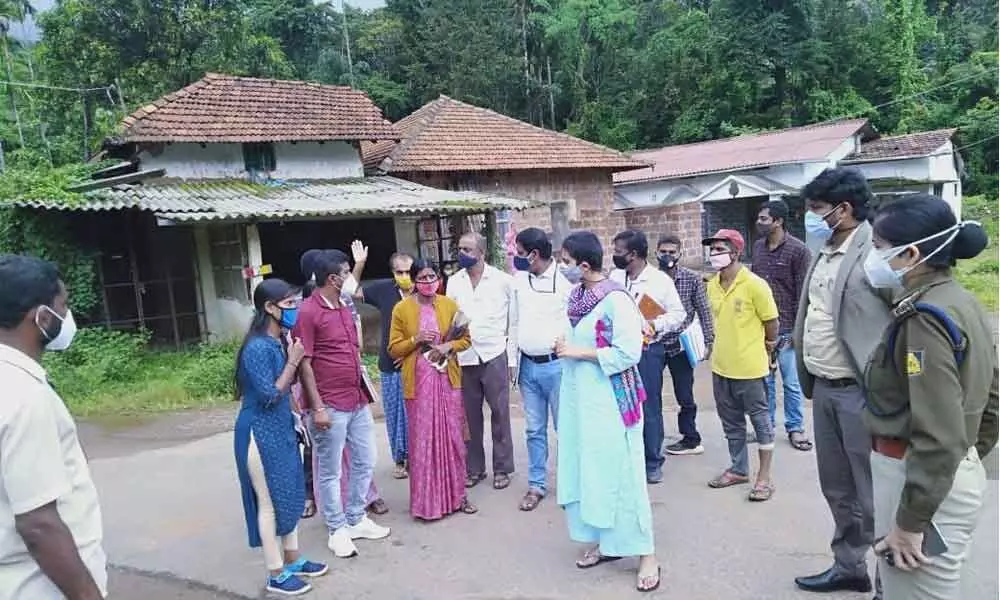
Deputy Commissioner Charulatha Somal on Friday visited the villages where positivity rate is more. She instructed officials to take all steps to reduce positivity rate.
IANS
source: http://www.thehansindia.com / The Hans India / Home> News> State> Karnataka / by Coovercolly Indresh / Hans News Service / June 06th, 2021
There is an impression that actresses generally hide their age or lie about their actual date of birth. In the case of Varsha Bollama, it is the other way around. She stated her real age. Also, she tried correcting Google.
Varsha Bollama is shot to fame with ‘Middle Class Melodies’. She also appeared in two other Telugu movies.
In a recent live interactive session with her fans on Instagram, a fan mentioned that Google is showing her age as 25. To this, she replied that she is just 24. Varsha Bollamma wrote, “I’m a 1996 born. So, I am 24! But Google knows it better than my mom, I guess!”
source: http://www.telugucinema.com / Telugu Cinema / Home> News / by Telugu Cinema / June 04th, 2021
The company is eyeing the Rs 100 crore artisanal coffee market.
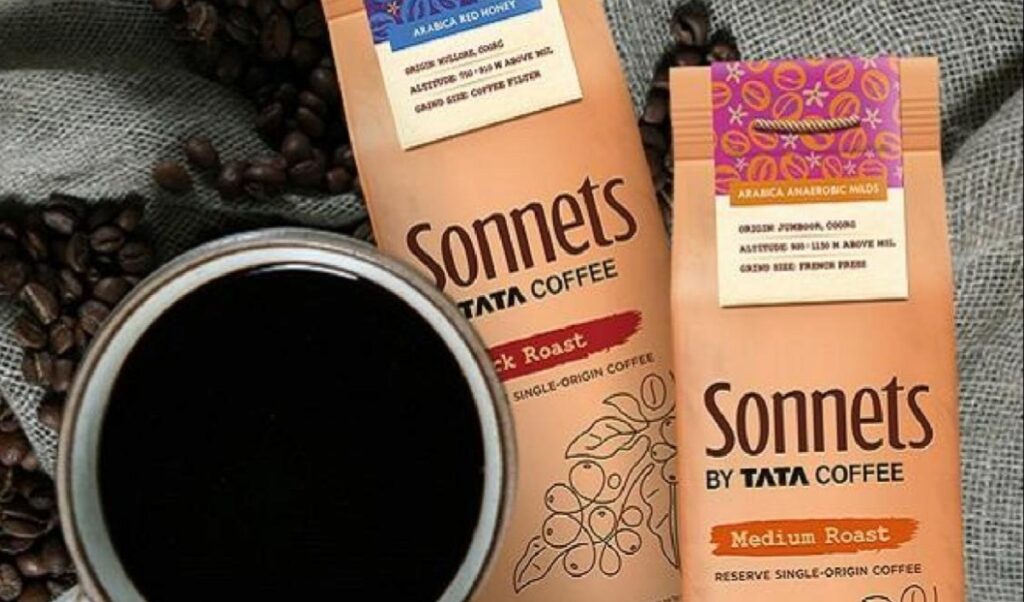
Tata Consumer Products Ltd (TCPL) has introduced a premium roasted and ground coffee under the Sonnets brand targeting urban and increasingly discerning coffee drinkers in India. With this launch, the company is eyeing the Rs 100 crore artisanal coffee market .
The TCPL’s move marks its maiden foray into the Direct-to-Consumer (D2C) market. It will let the company tap a growing number of buyers shopping online, especially during the pandemic when most are cooped indoors and unable to visit cafes and coffee shops.
Puneet Das, President, Packaged Beverages, India & South Asia, Tata Consumer Products Limited, said, “The user can choose the roasting level, grounding and flavors of the coffee which gets delivered to the doorstep of the customer via our delivery channels. We are leveraging both premiumization and home delivery trends through this launch.”
The coffee is produced in Tata Coffee-owned estates. The consumer can choose his preferred roast type from between a light, medium, and a dark roast option, and could also suit his brewing preference and opt for either a filter coffee or a French press grind.
Tata Consumer Products will be expanding the offering to gourmet stores in metro cities as it scales up in the segment.
“Our ambition is to be seen as a serious coffee player just like we have equity in the market with Tata Tea. We aim to have a sizable share in the market as we grow,” Das added.
As the coffee culture evolves, the company will also evaluate new coffee variants like green coffee in India.
source: http://www.indianretailer.com / The Indian Retailer / Home> News / by Vaishnavi Gupta, Features Writer / June 03rd, 2021
WELCOME. If you like what you see "SUBSCRIBE via EMAIL" to receive FREE regular UPDATES.
Read More »