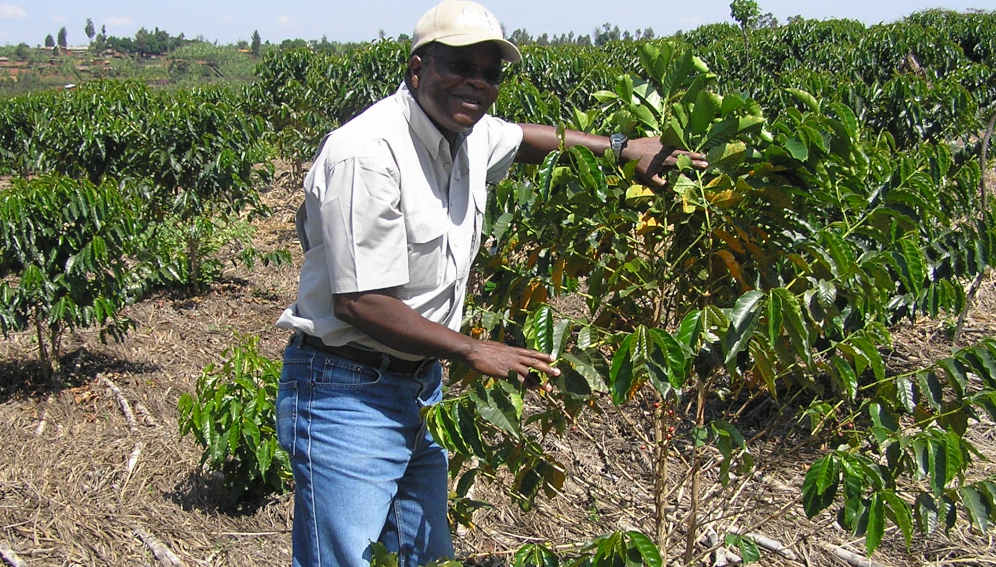
Coffee leaf rust on young coffee bushes in Rwanda. An expert advises farmers to grow the crop under shade to provide a conducive environment for a parasite that could control the leaf rust disease. Copyright: CABI
Nairobi :
Coffee farmers should grow the crop under shade to provide a conducive environment for a parasite that could control the fungal disease leaf rust, an expert says.
Coffee leaf rust, caused by the fungus Hemileia vastatrix, is characterised by small yellow spots on upper leaf surfaces and orange powdery lesions on the underside of leaves. Infected leaves eventually drop off, lowering the yield and quality of the crop.
“Shade also creates a conducive environment for the coffee leaf rust hyper-parasite and we need to maximise this potential.”
Beyene Zewdie, Stockholm University
But a study conducted in Ethiopia considered the origin of Arabica coffee, known scientifically as Coffea arabica, shows that a natural enemy that grows on top of leaves infected by the disease could be key to helping farmers fight it.
“The rust is a global challenge for coffee production,” says Beyene Zewdie, a co-author of the study and post-doctoral researcher at the Department of Ecology, Environment and Plant Sciences at Stockholm University, Sweden, adding that it reduces coffee yields by up to 30 per cent.
According to the study published in Agriculture, Ecosystems and Environment this month (1 May), researchers analysed both the rust and a fungus that attacks it called Lecanicillium lecanii. Observations were carried out from 2017 to 2019 during the wet and dry seasons in Southwestern Ethiopia.
“We found that coffee leaf rust was more severe during the dry season whereas the hyperparasite [parasite whose host is also a parasite or L. lecanii] was more severe during the wet season in two out of three years,” says the study. “The rust incidence increased with management intensity while the hyperparasite was more common under less intensive management.”
Zewdie says the research could help shed light on the relationship between the rust and the hyperparasite, and to manage the two.
“We also found a slight variation in the environmental requirement of the rust and the hyperparasite,” Zewdie tells SciDev.Net. “The rust can thrive in low moisture conditions whereas the hyperparasite favours areas characterised by moist and shaded habitats.”
Zewdie says most farmers in the study area perceive coffee leaf rust as a less important disease because although severe coffee leaf rust infestation leads to leaf-drop, coffee shrubs normally get back the leaves during the next wet season.
But he cautions that the loss of leaves can have a negative effect on the performance of the plant, and says shade would help mitigate the damage.
“Coffee needs shade and growing the crop under shade could buffer the microclimate around the coffee shrubs,” he tells SciDev.Net. “Shade also creates a conducive environment for the coffee leaf rust hyperparasite and we need to maximise this potential to make use of the capacity of the hyperparasite to suppress the rust in areas where the two interacting species co-occur.”
Bernard Mukiri Gichimu, a senior lecturer at Kenya’s University of Embu, Department of Agricultural Resource Management, who was not involved in the study, says that the findings could be important for farmers.
“The discovery of L. lecanii as a hyperparasite against the coffee rust fungus in a natural environment is a major breakthrough that may have a significant contribution in the management of the coffee leaf rust,” says Gichimu. “With climate change, the disease has become even more damaging … even in areas that were hitherto known to be less prone to the disease.”
Mukiri adds that using the natural enemy to fight the disease may be preferable to fungicides which can fail to control the disease either due to poor quality or handling or resistance of the disease-causing agent to fungicide.
“Reduced use of fungicides will also reduce environmental pollution which will be beneficial to the non-target organisms and safe to both the farmers and coffee consumers,” he says.
This piece was produced by SciDev.Net’s Sub-Saharan Africa English desk.
source: http://www.scidev.net / Sci Dev Net / Home> Agriculture> News / by Nelson Mandela Ogema / May 24th, 2021
“A week ago, a COVID positive patient underwent dialysis treatment at the centre. This resulted in the spread of COVID-19 to the staff,” explained one of the nurses.
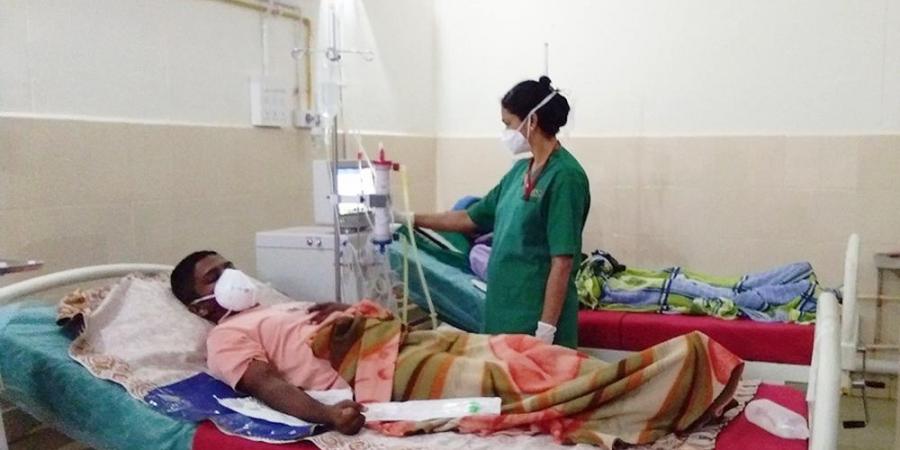
A patient undergoing dialysis at the Kodagu Institute of Medical Science in Madikeri (Photo | Special arrangement)
Madikeri :
Amid the COVID second wave, Kodagu district is faced with a massive staff crunch in the healthcare department, with numerous calls for appointment of staff not bearing results. The district requires 500 staff nurses in total to manage the healthcare sector efficiently, but over 70% of the posts remain vacant. The brunt of this crunch is faced by the minimal staff who are working overtime to enable proper treatment for patients. Their plight gets worse when some of the staff are laid low by COVID-19.
The District Dialysis Centre in Madikeri, which was running at Madikeri District Hospital, has now shifted its base to the Kodagu Institute of Medical Sciences following the pandemic. A total of 71 patients regularly report to the centre for dialysis and eight staff nurses alongside three Group D workers enabled treatment and care of these patients. However, a dialysis patient who visited the centre to avail treatment had tested positive for COVID-19 and reported to the dialysis centre despite the infection.
“A week ago, a COVID positive patient underwent dialysis treatment at the centre. This resulted in the spread of COVID-19 to the staff nurses. Five nurses and one Group D worker among the total 11 staff at the centre tested positive,” explained a staff nurse requesting anonymity. This resulted in five nurses being ordered to undergo isolation, resulting in shortage of hands at the dialysis centre.
“We have to continue the dialysis treatment to the patients. Out of the 71 regular patients, 57 are currently reporting to the centre as the rest of the patients are COVID positive and being treated separately. Only three nurses are conducting dialysis on 57 patients and this has forced us to work in double shifts,” she explained. The nurses report to the centre as early as 7.30 am and work for over twelve hours a day to continue treating the patients. While they did not complain, work stress, they say, is inevitable.
source: http://www.newindianexpress.com / The New Indian Express / Home> States> Karnataka / by Pragna GR, Express News Service / May 18th, 2021
Prior to joining Netflix, he was with Uber and has also worked for Google and Infosys
Streaming giant Netflix has announced the appointment of Nanjappa Palekanda as Vice President, Experience and Operations.
With 18 years of experience, Nanjappa has worked with big names, including Infosys, Uber and Google. His expertise lies in HR Service Delivery, M&A, Risk & Compliance and Portfolio Management for the People function.
On his appointment, he wrote, “I am grateful for the incredible professionals and amazing well-wishers I have come across throughout my career – Infosys, Google and Uber.
I now head into an exciting new adventure at Netflix, with the same drive to work with amazing people.
During this special personal moment, I would like to urge all my well-wishers to spare a positive thought/action in support of all those in India (or those who have loved ones in India), who are braving the heart-breaking situation brought upon by the pandemic.
There’s loss and suffering for sure, but there are also numerous everyday heroes, going out of their way to support others, many of whom they have never met before.”
source: http://www.exchange4media.com / Exchange4Media / Home> Internet Announcement News / by exchange4media.com Staff / May 20th, 2021
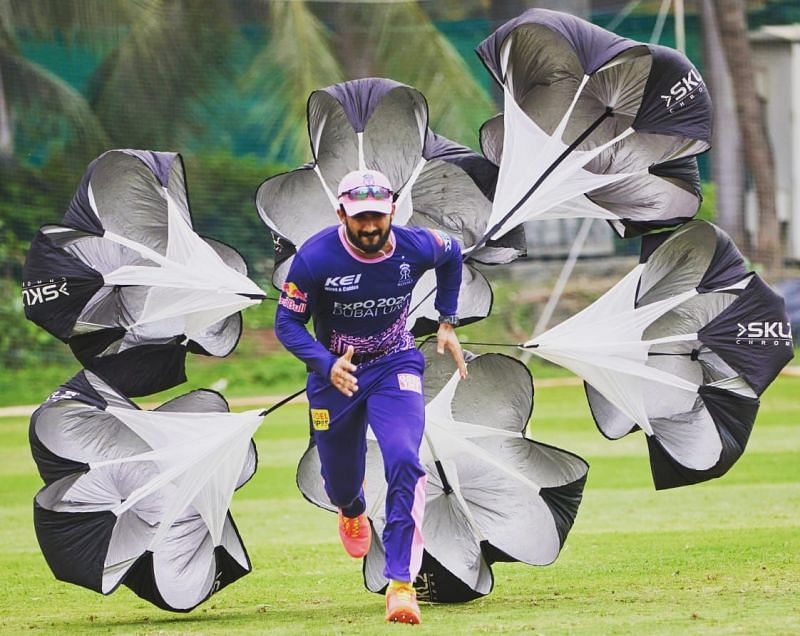
KC Cariappa was roped in by the Rajasthan Royals for IPL 2021.
In February 2015, when the Kolkata Knight Riders (KKR) refused to put their paddle down and looked destined to sign Karnataka’s KC Cariappa, it seemed like the stars were finally set to align for the mystery spinner.
For a man who was yet to play a First-Class or List-A game, Cariappa was the talk of the town after the Knight Riders landed the final bid at ₹2.4 Crore, 24 times his base price of ₹10 lakh. But for those devoted to the Karnataka Premier League (KPL), Cariappa’s talent was already there to see.
KKR’s investment in Cariappa came as a result of the spinner troubling the likes of Gautam Gambhir, Robin Uthappa and Jacques Kallis among others in the nets. A ban slapped on Sunil Narine meant Cariappa was the immediate beneficiary, with KKR turning towards the spinner for a quick replacement.
However, things didn’t exactly go to plan for Cariappa, with the spinner forced to bear the onslaught from Chris Gayle and AB de Villiers in his debut IPL game. That he foxed De Villiers to scalp his maiden IPL wicket did provide a means of consolation, but his figures (1/28 from 2 overs) forced him onto the benches for the remainder of IPL 2015.
Since then, Cariappa hasn’t had a chance to feature much in the IPL. 5 matches in the 2016 season, one less game in 2017, just a solitary match in IPL 2019 sandwiched between him being unsold in 2018 and 2020, and half a season on the bench for the Rajasthan Royals in 2021.
There’s a fair argument to say Cariappa certainly hasn’t enjoyed the rub of the green, with mystery spinners not ubiquitous in modern-day cricket, at least in India. Yet, with age on his side and IPL teams in recent times willing to hinge their bets on relatively unknown talents, Cariappa is willing to take whatever’s happened on the chin.
In an exclusive chat with Sportskeeda, Cariappa spoke about his IPL journey so far, admiration for Gambhir, learning from Ajantha Mendis‘ bowling videos and more.
“I haven’t got too many chances in the IPL. When I got selected in 2015, my name did the rounds, but I didn’t get too many matches. ABD was my debut wicket, but after that I didn’t play, Narine came back and I lost my chance. Even the few seasons I played for Punjab, I played only a few games. I feel there wasn’t a proper balance, even in my performance.”
“But like everyone says, more the matches, higher the confidence. I still remember the first match I played, there were 1 lakh people in the Eden Gardens crowd, it was surreal. I would love to get more matches in the seasons to come and re-live those moments.”
Cariappa’s rather serendipitous introduction to cricket was preceded by his interest in playing hockey, further pushed by his family’s roots in Coorg. Often referred to as the ‘Nursery of Hockey’, Coorg’s Kodava Hockey Festival is well known across the world, and it was only natural that Cariappa found a liking for the sport.
At around 19 years of age, though, life took a turn for the spinner. Cariappa walked through the gates of one of Bengaluru’s most famous cricket clubs, the Jawahar Cricket Club, seeking to transition from tennis ball to leather-ball cricket.
A fortuitous session in the nets handed Cariappa an opportunity to shift from fast bowling to mystery spin, but the art of perfecting the variations with the leather ball did not come easily for the Kodava lad.
“When I first shifted to spin, I didn’t even know it would be mystery (laughs). When I started bowling spin, my seniors told me it was coming nicely off my hand. I started watching a lot of Ajantha Mendis’ videos, at that time Narine hadn’t made a name for himself yet. Once I started bowling well, people started calling me Mendis, that’s a good memory.”
Cariappa’s early years of cricket with the tennis ball were restricted to him trying to stifle batsmen with pace, but once he got the hang of bowling spin, things started to fall in place for him.
However, by his own admission, it needed a lot more than just some tutorials on the internet.https://3d5eb348d2dd17a3b54d55303c13dbf4.safeframe.googlesyndication.com/safeframe/1-0-38/html/container.html
“It is very easy to bowl a carrom ball with the tennis ball. I didn’t have too much practice bowling with the leather ball, it was very hard despite me practicing for 2-3 hours a day. I then started watching Narine’s bowling videos, and I was shocked by the variations he had. Nowadays, times have changed, there are different types of mystery spinners as well!”
“People told me I haven’t been playing regularly for Karnataka when I went unsold in the IPL auction” – Cariappa
It’s no small truth that most of the opportunities in the IPL are a byproduct of good exhibitions in domestic circuit, even across formats. In this regard, Karnataka have boasted of probably the biggest names over the past few years, with the likes of KL Rahul, Manish Pandey, Mayank Agarwal and most recently, Devdutt Padikkal becoming household names through the cash-rich league.
The aforementioned players, though, have had a lot of opportunities to prove themselves for Karnataka, while that’s a luxury Cariappa has missed out on.
The spinner has featured in quite a few Karnataka squads since his maiden Ranji Trophy call-up in 2014, but the presence of established players such as K Gowtham, S Gopal and J Suchith has forced him to remain on the sidelines.
What’s more, Cariappa’s economy rate of just 5.02 played a big role in Karnataka’s 2018-19 Syed Mushtaq Ali title win, the state’s maiden T20 trophy victory. In 11 matches of the tournament, he picked up 10 wickets and was hit for just a single six, underlining the impact he had that season.
“I feel the main problem is that I’ve played only in the Syed Mushtaq Ali Trophy. Even there I’ve performed well, my economy rate is around 5-6 RPO. In 2016 KPL, I was the highest wicket-taker. Karnataka has some really good players like Gowtham, Shreyas, Suchith and so understandably my chances are less.”
“But the problem is even if you miss a year of domestic cricket, the chances of you getting picked in the IPL is less, and I have faced this issue a few times. When I went unsold, people said because I didn’t play for Karnataka, I wasn’t picked.”
“Gambhir wouldn’t compromise on the field, he was a very good captain” – Cariappa on his time with KKR
Cariappa spent just one season with the Knight Riders in IPL 2015, but it took only those many months for him to have some fond memories of the franchise. Cariappa reserved special praise for his KKR skipper Gambhir, who was his first captain in the IPL.
“Gambhir was a very good captain. He was a little strict in terms of bowling discipline, and effort on the field was something he wouldn’t compromise. Outside the field, he didn’t bother you. On the field, you had to give your 100% and that’s what I loved.”
The 27-year-old also had some words of praise for Sanju Samson, who led the Royals in IPL 2021.
“Samson was really good, he is always calm. When I played U-19, he also played that same season for Kerala. The way he captained the side in IPL 2021, he always ensured the players were brimming with confidence.”
“The RR management treats domestic and international players with the same respect”
As for his maiden season with his third IPL franchise, the Rajasthan Royals, Cariappa lamented the temporary cancellation of the tournament owing to the Covid-19 pandemic, but he had some positive things to say about the team.
“RR look at every player the same, there are no assumptions. Ben Stokes is such a warm person, he would come and talk to us while we would eat. Buttler would talk the least, he is always smiling, and when you see him you get really positive vibes. Even in the practice sessions, whether you are international or domestic, it didn’t matter, we were all looked after very well.”
He delved a little deeper into how his Karnataka teammate, Gopal, was at his pranking best during quarantine periods of IPL 2021.
“Shreyas is a prank master. When he was in quarantine, he would call up everyone through the hotel phone. He’s a very jolly guy. I was close with Miller and Tewatia in the RR camp, I have played with them before. This season was turning out to be good, hopefully when it resumes we should be in a good position to start off well.”
As for the opportunities that could come knocking at his door in the months or years to come, Cariappa is confident of making the most of what comes his way. There might be some mystery shrouding the future of domestic cricket or even the IPL, but for the talented spinner, there isn’t a shadow of doubt enveloping his final goal: give his 100% on the field, carpe diem and don the national jersey in the near future.
Through his four-year-old ‘Bhuvanam Foundation’ and initiative ‘Feed Karnataka’, Bhuvan with support from actress Harshika Poonacha handed over 200 food kits to the Municipal Council Commissioner.
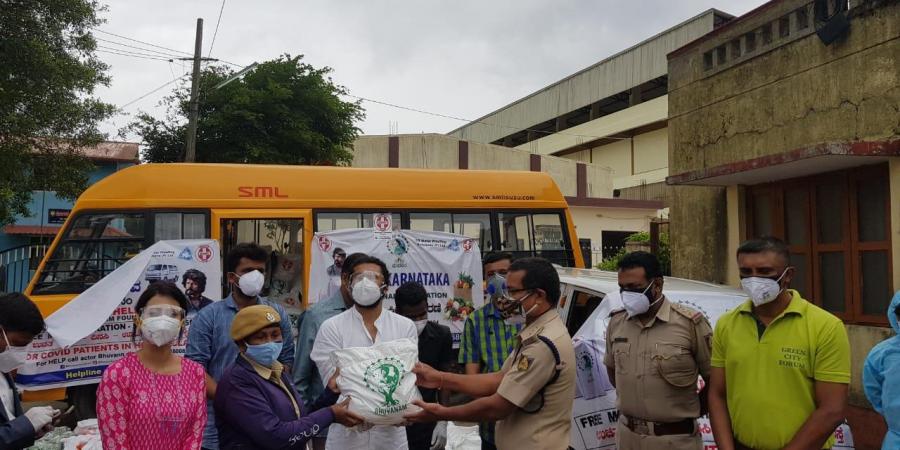
Food kits were distributed in Madikeri Mann’s Compound Ground on Tuesday (Photo | Special arrangement)
Madikeri :
It is not common for an actor to share his mobile number across social media. But Bhuvan Ponnanna, the Sandalwood actor and native of Kodagu, has done just that even as he is working relentlessly to extend a helping hand to the needy during the pandemic.
Through his four-year-old ‘Bhuvanam Foundation’ and initiative ‘Feed Karnataka’, Bhuvan with support from actress Harshika Poonacha on Tuesday handed over 200 food kits to the Madikeri City Municipal Council Commissioner Ramdas. These kits will be handed over to needy families across the city. Further, the home guards, police and a few journalists also received food kits from the foundation.
The actor has also taken a unique initiative where food kits and medicines will be home delivered to needy residents across Kodagu. Two vehicles equipped with food kits and medicines will start doing the rounds across Madikeri, Gonikoppal and Virajpet areas from May 26 and the needy can avail food kits from the foundation following verification. The medicines will be supplied with display of prescriptions only. To avail the services, the eligible beneficiaries can contact the helpline number 9945008004.
Also, the initiative helps local farmers by buying vegetables from them and distributing it to the needy along with the food kits. Many donors including doctors have donated to the foundation and the organisation has so far distributed over 2000 food kits to the poor across Karnataka.
source: http://www.newindianexpress.com / The New Indian Express / Home> Good News / by Pragna GR, Express News Service / May 25th, 2021
Sannuvanda Srinivas Chengappa (60), President of Virajpet Taluk Journalists Association and a resident of Thithimathi, passed away this morning at a hospital following brief illness.
He leaves behind his wife, two daughters, one son and a host of relatives and friends. Last rites were performed at Thithimathi today.
source: http://www.starofmysore.com / Star of Mysore / Home> Obituary / May 20th, 2021
Nidhi Subbaiah, who started her career in Sandalwood, surprised many with her decision to take part in Bigg Boss Kannada this season. Known for having acted in films like Anna Bond and Pancharangi, the actress has now revealed in an interview that her main intention to participate in the reality show was to let people know that she is right here and not in Mumbai.
Nidhi told Cinema Express, “I came back last year before the lockdown. Before that, I was in New York. I am currently in Mysuru and plan to shift to Bengaluru to stay closer to the film industry.” For the unversed, the actress had moved to Mumbai a few years ago after she got an opportunity to work in a handful of Hindi films.
Nidhi added in her interview that Bigg Boss Kannada 8 has given her a different kind of fame as people across Karnataka have connected with her on a personal level. She also shared that the show has given her seven good friends, with whom she plans to stay connected with.
On being quizzed about some key takeaways from her BB experience, Nidhi said, “Bigg Boss house has taught me some life lessons — how to deal with pressure, anger and frustration. I learnt to be disciplined — sleeping and waking up on time, something that had gone haphazard previously. I’ve also learnt to cook and eat simple food without having to order in junk food all the time. It has made a difference to my lifestyle, and I hope to continue these habits.”
Nidhi, who was last seen alongside Shivarajkumar in Ayushman Bhava, is now looking forward to her next project. She has signed her horror film, which is being bankrolled by Lohith H’s Friday Films. The yet-untitled film is being helmed by debutant directors Pavan and Prasad.
source: http://www.filmibeat.com / Filmi Beat / Home> Kannada> News / by Waiz Ahmed / May 19th, 2021
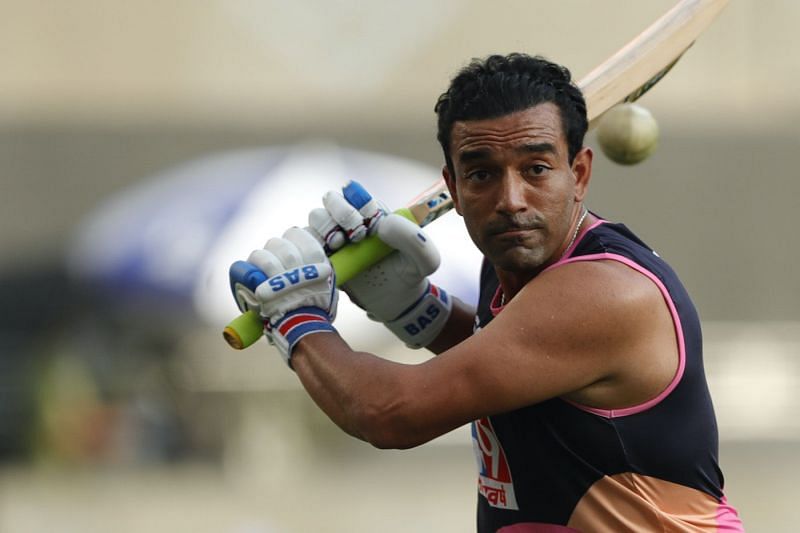
Out-of-favour Team India batter Robin Uthappa has revealed how former fast bowler Venkatesh Prasad inspired him to make a comeback to the national side back in 2007.
The right-handed batter from Karnataka has represented his country in 46 ODIs and 13 T20Is since making his debut in 2006.
Uthappa made it to the Indian side on the back of consistent performances in domestic cricket. He was soon rewarded with a place in the Indian team as a replacement for Virender Sehwag in the final ODI against England. He made the most of the opportunity by scoring 86 runs, the highest by an Indian on debut at the time.
That conversation with Venky helped me regain focus and get runs: Robin Uthappa
However, he soon hit rock-bottom and was left out of the squad after bagging a duck against West Indies. Robin Uthappa returned to domestic cricket for Karnataka, who was coached by former fast bowler Venkatesh Prasad back then.
During a chat with the Grade Cricketer, the 35-year-old revealed how a conversation with the coach helped him regain his focus and regain his form again.
“I scored a 50 in the first innings of the second game of the season and I was very happy with myself,” Robin Uthappa said during a podcast with the Grade Cricketer. “And then he called me to his room and he said, ‘Rob want to have a conversation with you.’
“He showed me the highest run-scorers list of that season. He said you are number 47. He said, ‘you are an Indian cricketer who has had a great start to international cricket but you are at 47th place. Is that where you want to be when the season ends?”
That kind of keyed me in to really focus and get runs. I got a hundred in the second innings and ended up scoring 850 runs in the season – top scored in the country with 4-5 hundreds and simply because of that one conversation with Venky (Venkatesh Prasad),” Robin Uthappa said.
That season, Robin Uthappa racked up 857 runs from just seven matches, making it impossible to keep him out of the national side. He was also part of the squad that won the World T20 in 2007. However, another poor patch in 2008, in which he only managed 179 runs from 11 matches, led to his downfall in international cricket.
He went onto make a comeback in 2014 following another dream run in domestic cricket but failed to replicate it on the biggest stage. The veteran batter was recently seen in the 14th edition of the Indian Premier League (IPL) plying his trade for Chennai Super Kings. He had to warm the benches in the presence of Ruturaj Gaikwad and Faf du Plessis at the top of the batting order.
source: http://www.sportskeeda.com / Sports Keeda / Home> Cricket> News / by Ankush Das / May 20th, 2021
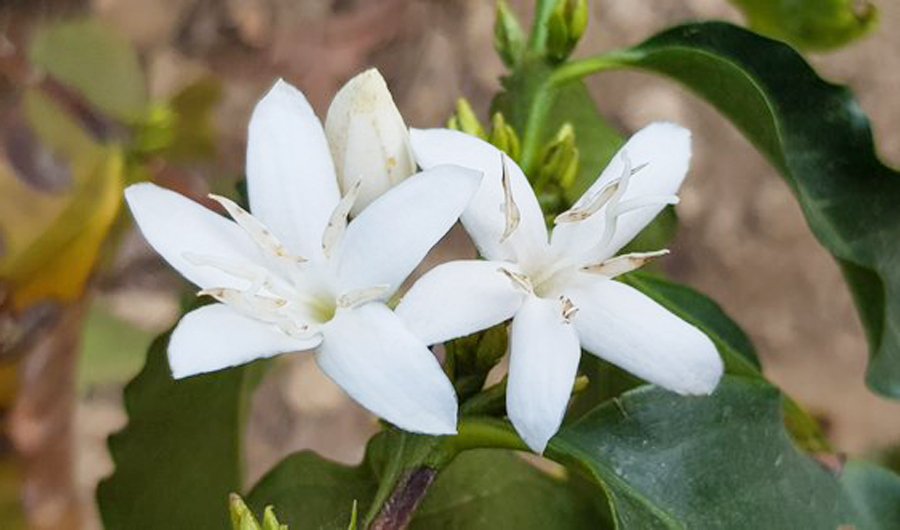
The coffee tree flowering process begins in late March ahead of the rainy season. The process takes between three to four days. (Supplied)
The coffee tree flowering process begins in late March ahead of the rainy season
Jeddah :
Coffee farms in the mountainous governorates of the Jazan region were covered in white after the flowering of the coffee trees, exhibiting signs of abundant production during this year’s season.
Coffee production is an important economic sector in the region, and enjoys special care by the Kingdom’s leadership. It is part of the Jazan region’s heritage, and is a crucial source of income for the residents of the mountainous areas, which are the homeland of the Khawlani coffee beans, whose production has increased by 70 percent in recent years.
The Saudi Press Agency’s camera caught pictures of the agricultural terraces in Al-Dayer Bani Malik blossoming with white coffee flowers that have a wonderful smell among the magnificent backdrop of the mountainous landscapes.
The coffee tree flowering process begins in late March ahead of the rainy season. The process takes between three to four days.
The flowering process is completed and coffee beans are formed and enter a six-month period until being harvested. This is considered a crucial period, as the coffee trees need to be irrigated with rainfalls in a timely way, while receiving adequate care from the farmers.
The flowering period is critical as it provides the farmers with an indicator about the volume of crops, according to the strength or weakness of the trees and the intensity of flowers on the branches, which entails further consideration by farmers, to ensure having abundant crops during harvest.
source: http://www.arabnews.com / Arab News / Home / by SPA / May 21st, 2021
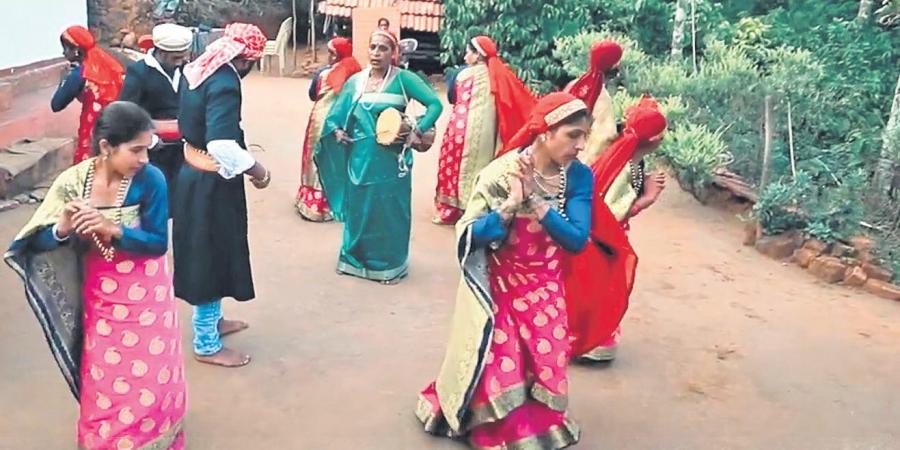
A Bengaluru organisation is building a multimedia archive of tribal music in Karnataka, starting with the Kudiyas of Kodagu.
Still from the video: Who are these Kudiyas?
Bengaluru :
A life without songs sung to the beats of drums is probably unimaginable for the Kudiya people of the Western Ghats. “We sing about the plants and trees in the forests, the roots, stones, snakes, and elephants… There is a rhythm to each song, and we play the drum to that rhythm,” Kudiya musician Sharada Somaiah says in an interview with Bengaluru-based Gobal Kulture, which is taking the first steps towards building an archive of tribal music in Karnataka.
On April 13, Global Kulture released a 2.50-minute video titled “Hidden Sounds: Who are these Kudiyas?” on its YouTube channel. They’ve started with the Kudiya community, but Arun Sivag, percussionist and founder of Global Kulture, says the idea is to collect audio and video recordings of songs, interviews and dances of artistes from 40 communities (the state government lists 50 Scheduled Tribes), and compile it into the Budakattu Music Archive, a partial multimedia ethnography of tribal music and culture.
“It took one-and-a-half years of research to figure out how to go about this,” says Arun. This includes conversations with several people – including playback singer and co-founder of Global Kulture, Sangeetha Ravindranath, and Sumanto Mondal, who is editorial and communications partner at the organisation. However, the idea of the archive comes from Arun’s own experiences, and thoughts about music and musicians. “I always saw musicians on the street, and wondered why they weren’t on stage. Folk artistes are not given a stage, but they are the torch-bearers of music,” says the 29-year-old.
pic: a shot
In 2019, he began visiting government offices looking for a list of tribal musicians, and realised that the government didn’t really have one. But the idea stuck, and he came in contact with folk and tribal art expert Srinivas Murthy, who worked with Sharada’s father decades ago. With the little footage they collected in February at Sharada’s house in Tora village (Virajpet, Kodagu), they know they’ve barely scratched the surface. “One would need a whole life to understand their music. We are doing what the government is supposed to do,” says Arun.
The Kudiyas’ culture is oral — their songs and stories are the historical record of their existence. “They sing songs while working, after getting back from work, when there is a birth or a death, during festivals… They even have a song about the daughters of the tribe and how they wish the best for them,” says Sangeetha, who is working on translating the songs from Kodava to English.
The archive will also have interviews of the artistes, such as the one in which Sharada talks about the community’s origin story, and why they call themselves Kudiyas, says Mondal, who is translating her interviews from Kannada to English. They are looking for institutional funding that will allow them to retain creative independence. But for now, they are using their own resources to fund the project. Arun put in the stipend he got from OneBeat, a US government fellowship.
A part of that was used as honorarium for the artistes. “We are artists too. We want to pay them for their work. Right now, the only opportunities they have are annual performances at Vidhana Soudha and Ravindra Kalakshetra (auditorium in Bengaluru). When the government calls, these are the people who get the peanuts,” Arun says. Sharada’s earnings are paltry and not steady, like many artistes.
She pretty much kept the music of her community alive by teaching younger generations, but knows survival is at stake without economic opportunity. In the trailer, Sharada talks about her “biggest dream”. “…If our art is to survive, the government and other organisations must help us get a good platform, give us respect. Only if this happens will our music become a livelihood for us and for our children, and only this way will our art survive.”
Arun too has big dreams. He eventually wants tribal musicians to get the recognition and remuneration they deserve. “We want to build a not-for-profit artist management system for them. They should be treated just like any other artiste.”
Preserving history Global Kulture aims to collect audio and video recordings of songs, interviews and dances of artists from 40 communities and compile it into the Budakattu Music Archive.
source: http://www.newindianexpress.com / The New Indian Express / Home> Cities> Bengaluru / by Anisha Sheth, Express News Service / May 23rd, 2021
WELCOME. If you like what you see "SUBSCRIBE via EMAIL" to receive FREE regular UPDATES.
Read More »