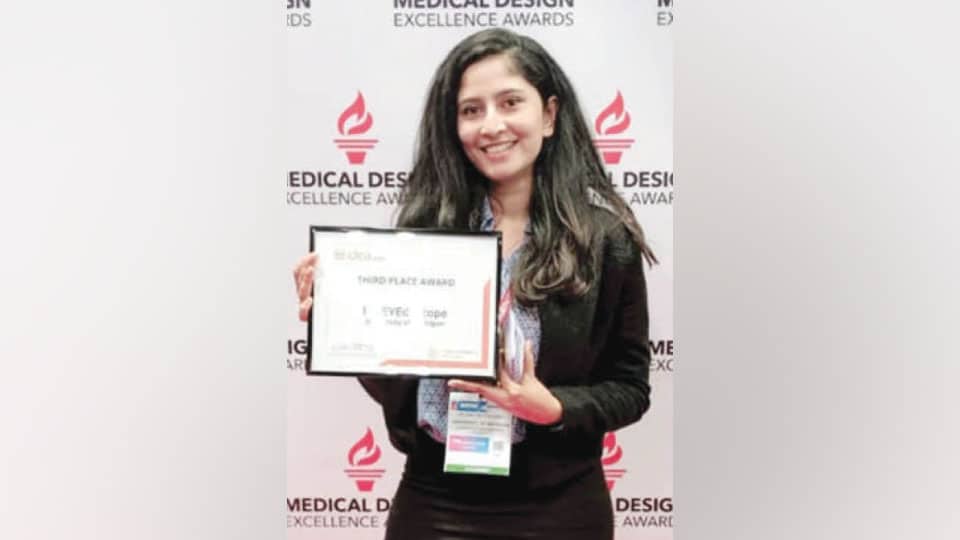
Palandira Vichal Muthanna has won the Medical Design Excellence Award-2019 with her team. The team stood third in national-level competition “BMEidea-2019” where teams across the United States with new innovative medical technologies participated.
The award ceremony was held at Jacob K. Javits Convention Centre, New York, on June 11. During her research at the University of Michigan, Vichal and her team developed a new device called ‘KalEYEdoscope’ to track the progression of a condition called ‘Age-related Macular Degeneration’
Macular Degeneration is the leading cause of blindness in the world and currently there is no device in the market to help track its progression on a regular basis. The award was in recognition of their work in the development of this innovative, simple and novel medical device and in support to further develop the same.
Palandira Vichal is an M.Tech in Bio-Medical Signal Processing and Instrumentation from BMS Engineering College in Bengaluru. Earlier, she had invented a device to monitor the vitals of both mother and child during labour. The device invented by Vichal not only monitored the vital parameters of both mother and child, but also raised an alarm in case of any fluctuations so that the doctors and medical staff can rush to the patient’s rescue.
Vichal completed her early education in St. Joseph’s Girls High School, Madikeri and higher secondary education at Vidyaniketan PU College, Gonikoppal. She did her engineering from Vidyavardhaka College of Engineering in Mysuru and M. Tech from BMS College of Engineering in 2015.
Vichal is the daughter of Palandira Jaya Muthanna and Mithuna Dechamma (daughter of Mukkatira Doremani Ponnappa) of Murnad in Kodagu district and grand-daughter of Karnataka Rajyotsava Awardee late Palandira Devaiah.
In her academics, Vichal was the co-ordinator for the Indian Society for Technical Education (ISTE) for 4 years from 2009-2013. She was the Branch Association (IMPULSE) Co-ordinator for two years in Vidyavardhaka from 2011-2013. She won the Gandhian Young Technological Innovation Award -2006 from Biotechnology Industry Research Assistance Council (BIRAC) – Society for Research and Initiatives for Sustainable Technologies and Institutions (SRISTI) for her project ‘Device for Intrapartum MaternoFetal Care.’
source: http://www.starofmysore.com / Star of Mysore / Home> News / June 21st, 2019
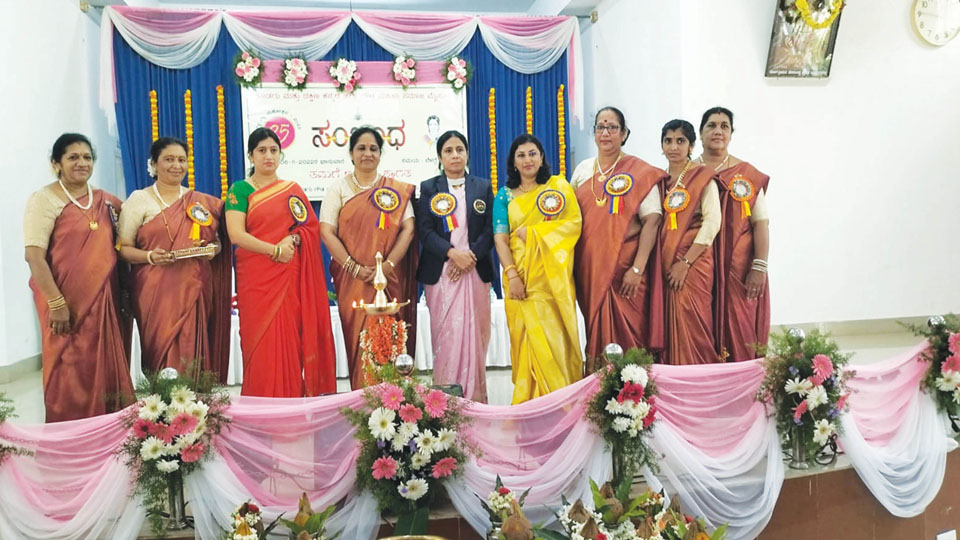
‘Sambandha,’ the Silver Jubilee celebration programme of Kodagu mattu Dakshina Kannada Jilla Gowda Mahila Samaja, Mysuru, was inaugurated by Pradhan Mantri Poshan Shakti Nirman Scheme, Bengaluru, Assistant Director P.S. Leelavathi at the Samaja premises in Vijayanagar this morning.
SAADHYA Trust for Social Development Founder-Head Achuda Arathi Harish was the chief guest. Samaja President Devajana Geetha Montadka presided. Income Tax Department, Bengaluru, Additional Commissioner K.M. Sulochana released the souvenir on the occasion.
Speaking after inaugural function, P.S. Leelavathi said that youths of today must utilise education and job opportunities and achieve in their respective fields. Elders should guide the youngsters, she added.
Samaja President Devajana Geetha Montadka spoke about the establishment of the Samaja and its objectives.
Uluvarana Lalitha Madaiah, T.M. Meenakshi, Paanathale Asha Vasanth and Mukkati Divya were felicitated on the occasion for their achievements in their respective fields. Samaja office-bearers were present.
source: http://www.starofmysore.com / Star of Mysore / Home> News / November 06th, 2022
Kodagu Mathu Dakshina Kannada Jilla Gowda Mahila Samaja, Mysuru, will be holding its Silver Jubilee celebration programme at its premises in Vijayanagar tomorrow (Nov. 6) at 10.30 am. Pradhan Mantri Poshan Shakti Nirman Scheme, Bengaluru, Assistant Director P.S. Leelavathi will inaugurate while Income Tax Department, Bengaluru, Additional Commissioner K.M. Sulochana will release the souvenir on the occasion.
SAADHYA Trust for Social Development Founder – Head Achuda Arathi Harish will be the chief guest. Samaja President Devajana Geetha Montadka will preside.
source: http://www.starofmysore.com / Star of Mysore / Home> In Briefs / November 05th, 2022
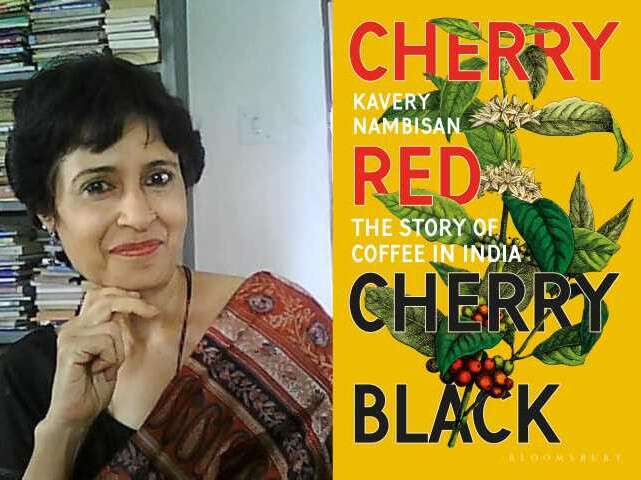
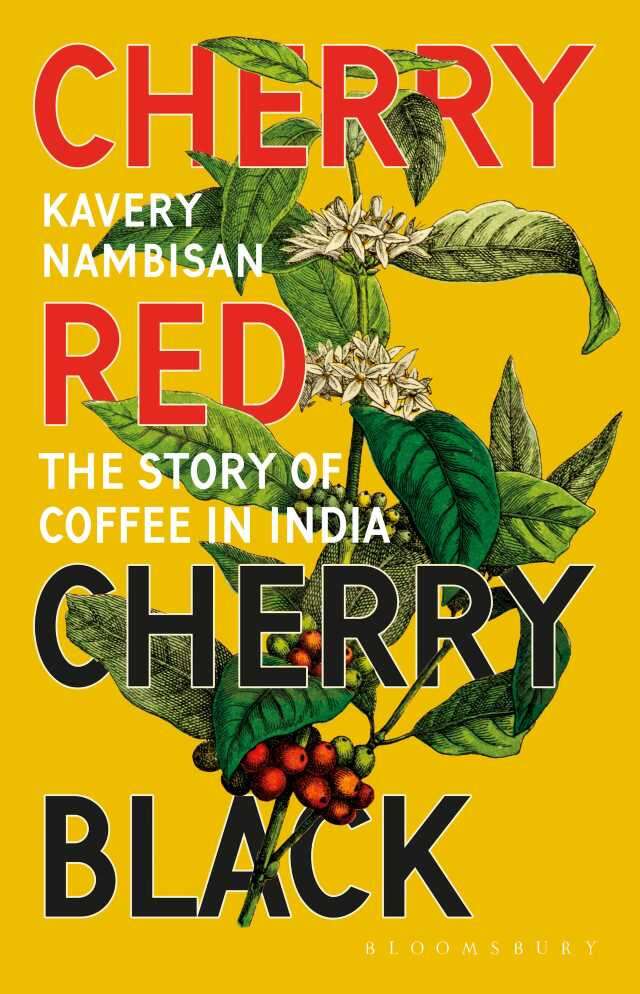
Kavery Nambisan’s new book Cherry Red, Cherry Black details the fascinating story of coffee in India
Kavery Nambisan was born on a coffee estate, grew up among the “twisted branches and dark green leaves of the coffee bushes”; her parents joked that she was among those children who had been “plucked off the coffee bushes.”
It is therefore fitting that the surgeon’s latest book Cherry Red, Cherry Black(Bloomsbury India) is about the history of coffee in India.
Written with anecdotes woven into chronology, this comprehensive look at the coffee industry reveals intriguing nuggets – the origins of the coffee terms ‘Robusta’ and ‘Arabica’; the story of how Southern India became coffee country (it’s more complex than the Baba Budan tale); how coffee made sugar popular… Kavery explores the world of coffee far beyond its cultivation via the journeys of rulers and invaders and the ways of governance and tribute to its current status as one of the most valuable legally-traded commodities in the world. With the pride of a true Kodava, she writes of how coffee cultivation in Coorg (now Kodagu) changed the social, ecological and economic nature of the land and its people, and of the planters clubs that still exist.
A large part of the book details the story of how Tata Coffee, with whom the author has been associated in her medical avatar, came to be, but its scope goes far beyond company history and personalities to showcase coffee’s ability to be the great leveller available to every layer of society, and details the journey of the bean from plant to cup. Readers will be fascinated to know that the coffee served at Starbucks is made with beans from Kodagu, Hassan and Chikmagalur and cured in Kushalnagar.
Excerpts from an interview
You speak of yourself as “almost a child plucked off a coffee plant”. How was the experience of going back with research to discover what is such an integral part of your childhood? How long has this book been in the making? Have there been any surprising learnings?
Yes, coffee has been integral to my being, but I did not consciously think about it until recently when I started to write this book. It has been a pleasure to discover the history behind coffee, and, along with it, to learn more clearly certain aspects of local history. I started to read up sometime after the middle of 2018 and wrote in 2019 but was unable to conduct some important interviews during the period when Covid came and went. After that, everything had to be ‘fast-forward.’
As for surprise learnings, yes, of course. There can be no better way of learning something new than writing about it. I learned much.
You are a proud Kodava and now live and work again in Kodagu. What aspects of life there do you enjoy most, both connected to coffee and otherwise?
I have worked as a surgeon in Kodagu for over 10 years, off and on. My husband and I built a house in a village here and it is surrounded by coffee estates that do not belong to us – so pleasure without responsibility! The tall shade trees that surround us are a blessing – with so much life going on in the branches and the undergrowth. As a doctor, I have a great rapport and a serious commitment to my neighbours, many of them being daily wage earners in the estates. I think we live a good life.
What does your own coffee cache look like? What would we find in there?
You would find a cache of roasted coffee beans (a blend of Arabica and Robusta). I roast the beans every few weeks or so and use about 10% of chicory to enhance its strength.
You’ve detailed a bewildering number of ways to prepare a cup of good coffee. Which is your favourite?
I use three methods, depending on my mood. Filter coffee (in the afternoons); the Moka pot or a rustic brew (adding coffee powder to just boiled water and letting it steep for two to three minutes) in the mornings. Always with a little milk and jaggery.
India Coffee House remains your coffee house of choice in Bengaluru. Tell us what you have there when you visit these days?
It’s a great place to hang around with friends. I always have coffee and, if peckish, an omelette or a cutlet. I have been frequenting this grand old place (although now in a changed location) from my medical college days. Satisfaction guaranteed.
source: http://www.femina.in / Femina / Home> Life> Books / by Primrose Monteiro D’Souza / November 04th, 2022
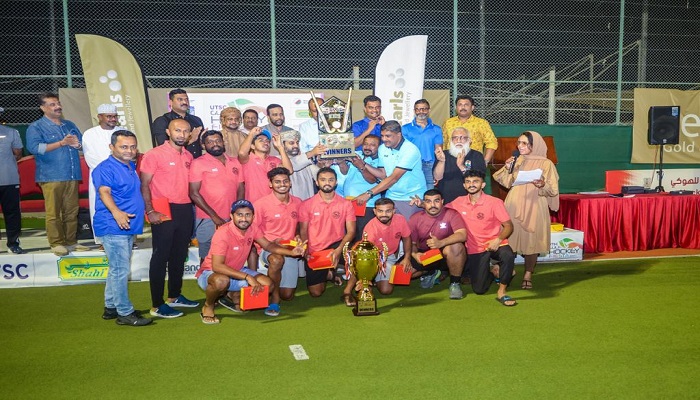
Hoks B Coorg from India emerged champions of the UTSC Gulf hockey fiesta-2022 that concluded at the Sultan Qaboos Sports Complex recently.
The two-day fiesta witnessed close and exciting matches between 12 teams with six outfits coming from the region and India.
Besides the main tournament, the event also hosted an inter-school tournament featuring Indian schools.
There was a women’s tournament too with the national women’s team making their competitive debut. The national women’s team played against the visiting Dubai side.
Hoks B Coorg, comprising few internationals, stayed unbeaten in the tournament to be crowned deserving winners.
The inaugural ceremony had Amit Narang, Indian Ambassador to Oman as the chief guest along with Marwan Juma al Juma, the president of the Oman Hockey Association (OHA). Narang lauded the efforts of the UTSC in promoting the national game of India and also offered India’s full support to the Sultanate of Oman as they prepare to host the inaugural edition of FIH Hockey 5s World Cup in January 2024.
On the sidelines of the fiesta, there was a cooking contest and the event attracted lot of families.
source: http://www.timesofoman.com / Times of Oman / Home> Sports / by Times News Service / November 01st, 2022
BP Govinda is very impressed by the Indian Men’s Hockey Team’s attacking unit.
New Delhi :
With less than 100 days to go for the FIH Odisha Hockey Men’s Hockey World Cup Bhubaneswar-Rourkela 2023, the anticipation to witness the world’s best hockey players at one of the world’s most preferred hockey destinations – Odisha, is only increasing by each passing day. While the Indian team carries out their preparations to end the medal drought in the prestigious event, it’s time for the hockey fans to relive the memories from India’s historic World Cup campaigns through Hockey India’s Flashback Series – World Cup Special.
Through these Series of articles leading up to the marquee event in Odisha, Hockey India will bring you thoughts, anecdotes and trivia from Indian Hockey Legends who ruled the world with their wizardry and panache.
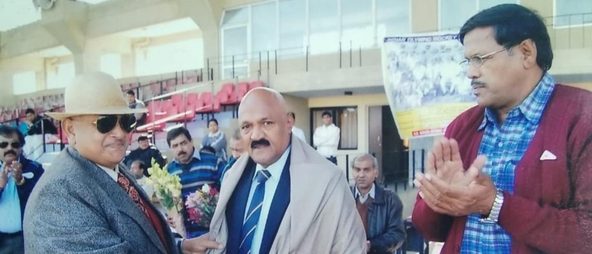
Winner of the Silver Medal in the 1973 World Cup held in Amsterdam in Netherlands, and the Gold Medal in the 1975 World Cup held at Kuala Lumpur, the legendary BP Govinda recalls his memories from the years gone by.
One of the most crucial cogs in the system for the Indian Men’s Hockey Team in the 1973 and 1975 World Cups, it was BP Govinda who ensured a berth in the Final at Amsterdam with the winner against Pakistan in the Semi-Final. The former forward terms that semi-final as one the best games in what was a decorated career.
“The Semi-Final against Pakistan is one of the best matches of my life. We won that game by one goal, and I scored the winner. I reverse flicked the ball and the keeper didn’t know where the ball was going and it went and hit the roof of the net. It was regarded widely as one of the best goals, by my teammates and the media,” he recalled.
“People used to love watching India and Pakistan in hockey when we were playing, we had full stadiums.”
Unmissable on the field of play due to his stylish long hair, Govinda said that the Indian Men’s Hockey Team believed that playing as a unit would always yield results. “Our team always had the thought process where we believed, no matter how strong the other team is, if we play as a team, we can achieve anything. Whether it was a practice match or tournament, I always played to win.”
Speaking about his camaraderie with the Captain of the 1973 team, MP Ganesh, the former forward said, “As a Captain, he was very straightforward and he would ask the players to play according to the plan. He wouldn’t scold any one, but he would tell everyone to go all out for the win, all the games. He used to guide all the players.”
Turning his attention to the glorious 1975 World Cup campaign in Kuala Lumpur, Govinda, who was considered to be among the fastest players at the time, recalled the love the team received from the fans.
“We outclassed Pakistan in the Final and the stadium was full with plenty of fans. When we came back to India, people told us that commentators made them feel like they were in the stadium and not listening in another part of the world.”
“I remember landing in New Delhi, and the fans were there with drums and they carried all of us. I don’t know where we finally went and landed, but it was definitely well outside the airport. It was a reception that I will never forget. I remember coming out of the aircraft and then the fans took over, we hadn’t got a chance to get our baggage either.”
‘Indian Men’s Hockey Team Will Not be Easy to Beat’
A former national selector himself, Govinda is quite impressed with the Indian Men’s Hockey Team and noted that they would not make an easy opposition at the FIH Odisha Hockey Men’s World Cup 2023 Bhubaneswar and Rourkela. India have been drawn in Group D along with Wales, Spain and England.
“I think the current Indian Men’s Hockey Team is quite fit. And I think our forward line is playing well and I think the strikers have also improved a lot. It was nice to see the team scoring more field goals.”
“In the upcoming FIH Odisha Hockey Men’s World Cup 2023 Bhubaneswar and Rourkela, I think the Indian Men’s Hockey Team is not an easy one to beat. They will give a good fight to each and every top team who are taking part in the World Cup,” he signed off.
Link to video of BP Govinda taking us down memory lane –
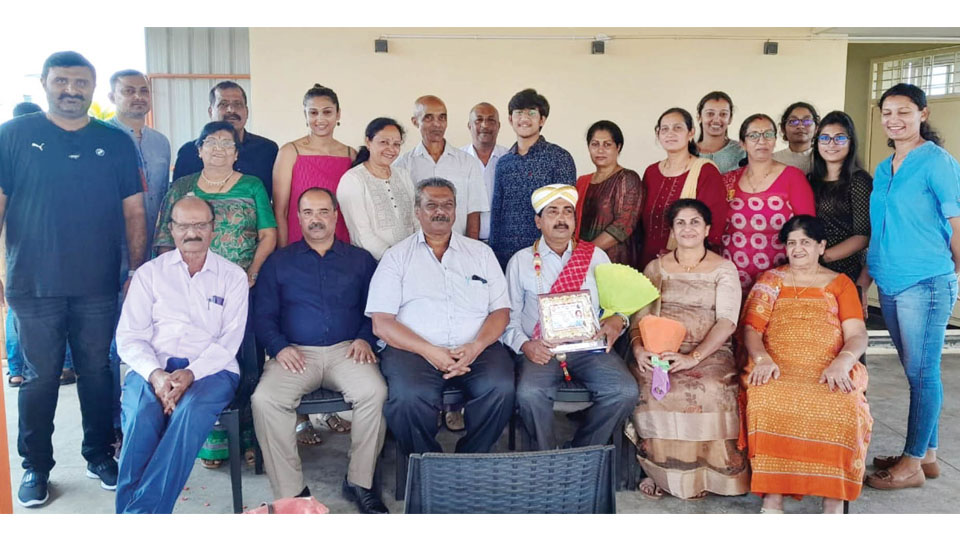
Chottemanda Monnappa is seen with Kullachanda Kesari – Association President, Nellamada Cariappa – Secretary, Noorera Yeshu Bipin – Joint Secretary, Chendanda Nirmala Subramani, Coluvanda Chengappa, Bachamada Vasanth and other members and their families.
Railway Kodava Association get-together was held recently at Simply Kodavas in Vijayanagar.
On the occasion, Association Member Chottemanda Monnappa, who retired on superannuation, was felicitated.
He is seen with Kullachanda Kesari – Association President, Nellamada Cariappa – Secretary, Noorera Yeshu Bipin – Joint Secretary, Chendanda Nirmala Subramani, Coluvanda Chengappa, Bachamada Vasanth and other members and their families.
source: http://www.starofmysore.com / Star of Mysore / Home> Photo News / October 29th, 2022
Progressive farmer and Rajyotsava awardee Somengada Ganesh Thimmaiah shares his thoughts
Madikeri:
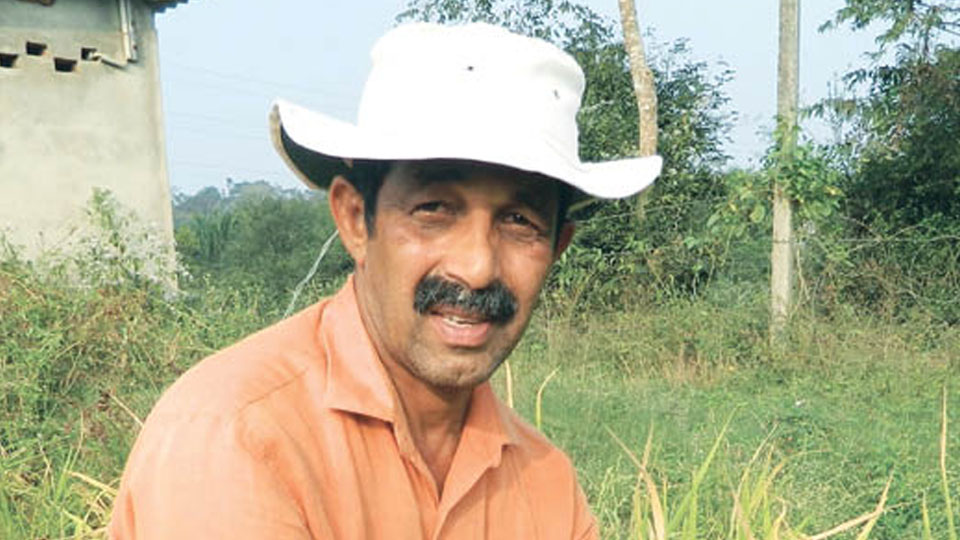
Kodagu’s progressive farmer Somengada Ganesh Thimmaiah of Nallur village near Ponnampet in the southern part of the district has won the Rajyotsava Award for agriculture.
Though coffee and pepper are the prominent commercial crops in Kodagu, Ganesh Thimmaiah has been growing both agricultural and horticultural crops in integrated farming methods and has scripted success.
He is actively involved in innovative agricultural practices since the last 30 years and had earlier served the Indian Army. After retirement from services, he took up agriculture in his 15-acre land and has grown more than 60 varieties of paddy.
To gain additional income, he has a poultry farm and is also involved in apiculture and pisciculture. Apart from the regular crops of coffee, pepper, ginger, mango, orange and jackfruit, Thimmaiah has cultivated rambutan fruit.
In the integrated method in agriculture, he grows areca, coffee and paddy as main crops and a variety of vegetables and fruits and sub-crops. Thimmaiah has also been growing the ‘Beth’ plants required for honey bees and has implemented a mechanised system in agriculture.
At a time when more and more youths are showing interest in jobs and businesses, Ganesh Thimmaiah has earned name and fame as model farmer and has bagged many awards in the past. He won the National-level Babu Jagjivan Ram Krishi Samman Award. The Indian Council of Agricultural Research (ICAR), New Delhi, conferred the prestigious award on Thimmaiah on the occasion of its 92nd Foundation Day in 2020.
In April this year, he gave comprehensive training in agriculture to the batch of IAS officers at Lal Bahadur Shastri National Academy of Administration, Mussoorie.
“I am honoured to be conferred with the prestigious Rajyotsava Award and this gives me an opportunity to innovate further. I have been involved in agriculture for three decades and there is a need of attracting more and more youths to agriculture as it is profitable if innovative,” he said.
source: http://www.starofmysore.com / Star of Mysore / Home> News / October 31st, 2022
In 2018 Kodagu was struck by a rain disaster never heard of or seen before causing landslides, devastating floods and destroying houses and properties of the people, specially in North Kodagu area of Madikeri and Somwarpet Taluks.
Thousands of people were homeless and had to take shelter in schools and public buildings turned into Gruel Centres (Ganji Kendras), where free food was provided. It was a heart-rending sight of hapless, suffering people.
The Government and many NGOs and social organisations rushed to help the victims of the disaster. Among them was also the Bharatiya Vidya Bhavan (BVB), Madikeri Kendra. September 2018 was the month, BVB launched its Bhavan’s Project Coorg to contribute its mite to help the victims of the great natural disaster. This month BVB is completing four years of its service to a section of the victims which is being continued successfully even now and will continue.
For the Bhavan’s Project Coorg initiative, BVB chose one village known as Kalur village which was badly hit with landslides resulting in loss of houses and cultivated lands — coffee estates and paddy fields. It was the worst disaster in the history of Kodagu.
Naturally, several families were in deep shock and limbo as their source of livelihood was completely destroyed. The future looked bleak. How long could they continue in the rehabilitation (relief) camp?
At such a dismal situation, BVB extended its helping hand to the women of Kalur village by taking them under the protective wings of Bhavan’s Project Coorg. It was an initiative to provide both psychological and financial stability to them.
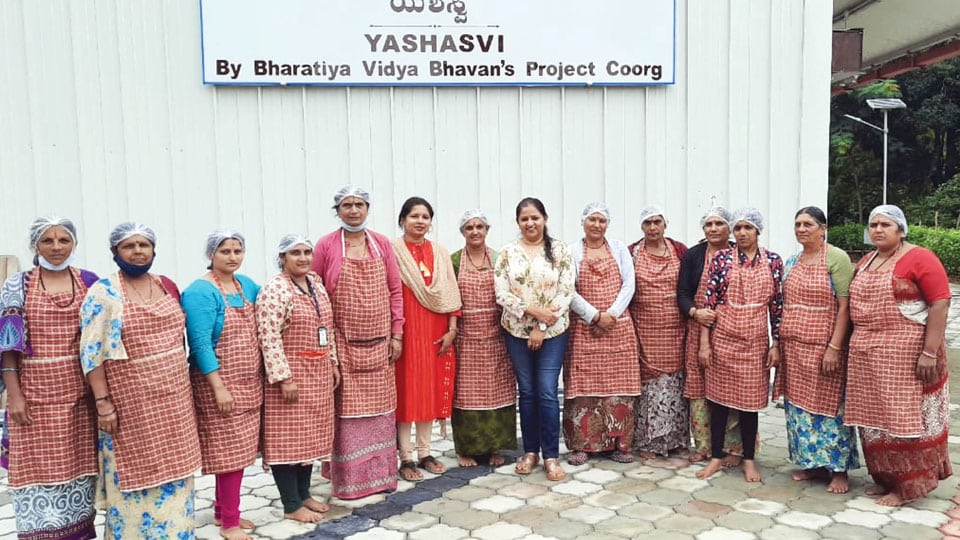
To begin with, BVB started skill development programmes by imparting training in food processing and tailoring to the agricultural women of Kalur village under a programme known as Yashasvi. BVB took 65 women of the village to train them in food processing and tailoring.
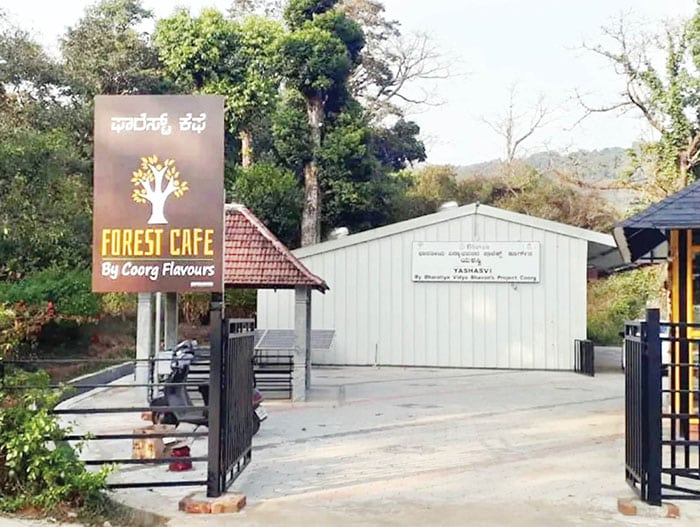
After training, they were provided work on a regular basis and they began to produce a line of packaged high quality masalas, apparently with a Coorg flavour, under the brand name, “Coorg Flavours.”
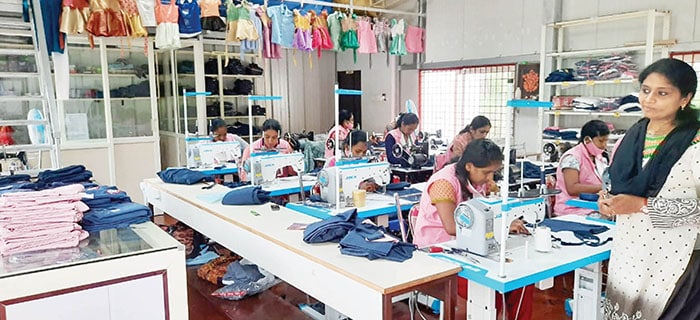
Simultaneously, Tailoring Unit was set up with sewing machines and required facilities, which now undertakes to produce school and NCC uniforms, uniforms required for Government Departments and private organisations. Every woman working here earns sufficient income because of BVB’s initiative.
Today, Food Processing Unit makes different products like home-made chocolates, masalas etc. BVB’s Project Coorg has two stores, which helps sustaining this project, at Madikeri, capital of Kodagu district. Thus BVB made self-reliance possible for hapless women.
Support from people is needed to make this initiative grow and sustain.
For more information, contact BVB Madikeri Hon. Secretary Balaji Kashyap on Mob: 98458-31683.
source: http://www.starofmysore.com / Star of Mysore / Home> News / By K.B. Ganapathy,Chairman, BVB Mysuru / September 15th, 2022
Traditional clothes, jewels and accessories set the Kodavas apart.
Madikeri :
Rituals and culture narrate the history and ancestral beliefs of a community. Traditional attire binds a community and signifies their identity, while also promoting its culture. One such is the Kodava community, nestled in the picturesque district of Kodagu, and boasts of a unique culture and even more unique attire.
Anyone who has attended a Kodava wedding will be familiar with the traditional dress worn by Kodava men. A half-sleeved knee-length black wraparound coat, a silk sash girding the waist and headgear make up the attire, known as ‘Kuppya Chele’.
“In the Kodava language, ‘Kuip’ translates to heat, and ‘ya’ means absent. In simple words, the attire that protects one from heat is the ‘Kuppya’,” analysed Bacharaniyanda Appanna, a Kodava historian. To hold the ‘Kuppya’ in place, a cloth belt called the ‘chele’ is used. The ‘Kuppya Chele’ is accessorised with traditional weapons.
Kodavas are a native Dravidian race that settled amid the thick forests of the ‘Malayadri Sahyadri’ range and speak the original Dravidian language of Kodava. Ancestors wore ‘Kuppya’ made of indigenous plant fibre called ‘Bolakka Balli’.
“When clothes started coming in from Kerala through the barter system, the ‘Kuppya’ or knee-length coat was stitched in white cloth. However, when the British came to Kodagu in 1834, the priests of the Church had issues with this attire. Since the white ‘kuppya’ resembled the habit of Christian priests, the British passed an order to change the colour of the Kodava attire,” explained Apanna.
It is said that the elders voiced their resentment against the British for meddling with their culture. However, a mutual understanding was arrived at. “During this rift, serge fabric came to India from England. Black serge was imported in large quantities, and became more convenient as it rarely appeared dirty. The ‘kuppya’ was soon stitched in black serge, but to ensure the survival of ancestral culture, white ‘kuppya’ is mandated on special occasions. The bridegroom, temple head or priest, village head or ‘thakka mukyasta’ are mandated to wear white ‘kuppya’. Even a dead body is dressed in white ‘kuppya’,” explained Appanna.
The ‘chele’ also witnessed a touch of modernisation, and the 25-ft long strong multipurpose cloth has been replaced with fancy brightly-coloured silk cloth. “During war times, the ‘chele’ was used to tie enemies and for other purposes,” said Appanna.
A married youngster wears the Kodava saree adorned with ‘pathak’
The comfort sari The women of the community also wear unique attire, and a mythological story is intertwined around it. The Kodava women wear a sari that is pleated at the back and the ‘pallu’ or loose end is wrapped around the front. “According to mythology, seer Agasthya and Cauvery had a rift, and Cauvery left Talacauvery discreetly. She showed up after ten days at Bhagamandala, and then left towards Balamuri, where villagers stopped her and requested her to stay. However, she flowed with great force, which caused the saris worn by the women to turn backwards. She was then calmed and promised to show herself every year during the Cauvery Sankramana celebrations,” narrated Appanna.
This sari also has scientific symbolism. Since Kodava women participated in agricultural activities, the back-pleat saris were more comfortable, and women could even climb trees easily. These saris hold great significance for the community and are paired with headgear called the ‘vasthra’. “Both Kodava men and women wear the head cloth. Our ancestors believed that the sun’s rays should never fall behind the neck and they covered it with ‘vasthra’. However, the headgear has been modernised to suit current trends and has intricate artwork, especially those worn by women,” he explained.
Traditional jewels The traditional knife called the ‘peecha katthi’, which was used in self-defence during ancestral times, forms part of the men’s attire and symbolises the tribal and warrior culture of the community. The ‘peecha kathi’ or dagger, and ‘odi kathi’ or traditional sword, are accessories for men, while a variety of traditional jewels add a touch of cultural flavour to the women’s saris.
“‘Peecha kathi’ was fixed to the attire using the ‘chele’. Earlier, these daggers had handles of wood. Now, they are carved in silver and gold and shine brightly on the traditional attire,” Appanna said.
The women have seven types of jewels. “At Talacauvery, the seven seers or ‘sapta rishis’ meditated. One could also find seven ponds at the centre, which are now covered. As a sign of blessings from the seers, the Kodava tradition mentions seven types of adornments from head to toe. However, only a few jewels have stood the test of time,” he explained.
Among the jewels, ‘Pathak’ holds great significance for married women. “When a girl goes to her husband’s house, her parents pack ten essential items – mostly traditional brass items – to be sent with her. These items are given to help her lead an independent life in her husband’s house, and must not be brought back to the girl’s house unless the couple is separated. To protect these items, a jewel consisting of ‘Naga’ (snake) god’s incarnation is tied by the mother of the bride during the wedding ceremony, called the ‘Pathak’,” explained Appanna. This jewel holds symbolic significance and is similar to a ‘mangal sutra’, while other traditional jewels include the ‘joe maale’ and ‘kokke thaati’.
Primarily nature worshippers, the culture, traditions and rituals of Kodavas are unique and tribal in nature. While the size of the community has shrunk in the past, steps are now in place to revive the community’s rich culture.
source: http://www.newindianexpress.com / The New Indian Express / Home> States> Karnataka / by Prajna GR, Express News Service / October 30th, 2022
WELCOME. If you like what you see "SUBSCRIBE via EMAIL" to receive FREE regular UPDATES.
Read More »