Experience the rich flavors of Coorg at The Westin Pune Koregaon Park from September 12-21. Join us for a 10-day celebration of authentic Kodava cuisine.
This September, embark on an exquisite culinary sojourn as The Westin Pune Koregaon Park brings the authentic flavors of Coorg to your table. From September 12 to 21, 2025, The Market will transform into a celebration of Kodava cuisine, offering a 10-day showcase of recipes and traditions that are deeply rooted in the region’s culture.
Curated by Chef Priya Aiyappa, a proud Coorg native, the festival promises an authentic dining experience, with dishes prepared using time-honoured techniques and locally inspired ingredients. On the menu are signature delicacies such as the legendary Pandi Curry, paired with pillowy Kadambuttu (steamed rice dumplings), alongside Paputtu (soft rice and coconut cakes), and Noolputtu (delicate rice noodles). Seasonal specialties like the rich Kakkada Nyend Curry—crafted with prized monsoon mud crabs—and the earthy Baimbale Curry made from tender bamboo shoots, bring the lush terrain of Coorg directly to the plate. For a sweet finish, the humble yet comforting Thambuttu, a banana-based dessert, completes the experience.
“Coorg food is a reflection of its land—simple, bold, and deeply connected to tradition,” says Chef Priya. “Through this festival, I want to bring the warmth of Kodava hospitality and the true flavours of my home to Pune.”
With its inviting ambiance and vibrant setting, The Market at The Westin Pune Koregaon Park provides the perfect canvas for this unique celebration. Whether you’re a passionate foodie or simply curious to explore the rich culinary heritage of Karnataka’s Western Ghats, the festival offers an unmissable opportunity to savour one of India’s most distinctive regional cuisines.
When: September 12 – 21, 2025| Lunch, Dinner & Brunch Where: The Market, The Westin Pune Koregaon Park Cost: 2399++ onwards Contact: +91 70662 00300
source: http://www.hospibuz.com / Hospibuz.com / Home> Hotel Listicles> Listicles / by Hospibuz / September 12th, 2025
From hand-picking cherries to experimenting with processing methods, Kodagu’s coffee growers are embracing change, writes Dhanyata M Poovaiah.
Once a paddy-growing area, Kodagu took to large-scale coffee cultivation during the British era. Today, it is India’s largest coffee-producing district.
Every district in the state has a speciality and when it comes to Kodagu, it is coffee. While Karnataka accounts for around 71% of India’s total coffee production, Kodagu alone contributes around half of the state’s total output, or roughly 37% of the country’s total coffee yield.
Originally, paddy was the region’s main crop. During the 19th century, the British started large-scale coffee plantations, considering the region’s suitable climatic and soil conditions for the crop. Today, Kodagu is India’s largest coffee-producing district.
Robusta and Arabica are the two main varieties of coffee grown in Kodagu. Initially, Arabica was the most widely grown variant of coffee. “Situated within a multi-storeyed coffee agroforestry system, Kodagu nurtures the GI-tagged Coorg Arabica Coffee, celebrated for its pleasant aroma, balanced flavour, mild acidity, strong body, and subtle floral notes,” says Pradeepa Babu, Deputy Director (Research), at the Coffee Board of India.
However, over time, planters gradually switched over to the heat- and pest-resistant Robusta. “Indian Robusta gets the highest premium in the international market, preferred for its good blending quality,” Pradeepa adds. This variety has a longer lifespan and is easier to maintain. Today, 80% of the coffee produced here is Robusta.
The Robusta plants are taller and have bigger leaves and rounder beans, and provide better yield. The beans also offer a stronger and bitter taste profile. Arabica, on the other hand, has elongated beans and is suitable in higher altitudes and colder climates.
Commercially available coffees are often a blend of Robusta and Arabica. The South Indian filter coffee contains a touch of chicory as well.
“Kodagu’s coffee has good markets in Europe, West Asia, USA and Australia, with Italy being the top importer,” says Vishwanath Keshavamurthy, CEO of Biota Coorg Farmer Producer Company Limited.
While Robusta and Arabica dominate the coffee scene here, two more varieties are gaining ground in the district. Liberica, a larger plant, is grown in smaller quantities, and Excelsa (locally known as Mara Kaapi) is also being introduced.
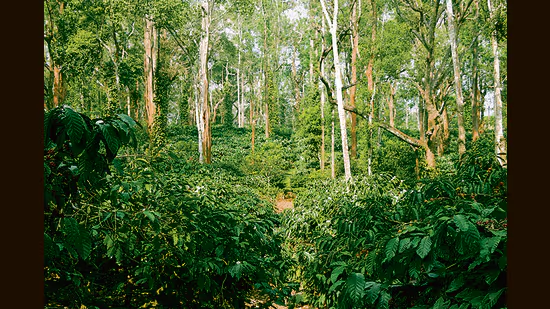
Shade-grown plantation
A unique feature of Kodagu coffee is the shade-grown method. “In Kodagu, coffee is grown in shade, wherein coffee plants are surrounded by taller trees and lush vegetation. The slow maturation process of coffee cherries here results in more mucilage, enhancing their flavour and the aroma,” says Naren Kuttaiah, director of Biota Coorg Farmer Producer Company Limited and the proprietor of Kallucoppa estate. Mucilage is a sticky, sugary, and pectin-rich layer found in the coffee cherry between the outer skin and the parchment layer.
“In other major coffee-growing countries such as Brazil and Vietnam, the crop is mainly grown in open plantations,” he adds.
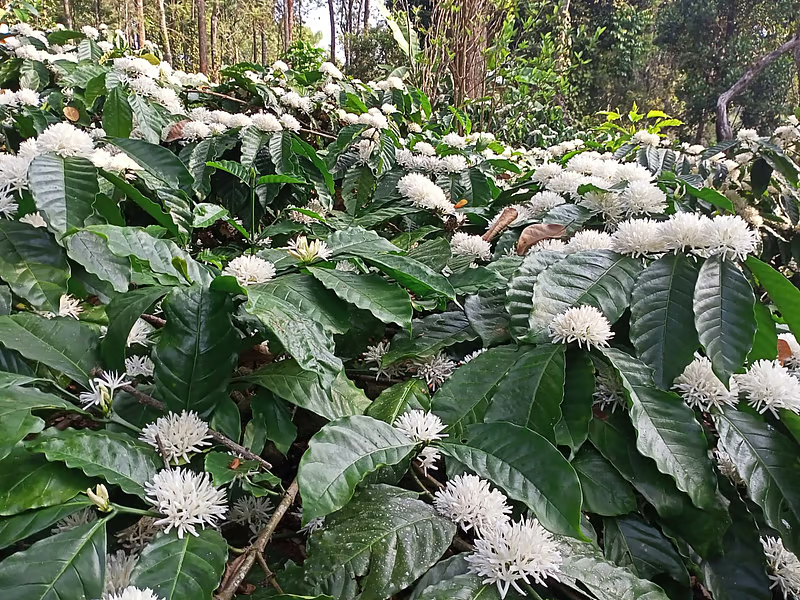
Additionally, the coffee cycle in Kodagu begins with blossom showers in February and mid-March. The right amount of rainfall and sunshine is crucial for the healthy blossoming of coffee flowers and the subsequent development of the beans. If rainfall is insufficient, irrigation is carried out after 20 to 22 days. This is followed by fertiliser application (pre, mid, post monsoon application), pruning, shade lopping, weeding, desuckering and disease control.
Post-harvest cycle
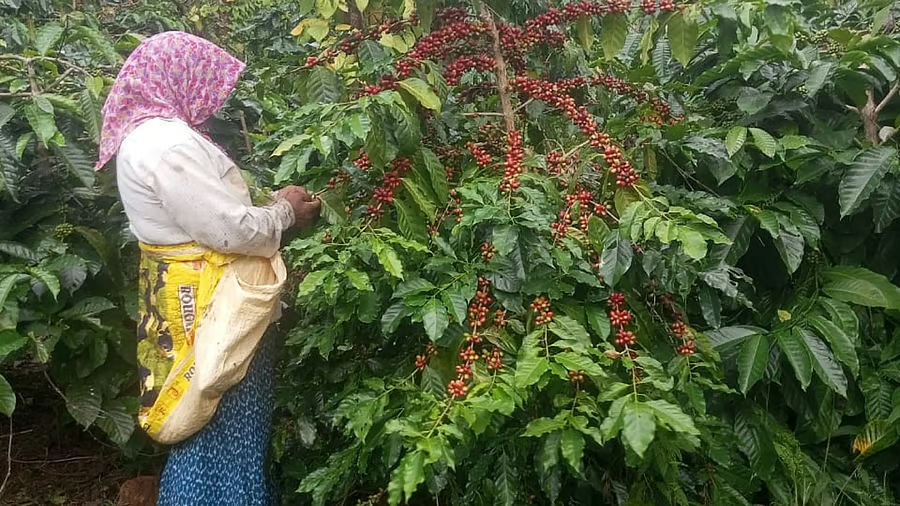
Most commonly, the coffee cherries are hand-picked and dried directly in the sun for nine to ten days. However, in the honey method of drying, ripened red cherries are picked, depulped and then dried to accentuate the flavour. In the washed process, the beans are fermented, washed and then dried. Nutty, fruity, floral, citrusy flavours can be achieved depending on the process of fermentation.
“To pick only the ripened cherries, we go through six cycles of picking. This ensures a uniform taste compared to when a mix of green and red cherries is processed. Right processing can even control the acidity, bitterness and flavour of the coffee,” says Rishwin Devaya, of the Riverside Estate in Kodagu. He grows a mix of Robusta and Arabica varieties and has also recently been experimenting with intercropping Robusta and Arabica.
Single-origin coffee
Today, there is a growing demand for single-origin coffee, where the beans come from one specific source, such as a single farm or region.
“This is because the local climate, soil, surrounding vegetation, foliage, and even the fertiliser or manure used, all bear an impact on the flavour profile of the coffee bean. The post-harvest process is carried out in a controlled manner to achieve desired characteristics,” says Sandalkad Estate’s Shamveel Nizam, who runs a specialty café in Kodagu.
Specialty coffee should score over 80 out of 100 on 10 parameters, such as aroma, flavour, acidity, aftertaste, body, balance and uniformity. This is tested by the Coffee Board of India and is increasingly sought after.
“The higher the score, the higher the price. Our specialty coffee is sold at Rs 25,000 per kg in West Asia. We also offer customisation, as per the client’s preference,” says Shamveel.
A coffee plant blossomed with flowers
Cupping is another standardised method to evaluate coffee. Under this, professional cuppers smell and taste coffee to assess its body (mouthfeel), sweetness, acidity and flavour notes. The practice is used by roasters and importers to assess new coffee beans.
New trends
In recent years, young planters have been driving innovation. “Traditionally, coffee planters only sold dried cherries. To maximise returns, we should handle the post-harvest processes as much as possible,” says Rishwin, who does end-to-end processing. Coffee workshops, seminars and courses are crucial to take the game to the next level, he adds.
The Coffee Board is also supporting coffee production through involvement in replantation, water management, quality improvements in drying yards and warehouses. Organic/eco-certification is encouraged for estates producing organic coffee, helping them achieve higher returns. In addition, an Integrated Coffee Development Project is being implemented to support the overall growth of the coffee industry.
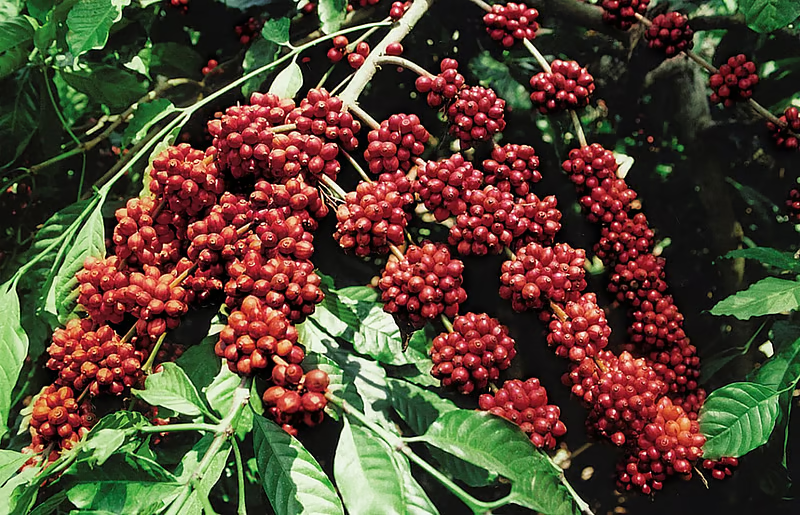
Coffee cherries.
“Specialty coffees with local narratives, wellness-oriented blends, consumer engagement, convenience coffee formats such as drip coffee pouches, home-brewing tools and marketing through e-commerce platforms are the new trends in coffee marketing,” says Pradeepa.
From misty plantations to global cafés, Kodagu’s coffee legacy continues to brew magic.
source: http://www.deccanherald.com / Deccan Herald / Home> India> Karnataka / by Dhanyata M Poovaiah / September 11th, 2025
Kodagu’s Aida Thimmaiah, a resident of Bengaluru, finished third in Girls 11 category at US Kids Golf World Championship – 2025 organised by US Kids Golf Foundation, which concluded at Pinehurst Village, North Carolina, on Aug. 2.
Competing in the Girls Age 11 category, Aida’s journey was nothing short of extraordinary.
After a challenging start on Day 1 with a score of +3, she stood in 27th position. Undeterred by the pressure, Aida staged a remarkable comeback on Day 2, shooting -4 and climbing an incredible 21 places to finish the day in 6th place.
On the final day, with grit and determination, Aida delivered her best round yet — a flawless -6, the lowest score of the day, propelling her into 3rd place overall among the world’s best young golfers.
Speaking to Star of Mysore, Aida Thimmaiah, said, “It is an amazing and proud moment to represent India on a world stage. I feel very happy to have finished third in the world championship. I am very thankful to my coach Rahul Ganapathy at Golf Academy in Karnataka Golf Association (KGA), Bengaluru, my parents for their constant support and also my sponsors.”
The US Kids World Championship is one of the most competitive platforms for junior golfers, bringing together the most talented young athletes from around the world.
Aida Thimmaiah is the daughter of Ballachanda Den Thimmaiah and Sanjana Thimmaiah couple. Den is a native of Virajpet in Kodagu, now settled in Bengaluru. While Den Thimmaiah is into land development, his wife is a wedding planner.
source: http://www.starofmysore.com / Star of Mysore / Home> Sports / August 04th, 2025
Team Ibbani from Heggadihalli, Bengaluru Rural, defeated Team Appu Boys from Marasanahalli panchayat, Chikkaballapur Rural, to emerge as regional champions.
Team Black Panthers from Maragodu, Kodagu, aced the women’s throwball competition at Isha Gramotsavam. Credit: Special arrangement
Bengaluru:
Team Ibbani won the men’s volleyball and Team Black Panthers the women’s throwball events at the Karnataka regional finals of rural sports festival Isha Gramotsavam on Sunday.
Team Ibbani from Heggadihalli, Bengaluru Rural, defeated Team Appu Boys from Marasanahalli panchayat, Chikkaballapur Rural, to emerge as regional champions.
In women’s throwball, Team Black Panthers from Maragodu, Kodagu, overcame Team Shasthara Padumale (Kudla Strikers), from Badagannuru, Dakshina Kannada, to clinch the regional title.
Sadhguru Jaggi Vasudev, former Indian cricketer Robin Uthappa and South Indian actress Srinidhi Shetty attended the event held at Sadhguru Sannidhi in Chikkaballapur.
The event featured men’s volleyball and women’s throwball competitions.
Eighteen men’s volleyball teams from nine districts and 16 women’s throwball teams from eight districts competed for their place in the grand finale to be held at Adiyogi, Isha Yoga Center, Coimbatore.
Launched by Sadhguru in 2004, Isha Gramotsavam was envisioned to rekindle the spirit of rural India. The festival helps rural communities break free from addictions, rise above caste, creed and religious divisions, and actively supports women’s participation in community life.
Unlike professional tournaments, Gramotsavam provides rural citizens with a platform to play, compete, and celebrate the unifying power of sports and culture, according to a press release.
source: http://www.deccanherald.com / Deccan Herald / Home> India> Karnataka / by DHNS / September 09th, 2025
Kottangada Dr. Pemmaiah, Indian Revenue Services (IRS – Income Tax), Deputy Director, Enforcement Directorate (ED), New Delhi, was felicitated by the Mysuru Kodava Samaja at the ‘Kailpodh Namme’ celebrations held at the Samaja premises in Vijayanagar First Stage this morning.
Picture shows a section of the audience.
Dr. Pemmaiah’s wife Lochan Pemmaiah, mother Kottangada Viju Devaiah (a social worker from Gonikoppa), Mysuru Kodava Samaja President Ponjanda Ganapathy, Vice-President Machimada P. Nanaiah, Secretary Ketolira A. Belliappa, Joint Secretary Ajjikuttira Diana Poovaiah and Hon. Treasurer Ittira G. Kashiappa and other office-bearers were present.
source: http://www.starofmysore.com / Star of Mysore / Home> Photo News / September 07th, 2025
The actor will join hands with the director for Hello 123, which will have music by V Harikrishna.
Bhuvvaan Ponnanna, known for his antagonist roles in films like Just Math Mathalli, Kool, and Kuchiku Kuchiku, worked his way to playing the lead in Randhava. Now, after a break, he steps into the spotlight as a hero with the upcoming musical, Hello 123, directed by none other than Yogaraj Bhat. The film features music by V Harikrishna and is produced under the banner of Amrutha Cine Craft by Vijay Tata and Amrutha Vijay Tata.
“When I came to Bengaluru in 2007, Yogaraj Bhat’s name was everywhere,” Bhuvvaan recalls. “Every actor wanted to do a film with Bhatru. While I was playing villains, I always had this wish, much like senior actors wanted to work in Puttana Kanagal. I wanted to be part of Yogaraj Bhat’s world, as I loved the magic he had brought to actors like Ganesh or Diganth.”
The actor admits he took his time after his debut as a hero in Randhava. “Yogaraj Bhat doesn’t push stories onto actors; he works around them. He told me, ‘I will not match the story with the actor; I’d rather work on the story, and then see how the actor fits.’ He was very particular, always striking up conversations, understanding me—my background, my language, my flavour. After many discussions, he tailored the story to suit me.”
Bhuvvaan, who also has a theatre background and trained in filmmaking at a New York film university, calls working with Bhat a learning experience. “Despite my theatre experience, this is going to be like film school. The chance to work with a director like Yogaraj Bhat is rare, and I am ready to absorb every moment.”
Hello 123, launched with Harshika Poonacha and Bhuvvaan’s daughter Tridevi in attendance, promises a light-hearted journey of a musician rising from nothing to everything. “It’s a typical Yogaraj Bhat film,” Bhuvvaan says. “Music, love, drama, the essence of Malnad, quirky characters, and humour—everything is in there.”
Pre-production is underway, and shooting is expected to begin in October. Apart from Bhuvvaan, the director and music director, the rest of the cast and crew is yet to be finalised.
source: http://www.cinemaexpress.com / Cinema Express / Home> News / by A Sharadhaa / September 05th, 2025
Annual Kail-Poldh Festival get-together, Ayudha Puja, Sports and Games, Lucky Dip, honouring eminent Kodavas and distribution of Scholarship to meritorious children.
Enforcement Directorate (New Delhi) Deputy Director Dr. Kottangada Pemmaiah chief guest, Samaja President Ponjanda A. Ganapathy presides, Samaja Vice-President Machimada P. Nanaiah, Secretary Ketolira A. Belliappa, Joint Secretary Ajjikuttira Diana Poovaiah and Hon. Treasurer Ittira G. Kashiappa will be present, Kodava Samaja premises, Vijayanagar 1st Stage, 10 am to 5 pm.
source: http://www.starofmysore.com / Star of Mysore / Home> Events Tomorrow / September 06th, 2025
The pest has already been detected in several locations 29 acres in Chinalabudu gram panchayat, 29 acres in Malivalasa, 7 acres in Malasingaram, 5 acres in Chinalabudu, and 2 acres in Turaikiida.
Visakhapatnam:
“The coffee berry borer can be eradicated, but only with the active cooperation of farmers,” said District Water Management Agency (DWMA) project officer Dr Vidyasagar during an awareness programme in Pakanakuddi village of Araku Valley mandal on Friday.
The session urged growers to recognise the pest’s rapid spread and take immediate steps to contain it. Vidyasagar stressed that early detection is crucial: once the pest is identified, affected crops must be removed, boiled in hot water, and buried to prevent further infestation. Failure to act could cause a severe decline in coffee yields.
To assist farmers, the Coffee Board has announced compensation of Rs 50 per kilogram of infested coffee and Rs 5,000 per acre to cover burial and pest-control costs.
The pest has already been detected in several locations 29 acres in Chinalabudu gram panchayat, 29 acres in Malivalasa, 7 acres in Malasingaram, 5 acres in Chinalabudu, and 2 acres in Turaikiida. Officials will mark infected zones with red, yellow, and blue flags and will hold follow-up awareness sessions in these areas.
Coffee Board assistant director Bonju Babu and district agriculture officer S. B. S. Nanda also addressed farmers, underscoring that community vigilance and coordinated response are vital to safeguarding the region’s coffee economy.
source: http://www.deccanchronicle.com / Deccan Chronicle / Home> Southern States> Andhra Pradesh / by DC Correspondent / September 05th, 2025
Agricultural soils, under better management, could store up to 1.2 gigatonnes of carbon each year. That’s substantial – and coffee is showing the way.
Shade trees protect a plantation in Coorg. It turns out that shade can help soil store far more carbon, slashing the footprint of the crop. (Shutterstock)
Dappled sunlight filtered through the broad leaves of a jackfruit tree, before trickling through the waxy canopy of an avocado, casting a cool shade over my feet, which were sinking into the brown, mulchy soil as my fingers squeezed two creamy seeds out of a bright shiny cherry and onto my palm.
That was when it hit me: Origins matter: How you were shaped determines where you will thrive.
Here, in the Palani Hills, Coffea arabica was thriving in a cool, humid forested nook much like its ancient home in the Ethiopian highlands. Old and planted forests sheltered it from heat and wind, while the humus-rich soil supplied year-round moisture without drought or waterlogging.
Shaker Nagarajan, the owner of this plantation, tells me farms like his have been increasingly caught between elephants, labour-scarcity and storms, in recent years. He’s mindful of what trees he plants, because some, like the banana, draw the elephants that migrate seasonally to these slopes. “The calves really cause havoc,” he adds, running amok like toddlers do.
Coffee harvests fall between October and February, a season of festivals and rains in these parts, making labour expensive and hard to retain. A giant storm a few years ago knocked over a number of large trees (most of them non-natives with less-deep roots). That year, Nagarajan says, he was only able to salvage 25% of his crop.
Such storms may become more common as the planet warms.
As I mentioned in my last column, Part 1 of this two-part series on coffee, a 2015 study found that, based on current climate projections, about half the land currently used for coffee production would no longer be suitable for the crop, by the 2050s. Brazil, the world’s largest producer, will be especially hard-hit. Any gains at higher elevations will carry a steep deforestation cost.
For a world that consumes two billion cups of coffee a day, this is terrible news. But there is a way forward. I even saw it in action here: forests and soil, working together.
In the early afternoon, it was cool at the plantation and a light drizzle fell. “I used to maintain 40 trees to provide shade to the 1,200 coffee plants on every acre of land,” Nagarajan said. “Now, with temperatures rising, I have increased the number of shade-providing trees to 100 per acre.”
David Hogg, chief agriculture advisor at Naandi Foundation, which supports Araku Coffee, the makers of award-winning coffee produced in collaboration with over 10,000 tribal families, agreed. “I measured surface ground temperatures both inside coffee farms and outside and consistently found the shaded coffee farms were 4 degrees Celsius to 7 degrees Celsius cooler,” Hogg said. “Forests were a natural buffer. So I was able to assure our trustees that Arabica coffee would remain resilient (here) for the next 50 to 100 years, provided the ecosystem was maintained.”
Araku uses a hybrid seed that is a cross between arabica and robusta.
Rattan Lal, distinguished university professor of soil science at Ohio State University and a global authority on soils, told me, “When it’s about 27 degrees Celsius outside, the soil temperature may be 40 degrees Celsius, but under the forest canopy, it is only about 27 or 28 degrees Celsius. So, there’s a big difference.”
That’s temperature taken care of, for now. Forests also help intercept the heavy downpour, and maintain humidity in dry months.
The other adaptation is soil.
Plants, like us, need water to maintain structure, move nutrients around, fuel photosynthesis and cool themselves. Most plants draw almost all their water through their roots from the soil. So, when water content in soil falls, yields suffer.
Soil is a dynamic matrix of mineral particles, organic matter, water, air and microorganisms. Healthy soil strikes a Goldilocks balance: enough large pores to let rainwater soak in and, during heavy downpours, drain away; and enough medium pores to hold onto water against gravity, yet release it when plants need it. Humus (the organic-litter component of soil) helps keep this pore ratio just right. It also acts as a sponge. Soils rich in organic matter can store far more water — anywhere from roughly one part water per part humus to eight parts water per part humus.
Organic matter reengineers the soil’s plumbing. Vitally, it also contains microbiota that can break organic matter down into a form of nitrogen that can be absorbed by plants.
***
In India, we have destroyed our soil.
Lal tells me tropical soils should ideally contain 1% to 1.5% organic carbon, but in many Indian farms, especially in the northwest, it is now 0.1% to 0.2%, because “we take away the crop residue and either burn it or convert it into feed where the dung doesn’t return. So, Indian soils are really depleted.”
That’s a problem. In 1937, in the aftermath of the Dust Bowl crisis, US President Franklin D Roosevelt wrote: “The dust storms and floods of the last few years have underscored the importance [of programmes to] control soil erosion… The Nation that destroys its soil destroys itself.”
Farmers try to compensate for falling soil health by adding more fertiliser or more water. “But that causes its own problem,” Lal says. “The efficiency of nitrogen fertiliser in India, under ideal conditions, is only about 30%. The remaining nitrogen, which is not absorbed, [leaches] into groundwater as nitrates, which harms the health of people who drink it, or escapes into the atmosphere as nitrous oxide, a greenhouse gas 200 to 300 times stronger than carbon dioxide.”
Yikes.
The interesting thing, Hogg found, is that tribal farmers didn’t want to use chemical fertilisers. When they applied the urea the government gave them, they told him, “all the earthworms ran away”. This gave him the confidence to build an organic programme in the Araku Valley in Andhra Pradesh.
“Because coffee in Araku is surrounded by biomass, we integrated composting and microbial inoculants to restore soil health. Over the years, soil life returned, coffee quality improved, and Araku coffee began earning international recognition,” Hogg says. “Coffee thrives in a beautiful symbiosis with the forest, in which trees feed the soil with dissolved organic carbon. Organic carbon levels have doubled or tripled in five years, as soils once depleted by slash-and-burn practices began to regenerate. Levels rose from about 0.4% organic carbon to 1.6%, sometimes even higher. Some farms have even gone up to 6% organic carbon, so the sky is the limit.”
***
Carbon here is not just about climate; it is also about soil health.
Soil carbon supports microbial life, modulates structure, improves aeration and, most importantly, holds water. This water-holding capacity reduces stress on coffee plants during dry periods, making them healthier and less vulnerable to disease.
“For me,” Hogg says, “this is the essence of regenerative agriculture: restoring soil life and protecting the environment for future generations.”
For the longest time, Indian coffee growers didn’t have an incentive to focus on quality. They had to sell everything to the coffee board, and a small payment to the chief inspector ensured it would be certified as fair average quality, or FAQ.
With liberalisation, the focus on quality began.
And there’s more. The world is realising that coffee, blessed with a rich array of polyphenols, particularly chlorogenic acids, can be a health food. A seven-year study of 36,758 adults, published in the journal Current Developments in Nutrition in 2020, found that even modest daily coffee intake was linked to a lower risk of death. These polyphenols act as antioxidants, modulate the gut microbiome and slow glucose absorption in the intestine, reducing post-meal blood-sugar spikes.
What’s fascinating is this: researchers have found that shade-grown arabica in Thailand contained roughly twice the levels of chlorogenic acids and markedly greater antioxidant activity than beans grown in full sunlight.
There’s even more: Shade changes coffee’s carbon math. A new accounting method that recognises shade’s impact on soil and biomass carbon, and on erosion protection, developed by Lal and his colleagues, shows that shaded systems store significantly more carbon than unshaded plots. This serves to lower the carbon footprint of shade-grown coffee by 22%.
Lal told me he believes that soil, globally, could sequester about 2.5 gigatonnes of carbon each year (or nearly a quarter of what humanity emits annually). Agricultural soils, under better management, could store up to 1.2 gigatonnes of carbon each year. That’s substantial.
Climate resilience, less carbon pollution, health. Those are worthy goals. Araku’s experience shows that the methods can be scalable, fair (the company’s practices have raised farmer incomes) and aspirational. Araku has won the Epicure d’Or award for taste, and the Rockefeller Foundation’s Food System Vision Prize for sustainability.
To actually scale this across India, and around the world, needs more action. “India needs a Soil Health Act,” Lal says, “to incentivise farmers to grow carbon in their soils.” While there are new schemes to wean farmers away from fertiliser abuse, when one compares the ₹1.2 lakh crore budgeted in 2024-25 for urea subsidy to the ₹45 crore for the Policy on Promotion of Organic Fertilizers, one wonders how much the needle will shift.
But shift it must, for good coffee and so much more.
(Mridula Ramesh is a climate-tech investor and author of The Climate Solution and Watershed. She can be reached on tradeoffs@climaction.net. The views expressed are personal)
source: http://www.hindustantimes.com / Hindustan Times / Home / by Mridula Ramesh / September 05th, 2025
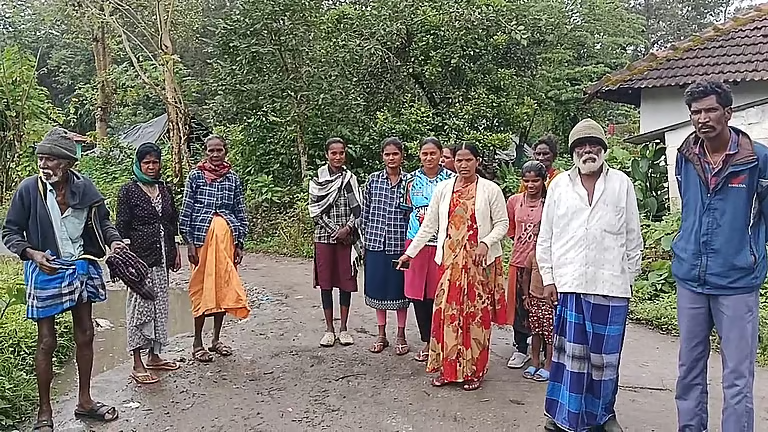
Over 150 families of tribes living within the Maldare Panchayat limits stated that they are unable to make ends meet as they are deprived of government facilities.
Over 500 tribes have not been supplied with nutritious food from ITDP for the past three months. (Photo | Express)
Madikeri :
The tribes settled across various settlements in South Kodagu have expressed anguish over the non-supply of nutritious food from the ITDP department for the past three months. They have demanded that the concerned officials take immediate action and resume the supply of the food items.
Over 150 families of tribes living within the Maldare Panchayat limits stated that they are unable to make ends meet as they are deprived of government facilities.
“The government used to provide nutritious food to the tribal settlements. The food items were helpful as most of the time we are unemployed and suffering from poverty. But no items have been received for the last three months,” shared Indira, a resident of the tribal settlement.
She explained that the tender for supplying food to the tribal settlements has allegedly been given to a contractor from outside the district and opined, “If the government gives the tender for supplying food to the district contractors, this will ensure timely supply of food items.”
She further stated that the tribal community living in the forest is deprived of all basic facilities. “We at least made sure that we did not stay hungry. But for the past three months, we are finding it tough to satiate our hunger,” she added.
Meanwhile, the tribes complained that their livelihood has been severely affected due to the increasing number of migrant workers from North Eastern states allegedly taking over their jobs as estate labourers.
“Migrant workers mostly live in the coffee plantations and work for low wages. In this context, several tribes have been rendered jobless. Alongside unemployment, the lack of facilities, including the absence of nutritious food supply, is affecting us,” she said.
When questioned, ITDP department district director Honnegowda said, “The supply of nutritious food was delayed due to technical issues. We had sent the sample of oil (supplied under the nutritious food scheme) for FSSAI testing in Mysuru over quality issues. The quality check report was delayed. Nevertheless, we have resumed the supply of food items for the past two days.” He added that the department has ordered the contractor to supply food before the 20th of every month.
source: http://www.newindianexpress.com / The New Indian Express / Home> Karnataka / by Express News Service / September 05th, 2025
WELCOME. If you like what you see "SUBSCRIBE via EMAIL" to receive FREE regular UPDATES.
Read More »