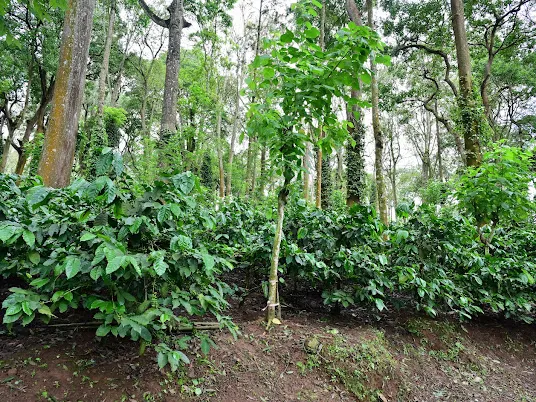
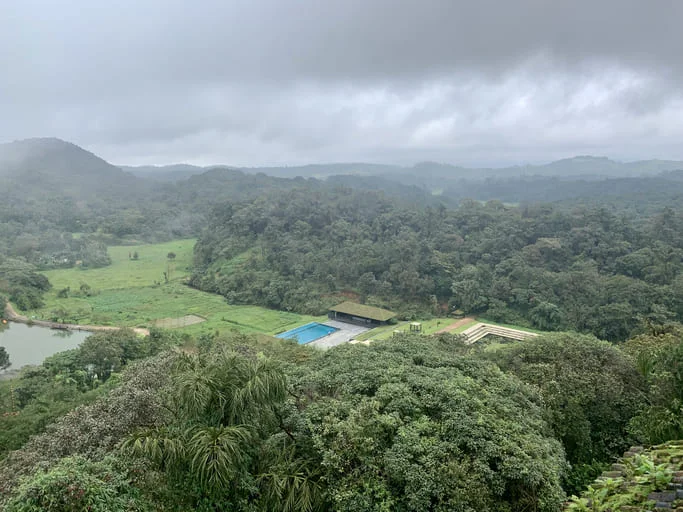
My love affair with coffee started during the lockdown; trying new flavours and textures became an escape for me in those tough times, which has now developed into a regular morning comforting ritual with my coworkers. As I sit here penning down a love story to coffee, my colleagues can spot me sipping on a big tumbler of iced coffee. I had the chance to experience a rich story of coffee-making firsthand, one that had me appreciating this beverage even more. A 6-hour drive from Bengaluru brought me to the Tata Consumer’s plantation on the beautiful slopes of Coorg, which gave me an opportunity to discover and learn all about coffee beans.
Coorg is more than a famous hill station; it is also India’s coffee-growing region. For a coffee-lover like me, this trip became a one-of-a-kind core memory. With tiny droplets of rain and stunning natural visuals, I was transported to a rain-soaked fantasy with the fragrant rustling from the coffee plants. Here I saw the labour and commitment that go into each cup. I was lulled into feeling of calmness, one of nature’s offerings that’s impossible to replicate. Strolling down the road that goes through the plantation with miles of trees and coffee plantations in either direction, I was drawn into the story of coffee. The coffee plants are laden with a green and maroon coloured beans which hang thickly from the branches.
The plantation slopes are renowned for their Arabica and Robusta brews and are surrounded by several lakes, verdant hills, and a diverse range of flora and animals. November is considered to be the best time to pick up the berries and witness the harvest. But when a coffee enthusiast like me is roaming around so much coffee, you can’t help but crave the brown beverage. So, while explaining the foundation and motives of their campaigns and crop, the brand served to cure our coffee craving with steaming hot sips of their best-selling filter kaapis.
A 150-Year-Old Legacy
You might wonder what makes Tata Consumer Products different from its competitors. Tata’s association with the beverage dates back more than 150 years when some tenacious planters from the then-state of Mysore in South India planted the first seeds of the estates and brought coffee to the Coorg Hills. These are some of world’s best coffees, produced by the land and most importantly the local people living there.
source: http://www.elle.in / Elle / Home> Food / by Ekta Sinha / October 09th, 2023
Coffee picking across parts of Chikkamagaluru and Kodagu has slowed down during the peak harvest season after a large section of migrant labourers returned to West Bengal for the Special Intensive Revision (SIR) verification exercise. The sudden labour shortage has pushed up wage demands from the remaining workers, leaving planters caught between the risk of crop damage if harvesting is delayed and the burden of higher labour costs.
The period between November and March is the peak harvesting season for Robusta coffee, when labour requirement is at its highest and timing is critical, N. Bose Mandanna, former Vice-Chairman, Coffee Board of India, said. He added that coffee cherries have to be picked at the right stage of ripeness, but the process has become a hurdle as many migrant workers have returned to their native districts for over 10 days for the verification process.
Delays threaten quality, yield
If harvesting is delayed, the cherries either over-ripen or dry and fall to the ground, where they get damaged and cannot be used, leading to losses. “The quality goes out immediately if fruit is not picked on time,” he said, adding that when the fruit is harvested at the correct time, the pulp extracted during processing is of the best quality, which gets farmers higher prices, and that any delay directly affects the quantity harvested and the quality of coffee produced.
Untimely rains
Adding to the disruption caused by workers leaving for the SIR verification, Abhishiek Ponnappa, a planter and representative of Kodava Coffee Growers, said untimely rainfall in parts of Karnataka and Kerala this January have created a double whammy for the farmers. The rains prevented coffee plants from drying properly, while continuing harvesting under wet conditions risks damaging the plants and affecting the next year’s crop.
Usually, migrant workers return to their home states either before the coffee harvest begins or after it ends in March. This time, however, labour shortage was a challenge throughout January due to SIR verification, as workers began receiving notifications and left within extreme short notice, Harish Maharishi, who owns a plantation in Mudigere, Chikkamagaluru said.
Local workers tied to tourism
In Chikkamagaluru and Kodagu, local workers are largely unavailable in plantation areas, as the growth of tourism has absorbed much of the local workforce, leaving coffee estates heavily dependent on migrant labour, planters said.
Producing one tonne of Robusta green coffee beans requires about 4,500–4,700 kg of coffee fruit. In Indian conditions, an average acre of Robusta yields around 600–700 kg of fruit. At the usual harvesting rate of ₹5 per kg, and assuming a picker harvests about 200 kg a day, it would take roughly 15–17 labourers to harvest one acre of a Robusta plantation, Mr. Mandana explained.
Rising wages
Another concern during large-scale labour shortages is a sharp increase in wage demands, planters said.
Under regular conditions, Robusta pickers are paid ₹4–₹5 per kg because the variety allows large volumes to be harvested in a day. The coffee picked by each worker is weighed, and wages are calculated accordingly. An average worker, Mr. Mandana explained, earns ₹476.11 a day, but those who pluck 200–250 kg can earn ₹800–₹1,200 in a single day. When labour becomes scarce, workers, as planters said they are witnessing now, demand higher rates of ₹7–₹8 per kg, which sharply increases the cultivation cost, leading to a difference of at least ₹600 per worker per day for the same quantity of coffee picked.
source: http://www.thehindu.com / The Hindu / Home> News> India> Karnataka / by Rishita Khanna / January 31st, 2026
The Annual Inter-Sangha Tennis Ball Cricket Tournament in memory of Kannambira Girish Kushalappa was organised by Kodava Samaja Cultural and Sports Club, Mysuru, recently at University and Gangothri Grounds in which 18 teams from different areas participated.
In the finals, Sri Igguthappa Kshemabivridhi Sangha, Hebbal A, emerged winner by defeating Sri Cauvery Kodava Association (Mysore East).
The winning team members are seen with chief guest Ajjikuttira T. Poovaiah (DCF retd.), Kannambira Neeta Kushalappa, Ponjanda A. Ganapathy, President, Kodava Samaja, Mysuru, Machanda Prakash Belliappa, Vice-President of the Club, Aramanamada Ponnanna, Secretary of the Club, along with Club office-bearers and others.
As part of the tournament, an exhibition match was also played between two veteran teams as Mysore North and Mysore South.
source: http://www.starofmysore.com / Star of Mysore / Home> Sports / January 29th, 2026
Tucked away in the Western Ghats of Karnataka, Coorg offers a landscape that feels untouched by time. Rolling coffee plantations, mist-covered hills, dense forests, and slow-paced village life define the region’s character. For travelers seeking nature, heritage, and refined hospitality in one place, Evolve Back, Coorg represents the kind of immersive stay that aligns naturally with Coorg’s surroundings rather than competing with them.
Coorg is not a destination built on spectacle. Its appeal lies in subtlety, where scenery, culture, and experience unfold gradually.
Coorg’s Natural Landscape and Sense of Place
Coorg’s geography shapes every aspect of life here. Forests dominate the terrain, broken by coffee estates and rivers that wind through the hills. The region’s elevation keeps temperatures moderate throughout the year, while seasonal monsoons add depth and greenery to the landscape.
This environment encourages slower travel. Visitors often come to disconnect from urban routines and reconnect with nature. Early mornings are marked by birdsong and mist, while evenings bring quiet walks and unhurried conversations.
The land itself becomes part of the experience, influencing how resorts, homes, and daily life are designed.
Coffee Plantations and Everyday Culture
Coffee is central to Coorg’s identity. Plantations stretch across hillsides, shaping both the economy and the visual character of the region. Estate living is deeply rooted in tradition, with generations of families maintaining ties to the land.
Local culture reflects this connection. Cuisine features fresh produce and bold flavors, while festivals and customs are closely linked to agricultural cycles. Hospitality here feels personal, grounded in familiarity rather than formality.
For visitors, engaging with plantation life adds context to the landscape, turning scenic views into meaningful experiences.
Travel Experiences That Define Coorg
Coorg is best explored at an unhurried pace. Nature walks, plantation trails, river viewpoints, and heritage sites form the core of most itineraries. Unlike destinations driven by constant activity, Coorg offers space to pause.
Popular experiences often include guided estate walks, birdwatching, wellness rituals, and learning about local food traditions. These activities are not designed to fill time but to deepen understanding of the region.
Resorts that recognize this rhythm tend to blend more naturally into Coorg’s setting.
Resorts as Extensions of the Landscape
In Coorg, the best resorts function as extensions of the land rather than isolated luxury structures. Architecture often reflects local styles, using earthy materials, open layouts, and natural textures.
Guests are encouraged to engage with their surroundings rather than retreat entirely indoors. Private courtyards, outdoor baths, and plantation-facing spaces help blur the line between accommodation and nature.
This approach enhances the sense of immersion that Coorg is known for.
Evolve Back, Coorg: A Plantation-Led Resort Experience
Evolve Back, Coorg is set within a working coffee and spice plantation, allowing guests to experience estate life as it naturally exists. The resort’s layout reflects the scale and openness of traditional Kodava homes, with pathways winding through greenery rather than formal corridors.
The focus here is not on visual excess but on thoughtful design that respects the land. Privacy, space, and quiet define the experience, aligning with what many travelers seek when visiting Coorg.
Architecture, Villas, and Spatial Design at Evolve Back Coorg
The resort’s villas are designed to echo local architectural traditions while offering modern comfort. High ceilings, natural materials, and open courtyards create a sense of space without disconnecting guests from the environment.
Many villas include private pools or landscaped areas, encouraging relaxation without distraction. Interiors are intentionally understated, allowing views of greenery and sky to remain central.
This balance between comfort and restraint reflects Coorg’s understated elegance.
Wellness and Slow Living at the Resort
Wellness in Coorg is closely tied to environment and pace. At Evolve Back Coorg, wellness experiences draw from traditional practices and natural surroundings rather than packaged trends.
Spa therapies, yoga spaces, and quiet zones are integrated into the landscape. Guests often find that the setting itself contributes as much to relaxation as any formal treatment.
This emphasis on slow living aligns naturally with Coorg’s rhythm, making wellness feel organic rather than scheduled.
Culinary Experiences Rooted in Place
Food in Coorg reflects the land and its seasons. At the resort, dining experiences highlight local ingredients, regional flavors, and estate-grown produce where possible.
Meals are not rushed. Whether enjoyed in open dining spaces or private settings, food becomes another way to engage with the region’s culture. The focus remains on authenticity rather than theatrical presentation.
For travelers, this creates a deeper connection to place through everyday experiences.
Exploring Beyond the Resort
While the resort offers a self-contained experience, Coorg itself invites exploration. Nearby forest trails, viewpoints, and cultural sites provide opportunities to step beyond the plantation.
Guided excursions often focus on understanding ecology, local history, and traditional livelihoods. These outings complement the resort stay rather than competing with it, reinforcing Coorg’s identity as a destination rooted in nature and heritage.
Returning to the calm of the estate afterward reinforces the contrast between exploration and rest.
Choosing the Right Kind of Stay in Coorg
Not all travelers come to Coorg for the same reasons. Some seek wellness and solitude, others nature and culture, and some a blend of comfort and authenticity.
Resorts that succeed in Coorg tend to respect this diversity. They offer flexibility without overwhelming guests with constant programming. The emphasis remains on allowing visitors to shape their own experience.
This approach suits travelers who value depth over pace.
Summary
Coorg’s appeal lies in its landscapes, coffee estates, and quiet cultural richness. It is a destination best experienced slowly, where nature and daily life intertwine. Resorts that align with this character enhance rather than dilute what makes the region special.
Stays such as Evolve Back, Coorg reflect this philosophy by offering plantation-led hospitality that respects local architecture, environment, and traditions. For travelers planning a visit, platforms like Goibibo provide convenient ways to explore accommodation options and organize a journey that matches Coorg’s calm, immersive appeal.
source: http://www.europeanbusinessreview.com / The European Business Review / Home> Blogs> Culture & Lifestyle / January 30th, 2026
Gulshan Devaiah began his career in Bollywood, like the majority of newcomers from outside the industry, with few roles. Nevertheless, Gulshan’s performance was recognised by the audience as well as the critics.
Image credit : Telegraph India
Gulshan Devaiah began his career in Bollywood, like the majority of newcomers from outside the industry, with few roles. Nevertheless, Gulshan’s performance was well-received by the audience as well as the critics. And he once again enchanted his fans with his most recent part in the web series ‘Duranga’.
Duranga is a suspense series that warrants your attention, and we’ll explain why. One of the most well-liked genres of television shows and films today is a thriller. Who doesn’t love the suspense and terrifying anticipation of what will happen next? The unfolding of the events keep you on the edge of your seat. Without further ado, let’s dive right into it!
Reasons Why Duranga Is Worth Your Time!
Image credit : Duranga Poster
The Duranga Plot Will Keep You Hooked Until The End
It is based on Sammit Patel and Ira’s story. Ira starts looking into several killings committed by a person she believes to be a serial killer’s accomplice, and as a result, she learns some shocking information about her husband’s dark background.
One is kept fairly engrossed in the story and on the edge of their seat by the writing and plot. The length of the episode is critical because thrillers frequently suffer from the risk of being stretched out a little too much, the duration of Duranga is just right for you to keeping yourself interested.
The series avoids trying anything new and succeeds in producing the same impression as the original with a compelling narrative and a crisp screenplay.
The Interesting Choice Of Cast
Gulshan Devaiah As Sammit Patel
Gulshan Devaiah gives his greatest effort yet in Duranga. Gulshan gives a convincing performance as a reserved character who doesn’t experience love, happiness, or grief and uses online courses to learn to grin or cry. He has aced his acting skills with each project he has done and is such an underestimated actor who deserves your time.
Drashti Dhami As Ira
Image credit : Duranga/Screengrab
Drashti Dhami, who plays a cop alongside Gulshan, has established herself in Hindi television dramas, and this is the first time she has performed such an intense and badass part of a cop, carrying a very strong character brilliantly; she has never been seen portraying a role this harsh.
The relationship between Drashti and Gulshan is not particularly endearing, but given the diametrically opposed nature of their characters, it nevertheless manages to explain the lack of blandness.
It is difficult to develop and maintain a career in the film industry, which may be ruthless at times. Gulshan, who has been a part of Bollywood for over a decade, believes that ‘being good is not enough.’
The idea that hard effort helps you sustain and that being competent at your craft is enough is appealing, but it is fiction. Gulshan believes that as an actor, one must learn to build relationships and be in the right place at the right moment.
Here are some characters played by Gulshan that need your attention
1. Ghost Stories
Image credit : Indiatimes
Despite having only 10 minutes of screen time and wearing unrecognisable make-up, the actor received some of the greatest accolades of his career for the character of a village strongman who transforms into the alpha zombie in the horror film Ghost Stories. Devaiah recalls Karan Johar and Reema Kagti complimenting Gulshan for his spooky act. Gulshan had no expectations from the movie and wasn’t sure he would be recognised at all.
Most performers would have turned down the role owing to the limited screen time or unrecognisable makeup. However, we are confident that Gulshan chose craft over fame in this role.
Watch It On Netflix
2. Afsos
Image credit : Prime video/Screengrab
In Afsos, Gulshan plays Nakul, a writer with chronic depression who hires an assassin to kill him after 11 unsuccessful suicide attempts. The plot is unusual; for example, have you heard of someone who is sick of trying to commit suicide hiring a hitman to help them? Anyways, things go wrong when Nakul decides to cancel the assignment after falling in love with his therapist.
Watch It On Amazon Prime Video
3. Goliyon Ki Raasleela Ram-Leela
Image credit : Goliyon Ki Raasleela Ram-Leela/Screengrab
For Sanjay Leela Bhansali’s “Ram Leela,” Gulshan appears in a brand-new appearance. In the film, the gifted actor plays the adversary. The character played by Gulshan is a famous member of the Jadeja clan, a group of Chandrivanshi Rajputs who currently reside in Kutch, Gujarat.
Watch It On Jio Cinema
4. Footfairy
Image credit : Footfairy/screengrab
A monster who suffocates young girls and slices off their exquisite feet to keep as his mementos is the subject of the psychological thriller. Gulshan Devaiah portrays CBI officer Vivaan Deshmukh, who trusts his intuition over anything else. He presents himself as an assured police officer. It was incredible that a film made in 2020 captured people’s attention in 2022 with an OTT distribution on Netflix.
Watch It On Netflix
5. Badhaai Do
Image credit : Badhaai Do/Screengrab
The unexpected component of Badhaai Do is Gulshan Devaiah. The actor who portrays Rajkummar Rao’s love interest in the movie, Guru Narayan, is a lawyer. His character is such a fantastic representation of the LGBTQIA population that is not ashamed to be ‘Gay.’ Though Guru’s character appears for a little moment, he plays an important role in the film.
Watch It On Netflix
6. Mard Ko Dard Nahi Hota
Image credit : Movietalkies
In Mard Ko Dard Nahi Hota, Gulshan plays the character of Karate Mani and Jimmy and is a laughing stock. It was pure joy to witness him flawlessly portray two utterly different personalities in a double role.
Watch It On Netflix
7. Shaitaan
Image credit : Shaitaan/Screengrab
Shaitan was one of the first projects to bring Gulshan the attention he deserved. It was a crime thriller, which was highly opposite of what Bollywood thought of these genres. He portrays the slightly insane, affluent brat Karan ‘KC’ Chaudhary, and his diabolical intensity in the part drew many fans.
Watch it On Netflix Since making his acting debut in That Girl in Yellow Boots in 2010, Gulshan Devaiah has advanced significantly while consistently raising the bar with his films and web series
source: http://www.indiatimes.com / India Times / Home / by Tanishk Juneja / September 01st, 2022
Birth anniversary of General KS Thimayya aka Timmy Sahib, a military legend in his own right.
1. He was the first Indian to ever command an Infantry Brigade during the WWII.
2. His elder brother Ponnappa served in the INA, while his younger brother Somaiah was killed in action in Kashmir.
3. In the Army he had a running feud with his British officers over their snobbery and racism.
4. He wanted to quit the Army and join the freedom movement but was however and fortunately dissuaded by PM Motilal Nehru.
5. During Quit India movement he gave orders to the troops not to fire on the protesters.
6. He oversaw the surrender of INA at Rangoon, his brother, Ponnappa was one of the POW(Prisoner of War).
7. After the Korean War, he played a major role in repatriation of POWs, winning plaudits from General Douglas MacArthur.
8. During the first Kashmir War in 1947, personally led from the front, in a tank to capture the Zozi La Pass.
9. He asked Nehru for just three months to beat back the raiders in Kashmir, however the latter (controversial) referred it to the UN.
10. Had a running feud with the Defence Minister VK Menon (Another LUTYENS Roadblock) over undue interference with Army.
11. Had the foresight to recognize the dangers from China, much before any one.
12. His proposal to appoint Lt Gen Thorat as Army Chief was shot down by Nehru, who instead appointed the mediocre Pran Nath Thapar (Also COR of the RAJPUTANA RIFLES).
He spent his last days in Cyprus , as part of UN Peacekeeping Force during the Civil War there.
He passed away in Cyprus in 1965, due to heart attack.
No important person attended his funeral (like Sam’s), he was buried in a nondescript site at Wilson Garden Cemetery.
When the President of Cyprus, came to India, specifically to honour him, our government (then the LUTYENS), woke up and hastily erected a memorial, at ASC center, Bangalore.
When General Thimayya died in Cyprus, the Cyprus Govt declared a 10 day mourning , and their Flag was at Half Mast !
On his birth anniversary please do forward this to as many as you can.
Posted by a proud RIMCOLLIAN, alumnus of RIMC. VIVA RIMC – JAI HIND!.
source: http://www.clnews.in / Coffeland News / Home> Articles / by CLN Newsdesk / March 31st, 2025
Raghu Karnad, in his debut book brings back memories of World War II through the lives of three men from his family.
Hyderabad :
For my mother, who didn’t let me forget,’ reads the dedication to Raghu Karnad’s debut book Farthest Field: An Indian Story of the Second World War.
The much-acclaimed book that hit the stands last year tells us a story, a part of history that almost slipped out of public memory. In his prologue, Karnad writes: ‘People have two deaths: the first at the end of their lives, when they go away, and the second at the end of the memories of their lives, when all who remember them have gone.’
Thus, people also have two burials – one physical and another when their names and then photographs are forgotten. When their memories had become mere pictures in his grandmother’s home in Madras, Karnad discovered the existence of Bobby (Godrej Khodadad Mugaseth), her brother, trying to cross ‘the farthest field of all’, the second death.
In frames alongside his were photographs of his maternal grandfather Kodandera Ganapathy (Ganny) and Manek Dadabhoy, his brothers-in-arms in the Second World War, one of the first things the family recalled about the three.
So Karnad began with the registry of the Commonwealth, visited their graves and retraced their lives through interviews of those who knew them individually or as part of the British armed force. For, he writes, ‘the larger story was the key to retrieving what I could of their private stories’. But somewhere along the way, this became the story of not just the story of three men of his family, but the untold story of the tens of thousands of soldiers who fought for the British in World War II.
Hyderabad Express interviews the author-journalist before he heads to the Jaipur Literature Festival to be part of a discussion on the forgotten role of India in the First and Second World Wars.
Excerpts
How long have you been working on the book?
I spent three years – a year on research, one year writing, and one year editing it, though it wasn’t that clean-cut. I was still interviewing WW II veterans, whenever I could find one, even in the final lap.
How old were you when you first started asking questions about the photos of Bobby, Ganny and Manek in your grandmother’s house?
I’d seen those photographs right through my young life, but I never did ask questions about them – not while my grandmother, who’s at the centre of the story, was still alive. It wasn’t until four years ago, when I was 28 and working in Delhi, that it slipped out as a wisp of anecdote in a family conversation. But even then, it was just a hint of what would turn out to be their full story.
You write that you couldn’t believe you hadn’t noticed you looked like Bobby. After tracing the threads of their lives, how much do you think you and Bobby have in common?
In some ways, not much – Bobby was a wild, reckless young guy by everyone’s account – he liked to gamble, he really liked to tempt fate, and I doubt he liked sitting still. He wouldn’t have made much of a writer. But there’s a deeper level on which I do imagine I share something with Bobby, which has to do with his loose sense of identity – with not feeling like he belongs too firmly to any of the camps around him – in terms of community, language, national identity.
Do you think of these three as family, or as characters you recreated from the brink of their second death?
I struggled sometimes to reconcile the fact that these young people, who felt like my characters, were also close members of my family. But knowing that helped me check myself when I drifted towards clichés, or got carried away by sentiment. It’s easy to take liberties with the lives and deaths of perfect strangers; it’s not as easy when they’re family.
There are moments in their lives, including a secret romance and a shotgun wedding, which some of my relatives think should not have been shared. But to me those moments were the most valuable and the most moving in the book.
Where all did the research take you?
I travelled quite a lot across the country, from Calicut to Chandigarh and Roorkee. And of course to Manipur and Nagaland – the only parts of mainland India that the fighting actually reached. These were most exciting, because in Manipur, the oldest living memory is of the war – for tribal societies, modernity arrived overnight in the form of hideous industrial war machines. The novelist Easterine Kire described it as being, for the Nagas, like the Big Bang.
It was a chance encounter with one elderly man, Yangmasho Shishak, that opened my eyes to some of the themes that run through Farthest Field. He lives in a village near the Burmese border. He was a teenager when the war came, and found himself serving one side – the British – and then the other – the Japanese. A perfect, one-man symbol of Indians in the war.
The Characters
Bobby, or Godrej Khodadad Mugaseth was a Parsi native of Calicut. He was Raghu Karnad’s maternal grandmother Nurgesh’s (Nugs) younger brother. Of the three, Bobby,who studied to be an engineer, saw most action in the war. He signed up with the British Indian Army (Bengal Sappers) in 1942, and went to Sudan, Abyssinia, North Africa, Iran, Iraq, before going towards Imphal, where he is buried. He died in 1944.
Ganny, or Kodandera Ganapathy from a Kodava family, was a Karnad’s grandfather, and studied medicine like his wife. Recruited as a military doctor, he was posted deployed at the Northwestern Frontier, home to the Pashtun tribes, in present-day Pakistan. He died of asthmatic bronchitis in December 1942, a month before his daughter, the author’s mother, was born.
Manek Dadabhoy, also a Parsi, was a friend Bobby made in Madras. He married Nugs’ younger sister Kosh (Khorshed). Always fascinated by speed, and signed up with the RAF as a pilot. He was sent to the Northwest Frontier and later, when the Japanese invaded, to Burma where he died in 1943, when his plane crashed.
source: http://www.newindianexpress.com / The New Indian Express / Home> Hyderabad / by Chetana Divya Vasudev / January 26th, 2016
In the quiet village of Ullikal near Iritty in Kerala’s Kannur district, stands the ancient Vaithur Kaliyar Shiva temple reverently known as Bythoorappa by the Kodavas. As preparations begin for the annual festivities scheduled from 13 to 26th January, 2026 the temple once again becomes the focal point of an unique cultural and spiritual bond that has endured for generations across state borders.
More than a place of worship, the Bythoorappa temple represents a shared legacy between the people of Kodagu and northern Kerala. For centuries, traditions here have flowed seamlessly across geography, language and community, held together by faith and mutual respect. The administration of the temple itself reflects this harmony, being traditionally managed by a Trust comprising members of both the Kodava and local communities.
One of the most touching sights during the festival is the procession of bulls carrying offerings of rice from Kodagu. As the bulls walk steadily towards the temple, carrying grains grown by devoted hands , it feels as though the earth itself is offering thanks to the divine. There is a miraculous observation to be made here – the chosen bulls make their way to the temple without being aided – they “know” the way and wait at the destination where the rice is ceremoniously taken as an offering.
Devotees from Kodagu are welcome not as outsiders, but as family returning home. Hospitality here is instinctive, heartfelt and sacred – proof that cultural bonds can be stronger than physical boundaries. In these moments, Bythoorappa becomes more than a deity, and is a sacred guardian of shared heritage,
Among the many okkas spiritually bound by Bythoorappa, the connection of Kodandera Okka stands out rooted in our oral history that speaks of fear, faith and deliverance. Elders recount a grieving period when a Kodava Raja , driven by suspicion and authority, ordered the killing of young boys belonging of a particular clan. As the shadow of death loomed over the Kodandera lineage, an elderly woman of the Gummatira Household is believed to have turned to Lord Bythoorappa in prayerful obeisance.
With no power to resist and nowhere else to seek refuge, she made a solemn vow to the deity, pleading for the lives for the children of her clan and promising lifelong devotion in return. It is legendary folklore that the boys were spared. The clan survived. And with that survival, a sacred bond was sealed.
That vow did not end with her lifetime. Even today a fixed quantity of rice from Kodandera okka is offered at the Bythoorappa temple, faithfully continuing a promise made generations ago. The offering is modest and made with unwavering sincerity. Each grain standing as silent testimony to gratitude, remembrance and the power of belief, which is not ritual alone, but history placed gently at the feet of the divine.
Bythoor, also known as Baithur, represents faith well beyond stone and sanctum. It is History remembered through faith, a testament of centuries of respectful camaraderie and a symbol of harmony rooted in devotion. As long as prayers rise from both the hills of Kodagu and the plains of Kerala, Baithur will continue to stand as a living bond between the two communities united by solemn belief and heritage.
source: http://www.clnews.in / Coffeland News / Home> Articles / by Kodandera Mamatha Subbaiah / January 21st, 2026
The renovated building of the Maharshi Valmiki Tribal Residential School at Nagarahole, constructed at a cost of ₹1.8 crore, was inaugurated on Friday by Kodagu District In-charge Minister N.S. Boseraju and Chief Minister’s Legal Advisor and MLA A.S. Ponnanna. The project was undertaken jointly by the Kodagu District Administration, Zilla Panchayat, and the Department of Welfare of Scheduled Castes and Scheduled Tribes.
After the inauguration, Minister Boseraju interacted with the students and enquired about their learning environment, food quality, and facilities. He asked whether they were receiving eggs, bananas, and “chikki” as per the weekly menu. When students replied that they had rice, sambar, and ragi balls for lunch, he further inquired about the type of sambar served. The students responded it was made of gram and vegetables, following which the minister advised them to study well and make the best use of government facilities.
Inspecting dormitories and storage rooms, Boseraju said that several deficiencies in the school had been addressed through this renovation, which included new classrooms, solar power installation, playground development, and construction of a protective railway barricade. He added that the Integrated Tribal Development Project (ITDP) would provide additional funds for pending works.
MLA A.S. Ponnanna said efforts were being made to bring tribal students into the mainstream through better infrastructure and learning support. He urged authorities to expedite the remaining works, such as the teachers’ quarters, playground facilities, and iron fencing along the railway boundary. He also appealed for the distribution of Forest Rights Certificates to unregularised tribal families in the Nagarahole region.
On the occasion, Minister Boseraju distributed sports materials to students. Several district and local officials were present.
source: http://www.thehansindia.com / The Hans India / Home> News> State> Karnataka> Bengaluru / by The Hans India / November 05th, 2025
Chikkamagaluru, often called the “Coffee Land of Karnataka,” produces a significant portion of India’s coffee, with vast plantations carpeting its rolling hills. The new rail line is set to revolutionise logistics for farmers and exporters. Previously reliant on road transport, which is prone to monsoon disruptions and higher costs, coffee growers can now anticipate faster, more reliable shipments to ports and markets. This could lower transportation expenses by up to 30%, enhancing competitiveness in global markets.
With better access, investments in agro-tourism and value-added products like specialty coffees could flourish, turning Chikkamagaluru into an even stronger economic power.
In 2025 alone, tourism contributed over Rs. 500 crore to the local economy; with rail access, projections suggest a 20-25% surge in visitors. The misty mornings amid coffee estates, jeep safaris, and temple tours will become more accessible, drawing eco-tourists and history buffs alike.
Looking forward, integrating this line with broader networks, like connections to Mysuru or Mangaluru, could amplify benefits. For Chikkamagaluru’s residents, this isn’t just about trains; it’s about bridging isolation, fostering growth, and preserving the district’s unique blend of nature and culture.
This rail breakthrough signals a new era for Chikkamagaluru, where the aroma of fresh coffee meets the whistle of incoming trains, heralding progress in one of India’s most enchanting regions.
source: http://www.thehansindia.com / The Hans India / Home> News> State> Karnataka> Bengaluru / by The Hans India / January 13th, 2026
WELCOME. If you like what you see "SUBSCRIBE via EMAIL" to receive FREE regular UPDATES.
Read More »