‘We belong to these forests’: Nagarahole Adivasis’ padyatra for ancestral rights
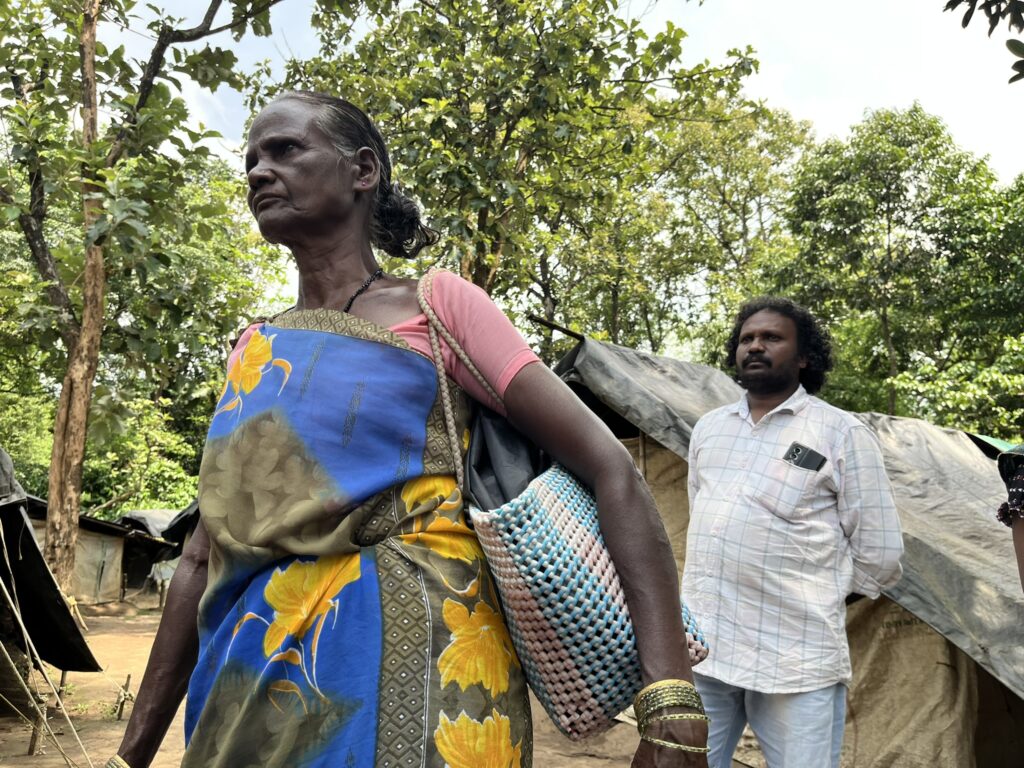
The Jenu Kuruba community marched towards their ancestral land on May 5, 2025, a day they claim is now reserved forest land. Photo: Nikita Jain/Maktoob
Continuing with their demand for recognition and claims to their ancestral lands, different tribal communities in Karnataka’s Nagarahole took out a padyatra (march) demanding their rights, including the stoppage of the Tiger Safari that the community claims is illegal.
A small group of Adivasis from 52 haadis (tribal villages), led by the Nagarahole Adivasi Jamma Paale Hakku Sthapana Samiti (NAJHSS), walked over dozens of kilometres and covered 29 villages in Kodagu and Mysuru districts to assert their rights to their ancestral lands in the Nagarahole forests.
Speaking to Maktoob, J.A. Shivu, president of the Karadi Kallu Forest Rights Committee (FRC), said that the yatra was a way to raise awareness about the recognition and enforcement of their rights under the Forest Rights Act (FRA).
“There are many issues against which we conducted the yatra. One major reason was to raise awareness on the community rights claims. Another issue is the tiger safari that is being carried out on our ancestral lands without the consent of the Gram Sabhas, because there has been no recognition of community forest rights in any of the villages inside Nagarahole,” he said.
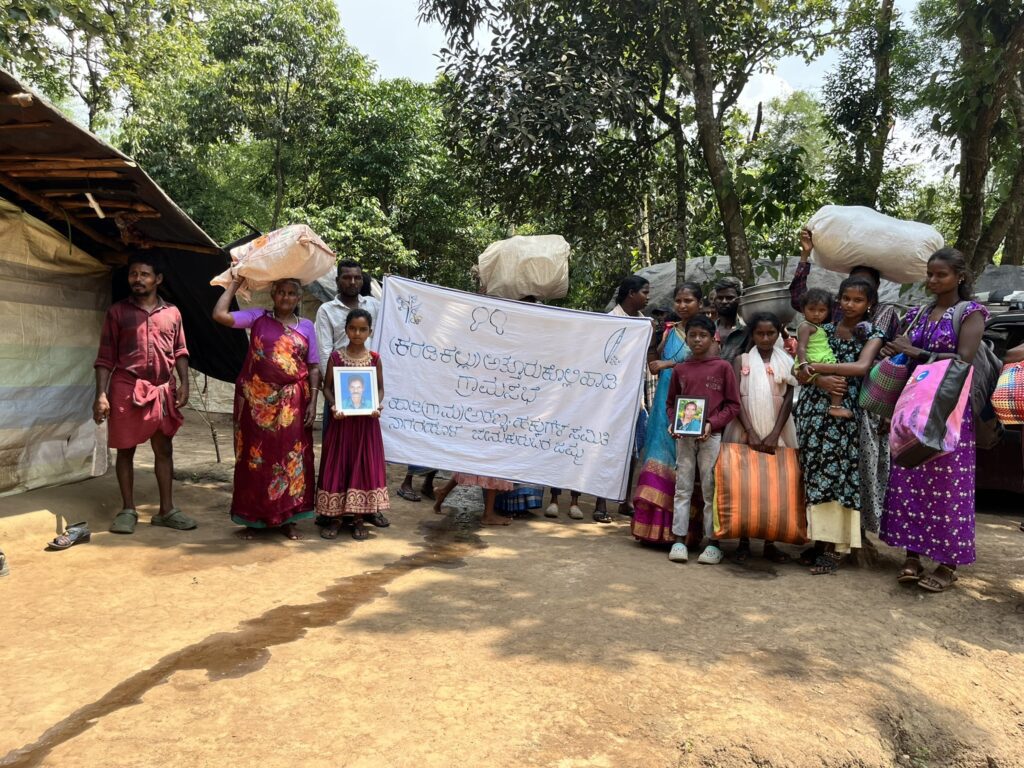
A small group of Adivasis from 52 haadis (tribal villages), led by the Nagarahole Adivasi Jamma Paale Hakku Sthapana Samiti (NAJHSS), walked over dozens of kilometres and covered 29 villages in Kodagu and Mysuru districts to assert their rights to their ancestral lands in the Nagarahole forests. Photo: Nikita Jain/Maktoob
NAJHSS had announced a historic awareness foot march regarding the Forest Rights Act, 2006, in the traditional lands of the Jenu Kuruba, Beta Kuruba, Yerava, and Paniya Adivasi communities residing in the Nagarahole region.
This foot march commenced on December 21, 2025, from Thitimathi Aiyrasuli village in Kodagu district and, passing through the villages of the Nalleri forest region, covered a distance of approximately 70 km and reached Bavali in H.D. Kote taluk of Mysuru district.
Along the route, Gram Sabhas were conducted in many villages under the Forest Rights Act, 2006. Awareness was created about the Act, and discussions were held regarding its non-implementation and violations in the forest areas of Nagarahole, declared as Rajiv Gandhi National Park and Tiger Reserve.
Tribal communities, primarily the Jenu Kuruba, in the Nagarahole Tiger Reserve are in a prolonged conflict with forest authorities, fighting for their ancestral land rights, demanding the implementation of the FRA, and protesting forced evictions and what they perceive as “colonial conservation” models that displace them for wildlife preservation.
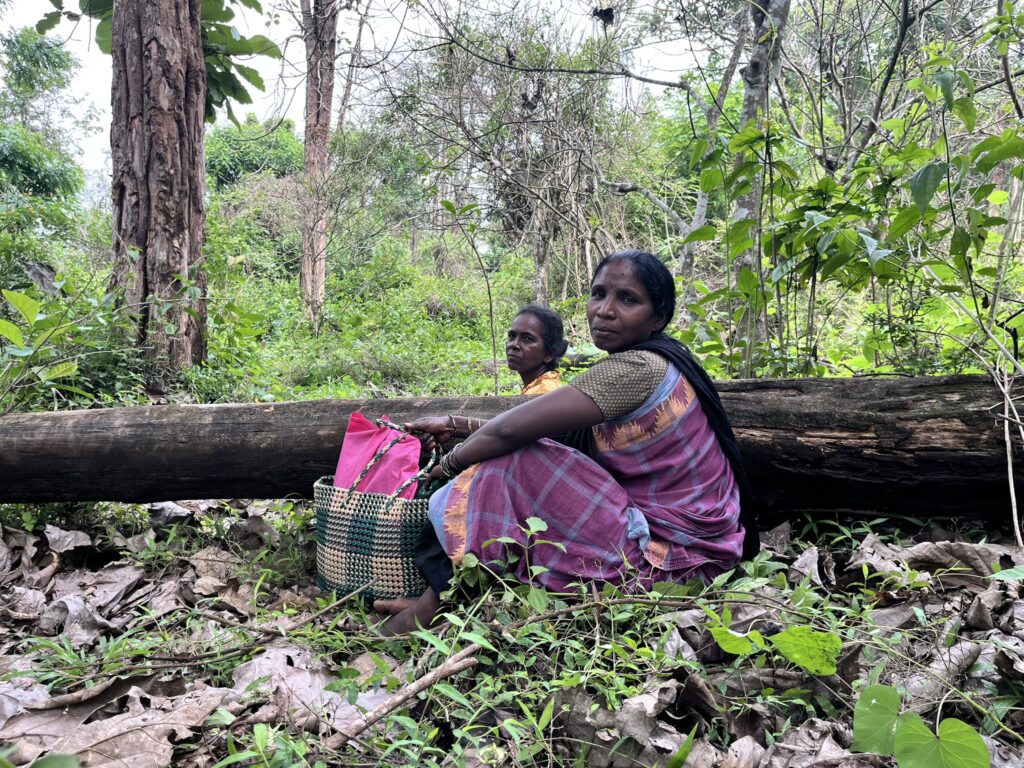
Members of the Jenu Kuruba community inside their village area, which is located in Nagarahole Forest area. Photo: Nikita Jain/Maktoob
Maktoob had earlier reported how the Jenu Kuruba community marched back to their ancestral village in May 2025 and were facing threats of displacement again, as forest officials said claims for the land had earlier been rejected.
Since then, other communities facing similar situations have started demanding the same. The padyatra was an extension of this struggle.
Shivu explained that the Nagarahole Tiger Reserve was declared in 2007 without the consent of the community members.
“This is a larger issue. Neither any discussion nor public consultation happened, nor were any Gram Sabhas held for that. With the padyatra, resolutions were passed in more than 40 villages where all these issues were discussed,” Shivu added.
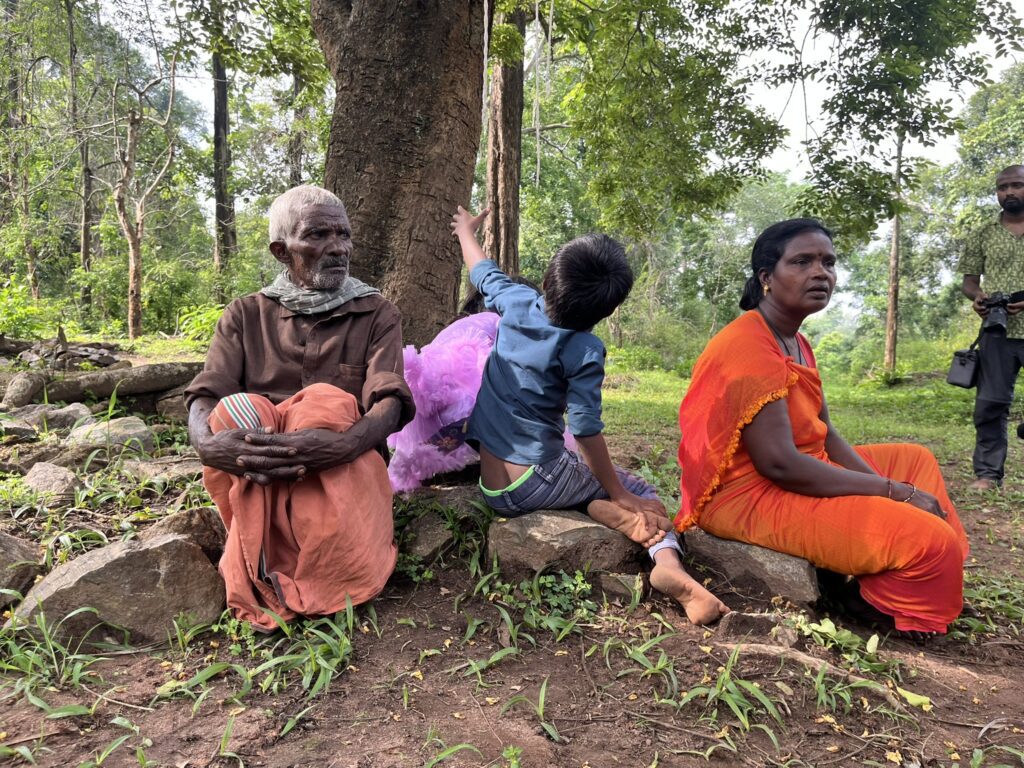
Jenu Kuruba families stay put at the Nagarahole Forest Reserve Area in what they say is their ancestral village. Photo taken on 5 May 2025. Photo: Nikita Jain/Maktoob
NAJHSS has also given the district administrations of Kodagu and Mysuru a week’s time to convene a public meeting to initiate action on their demands to assert their rights to their ancestral lands. The demands were made on January 3, after the conclusion of a 13-day-long march (padyatra) through the Nagarahole forests.
In a meeting with the Additional Deputy Commissioner of Mysuru, the protesting group demanded a meeting with the district collectors of Kodagu and Mysuru.
Another demand by the community is to convert old dilapidated buildings, which were part of a cancelled Taj Resorts project, and hand them over to the community members.
“The Gram Sabhas passed the resolution that those old dilapidated buildings which the Taj constructed will be taken over by the community and converted into an intergenerational learning centre. It will be a learning centre and an intergenerational learning centre for the Jenu Kuruba, Yerava, Paniya and Beta Kuruba communities,” J.K. Thimma, president of NAJHSS, told Maktoob.
Struggle for rights
On May 5, 2025, 52 families belonging to the Jenu Kuruba tribe marched towards their ancestral village, Karadikallu Attur Kolli, to reclaim their right to live on their land under the FRA.
The families still remain there. Beating harsh weather conditions, the community members have set up tents in a limited space. However, as the tussle between the community members and officials continues, the families are forced to endure these harsh conditions.
Shivu, whose family is also staying with the community members, said that many children and women have fallen sick due to changing weather conditions.
“While there have been no threats by the forest department as of now, the living situation is hard. It is very cold at the moment and a lot of children and women are falling sick. Before winter, there were also continuous rains,” he said.
Three tents have been set up inside the area, with forest officials forcefully tearing down a fourth tent on May 7, 2025, which had been set up for menstruating women’s use.
The community members also said that there are threats from forest watchers who come to check occasionally.
“We have not been able to construct our own houses, and the problem is that the entire Individual Forest Rights process has been put under a sort of status quo by the Karnataka High Court. But the Community Forest Rights Resource process has not even begun yet,” Shivu added.
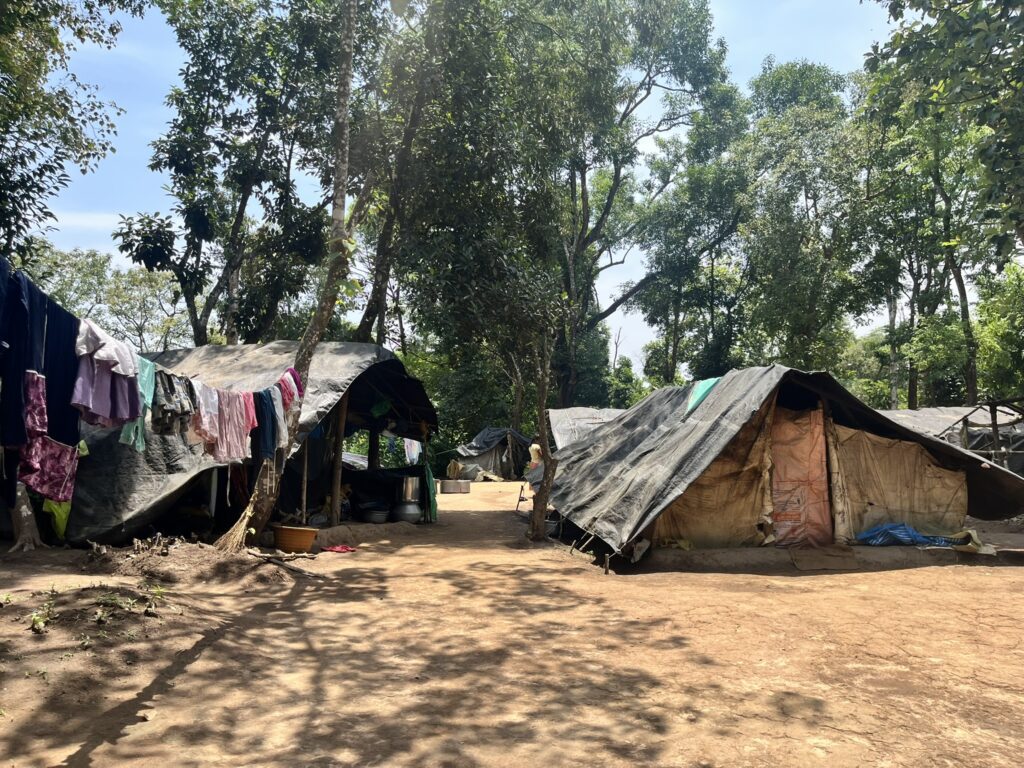
The makeshift tents where the Jenu Kuruba community from Karadikal were staying for decades in Karnataka’s Nagarahole on May 5, 2025. The same day, they marched into the forests to what they claim is their ancestral land. Photo: Nikita Jain/Maktoob
The case is ongoing in the Karnataka High Court, where the former has ordered forest officials not to harass or attempt to remove the community members, while the community members have been ordered not to expand the area of habitation for now.
The Community Forest Rights (CFR) Resource Process is the legally mandated procedure under the Forest Rights Act, 2006, through which a Gram Sabha identifies, claims, verifies, and secures collective rights to protect, manage, and govern its traditionally used forest resources.
Located in the Mysuru and Kodagu districts of southern Karnataka, the Nagarhole Tiger Reserve is barely 40 km north of the Kerala border in Wayanad. It is also part of the Nilgiri Biosphere Reserve, India’s first, declared under UNESCO’s ‘Man and the Biosphere’ programme, which seeks to protect natural ecosystems along with their human communities.
The families were forcibly evicted in the mid-1980s, shortly before Nagarhole was declared a national park under the Wildlife Protection Act, 1972.
Forced into bonded labour
Community members who were children at the time of eviction told Maktoob that they were forced to earn a living in the coffee plantations of the Kodagu–Mysuru belt, located on the fringes of Nagarhole and producing more than 110,000 metric tonnes of coffee annually — more than a third of India’s total production.
Even now, many people remain in forced bonded labour, which has been abolished by law in India.
JK Putti, now in her 80s, was forced into bonded labour. Adamant about staying put, she said that her family has a right over this land and that they will not leave.
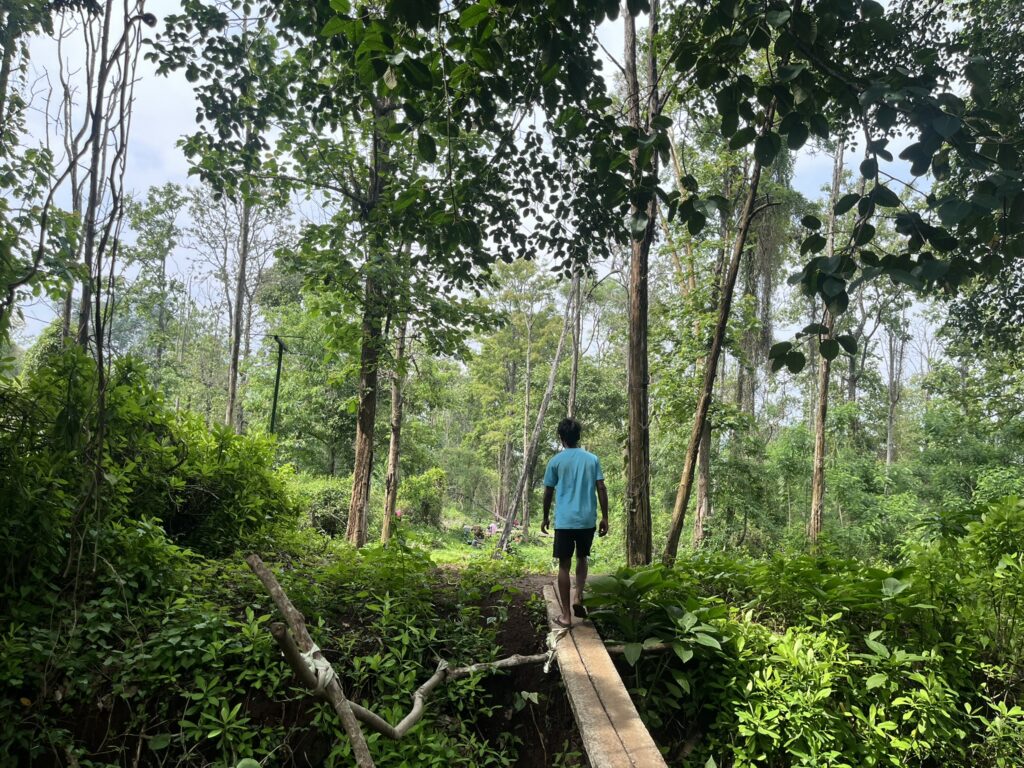
A young man walks towards the entry of Nagrahole forest area, where the Jenu Kuruba community claim their village was. Photo: Nikita Jain/Maktoob
“We have survived inside these plantations for wages as low as Re. 1 or Rs. 2. That is how difficult our lives have been. This time, we will stay here. We will take back our rights and those forest officials will have to move out. This is the land of my forefathers. They lived on this land. What rights do those officials have over this land?” she said.
She added that the communities belong to these forests, have nurtured the trees, and lived alongside animals.
“These outsiders who do not understand or belong to this land want us to leave. But we will sit here. We won’t leave. We used to eat vegetables, leaves, and mushrooms from the forest as food, but this forest department says that we are killing animals. We have been living here for generations. We grew up with these animals in this forest,” she said.
In the 1970s, Jenu Kuruba villages witnessed massive forced displacement. Shivu, whose ancestors were also displaced, estimates that about 3,400 families were forcibly evicted. At the time, thousands more Adivasis continued to live in dozens of hamlets within the Nagarhole Tiger Reserve, their presence in the region dating back centuries.
After people were displaced in the 1970s to build the Kabini reservoir and establish Bandipur National Park, many more were later forced to relocate. This included families from Karadikallu, as the area was successively declared a national park, a tiger reserve, and later a critical tiger habitat.
A large number of those displaced were Jenu Kurubas. They are among the 75 Adivasi communities officially classified as Particularly Vulnerable Tribal Groups (PVTGs), who face severe gaps in development and access to basic facilities.
“Some of our forefathers could not understand and were forced to leave, but we who were forced to work in these coffee plantations were stopped and restricted from collecting mushrooms or leaves. Now they say there is no place for elephants, bears, or tigers to survive in the forest, but our parents lived their lives under the shade of these trees,” Putti added.
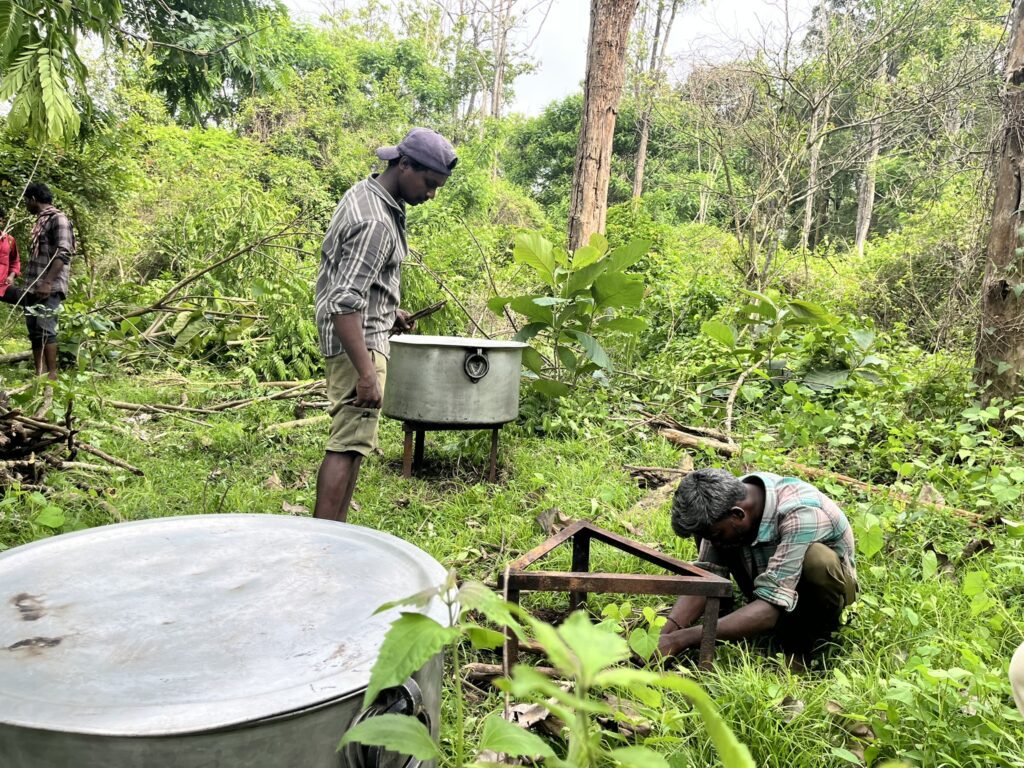
Community members cooking after they marched and reached what they claim to be their ancestral village. Photo: Nikita Jain/Maktoob
Continued dissent
Shivu added that the right to return to their ancestral land is guaranteed under the FRA.
The fight for recognition, however, did not begin last year. In 2021 and again in 2023, all 52 families of Karadikallu applied for recognition of their Individual Forest Rights (IFR) under the FRA, 2006.
They sought legal rights over the land they had long used for living and farming. On October 28 and 29, 2024, officials from the state forest department, revenue department, and the local panchayat conducted a joint survey to verify the claims and record GPS coordinates for all 52 plots.
In January 2022, the Sub-Divisional Level Committee (SDLC), the second stage in the claims review process, rejected the claims of 44 residents, citing a lack of evidence.
The most recent rejection came after the current protest began. The SDLC and the District Level Committee (DLC), the third stage of review, held quick meetings in Madikeri on May 16 and 19. The SDLC met again on May 22 and rejected all forest rights claims from Karadikallu Attur Kolli Haadi, citing insufficient proof of long-term residence or cultivation.
Speaking to Maktoob, forest officials emphasised these factors, stating that the community is “illegally entering the forest area, despite their claims being rejected.”
However, Shivu asserted that the delays and rejections are a way to delegitimise the community. “During the survey, they found the remains of our village. Then on what basis are they rejecting our claims or even our identity?” he said.
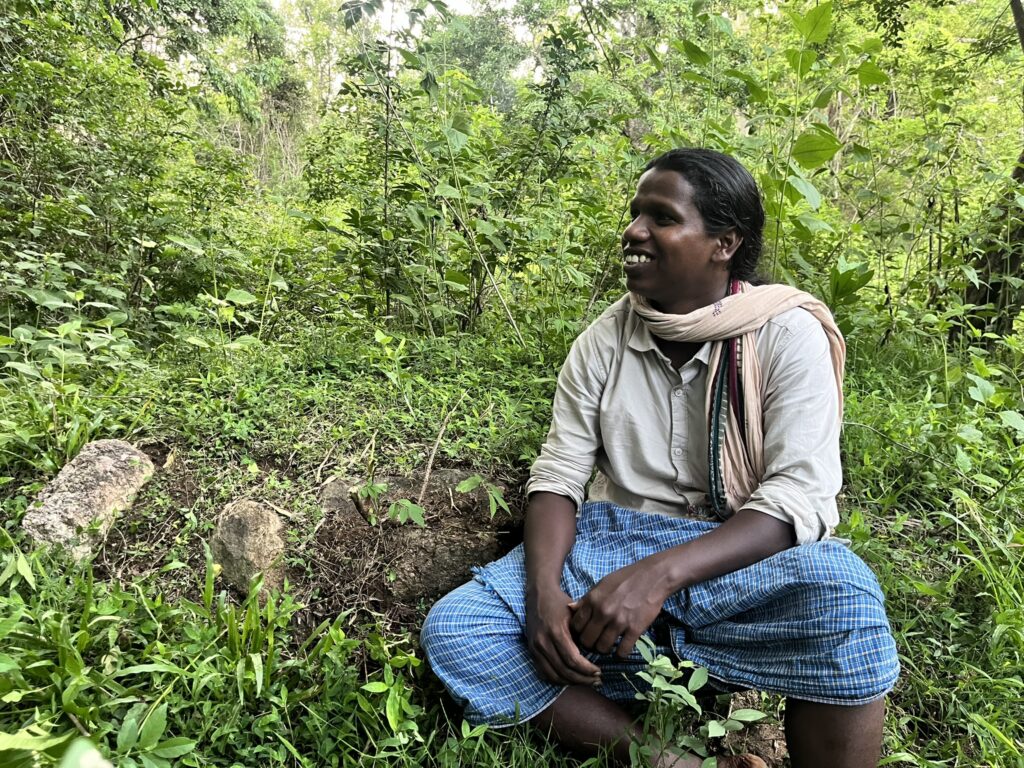
Community leader Shivu sits atop a rock structure, which was a base for the houses that used to be inside the reserved area, showing that the area was indeed a village once. The same was mentioned in the survey. Photo taken on 5 May 2025. Photo: Nikita Jain/Maktoob
Failed conservation policies
The community’s struggle highlights a broader global pattern in which conservation policies are used to justify the displacement of Indigenous communities. Critics argue that while tribal peoples are evicted in the name of environmental protection, governments simultaneously promote tourism and approve large-scale development projects benefiting powerful corporations.
Under India’s right-wing Bharatiya Janata Party government, conservation zones have increasingly become sites of commercial expansion, raising concerns about environmental justice and Indigenous rights.
Speaking to Maktoob, Sharanya Naik — a member of the RITES Forum, part of the regional feminist network Asia Pacific Forum on Women, Law and Development (APWLD) — said that all governments have attempted to grab Adivasi land.
“It is not just about the current government. In fact, all governments have always had their eyes on Adivasi lands, forests, peoples, and territories for expanding their extractive economies. The model of development set in motion by Nehru and followed by successive governments, including the current BJP government led by Modi, is based on the extraction of land, forests, and territories that have been protected, nurtured, and worshipped by Adivasi communities,” she said.
Naik emphasised that whether through tourism-based conservation or mining-driven economic profiteering, “every government has displaced, dispossessed, disinherited, and dislocated Adivasi communities.”
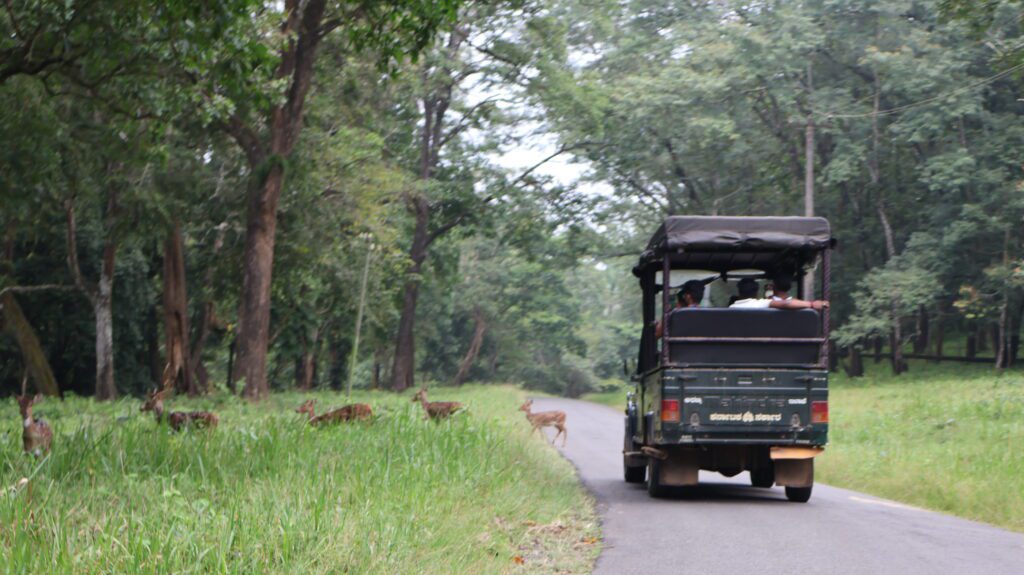
Safari bus inside the Nagarahole Forest. One of the demands at the padyatra is to stop the tiger safari inside the Nagarahole Forest that the various tribal communities say is ‘illegal.’ Photo Taken 10 October 2025. Photo: Nikita Jain/Maktoob
Thimanna, who has been part of several movements to save tribal land in Nagarahole, including the fight against Taj Hotels, said that their struggle is only beginning.
“The forest department has imposed several projects on our lands — wildlife sanctuaries, protected areas, tiger reserves, national parks — all in the name of conservation. Our ancestral homes are being occupied in the name of forest conservation. We are not the occupiers; we are the original inhabitants. Through this, Adivasis will start reclaiming their ancestral lands — in Nagarahole, across the state, and across India,” he said.
India’s conservation framework has historically treated forests as wildlife-only spaces, often excluding Indigenous communities who have lived in and protected these landscapes for generations. While conservation aims to protect biodiversity, its implementation has frequently resulted in displacement, criminalisation, and denial of rights for tribal communities.
“Conservation is a euphemism for tourism expansion and profiteering by turning ‘forests and wildlife’ into commodities for entertainment and leisure. That is why, contrary to the Adivasi worldview where ‘forests, animals, and people are equals’, governments see people as a hindrance to their tourism-driven, extraction-based conservation models,” Naik added.
For now, the Nagarahole tribal communities have given a time frame for a meeting with officials. Failure to hold the meeting, they say, will only lead to further dissent.
Note: This story is part of the APWLD Feminist Media Fund for Alumni Grant.
source: http://www.maktoobmedia.com / MaktoobMedia.com / Home> Features> Topics / by Nikita Jain / January 20th, 2026
The Chemistry Behind Civet Coffee’s Distinctive Flavour
Researchers found that coffee beans harvested from the faeces of the Asian palm civet had a significantly higher total fat content than the traditionally harvested beans.

Civet coffee, better known as kopi luwak, is a premium and highly-priced coffees globally, known for its unique aroma, taste, and nutritional value.
The beans, which can sell for as much as USD 1,000 per kilogram, are harvested from the faecal matter of civets — usually Asian palm civets (Paradoxurus hermaphroditus) — which eat ripe coffee berries and digest the pulp whilst the beans inside pass through the digestive system.
Although this type of coffee has been harvested and sold for over 100 years, there is still debate around whether the unusual harvesting method changes the coffee’s chemical composition.
A new study published in Scientific Reports might have answers to this. Researchers from Kerala, India, have found that coffee beans harvested from the faeces of the Asian palm civet may have higher levels of fats and other key flavour-enhancing compounds than traditionally harvested beans.
“Civets feed on ripened coffee berries, which undergo digestion, absorption, and a natural fermentation process during their passage through the gut. While the pulp gets digested, the beans are excreted through their faces,” the researchers stated in the study.
The study investigated the physical and chemical characteristics of civet-derived and manually collected Robusta coffee from conventionally managed and organically managed coffee estates across Kodagu, which ranks among the highest coffee-producing districts in India.
The team of researchers from the Central University of Kerala, India, collected 68 faecal matter samples from wild civets on five estates growing Robusta coffee in January. The researchers also collected ripe coffee berries from each estate for comparison.
“In our study area, located within the biodiversity hotspot of the Western Ghats, civets are part of the natural ecosystem and consume fruits wildly,” the researchers stated. “The civets in the area belong to three different species. However, based on our observations and previous research, the Asian Palm Civet, a nocturnal mammal, is found most frequently.”
The team, led by Professor Palatty Allesh Sinu from the Department of Zoology, found that the civet beans had a significantly higher total fat content than the manually harvested beans. The civet beans also had significantly higher levels of two fatty acid methyl esters (FAMEs) — caprylic acid methyl ester, and capric acid methyl ester.
“The chemical differences in the civet coffee are a result of fermentation of the beans in the digestive system of the civets, and that the differences likely affect the coffee’s final flavour,” the researchers stated.
The higher fat content would affect the coffee’s aroma and taste profile, whilst the higher levels in the two FAMEs may add a dairy-like flavour.
The team analysed unroasted beans for the study, as the roasting process would further affect the beans’ chemical composition. They also noted that they analysed Robusta beans, whilst most civet coffee is produced using Arabica beans.
—
Source: Central University of Kerala ; Image: Faiz Dila/shutterstock
Study link: Civet Robusta and natural Robusta coffee are different on key fatty acid methyl esters and total fat
Disclaimer: This article does not necessarily reflect the views of AsianScientist or its staff.
source: http://www.asianscientist.com / Asian Scientist / Home> General / by Kasturi Das / January 18th, 2026
Lives lived between shame and sunrise
The hamlet of Kesarugattu is evoked with tender fidelity: dusty lanes, temple bells, the drawing of water from wells, gossip thick as humidity, and the invisible yet unbreakable lines of caste that arrange bodies and destinies.

Rising Sons
There is something compelling about Indian fiction that returns to the soil — its memory, its violence, and its stubborn hierarchies — placing ordinary lives against the tremors of national transformation. When such fiction is also shaped by a supple, idiomatic use of language, as in Kavery Nambisan, the result is especially resonant: “No fighting the British. We must ask them gently-gently to leave.” “If a robber enters your home, and you request him to leave, by gently-gently leading him to the door, will he go, leaving behind the bag he just filled with your provisions?” The prose carries the cadence and rhythm of Indian speech, anchoring the novel firmly in its linguistic and cultural terrain.
Kavery Nambisan’s Rising Sons, set in a small village near Mysuru between the 1920s and 1940s, is a quiet yet searing account of the making of modern India — not through the grand speeches of history, but through the fragile interiors of a family trapped between caste, patriarchy, shame, and awakening. At the centre is Devaraya, a Brahmin patriarch whose pursuit of wealth and respectability masks deep fragility. His carefully curated identity begins to fissure from the opening line, when he announces — half-proud, half-playful — that he has “two sons and one-and-a-half daughters.” The “half” is Chinni, the adopted daughter whose presence inside a caste-sanctified household is both an affront to orthodoxy and a reminder that affection in such worlds is always conditional. Nambisan builds her narrative on this foundational crack.
The hamlet of Kesarugattu is evoked with tender fidelity: dusty lanes, temple bells, the drawing of water from wells, gossip thick as humidity, and the invisible yet unbreakable lines of caste that arrange bodies and destinies. Colonial rule hums in the background, but the more immediate and intimate oppressor is caste itself. Ancestral dominance and the fear of social humiliation govern every gesture inside and outside Devaraya’s house. Working in a bank as a peon in Mysuru while running a modest money-lending shop back home, Devaraya embodies the dangerous intersection of caste pride and capitalist ambition. His public face projects ritual purity; his private life is riddled with moral compromise. In a paraphrased confrontation, his younger son Anna articulates the novel’s central fracture: you speak of purity, but conceal your own stains — what kind of honour demands lies? It is a quiet but devastating rebellion, marking the first collapse of the old order.
The revelation of Devaraya’s hidden past — one that undermines the very caste purity he venerates — shatters the world he has built. The family collapses under the weight of shame; one son disappears; Devaraya is disgraced and imprisoned; the village that once deferred to him turns away with vindictive satisfaction. Inside the house, silence becomes a weapon. In another paraphrased exchange, Gowru, his long-suffering wife, speaks with restrained fury accumulated over decades: a home built on fear cannot survive a single gust of truth. The line is quiet on the page but detonates through the moral architecture of the novel.
From the family’s ruins, a new consciousness emerges. Anna is drawn into the freedom struggle. His rebellion is both political and personal — a rejection of shame as a mechanism of control. In a moment that captures the novel’s fusion of private and national liberation, Anna tells his father that if the nation must free itself, individuals must first confront older chains than those imposed by the British. Chinni, meanwhile, becomes the emotional heart of the story. Experiencing progressive hearing loss, dismissed by society and bound by deep affection to Anna, she embodies the resilience of the marginalised. Her silence is not weakness; it is resistance.
One of the novel’s notable achievements is its portrayal of how colonial capitalism intersects with caste hierarchy. In a sharply staged scene, a village priest — the former custodian of ritual prestige — visits the lending shop to deposit his money, bargaining for interest with head bowed. Devaraya’s paraphrased reflection is telling: even gods have begun to bow before Mammon. With this, Nambisan captures an India shifting uneasily from spiritual hierarchy to monetary hierarchy, neither offering dignity to the powerless.
Nambisan writes with felicity and restraint. Some readers may find the pace measured, but the emotional intelligence and historical density more than compensate. At a time when conversations around caste are often flattened into slogans or denial, Rising Sons insists on remembering.
source: http://www.deccanherald.com / Deccan Herald / Home> Features> Books / by Gurucharan Gollerkeri / January 18th, 2026
Stay the Raho way: A new blueprint for India’s homestays
From a single Coorg cottage to a growing cluster-based model, Simona Mohan is reshaping the mass-premium homestay market with curated stays and local experiences.

Simona Mohan, Co-founder, Raho Hospitalities / Photo by Mexy Xavier /
Simona Mohan (28)
Co-founder, Raho Hospitalities
As with every 20-something, Simona Mohan and her friends were on a hunt for a New Year’s escape a few Decembers ago. A holiday in Coorg, dealing with subpar accommodation, planted the seed that eventually became Raho Hospitalities—an experience-led, mass-premium homestay brand that offers curated, end-to-end holiday experiences in non-urban leisure destinations.
Mohan, along with family friends Sidharth and Gautham Somana, twin brothers aged 35, started a pilot project two years ago with a single, family-owned, two-bedroom cottage in Coorg. “We did some simple decor, changed the bedsheets, added some paintings, and spent less than ₹5,000 on the project,” Mohan says. “We listed it on Airbnb to test it out, and we saw high occupancies of about 85 percent.”
At the time, Mohan was working in politics, drafting election manifestos, writing papers for MPs, and tracking parliamentary sessions. Sidharth, who was on a gap year from university, focussed on Raho, while Gautham was studying in the US. Mohan was helping with operations and on-ground guest service part-time. Sidharth had to return to university in the US the following year, and Mohan took charge.
“That’s when I started to enjoy the process. I quit the policy space completely and started doing it full-time,” she says.
Raho operates via a hub-and-spoke model: It sets up clusters of 40 to 100 rooms within a 30-minute radius to create micro-tourism hubs. This allows them to easily access and manage these properties from a central location within that zone.
Raho’s tagline says that it begins where Airbnb ends. “Airbnb and other OTA platforms like MakeMyTrip or Booking.com will only provide a listing; they won’t manage the property,” says Mohan. Raho partners with property owners, redesigns and standardises homes, and operates them end-to-end to deliver holiday experiences. “This includes not just the stay, but everything from the food to experiences on the ground, including shopping, taxis, local experiences, and even a personal host throughout your stay.”
An average booking with Raho can cost between ₹3,000 and ₹5,000 for a three-bedroom cottage in Coorg for one night. Their target audience is people between the ages of 25 and 40, who are looking for affordable but valuable experiences.
Raho currently has 50 operational rooms in Coorg and is focussed on expanding within the region before moving on to target markets, including Chikmagalur and Wayanad; its goal is to have 100 operational rooms by April.
The company raised a pre-seed round of ₹2.6 crore from Campus Fund and angel investors in April 2025. It operates a multi-channel, asset-light revenue model: Profit-sharing for rooms, 60 percent of which goes to property owners; Raho earns 15 percent commission on direct bookings. Beyond rooms, it earns about 30 percent margins on food and beverage, and 30 percent on curated experiences, services and in-property product sales.
“This blended model maximises guest value, strengthens unit economics at scale, and allows us to reinvest in brand consistency, guest experience, and operational excellence across clusters,” Mohan says.
Raho’s revenue for FY25 was ₹65 lakh; the company’s projected revenue for FY26 is ₹3 crore. It hopes to break even by April.
“Raho adopts a smart model, bridging design and homestay operations. It’s strong on structure, asset-light scalability and consistency. However, to elevate further, it could focus on curated luxury differentiation and stronger brand storytelling,” says Kapil Chopra, founder of EazyDiner and The Postcard Hotel, and 30 Under 30 jury for the hospitality category.
(This story appears in the Jan 09, 2026 issue of Forbes India. To visit our Archives, Click here
source: http://www.forbesindia.com / Forbes India / Home / by Pankti Mehta Kadakia / January 14th, 2026
Explained: Coorg’s unique land record system that prompted Karnataka government to amend its land law
Karnataka’s Kodagu district has a unique system of land ownership called Jamma Bane where the land records contain the names of original grantees even when bequeathed to new generations. The absence of officially recognised land ownership documents has created issues for current owners.

The amendment is aimed at modernising the land records in Coorg, which is in Kodagu district. Wikimedia Commons
The Karnataka government has amended its land revenue law to modernise an age-old system of land records in the scenic Coorg region, home to the indigenous Kodava community.
Karnataka Governor Thawarchand Gehlot gave his assent to the Karnataka Land Revenue (Second Amendment) Act, 2025 on January 7, and the state government issued a gazette notification the following day.
The amendment is aimed at modernising the land records for the unique Jamma Bane land holdings in Coorg, which is now in Kodagu district.
In this region, families have passed down land grants from the time of the British and Kodava kings for generations. But the records contained the names of original grantees (pattedars) even when bequeathed to new generations.
The absence of officially recognised land ownership documents made it difficult for current owners to buy or sell land or to secure bank loans.
What exactly are Jamma Bane lands, and how does the new law plan to address the issues arising out of this unique system of records? The Indian Express explains.
What are Jamma Bane lands of Kodagu or Coorg?
The Jamma Bane tenure is a form of land holding prevalent in Kodagu district which is distinctly different from other classes of land holdings in the state. The word Jamma means hereditary.
These Jamma lands were originally granted by erstwhile kings of Coorg and the British — between 1600 and 1800 — to local communities in return for military service.
The Jamma lands comprise both wetlands, used for paddy cultivation, and forested highlands, which have transformed into the now-famous coffee estates of Coorg.
The Jamma Bane land ownership is registered in the name of the original pattedar from a family. Over generations, the names of the new owners are added alongside the name of the pattedar. The land ownership name could not be changed to reflect new owners.
The Coorg Land Revenue and Regulations Act, 1899 was in place to govern land ownership in the region till the introduction of the Karnataka Land Revenue Act, 1964. However, some provisions of the 1899 Act were continued in Kodagu despite the absence of these provisions in the Karnataka Land Revenue Act of 1964.
A S Ponnana, the Congress MLA from Virajpet, said during a debate in the Karnataka Assembly: “The name of the family head (pattedar) continues in the land records even after death and even after 40 to 50 years of change (of owners). This has been continued as a tradition. This has continued despite the lack of provisions in the Karnataka Land Revenue Act.”
The ownership rights of the people of Kodagu over the Jamma Bane lands in the region was recognised by a full bench of the Karnataka HC in 1993 in Chekkera Poovaiah vs State of Karnataka.
In 2024, the Karnataka HC upheld the Karnataka Land Revenue (Third Amendment) Act, 2011 which gave full ownership rights over Jamma Bane lands in Kodagu to Kodava families.
“It is clear that by way of the amendment what is achieved is to grant full ownership of the land to the Kodava family, including all division holders i.e., all members of the family, in a land which earlier had stood vested in the government and the government was the owner thereof,” the Karnataka HC ruled in a plea where it was argued that amendments made in 2011 would violate the land traditions and customs of the Kodava community.
Why was the Karnataka Land Revenue (Second Amendment) Bill, 2025 introduced?
“Historically, these lands have been held and enjoyed on the basis of customary rights by members of joint families, often without clear entries in the Record of Rights. With the passage of time, complications have arisen in maintaining accurate records of ownership, inheritance, survivorship and alienations pertaining to Jamma Bane holdings,” says the statement of objects and reasons for the draft of the Bill that was tabled in the August 2025 monsoon session of the Karnataka Assembly.
“In particular, the absence of explicit provisions in the Karnataka Land Revenue Act, 1964 (Karnataka Act 12 of 1964), to record the rights of joint family members in such holdings has led to difficulties in mutation, registration, inheritance and maintenance of revenue records,” stated the draft Bill.
This led to numerous disputes regarding succession, alienation and privileges attached to Jamma Bane lands. “It has therefore become necessary to provide statutory recognition of the peculiar nature of Jamma Bane tenure in Kodagu District and to ensure that the rights of all members of a joint family are duly recorded in the mutation and revenue registers,” the Bill stated.
The modified version of the Bill which was tabled and passed by the legislature last month — after incorporating the recommendations of a sub-committee of state legislature — states that changes introduced in the land records of Kodagu district were not consistent with the Karnataka Land Revenue Act, 1964.
The Bill says that changes made to land record on the basis of a circular dated 14.09.2000 had “resulted in anomalies in the classification and maintenance of land records, including entries in the Record of Rights (RTC), which are legally unsustainable and not in conformity with the prescribed procedure under the Act.”
“In view of the ongoing digitization and standardization of land records under the Bhoomi Project, and in light of various judicial pronouncements upholding the need for accuracy, uniformity and legality in maintaining revenue records, it has become necessary to empower the Tahsildars of Kodagu District to correct such inconsistencies in the land records following the due process of law,” the Bill has stated.
What does the new amendment do?
The new amendment to the law essentially empowers tahsildars (assistant commissioners of the revenue departments) in Kodagu to make necessary corrections in land records to bring them in conformity with the Karnataka Land Revenue Act, 1964 for Record of Rights containing “the names of persons who are holders, occupants, owners, mortgagees, landlords or tenants of the land or assignees of the rent or revenue…”
“This amendment will bring the land records of Kodagu District in conformity with law and ensure consistency with the rest of the State,” states the amended new law.
The state revenue minister, Krishna Byre Gowda, said during the debate on the new law in the state Assembly that local tahsildars would hold adalats to address objections before land records are modernised and finalised in the region to give land rights to owners.
The initial draft of the bill sought to amend sections 127, 128, 129 and 130 of the Karnataka Land Revenue Act, 1964 to allow inclusion of particulars of joint family members in the Register of Mutations in respect of Jamma Bane holdings; reporting of acquisition of rights as members of a joint family; empower revenue officers in Kodagu to recognize rights; registration of rights in land records and “ensure that relevant information relating to family tree, survivorship, inheritance and privileges is furnished”.
The final Bill, which has now been enacted, has only amended Section 127 of the Karnataka Land Revenue Act, 1964 by adding a subsection.
Subsection 4 states: “Notwithstanding anything contained in the preceding sub-sections, the Tahsildars of Kodagu District shall, on receipt of an application or otherwise, after following the procedure prescribed, and after conduct of enquiry as he deems fit, make necessary corrections or deletions in the land records pertaining to entries that were transferred from Column 3 of Jamabandi Register to Column 9 and 12 of RTC and consequential entries made due to such transfer thereof, to bring them in conformity with the provisions of clause (a) of sub-section (1) of this section.”
The bill adds a caveat that “any such order passed by the Tahsildar under this subsection shall be appealable as per the procedure prescribed under this Act”.
source: http://www.indianexpress.com / The Indian Express / Home> News> Explained> Explained Law / by Johnson T A / January 15th, 2026
Millet dishes take centre-stage at traditional food revival competition in Madikeri
Millet dishes take centre-stage at traditional food revival competition in Madikeri.

Dishes prepared from millets grabbed the attention at a cooking competition organised in Madikeri to revive forgotten culinary traditions. | Photo Credit: Special Arrangement
Traditional dishes prepared with millets emerged as the highlight of a cooking competition organised in Madikeri, in Kodagu district of Karnataka, to revive forgotten culinary traditions.

Over 60 teams participated in the district-level competition, organized by the Kodagu district administration, Zilla Panchayat, and the Department of Agriculture. | Photo Credit: Special Arrangement
Over 60 teams participated in the district-level competition, organized by the Kodagu district administration, Zilla Panchayat, and the Department of Agriculture at the office of the Joint Director of Agriculture in Madikeri earlier this week.
The exhibition showcased an impressive variety of snacks and dishes prepared using diverse millets, including jowar, ragi, foxtail millet, pearl millet, kodo millet, barnyard millet, and little millet.
Among the creative entries were ragi dosa, nippattu, chakli, kodu bale, kajjaya, millet payasa, millet pulao, ragi biscuits, white jowar biscuits, millet cake, millet paddu, millet laddu, brinjal cutlet, and foxtail millet dosa.

Separate prizes were awarded across three categories: spicy dishes, sweet dishes, and forgotten traditional dishes. | Photo Credit: Special Arrangement
Other notable dishes were jackfruit cutlet, buki kajjaya, ragi laddu, gulige payasa, sajje nadu, foxtail millet cutlet, papaya halwa, pearl millet halwa, millet vade, and fenugreek leaf vade.
Separate prizes were awarded across three categories: spicy dishes, sweet dishes, and forgotten traditional dishes. First prize winners received ₹5,000, second prize ₹3,000, and third prize ₹2,000.
Speaking at the event, Joint Director of Agriculture Chandrashekar emphasized the nutritional benefits of millets, and encouraged people to incorporate them in their daily diet. He highlighted that millet consumption strengthens bones and provides essential calcium.
Awareness rally
Prior to the competition, an awareness rally on the importance of millets was flagged off by Kodagu Zilla Panchayat Chief Executive Officer Anand Prakash Meena.
NCC students, farmers, and officials from the Agriculture and Horticulture departments participated in the rally, which began from the fort premises in Madikeri and concluded at Gandhi Maidan.
Addressing participants at the fort premises, Mr. Meena stressed that millets are nutrient-rich. He called for greater awareness about their benefits. He opined that incorporating millets helps maintain a balanced diet, and can aid in managing diabetes and blood pressure.
source: http://www.thehindu.com / The Hindu / Home> News> India> Karnataka / by The Hindu Bureau / January 16th, 2026
US honour for Kodagu researcher

Mysore/Mysuru:
Theetharamada Dr. Devaki (Kollimada) has completed a prestigious Post-Doctoral Research Degree in Commerce from an institution in YUVA University Florida, USA.
She is the only lady from Kodagu to receive this honour in the field of Commerce.
Her post-doctoral study, titled ‘Impact of Yoga Practice on Stress Management Among Higher Secondary School Students in Mysore District,’ explored the effectiveness of structured yoga interventions in reducing stress levels among adolescents.
The research offers valuable insights for educators, policymakers and wellness practitioners, highlighting yoga as a powerful tool for enhancing student well-being.
source: http://www.starofmysore.com / Star of Mysore / Home> News / January 13th, 2025
This instant coffee is crafted from India’s finest Coorg and Chikmagalur beans
A new indulgent coffee experience crafted by Vintage Coffee for modern Indian consumers.
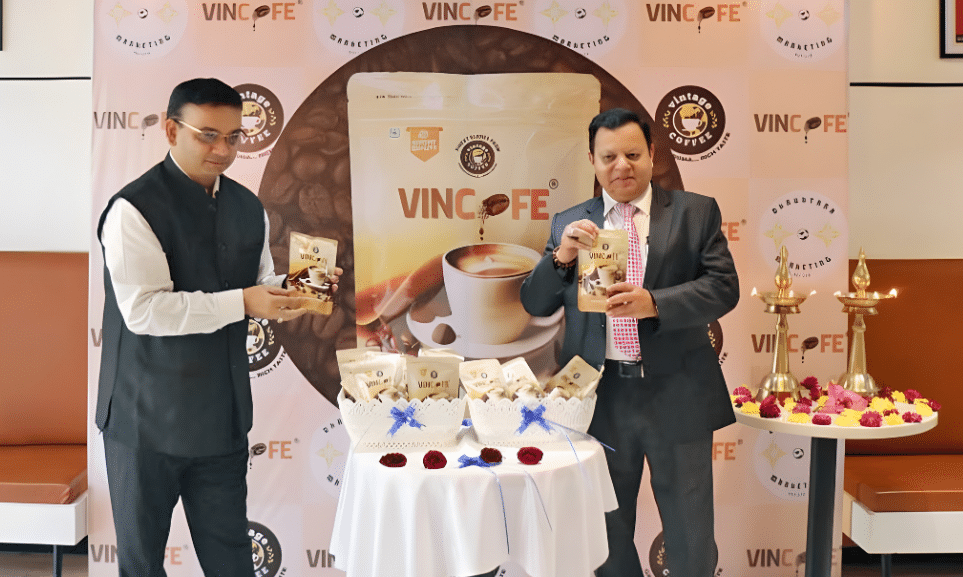
Vintage Coffee and Beverages is set to elevate daily coffee rituals with the launch of VINCOFE™ Instant Coffee Pure, a premium, 100% pure instant coffee designed for consumers who savour richness, aroma and a smooth, refined taste in every cup.
Building on Vintage Coffee’s growing legacy
After the warm reception of Vintage Coffee Café in Nerul, Navi Mumbai, and the success of its Roast & Ground offerings online, the brand now steps into the instant coffee category with a product that blends global sophistication with Indian flavour sensibilities.
Crafted from India’s finest coffee estates
Celebrating India’s renowned coffee-growing regions — Coorg, Chikmagalur and Hassan — VINCOFE™ Instant Coffee Pure is crafted from shade-grown beans, handpicked with care. Artisan roasting, precise extraction and modern agglomeration at VCBL’s advanced facility near Hyderabad ensure purity, consistency and a superior sensory experience.
A cup designed for modern lifestyles
Rich aroma, smooth texture and balanced flavour come together to create a premium coffee moment, whether at home, at work or on the go.
“As India’s coffee culture evolves, we are proud to introduce a blend loved in global markets,” said Balakrishna Tati , Chairman & Managing Director, VCBL. “VINCOFE™ Instant Coffee Pure is crafted for everyday indulgence — rich, smooth and perfect for modern lifestyles.”
source: http://www.hotelierindia.com / Hotelier India / Home> F & B / December 07th, 2025
Rohan Bopanna backs Maverick & Farmer parent Good Farmer Food Concepts in $1.5 million funding round
Capital infusion to fuel café expansion, retail growth and production infrastructure.

Good Farmer Food Concepts, the company that founded artisanal coffee brand Maverick & Farmer Coffee and Square Burgers & Co., has raised $1.5 million in an ongoing Pre-Series A round. The company’s first external fundraising has been led by investment firm CreedCap with participation from Indian tennis star Rohan Bopanna and former Indian cricket team captain Rahul Dravid, along with Meraki Sport & Entertainment.
Planned use of funds
The company will utilize the fresh funds to expand its national presence with its cafes, invest in R&D and production infrastructure, and bolster and grow the brand’s retail vertical. The retail segment focuses on creating various SKUs of specialty coffee roasts and nurturing the home brewer experience by curating a variety of equipment. The brand’s new outlets in the pipeline are in Mumbai, Delhi NCR, Goa, and Bangalore. The company currently operates seven outlets in Bangalore and Goa and expects to reach ten by the end of the year.
Founders and brand philosophy
Founded by Ashish D’abreo, Sreeram Gangadharan, and Tej Thammaiah, Good Farmer Food Concepts is built on a product-first philosophy and a strong focus on quality and innovation. The company blends experimentation with coffee for retail, community-driven cafes, and a health-forward take on fast food. Maverick & Farmer is known for its experimental and maverick approach to Indian coffee, while Square Burgers & Co. continues to grow as a health-first food brand.
Co-founder’s perspective
“Before expanding, we first ensured that our people and operations were completely in order. Once that foundation was set, we began exploring funding and new locations. From the outset, we knew that each Maverick & Farmer Café should tell its own story and connect with a unique community. With Square Burgers, our vision was clear—we wanted to experiment with health-forward fast food. The current round of funding has enabled us to bring these ideas to life,” said Sreeram Gangadharan, Co-founder, Good Farmer Food Concepts.
Investor association and brand support
Bopanna has previously collaborated with the brand on a signature blend called the Rohan Bopanna Masterblend and has been closely associated with its evolution over the years. Dravid, who has long supported homegrown businesses built on strong fundamentals, joins the cap table for the first time.
“I’ve watched Maverick & Farmer grow from the very beginning and what’s always stood out to me is the honesty and intent behind the brand. Their commitment to quality, experimentation and staying true to their roots is rare. I’m proud to continue supporting their journey and excited to be part of what’s in store next,” said Rohan Bopanna.
source: http://www.hotelierindia.com / Hotelier India / Home> Operations / January 12th, 2026

