The Kodagu Press Club has invited applications for its annual journalism awards, recognising excellence in reporting across multiple categories. Interested journalists have been asked to submit their entries on or before April 30, according to a statement issued by General Secretary M. K. Adarsh.
The “Best Human Interest Report” award has been instituted by veteran journalist Coovercolly Indresh and family in memory of his parents, B. V. Chandrashekar and B. C. Pushpalatha, with an endowment fund of ₹1 lakh to support the award.
The awards also include the “Best Impactful Report,” instituted in memory of senior journalist K. B. Mahantesh. Another category, “Best Environmental Report,” has been instituted by M. N. Chandramohan in memory of his parents M. Narayana and N. Padmavathi.
Each award carries a cash prize of ₹5,000 along with a plaque. The awards will be presented during the Press Club Day celebrations scheduled to be held on June 7 under the presidentship of president Bollajira B. Ayyappa.
As per the guidelines, entries must be special reports published between January 1, 2025, and December 31, 2025. Applicants must be members of the Kodagu Press Club and can submit entries for only one category. It is mandatory to clearly mention the category while applying.
Journalists are required to submit two copies of their published report along with the application at the Kodagu Press Club office. The initiative aims to encourage quality journalism and recognise impactful reporting in the region.
source: http://www.thehansindia.com / The Hans India / Home> News> State> Karnataka> Bengaluru / byThe Hans India/ April 18th,2026
In Brief: Minor Hotels has signed agreements for the Anantara Zanti Coorg Resort and Anantara Kolkata Hotel, marking the first Anantara-branded resort and urban hotel in India.
Rendering of the Anantara Kolkata Hotel – Image Credit Minor Hotels
Minor Hotels has signed agreements for two new properties in India under its luxury Anantara Hotels & Resorts brand: Anantara Zanti Coorg Resort and Anantara Kolkata Hotel. These will be the brand’s first resort and first urban hotel in the country.
Anantara Zanti Coorg Resort is scheduled to open in 2028 near Madikeri in Coorg, Karnataka, within the UNESCO-recognized Western Ghats. The 69-key resort is being designed by Sri Lankan architect Channa Daswatte and will draw on the region’s natural landscapes, coffee heritage, and Kodava culture. Planned facilities include four dining venues, a swimming pool, a lobby lounge and library, Anantara Spa and wellness center, a fitness studio, meeting and event spaces, and a kids’ club. Zanti Hospitality owns the property.
Anantara Kolkata Hotel is slated to open in 2032 as part of the World Trade Center Salt Lake Kolkata, a mixed-use development. The 170-key hotel is designed to serve the city’s business, meeting, and event needs, with facilities including two restaurants, a lobby lounge, flexible meeting and event spaces, an Anantara Spa and wellness center, a gym, and a swimming pool. The World Trade Center Salt Lake is a joint venture between Aryan Realty and Merlin Group.
These signings expand Minor Hotels’ portfolio in India, following the introduction of the Anantara brand with Anantara Jewel Bagh Jaipur in 2025 and the signing of the first Avani-branded property, Avani+ Sunray Beach Visakhapatnam Resort. The company is progressing toward a target of 50 properties in India within the next decade.
Minor Hotels’ strategy in India includes developing both leisure destinations and key cities, with a focus on its luxury and premium brands such as Anantara, Avani, and NH Collection, as well as select-service brands including NH, Oaks, and iStay. The company has also launched the Minor Reserve Collection and Colbert Collection to provide opportunities for independent hoteliers. Expansion in India is primarily through hotel management agreements and franchise opportunities.
source: http://www.hotelnewsresource.com / HNR Hotel News / Home> All News> Asia Pacific> Development News> Previous Article / by News-Hotel Development India / April 08th, 2026
Rashmika Mandanna and Vijay Deverakonda’s intimate Kodagu reception goes viral, with unseen moments, a heartfelt speech, and her traditional Coorgi look stealing the spotlight.
Rashmika Mandanna and Vijay Deverakonda’s wedding reception in Kodagu. (Photo: X/Rashmikadelhifc)
Rashmika Mandanna and Vijay Deverakonda’s wedding celebrations are far from over. After tying the knot in Udaipur on February 26 and hosting a reception in Hyderabad on March 4, the couple held an intimate gathering in Kodagu on April 6.
The reception was held at the Serenity Convention Hall in Virajpet, Kodagu, a day after Rashmika celebrated her 30th birthday with close friends and family. It also marked the couple’s first visit to Coorg after their wedding.
Pictures from the ceremony show the couple walking hand-in-hand, smiling warmly as they greeted guests in an intimate setting attended only by their inner circle. In one moment, Rashmika was seen affectionately styling Vijay’s hair on stage, framed against elegant white floral décor.
Rashmika Mandanna’s father reportedly gifted her the family’s Coorg bungalow, Serenity, located in Kukloor village near Virajpet, a home tied closely to her roots.
Rashmika Mandanna embraces her heritage, Vijay Deverakonda channels retro charm
For the reception, Rashmika Mandanna embraced her heritage in a pink and olive-green silk saree draped in the traditional Kodava style. The pleats were tucked at the back, with the pallu brought over the right shoulder and secured in place, an authentic Coorgi touch.
She paired the look with layered gold jewellery, including stacked bangles, classic jhumkas, and statement necklaces. Her hair was styled in a sleek bun adorned with gajra.
Vijay Deverakonda, meanwhile, channelled retro charm in black flared trousers, a white open-collar shirt, and a blazer with silver detailing, finishing the look with white shoes.
Vijay Deverakonda’s heartfelt speech in Coorg
During the reception, Vijay Deverakonda delivered an emotional speech, talking about his growing connection with Kodagu and his personal memories tied to the region.
“Next time I come I’d like to go around and see her childhood and life here. This is the third time I am here. The first time was before I even knew her, with my school friends – Coorg was our first holiday destination. I found out later that I had stayed in one of her friend’s house (who was not there at the event),” he was quoted as saying by India Today.
Speaking fondly about the place and its people, he added, “I’ve become so fond of this place, such a beautiful place. I always thought that women from here (Kodagu) are super beautiful, even before I met her. I think coorgi women are very beautiful, and I’m married to one, and I’m very happy. Lovely meeting and seeing you all here.”
Rashmika Mandanna-Vijay Deverakonda wedding
Rashmika Mandanna and Vijay Deverakonda tied the knot on February 26 at ITC Momentos in Udaipur in a grand three-day celebration that included haldi, sangeet, and ceremonies honouring both Telugu and Kodava traditions.
They later hosted a star-studded reception in Hyderabad on March 4, followed by an intimate lunch for fans. In a unique gesture, the couple also arranged for sweets to be distributed across multiple cities, sharing their joy with people across the country.
On the work front
On the work front, Rashmika Mandanna and Vijay Deverakonda have resumed shooting for their third on-screen collaboration, Ranabaali, directed by Rahul Sankrityan, which is slated for release on September 11.
source: http://www.indianexpress.com / The Indian Express / Home> SCREEN> News> Entertainment> Telugu / by Entertainment Desk / April 07th, 2026
While the couple had booked their return tickets from Bengaluru to Bojnurd via Sharjah for March 16, the flights were cancelled due to the West Asia crisis.
Naveen and Nadher / Special Arrangement
Madikeri:
A couple from Iran has been stranded in Kodagu and is unable to book flights back following the Iran-US/Israel War.
The woman, who is a native of Kodagu and her Iranian husband, who were on an annual visit to Kodagu, hope that they can fly back before their Visas expire.
Naveen, a native of Murnad in Kodagu, met Iranian National Nadher over four decades ago when the former was working for a private company in Bengaluru. The couple was married and settled in Bojnurd city in Iran.
They have two children; one of them is a civil engineer and the other is an architect.
Naveen and Nadher own an orchard in Iran and sell exotic fruits, including almonds, apricots, pistachios and other berries.
As confirmed by the two, they annually visit Naveen’s house in Murnad during December every year, and they arrived in Murnad at the end of December last year.
While the couple had booked their return tickets from Bengaluru to Bojnurd via Sharjah for March 16, the flights were cancelled due to the war crisis.
The two later booked a flight that was scheduled to take off on April 15, but they confirmed that this flight too had been cancelled. Following these developments, the couple is stranded in Kodagu.
The couple shared that they are unable to contact their children due to the internet shutdown in Iran, and they fear legal issues as their visas will expire in May, and hope to find a return flight to Iran before it.
source: http://www.newindianexpress.com / The New Indian Express / Home> Karnataka / by Express News Service / April 05th, 2026
Experienced trekkers cautioned individuals against going on a solo trek or a solo hike on a new trek trail, even as the forest department ramps up safety measures.
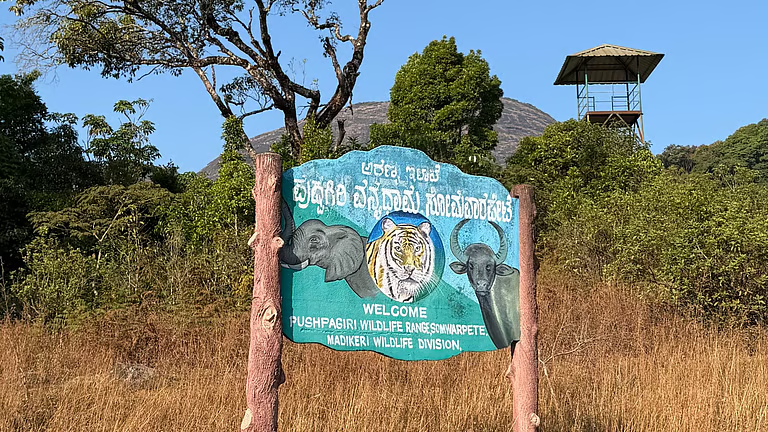
Board marking Pushpagiri wildlife range territory under Madikeri Wildlife Division.Photo | Express
Madikeri:
The Kodagu division forest department has currently closed Tadiandamol for trekkers after a woman techie from Kerala went missing for four days while on a solo trek.
Sources confirmed that the trail will open after the department takes a few precautionary measures to avoid repetition of such incidents.
“The Tadiandamol Trek is closed for trekkers till April 11,” confirmed Madikeri Deputy Conservator of Forests Abhishek. He explained that the department will conduct proper markings of the trek trails and will implement more safety measures to avoid such incidents in the future.
He stated that Kumara Parvatha is another major trekking route in the district managed by the department, where the trail is properly visible. However, since this trek also falls in a thick forest region, steps to implement safety will likely be planned.
Meanwhile, Kodagu district has instructed several trekking organisations based in Bengaluru and other cities to ensure safety measures.
However, experienced trekkers caution individuals against going on a solo trek or a solo hike on a new trek trail.
“It is not advisable for anyone, no matter how experienced they are, to go on a solo trek on a trail they are exploring for the first time,” shared Meghna Kushalappa, co-founder of Trek n Tales organisation.
She advised trekkers to research the trail before they head out and try to physically mark the trail path, in case they are trekking alone.
She suggested that trekkers download several mobile applications like Wiki Loc, Maps.me and Strava, which have trails saved (in paid versions).
She also advised trekkers to carry all basic essentials including a flashlight, extra water and snacks, a whistle, portable charger and a basic first aid kit.
‘KA 12 Miles’, another trek group based in the district, put forth various requests before the authorities to make trekking feasible and safe in the district.
The need for caution/danger boards on the trails, sign boards at deviations, emergency communication stations, rest shelters, backup rescue teams, proper healthcare in base camps in case of emergencies, eco-toilets and proper waste management system are among the few demands put forth by the trekkers from the district.
The group also demands a ban on solo trekkers as incidents like that of the missing woman from Keralam can affect the entire trek community in the district. They opined that all the trek trails in the district are wildlife-prone areas and solo trekking must be prohibited keeping safety in mind.
“Heavy penalties must be imposed for breaking trek rules and guidelines,” demand the KA 12 Miles trekkers. Further, they also urge the departments to make all the treks in the district a plastic-free zone and urge for stricter checking of the trekkers at the chek posts.
source: http://www.newindianexpress.com / The New Indian Express / Home> Karnataka / by Express News Service / April 06th, 2026
“Trace the Cup” new film-led series follows the journey from estate to cup, spotlighting sourcing and flavour.
Tata Starbucks is turning the focus to India’s coffee-growing regions with a new film centred on its first estate-specific single-origin offerings.
Sourced from the Nullore, Margolly, and Karadibetta estates in Coorg, Karnataka, the launch marks the brand’s first move into estate-exclusive coffees in India. The initiative puts a spotlight on how factors like origin, altitude, and farming practices influence flavour — elements often discussed in global coffee conversations but less visible to everyday consumers in India.
As part of this, the brand has introduced “Trace the Cup”, a content series that follows the journey of coffee from estate to cup. The idea is to make the sourcing and production process more transparent, while building awareness around Indian coffee and the people behind it.
“Indian single-origin coffees have a distinct identity shaped by their origin and more than that, the people who grow them. ‘Trace the Cup’ helps us bring that story to the forefront, allowing customers to better understand where their coffee comes from, what makes each origin unique and how it all contributes to the signature Starbucks experience, in our stores,” said Mitali Maheshwari, Head of Product & Marketing, Tata Starbucks.
source: http://www.afaqs.com / afaqs! / Home> Advertisins> News / by afaqs! news bureau / April 02nd, 2026
Largely from Adivasi communities, many neither remember their earlier place of enrolment nor possess documents to establish it .
Residents have, over the years, moved across more than 20 plantation belts in the region. | Photo Credit: File photo
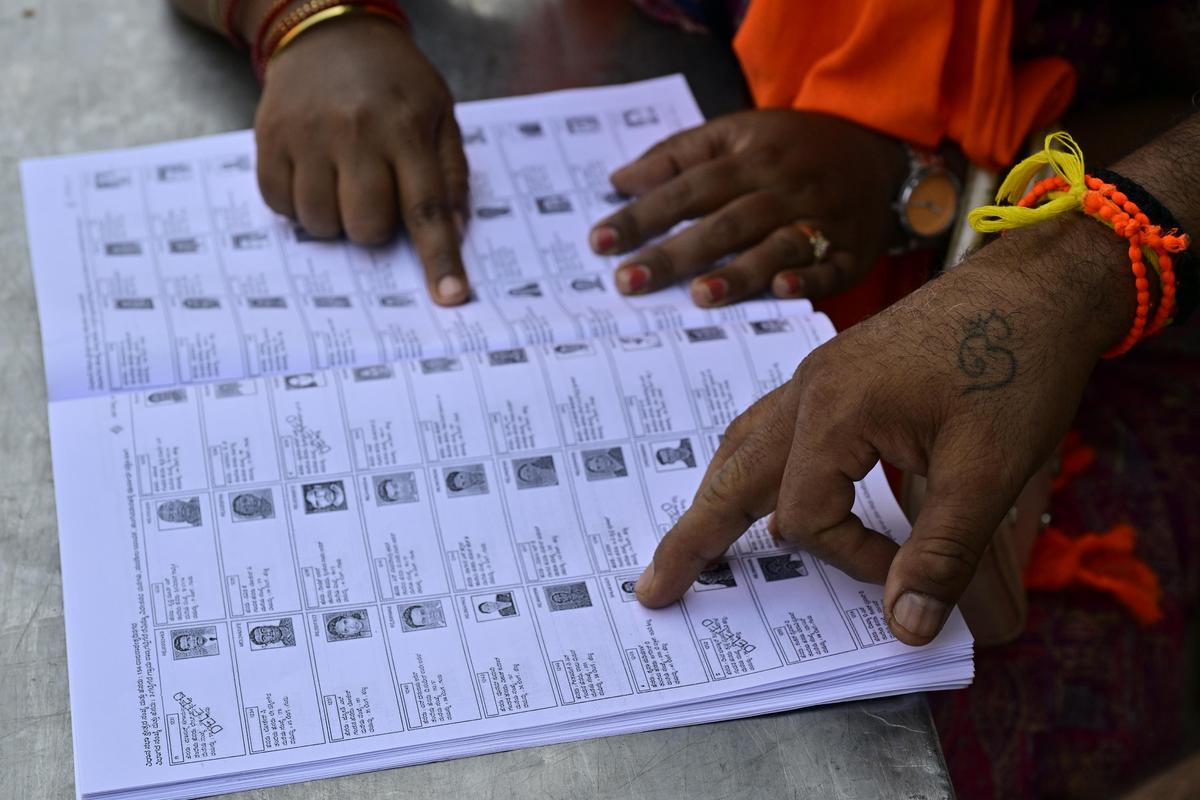
In Kedamulur, a village in Virajpet taluk of Kodagu district, Booth Level Officers (BLOs) have not been able to map even a single resident to the 2002 electoral rolls, a key requirement ahead of the Special Intensive Revision (SIR) expected to begin in Karnataka in April.
This is because residents here have, over the years, moved across more than 20 plantation belts in the region. Largely from Adivasi communities such as the Paniya Yerava, Jenu Kuruba, and Yerava, people told The Hindu that they neither remember their earlier place of enrolment nor possess documents to establish it.
Most families said they have worked across plantations in areas such as Kutta, Ponnampet, Kaarekadu and Ammatti, among others, shifting every few years depending on work. With no records of earlier addresses, they are unable to show where they were living in 2002. In many cases, even recalling details needed to locate their names or those of their parents or grandparents in the electoral rolls has been difficult.
“No one in Kedamulur could be matched during the mapping exercise,” a BLO associated with the Tomara Booth said, adding that similar conditions exist across plantation areas in Virajpet and Ponnampet taluks, apart from parts of Chikkamagaluru and Sakleshpur.
Under the SIR process, if a person cannot be linked to the 2002 electoral rolls during the enumeration phase, their name is likely to be left out of the draft rolls that follow. It is only after this stage that individuals are issued notices asking them to submit one of 11 specified documents as proof.
No proof of address
For many families here, accessing those documents itself is a challenge. Gauri, from Adivasi Sangharsh Morcha, said it is common for workers’ documents such as voter ID cards and ration cards to be held by employers, and not returned when they leave plantations. With families shifting every few years, most also do not have proof of permanent residence. Even Aadhaar, which is accepted only as proof of identity and not citizenship for SIR, is not possessed by many in these settlements.
The SIR guidelines also require people to produce documents based on their age. Those born before 1987 must submit their own documents, those born between 1987 and 2004 must provide documents for themselves and one parent, and those born after 2004 must provide documents for both parents. In communities where older generations themselves lack documents, this requirement, Ms. Gauri argued, is impossible to meet.
Under the SIR process, if a person cannot be linked to the 2002 electoral rolls during the enumeration phase, their name is likely to be left out of the draft rolls that follow. | Photo Credit: File photo
Discrepancies galore
Even among those who do have documents, discrepancies are common, with differences in spelling, variations in names, and inconsistencies across records. In several cases, it was common that two documents of the same person had different names. BLOs explained that this can happen for multiple reasons — sometimes, names are changed by employers or recorded along with the name of the community, and in other instances, spellings differ across languages or records.
In one case, a person’s Aadhaar card carried the name “Manju”, while the voter ID recorded it as “Paniya Yerava Manju”. In another, the same individual’s name appeared as “Chubba” in one document and “Subba” in another. BLOs acknowledged that such variations are required to be proven during the SIR and will only make it difficult to establish identity under the SIR, even for those who possess documents.
Adivasi Sangharsh Morcha has called for a survey in Adivasi settlements to identify gaps in documentation and address discrepancies in names across records.
BLOs struggle to reach
For BLOs, the exercise itself has been difficult to carry out. These settlements are located inside plantations with no bus connectivity, requiring them to walk long distances. Even then, workers and their families were always away in estates during the day. Officials said there is little awareness among residents about the exercise, even as they are expected to complete the work within deadlines and adapt to new rules.
source: http://www.thehindu.com / The Hindu / Home> News> Cities> Bengaluru / by Rishita Khanna / April 01st, 2026
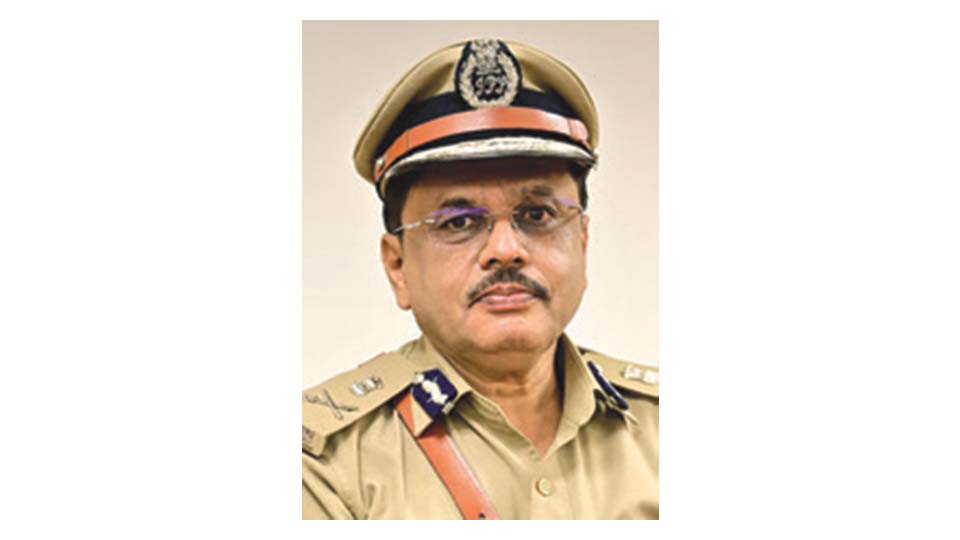
DG&IGP Dr. M.A. Saleem will be on a two-day visit to Mysuru and Kodagu districts today and tomorrow.
Dr. Saleem, who will be arriving in Mysuru by road at 5 pm today, will visit KARP Mounted Coy and stay overnight in city.
He will attend the Passing Out Parade of 46th Batch of Probationary PSIs (Civil) at Karnataka Police Academy (KPA) Grounds at 8 am tomorrow (Mar. 29).
Following this, Dr. Saleem will leave for Kodagu at 11 am to hold a review meeting of Kodagu District Police. He will visit Police Stations and Police Lines before leaving Kodagu at 6 pm to reach Bengaluru by 10 pm.
source: http://www.starofmysore.com / Star of Mysore / Home> News / March 28th, 2026
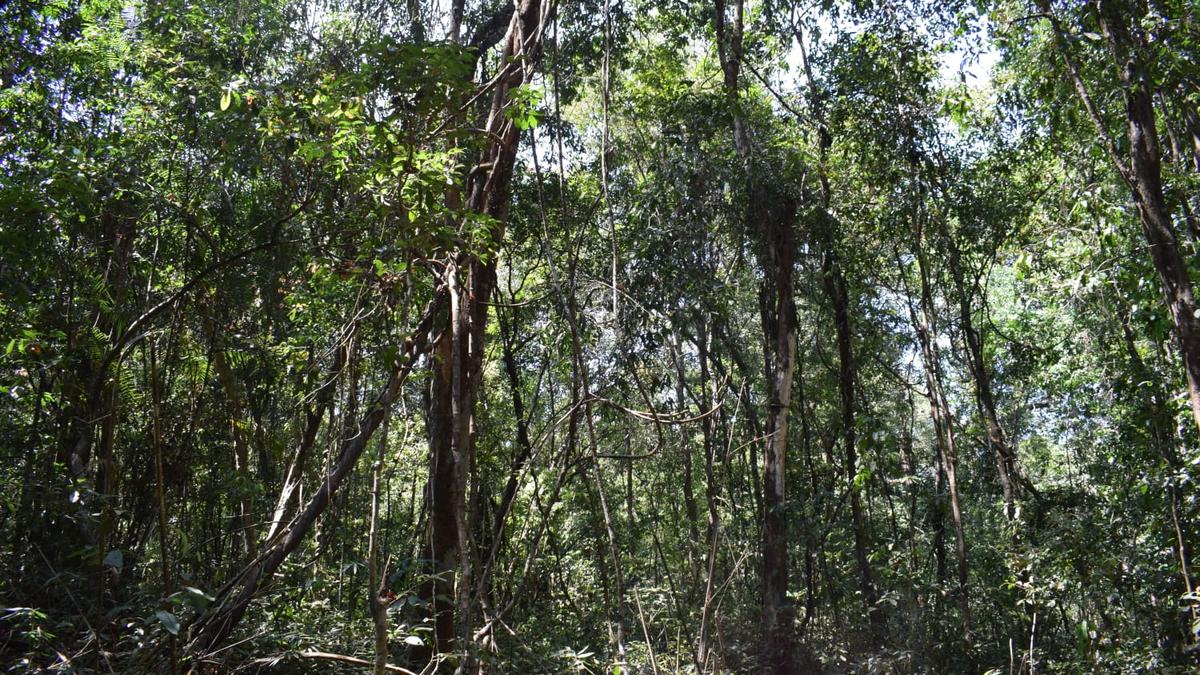
A study by researchers of the French Institute of Pondicherry at the Uppangala forest in Kodagu, Karnataka, showed how lianas, or creeper vines, hold key to framing green legislation. | Photo Credit: Special Arrangement
With their knack for piggybacking towering trees in evergreen forest ecosystems to access sunlight and nutrients, the lianas, a type of creeper vines, may appear to have patented a survival guide to grow and thrive inside the deep jungles.
Research at the French Institute of Pondicherry (IFP) offers new insights on the “intelligence” of this flora species and the dynamics at play in the liana–host interaction networks that could be crucial determinants of conservation strategies and for robust green legislation.
The study, set in the Uppangala evergreen forest in central Western Ghats of Kodagu district, Karnataka, led by Vincy K. Wilson, IFP associate researcher and researcher N. Ayyappan, delved into the survival traits and adaptive tricks of lianas, from minimalist sustenance to extroversion in networking with other tree species.
According to the researchers, despite the increasing number of liana studies in India, few have examined the distribution and association of hosts with lianas, or liana–host interaction networks to determine their functional significance and conservational value.
“Our objective was to fill the knowledge gap about the diversity, abundance, and network structure of liana–host interactions in response to logging disturbance in a typical wet evergreen forest”, said Ms. Wilson.
The study focused on lianas spread in an area demarcated into six one ha plots — four plots that had been selectively logged and two unlogged compartments. Before the 1988 ban on logging, specifically in the 1974-83 period, the site was subjected to extensive manual logging of trees, predominantly the dipterocarpus species.
Presenting a comparative investigation of the biodiversity variation of regeneration in the logged and unlogged sites in the Western Ghats, the IFP research found that the total regeneration density was 1,860 individuals, and species richness was 98 species representing 31 families. Logged sites had higher Shannon and Simpson diversity indices. Five species, namely Humboldtia brunonis, Vateria indica, Knema attenuata, Dipterocarpus indicus, and Psychotria nigra, collectively accounted for 36% of the overall density and exhibited a greater important value index.
While approximately 40% of the adult tree species at the logged site and 46% of the unlogged site were not represented in the regenerating species, the occurrence of ten species that are considered rare in unlogged plots was found to be more prevalent in logged sites.
Liana-tree interactions are a good indicator of nestedness (high frequency of interactions) and a sign of a robust system that allows species replacement. On the contrary, anti-nestedness points to fragility, where the removal of a single element in the network can potentially lead to a system collapse.
A striking aspect of the lianas is how they achieved the goal of height, instead of breadth, by willingly sacrificing supporting tissue, said Ms. Wilson, who had a few months ago, shared some research findings at a presentation, “Green Genius: Nature’s Amazing Tricks to Survive and Thrive”, at the Alliance Francaise.
“Their aim is to reach the canopy where they will get light… so they do not invest in lateral branches unlike trees”, she noted.
A significant takeaway from the IFP study was that a higher density and diversity in the logged sites may only signify robustness at a superficial level, as a deeper probing of modularity and nestedness, showed that logged systems exhibited anti-nestedness, low connectors, high modularity, high specificity — all clear signs of a fragile system.
“This understanding is important for implementing good laws. We need to continuously monitor the system to know the forest dynamics and the network properties in order to evolve appropriate and robust conservation laws and interventions”, said Ms. Wilson.
source: http://www.thehindu.com / The Hindu / Home> News> Cities> Puducherry / by Dinesh Varma / March 30th, 2026
Deviah Memorial Preparatory (DMP) School is one of the few schools in Karnataka to teach garbology, the study of a community or culture by analysing its waste.
Our waste, our responsibility: A Kodagu school is teaching its students garbology
Multiple hands shoot up in the air, almost instinctively, when the teacher asks the question, “What are the ten categories of waste?”
Subaiah, a scrawny Class 4 student, begins answering the question even before he is prompted. “Paper waste, plastic waste, glass waste, metal waste, construction waste, mixed waste, recyclable waste…”
At this point, Shavari, a Class 5 student standing next to him, cuts in to add, “Hazardous waste, organic waste and e-waste,” to the dismay of the boy.
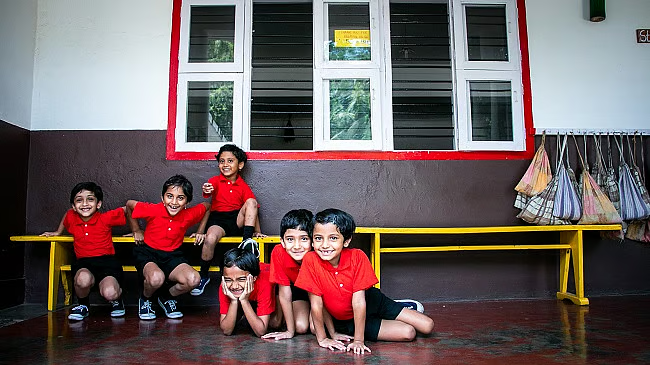
Inside the Deviah Memorial Preparatory (DMP) School in Kodagu district of Karnataka, this is now a routine after the school introduced Garbology lessons for the students of classes four and five in 2017.
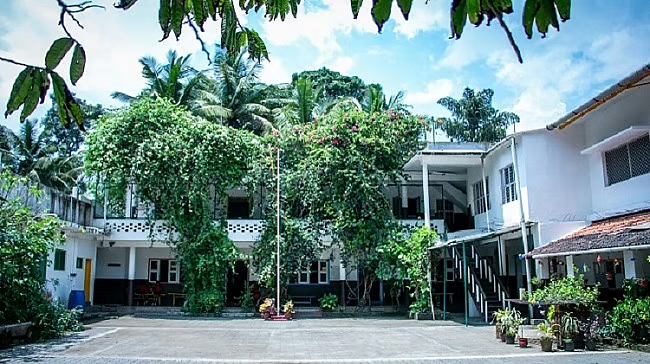
Tucked away just off the Mysuru-Virajpet road in Bittangala village, DMP is one of the few schools in Karnataka to teach garbology – the study of a community or culture by analysing its waste.
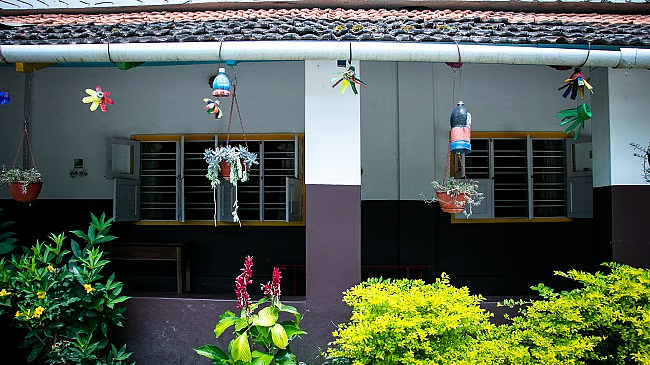
Crafts made out of recycled materials hanging in the school premises
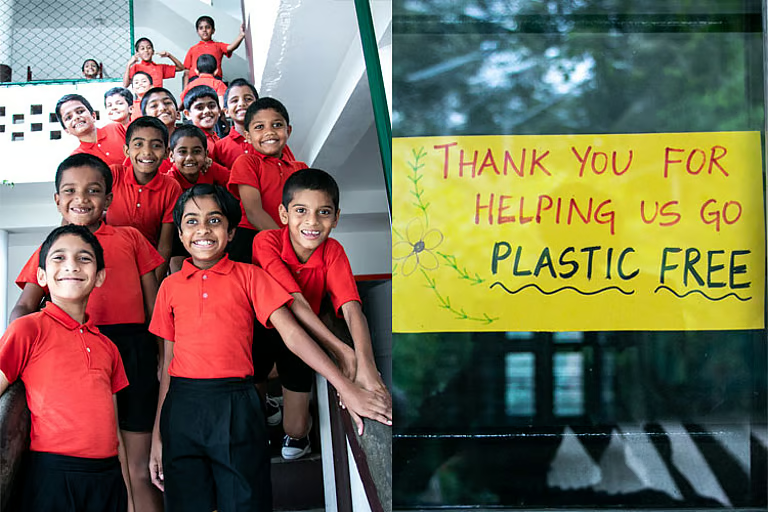
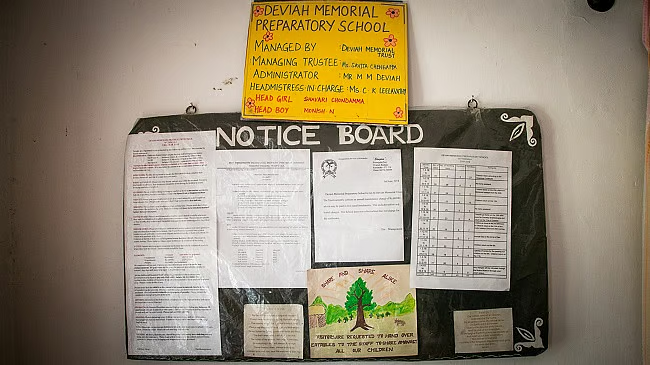
The school was founded by Mundachadira Gangu Deviah in 1981 and is one of the oldest residential schools in Kodagu district. According to MM Deviah, the administrator of the school, the staff has always placed importance on protecting the environment. In the school, there is an almost zero-tolerance policy towards plastic.
“We don’t even allow parents to send items to their children in plastic covers. There have been times when we have returned parcels sent to the school which contain chocolates wrapped in plastic,” Deviah says.
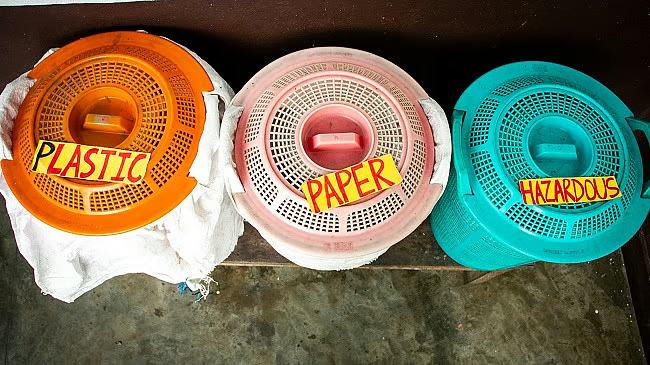
Separate dustbins at the school
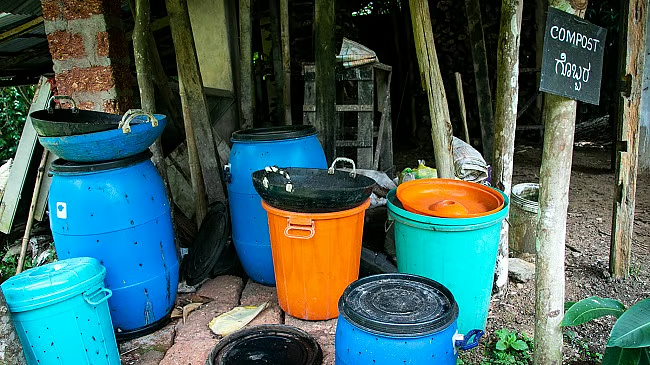
The school hopes to set an example to its students by managing the waste created in its own premises effectively. The school building is filled crafts made out of upcycled and recycled plastic. The school maintains separate dustbins for plastic, paper and hazardous waste. The students and teachers grow fruits and vegetables in a field close to the school which is used to cook most of the food prepared by the school. A soapnut liquid is used in place of handwash while natural loofahs are used to scrub the body instead of plastic ones. Kitchen waste generated in the school is also turned into compost and the school is planning to make invitations for their annual day programme using recycled newspaper.
“Even before we began garbology lessons, students were introduced to the idea of reducing and managing waste,” explains Nina Chengappa, a teacher at the school.
Deviah Memorial Preparatory School, Kodagu
In 2017, garbology was introduced in the class 4 and 5 syllabus. The classes for the subject are held every Tuesday and they are based on material provided by Wasteless, non-profit social enterprise that focuses on innovative education for sustainable waste management. Students are taught about waste management, the different grades of plastic, how much waste is generated in the production of paper, among other topics.
Composting at the school
“We conduct the sessions in such a way that the theory and practical classes go hand in hand. For instance, we teach the students about a land dump and then we take them to a land dump the following week so that they can actually see it. It is not enough that the students visualise it, they need to experience it. But, they are not asked to handle the waste, of course,” says Pavan Aiyappa, the garbology teacher at the school.
According to Pavan, the lessons are designed to create a sense of responsibility among students about managing waste. “The idea is that if the students understand the harmful effects of not managing waste, they will understand it is their responsibility to manage it. We want to teach them that garbage is their own responsibility,” says Pavan.
The lessons are not only changing the attitude of students towards waste but it is also giving the teachers plenty to think about. “One of the students suggested to us that the school should stop serving biscuits wrapped in plastic during tea break and instead give fresh fruits since it creates less waste. We realised then that the message is reaching the students,” says Nina.
The students in the school are also changing the attitudes of their family members. They have also enacted plays and recited songs in other schools in the district about managing waste responsibly. “The students are telling their family members not to litter, people listen when children tell them something and that becomes a habit over time and this leads to right choices. The students also perform plays in other schools to spread the word of reducing waste. They have performed in six government schools so far reaching an audience of around 800 students,” adds Pavan.
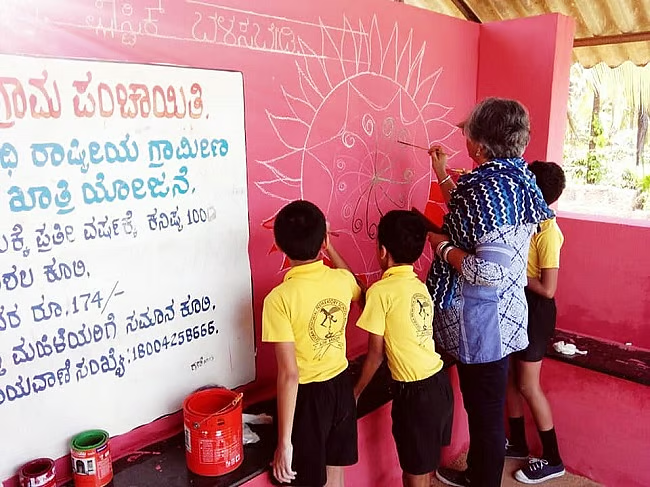
The students cleaned and re-painted a bus-stand on the main road in Bittangala on September 15, World Clean-up Day. They hope to lead by example and spread the message of taking responsibility for the waste created.
“We want to tell students that the waste we create is our responsibility,” says Deviah, before adding, “Even before we started garbology lessons, we used to teach the students here to love nature because we don’t destroy what we love.”
Photographs by: Dhruv Khanna
source: http://www.thenewsminute.com / The NEWS Minute / Home> Karnataka / by Prajwal Bhat / Photos by Dhruv Khanna / October 05th, 2018
WELCOME. If you like what you see "SUBSCRIBE via EMAIL" to receive FREE regular UPDATES.
Read More »