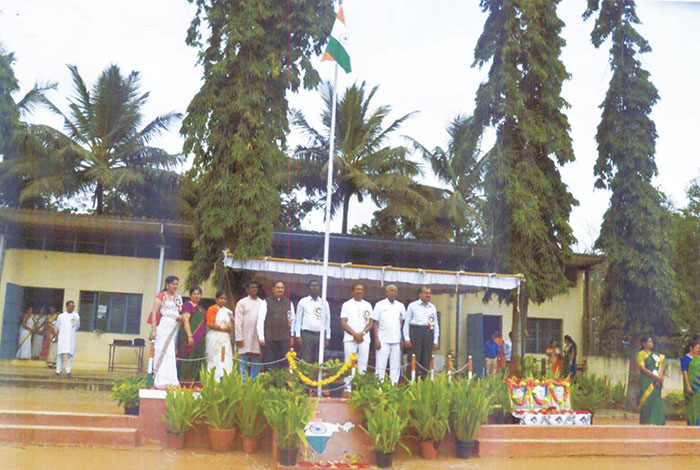
Makkala Dasara or children’s dasara was inaugurated at Gandhi Maidan in Madikeri on Monday.
It was a platform for children to showcase their talents and the authorities had arranged a slew of cultural programmes to mark the occasion including clay modeling.
source: http://www.thehindu.com / The Hindu / Home> Life & Style> Homes & Gardens / by Venkatesh Bhat S 3162 / October 03rd, 2022
Actress Varsha Bollamma, who has acted in several critically acclaimed films in Tamil and Telugu, on Wednesday chose to have some fun with her followers on Instagram by putting out a video clip in which she was seen asking “tough questions” and also answering them.
Varsha Bollamma Instagram/ @varshabollamma
Taking to Instagram, the actress wrote: “After years of research, I bring to you the toughest questions to crack.!! #DontHate,” and posted the clip.
Some of the questions she asked and answered in the clip included:
“What did one volcano say to another?”
“I lava you.”
“What do you call a honey bee that is from the United States of America?
“A USB”.
“What do you call an ant that will never leave you no matter what you do?”
A PermanANT.”
“What do you call a honey bee that is not sure?”
“A MayBE.”
“Which sweet is never on time?”
“ChocoLATE, cos it is always late.”
On the work front, the actress will next be seen in the Telugu film ‘Swathimuthyam’, which is scheduled to hit screens on October 5.
source: http://www.outlookindia.com / Outlook / Home> Art & Entertainment / by IANS / September 21st, 2022
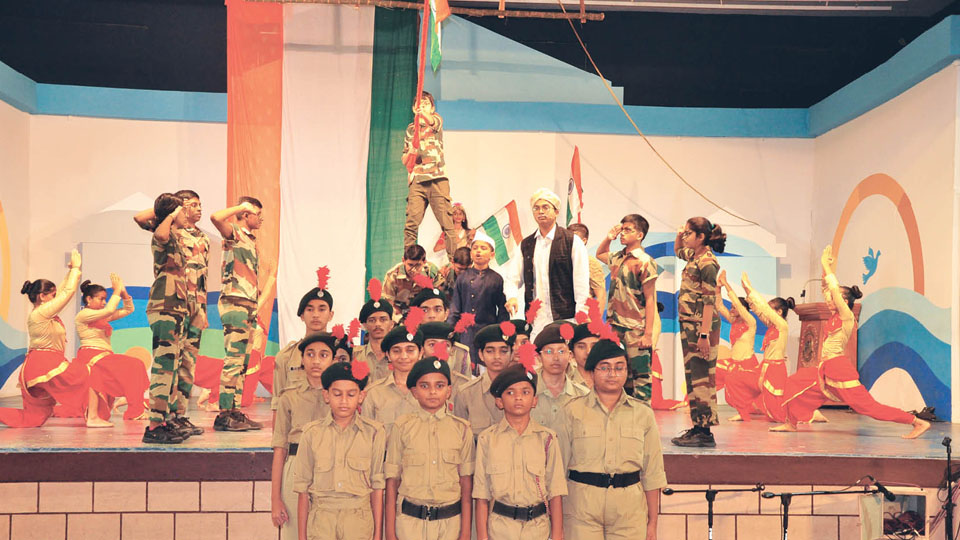
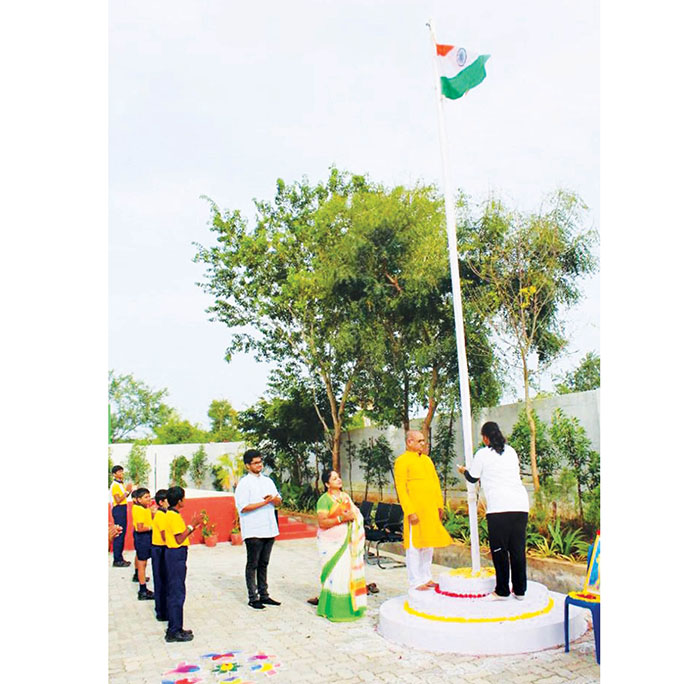
Azadi Ka Amrit Mahotsav celebrations began with hoisting of the Tricolour. Students dressed up as legendary freedom fighters revisited the milestones of historical journey from 1857 to 1947. The Copsians took part in a plethora of activities such as dances, songs, speeches and dance dramas. Principal Dr. Benny Kuriakose spoke about the significance of National Emblem and the Tricolour. The programme concluded with rendition of National Anthem.
Sarada Vilas College, Krishnamurthypuram:
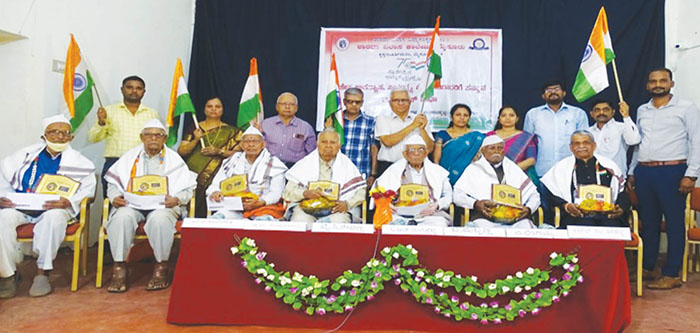
To commemorate Azadi Ka Amrit Mahotsav, Sarada Vilas College honoured six freedom fighters of Mysuru city and had organised a special talk on Freedom Movement in India and the planting of saplings in the campus.
Freedom fighters S.L. Ramachandra, Rangashetty, Dr. M. Somashekaraiah, B. Lingaiah, B. Puttanna, Y.C. Revanna, retd. Col. Ravi Shirahatti were feted. Dr. J. Anand, Dr. Yeshwanthkumar and Thejas Gowda introduced the freedom fighters. Prof. Shashikaka, retd. Botany Professor, introduced late freedom fighter Krishnamurthy, an alumnus of Sarada Vilas College. Dr. M. Devika, Principal, presided and said it was a blessing for the Institution to honour freedom fighters. She opined that patriotism must run into the blood and soul of the students so that each one can contribute to the nation. Secretary N. Chandrashekar and Governing Council Members Narasimha and Ramachandra were present.
University of Mysore History Professor R. Rajanna spoke about various phases of freedom struggle during 1857 to 1947. M.N. Abhishek welcomed. Adhithya Bharadwaj compered. Darshan proposed a vote of thanks. Literary Committee Convenor Dr. Rekha was present.
JSS Academy of Higher Education & Research, Mysuru:
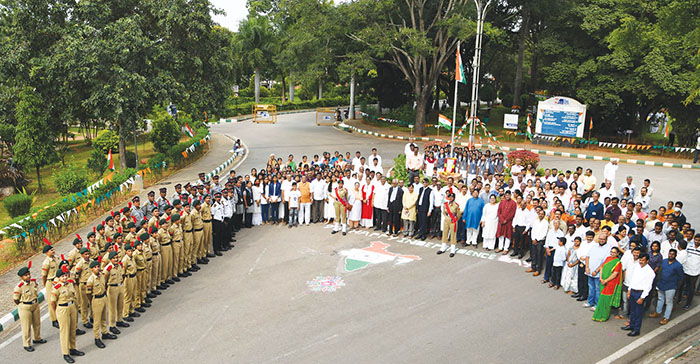
The National Flag was hoisted by Dr. B.S. Basavarajaiah, Rtd. Civil Engineer & Eminent academician, who was the chief guest of the day along with Registrar, JSS AHER, Principals and staff of constituent colleges of JSS AHER.
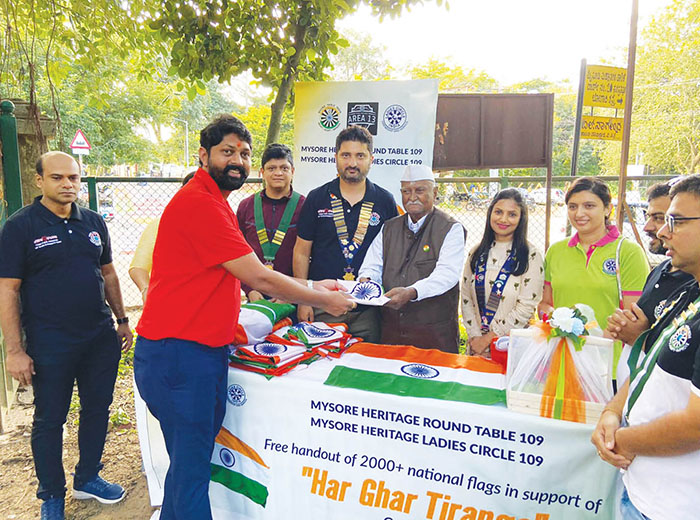
As part of Har Ghar Tiranga campaign, Mysore Heritage Round Table & Ladies Circle-109 had organised a Free Flag distribution programme at Kukkarahalli Lake in city. Veteran freedom fighter B. Lingaiah was the chief guest. Seen are (from left) 41 Er. C.V. Mahesh, Round Table Area-13 Chairman Tr. Ram, MHRT-109 Chairman Tr. V.K. Vaibhav, freedom fighter Lingaiah, MHLC-109 Chairperson Vinutha Dutt, Past Ladies Circle National President Cr. Namratha Shenoy, Tr. Deepak and IPC Tr. Kumarpal.
S.V.E.I. Institution, Vijayanagar 4th Stage:
T.N. Narasimha Murthy, Commissioner, City Municipal Council, Hootagalli, was the chief guest. B. Shivalingappa, Hon.Secretary, S.V.E.I. presided. Dr. M.K. Potharaj, President, S.V.E.I., K.M. Rajashekar, Vice-President, T. Prabhakar Shetty, Treasurer, Shobha Rajashekar, Director, Lady members Komala Potharaj and Nuthan P. Shetty, Section Heads and parents were present. The programme started with March-past followed by band, flag hoisting and other cultural programmes including dance, song, karate, yoga and drill.
Nypunya School of Excellence, R.T. Nagar:
Retd. Bank Officer B. S. Narayana Gowda hoisted the Tricolour at the School premises during I-Day celebrations and addressed the gathering. Principal Shilpa Prashanth, Secretary Kautilya, teaching staff, students and parents were present. Various cultural programmes were presented on the occasion.
source: http://www.starofmysore.com / Star of Mysore / Home> Gallery> PhotoNews / August 22nd, 2022
‘One for All, All for One’ is the motto driving Koothi, a settlement in Kodagu district, which has a lesson or two to teach in self-governance.
Madikeri :
In the sylvan vistas of Kodagu stands a village, small, yet tall and proud. As one approaches Koothi, as this village is known, it becomes certain that this self-sustaining microcosm of fraternity, self-reliance and equality, has stood the test of time to create a system of self-governance, keeping its residents in a state of well-being and independence.
“The soul of India lives in its villages,” observed Mahatma Gandhi. Living this thought, Koothi’s vision for self-governance, while maintaining its democratic and just values, is a unique study into the concept of decentralisation.
About 53 km from district headquarters Madikeri, one is welcomed into Koothi by a vast ground that hosts a community hall and the grama samithi (village committee) building. As one proceeds further, neatly laid-out estates and houses form the heart of this settlement. The village, primarily composed of Vokkaligas and members of Scheduled Castes, symbolises cohesion and belonging. What one finds even more extraordinary is that Koothi abides by its own set of administrative rules and regulations, untouched by modern policies and laws.
“Since ancient times, the grama samithi has been in existence to ensure development and well-being of the village. Any problem or dispute is resolved within the village and our unity is our strength,” explains Mohan MD, president of the Koothi Village Committee.
While Koothi does fall under Tolurushettalli Gram Panchayat, it nevertheless has its own village committee. The village has three sub-villages – Hosmane, Dinekere and Kerekoppa. Once every two years, four villagers are nominated from the sub-villages, who form the committee.
Further, the president and vice-president are elected by the nominated members and this non-political team ensures overall development, welfare and safety of the village. The committee meets at least once every month. “There are over 160 houses and over 600 residents in the village. At least one member from each household must attend the meeting. Anyone who fails to be present is fined,” Mohan adds.
(From left) Lakshmikantha, KT Joyappa and Mohan MD, in Koothi village | Express
Further, the committee holds the important responsibility of maintaining cordial relations between all the villagers, and any dispute is first heard by it. “There are less than a handful of instances when villagers have approached the court or police. Most of the disputes, including property or family rifts, are resolved within the village,” mentions KT Joyappa, former president and a consultant of the committee.
Dispute redressal is very systematic. An application is first forwarded to the committee, which is addressed during the meeting. After the hearings from the parties involved, the dispute is resolved amicably.
“In case of a property rift, committee members visit the spot for an inspection. The committee possesses detailed land survey documents of the entire village. Further, witnesses are heard in favour of both parties. Following this, the issue is heard during the meeting and a judgment passed after consulting and taking into account the facts fulfilled by a majority of the villagers. It is not just the committee members’ decision, but a collective judgment of the village,” states Mohan.
Rarely, there have been instances when a few villagers have moved court against the committee’s decision. “But in all these cases, they have returned to abide by the decision of the committee. While court hearings take years, a dispute addressed by the village committee finds closure in about two meetings,” shares Lakshmikantha, secretary of Someshwara Yuvaka Sangha.
Meanwhile, all proceedings are recorded in a ledger, safely preserved in a secure locker at the committee office. “No matter what, the proceedings recorded in the ledger are not shared with anyone – not even the police,” says Mohan.
The village committee has a separate bank account to collect fines. “The massive committee office and the community hall were built using funds collected by the committee. For the hall which was built over two years ago, each household contributed Rs 17,000. We aim to become self-reliant in all ways and the unity amongst us helps achieve the same,” shares Mohan.
Thanks to its novel, yet time-honoured approach to self-governance, the Koothi Grama Samithi has won accolades from the government too. While villagers from the interior have to frequent the taluk offices for paperworks, officials visit the village as and when summoned by the committee.
Koothi’s social milieu There is an interesting regulation that forbids marriage between residents of the same village. “All of us in the village are like siblings. We have grown up together as blood relatives and hence, from the times of our ancestors, marriage between men and women from the same village is forbidden. Anyone violating this norm is fined,” confirms Lakshmikantha.
Any death in the village is mourned by one and all. The victim’s family is spared the duties and expenses, as every household donates a log of wood to set the pyre and all arrangements at the village graveyard are made by villagers.
source: http://www.newindianexpress.com / The New Indian Express / Home> States> Karnataka / by Prajna GR / Express News Service / October 17th, 2022