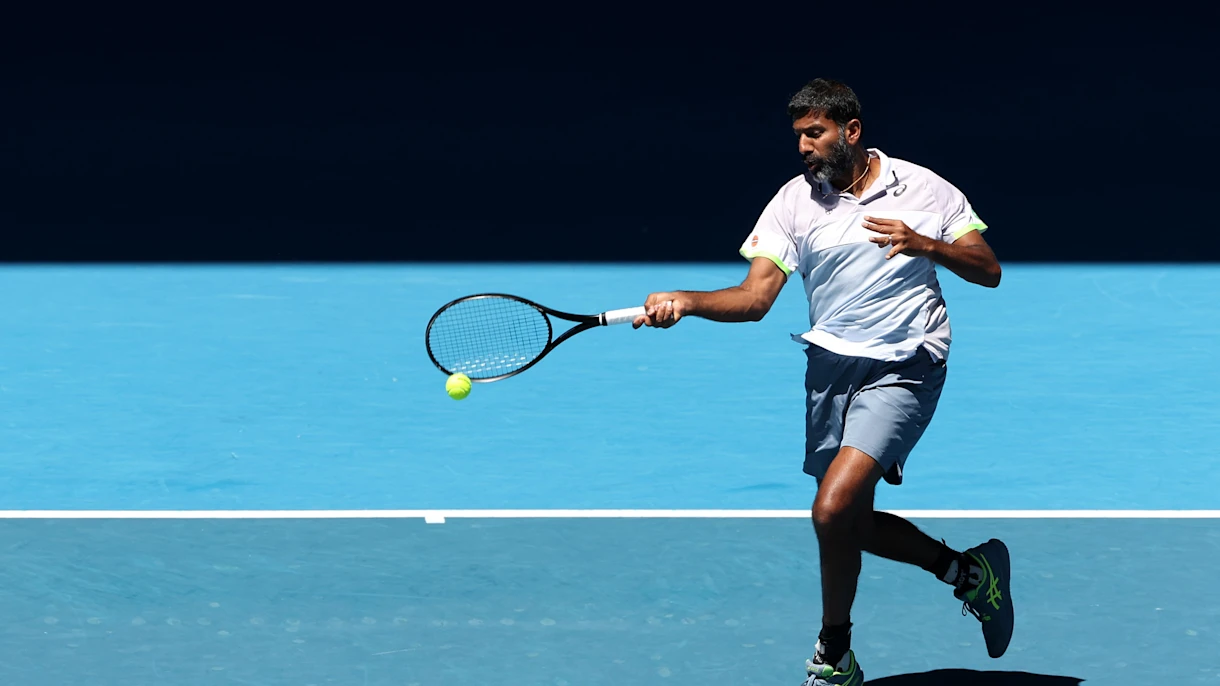
On Friday, Indian tennis player Rohan Bopanna and his Australian partner Matthew Ebden took home the men’s doubles championship in the Qatar Open 2023 tennis competition in Doha. The pair defeated Botic van de Zandschulp of the Netherlands and Constant Lestienne of France 6(5)-7(7), 6-4, 10-6.
It was Rohan Bopanna’s second victory in the Qatar Open. He had finished second last year with Canadian Denis Shapovalov in the doubles competition after winning it in 2020 with his Dutch partner Wesley Koolhof.
Throughout his career, Rohan Bopanna has already won 23 doubles championships. It was his first time playing alongside current Wimbledon doubles winner Matthew Ebden. At Tel Aviv, Pune, and Adelaide, the Indian tennis player won three championships last year. Bopanna’s first championship of 2023 was the ATP 250 victory in Qatar.
Bopanna and Ebden also advanced to the Rotterdam Open ATP 500 final last week, but they fell to Austin Krajicek of the USA and Ivan Dodig of Croatia in the match tiebreaker following the winning point.
The third-seeded Indian-Australian combination in Doha on Friday had a break advantage at 6-5 in the first set before being pushed back and dropping the set in a tiebreaker. In the second game, both defences improved, and the teams maintained their serves until the ninth game. Bopanna and Ebden, though, triumphed in the tenth game to force a match tiebreak.
Bopanna is ranked No. 37 in the world and No. 17 in the ATP doubles rankings. The match tiebreaker was won in 99 minutes by Ebden after they successfully converted four of six break-point opportunities.
source: http://www.sportscafe.in / Sportscafe / Home> Tennis> National> News / by SportsCafe Desk / February 25th, 2023
Conservationists hope to connect people and the dwindling fish species, to save streams, rivers and otters.
Volunteers conduct survey of the stream to look for signs of Koilemeen and Small Clawed Otters
Madikeri :
Food has a way of bringing people together. Raising awareness using a local delicacy to protect streams and the ecosystem of Kodagu is the unique ‘Koilemeen Project’ — an initiative by conservationist Gopakumar Menon. To understand the motto of the project, it is important to first understand that koilemeen is the Kodava name for freshwater fish, commonly known as Spiny Loach, with the scientific name ‘Lepidocephalichthys thermalis’.
A local variety found in streams and water-filled fields of Kodagu, the koilemeen used to be a popular delicacy in Kodava households during the monsoon. However, the numbers have dwindled over the years due to various reasons, and this is where the ‘Koilemeen Project’ comes into the picture.
The objective is to involve the local community in the conservation of streams and rivers, by connecting the people to their once-popular koilemeen dish, Gopakumar explains. “In the past two decades, there has been a precipitous drop in the availability of Koilemeen. We spoke to several coffee planters and a fish trader in Virajpet, who shared his worry due to the non-availability of koilemeen,” he said.
He explained that the use of chemicals in agriculture and horticulture has severely affected the koilemeen population, which also indicates that stream and river waters are being polluted by chemicals. “Increased use of weedicides, pesticides and other fertilisers have affected the koilemeen, and indicates that our water is polluted. The project addresses the loopholes and tries to bring awareness in the community,” he added. Illegal sand mining across the streams of Kodagu has also affected the koilemeen population.
These tiny fish breed on sand, and with sand illegally mined for commercial purpose, it has affected their numbers. “The fish spawn across paddy fields (during monsoon) and other shallow streams, and swim upstream post the monsoon. However, the use of chemicals, sand mining and deposits of plastic waste across the streams has affected the fish. The project is trying to sensitise locals and get them involved. For the community, koilemeen is an easy logo to enable the conservation process,” he shared.
The group is active across social media platforms, and wants youngsters from the district to get involved in the conservation project. The project team meets small groups of planters and raises awareness on the need to stop the extensive use of chemicals. “We tell planters and farmers about the correct method to use chemicals. We are creating awareness on the hazardous use of weedicide and urging them to use fewer chemicals, while ensuring there is at least a 20-ft gap from the chemical-sprayed area and water source,” he explained.
While the project’s main objective is to protect the streams of Kodagu, the focus is not just the tiny koilemeen fish. The bigger picture includes small clawed otters – a Schedule 1 species under the Wildlife Protection Act, whose habitat is found by freshwater streams of Kodagu.
Small beings in the ecosystem, like small clawed otters, have the same protection right as elephants or tigers, but are less talked about though their existence touches the level of endangerment. Since koilemeen are occasionally hunted, it is being used as a mascot to protect the small clawed otters in their natural habitat of freshwater streams and rivers.
The team — geared in gumboots and equipped with GPS — heads out to survey streams to find signs of small clawed otters. “The signs or presence of otters indicate good health of the ecosystem. We look for droppings or spraint of otters and are collecting data on their habitat,” explained Yashas S, a master’s student, a volunteer for the project. He stresses the need to conserve the riparian habitat to protect small clawed otters.
The project aims to collect research material on the otters, and find ways to protect them from being poached. “The diet of an otter includes crustaceans and koilemeen. Our aim is to protect the prey which will help conserve the predator. Protecting the prey also means protecting the streams,” explained Gopakumar.
Alongside the community conservation initiative, the project is conducting a baseline analysis on the otter habitat, which will help take an intelligent step towards their conservation.
Purpose of the project
To involve the community in conservation of fresh water streams, rivers of Kodagu. Enable conservation by connecting community to their once-favourite delicacy. Protect koilemeen, the prey, in freshwater streams.
Urge planters to opt for organic farming, stop use of harmful weedicides Protect, conserve vand conduct analysis on small clawed otters, the predator.
source: http://www.newindianexpress.com / The New Indian Express / Home> Good News / by Prajna GR, Express News Service / Februry 26th, 2023
She sits inside a cage, goes down 25-feet deep well to bring back the feline after darting
Mysore/Mysuru:
One of the most challenging and dramatic animal rescue missions has been accomplished by a Kodagu-born veterinarian Dr. Pandikanda Meghana Pemmaiah, now settled in Mangaluru.
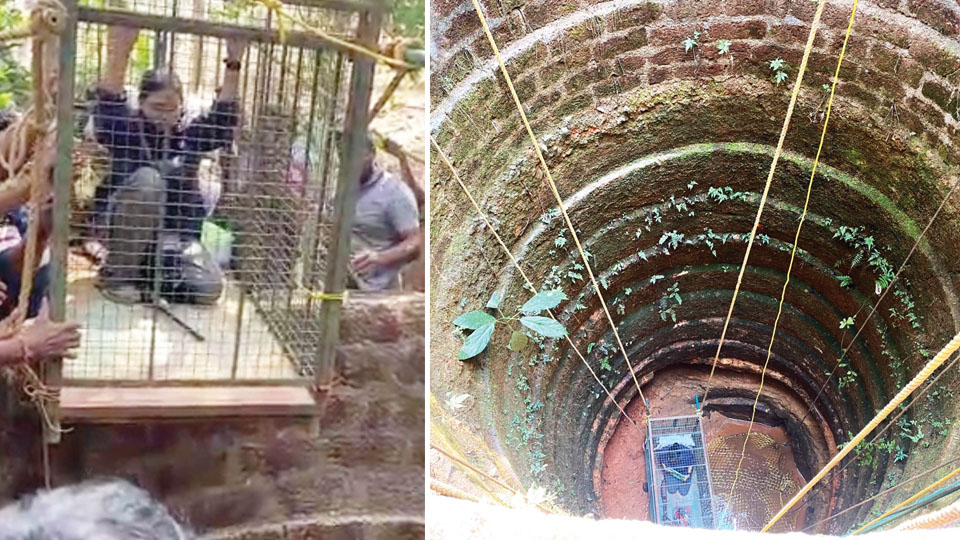
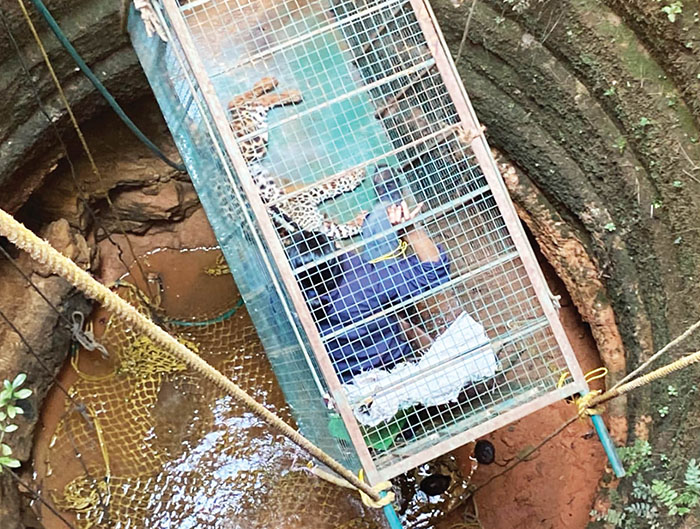
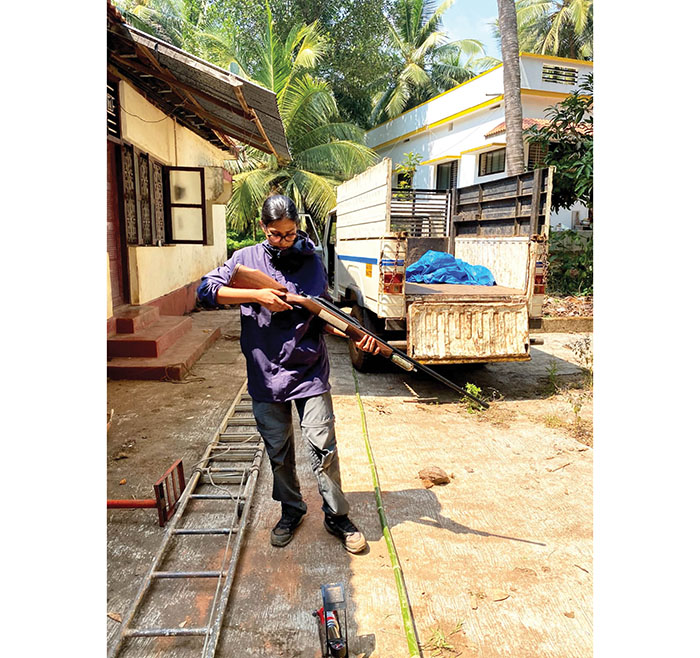
She recently saved a leopard that had fallen inside a 25-feet deep well and performed the act by sitting inside a cage that was lowered into the well to sedate the leopard that was stuck there and starving for 36 hours. She was able to pull the one-year-old feline into the same cage in a tense and dare-devil two-hour rescue operation. Her husband Dr. Yashaswi Naravi too was a part of the rescue mission.
In fact, it was 31-year-old Dr. Meghana, who volunteered to go down the well. She told Star of Mysore that though she was scared as it was deep inside the well and the leopard was not visible from the top, the adrenaline rush to save the starving and stuck animal overcame the fear.
The incident took place near a house in Niddodi near Kateel in Dakshina Kannada, about 35 km from Mangaluru. “We got a call at 9 am on Feb. 12 from the Forest Department. We are a team from Chitte Pilli, a Wildlife Rescue and Research Centre in Mangaluru and the team comprises me, my husband and experts Dr. Prithvi Salian and Dr. Nafisa Kousar. We reached the place at 11 am with some necessary equipment for the rescue,” she said.
After successfully tranquillising the big wild cat, Dr. Meghana being pulled up along with the tranquillised leopard inside the cage.
Failed attempts
The Forest Department had tried to rescue the feline with a ladder and a cage, as in other instances the trapped leopard had walked into the cage when it was lowered inside a well. However, this leopard was unwilling to move, she added.
The leopard was not visible from the top and it had taken shelter at a cosy spot that was shaped like a cave-like cavity — to avoid falling into the water — inside the sturdy well that was built with stones. The leopard was aggressive when attempts were made by the Department to drain the well water.
“Later, a different strategy was adopted and it was decided to lower a cage carrying a person to tranquillise the leopard and bring it back. We had no other choice and someone had to do it. I volunteered despite the dangers involved,” Dr. Meghana revealed.
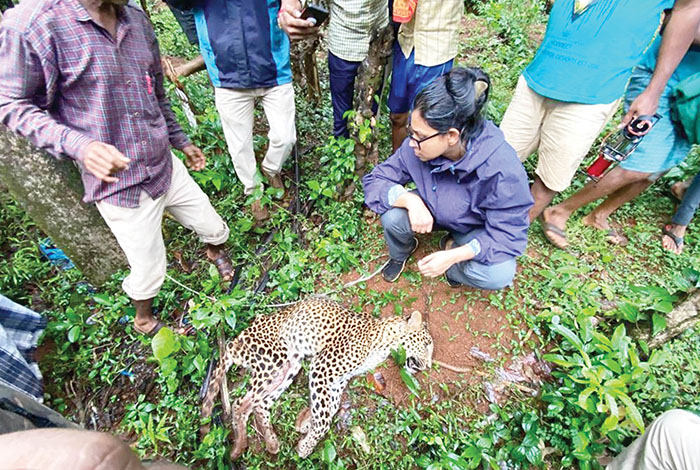
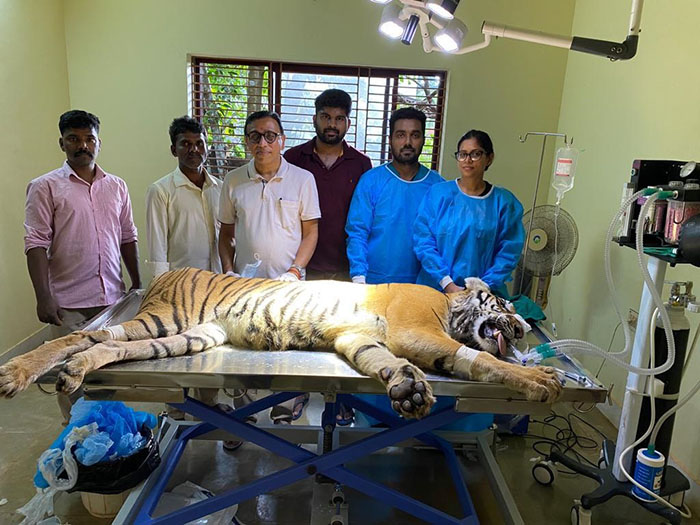
The leopard being treated after capturing in Mangaluru.
A risky mission
The cage was lowered by villagers, volunteers and the Forest Department staff in a coordinated action and with Dr. Meghana holding the tranquilliser gun. “We did not have a visual of the leopard and as such, it was a risky mission as no one had a clue as to how the leopard would react,” she said.
“I waited patiently for a sight of the leopard as the cage was lowered gradually and finally I could spot the animal around 10 to 15 feet inside the well and it was growling at me though it looked exhausted without food and water. I had very little time and hence aimed the dart at the animal and shot at it. Luckily, it was a precision shot and the dart hit the feline’s thigh in the first attempt itself,” Dr. Meghana said.
Meghana had carried about three to four syringes containing the sedating medicine as she did not know about its weight, size, health and other parameters for darting it. If she missed the aim the first time, she could well refill the tranquilliser gun with the second shot but the leopard could have moved away from the initial close proximity and there was more probability of her missing the shot.
Growling leopard
“In fact, I had to sit inside the cage for over 15 minutes for the dart to take effect and the leopard was right in front of me. It was growling and looking at me. Slowly, the sedation process began and I tried to pull it to the cage but could not. Another youth got inside the well and helped me and we both put the 25-kg leopard inside the cage. It was a leopardess. Now when I look back, sometimes I fear what could have happened if something had gone wrong,” she said.
So tense was the situation after the dart was fired that Dr. Meghana sat motionless inside the cage as any movement or noise would disturb the leopard and it would take a long time for the animal to get sedated. Finally, the feline fell unconscious after over 15 minutes. After the leopard was lifted back to the ground, it was checked and the vets found no external injury marks.
“It was a healthy leopard but was exhausted. After administering the required medicines for the feline to rejuvenate and get back its strength so that it has the capacity to hunt on its own, it was handed over to the Forest Department that released it back to the wild,” Dr. Meghana said.
Passion for wildlife keeps her going
Wildlife rescue operations are nothing new for Meghana and she has been a part of many rescue operations in the last six years in Karnataka. She has been a part of many missions where she has rescued and treated tigers, owls, star tortoises, pariah kites, crows, pigeons, birds and even pythons.
“Passion about wildlife, increasing human-animal conflicts and the resulting rescue mission keeps me going. I dread to see an animal suffering due to injuries,” she said.
Every year, she does almost 10 darting procedures after following the scientific process and protocols. But this was the first time she had to get down into a well, sitting inside a cage to rescue a leopard. She hails from Halugunda village near Virajpet in Kodagu district and studied in Bengaluru.
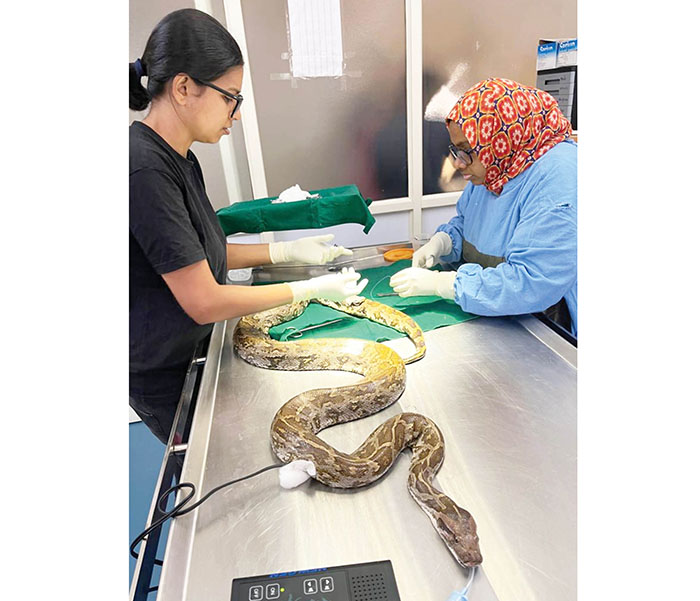
Dr. Meghana treating a python.
After completing her PUC from Christ College, Dr. Meghana did her BVSc followed by MVSc in Wildlife and Surgery from Veterinary College, Bengaluru. The next four years, she worked in People For Animals (PFA) as a senior veterinarian and this gave her on-hand exposure to animal rescue and medication.
Her father late Pandikanda M. Pemmaiah was a retired Superintendent of Police and her mother P.P. Sarasu and rest of the family live in Bengaluru. She married veterinarian Dr. Yashaswi Naravi of Mangaluru and both have been working at Chitte Pilli — a Wildlife Rescue and Research Centre.
source: http://www.starofmysore.com / Star of Mysore / Home> News> Top Stories / February 21st, 2023
The Kodavas have a unique culture and history rooted in martial traditions, and have made significant contributions to the Indian Armed Forces. Defence and aerospace analyst Girish Linganna explains
The Kodavas, a small warrior community from the Coorg district in southern India, have a long-standing tradition of serving in the Indian armed forces. This is due to a number of factors, including their martial culture, sense of duty and loyalty to the country, and the prestige and honour associated with military service in their community.
The Roots of Warrior Culture
The Kodavas are an ethnic group with a distinct culture and language. They have been living in the Western Ghats region for centuries, with a history dating back to even before 1100 AD. They have a martial culture, and the men are trained in the use of traditional weapons such as the odi katti (traditional Coorgi sword). They have a rich history of military service, with many Kodavas having served in various conflicts and peacekeeping missions.
In fact, Coorg is the only district in India to have produced all the ranking officers in the Indian army, despite having a population of just over 1.5 lakh. Coorg was once a state and had its own chief minister. Four diwans served the Mysore maharajas; many held the commander-in-chief position even pre-independence during Mysore rajas’ rule.
Dedication to Duty: The Kodavas in the Indian Army
The Kodavas have a strong tradition of serving in the Indian armed forces, driven by their martial culture, sense of duty, and desire to protect and defend their country. Many come from families with a history of military service, and it is not uncommon for multiple generations of a family to have served in the armed forces. There are even Kodava couples who have served together in the Indian armed forces. They are also known for their physical fitness and discipline, which makes them well-suited for military service.
In addition, serving in the armed forces is often seen as a way for Kodavas to protect and defend their country, and many view it as a matter of great pride and honour. As a result, many Kodavas are willing to make significant sacrifices, including leaving their families and communities to serve in the armed forces.
Bravery in the Face of Danger: Kodavas in Action
The Kodavas have a rich history of military service and have played a significant role in defending the country in various conflicts and peacekeeping missions. They have been known for their bravery and dedication in the face of danger.
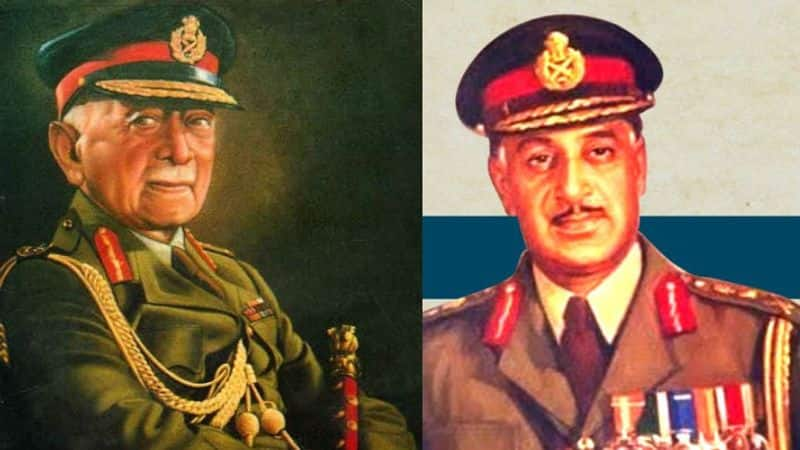
One of the most notable Kodavas to have served in the Indian Armed Forces is Field Marshal K M Cariappa, who was the first Indian commander-in-chief of the Indian Army. He played a key role in the integration of the Indian states after independence and was honoured with the Order of the British Empire and the Legion of Merit.
Another notable Kodava is Lieutenant General K S Thimayya, who served as the Chief of Army Staff from 1957 to 1961 and was awarded the Padma Bhushan and the Distinguished Service Order. Other notable Kodavas who have served in the Indian Armed Forces include Brigadier B K Ponnappa, who fought in World War II and the Indo-Pakistani War of 1947, Lieutenant General B K Krishnan, who served as the Director-General of Military Training and the Commandant of the Indian Military Academy, Lieutenant General P K Dewan, who served as the Deputy Chief of Army Staff and the Commandant of the Indian Military Academy, and Major General K S Chandrashekar, who served as the General Officer Commanding of the Indian Army’s Southern Command.
In conclusion, the Kodavas have a unique culture and history rooted in martial traditions and have made significant contributions to the Indian Armed Forces. Their sense of duty and loyalty drives their dedication to the military to the country and their desire to protect and defend their country.
They have a rich history of military service and have played a significant role in defending India. The Kodavas of Coorg are a shining example of bravery, honour, and sacrifice, and their service to the nation should be revered and celebrated.
source: http://www.newsable.asianetnews.com / Asianet Newsable / Home> English News> India News / by Team Newsable / February 21st, 2023
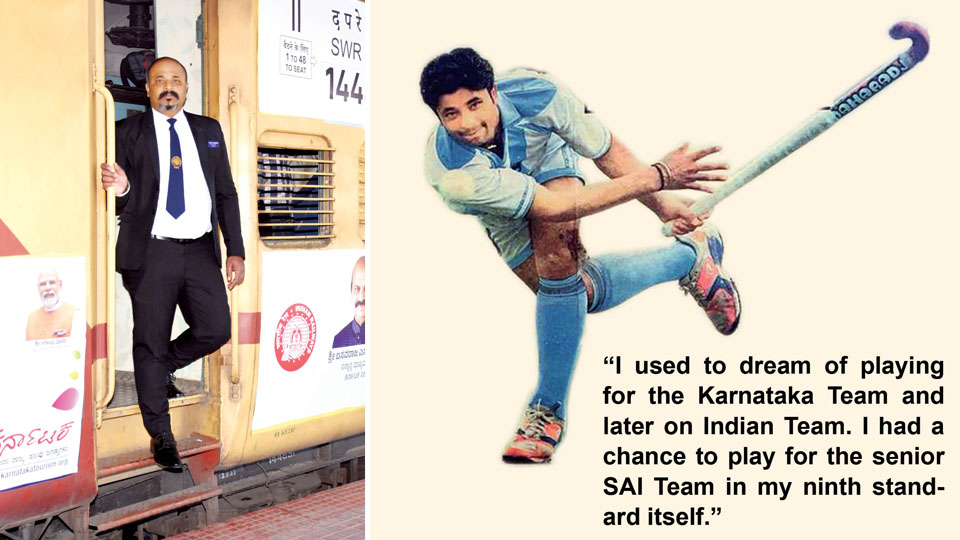
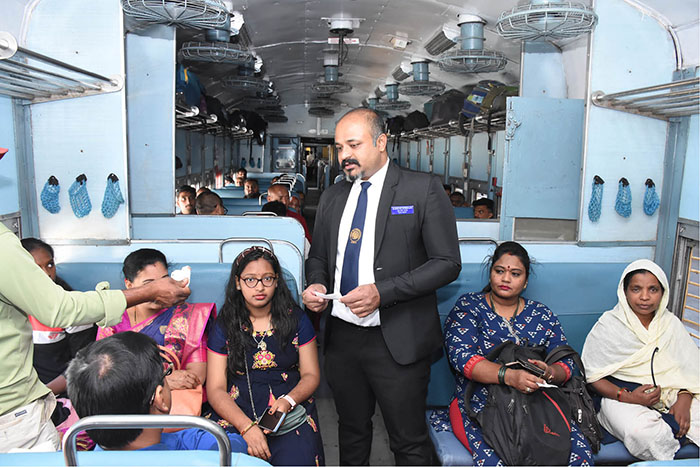
All of 37, Mayur Subbaiah, once a part of India’s medal-winning hockey team, now takes pride in working for the South Western Railways as Deputy Chief Inspector. He was a vital cog in Indian hockey as a drag specialist and an expert in penalty corner conversion.
Mayur might not have been born under a lucky star as the most sought-after Indian hockey player, but he has made his mark in the Indian Hockey arena and his love for the game and sense of duty keeps him going. He continues his passion for the game and does not miss a chance to wield the hockey stick and wants to do something worthwhile for his home district of Kodagu, the cradle of hockey.
Born to Bollajira Jaya Subbaiah and Rathi Subbaiah at Balaji village in South Kodagu on 18.7.1986, Mayur did his primary at Lions School, Gonikoppal from 1990 to 1995 and later went to Bangalore to join Junior Sports Authority of India (SAI) Training Centre in 1996 for hockey selection and he was the youngest and talented player.
He did his schooling at St. Joseph’s Indian High School from Seventh to Tenth Standard and played for several School, District, State and National-level School games. His position in the game was right half and back. Coach Manohar Katige recognised Mayur’s talent and game skills and motivated him. “I hold him in great respect and fondly recall the memories of Manohar Sir who groomed me,” Mayur reveals.
Making the mark very young
“I used to dream of playing for the Karnataka Team and later on Indian Team. I was the youngest player in the school team and many seniors and my coach encouraged me and I had a chance to play for the senior SAI Team in my ninth standard itself. I worked hard and got selected for senior SAI team in 2000 and was a regular player for that team,” he says.
“I saw many senior players on the SAI campus and my inspiration was Anjaparavanda B. Subbaiah, the former Indian hockey goalkeeper and coach. His passion, confidence and positive attitude further motivated me and I had a deep desire of wearing the Indian jersey. At SAI, I saw many Indian top players play like Dhanraj Pillai, Ashish Ballal, Sabu Varkey, Prabhjot Singh and Baljit Singh in action and that was inspirational,” he recalls.
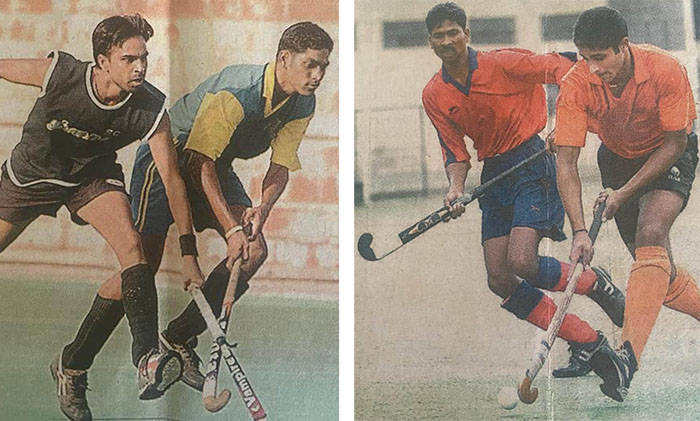
Mayur has played for several Sub-Junior Karnataka, Junior Karnataka and Senior Karnataka hockey teams and he was a specialist in drag-flick. He has played multiple nationals in all categories Under-16, Under-19 and Senior National. He was a part of the Sub-Junior India team in Singapore in 1999 and emerged winners, played for Junior Indian Hockey Team Under-21 match in Dhaka in 2004 and was in the World Cup Under-21 in Chennai.
Lost out due to political lobbying
Though he had a vast experience in playing, Mayur could not play much for India due to political lobbying. “I was best in the ground and was the best in drag-flick and dribbling and no one could match my skills. Still, the selectors preferred some other players over me and this demotivated me. But I managed to make my mark in Indian hockey, despite the politics played by the selectors to include their family members in the national team. If I had support then at my peak, I would have been an ex-Olympian now,” Mayur says with a wry smile.
Mayur was upgraded to the senior SAI camp at the young age of 17. “Len Aiyappa taught me the drag-flick (penalty corner conversion). It involves a player crouching down low next to the ball. It is then picked up by the shaft of the hockey stick and pushed along the ground, while the stick acts like a sling. This helps accelerate the ball. These penalty corners are always taken by a specialist player, known as the drag-flicker. I am proud to say that drag-flick always falls upon the shoulders of someone who is proficient,” Mayur says with confidence.
Camp with commandos
A memorable experience was his time in the National Security Guard (NSG) 45-day Army fitness camp in Manesar with senior Indian hockey team probables where Mayur had the opportunity to play with Dhanraj Pillay, Jugraj, Dilip Tirkey, Ignace Tirkey and many more senior players. This was to make the players mentally tough and increase their endurance levels. “I got an A-1 certificate at the camp,” he adds.
“Being at Senior SAI, I was even playing for the Air India team, Bombay. Bombay was part of the Air India team and I got a job at South Central Railway (Secunderabad) when I was just 18 years and two months. I got through in talent quota and was directly appointed by the Railway Board, New Delhi in 2005 and was the youngest sportsperson of Railway Sports Promotion Board,” he recalls.
Contribution in the Railways teams
As the youngest employee in the Railways, playing for South Central Railway, he gained more experience and laurels and entered the Indian Railways Hockey Teams. Mayur played in All-India tournaments and Senior National Hockey tournaments to win several medals.
“I got the Best Player of the Year Award from the Railway Board. In 2007, I got a call from the Indian Hockey Federation for the Indian National Camp for Olympic Qualifiers Camp and Asia Cup. I got selected for the Asia Cup held in Chennai in 2007 and continued my hockey journey in the Indian Railways and South Central Railway. After playing many All-India tournaments and winning several medals, I got transferred from South Central Railway to South Western Railways,” he says.
“The South Western Railways is the nearest station to my native Kodagu. From 2012 to 2019, I played for this Division and had a successful hockey career for over 22 years. I am now concentrating on my duty as Deputy Chief Inspector. I have received many awards like the DRM Award, PCCM Award and even the GM Award. The motivation provided by the Railway administration helps me keep my dreams alive and every day is a learning experience. Whatever I am today is because of the Indian Railways,” he says.
On future plans, Mayur wants to give back to society. “I want to extend a helping hand to my village, my town, my land and my community which have brought me so much name and fame,” he signs off.
Words of praise from the mentor
“We have had drag-flickers in the team but they are not well-versed in other areas, but Mayur Subbaiah is exceptional. He has the uncanny ability to play in all areas, under any circumstance. If he is provided with a chance in the senior team, he will definitely make a world of difference. I coached Mayur when he was representing SAI and he does not lack in any area because he has got strong basics coming from SAI. His dedication to learning more in the game is tremendous. He has got the passion, is consistent, aggressive, hard-working and has the game.”
[Two-time Olympian and former Indian Goalkeeper Anjaparavanda B. Subbaiah said this about Mayur Subbaiah to a sports magazine]
source: http://www.starofmysore.com / Star of Mysore / Home> Feature Articles / by B.C. Thimmaiah / February 16th, 2023
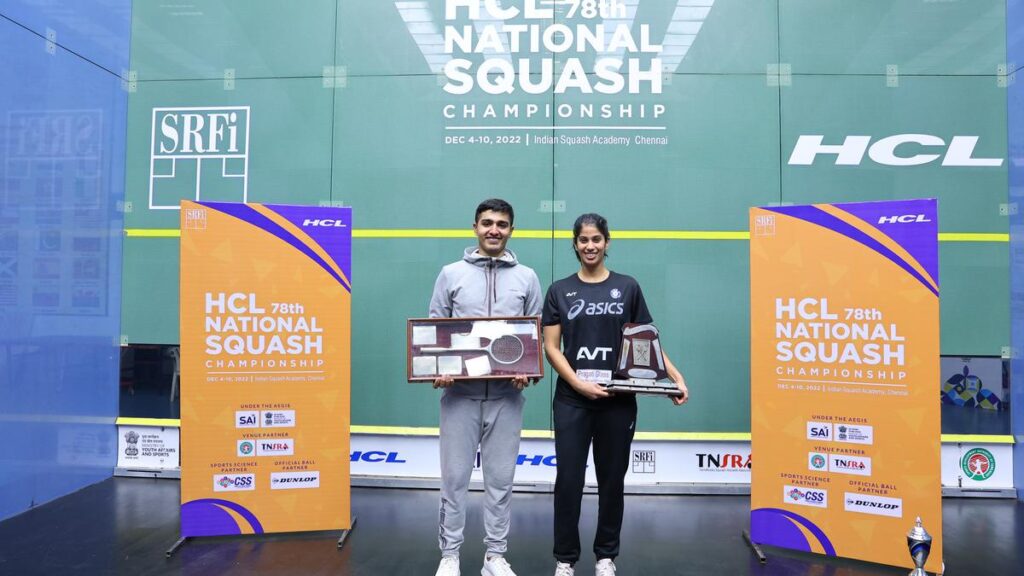
Abhay Singh and Joshna Chinappa with their reward for emerging on top in the 78th senior National squash championships in Chennai on Saturday. | Photo Credit: Special Arrangement
Joshna Chinappa kept her date with destiny by bagging a record 19th women’s title while Abhay Singh won his maiden crown in the HCL-78th senior National squash championships here on Saturday.
Joshna, seeded No. 1, overcame a strong challenge from Anahat Singh, the second seed, 11-8, 11-9, 11-9 in the final, with assured court-coverage and precise shot execution. Abhay, the men’s top seed, powered past S. Velavan (5/8) 11-13, 11-7, 11-6,11-4 in the summit clash.
A composed Joshna attacked with power and used her vast experience to deceive the 14-year-old. In all three games, the 36-year-old took a sizeable lead only to find Anahat come back strongly.
Anahat fought for every point, showing her skills on the forecourt and backcourt with delicate drops, forehand and backhand winners. But Joshna was too good on the day.
“She played a fearless game and handled the pressure well. I remembered my first finals against Vaidehi Reddy, in the 2000 Nationals here, as a 14-year-old. It feels great,” said Joshna, who was resting for four months after suffering a knee injury and took the decision to play only days prior to the Nationals.
Velavan, playing in his first final, did well to save four game points to win the first game against Abhay. But the 24-year-old, who had won three PSA titles this year, came back strongly, pushing his State-mate to both sides of court and finishing the points with backhand crosscourt placements and forehand flourishes.
“Winning the Nationals was a dream for me and winning it in my first final is great. It is certainly my biggest win and very special,” said Abhay.
K. P. Karthikeyan, Member Secretary, SDAT, gave away the prizes.
The results (finals): Men: Abhay Singh (TN) bt S. Velavan (TN) 11-13, 11-7, 11-6, 11-4.
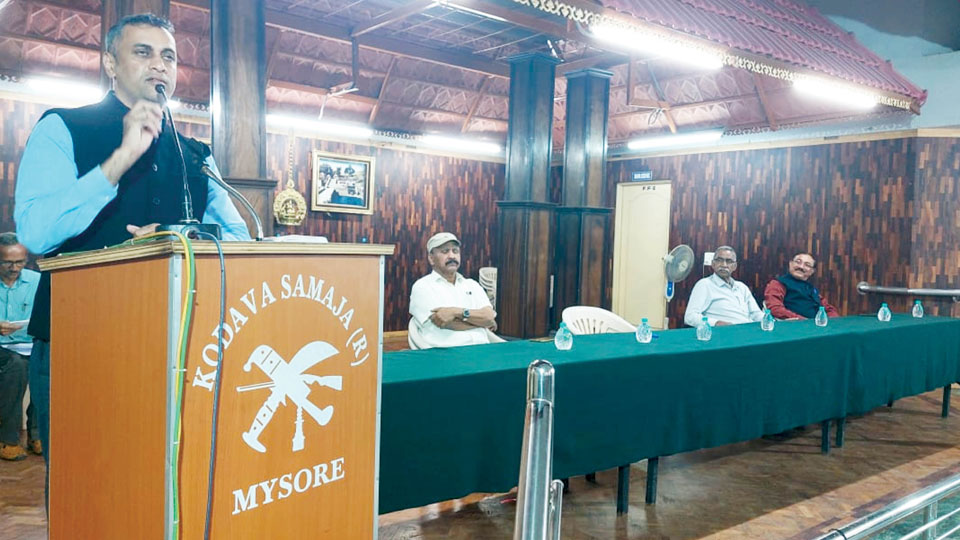
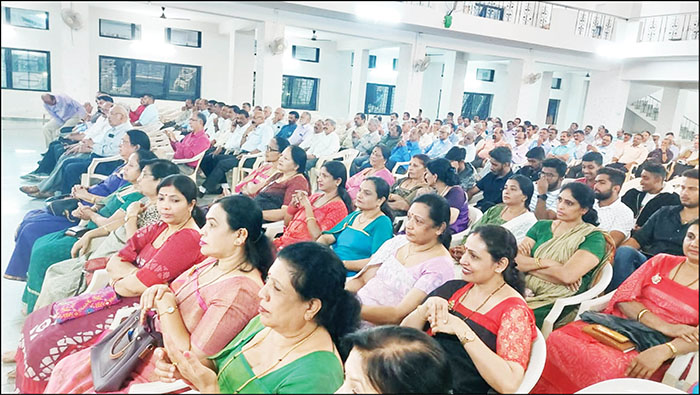
A large number of Kodava families attended the Kodava Convention organised by Kodavas residing in Mysuru at Kodava Samaja in Vijayanagar here recently.
The objective of the Convention was to discuss and deliberate various burning issues and problems concerning Kodavas and Kodagu.
Former Principal of Cauvery College in Gonokoppa, South Kodagu, Prof. Ittira Biddappa, who was the main speaker of the evening, narrated the history of Kodagu. He also mentioned various services rendered and sacrifices made by Kodava community in nation-building. He also remembered the gallant and valiant combatant men and officers of Armed forces and Para-military personnel.
Cheppudira Arun Machaiah, International Karate Master and a social worker, called upon Kodava community to protect their own interest in Kodagu. He urged the gathering to be cautious regarding the political atmosphere in Kodagu and to choose the best political leaders for Kodagu.
Former Additional Advocate General and Advocate Ajjikuttira S. Ponnanna, who was the chief guest, appealed to the Kodavas to unite themselves to protect the legacies left behind by their ancestors.
Ponnanna also briefed about various issues concerned with Jamma land, the difficulty in getting their name recorded in Record of Rights and RTC by all those who left Kodagu long ago to other districts, other States or joined the Armed Forces and Para-military forces.
He reiterated that the land tenure in Kodagu is entirely different from other States. If Kodavas cannot succeed to include themselves and their children in the 9th column/ RTC in the share of Jamma land belonging to them, then the future generation of Kodavas would lose their identity as Kodavas which would be a disaster.
He also spoke at length regarding a writ petition filed by a person in the Supreme Court questioning the exemption given to Jamma land owners and Kodavas by race to possess guns as per Indian Arms Act.
Regarding the increasing human-animal conflict in Kodagu, the Advocate expressed concern over tigers attacking and killing humans and the troubles faced by people with more than 200 resident elephants in coffee estates posing threat to the life and property of owners and workers constantly. He also highlighted the inability of the present Karnataka Government and Forest Department to minimise the human-animal conflict in Kodagu.
The Convention concluded with an interaction session. Chenanda Raghu Uthappa compered.
source: http://www.starofmysore.com / Star of Mysore / Home> News / February 13th, 2023
The parasitoid can be released across estates during the summer months, which is the breeding time of the mealybugs.
Madikeri :
Coffee plantations are prone to several diseases and the attack from mealybug pests is among the major reasons for crop loss across estates. However, the Coffee Research Sub Station (CRSS) in Chettalli of Kodagu district has come up with a unique and organic way to fight this pest. Leptomastix Dactylopii, a parasitoid, has been developed at the station that will be effective in culling the mealybugs in the most ecofriendly way. “Mealybugs are major pests affecting coffee and they cause considerable crop loss,” explained Dr Manjunath Reddy, Entomologist at CRSS.
Ovalshaped, soft-bodied insects, the mealybugs are a threat to the pepper vines and other fruit trees in the estates too. The bugs breed during summer and cause immense damage to the crops during monsoon. “The bugs are covered with white mealy wax, making it tough to eradicate them.
Leptomastix Dactylopii (left); File photo of a mealybug-infested coffee plant
They suck a large amount of sap from leaves and stems with the help of piercing mouthparts, depriving plants of essential nutrients,” he explained. There has been an increased buildup of the mealybugs in the estates and the wild in recent times and Dr Manjunath analysed that this might be due to the abiotic changes in climate and environment. While there are a few chemical sprays to fight the mealybugs, they have been proven ineffective as these bugs infest the estates during the monsoon. However, the CRSS has come up with the most organic way to fight these bugs.
The substation has reared Leptomastix Dactylopii, a parasitoid that attacks and hunts mealybugs. “Female parasitoids lay eggs on the third instar (a lifecycle stage) and young adult mealybugs. A single parasitoid emerges from one mealybug. The parasitoid larvae eat the mealybug from the inside out. After 20-30 days, a young adult parasitoid emerges through a hole on the top-end of the dead mealybug,” he detailed.
A female parasitoid lays 300- 400 eggs,which develop into adult parasitoids in 20-30 days. These adult parasitoids have a lifespan of 2-3 weeks. The Leptomastix Dactylopii can be left in coffee estates that suffer from mealybug infestation and 1,000 Leptomastix Dactylopii are required to be released per acre of estate.
The parasitoid can be released across estates during the summer months, which is the breeding time of the mealybugs. The parasitoids are available at the entomology department at the CRSS in Chettalli and they are priced at Rs 250 per 1,000 parasitoids. This method is seen as the most economical and organic way to fight the mealybugs that infest both Robusta and Arabica varieties of coffee plants.
source: http://www.newindianexpress.com / The New Indian Express / Home> Cities> Bengaluru / by Prajna GR / Express News Service / January 25th, 2023
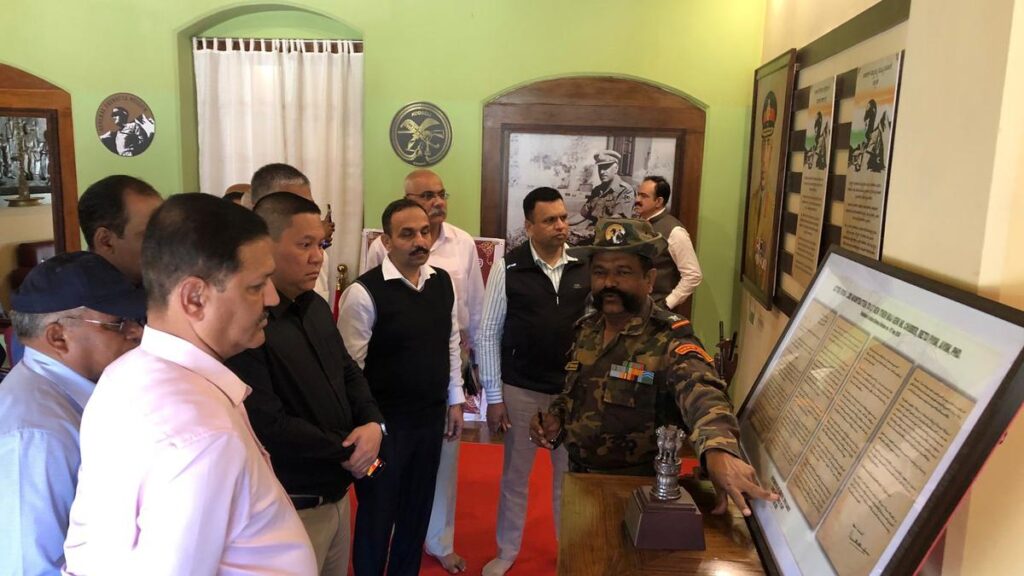
An 18-member team from National Defence College, New Delhi visited Gen. Thimayya Memorial Museum at Madikeri in Kodagu district on Wednesday.
The team was led by Air Vice-Marshal Tejbir Singh who said that the museum is a source of inspiration for present and future military leaders and eulogised Gen.Thimayya’s role in strengthening the defence forces.
source: http://www.thehindu.com / The Hindu / Home> News> India> Karnataka / by The Hindu Bureau / February 01st, 2023
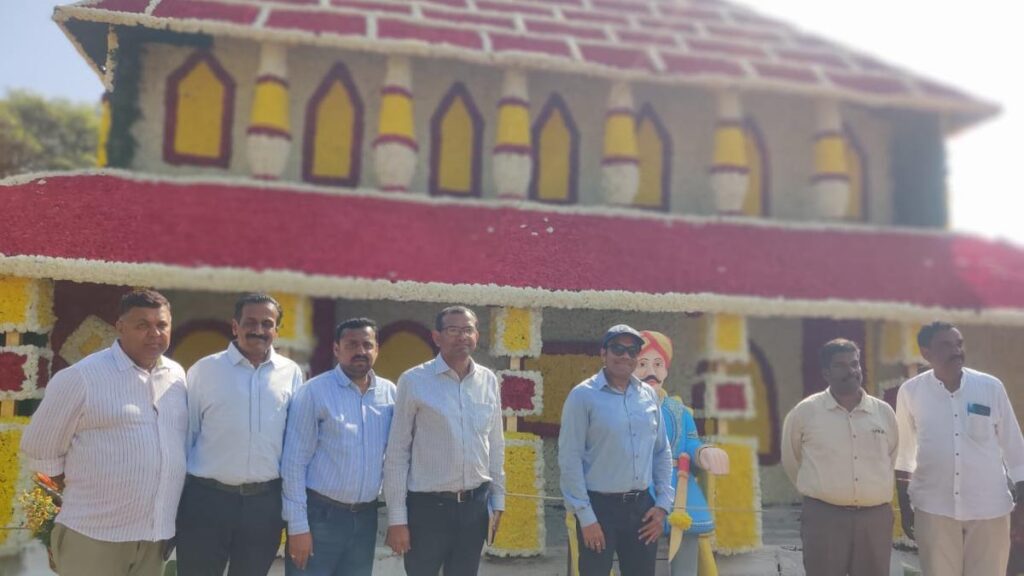
Tourist footfall at Raja Seat in Madikeri has risen with the top tourist destination and one of the most visited sites in Kodagu hosting a flower show since Friday.
The flower show concludes on February 6.
Nearly 20 species of flowers and about 12,000 plants are part of the show with special floral decorations.
The highlights of the show include varieties of exhibits created in flowers, bonsai plants and others.
The Principal Secretary, Horticulture, Rajendra Kumar Kataria, visited the flower show with Deputy Commissioner B.C. Satish on Saturday.
source: http://www.thehindu.com / The Hindu / Home> India> Karnataka / by The Hindu Bureau / February 04th, 2023
WELCOME. If you like what you see "SUBSCRIBE via EMAIL" to receive FREE regular UPDATES.
Read More »