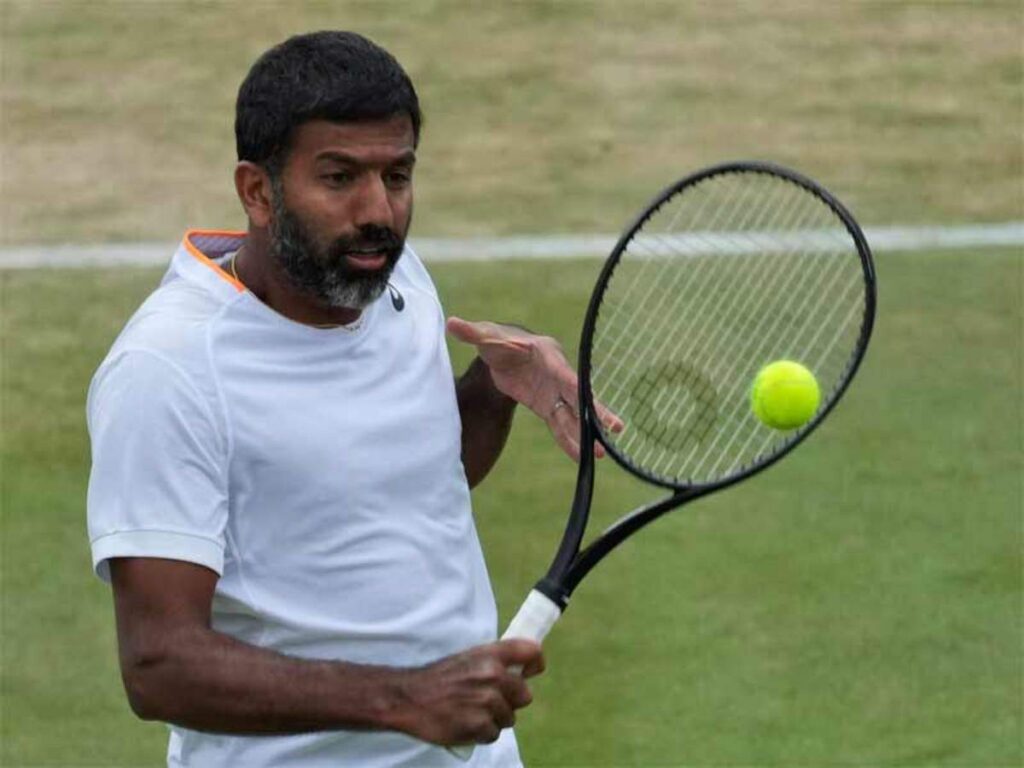
The Rohan Bopanna Tennis Academy, run by the Indian doubles ace, on Monday opened at a school.
“I am very happy to be able to see young talent, giving them the positive encouragement of sport,” he said at the virtual inauguration of Coimbatore’s first development tennis centre in association with the Rohan Bopanna Tennis Academy (RBTA).
The academy is being set up at RAK’s school.
It is also special because it is the first development academy for RBTA outside Karnataka , he added.
Bopanna, India’s top doubles player currently, said Coimbatore has had a lot of talent for many years, adding “one of the main reasons to start a centre here is that there are a lot of students with tremendous talent but lack opportunity.
“We have a structured programme in place.”
Further, Bopanna said when children come to the school, they would get to watch young talent training there, get inspired and start playing tennis.
Speakers at the event, including the RAK’s School founders, emphasised that sports and academics should go hand in hand to ensure holistic development of a child.
source: http://www.timesofindia.indiatimes.com / The Times of India / Home> News> Sports News> Tennis News / by PTI / July 12th, 2021
Film stunt director Fayaz Khan wants to set up institute in Kodagu
HIGHLIGHTS
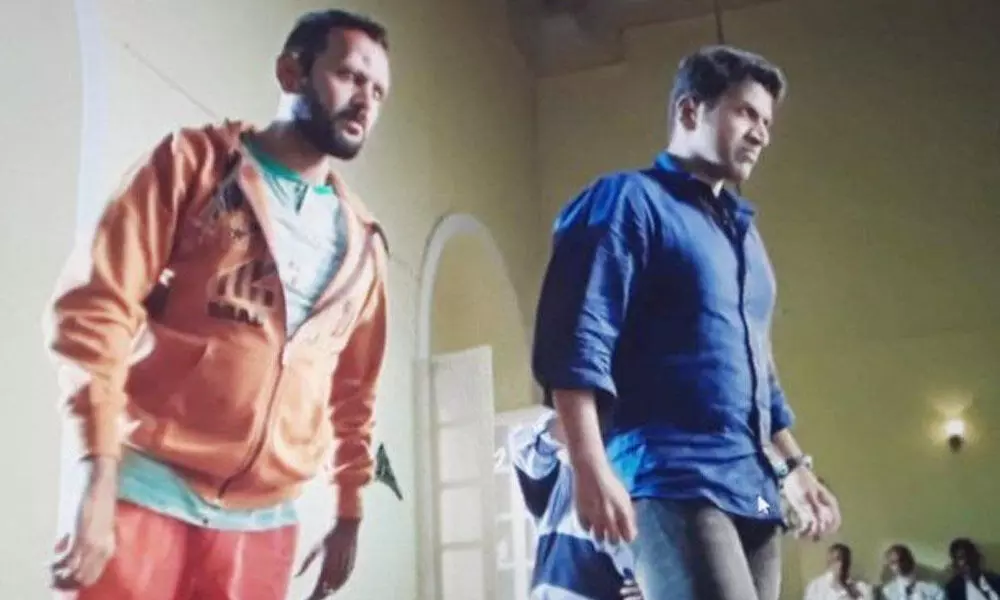
Fayaz Khan who has directed stunts and acted in 1,560 films in various languages wants to set up an institute to train youths in the art in his native Kodagu district.
Madikeri:
Fayaz Khan who has directed stunts and acted in 1,560 films in various languages wants to set up an institute to train youths in the art in his native Kodagu district. As small boy in 1980s, he sold peanuts in cinema halls to support his family in Gonicoppa, a small town in Kodagu district. Sounds like a film story? But it’s true. Fayaz Khan who directed stunts for 1,560 films till now once sold peanuts in cinema halls and never studied beyond class III.
Born in a poor family and fond of films, Fayaz Khan left home in 1985 and landed in Bengaluru in search of his dream. He came to Gandhinagara and begged film directors for a chance and got a small role in Tamil film Idiyadagam. After seeing his performance, many directors gave him a chance. However, his passion lay in stunts. Later he became a stunt artiste and worked for 1,560 films in various languages including Kannada, Hindi, Tamil, Telugu and Malayalam.
Fayaz started his own stunt artists association and trained more than 1100 artists since the outbreak of Covid-19.
Apart from being a stunt master, he acted with such stalwarts like Dr Raj kumar, Vishnuvardhan, Rajanikanth, Salman Khan, Akshaya Kumar, Mammootti, Mohan Lal, Chiranjeevi, Punit Raj Kumar. Speaking to this reporter, Fayaz said that there is a good environment for films in Kodagu. “There is a lot of employment potential in film industry for youths from the tourism district if we train them properly,” he said and expressed his wish to open a film training institute in Kodagu to tap hidden talent.
source: http://www.thehansindia.com / The Hans India / Home> News> State> Karnataka / by Coovercolly Indresh / Hans News Service / July 09th, 2021
Krishi Thapanda, who was involved in organising COVID relief through the pandemic, has taken on a new responsibility now.
Along with four other like-minded friends, Krishi is part of a core group that is working on teaching homeless children at government-run childrens’ shelters in Coorg. “While children in cities have access to the best teaching methods, those in rural areas often don’t have access to laptops or phones to enable online learning. So, they haven’t had any kind of learning in the past year and a half owing to the pandemic,” points out Krishi.
The actress and her friends identified three government-run shelters that were in need of help and set up a programme that will look into their educational needs. “The idea is to give them basic knowledge. The age group of children is from six to 18, who have been divided into three categories. Volunteers have signed up for it and they will teach the kids various subjects.
We have got permission from the authorities to hold two hours of class on week days and we want to make the most of it. As of now, we are in the process of gathering pre-loved laptops and phones to give these children and teach them basic English, so that they find it easier when they step into the real world to earn a livelihood in their later years,” shares Krishi, who will be teaching them acting, dancing and some other art forms too.
source: http://www.timesofindia.indiatimes.com / The Times of India / Home> News> Entertainment> Kannada> Movies / by TNN / July 01st. 2021
Project RE-HAB (Reducing Elephant – Human Attacks using Bees) aimed at thwarting elephant attacks in human habitations using honey bees, seems to have yielded success with jumbos taking alternative routes to avoid coming into contact with bees.
With a view to reduce human-elephant conflicts in the country, Khadi and Village Industries Commission (KVIC) has launched a unique project of creating “bee-fences” to address this burning issue in several States including Karnataka.
The pilot project has been launched at few locations in Kodagu. These spots on the periphery of Nagarahole National Park are known to be human-elephant conflict zones. Total cost of project is Rs. 15 lakh.
Reality check has revealed that the wild pachyderms were maintaining a safe distance from bee boxes. Locals say this has reduced the elephant menace by 70 percent. Bee boxes have been placed at Kutta including Choorikaad and Tithimathi ranges. Jumbos were not seen in these places in the last 25 days. Villagers opined that elephants may have found alternative route.
In fact, the jumbos had damaged bee boxes near Kodange Haadi near Nagarhole recently. Since then, they have not come back. There are instances of young elephants straying into these fences. The cameras have captured the hesitancy of jumbos crossing the fence fixed with bee boxes and also taking de-tour within 27 seconds.
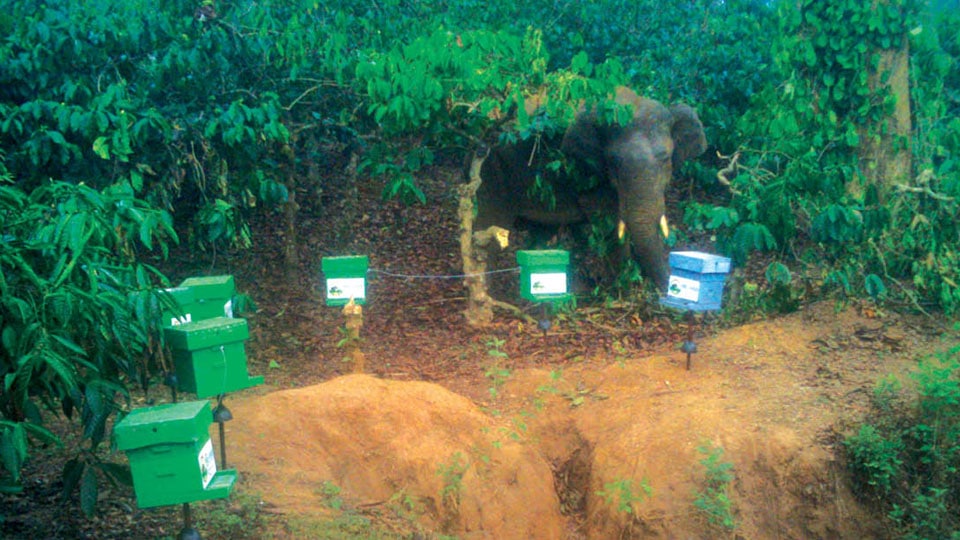
KVIC has set up 15-20 interspersed bee boxes at selected locations. The bee boxes are set up in the passage ways of elephant-human conflict zones to block the entrance of elephants to human habitations. The boxes are connected with a string so that when elephants attempt to pass through, a tug or pull causes the bees to swarm the elephant herds and dissuade them from progressing further. Bee boxes have been placed on the ground as well as hung from the trees to block the passage way of elephants. High resolution, night vision cameras have been installed at strategic points to record the impact of bees on elephants and their behaviour in these zones. The collective buzz of the bees is annoying to elephants that force them to return. Elephants, which are the most intelligent animal and carry their memories for long, avoid returning to the place where they have encountered honey bees.
Nearly 500 people die every year due to elephant attacks in India. This is nearly 10 times more than the fatalities caused by big cats across the country. From 2015 to 2020, nearly 2,500 people have lost their lives in elephant attacks. Out of this, nearly 170 human fatalities have been reported in Karnataka alone. On the contrary, nearly one-fifth of this number, that is nearly 500 elephants have also died in retaliation by humans in the last 5 years.
In the past, Governments have spent crores of rupees on digging up trenches and erecting fences to dissuade elephants. Also, hundreds of crores of rupees have been spent on compensation for loss of human lives. These trenches and barbed wire fences have often caused the deaths of elephant calves and thus rendering these ideas largely impractical.
source: http://www.starofmysore.com / Star of Mysore / Home> News / July 05th, 2021
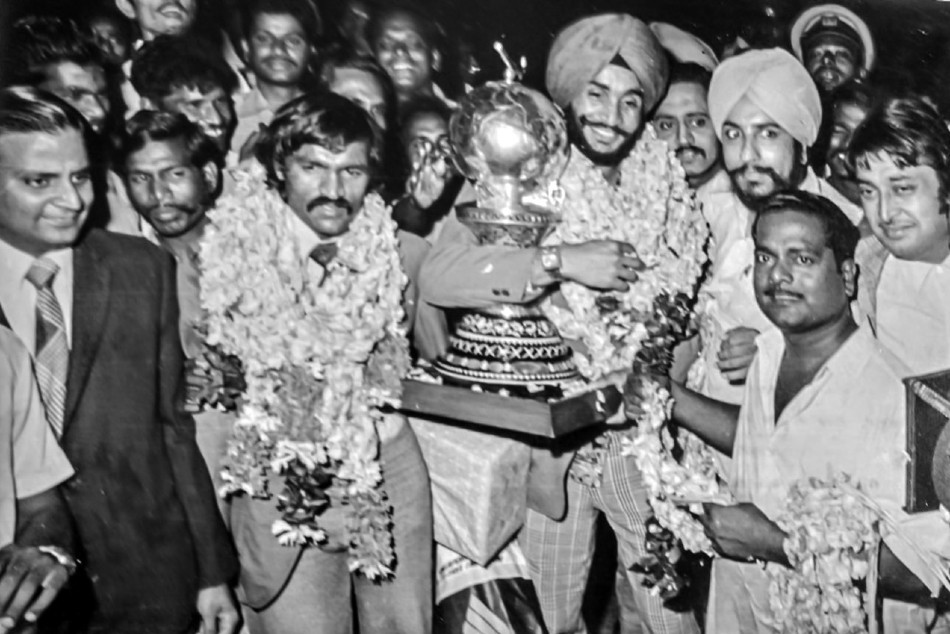
With less than 30 days to go for Tokyo 2020, the Olympic fever is slowly gripping the entire sporting world. While the Indian athletes are leaving no stones unturned and carrying out high-octane practice sessions, it’s time for hockey fans to relive the memories from the triumphant Olympic campaigns in the past through Hockey India’s Flashback Series.
In this article of Hockey India’s Flashback Series, the fiery centre-forward BP Govinda went on a nostalgic trip, fondly talking of his hay days as an iconic figure with a distinctive headband. “Our Coach KD Singh Babu made me play as outside-left in the Bronze Medal match against the Netherlands,” recalled the stylish striker.
“All through the tournament in Munich, I had played as centre-forward, but our Coach insisted I change my position for this match, and it so happened that I scored the equaliser and then Mukhbain Singh scored the winning goal through a penalty corner which helped us win the match 2-1,” recalled Govinda, who was drawn to hockey from his school days in Somwarpet in Coorg.
Having won a Bronze Medal in 1968, India had fielded a young team in Munich which saw stalwarts like Michael Kindo, Ashok Kumar Dhyanchand and BP Govinda make their Olympic debut. But the campaign didn’t go as expected despite a good start against teams like the Netherlands (1-1 draw), Great Britain (5-0 win), Australia (3-1 win), Poland (2-2 draw) and Mexico (8-0 win). India had also beaten New Zealand 3-2 to make the cut for the semi-final.
“But we lost 0-2 in that match. I think we played particularly well in the second half. Almost the entire 35 minutes, we were in their D and we were attacking with all our might, but it was so disheartening that we couldn’t convert a single goal. All our shots would go near the goal mouth, and we would miss. It was as though we were jinxed,” explained Govinda, who is also part of Hockey India’s National Selection Committee.
The former India skipper who led the team to a Silver Medal at the 1978 Asian Games rued missing an opportunity to play for the World XI side at the Munich Games, but the match was called off due to the Palestinian terrorist attack on Israeli athletes. He said, “West Germany had beaten Pakistan in the Final to become the new Olympic Champions and the organisers had planned an exhibition match between World XI and the Olympic Champions. I was chosen from India to play for the World XI side but due to the Black September incident, they called off that match. Though there was no safety concern for us within the village, our contingent was quite close to where this incident happened.”
Another instance Govinda regrets to this day is the penalty stroke he missed against Pakistan in the 1973 World Cup in Amstelveen. “I had scored the only goal (in the 62nd minute) against Pakistan in the semis and that goal of mine took India to the Final against the Netherlands. I had become an instant hero back home but unfortunately; I couldn’t replicate that in the Final. Surjit Singh had scored two goals and the score was level at 2-2 when we earned a penalty stroke towards the dying minutes of the match.”
“Barring Harmik Singh, Ajitpal nobody was coming forward to take the penalty stroke. I told (teammate) MP Ganesh, no one is going so shall I go? I went voluntarily. Before taking the strike, I had decided I will hit the left corner of the goalkeeper but when I lifted my stick, it went underneath the grass, and the ball didn’t connect properly to the stick. My shot didn’t even reach the goalie. We lost the opportunity, and the match went into extra time, and we eventually lost,” recollected Govinda.
However, he fondly remembers from his playing days is his formative days when he played for Mohun Bagan. “That’s where it all began for me. In 1967-68, we won the first division and the Beighton Cup. I was very fortunate and lucky to have played with greats like Gurbux Singh and Vece Paes. I got my first call up for India in 1970,” he said.
Consistent India team stand great chance to finish on podium in Tokyo 2020
Speaking of the current Indian hockey team led by Manpreet Singh, Govinda said, “They have been playing consistently in the past two years, and they have shown a lot of promise. But my advice to them is to take it match-by-match and their first aim should be to make the Quarterfinals. I would say, once they have crossed that hurdle, it is anybody’s game in the Semis and Final.” “This team has been doing well under Graham and have shown that they are capable of beating big teams like Australia, Netherlands, Belgium and even the Olympic Champions Argentina. I have no doubt that they can perform well in Tokyo,” he added.
Source: HI Release
source: http://www.mykhel.com / My Khel / Home> English> Hockey> News / by Avinash Sharma / July 01st, 2021
Kozhikode Mayor Beena Philip has said that the corporation was willing to cooperate with the Indian Institute of Spices Research (IISR) for the proposed spice street project.
Inaugurating the foundation day programme online at the IISR here on Thursday, she said the emerging farming scenario enhanced the social and scientific relevance of institutions like ICAR- IISR in the wake of the pandemic.
She also emphasized that the spice economy was important for the farming sector. However, the ability to maintain and enhance spices production needs to be anchored on improved cultivation practices and research advances, she said.
Presiding over the session, Dr. A.K. Singh, Deputy Director-General, ICAR, New Delhi, said the spices sector had witnessed significant changes in the recent past, and that the country was poised to make gains in production and trade in spices in the coming years.
Dr. Athulya G. Ashokan, Associate Professor, Pushpagiri Institute of Medical Sciences, delivered the foundation day lecture on ‘Management of post-COVID syndrome’. The IISR also launched the e-commerce platform for sale of good quality spices from verified sources and products from incubatee entrepreneurs associated with the institute.
In a new initiative aimed at supporting women entrepreneurs, the institution has entered into an agreement with the Kozhikode District Kudumbashree Mission to provide support for development and marketing of value-added products, production of quality planting materials, and delivery training services.
The IISR also executed two technology commercialisation agreements for the turmeric variety IISR Aleppey Supreme and black pepper micronutrient mixture.
Marking the occasion, the institute conferred spices excellence awards on Kanthraj K.M. from Kodagu district in Karnataka and Rajesh E.M. from Kozhikode. R.L. Innovative Agri Pvt. Ltd., an agri-startup company, was also honoured with the award.
The staff recreation club of the institute donated 10 mobile phones and tablets to support online education of students from under-privileged sections as part of its outreach activities. The institute released five extension folders and three technical bulletins on various aspects of spice cultivation to mark the foundation day.
Dr. J. Rema, Director, ICAR-IISR, and Dr. Vikramadithya Pandey, Assistant Director General, ICAR, spoke.
source: http://www.thehindu.com / The Hindu / Home> News> Cities> Kozhikode / by Special Correspondent / Kozhikode – July 02nd, 2021
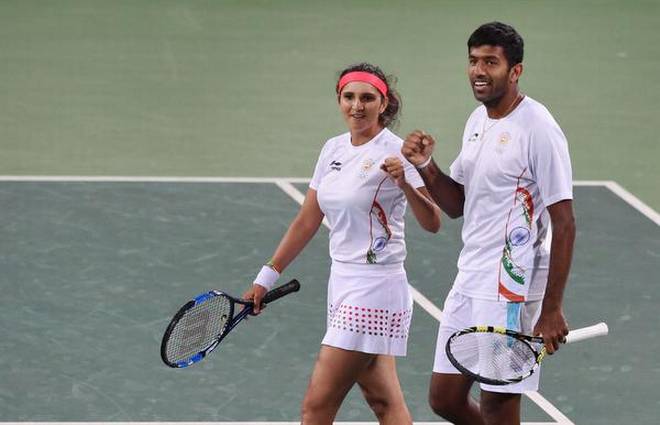
File photo of Sania Mirza and Rohan Bopanna. | Photo Credit: PTI
It was the first time in open era that two Indian teams competed against each other at a Grand Slam tournament.
The experienced pair of Rohan Bopanna and Sania Mirza defeated the brand new combination of Ramkaumar Ramanathan and Ankita Raina 6-2 7-6 (5) in the historic all-Indian mixed doubles first round match at the Wimbledon here on Friday.
It was the first time in open era that two Indian teams competed against each other at a Grand Slam tournament.
The contest finally brought a Grand Slam debut for Ramkumar, who has made 21 attempts to qualify for the singles main draw of a tennis major.
While the first set ended quickly in favour of the veterans, Ramkumar and Raina presented a good fight in the second set, which even they led for a brief period with a break of serve.
Bopanna was clearly the best player on the court with his powerful serve and solid ground strokes from the baseline as well as the ability to execute a superior net game.
On expected lines, Ramkumar served big while Raina gave her all after growing in confidence.
Mirza’s serve is still not at its best and would improve as she plays more matches.
Mirza has moved has also moved to women’s doubles second round with Bethanie Mattek-Sands while Raina and her American partner Lauren Davis lost in straight sets to the US pair of Asia Muhammad and Jessica Pegula on Thursday night.
The 14th seeds disposed off the challenge from the Raina-Davis pair 6-3 6-2 in 70 minutes.
Bopanna and Divij Sharan are already out, having lost their men’s doubles opening round match.
source: http://www.thehindu.com / The Hindu / Home> Sport> Tennis / by PTI / London, July 02nd, 2021
‘C’ Division team to figure in top tier this season
‘C’ Division team to figure in top tier this season
Bengaluru :
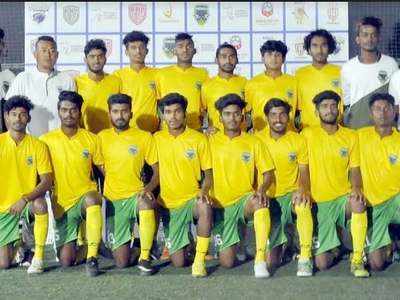
Scores of aspiring footballers, including those from the underprivileged section of society, from the traditional sporting hub of Kodagu will get a chance to sharpen their skills and show their class at the Bangalore Football Stadium with the Kodagu FC set to figure in this season’s BDFA Super Division League.
The club, which played in the crowded ‘C’ Division league, has taken a big leap with the owners shelling out a small fortune to nurture the players of the hilly region.
It all started with the INS Sports Centre near Kushalnagar, established five years ago by Ravi and Kamni Somaiah in memory of their son Naren, a budding footballer, who passed away in a road accident in 2015.
“We want to give the best of opportunities to the talented players in our region. And we were determined to live the dream of Naren who aspired to be a footballer. He left us at the age of 20,” Naren’s elder brother Ponnappa Iychettira, who runs the team, told TOI.
Last year, Kodagu FC did well in the ‘C’ Division, competing against Bengaluru teams. “It was a big learning experience for the players and they have emerged stronger from that,” he said.
On the foray into the top tier of the league, Ponnappa said the idea is to give a bigger platform for the boys to showcase their talent and catch the eye of scouts. “We know it is going to be tough but the main idea is to bridge the gap for talented players. If they get noticed and are picked up by other clubs then we would have succeeded in our efforts”.
Many of the players are part-timers who work in the fields, estates and double up as mechanics and painters. Their entry into the Super Division will see the best of the lot emerge as full-time players.
source: http://www.timesofindia.indiatimes.com / The Times of India / Home> News> Sports News> Football News / by Biju Babu Cyriac, TNN / June 29th, 2021
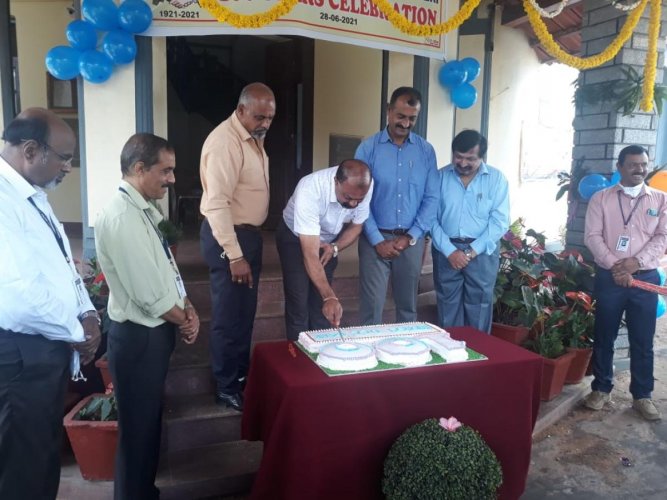
District Central Cooperative Bank president Kodandera P Ganapathy cuts a cake to mark the bank’s centenary on Monday.
Simple celebrations were observed to mark the centenary of Kodagu District Central Cooperative Bank on Monday.
The bank was established on June 28, 1921, owing to the efforts of the then pioneers of the cooperative movement, Dandera Kuttaiah, Puliyanda Thimamaiah, Kuppanda Bellyappa and Udiyanda Machaiah.
The bank began operations with 45 cooperative societies, 16 members, share capital of Rs 4,400 and deposits worth Rs 10,000.
Rao Bahaddur Kodandera Kuttaiah was the founder president of the bank and served in the post from 1921 to 1927.
The centenary programme was celebrated at the bank’s head office in Madikeri, in the presence of the president, vice president, directors, chief executive officer and other officials and staff.
A cake was cut in all 21 branches of the DCC bank, to mark the occasion. Sweets were distributed to the customers.
Bank president Kodandera P Ganapathy said that the bank could complete its 100 fruitful years due to the cooperation of the staff and the customers.
A public function of the centenary celebrations is planned for August 20, 2021. The groundbreaking ceremony for the centenary building will be done on the day, by the state cooperative minister, said Ganapathy.
The district in-charge minister, elected representatives from the district, representatives of cooperative societies, department officials and the former presidents and staff of the bank will be present, he added.
source: http://www.deccanherald.com / Deccan Herald / Home> State> Mangaluru / by DHNS, Madikeri / June 28th, 2021
C.S. Satheesha keeps children from Ist to 5th standard engaged with a slew of exercises in English, Kannada and mathematics, going beyond the syllabus.
Facilitates learning via online mode in remote village in Kodagu district
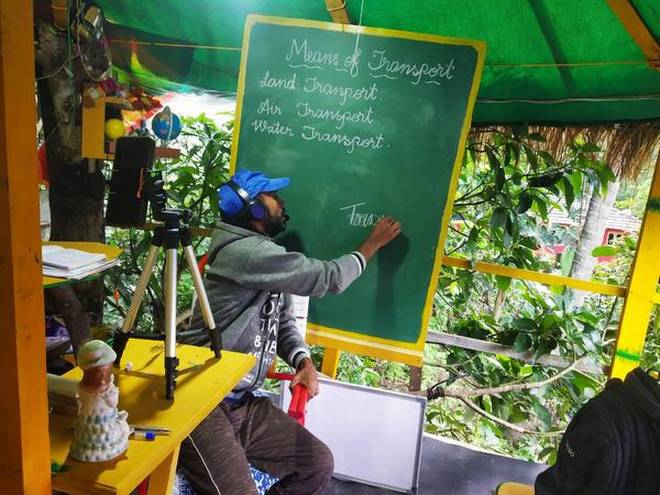
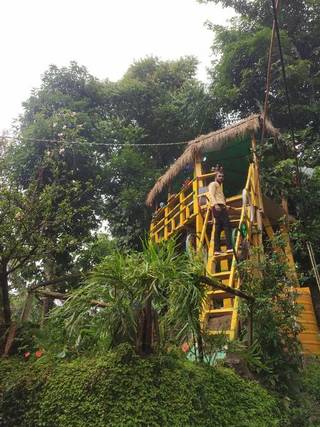
A school teacher in Mullur village in Kodagu district has hit upon a tree-top solution to digitally connect with his students and ensure continuity of their education during the COVID-19 pandemic.
He has fabricated a make-shift room atop a mango tree using locally available materials, including bamboo and grass, besides waste materials.
Constructed at a height of 20 feet from the ground, this has helped overcome the problem of weak reception and signal of service providers in this remote village, located about 20 km from Somwarpet, which is the nearest town.
The tree-top classroom built by C.S. Satheesha, a school teacher, in Mullur village in Kodagu district.
C.S. Satheesha is a teacher at the Government Lower Primary School in Mullur. He handles classes for students from Ist to 5th standard. But the COVID-19 pandemic and the consequent lockdown resulted in disruption of education of children. The impact is more in rural areas, among tribals and first-generation learners as they lack facilities or parental backup, which their urban counterparts have, to ensure continuity in learning.
Hence, Satheesha thought of keeping them engaged during the lockdown with a slew of exercises in English, Kannada and mathematics, going beyond the syllabus.
But connectivity issues forced Satheesha to do some out-of-the-box thinking. He decided to work from a tree top. It took him two months to build a classroom atop a tree.
A conventional RCC roof may have made things easier but Satheesha’s house is tiled and sloped – a building practice that is common in the coastal belt where rains are heavy – and hence he thought of this ingenious solution.
Atop the tree, the teacher not only feels safe, but a double layer of tarpaulin ensures that the make-shift office, where he imparts online classes, remains water-proof. He invested in a mobile stand and also procured a focus light, which ensures better visibility to children at the other end.
“In case of students who do not have a smartphone, I personally distribute exercise sheets during my rounds in the village as part of my COVID-19 duty with an instruction that the answer sheets would be collected by evening,” said Mr. Satheesha.
The online classes also focus on the immediate surroundings of the children. They are asked to identify a bulb, a mirror, a furniture or anything around them and describe their function in full sentences in English. Not only has this endeavour ensured continuity in learning, but children are learning how to make short videos and upload them, using the internet, for evaluation.
The day starts with a ‘WhatsApp Challenge’ comprising a set of questions tailor-made for each student, and sent out by the teacher. By evening, the challenge is accepted!
source: http://www.thehindu.com / The Hindu / Home> News> States> Karnataka / by R Krishna Kumar /Mysuru – January 28th, 2021
WELCOME. If you like what you see "SUBSCRIBE via EMAIL" to receive FREE regular UPDATES.
Read More »