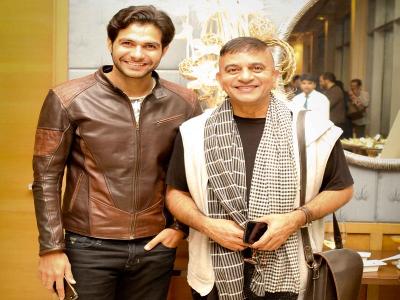
The city’s art connoisseurs were in for a treat early this week, when US-based Sri Lankan artist Geramin Sebastian La Brie held a charity exhibition of her work.
The proceeds of the show were in aid of underprivileged children suffering from cleft lip and palate, and art lovers wasted no time in picking up the paintings.
The show was curated by Rubi Chakravarti and supported by Deutsche Cleft’s Regional Director, South Asia, Dushyant Prasad, and Lalit Sanghvi.
source: http://www.timesofindia.indiatimes.com / The Times of India / News> City News> Bangalore News / TNN / January 05th, 2017
Not only do they handle business in acres, but also take utmost care to manage the crop sustainably. Care T Acres, a private initiative begun in 1998, has been helping coffee planters in Kodagu manage their properties. This initiative has become a boon to many planters who are unable to look after their estate.
“Care T Acres has stopped planters from selling their property and moving away from Kodagu,” says Nanjappa Kuttaiah, a coffee grower. With eight partners — Bose Mandanna, N K Chinnappa, N P Machaya, K M Cariappa, K Ajit Appachu, Aruna Biddappa, B Ram Bopaiah and K M Appaiah — the team comprises competitive planters with a combined experience of over 300 years!
The beginnings
Kodagu, the coffee haven that contributes to over 40% of India’s coffee production, has a lot of estate owners staying overseas. While selling the property has sentimental issues, maintaining them from overseas is illogical. This is where Care T Acres steps in, with the role of prime mover being Managing Director, N K Chinnappa. So, how did ‘Care T Acres’ come into existence? Among the founding members, Late Arun Bidappa was a well-known coffee trader. However, he needed expertise in maintaining his estate, which he developed with the help of expert planter Bose Mandanna.
Arun’s estate was the first property that received tendering from ‘Care T Acres’. “He (Arun Bidappa) said, ‘I help you trade your coffee, why don’t you help me look after my estate?’” recalls Bose. This conversation got the best planter friends together and thus began ‘Care T Acres’ with a maxim that “no one should neglect or sell their estate in Kodagu,” as Bose states.
The initiative is currently managing 600 acres, all under the constant supervision of Chinnappa — who grooms them like brides-to-be. The bottle green coffee plants nurtured by him are shaped like woven skirts. “Chinnappa’s way of raising and nurturing estates is a win-win proposition,” notes Nanjappa.
Professional care & support
The service (for estates that are more than 30 acres) begins with the client signing a five-year contract. Once done, the company starts looking after the ailing estates and fosters them like their own. When a grower approaches them, the team members visit the estate and analyse it. Then, the operations required to revive the estate are prioritised and the ‘surgery’ begins. “The person who can take care of his estate very well will not come to us. It is always the owner unable to manage his property who comes to us. In many cases, the grower would be suffering financial loss. So, the foremost ‘operation’ would be to clear the debt,” explains Chinnappa.
The team acts not just like a doctor but also that of an antibiotic as the second step towards betterment would be to develop proper infrastructure. Drying yards, labour line, proper cut roads, pulping yard and irrigation facility are developed to make the estates sustainable and self-reliant. Simultaneously, the grooming session begins — coffee plants are pruned, nourished, irrigated and shades are regulated to produce better yield.
With constant efforts, the estate breathes a new life. While they work for remuneration in the first two years, they sign up for a 30% profit from the third year. “I might be getting 70% of the profit, but that is equal to 150% of what I was earning before. Also, you get the profit without having the headache of managing it,” opines Nanjappa.
Another grower, Dalia Chengapa, has her estate being cared for by the company since 2007. She recalls how the estate owned by her father, Late A T Chengapa, lost its focus after he fell ill. “My father was a wonderful planter and he looked after the estate properly. But after his health deteriorated, the estate needed support. My sister Ramona and I stayed in different cities, and we did not have the practical knowledge for growing coffee. My father was unable to guide us as he was unwell. That is when we approached ‘Care T Acres’,” she recalls. While her estate incurred loss before the team took over, it is now making good profit.
Nanjappa’s story goes on the same lines. His mother passed on and the 45- acre estate in Suntikoppa that she looked after relied on him for tending. He had known that ‘Care T Acres’ turned the estates around and yearned for their support; eventually the deal was sealed. “Eight competitive planters, financially trustworthy and among the best planters in the district took over my estate and it was a blessing at the right time,” he says. Chinnappa started the work here and looked at two primary problems. Firstly, he pruned the coffee plants in a better way — there were more branches and nodes earlier, which reduced the picking cost. “When pruning is done properly, the plant flows down and it becomes easy to pick berries. The yield also increases,” explains Chinnappa. Secondly, the roads were laid for convenient movement.
The estates cared for by the team improve their pepper yield as well. With a systematic auction and tendering system in place, planters get an optimal price for pepper. The team has taken up risks as challenges and revived many estates. However, Mandanna explains, “While we have gone beyond limits and put money from our pockets to revive the estates, there are instances where we have rejected a few. These estates are uncultivable and there would be no absolute hope for coffee.” Chinnappa adds, “It is not just about profits but it is about leaving a legacy behind.”
One can contact the team at rkpagastya@gmail.com.
source: http://www.deccanherald.com / Deccan Herald / Home> Supplements> Spectrum / Prajna GR / November 22nd, 2016
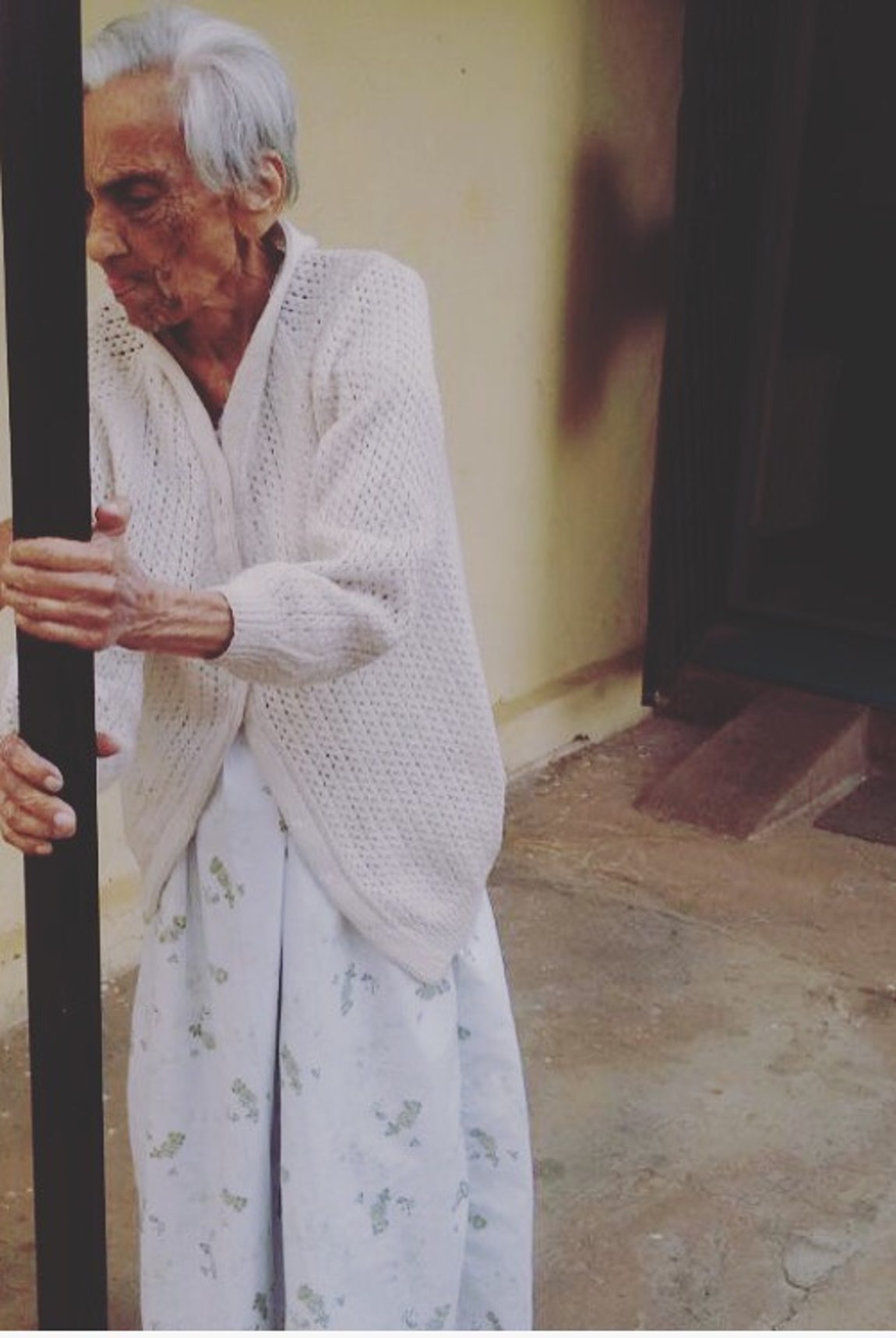
For as long as I can remember, my grandmum has always been old, almost timeless. Time is perhaps the most active change agent. It makes even actors and actresses, with millions to spare for matters, cosmetic, look like second hand imitations of their older selves – but what can it take of those like my Avayya?
In many ways, I always assumed she had conquered time. Even looking at her lying motionless, now, in the midst of a crowd, it only seemed as if she was going to awake from her nap and sip her cup of black coffee, and then some time later, brandy with hot water.
She lived a simple life that belay the many tribulations, women – especially those widowed at an early age – overcame for the prosperity of their family. At 101, she had passed. Quietly.
My Memories of Avayya (and her Imaginary Friends)
As the mournful masses milled around her body to pay their final respects, I couldn’t keep a steady mind. I was sad but also confused.
Here was a woman who in her lifetime had lived through the invention of the modern television set, World Wars I and II, the Indian freedom struggle and independence from the British, the Cold War, the Emergency, the invention of the internet, the Pokhran nuclear tests, the year 2000, her second (or third, I don’t know for sure) favourite grandkid’s playing Bryan Adams’ Summer of 69 on repeat, and much else. You tend to associate a certain degree of immortality to someone of that stature.
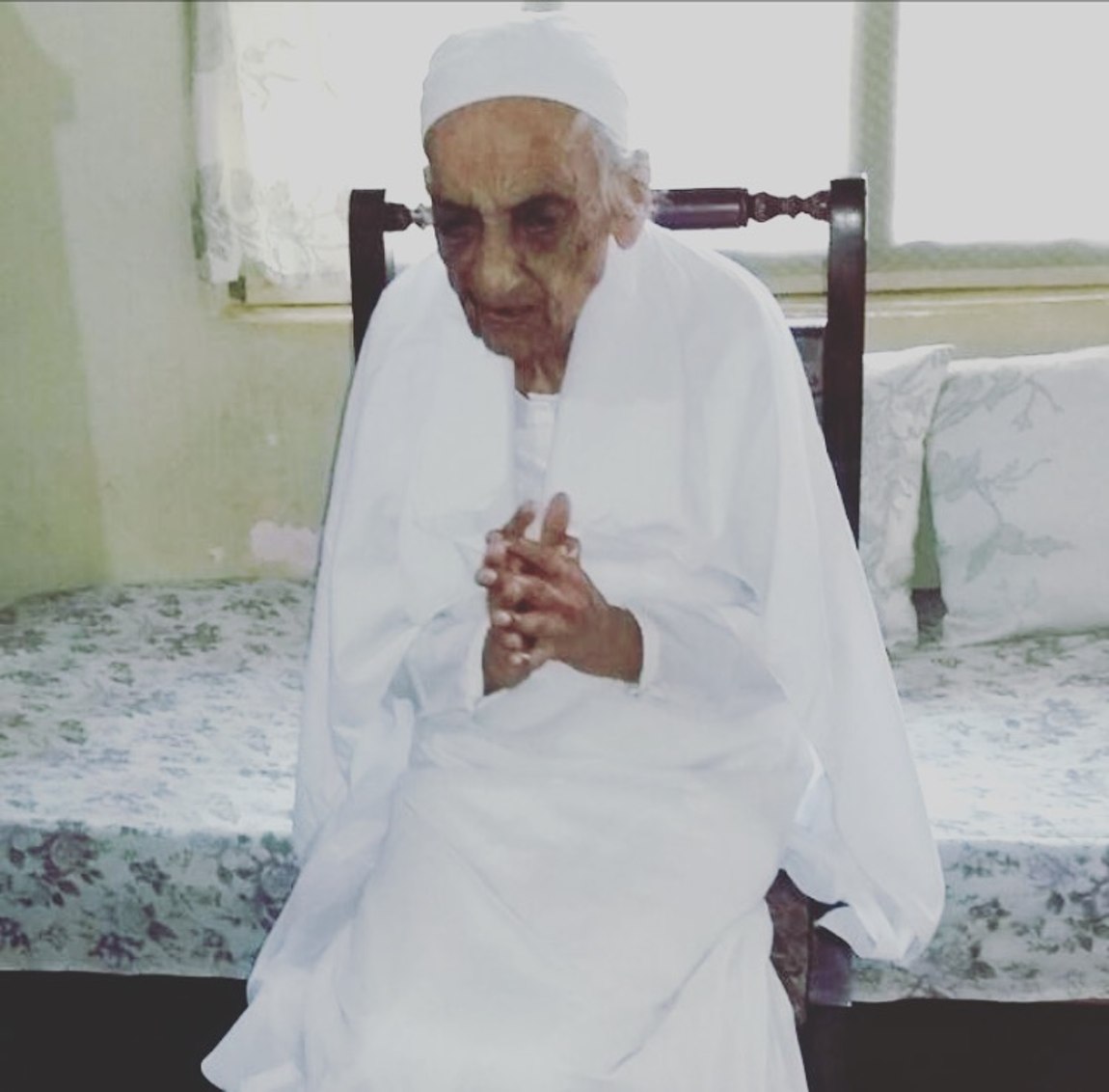
At 101, she had passed. Quietly. (Photo Courtesy: Roshan Cariappa)
She was a reservoir of knowledge, the lone connecting thread between five generations of a family that stretched across many geographies far from her native town.
My own personal memories of her were fond.
When we were children, we visited Coorg in the summers a couple of times. Avayya – probably in her 70s then – still managed a home and an estate by herself. I found old houses eerie – a fact manifoldly exacerbated by Avayya’s telling us of our long deceased Granddad’s proclivities for pinching people’s bottoms in the night. I huddled under the blankets in the night, my tiny bottom firmly planted on the ground, waiting to fall asleep. It worried me greatly that the others seemed unperturbed by Granddad’s post life nocturnal harassment. Some even attested, amusingly, that they had been subject to said antics.
Sometimes, while making supper in the kitchen, she’d venture out in the abject darkness to fetch firewood or water. While we sat beside her and ate rotis and bamboo shoot curry, she’d narrate anecdotes of people and events that, for us city rats, seemed from North of Jupiter. Somehow, she seemed to know it all. Mostly, her stories were about our Uncle Jimmy and his drunken misadventures. She had a wry smile; her eyes closed momentarily in a wink. And if you saw her then, with the many wrinkles even, her face betrayed a childlike impish charm.
She also had a wicked sense of humour. Many years later, while living at my uncle’s house in Mysore, she started animated conversations with imaginary friends from across the hall. Now, if you were studying late for your board exams (like my cousin Bopu was at that time), this was no laughing matter. Try doing any of those innocuous activities you do around the house with someone actively conversing with people you can’t see, let alone host. It warranted a visit from my uncle from abroad to set things straight. Having inherited some of her traits, my uncle armed her with a stick and some ash, and is said to have told her to put it to use if ‘them imaginary friends’ showed up. Just in case. And surely enough, her friends and conversations were gone. Maybe it was a ploy to see her son, but I think she did it just for kicks.
She was a reservoir of knowledge, the lone connecting thread between five generations of a family that stretched across many geographies far from her native town. (Photo Courtesy: Roshan Cariappa)
The week after she passed, we had a traditional ceremony. The family gathered to partake in the rituals – that included sharing her virtues, praying to the gods to look upon her kindly, offering her favourite things: food and drink.
While we took turns keeping aside a morsel of rice and meat, each, for her on a plantain leaf, somebody remarked to refill the brandy. Apparently, the level of brandy in the glass from the night before had depressed. While some of us looked at Bopu, who maintained it had evaporated, I couldn’t help but smile.
It just could have been Avayya and her imaginary friends.
(Roshan Cariappa is a Bangalore-based tech entrepreneur, occasional writer, and musician. He finds inspiration in Bharat, dharma, economics, music, and startups. He tweets at @carygottheblues.)
source: http://www.thequint.com / Home> Blogs / by Roshan Cariappa / February 19th, 2017
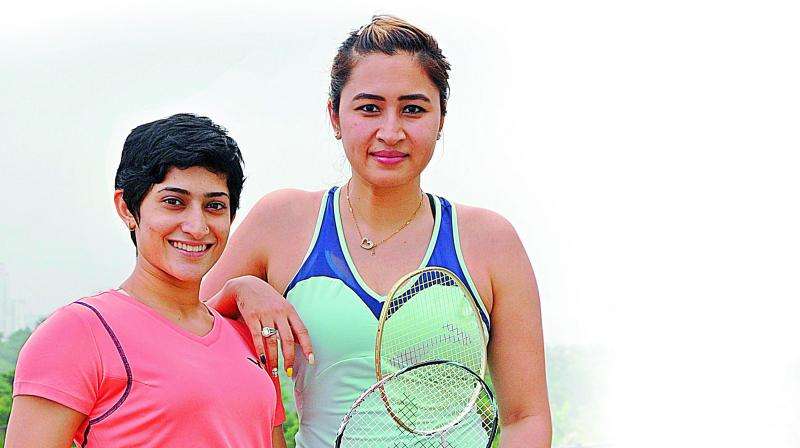
Ashwini Ponnappa opens up to Sportskeeda about her career, struggles, achievements, doubles getting ignored and much more.
Ashwini Ponnappa. [Image Courtesy: Red Bull]
“India, as a country, is reactive rather than pro-active.
”Having won tournaments ever since joining the international circuit and still not getting enough support, Ashwini Ponnappa hits the nail on the head with this statement.
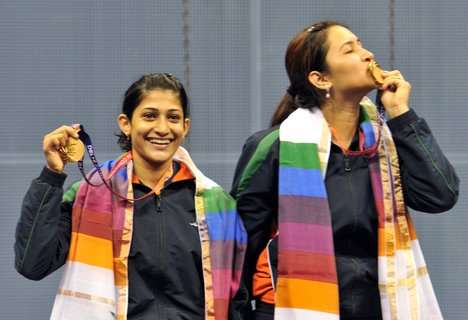
The Gold at the 2010 Commonwealth Games in women’s doubles was supported with a mixed team silver while she and Jwala Gutta became the only Indian pair, and second Indians after Prakash Padukone in 1983, to win a medal at the World Championships when they won the bronze at London in 2011. The 2015 Canada Open triumph came on the back of yet another successful CWG campaign in Glasgow and a bronze at the 2014 Asian Games.
Despite all these achievements, it wasn’t until September 2015 – less than a year before the Rio Olympics – that Jwala and Ashwini were included in the Target Olympic Podium (TOP) scheme. And that, too, came after a war of words and multiple requests and demands to the Sports Ministry.
“Not just the TOP scheme, a lot could have been handled way better, to be honest. I think when Jwala and I did well at the World Championships in 2011, things should have changed then,” the 27-year-old claimed. “When we did well in 2010 at the CWG, we should have had support, which would have eventually led to us, probably, doing well at the 2016 Olympics, not in 2012, where we lost out by just 1 point.”
“So when you see a pair having potential, who have done well, are doing well and have the potential to do even better, support them! Did anyone come forward to do that?,” questioned Ashwini. “They didn’t. And that’s why I think the delay in us being involved in the TOP scheme cost us a little bit (at the 2016 Olympics).The support we got was not enough to guarantee a medal.”
Looking at the likes of HS Prannoy, Guru Saidutt part of the list already, it is natural that the country’s most successful doubles pairing would be hurting from being overlooked time and again.
Doubles ignored by the badminton fraternity
This inadvertently prompted the question if doubles badminton gets step brotherly treatment as compared to singles. And like she plays on the court, Ashwini didn’t hold back from this either, bluntly admitting that it is foolhardy to harbour expectations of a medal from the Olympics without significant backing.
“You see the companies that are supporting the junior players – all of them are supporting singles players while nobody supports doubles players. Nobody wants to gamble on a doubles pairing and pick a pair and back them to win a medal, the way they would do for a singles player.”
“If you look at Saina and Sindhu, they have been given consistent support since the age of 13-14 and that’s what has helped them achieve everything at the international level. There’s not one doubles player who is given that backing. But, you expect so much out of us when we are struggling, as it is. You can’t expect miracles at the Olympics as it is simply not going to happen with this backing,” she continued.
Rewinding the clock and remembering the unrealistic expectation the nation had on the pair during the London and Rio Olympics, I had to agree with her. Just when my mind began to wander about how they kept their motivation up, she explained:
“Everything that Jwala and I achieved. Everything that Jwala-Diju achieved, what the other doubles players have achieved – is amazing. I think that’s remarkable. It’s an outstanding effort put by all of us because without having support, to just go there and play because you want to play and work hard for yourself, for your country. Of course, it stings when you don’t get any support, but it hasn’t stopped us from working and fighting and trying to do really well,” she answered as if she could read my mind and anticipate the next question.
“But, to push us to the next level, we need more – a lot more – to make us do that and that isn’t happening. We still believe that despite all that we are going to do well, but how far can belief just take you alone. We need a lot of support. But, hopefully things change. It hasn’t happened in the past, though despite Jwala and I performing well,” the anguish was quite palpable on her face as she talked about the obvious lack of support.
Jwala Gutta’s and Ashwini Ponnappa’s success has come despite the obvious lack of support
By this time it was clear that having already competed with the top nations and coming out on top on quite a few occasions was despite the negligible funds and backing given to doubles badminton in India rather than because of it.
No Indian pair goes into any Superseries, Olympics or Asian Games as one of the favourites. Any achievement by any Indian pair, not just Jwala and Ashwini, is considered as a bonus. From parents not encouraging kids to take up doubles to lack of media coverage, it is not just the lack of funds or support that has resulted in Indian players merely making up the numbers at every tournament and playing second fiddle to the Far East and European countries when it comes to doubles. The problems are deep-rooted and many, which have resulted in India’s current standing in doubles badminton.
“When we look at other countries, I feel, we are definitely capable of beating them. But, at the same time, there’s a massive difference in the kind of facilities they are provided in terms of training and encouragement – which is most important at the grassroots level.“The fans, as awesome as they are, can only feed what’s given to them and that’s where the media plays a huge role. Unfortunately, there’s not a lot mentioned about doubles as opposed to singles. The same performance between a singles player and a doubles player, the singles player would get definitely more. In terms of that, I feel doubles is not given any importance, whatsoever. And that makes parents question whether they want to put their kid into doubles or let them continue there if he/she is put in doubles,” a realistic Ashwini confessed.“As a parent, you are looking out for the well-being of the child. So, you see how much a singles player gets and at the same time you see that a doubles player doesn’t get anything, it makes you question if you should let them continue doubles. I feel in that sense, India’s got a HUGE way to go to ensure the doubles players get the respect, acknowledgement, and encouragement – which is there in the other Asian as well as European countries,” said Ashwini, for whom being pragmatic about the whole ordeal seemed to come naturally. To be honest, if I was a doubles player like her, I would be seething at the system we’ve created.
“There are plenty of problems, but it all starts from the backing you have. You go to a tournament, we send 5-6 singles player, but just 1 doubles pair – that’s it. So, how can we expect India to catch up because there’s a vast difference between that one pair and everyone else?”
Playing singles with Carolina Marin
After listening to the Cinderella-esque challenges that doubles badminton faces in India, I begin to ponder when they would get the Fairy Godmother it so badly requires. After an awkward silence, I look down at my list of questions as I seek to change the mood in the reception of the Karnataka State Badminton Association facility – the venue of the interview.
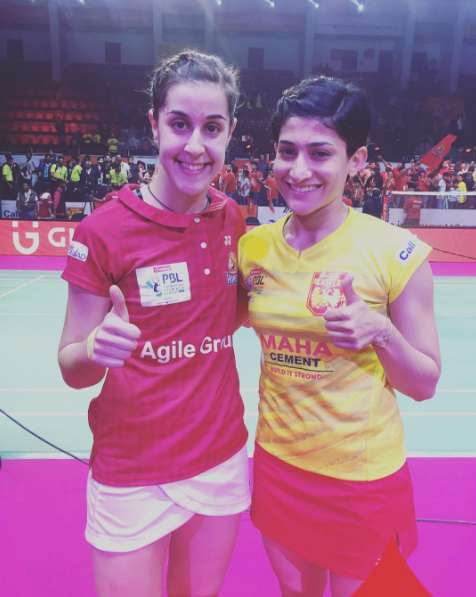
Suddenly my thoughts began to move towards the Premier Badminton League (PBL) where the ‘interviewee’ played an unexpected, yet delightful singles match against the reigning Olympic champion Carolina Marin. Ashwini displayed an array of shots to surprise the Spaniard, and everyone else, and take the first game 11-9. Although she went down 5-11 and 8-11 in the other two games, it was refreshing to see her step away from her comfort zone and give an excellent account of herself.
“Thank you so much,” she uttered mustering a smile when I mentioned that it was my favourite match of the 2017 PBL. “It (playing with Marin) was amazing, to be honest. That’s the best part about PBL – it gives you opportunities. In life you have things thrown at you and you have to grab them. And as I love playing singles despite being better at doubles and not having played that format for a long time, I put my hand up to play against the Olympic gold medallist.”
Ashwini Ponnappa gave the Olympic champion a scare at the PBL
Talking about the match, she explained how well she prepared herself that led to winning the opening game against the then World No. 1. “I wanted to make sure that I play really well. Getting on the court, I just wanted to put up a fight and make sure I didn’t lose 11-0, 11-0. (grins as she recalls her mentality at the time). I just wanted to prepare well and I think it is part of being a professional badminton player that you don’t get into a match, irrespective of whether you’re training for it or not, without being prepared. So, I decided I was going to prepare myself, watch how she plays, and it actually paid off,” she recalled.
The PBL has thrown up such challenges at players time and again while giving them the opportunity to share the dressing room with the who’s who of the badminton world. Although she never had an idol growing up, she had always been a keen observer, trying to pick things from each and every player and that is precisely what she has been doing at the PBL as well. Asked about how the league has helped her and other youngsters, the Bangalore-born shuttler was unequivocal in her praise of the tournament.
“The PBL has helped me a lot, personally and I am sure it has helped the others too. When I played the first edition of the IBL (the IBL was rechristened as the PBL after the first edition), I partnered Victor Fischer who had won bronze in the Olympics and the World Championships. So I learnt A LOT! Being somebody who isn’t primarily a net player, and playing with someone like Fischer helped me immensely and I partnered him in the second season too,” she fondly recalled.
“Like I have learned a lot, I am sure the other Indians would have also learned by just watching them play, get ready, their preparations. These top players are very forthcoming with their opinions. They are happy to share and give you advice as well.”
Partnering with Sikki Reddy
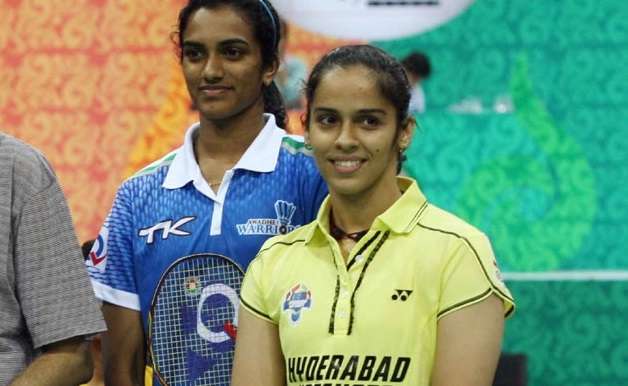
In the 2017 edition of the PBL, Ashwini Ponnappa partnered Sikki Reddy for the Bengaluru Blasters and had the former World No. 2 Korean pairing of Ko Sung-Hyun and Yoo Yeon-Seong to learn from – something she believes helped her massively as it was one of the biggest learning curves in her illustrious career.
“In the last PBL, when Sikki and I partnered, the Koreans in our team were like coaches to us and it was amazing how well we got to interact with them. They would guide us how to move and also give us drills. I learned a lot, and I am sure Sikki did as well as they would point out the nitty-gritties tell us what we were doing right and wrong, that nobody generally tells you. But, the fact that they did, was really helpful as we’re constantly learning,” uttered Bengaluru Blasters’ star doubles player.
Post the PBL, the unseeded pair of Ashwini and Sikki got another feather in their cap by reaching the final of the Syed Modi International. Despite leading in both games at one point, they ended up on the losing side against the Danes, something which Ashwini believes would not happen if they were to get more consistent.“I feel, we still have to get more consistent. At the Syed Modi International, I feel we improved on the consistency bit. But, as a pair, we haven’t had that many matches, so I think it would still take time,” confessed the 27-year-old. “I am quite disappointed that we lost, irrespective of it being just our fourth tournament, because as a player you go to every tournament to win. And, I truly believed we could have won and pull it off. But, we do tend to lose a couple of points in cases when we’re leading. So, we’ll have to work on that and maintain a consistent lead.
”Unlike with Jwala where Ashwini did most of the running, we have seen Sikki and her share the running and be a more fluid unit, exchanging positions effortlessly. Their debut tournament was a second round exit before a final in Wales, a semi-final appearance at Ireland and reaching the final at the Syed Modi Int’l. Asked if the team dynamic was the reason behind the upward curve ever since they teamed up, Ashwini said that could be one of the reasons along with the fact that the two of them are “go-getters” while playing down all their achievements so far.
She explained, “We’ve started with tournaments that we thought we could handle well as a pair. But, as you go on to the bigger tournaments like the Superseries, it’s not going to be so easy. It’s good to start on a positive note and that’s why we started off in the smaller tournaments and the results in the first 3 tournaments gave us confidence. And now reaching the final at the Syed Modi, which is a big tournament, is a big deal for us. So, that motivates us a lot.”
With the All England Championships up in March the next major challenge for the pair, Ashwini said that the duo would be ready for their first Superseries despite the stiff challenge posed by the presence of the Chinese and the Koreans.
The difference between Sikki and Jwala
A hyperactive child growing up and one who loved running out and playing till the sun went down, Ashwini didn’t envisage herself as a professional badminton player when she was ‘forced to pick up the sport’ as her parents thought it was a good way to keep her busy. However, once she got into the junior category, it was then that the bustling little girl began taking badminton seriously.
After spending a few years in the junior category, she was thrown into the deep end when she, just 20 years old was asked to partner a then 26-year-old Jwala Gutta. Their partnership lasted for 6 glorious years – a period she looks back on fondly, calling her former teammate a great mentor and partner.
“When I partnered with Jwala, I had zero experience. I started playing in the junior category and then moved to the seniors for a year and the next thing I know, I was partnering Jwala. So, I believe Jwala had a lot of responsibility because we played in big tournaments. However, the good thing is that when I started playing with Jwala, we clicked instantly! She guided me a lot, was very supportive and was there for me every step of the way. She was always the one with experience and I was picking things up,” Ash gave a glowing tribute to her former partner.
Drawing parallels to Jwala in 2010 and Ashwini now, I asked her if she felt any added pressure to guide 23-year-old Sikki Reddy similar to how Jwala mentored her? “Not at all,” came the instant reply from her. “Sikki and I are, more or less, on the same page considering she already has a few years of experience under her belt, unlike me when I started out with Jwala.”When quizzed about the future of the partnership, Ashwini is taking a pragmatic approach while looking forward to a great partnership in the meantime.
“We are two ambitious individuals who have gotten together. We are going to see how it goes. If it works, that’s great. If it doesn’t, well, that’s how life is,” admitted Ashwini.
Saina or Sindhu
Moving on to the biggest debate in Indian badminton was a no-brainer, but Ashwini, diplomatically, refused to pick one out of Saina Nehwal or PV Sindhu, saying they both have a long way to go.
Answering the debate in the same clever manner she deals with a tricky drop shot on the court, she said, “I feel the one that is more mentally tough and lasts there the longest will be considered the greater player. Sindhu is still young while Saina also has a few years ahead of her. Saina is very strong mentally and is extremely hard working while Sindhu has age on her side. When they both hang their boots, we may have Saina and Sindhu as 1-2, or it could be the other way around, you never know. Either way, it doesn’t matter as both of them are Indians at the end of the day.
”Going nowhere with the Saina-Sindhu debate despite repeated probing, I moved on to ask her about her fitness mantra, which has helped her stay at the top of her game for so long.
“Currently, my fitness mantra is being smart. I’ve always been on the stronger side physically. When I started working on my fitness in December after a spell out, I took on a routine that was ‘my body specific’. Being a sportsperson, it is very important you only do stuff which helps your body and not everything which ends up breaking your body.
”She talked about having to keep herself motivated to work out and keep her fitness levels up, specifically highlighting the effort of fitness trainer Deckline Leitao and Red Bull, who have let her enjoy her fitness sessions once more with their unique ‘best fitness friend’ campaign.
“It’s nice I’ve found this new found love to enter the gym and go and work out. It’s been good,” said the Red Bull athlete.
Using social media as a motivating tool
Ashwini is one of the most accessible Indian sportspersons, regularly using social media as a tool to communicate with her fans and loved ones – something she thinks the European players do extremely well. However, she has made her share of mistakes by being over-indulgent and says that she has been learning over the years.
“In the past, I had put out my email address on social media, and I got a lot of mails. I was overwhelmed with all the love and replied to each of them. But, I would get more replies and it became an endless cycle,” laughed Ashwini recalling her young, naïve self.
“Twitter helps that way. When I have time, I go there and answer questions of fans who I feel are genuine and want to know about me. So, I feel like social media like Twitter and Facebook is a good way to let your fans know what you’re up to. It’s amazing the kind of support you get, especially when you’re down and things aren’t going your way. They give you messages like ‘It’s okay. We’re with you, etc. So, it’s very motivating.’” she claimed.
“Being a public figure, it’s important you stand up for a cause”
Anyone who knows Ashwini Ponnappa is well aware of her love for animals. She has been an active PETA campaigner while constantly lending her voice and face for causes supporting animal rights. Being a public figure, she feels it is imperative that one supports a cause.
“For me, personally, I do it because I love animals. Being in the limelight, a celebrity, sportsperson or a public figure, it’s important you stand up for some cause – need not be animal rights, it could be the environment, supporting the girl child, old age homes, etc. I think that when you are in a place where you can make a difference and you can help out, I think you should do that,” professed the animal-lover, who herself has 4 adorable dogs at her parents’ house in Coorg.
Biggest achievement
The coveted gold at the 2010 CWG made a massive impact as it was won in front of the home crowd.
A quick glance at my watch made me realize that I had overshot my time by over 20 minutes – a period which had flown by as she patiently answered each of my questions, keeping me entranced all the time. Trying to quench my never-ending thirst, I put forth a final question in front of her: ‘Which achievement would you classify as your best so far in your career?’
“The best would definitely be the 2010 Gold at the CWG. The next would be followed by the bronze at the World Championships because it is, after all, the World Championships! Also because we were the first Indian pair to win it and the second after Prakash sir to win a medal there was a huge deal,” she revealed. “However, the CWG is close to my heart as it was the first win for us (Ashwini and Jwala) and it was massive because it was in front of our own fans with everyone watching.”
“It made a huge difference that we won it in India. If we had won it in 2014 in Glasgow and not in 2010, the impact wouldn’t have been the same and people probably wouldn’t have known who Jwala and I were. If it was somewhere else other than India, the newspapers would have carried it as (uses her hands to indicate a small heading at the bottom of the page) ‘Jwala and Ashwini won CWG gold’. While the same paper would have printed ‘Saina won CWG gold’ (gestures it to be a front page headline).
With the kind of treatment meted out to doubles players despite all the achievements, I shuddered as I thought of the impact, or lack of, it would have made had the 2010 CWG been held outside India. The repercussions would have been unimaginable and despite going through it all, Ashwini continued with her charming smile as I thanked her for her time before she humbly bowed out of the room to continue working ‘smart’ on her fitness in her quest to bring further laurels to the country.
source: http://www.sportskeeda.com / Home> Badminton / by Saransh Gehlot @saransh2703 / Editors Pick / February 13th, 2017
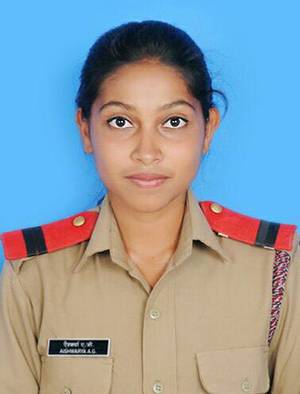
A.G. Aishwarya is a student of St. Joseph’s PU College in Madikeri.
It was a moment to savour for senior under officer A.G. Aishwarya of Kodagu as she led the all-girls National Cadet Corps (NCC) contingent at the Republic Day parade held at Rajpath, New Delhi, on Thursday.
For the student of St. Joseph’s PU College in Madikeri, participating in the parade was a childhood dream inspired by her elder sister Ambika, who was decorated as the ‘Best Cadet’ and honoured at her institution a few years ago.
Her father Ajjinanda Ganesh, mother Monthi Ganesh and sister were in New Delhi on Thursday to witness the parade and cheer her on. Aishwarya belongs to the 19KAR Battalion and was also part of the Republic Day camp in 2015 as a junior wing cadet. She hopes this is just the beginning of an incredible journey as she is determined to join the Indian Air Force and become a fighter pilot.
Ms. Ganesh spoke to The Hindu from New Delhi soon after witnessing the parade and said the entire family was proud of Aishwarya. “There are no words to explain how proud we felt at that moment,” she said.
She recalled that Aishwarya was in class 2 when she witnessed seniors, including her sister, participate in NCC activities. She was also inspired by her uncle Major Nanjappa and other relatives in the armed forces. “She joined Bulbul while in primary school and later joined the Guides and finally the NCC when she was in class 8 and 9,” she said.
Aishwarya, who is a science student with good academic track record, has a little more than a month to prepare for her II PUC examinations, which commence in March, but she is not at all tense. “She has consistently secured distinction in all subjects despite her extracurricular activities and [she] is not tense at all,” her mother said.
Aishwarya is an accomplished skater and hockey player apart from also playing the guitar.
source: http://www.thehindu.com / The Hindu / Home> News> States> Karnataka / by Special Correspondent / Mysuru – January 26th, 2017
Struggling to improve yield levels with traditional methods at his coffee plantation, Hoysala found great success with technological innovations.
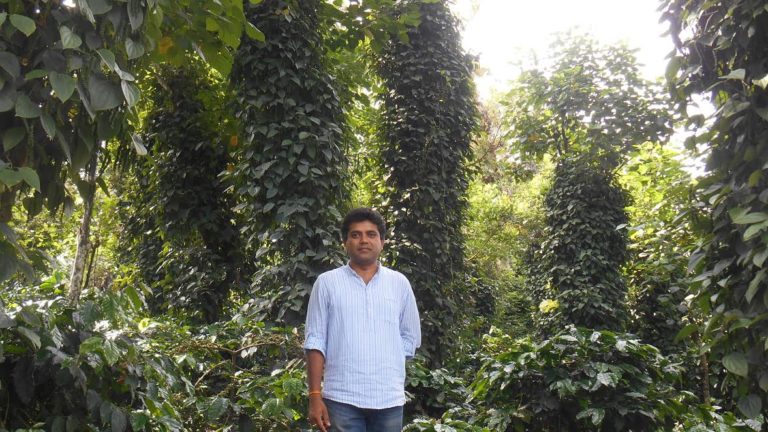
Hoysala at his plantation. Credit: M.J. Prabu
Farming, especially in India, is generally considered to be a traditional field that’s averse to innovation, however M.G. Hoysala’s successful decision to quit banking for farming with the help of technological innovations, shows that keeping an open mind towards new, nontraditional cultivation techniques and interacting with experts in the field is essential for achieving farming success.
While many come into the profession unwillingly, Hoysala represents a section of people that actually wants to take on the family vocation. After spending five years working at a private bank, Hoysala came to realise the importance that the agriculture and plantation sector held for him. So he left his job and took over his father’s coffee plantation.
Since he took over, the Hoysala’s 40 acre farm in Karnataka’s Kodagu district has become a role-model of sorts for the other farms in the area.
As is common in the region, Hoysala grows Arabica coffee on his farm, but what differentiates his farming practices from the rest is the presence of tall indigenous trees that grow alongside the rows of coffee bushes, their height providing shade for the lower shrubs. Another distinguishing factor is the presence of black pepper vines that cover the trees’ trunks.
Starting off as an amateur, Hoysala initially followed the locally practiced traditional forms of cultivation. However, his lack of experience and the absence of proper guidance worsened his predicament. Disease-damaged crops, low productivity and a lack of knowledge about advanced production technologies were just some of the problems Hoysala faced when he took over the coffee plantation.
Collaborating with experts
Hoysala recalls contacting the Indian Institute of Spices Research around the same time as he started to realise that he would need technology if he wanted to stabilise his plantation’s yield level in a sustainable manner. His association with the institute started when he attended an eye-opening seminar organised by the organisation’s regional station at Madikeri, Kodagu.
That first seminar taught him about the varietal wealth of black pepper along with information on various crop production, protection and processing technologies that were being developed at the institute.
Drawing on his experiences from the banking sector, Hoysala was certain that the timely and meticulous adoption of technologies designed to aid crop production were essential to maintaining a profitable plantation.
“The productivity of vines was below the level of expectation and we could hardly harvest six tonnes from an area of 40 acres. We understood that not adopting recommended measures in time, especially to control diseases, could lead to heavy crop loss,” says Hoysala.
“Moreover, we were unaware that instituting shade regulation before the monsoon and irrigation during the summer months would improve the setting of berries and ultimately increase the yield.”
After Hoysala had established a close relationship with the regional station’s scientists, he set about addressing his plantation’s problems one by one.
Shade regulation was the first priority, followed closely by the scheduling of fertiliser, increasing organic inputs fortified with growth-promoting organisms, regularly monitoring the crops for diseases and irrigation during the summer months.
“By adopting these [new and] improved technologies, we have increased the production from six to 12 tonnes. [Which is] on average a two-fold jump within a time span of five years,” said Hoysala.
The plantation’s irrigation system was further strengthened by the construction of water harvesting structures like farm ponds and bore wells. Besides these measures, Hoysala also had pits dug between the rows of coffee plants to harvest run-off water as it also helps with enriching the soil.
The changes extend to pepper cultivation as well. Two years ago, Hoysala took ten acres of land which was used to grow ginger and transformed it into a well-designed pepper plot with silver oaks to serve as standards for the vines and robusta coffee bushes interplanted with the pepper vines.
It currently costs Hoysala a total of Rs 85,000 per acre to implement these measures along with paying the regular operational costs of running the plantation. In return, he earns Rs 1 lakh per acre per annum from the coffee and black pepper grown on the farm, allowing Hoysala to maintain the sustainable, profitable plantation he aspired to.
For further information, contact: M. G. Hoysala, Sri Siddalingeshwara Estate, Hardur P.O., Suntikoppa, Kodagu, Karnataka–571 237, mobile: 09449682430.
Email: hoysala.mg@gmailn and his guiden Dr. S. J. Ankegowda, Principal Scientist and Head, ICAR-Indian Institute of Spices Research Regional Station, Hervanadu Post, Appangala, Madikeri, Karnataka – 571 201, Phone 08272 – 245451; 245514; 298574. Mobile: 09663069241, email: crc@spices.res.in;gowda@spices.res.in
Liked the story? We’re a non-profit. Make a donation and help pay for our journalism.
source: http://www.thewire.in / The Wire / Home> Agriculture / by M J Prabu / December 29th, 2016
All SOS organics products are made from crops that are completely rain fed, chemical free and using natural farming and sustainable agricultural techniques.
A quick look at SOS Organics website and you will realize that there is something more than natural and organic in their varied products. Gur Shakkar, Khandsari sugar as alternatives to white sugar and sweeteners, soapnuts as natural cleansers, environmentally sound beeswax candles devoid of soot/smoke, home care products made of native plant oils, herbs and natural essential oils – these catch your immediate attention. All these products are made from crops that are completely rain fed, chemical free and using natural farming and sustainable agricultural techniques.
The Alternative spoke to its founder, Amrita Chengappa about her venture in Uttarakhand.
A little bit of everything to nourish and heal
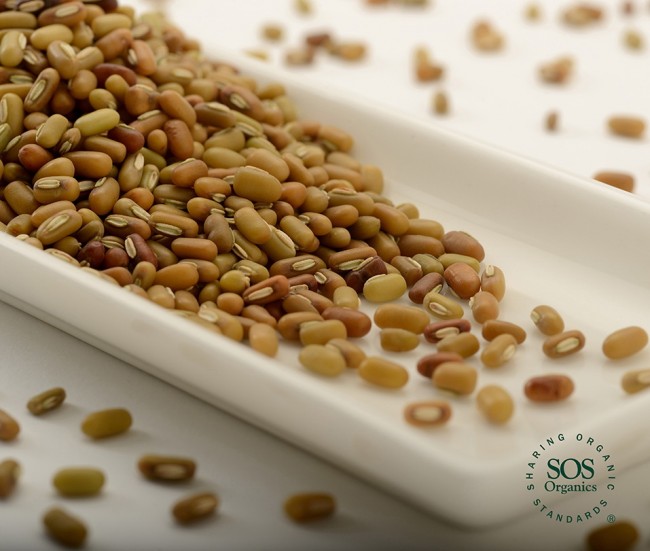
Pulses, flour, millet, spices, herbs, pickles, jams, marmalades and honey, tea, as well as beeswax candles – there is a little bit of everything needed to lead a healthy life. Amrita says, “Our line of natural cosmetics is based on apricot kernel oil, and includes soaps, hand creams, face creams, body and foot scrubs, lip balms, and body oil. All items are made with beeswax and precious essential oils and are free of chemicals and hormones.”
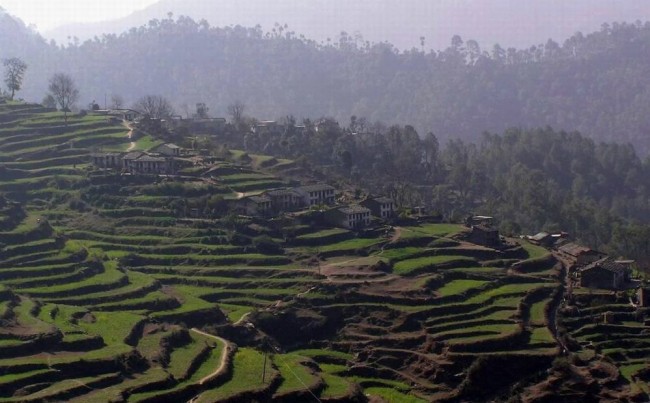
Himalayan terrace farms are the source of SOS organic products Courtesy: SOS organics Facebook page
In Uttarakhand, farmers have very small land holdings that are completely dependent on rain. So instead of asking the farmers to grow one particular type of crops, say only rice or millet, Amrita has encouraged mixed farming. “We are targeting indigenous low input crops that they have been growing over the last hundred years. We encourage them to grow a little bit of everything so that it all adds up to become a basket full of goodness to nourish and heal the body,” says Amrita.
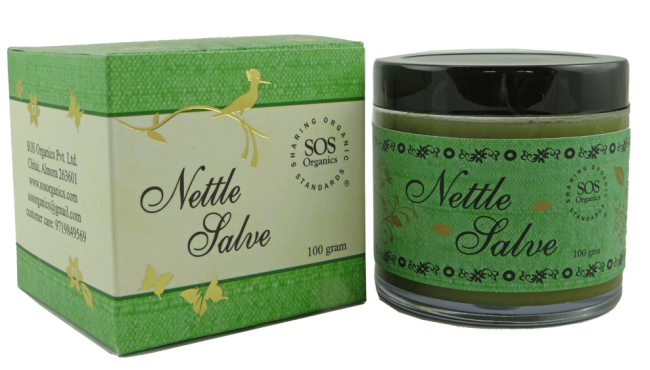
Their latest products are based on the humble nettle which has an abundance of health benefits. “One day we became aware of just how much nettle was growing all around us in the wild and nobody was using it. After some in-depth research that took us all the way back to Milarepa, who lived on nettle soup for years while meditating in a Himalayan cave, we began experimenting and created nettle tea and nettle flakes,” says Amrita.
The Inspiration
Amrita and her husband who have set up a village unit in Uttarakhand have been closely working with locals there.
“We had the inspiration to move to the Himalayan foothills in 2002, with only an idea to work in a village and bring meaningful employment in the area,” says Amrita. She adds, “We have found that the specific environmental conditions of the Himalaya produces incredible crops. The mineral content in the soil adds to the quality of the crop and it has many medicinal properties as well.”
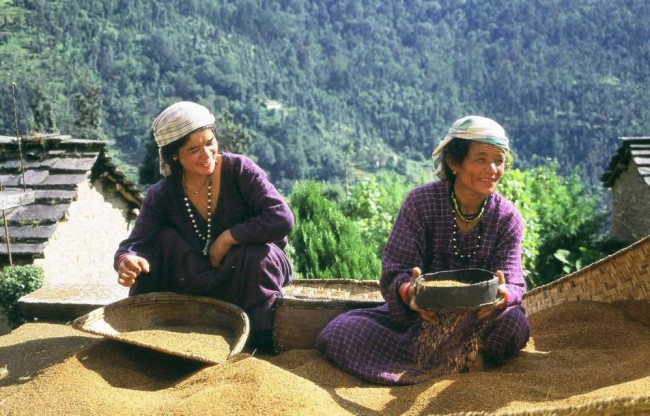
One of the main issues in the state has been a lack of employment opportunities. So they decided to set up a self-sufficient unit at Kumaon. “My main concern was employment of the local ladies as I believe that all over India it has always been women who run the show and they deserve to be empowered,” adds Amrita.
Happiness that comes with healthy living is the only true happiness! Courtesy: SOS Organics Facebook page ita at this point also mentions,“We did not want to take something or destroy anything from the environment, rather our emphasis has always been on the preservation of biodiversity and environment, and the providing of holistic technologies to ensure highest quality.”
Every village needs to be self-sufficient
The company strongly believes in Mahatma Gandhi’s saying that every village needs to be self-sufficient. Their entire unit runs on rain water harvesting. And they work with local small scale farmers from over 70 villages in the Himalayan region.
Amrita further adds, “SOS Organics is an ongoing experiment dedicated as a model for holistic sustainable living in the villages of the Himalaya.”
In addition to the farming techniques, natural processing and product development have also been undertaken. The Foundation is presently deeply involved in special holistic milling techniques, sun drying and sun-UV-radiation, ventilation drying, dehydrator development for low temperature drying, vacuum packing and systematic moisture proof storing of raw material. An extensive initial product line of natural farming produce has been developed and tested in the market and is now available online and in select holistic outlets.
Engaging community and being in tune with rural life
“The problem in the hills is that you cannot do anything that has a lot of volume because the lifestyle is different. We have six hour working days for the ladies as on most days they have to go home, collect water, cut wood etc. Plus in the winter it gets darker soon and the area where we live there are leopards and other wild animals,” she says.
So they had to modify their business model, making it in tune with the local life and with less stringent deadlines. They also make sure to celebrate local holidays and to stay connected with the community in all possible ways. “Our aim has always been to make the business model sustainable for everyone from the consumer to the person actually engaged in making these products. We make the people working here comfortable and the orders are worked around this,” says Amrita.
Challenges
Amrita says, “So much of the incredible knowledge of the Himalayan people is in danger of getting lost. The older living generations have often not been able to pass on their wisdom to the younger people as they have set out to live everywhere else than in their own village, embracing modern life and technology.”
She adds,“The scary thing is that we do not have a proper understanding of traditional knowledge system and what we are replacing it with does not seem to make the grade. People here feed millet to animals as they have been told the white rice is aspirational. We are striving to work against this kind of a mindset.”
Future Plans
“We very much live in the here and now, which is full of experiencing, learning, and understanding. New insights and inspirations happen on their own and we are always ready to say yes! – and embrace yet another venture,” concludes Amrita.
source: http://www.thealternative.in / The Alternative.in / Home> Magazine> Lifestyle / by Usha Hariprasad / Juine 18th, 2015
by Mandetira N. Subramani, President, VeKare Ex-Servicemen Trust, MysoreM N Subramani
Most of the Ex-Servicemen of yore, who joined the British Indian Armed Forces during early 1940s, and participated in World War-II, are no more. However, there are still numerous widows of World War-II veterans, around 70 odd years of age, living in Mysore and Kodagu region, who narrate their helplessness and pathetic stories.
It was customary for men of yesteryears to marry a life partner who is younger to them by 10 to 15 years. It is quite but natural that most of such wives become widows and may live for 10 to 15 years, or even longer, after the demise of their husbands. Trends have changed. The present day men don’t mind marrying a life partner elder to him by 3-5 years and the educated ladies consider it as out of fashion and a mismatch to marry men who are 3 or 4 years elder to them.
Reverting to the subject of helplessness of widows of World War-II veterans, a gentleman barged into my office a few days ago with a complaint that his 76-year-old mother, living in a remote village called Kiggal, near Murnad, Kodagu (erstwhile Coorg), is not being granted defence family pension even after a lapse of 12 years after the demise of his father, due to some vague reasons projected by the Army’s EME Record Office, Secunderabad. The hapless widow happened to be one Mrs. Kaveriamma, widow of a World War-II veteran, Naib Subedar Ballachanda Nanjappa Ayyappa.
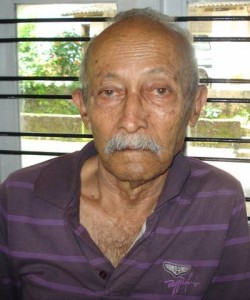
Mrs. Kaveriamma & late Nb Sub B.N. Ayyappa.
I being not only an Ex-Serviceman myself but also a son of a World War-II veteran who served in the Corps of EME and died unsung and unheard 22 years ago, decided to help the Late Nb Sub Ballachanda N.Ayyappa’s widow Kaveriamma with whatever little bit of knowledge and expertise I had gained during the course of taking up the cause of Ex-Servicemen and widows of Ex-Servicemen since the past 22 years after I quit the Armed Forces.
I believe in “seeing is believing.” Hence, I told late Naib Sub B.N. Ayyappa’s son, Ganapathy, that I wished to see his mother Kaveriamma personally, without doubting his (Ganapathy’s) version of the pathetic story of his mother. Without a second thought, Ganapathy informed me that his 76-year-old mother has been suffering from all sorts of old age ailments and that if I wished to see her, I would have to visit his ancestral Ballachanda House in Kiggal village in Coorg, which is well over 150 kms from Mysore. He also suggested that I could accompany him the following day itself to his village to see his mother. Though there was a clash of opinions between my mind and heart regarding his suggestion, I decided to listen to my heart, which is always weaker than the mind. The widow’s old age and ill health became a priority over my next day’s assignments and engagements all of which I had to abort.
It was indeed a huge expedition on the next day. It took almost nearly three-and-a-half- hours to reach the 100-year-old ancestral house of late Nb Sub Ayyappa in his village, which resembled a bit of British architecture. However, it took me waiting for nearly two hours to get the audience of the grand-old-lady, as she took time to wake up from her sleep, get ready and come out of her bedroom with the support of her son. B.A. Kaveriamma, widow of late Nb Sub B.N. Ayyappa.
During the waiting period, in Kaveriamma’s house, I had to perforce spend my time speaking to an 87-year-grand-old gentleman, who was resting in his easy chair. I was amused when he kept showing extra attention and courtesies to me than what I really deserved. This grand-old-gentleman, however, kept firing some uncomfortable questions to me such as, when did I join the Armed Force? When did I quit? Why did I quit? What was the last rank held by me? What I have been doing after quitting the forces etc… etc… as if I were put in a witness box for some crime committed by joining the Armed Forces! If someone around my age had asked me those questions, I would have blown my trumpet about my life in the Armed Forces, my last rank held as equivalent to one of those one star or two stars rank etc. But, I held back, because, in my subconscious mind I saw something very special in him that made me to tell him only the truth, including the last rank held by me, that is, Sergeant in the Indian Air Force.
While answering all the questions fired at me by this grand-old-gentleman, I was also looking at the walls of the huge verandah to deter him from firing anymore questions. However, I found some old photographs of late Naib Sub Ayyappa’s father, who was a Sub-Inspector of Police during the British regime, hung on the wall. Among the numerable old photographs on the walls, I also noticed a certificate framed and hung in a remote corner, which I could not read because of the size of the certificate, and my failing eye sight. I was compelled to remove the framed certificate and read it just out of curiosity. To my surprise, it was a citation of a gallantry award, that is, “Mention in Dispatches” awarded to Flight Gunner Sgt. Ballachanda N. Medappa.
Ex-Warrant Officer B.N. Medappa, M-In-D
I became very curious and asked Ganapathy as to who this Flight Gunner was ? Ganapathy pointed out at the grand-old- gentleman who was sitting on the same easy chair busy reading a Kannada daily Mysooru Mitra and said, “he is my father Nb Sub Ayyappa’s younger brother Ex-Warrant Officer of the Indian Air Force.” I realised that he is really an ‘Ex-Air Warrior,’ a term commonly referred to all Ex-Air Force personnel of late. I too sometimes proudly call myself as an Ex-Air Warrior to my advantage but it proved to be otherwise all the time with my retired rank ‘Ex-Sergeant.’
In the meantime, the widow of Nb Sub Ayyappa managed to come up to the verandah with the support of her son. As per the customs of the Coorgs’, I touched her feet to seek her blessings, and took a few photographs of her from my worn camera. After speaking to her for a few minutes I casually told her that I would try to resolve her defence family pension issue, at which she nodded her head casually, without any anxiety or hope of receiving it in the near future. I understood that she was fed up of trying for her defence family pension for the past 12 years.
On our way back to Mysore from Coorg after having met the widow, my thoughts were more on the unassuming Ex-Air Warrior I met that day than the problem of the widow of World War- II veteran Ayyappa. I tried to make a guess as to how many such great war heroes were still living or dead, unheard and unsung, among the tiny Kodava Community besides the number of General Officers this tiny Coorg District has produced till date. I even started calling up all my fauji friends, as if there was an impending war.
All armed forces veterans who served three decades ago know that there was a separate Coorg regiment, which largely included people from non-Kodava backgrounds while the Kodavas themselves served in different other regiments; this is in keeping with the Army’s non-bias policy. Field Marshal Kodandera Cariappa of the Rajput regiment and General Kodandera Thimayya of the Kumaon regiment are the most distinguished Army men among the Kodavas. Other illustrious Kodavas from all ranks lead from the front in their own way, not only during wars but also in war-like situations and counter insurgencies.
Lt. Gen. Apparanda Aiyappa is best remembered for his contributions towards the Corps of Signals and towards Bharat Electronics Limited. There were several war heroes as well such as Nadikerianda Bheemaiah, a JCO who was the first among Coorgs to be awarded the Vir Chakra for conspicuous bravery in J&K Operations during 1947, and Air Marshal Cheppudira D. Subia, a daring fighter pilot, was awarded the Vir Chakra during 1950 for his courageous and relentless attacks on the enemy targets which has largely contributed to the successful capture of Garais in Jammu & Kashmir.
Squadron Leader Ajjamada B. Devayya (known as the ‘wings of fire’), a fighter pilot of rare acumen, was awarded the Maha Vir Chakra after the 1965 Indo-Pak War, posthumously. Lt. Col. Ganapathi Puttichanda Somaiah (then known as the ‘Major who kept his cool’) was awarded the Maha Vir Chakra for his conspicuous bravery of fighting against the militants under odd condition while deployed in Sri Lanka as part of Indian Peace Keeping Force.
Lt. Col. Anjaparavanda Ganapathy was decorated with Vir Chakra for his valour during the 1965 war. Maj. Gen. Kuppanda Nanjappa and Colonel Mandettira Ravi were decorated with Vir Chakra for their valiant display of courage and gallantry in the face of the enemy on land during the 1971 Indo-Pak war. Sqn. Ldr. Mandepanda Ganapathy was awarded Vir Chakra for shooting down one of the first Pakistani Sabre Jets, which intruded into Indian air space during the 1971 war.
Wg. Cdr. Ballachanda Karumbaya is another war hero to be decorated with the Vir Chakra for displaying his gallantry in the air during the 1971 war. The youngest among the above said war heroes is the then Capt. Baleyanda M. Cariappa to be decorated with Vir Chakra on 21st June 1999 for displaying repeated acts of valour, bold leadership, unparalleled courage, leading from the front and devotion beyond the call of duty in the face of the enemy.
Kodagu being one of the smallest districts across India, today boasts of the highest density of devoted, daring, dedicated, disciplined and duty-bound gentlemen soldier officers, with many adorning the highest echelons of the defence services in India.
At any given point of time, till 1980, the number of persons serving the forces far exceeded the proportion of any other set of people from any other region in India. The contribution of Coorg to the cause of the nation has been phenomenal and Armed Forces Martyrs from Kodagu District are innumerable.
The appended list of Army General Officers the tiny District of Kodagu [population 5 lakh and population of Kodavas is about 1.3 lakh] has produced over the last 65 years is testimony to the fact that the District is a cradle of mighty Generals:
1. Field Marshal Kodandera M. Cariappa, OBE; 2. General Kodandera S. Thimayya, DSO; 3. Lt. Gen. (Retd.) Apparanda C. Aiyappa PVSM, MBE; 4. Lt. Gen. (Retd.) Biddanda C. Nanda PVSM, AVSM, ADG; 5. Lt. Gen. (Retd.) Codanda N. Somanna PVSM; 6. Lt. Gen. (Retd.) Bittianda K. Bopanna PVSM, AVSM, VSM; 7. Lt. Gen. (Retd.) Ballachanda K. Chengappa; 8. Maj. Gen. (Retd.) Guddanda C. Somanna; 9. Maj. Gen. (Retd.) Kongetira M. Chengappa; 10. Maj. Gen. (Retd) Kotera C. Bheemaiah; 11. Maj. Gen. (Retd.) Codanda K. Karumbaya SM; 12. Maj. Gen. (Retd.) Cheppudira I. Jay Appachu AVSM; 13. Maj. Gen. (Retd.) Somaiyanda K. Kariappa AVSM, YSM; 14. Maj. Gen. (Retd.) Madaiyanda M. Belliappa AVSM, VSM; 15. Maj. Gen. (Retd.) Bovverianda M. Aiyanna; 16. Maj. Gen. (Retd.) Bachamanda A. Cariappa; 17. Maj. Gen. (Retd.) Moovera C. Nanjappa AVSM, VSM; 18. Maj. Gen. (Retd.) Kuppanda P. Nanjappa AVSM, VrC; 19. Maj. Gen. (Retd.) Kelapanda B. Swaraj; 20. Maj. Gen. Kodandera Arjun Muthanna; 21. Maj. Gen. Paruvangada M. Cariappa VSM.
Courtesy: Star of Mysore
source: http://www.exservicemen.in / Ex-servicemen India / Home> India> News> Views, Articles / by M N Subramani / October 19th, 2012
Gen Dalbir Singh, Chief of the Army Staff, dedicated a statue of Field Marshal K M Cariappa at the Army Parade Ground, Delhi Cantonment and rechristened the parade ground as “Cariappa Parade Ground” .
It is customary in the Indian Army that parade grounds are named after eminent military personalities and war heroes.
Army Parade Ground at Delhi Cantonment has been rechristened as Cariappa Parade Ground in the memory of Field Marshal KM Cariappa, the first Commander-in-Chief of the Indian Army.
The Parade Ground in Delhi Cantonment is one of the largest and most prominent parade grounds of the country.
source: http://www.defenceaviationpost.com / Defence Aviation Post / Home> News Updates / December 31st, 2016
Tennis doubles player Rohan Bopanna today said that wheelchair tennis was already a big sport in the world, which is reflected in top players like Roger Federer and Novak Djokovic sharing the same locker-rooms with top wheelchair players.
“Roger Federer, Djokovic and top wheelchair players – all of them share the same locker-rooms. There is no difference between wheelchair tennis players and the straight players,” he said.
“That’s where it shows, how big the sport already is, and million and millions of people are already watching it and supporting it,” he added.
Bopanna said holding the All India Tennis Association ranking wheelchair tennis tournament shows interest in this sport.
“Holding the wheelchair tennis tournament is a fantastic initiative and big step, which shows the interest people have in it,” he said.
Asked what sort of support he would give to promote wheelchair tennis, Bopanna said he would share details of wheelchair tournaments held in different parts of the world.
“I am always with them, no matter what support they need. As I am travelling a lot, it will be easier for me to share the details which will be of great help for improving the sport in India,” he said.
Earlier, Bopanna announced India’s first AITA ranking Wheelchair Tennis Tournament – tabebuia – which will be played from December 2 to 4 at Karnataka State Lawn Tennis Association.
The cash prize is Rs 2.5 lakh and the organisers have raised Rs 14 lakh from various sources including the corporate and individual donors, Sunil Jain, Founder Trustee of Astha, a part of Wheelchair Tennis, said.
As many as 40 wheelchair tennis players will participate in the tournament, he said.
Jain said the organisers would love to hold an International Tennis Federation tournament with the cooperation of AITA and KSLTA.
BDN PDS PDS
source: http://www.timesofindia.indiatimes.com / The Times of India / News> Sports> Tennis> Top Stories / PTI / November 29th, 2016
WELCOME. If you like what you see "SUBSCRIBE via EMAIL" to receive FREE regular UPDATES.
Read More »
![Ashwini Ponnappa. [Image Courtesy: Red Bull]](http://www.kodagufirst.in/wp-content/uploads/2017/02/AshwiniPonnappa01feb152017.jpg)
![Ashwini Ponnappa with Sikki Reddy (L) [Image courtesy: Ashwini Ponnappa’s Facebook]](http://www.kodagufirst.in/wp-content/uploads/2017/02/AshwiniPonnappa04feb152017.jpg)