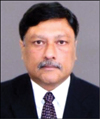
Air India’s Senior Manager (In-flight Services), Bangalore and Hockey Olympian Mr A B Subbaiah has been conferred the degree of Doctor of Literature (Honoris Causa) by Mangalore University for his contribution to the field of Sports and Social service.
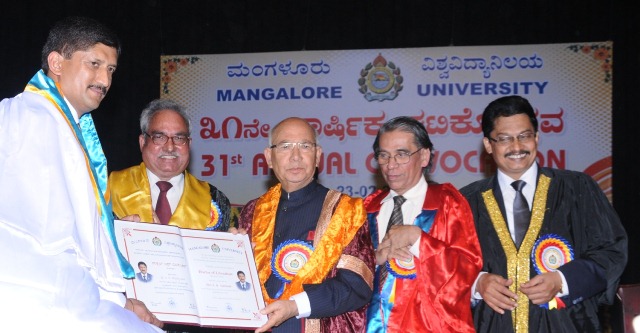
Hans Raj Bhardwaj, the Governor of Karnataka, conferred the same on Anjaparavanda Bopaiah Subbaiah on the occasion of the 31st Annual convocation of the University held on February 23, 2013 at Mangalore, in the presence of Mr T C Shivasankara Murthy, Vice-chancellor of Mangalore University, Mr. Ramasami, Secretary, Department of Science and Technology, New Delhi, besides other dignitaries. He shared the stage with two other noted recipients Padma Shri. Kadri Gopalnath, a pioneer in Carnatic music on saxophone, and Chandrashekhara Kambara, the founder Vice-Chancellor of Kannada University at Hampi and a Jnanpith awardee.
Born in Madikeri of Kodagu district in Karnataka, Subbaiah joined Air India in 1989 and has represented the airline’s hockey team over many years. He has been involved in the game of Hockey for over 30 years and has represented the national team in more than 285 international matches. Between 1988 and 1998, he took part in over 285 international fixtures, thereby winning several gold, silver and bronze medals.
He represented India in Barcelona Olympics in 1992, led the India International Hockey team 1993, represented World cup in 1994 and Atlanta Olympics in 1996 besides three Asian games winning one Gold and two silver medals. He was honoured with Karnataka Rajyostva award in 1993, Arjuna award in 1997, Ekalavya award in 2003 and Karnataka Olympic association award for life time achievement in 2010.
Subbaiah led the Bangalore University’s hockey team in 1986-87. In the recent league tournament fixtures, he donned a new role, that of a commentator. He continues his services to the game by acting as the coach, Manager, umpire, administrator and selector.
The 20th annual Kodava hockey festival began at the Field Marshall K.M. Cariappa Grounds in Madikeri on Sunday.
Union Law Minister Sadananda Gowda inaugurated the 28-day-long festival by hailing the concept of community sport that serves to strengthen human relationships, which had taken a back seat the world over.
Pointing out that community hockey does not merely serve to promote ties between different Kodava families, Mr. Gowda said the sport also helps protect the community’s culture and traditions.
The Kodavas, who had contributed to the defence of the country, had also made immense contribution to hockey.
A large number of people, from different parts of Kodagu district, had arrived in Madikeri to watch the inaugural hockey match that was preceded by a cultural programme that included a procession showcasing Kodava traditions prominent being its agricultural practices.
The Kodava Hockey Academy president Pandanda Kuttappa, who is also the founder of the Kodava hockey festival, signalled the start of the festival by pushing a silver ball with the silver stick.
The annual Kodava hockey festival is being held in Madikeri after a gap of 11 years with the last one being held in 2005.
During the 2015 edition of the hockey festival organised by Kuppanda family in Virajpet, a total of 255 teams had participated.
The ongoing festival organised by the Shanteyanda family will continue till the finals scheduled for May 8.
299 teams
The festival will feature not only a record 299 teams, but also close to 5,000 players.
source: http://www.thehindu.com / The Hindu / Home> National> Karnataka / Laiqh A. Khan / Mysuru, April 11th, 2016
When things around you are falling apart, there are only a few who not only rise to the occasion, but also create opportunities for themselves and others. Having been able to support the tribals, rural folk, and small farmers with her brand Nectar Fresh, Chayaa Nanjappa is one such example.
Chayaa’s single-minded efforts have established her honey brand – Nectar Fresh – in a highly quality-conscious premium segment. While serving high-end hotels and resorts, she (her brand) has created employment and better earning opportunities for tribals and marginal farmers. In fact, she has come a long way since the launch of the brand in 2007, and now she receives orders from importers from different parts of the world who want to buy honey from her company. She is also hopeful that Nectar Fresh products will soon be decked up at Walmart stores.
The honey market is a crowded space with big brands at play, so what made a small Khadi & Village Industries Board-backed rural enterprise from Mandya (in Karnataka) to earn a name for itself in both domestic and international markets? According to her, it is their obsession for quality that has made the brand stand out. The global exports of natural honey is about $2.3 billion (CY2014), of which India’s share is just $77 million, which is a minuscule 3.5%. Nanjappa saw the potential for growth. When she started in 2007, total honey production by her company was just 20 tonne per month. That has now increased to 200 tonne per month. And the company has plans to further increase the production to 400 tonne per month in the near months.
Earlier, she would export through agents, but presently, the company has started exporting under its own brand name. That most of her new orders are accounted for by referrals from existing, happy clients is a sign of her company’s product quality.
In the domestic market too the company has positioned itself strategically at few select outlets like Himalaya Drugs and Kerala Ayurveda, and serves brands like Kitchens of India, etc., to stay away from the clutter.
Though the company has expanded its product portfolio with jams, sauces, and coffee, honey still remains the mainstay. Her efforts in the field of rural empowerment and giving tribals and marginal farmers opportunities to sell their produce in the global market has earned her many state and national-level accolades, including the Priyadarshini Award by Federation of Indian Women Entrepreneurs (FIWE). She proudly says that Nectar Fresh has become the first brand in India to use women-owned logo of WEConnect International, a US-based women entrepreneurs’ body which supports brands that stand for quality. Chayaa is a social capitalist who deserves much praise.
TDB: What was life like before you started Nectar Fresh, and what made you take up entrepreneurship as a profession?
Chayaa Nanjappa (CN): I started this business at a point in time when I was going through a tough phase in my life due to personal reasons. I got into the business because I wanted to do something to keep myself busy and be independent, and create employment to help other needy people. And that’s how Nectar Fresh Foods came into existence. Initially, I started it as a small scale unit in Bangalore, but later, I moved to Mysore.
TDB: How did you manage the initial funding? Why honey and food products only?
CN: As my place of origin is Coorg, I looked at products which can be related to the region. Long ago, Coorg was known for its honey but, gradually, the honey production fell to shockingly low levels. So, I decided to source best quality honey from different parts of the country and market it under the brand name Nectar Fresh in small quantities. I underwent a week-long training on honey production at the Central Bee Research and Training Institute in Pune and learnt technicalities involved in the production and storage of honey.
I had lost my father and had no one to look up to for guidance. I took some financial help from my mother. I prepared a project report based on which I got a loan of Rs.10 lakh from a bank. I also got a lot of support from the Khadi and Village Industries Board.
TDB: Having started with just a corpus of Rs.10 lakh is very interesting and inspiring. What was your initial approach?
CN: I market my products on my own across India; I have no budget for advertisements. My approach was to do something new and give a unique positioning to my product. There was a monopoly of honey brands from Germany and France in the high-end segment of the hospitality industry in India. No Indian brand was catering to the segment that includes high-end hotels and resorts. I maintained product quality from the very beginning. Quality and world-class packaging helped us to break the monopoly of foreign brands. To counter MNCs, we expanded our product line, and now supply an entire basket of products including honey, jam, sauce and coffee.
TDB: Tell us something about your export markets. And how exactly did you foray into them?
CN: Until recently, we were exporting through agents but are now exporting directly across the globe. We are enhancing production capacity of honey from 200 tonne per month to 400 tonne per month to meet demand from export markets. We also have plans to produce 50 tonne of jam per month. Well, ITC was the first organisation that recognised us for our quality, and thus, I got my first order from them. The association with ITC gave me the confidence to approach other premium hotels. My export orders started coming when people started noticing our products in some of the premium hotels in India. The positioning of our products in these hotels helped in image building. Two months ago, we started exporting directly under our brand name.
TDB: You have ventured into a highly competitive segment, both in the domestic as well as overseas markets. How do you deal with competition?
CN: Our products stand for quality, and it’s an integral part of our brand. Nectar Fresh has grown due to our ethics in business. Because of positive word of mouth, farmers have remained loyal to us, and for the last five to six years we have held on to the same group of suppliers. We source directly from farmers and with the growth of the company, farmers have also benefitted. We may be a small-scale unit, but from the batch code, we can trace a product from the level of procurement to final despatch. That’s how we maintain consistency in quality in the entire process. It’s because of the quality of our products that even people from US and Germany come to our small unit and buy from us.
TDB: What role has your family played in your success? Were there initial apprehensions?
CN: As I have already mentioned, I started my business when I was going through a rough phase in life, and due to that my mother had her apprehensions. But still, she encouraged me. My close friends supported me a lot too. Rajappa, my business partner, has been a big, big, big support.
TDB: What would be your advice to all, especially women, who want to take a plunge into entrepreneurship in general, and exports and imports in particular?
CN: Work hard. If you are really focused, you can achieve the impossible. My new unit in Mandya in Karnataka is a 100% rural enterprise, but I haven’t availed any subsidy for it. The system is such that it will take its own time. Instead of wasting time and energy on it, if you focus it on your work, you will get better results. My past experience made me realise this, and this time I applied for a loan from a bank and set up my unit without taking any subsidy. There are many opportunities for those living in urban areas, but the necessities of rural women need to be addressed. They can make a big difference to exports. They have world class products around them, but they don’t know how to take them to market.
source: http://www.thedollarbusiness.com / The Dollar Business / Home> Cover Story> March 2016> Power Woman> O Success, So Sweet / by Sisir Pradhan / March 20th, 2016
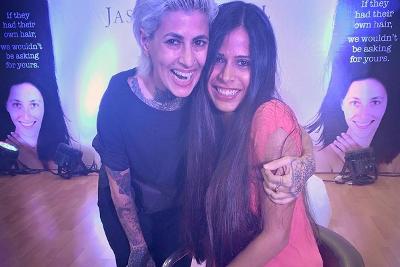
Splitsvilla’s host and popular MTV VJ, Nikhil Chinapa’s wife Pearl is up for a noble cause. Recently, Nikhil’s wife Pearl chopped off her tresses to donate her hair to cancer patients. Pearl, who visted Jaslok Hospital on Women’s Day, found out celebrity hair stylist and ex-Bigg Boss contestant, Sapna Bhavnani, cutting hair for cancer patients.
Looking at this initiative, Pearl also decided to bid adieu to her long hair and chopped them off for hair wigs of cancer diagnosed patients.
Hair donation is a concept many celebrities have been supporting and Sapna Bhavnani has been attached to this cause for long now. Hair donation raises money and awareness for cancer patients and make wigs for them.
It was an inspirational initiative by Pearl to support the movement along with Sapna. Doting husband Nikhil, took this to Social Media by posting pictures of Pearl’s hair before and after, and expressing how proud he is of her.
Before Pearl, we reported Digangana Suryavanshi chopped her long hair off after taking Salman Khan’s advice. The talented actress looks stunning with her new locks now. Also, in news, recently is Avika Gor, of ‘Balika Vadhu’ fame, who has also cut her hair too short.
TV Times conducted a poll amongst the fans asking which celebs’ new look impresses them the most. Have a look
source: http://www.timesofindia.indiatimes.com / The Times of India / News Home> TV> News / TNN / March 09th, 2016
On the occasion of International Women’s Day, IDL Foundation, a non-profit organization, is all set to organize a unique and innovative programme – IDL Blind Pinkathon – for the benefit of blind and visually-challenged on March 6 at NGO Hall, Cubbon Park.
Speaking with Iamin, Dr P K Paul, founder and executive trustee of IDL Foundation, said that the NGO plans to organise similar programmes at other cities for the benefit of blind and visually-challenged people. “Our objective is to provide a platform to the special people to showcase their talent and provide opportunities to celebrate womanhood in a special and unique way by organising a programme for interaction among abled, differently abled and celebrities which will be a life time memory for the participants,’’ Dr Paul said.
Participation is open to all on the first come first basis, provided they possess a Medalor Blind Certificate.
Sandalwood actress Harshika Poonacha, the brand ambassador of this project, had launched the IDL Blind Pinkathon logo in the presence of blind and visually-challenged couples on Valentine’s Day at Cubbon Park recently. “I am inspired to see the love and affection I received from the special people. I appeal general public to come forward to lend a helping hand to blind and visually-challenged people to cross roads, to board BMTC buses, read books, and write exams,’’ Harshika Poonacha said.
According to Dr Paul, there are loads of goodies awaiting special people. “We have made arrangements to give Rs500 each as honorarium for 500 participating blind and visually-challenged women, girl students and children. Each participant will get a designer ladies bag and five gifts such as talcum powder, oil, shampoo, soap, cream and moisturizer as a token of appreciation of participating and memorabilia,’’ he said.
Those who want to participate in the programme may contact at 880268787/7813018787/7813028787.
When: Sunday, March 6.
Where: NGO Hall, Cubbon Park, Bangalore.
source: http://www.dnaindia.com / DNA / Home> Locality> Bangalore Central / by Y M Reddy / Tuesday – March 01st, 2016
Niranjan Nikam in conversation with Yamini Muthanna.
Mysuru is the Ashtanga Yoga capital of the world, a sobriquet which is music to the ears of Mysureans, after the cleanest city tag for the second time. The city has also produced two of the finest yoga exponents in the world, B.K.S. Iyengar and Pattabhi Jois. However, there is one more Guru, who is quietly doing his bit on whom many discerning yoga practitioners swear — it is B.N.S. Iyengar.
Bengaluru-based Yamini Muthanna, dancer and yoga exponent, is one such. She was in city recently to participate in the launch function of her book “The Power of Yoga” at Dhvanyaloka Open Air Theatre.
After the book launch, organised by the Mysore Book Club, a first-of-its-kind experiment in Mysuru, Yamini, who gave a breath-taking yoga demonstration, shared her views on how the book shaped, the power of yoga, the undue importance for competitions and why everybody should practice yoga, with Senior Journalist N. Niranjan Nikam. Excerpts. — Ed
by N. Niranjan Nikam
SOM: We just saw your demonstration of yoga. I was thinking all the time, aren’t children the best yogis because their body is so flexible. How is it that we lose all that and only when we see people like you, we say to ourselves, “I wish I was like her — flexible, elastic and graceful.”
Yamini Muthanna: Children are natural Yogis. They are so free in their mind and body so the Asanas are easy for them. They do not have points of resistance either in their body and mind due to stress or tension that an adult might have. Therefore, I personally feel that flexibility in a Yoga Asana practice is a product of freeing the body and mind rather than putting in a lot of imposed effort. Anybody can train to be flexible with proper training of the body and freedom in mind. Yoga Asanas are patterned so beautifully that the body can be slowly animated into an Asana with proper judgement and care.
SOM: Yamini, you started yoga at a young age and you have come a long way. What made you write “The Power of Yoga?”
Yamini: My practice of Yoga has been extremely beneficial for me in all circumstances of my life. It helped me cope during my teenage through motherhood. I have been in constant touch with my body and mind and Yoga has helped me to be always aware. Once I started teaching from 2001 onwards, I noticed it was helping my students also to deal with situations better than how they used to handle things before they started practice. I started documenting their progress and started prescribing need-based specific practice sessions. It was helping my students and, therefore, I decided to share it for a larger group of yoga enthusiasts. My message in the book is you can choose your daily practice according to your day’s needs and have tried to explain how it works.
SOM: I learnt a little bit of yoga about 25 years ago from a Guru here. Later, I practiced for quite some time with the book, “Light on Yoga,” by B.K.S. Iyengar. Your book is equally interesting as you make it look very simple, how far have you come?
Yamini: Guru B.K.S Iyengar’s book is my Bible for my personal Asana study. He has set the benchmark of perfection in the Asanas and I am yet to come across another book equal to that of “Light on Yoga.” The book has been my Guru ever since I started personal practice. I did personal practice from 1996 to 2001 before I started to teach. I did a thorough study of the book, summarised by Guru B.N.S. Iyengar’s teachings and built up my practice, experimented my understanding and documented them in a way which would be easy for a Yoga Practitioner to comprehend. My book is not about loads of information but it is a guide to delve deeper in the practice by triggering a curiosity.
SOM: Yamini, you were talking to me about angles and Trikonasana which is the cover page that has caught you in action is such a perfect pose. Share a little about angles and sequences with our audience.
Yamini: I have a strong understanding that Yoga Asanas are geometric patterns from the Sri Chakra Yantra. I do not want to go to the details of it as I do not have proof and specific information about it. Just as Guru B.N.S.Iyengar mentioned in his speech earlier that the body will get chiselled into a fine cut diamond with perfect glitter in the body with the practice of Asanas and Pranayama. I would like to add that perfect geometry exists in pyramids and prisms also creating certain beneficial energy source forming specific benefits in the universe. It is in the same lines I personally feel that Asanas are also patterned to generate specific benefit to the body. Therefore, it is very important to maintain perfect lines in an Asana construction.
SOM: You have talked at length about asanas, chakras, mudras, pranayama and their benefits, all with photographs and you yourself doing each one of them. However, you have not mentioned time needed for each asana, or have I missed it?
Yamini: No I have not gone too much into the details of these deeper practices of Hatha Yoga as I do not want practitioners to try them on their own with the help of a book as they could be dangerous. It is very important that their first instruction comes from a Guru. I have just mentioned them as an information guide into the future practice.
SOM: You said that you do not believe in giving certificates. I would like to share my experience — I had written a story about yoga talking to a teacher about four years ago titled “Posturing ‘Olympics’ (op)position.” I had read an article in Deccan Herald about a move to include yoga performance in Olympics. The yoga teacher had opposed this idea and I had even quoted that B.K.S. Iyengar was also not in its favour. You yourself and a few noted yoga exponents including Sharath Jois, grandson of Pattabhi Jois, whom I met the other day does not favour it. When I sourced this article of mine which I had promptly forgotten, after four years, I was pleasantly surprised to see that there were 39 comments on it but all blasting me away to glory.
Yamini: I do not agree that Yoga Asana be treated as sports. Yoga is all about a personal well-being routine rather than challenge or competition. Your practice is your personal journey and you don’t need to get a medal or stand on a victory stand to announce your success. You silently practice yoga and reap the glory of the practice by using it in life and your routine mundane activities. It’s not sports.
SOM: But you yourself had participated in competitions earlier. In fact that is how you started your tryst with yoga.
Yamini: I did go for two competitions in 1986 and 1987, won the championships and understood it was a mistake. Master was also not too pleased by it. I did not inform him before entering the contest, because I knew he would not let me. I was sorry for a long time for that mistake.
SOM: What is the difference between a Nadia Comãneci’s perfect ten and yoga postures is the question many ask? Can you highlight the difference?
Yamini: Well, I am going to answer this in brief. Gymnasts use a lot of kinetic energy in their postures and expel a lot of force and energy to get into their perfect positions. Yoga uses potential energy with holds and binds in the asanas conserving energy. So some of the postures look the same but the benefits and the source of construction are different in both Yoga and Gymnastics.
SOM: Yamini you are a Kodava — and Kodavas are slim, tall, elegant, beautiful, handsome, rugged and with wiry bodies. The trouble sometimes is, we stereotype people. Did you turn a vegetarian when you started practicing yoga?
Yamini: I am a proud Kodavathi rooted in my Kodava culture and tradition. I have not given up anything at all. But my personal development has adopted various principles from my study of the two classical disciplines. They are my personal principles that do not interfere with my home culture, which is Kodava. [Daughter of Chendrimada Raja (late) and Sundari, Yamini is married to Kotera C. Muthanna].
No I did not turn vegetarian when I started practicing Yoga, though I changed a lot of principles to suit my practice. However, I am not a great fan of non-vegetarian food. You can call me a “No-fussytarian.” I eat whatever is healthy.
SOM: How much of your yoga has influenced your dance?
Yamini: A lot, in terms of energy and health. Breathing especially gets regulated when we do rigorous dancing. It has helped me keep my body agile and supple and less injury-prone.
SOM: What are your future plans and why the word ‘Power’ in the title of the book?
Yamini: Future plans — I shall keep doing what I am doing with more passion and conviction. I shall keep replenishing my knowledge in these two subjects. With the blessings of my Gurus, I have no doubt in accomplishing this; I will need their support and guidance always. I have already started my next book on Yoga, which would be exclusively for women from 18 to 80. The contents are just shaping up. I feel it will give an interesting perspective on woman’s body and how Yoga could benefit maintenance.
“Power,” I can’t think of a better term for Yoga. Yoga is a source of Power to better your life. As one adapts Yoga into his/her lifestyle, it becomes more and more obvious. I am using the term to emphasise this fact… It’s been my personal Power.
source: http://www.starofmysore.com / Star of Mysore / Home> Feature Articles / by Niranjan Nikam / February 24th, 2016
“An Indian and to the last breath would remain an Indian. To me, there are only two Stans – Hindustan (India) and Foujistan (the Army).” – Field Marshal K. M. Cariappa
Famously known as Kipper, Field Marshal K. M. Cariappa was born today, 117 years ago on January 28, 1899. He was the first Commander-in-Chief of the Indian Army and was the first Indian Officer who was given command of a unit before independence.
Some interesting facts that you must know:
– K. M. Cariappa’s full name was Kodandera Madappa Cariappa
– He was born at Shanivarsante in Kodagu, which was a princely state in Karnataka
– Cariappa was selected to the first batch in King’s Commission after the World War I in 1918
– His permanent regimental home was 2nd Queen Victoria’s Own Rajput Light Infantry
In 1933, he was the first Indian officer to undergo the course at Staff College
– Cariappa served in many countries like Iraq, Syria and Burma
In 1949, he was appointed as the first Indian Commander-in-Chief of the Indian Army
– After his retirement, he served as the High Commissioner to Australia and New Zealand till 1956
– He was awarded with the General Service Medal, Indian Independence Medal, Order of the British Empire, 1939-1945 Star, Burma Star, War Medal 1939-1945, Indian Service Medal and Legion of Merit
– He died on May 15, 1993 at the age of 94.
source: http://www.indiatoday.intoday.in / IndiaToday.in / Home> GK & Current Affairs> Listicles : Microfacts / Story / New Delhi – January 28th, 2016
Three men from Kodagu have made their heartland proud by playing a leading role in Tuesday’s Republic Day parade in New Delhi. Their families are happy their young and courageous sons have brought fame to their district.
Bommanda Chengappa, 76, is overjoyed that his only son, Colonel Bommanda Dheeraj Chengappa, 45, participated as a commandant of the President’s bodyguard at the Republic Day parade in New Delhi. Chengappa, himself a former BSF man, says it’s a great honour for the family.”Dheeraj was selected for the Army through the UPSC. He lives New Delhi with his wife and son. Dheeraj loves Kodagu, and speaks the Kodava language, but since he spent most of his childhood in Army schools, he is more fluent in English and Hindi,”laughs Chengappa. Dheeraj graduated from Delhi University and then joined the Army. Chengappa and wife Reeta, who live on their estate in Ammathi, Virajpet taluk, say they they visited him a month ago.
Captain Balyamanda Thimmaiah, 28, son of retired colonel Balyamanda Kaverappa, led the mechanized force contingent (Bees Bahadur). Kaverappa and his wife Pushpa are proud that Thimmaiah, an alumnus of APS Delhi, COPS Gonikoppal, St Joseph’s and MS Ramaiah College of Law, Bengaluru, participated in the parade. The family lives in Virajpet.
Mandapanda C Thimmaiah participated in the MiG-29 flypast at the parade. His father Mandapanda Sada Chengappa, a coffee planter residing at Chermabane, said these youths are giving Kodagu its moment in the sun. His other son, MC Appaiah, is in the Air Force.
source: http://www.timesofindia.indiatimes.com / The Times of India / News Home> City> Bangalore / TNN / January 27th, 2016
Athlete M.R. Poovamma.— PHOTO: By Special Arrangement
Athlete M.R. Poovamma, winner of the 2015 Arjuna award for her contributions in the field of athletics, is the ‘Coorg Person of the Year, 2015.’
Machettira Raju Poovamma, (25), a native of Kodagu, won the gold medal inwomen’s 4×400 meters relay at the 2014 Asian Games in Incheon, South Korea and clinched a silver in the 400m race in the Asian Championships at Wuhan, China, last June.
Ms. Poovamma participated in the 2008 Beijing Olympics and is currently ranked No.2 in Asia in the 400 meter category.
She was chosen as the ‘Coorg Person of the Year, 2015’ in a poll conducted by www.coorgtourisminfo.com, according to a release.
Daughter of M. G. Raju and Jaji, Poovamma completed her bachelor’s degree in business management from SDM College of Business Management, Mangaluru.
The past winners of this award include Dr. Kavery Nambisan, novelist (2005), Dr. Boverianda Nanjamma Chinnappa, researcher (2006); Robin Uthappa, cricketer (2007), Joshna Chinappa, squash player (2014), the release stated.
source: http://www.thehindu.com / The Hindu / Home> National> Karnataka / by R. Krishna Kumar / Mysuru – January 18th, 2016
Robin Uthappa has become the first batsman to register over 1,000 runs in the Syed Mushtaq Ali Trophy. This is testimony to the Karnataka batsman’s explosive abilities with the bat which have also made him a prominent name in the Indian Premier League (IPL). Uthappa achieved the milestone en route his knock of 48 against Odisha which enabled Karnataka to take an easy six wicket win. Uthappa is a Karnataka stalwart and has been with the team for a long time now. In all, Uthappa has played 183 T20 matches including games for India and IPL teams and has scored an astonishing 4,665 runs at an average of 29.71.
Uthappa will hope that this milestone brings him in focus of the national selectors and perhaps an opportunity for him to make a comeback in the near future. Uthappa’s team Karnataka has not being doing too well in this edition of the Syed Mushtaq Ali Trophy. They have played five games and won only two while facing defeat in the other three.
Uthappa will hope that his milestone helps inspire Karnataka from here on and that they can pull off a miracle to stay alive in the tournament. Uthappa is a senior member in the Karnataka side and he holds a strong sway in the mood of the team. This feat will help brighten his mood and is likely to give the team bit of a psychological uplift. Uthappa has been a bright spot in Karnataka’s dull campaign having scored 205 runs in the five games so far at an average of 41 and strike-rate of a magnificent 139.45.
source: http://www.cricketcountry.com / Cricket Country / by CricketCountry Staff / January 09th, 2016
WELCOME. If you like what you see "SUBSCRIBE via EMAIL" to receive FREE regular UPDATES.
Read More »