Category Archives: Inspiration / Positive News and Features

Respect the Girl Child: Prema Cariappa


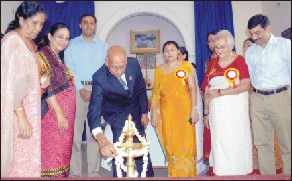
Caption: Prema Cariappa, Chairperson, Central Social Welfare Board, inaugurating the International Women’s Day celebration organised by Karnataka State Social Welfare Board at Rajendra Auditorium in JSS Hospital premises here recently. Others seen are State Board Chairperson Vinoda Nataraj and Karnataka State Women’s Development Corporation Chairperson Sarojini Bhardwaj.

Mysore, Mar. 28

“Members of the Indian society need to shed the ancient notion that only male issues can support us in our old age and that one attains ‘sadgati’ after death only if one is the a parent of a male child,” said Prema Cariappa, Chairperson, Central Social Welfare Advisory Board, New Delhi.

Speaking after inaugurating International Women’s Day celebration held under the aegis of Karnataka State Social Welfare Board at Rajendra Bhavan in city on Monday, she said that women are playing a pivotal role in the development of the nation and the country; but in spite of this, they are being discriminated.

She further said that even today, the birth of a female child is considered shameful. Even though girls excel in education they are being discriminated in the fields of higher education, professional courses and employment.

“The need of the hour is to educate girls. She said that the social evils like dowry etc. have ruined the society. Women are being burnt alive if dowry is not given. Police and judiciary seem to be helpless in stopping these crimes. Govt. is taking appropriate steps for the development of women but it is the duty of the voluntary organizations to come forward to work in the field of social work,” she said and opined that local elected representatives need to work towards eradicating this discrimination.

Board’s chairperson Vinoda Nataraj, State Women’s Development Corporation Chairperson Sarojini Bhardwaj and Women and Child Welfare Department Deputy Director N.R. Vijay were the chief guests.

source: http://www.StarofMysore.com / General News / March 28th, 2012

India’s homemakers recruited as hotel chefs

A new breed of chefs is taking over hotel kitchens in India. Housewives and mothers are now being recruited to bring “home-cooked” food to five-star plates, as Vasanthi Hariprakash reports from Bangalore.

As I finish my lunch at a restaurant in the city-centre, I reach for the dessert that the steward has recommended.
It turns out to be “obbattu”, a sweet usually made in south Indian homes during festivals and not often seen on upscale hotel menus.
The “flat, wafer-thin chappati with a mix of jaggery and dried coconut, fried gently on a skillet” melts in my mouth and feels light and wholesome – like your mum made it for you.
The irregular shape of the obbattu, unlike the perfect round a chef would have produced, is a clear giveaway.
At Bangalore’s Gateway Hotel, a homemaker has put on the chef’s apron. It is a conscious strategy to woo upwardly-mobile clients who “typically crave home food”, executive chef Naren Thimmaiah says.
“Our guests are increasingly aware of fresh healthy food they ought to eat, but in the midst of their jobs, travel and meetings, they have no time to do that,” chef Thimmaiah says.

‘Foreign Veggies’
So, a couple of years ago, Naren and his team came up with a menu that would put healthier food on their tables.
And who better to bring in as experts than those who have been making it for years and serving it up with love?
Twenty-two women, once queens in their own kitchens, are now working in the kitchens of the Gateway Hotels’ group across India.
From cities like Bangalore, Chennai (formerly Madras) and Vadodara to smaller towns like Khajuraho and Coonoor, these homemakers are now the speciality chefs.
These are women who hold no degrees or qualifications in hotel management, but are trained by life to cook tasty, appetising food, quickly and without fuss.
One of these is 30-year-old Jyoti, mother of two, whose schooling stopped at the fourth grade.
Her specialities – akki rotti (griddle-cooked rice pancakes) eaten with maamsdha saaru (a spicy broth cooked with mutton or chicken, or optionally green leaves for vegetarians) – are rated top grade by not just the guests but colleagues in the kitchen.
“I love the obbattu that akka [sister] makes”, Vipin Rajesh tells us as he stands next to the domestic gas stove and small utensils that were specially brought in to make Jyoti “feel at home”.
Jyoti is not overwhelmed by the sophisticated high-end kitchen equipment around her.
“But some of the vegetables they use here I had never seen before in my life,” she says.
The broccoli, artichokes and courgettes that chefs commonly use for continental dishes are “foreign veggies” for Indian cuisine.
Naren says it was a priority when he selected Jyoti for the job – that what she cooks “should not taste commercial”.

‘Just right’
Thousands of miles away, the Gateway’s kitchen at the tourist town of Khajuraho in central India has been home for a month now to 62-year-old Santosh Pataria.
Otherwise a poet, writer and folk singer at the local radio station, Santosh has been brought in for her expertise in the local Bundelkhandi cuisine.
At an age when many people retire from their daily jobs, taking on a new job cooking the food known for its subtle flavour and mild use of spices comes naturally to Santosh.
“Our cuisine doesn’t have too much mirch-masala (spice). I believe food should neither be too hot, nor too tangy. It should taste just right,” says Santosh.
That “just right” cooking is bringing in the compliments.
Like those from a group of visiting tourists who sent a note into the kitchen asking for the recipe of the rare delicacy, mahue ki doobri, that she had made with mahua (a type of fragrant fruit used mainly for its medicinal properties).

Confidence

In the picture-pretty hill station of Coonoor in the southern state of Tamil Nadu, 51-year-old Indira is busy making the signature dishes of her community, the Badagas.
Indira, a single woman in her first job, says her family has kept the traditions of their centuries-old Badaga cuisine.
Whether it is avarai uttakka – local beans cooked with potato, tomato, onions, garlic and tempered with mustard seeds, or sandagai – roasted tomato sauteed with small onion, garlic and coconut ground to a fine paste – the “masala made carefully after dry-roasting 17 spices and not bought off the shops” is the key, Indira says.
She has the confidence of a professional chef who has fed a president’s entourage.
It is perhaps this passion blended with cool confidence that makes these homemaker-chefs a draw at the dining tables.
However, all of them say the money could be better. Pay ranges from 5-8,000 rupees ($100-162, £64-102) a month and there are no benefits.
For now, the guests are only too happy getting comfort food on a platter.
Sahil Saraf, a doctor by profession, and a regular at the Gateway Bangalore, has no idea who is behind it all.
“I heard somebody’s wife comes to cook here. All I know is that the food tastes yum,” he says.
Award winning chef Naren Thimmaiah has the last word: “We can dish out the most exotic of cuisine, but ultimately simple, homely food is what will win the guest’s heart.”

source: http://www.bbc.co.uk / Home> BBC News> India / March 06th, 2012

AINMANE: Preserve it for Posterity

Ainmane, the house of the elders in Kodagu, has given an opportunity for the families to live without any discrimination. Men and women were considered equal. If a girl whose married life was not happy and if she had a serious problem in her husband’s place, she had a right to leave her in-laws’ house and live at Ainmane as long as she lived. Obviously, Ainmane protected women by providing a shelter with affection.
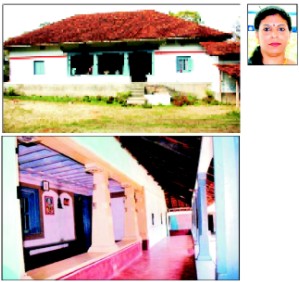
The pressures of 21st century’s globalisation and urbanisation has made people of Kodagu re-think about their cultural heritage and rich tradition. Today, one can see this healthy growth in their thoughts too with each ‘Vokka’ trying to protect their Ainmane — more as a prestige issue for every family to have their Ainmane renovated, re-built and protected. With some hope towards a prosperous life, let’s preserve our Ainmanes for posterity.

One finds Kodavas’lifestyle unique. Its recorded history dates back to 18th century. The people here live in a hilly region amidst heavy rain, cold and wild animals. Hence they have their own lifestyle and culture that is unique in its nature.

Kodagu people lead their lives in houses that stand apart in architecture. The house that is remarkable in its structure and a place of unique bonding, that ancestral house is called Ainmane. Ainmane has always stood as a mirror reflecting the Kodava culture, life, family practices, worships and festivals according to seasons.

Kodava culture enjoyed joint family system in the past. It is because of Ainmane that Kodava families have a family name. According to the names, the families of Vokka or Vamsha is identified. Under one Vokka, there are many family units. Many Vokkas have more than 500 units. All these families put together has one Ainmane. The family also has its own ornaments, weapons, implements used for agriculture, the gift from the kings who ruled Kodagu etc. These are treasured items that are collected and preserved.

Based on this, Ainmane is not only a living place for families but it acts like a museum of the community that helps to enhance the cultural heritage of Kodavas.

The relationship between Kodagu and Kerala seems to be closely knit since ages. Ainmane stands as a proof to it. Comparing to the house of Nayars of Kerala (that is called as Taravad) and the Ainmane, we can see many similarities. The influence of Malayalam on Kodava language cannot to be ignored. Similarities can be found between the two languages. The festivals, a few rituals, ceremonies performed and some celebrations have a strong Malayalam impact. It is clearly identified that Ainmane has played a significant role and has provided enough room to have a good relationship between Kodagu and Malayalam province. More important is the structure and architecture of Ainmane that is a living example to recognise the relationship from the past between Kodagu and Kerala.

The Kings who ruled Kodagu built their Palaces in the same style of Taravad houses. Towards the North of Kodagu in a place called ‘Yavakapadi,’ king Doddaveera Rajendra, who ruled Kodagu, built a Palace in Nalaknadu village in 1792. Architecture of this Palace resembles Ainmanes of Kodavas. This clearly shows that architecture of Ainmane has been influenced from Kerala and hence instilled the same kind of style to their Palaces.

Likewise, the Palaces that exhibit their majestic nature seem to be unique, like that of Ainmane that which is a link to depict the history of Kodavas of Kodagu. The pivot of joint families was the Ainmane where in the past era, people of different age groups lived together. The centre was always full of life. But today, because of modernisation, the Ainmane is only an epitome depicting Kodava cultural heritage.

Modern education and urbanisation has opened a new lifestyle for Kodavas. Herein they look down upon their own culture and hence the existence of Ainmane has become obsolete. Higher education has made many to take up urban residence. Therefore, elders of the family are the only people who are living in Ainmane; but after their death, Ainmane is sort of abandoned and edge towards dilapidated condition, without any family living there. In a few circumstances, there are modern style houses coming up. Members of the families live in these modern houses near to Ainmane, which is kept locked. They open it at dawn and at dusk to light the traditional lamp at the Nellakki Baade inside it.

As families become financially stable, they try to migrate to the cities either selling their property or asking somebody to look after it. Such families have abandoned Ainmane and hence, most of them are in a neglected state. Growth in economic conditions and the family planning followed by Kodava families has resulted in one or two children in a family. Moreover, the children are brought up in cities. Education is provided there and hence they get employed in the cities itself. The above reasons have led Kodava families to leave their native. All family members have a right on Ainmane, but their lack of interest and their dislike towards rural lifestyle have prevented them to give a serious thought on their ancestral house.

The house of elders has given an opportunity for the families to live without any discrimination. Men and women were considered equal. If a girl whose married life was not happy and if she had problem in her husband’s place, she had a right to live at her parents’ Ainmane. Obviously, Ainmane protected women by providing them shelter and respect.

The pressures of 21st century globalisation and urbanisation has made people of Kodagu re-think about their cultural heritage and rich tradition. Today, one can see this healthy growth in their thoughts too with each Vokka trying to protect their Ainmane — more as a prestige issue for every family to have their Ainmane renovated, rebuilt and protected. With some hope towards a prosperous life, let’s preserve our Ainmanes for posterity.

Significance of Ainmane

Ainmane is not only a part of the culture of Kodavas, but also of Kodava dialect speaking communities. Though Ainmanes of all sects are similar, they are also called Balyagattumane, gurukarana mane, gurumane etc.

Rev. G. Richter writes in the Gazetteer of Coorg (1870) that Ainmane usually is near paddy fields. Ainmane would be one-storied and square shaped, with an attic. Though east-facing houses are preferred, more emphasis was on houses facing paddy fields. A typical Ainmane will have two doors at the entrance. Entering inside, Nadu mane is found. Living rooms in this square-sha-ped house have small doors and usually no windows.

Ainmane has an open roof space in the middle, so that rain water is collected within and excess water is drained out. The house consists of two doors to go to backyard. Front portion of the house is a canopied open hall called as Kaiyale. It consists of a 2-feet high seater of thick wooden plank which is used as a bench, called Aimara. Daughters-in-law of the house are not allowed to sit on Aimara whereas married daughters of the house can sit on it. Elders of the family usually sit here to exchange cordialities, discuss various issues and take important decisions.

Two massive wooden poles adorn the entrance. The central Nadubaade would consist of three wooden poles. The first pole is called as Kannikamba — it supports the whole roof of Ainmane. The kannikamba is as significant as the thook bolcha (hanging lamp) lit everyday at the Nellakki Baade (prayer room).

During ceremonies, family members would seek blessings by touching the base of kannika-mba and then the feet of elders. Images of sun, moon, flowers etc. adorn Kannikamba and main doors, signifying that Kodavas were nature worshippers.

An integral part of Ainmane is Kaimada — an important structure built in memory of the founder of that family or Vokka. It is a prayer place which is used during happy or sad ceremonies.

At Ainmane, the prime position is given to karona, the head of that particular family. Unique feature about Kodava culture is that men and women share same kind of respect, status and position.

Earlier, families of a Vokka lived together at Ainmane. Later, a few families left Ainmane to live independently and improve their property. The result was joint families gave way to nuclear families. New houses are built in modern architecture. But during festivals and other occasions, Vokka members gather at Ainmane and partake in the ceremonies and feast, symbolising unity.

source: http://www.StarofMysore.com / Feature Articles / March 04th, 2012
ZP member a ray of hope for tribals

Mysore:
Ketamma, Zilla Panchayat member at BR Hills, Chamarajanagar, has taken up several development projects for the uplift of tribals.

She has provided water facility to nine villages in BR Hills and is creating awareness among tribals about forest rights and their reservation.
She has also taken the initiative to provide title deeds to about 1,500 tribes.

She said that many schools have been opened to provide education to the tribals but due to lack of awareness among parents, many are not sending their children to schools.

She requested the government to provide special grants under the Tribal Sub-Plan for the welfare of tribes.

Hailing from HD Kote, she belongs to the Soliga community and contested in Gram Panchayat elections and was elected in 2000.
Since then she has never looked back.

From 2000-10, she served as member and president of the Taluk Panchayat and at present she is a ZP member.

She said: “I have used the facilities provided by the government and reached this position.

Every tribal should be aware of their rights and claim it.
At present only about 30 per cent of tribals are aware of their legal issues.” “We have obtained only 50 per cent facilities from the government and are deprived of basic facilities like health, education and transportation.

I have taken the initiative to provide drinking water facility to nine villages.,” she said.

She added that her next step was to provide good roads and create awareness about the importance of education among the tribals at large.

source: http://www.ibnlive.in.com / South> Karnataka / The New Indian Express / Express News Service / March 05th, 2012

Udyogini women avail benefits

Women should utilise various government schemes and programmes which have been introduced to make the poor women financially independent and to improve their standard of living, said Zilla Panchayat President Ravi Kushalappa.

He was speaking after distributing financial aid to women beneficiaries under Udyogini scheme by Karnataka State Women Development Board and Women and Child Welfare Department at Fort Hall in Madikeri on Friday. Speaking about the scheme, he informed that the government has decided to benefit as many as 47 beneficiaries from Madikeri and Virajpet taluks each, 49 from Somwarpet taluk out of which 33 from Madikeri, 46 from Virajpet taluk and 49 from Somwarpet taluk are given the finacial aid at present. Rs 10,000 financial aid will be given to the women from SC/ST community and Rs 7,000 will be given to women belonging to other communities. The women can avail loan from the bank up to Rs one lakh, he said.

Women and Child Welfare Department Deputy Director Vijayalakshmi Shenoy provided information about the method of self-employment under Udyogini scheme.

source: http://www.DeccanHerald.com / Home> District / DHNS / Madikeri, March 03rd, 2012

MLA to stay with tribals today

Haadi bustling with activities to make arrangements for Ranjan

There is festive mood in Balegundi tribal haadi situated in Somwarpet taluk. MLA M P Appacchu Ranjan will visit the haadi and will stay with the tribals on Monday.

The residents are making all preparations to welcome the MLA. Flex boards, buntings and cut outs of the MLA are seen on either sides of the road leading to the haadi.

The MLA will inaugurate the development work in the haadi. He will also listen to the woes of the tribals.

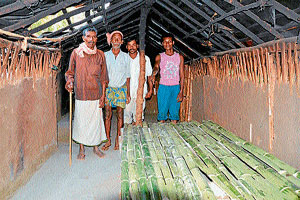
In fact, a bamboo hut has been created beside the house of haadi resident Bhoja for the MLA to take rest.

The hut is four metre high. Arrangement has been made for the MLAs associates to sit. Bhoja is happy that MLA would be spending entire night in his haadi.

“The MLA will be given traditional dinner with rice, sambhar, chutney and other delicacies. The tribals will also entertain the MLA through traditional tribal dance and ‘Kurubara Bunde’ song, kolata,” said senior member of the haadi Raju. The youth from the haadi Shivanna, Y K Lokesh, Lakshman, Naveen, Mani are joining hands with each other for making arrangement for the MLA’s stay.

Demands
Muthamma said “our huts are on the verge of collapse. It would be good if MLA makes arrangements to get a house for each one of us. At the same time, we did not get title deeds under Forest Rights Act. The title deeds should be distributed at the earliest.”

Raju says that there is lack of toilets in the haadi, which is causing lot of inconvenience.

Taluk Panchayat President V K Lokesh said the MLA will lay foundation for road work, which was sanctioned recently. The road will be developed at the cost of Rs 29 lakh.
The work on aganwadi building will also be started on Monday. Officials from the revenue, forest and health department will also accompany the MLA.

source: http://www.DeccanHerald.com / Home> District / by Srikanth Kallammanavar, Madikeri / February 26th, 2012, DHNS:

Looking out for the destitute

Mysore:
Unlike other business administration postgraduates, these two graduates have opened a non-government organization to help the needy. They provide food, shelter and rehabilitate mentally-challenged persons and the destitute in Mysore.

Meet 28-year-olds, B Manu and Vinod Kumar, who have rehabilitated around 109 mentally-challenged destitutes since the inception of their NGO two years ago. They aim to rehabilitate the destitute and reunite them with their family members.

They earn by organizing rehabilitation camps for individuals, who are addicted to alcohol and drugs and use the income to help poor orphans, who are suffering from diseases. So far, this NGO has rehabilitated more than 300 people, including destitute, drug and alcohol addicts.

Speaking to TOI Manu said, “I had been to Himalayas three years ago and I found many people who had left their families and were suffering from psychiatric problems. This inspired me to help mentally-challenged orphans. We don’t collect any donations from people but we accept even old clothes, food grains and other necessary things.”

Presently, doctors, psychiatrists, and nurses in this center are treating 11 mentally-challenged orphans for free of cost.

Manu and Vinod, who run the NGO-Wee Care Hospital-have formed a rescue team. Whenever the NGO gets a call from the public regarding mentally-challenged people suffering from diseases from any place of Mysore district, they visit the area and bring them to the NGO on T Narasipura road for treatment.

Two destitutes who were rehabilitated here are now working as security guards at their place. They are getting good salary too.

Manu was residing with his father Bal Gopal, a businessman and mother Shobanna. But for the past year, both Manu and Vinod are residing on the hospital premises to provide better service. Vinod’s parents K A Bojappa, a coffee planter and K B Kamala, are in Kodagu.

“Nowadays people are depressed for various reasons, so we have started working from the grassroots level. We have started organizing training programmes in schools to build self-confidence among children,” says Vinod Kumar.

Self-confidence training programmes have been organized in 33 schools. Soon similar kind of programmes will be organized in rural areas.

source: http://www.Timesofindia.indiatimes.com / City> Mysore / Home> City> Mysore / by Pavan M V / TNN / February 25th, 2012

Field Marshal K M Cariappa – an Officer and a Gentleman

By Richard Lasrado [ Published Date: January 29, 2012 ]

As I keep recalling the great personality I had met a few times, esp., for an interview as a budding journalist way back in 1974, the picture gets etched in the mind, deeper and deeper.

The Grand Old Man of Kodagu (then Coorg), Kodandera Madappa Cariappa (January 28 1899 – May 15, 1993), then a retired General, who was an epitome of discipline, punctuality and promptness, had graciously consented to my request to be interviewed for an Indian journal.

He, as independent India’s first and until then only Commander-in-chief, had retired in early 1952. He was made an honorary Field Marshal only later, as late as in 1986, during prime minister Rajiv Gandhi’s tenure.

A couple of kilometres down the serpentine road from Mercara, now Madikeri, to Siddapur stands the palatial ‘Roshanara’, the residence of the great man.

My nervousness was showing. Being a cub journalist, I was to meet a great warrior of world status and a hero of the world wars, who had been honoured by presidents, kings and heads of states.

Led into his drawing room by an attendant, I was awe-struck by the splendid display of military trophies, mementoes and souvenirs.

Field Marshal with his daughter Nalini
Two minutes after the appointed time, the broad-shouldered, six-foot-plus celebrity with peach-pink complexion appeared on the scene. As said already, it was not the first time that I had seen or heard him. But his simplicity and friendly nature were absolutely heart-warming and disarming at the same time. To cap it all, when the General repeatedly apologized for the two-minute delay with folded hands, I was rendered totally speechless and blank, for a moment making me forget the questions I had long planned to shoot.

Our meeting was scheduled to last just about an hour. But as the clock ticked away, the General seemed to be interested and asked to go on.

Reminiscing about that interview I had almost forty years ago invariably necessitates the quoting of some words of his, which, over the years have proved prophetic.

The following excerpts from the interview may provide an insight into his personality and thinking. They should be appraised only in the light of circumstances that prevailed in India in the early 1970s. Those among the readers who may have closely followed the India’s developments since 1970 may find his words quite fascinating.

******************

On the prospects of a military government in India and if such a measure would cure the country of all its ills and ailments.

The moment I mention a military rule, I am misunderstood. I would say, military rule can never take over India. One, we are a huge country and are beyond the control of a military machine. Two, we have too many diversities to keep us together. Three, when our defence resources are engaged at the borders, they may not be equipped to rule the country.

It makes me sad to see the inroads of foreign ‘isms’ into our body politic and havoc they have wrought. But democracy is deep down in our blood. Yet, under the present conditions, an indefinite President’s rule all over the country would do us a lot of good. Only such areas as may be unruly can be given in the hands of the army. Only after restoration of normalcy can elections be held.

The President can draw on the best talent in the country and form a cabinet of intellectuals and run the affairs of hte state more efficiently.

Commemorative stamp issued in his honour

On Jayaprakash Narayan’s movement against corruption in Bihar and elsewhere.

It is comforting to know there is a clean and upright person like JP to show us the way. But the public opinion is not strong enough in our country. People might curse the leader and the government. But in private the same persons run after politicians for licences, permits and favours.

Matters have come to such a dangerous pass that corruption is almost being regards as a way of life. Today’s students might call the politicians corrupt, while they indulge in copying and toehr malpractices themselves. It is just like a pot calling the kettle black.

On the future of the opposition parties and if the newly-formed Bharatiya Lok Dal (BLS) would be a mess or a Messiah?

A steam-roller of the ruling party anywhere poses a great danger to democracy. Presence of a plethora of political parties aggravates the situation.

All along, I have been advising all opposition parties to sink all their ideologies and come together on four major issues – 1. Defence of the country, 2. Foreign policy, 3. A realistic economy and 4. Internal security.

I can only say that the formation of BLD is a healthy democratic development, but how how far it is going to be a success, only the future can tell.

On the future of sports and games in India – he was a spin bowler, and a tennis and hockey player himself.

Sports is in our blood. Yet our achievements are not up to the mark. The main reason is the lack of practice as well as the grace to accept defeat. Dedicate practice is a must.

On India’s dismal failure in the field of hockey in spite of having a staggering line-up of talent.

There could be many reasons. But I would like to blame it on the lack of practice in the first place. Matters have been made worse by the ubiquitous ‘politics’. I did my best to keep this menace at bay during my tenure as three years as chairman of the All India Council of Sports (AICS), but it was in vain.

**************

I had two more issues that I wanted to broach with him. With much diffidence and hesitation, I took courage to ask him. First was about a little-known and little-publicized episode between him and Mahatma Gandhi. There was a brief pause.

Obviously, many had hesitated to put this question to him. He said, ‘Your way of asking such questions reminds of Melville de Mellow of All India Radio, who was here to meet me a few days ago.’ I was lost for words as my jaw dropped.

Then he handed me the Mahatma’s biography by Prarelal, who has devoted a whole chapter to this particur incident. The General felt that I would be better off with a third-person account than his own version.

Soon after the Indian independence, Cariappa had thundered at a metting in London that in the then-prevailing circumstances, the concept of Ahimsa (non-violence) was not going to be any help to India and a powerful army alone could make it one of the strongest nations in the world.

Gandhi was indignant at this candid outburst and shot back a rejoinder in his journal, ‘Harijan’, saying that even Generals greater than Cariappa would admit that they had no right to talk on non-violence. The concept of non-violence alone could eliminate the causes and chances of wars, wrote the Mahatma.

The General wanted to clarify matter with the Father of the Nation. They did not know each other personally and so he sought an audience. In December 1947, in full military attire, he visited Gandhi in Delhi.

It was a day of silence for the Mahatma., who was spinning his celebrated charkha. The General left his shoes behind, entered the room and saluted Gandhi. He told him that he had come to seek his blessings. Declining the chair offered by Gandhi, he preferred to squat next to him.

Bapu broke his silence and asked Cariappa if he had read the article in ‘Harijan’. Cariappa answered in the affirmative and humbly said that he felt honoured by Gandhi’s reference to his speech, all the more because he had commented on someone who he had never met before.

Then he went on to clarify that the soldiers’ community was the one that bore the brunt on many counts. They too believed in non-violence. If at all thre was a community opposed to wars, it is the soldiers’ community, he said.

Cariappa continued as Gandhi heard him with rapt attention: Soldiers did not like wars, not so much for the dangers and risks they were fraught with, but because they were aware of the futility of war in solving disputes and problems of the world. If at all soldiers fought wars, they did it as a mandate of the people. If people did not want wars, they should tell their governments so; it that didn’t work, they should change their governments. Gandhi looked impressed with the stream of thought and said he needed time to think it over.

Two days later, they met again and conferred on the same subject. On January 18, 1948 they met yet again in Birla Bhavan, Delhi. The General had come to bid good-bye on his wasy to Jammu-Kashmir action mission and seek his blessings. The Mahatma expressed the hope that the problem would be solved by peaceful and non-violent means, and asked Cariappa to report to him about his mission thereafter. The General said he would certainly do so.

By a strange quirk of fate, on January 30, 1948, the General returned to Delhi with the sole purpose of meeting the Mahatma, only to pay his last respects to the latter’s mortal remains at Raj Ghat.

====

The second question was also sensitive. I could sense a tinge of sadness and bitterness when he replied to my query. It was about the only only political shot he took by contesting a southern Mumbai – then Bombay – Lok Sabha constituency sometime in 1971.

I enquired of him as to why he had to contest from there and earn a needless tag of being a Shiv Sena candidate, although he was being supported by seven different parties, including the Bharatiya Jan Sangh and the Swatantra party. Instead, he could have contested from south Mangalore constituency which included his own home district of Kodagu, I said.

He replied: ‘ When I contested, my manifesto was simple and plain – giving priority to people’s basic needs of food, clothing and shelter and education, strongly opposing luxury life, control over pompous offices, conference and foreign tours, instilling a national feeling in everyone instead of narrow parochial and linguistic atttitude.’

I decided to contest in certain circumstances. At 71 then, I had no ambition or craving for power. One day, Congress (O) leader former railway minister Poonacha called me up and said the his party’s high command had chosen him to be their candidate. All opposition parties were to lend me their support. Hence I had to consent, he said. I thought to myself, just like General de Gaulle reached the top with military experience behind him, that I could raise my voice in the parliament at least for ex-Servicemen and thought this could give me a suitable opportunity to fight for them.

I told Poonacha, ‘ I am an VOP – very ordinary person. I do not have the resources to fight the election.’ He told me not to worry, assuring that all the parties would take care of it. However, a few days later, Poonacha called again to tell me that the party had instead chosen himself instead of me. Anyway, I said it was OK.

Another few days later, I received a telegram from the Swatantra party leaders informing me that 6 or 7 parties had chosen me as their joint candidate from southeast Bombay constituency. Shiv Sena happened to be one of them. I had a formidable Congress candidate like A G Kulkarni against me. Yet the mood was so upbeat that my victory was thought to be easy. There was even a talk going around that in the likely coalition government in Delhi, my name was thought to be the right one for the defence portfolio.

Yet I lost. Former president V V Giri once met me after the election and enquired why I lost when the chances were bright. Without mincing words, I told him, ‘One of your own central leaders came down and started saying that Cariappa was a Kannadiga and a southerner should not win in Maharashtra’ and such other narrow-minded words. There were twelve horses in the race. Jan Sangh and a few others let me down in the middle. Jan Sangh termed me pro-Muslim since I refused to attend the Vishwa Hindu Parishat programmes. Bombay Kannadigas alienated me saying that I was a Shiv Sena candidate. I called all representatives and tried to clear the misunderstanding in the presence of a Swamiji from Udupi, but it was of no avail. I fell a victim to adverse propaganda.’ Giri seemed to agree with in full.

*************************

Cariappa was a no-nonsense, no-compromise personality. There have been cases of chiefs of service staff, as they approached retirement, having tried to appease the centres of power with an eye on plum posts like those of ambassadors, governors and the like. Many retired officers have taken up adminstrative posts in corporate houses. But this intrepid fighter stood above all that. He kept on raising his voice against misrule, corruption and political chicanery.

During his tenure as India’s high commissioner to Australia and New Zealand between 1953-55, an off-the-cuff remark against the racial policy of the Australian government is said to have created a diplomatic row, which created a rumpus in the Indian parliament seeking his recall. But he stood his ground, without any fear.

His differences of opinion with the Nehru-Krishna Menon combine was a matter of an open secret. During Indira Gandhi’s rule, once he had advocated handing over of disturbed areas to the military. Politicians sought his arrest on charges of giving a call for military rule. They even demanded withdrawal of his pension.

Those were the days when a late prime minister used to blame the ubiquitous ‘foreign hand’ or the ‘CIA’ for most of the problems in the country. Cariappa did not hesitate to ridicule it saying that a day would come when the prime minister’s chest pain would be blamed on the CIA.

Naturally, he had earned the displeasure of the ruling classes. No wonder, he was not recognized until late in his life. Gen Sam Manekshaw was upgraded as Field Marshal soon after the Bangladesh war victory in 1971.

The very fact that a man like General Cariappa, who had served the Indian army for a good 33 years, was made an honorary Field Marshal 33 years after his retirement during Rajiv Gandhi’s tenure as PM, speaks of the vagaries and systemic malaise that plague our country.

Field Marshal Cariappa always said he was an Indian first, and a Kodava or Kannadiga only next. He played a major role in getting the names Mercara and Coorg changed back to their ethnic forms as Madikeri and Kodagu. He also had fought against the Kambadakada dam project which would have gobbled up thousands of acres of fertile land of Kodagu.

His residence ‘Roshanara’ and a lifesize statue at a circle on the way to Mysore stand majestically in his memory. A college in his hometown has been re-named after him.

When the messenger of death came calling in a Bangalore hospital in 1993, for sure, he mght have struggled to take away this giant, the fearless soldier who may have said good-bye to this world with sadness. Because the India of his dreams is still a long distance away.

If power lay in the hands of patriots and upright Indians like Field Marshal Cariappa, it would have been a different picture. Maybe his dream may come true some distant day, but, alas, there cannot be another Cariappa.

source: http://www.Mangalorean.com / by Richard Lasrado / January 29th, 2012

Starbucks Coffee takes giant strides in India along with Tata Beverages

Tata Global Beverages Limited and Starbucks Coffee Company have announced a joint venture — Tata Starbucks Limited.

This is one of the biggest joint ventures shared between the second-largest branded tea company in the world and the iconic international coffee brand.

The 50/50 joint venture will own and operate Starbucks cafés which will be branded as Starbucks Coffee “A Tata Alliance.”

The retail stores will be developed in cities across the country, starting with Delhi and
Mumbai, in the year 2012.

Through a separate coffee sourcing and roasting agreement, Starbucks and Tata Coffee Limited will work towards developing and improving the profile of India-grown Arabica coffees around the world by elevating the stature of Indian coffee through joint marketing efforts, as well as improving the quality of coffee through sustainable practices and advanced agronomy solutions.

Together, the JV will enable an expanded range of beverage offerings for Indian consumers. As a first step, the companies have agreed to jointly leverage assets and innovation to offer a premium tea product branded, Tata Tazo. The JV will operate cafés under the Quick Service Restaurant (QSR) category. This partnership will enable the introduction of the unique Starbucks Experience to Indian consumers.

“The joint venture with Starbucks is in line with Tata Global Beverages’ strategy of growing through the inorganic growth focussing on strategic alliances in addition to organic growth,” stated R K Krishnakumar, VC, Tata Global Beverages.

He added, “It opens up exciting business opportunities and new formats for Tata Global Beverages. Starbucks brings unique retail expertise as well as a shared sense of business values. We are excited about the opportunities the alliance presents to innovate in the retail space and bring new beverage experiences to more consumers in India, leveraging the global in-home expertise of Tata Global Beverages and the global out-of-home expertise of Starbucks.”

Through an initial financial commitment, Starbucks will work with Tata to support ‘Swastha’, a school for children with special needs (in partnership with the Coorg Foundation) and aim to increase its capacity and outreach into the rural communities in the coffee-growing region of Karnataka. Tata Coffee and Starbucks also plan to work together on initiatives including the promotion of responsible agronomy practices and the provision of training local farmers, technicians and agronomists to improve their coffee-growing and milling skills, along with exploring community projects which could positively impact the communities in the coffee-growing regions where Tata is active.

source: http://www.fnbnews.com / Top News/ our Bureau, Bangalore / Thursday, February 02nd, 2012

Madikeri: National-level Jaycee Award for Hockey Star Arjun Halappa

Team Mangalorean – Madikeri
Inputs and pic from B M Lavakumar

Madikeri:

Arjun Halappa, India international hockey player from Kodagu, has been selected for Indian Jaycees top award ‘Outstanding Young Person’ (OYP).

The award was handed over by Jaycee national president Velayudham to Arjun at the 56th national Jaycee convention held in Hyderabad. Every year the Jaycees organization selects ten top achievers from the country to receive this award.

Arjun was selected by the national-level selection committee in recognition of his significant contribution to the field of hockey for several years. One of the yardsticks was his achievements in hockey at a young age.

The Junior Chamber International’s Bangalore metro chapter, under its founder-president A P Kariappa, had nominated Arjun Halappa for the award. The selection committee was headed by Supreme Court advocate and former Jaycee national president Ravishankar.

A P Kariappa, Arjun’s wife Bhavana Arjun, Ponnampet Nisarga Jaycees president Rafiq Toochamakeri and other Jaycees from zone 14 and others were present on the occasion.

source: http://www.Mangalorean.com / January 18th, 2012