Category Archives: Leaders

Field Marshal K.M. Cariappa Memorial Prog.

Kodagu, Mar. 10 (KBM& DM)

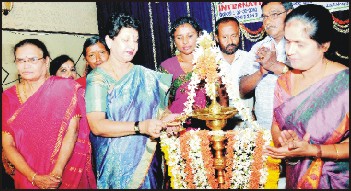
Nenapu-Namana, a programme to commemorate and pay tributes to Field Marshal K.M. Cariappa, was held at the Field Marshal’s birth place Shanivarasanthe in Somwarpet taluk of Kodagu district today.

The programme took place at Shanivarasanthe’s Government Middle School ground under the auspices of Field Marshal K.M. Cariappa Smarana Samithi.

Assembly Speaker K.G. Bopaiah unveiled a stone plaque. Madikeri MLA Appachu Ranjan presided. Renowned Cine Director Nagathihalli Chandrasekhar, High Court Public Prosecutor H.S. Chandramouli, MLC M.C. Nanaiah, former MLA B.B. Shivappa, former MLC S.G. Meda-ppa and others were present.

Earlier, the public and school children accompanied by folk and cultural troupes, marched in a colourful procession through the main roads of the town to reach the venue.

source: http://www.StarofMysore.com / General News / March 10th, 2012

General Thimmaiah birth anniversary on March 31

The 106th birth anniversary of General Thimmaiah will be observed on March 31, said Field Marshal Cariappa and General Thimmaiah Forum office-bearers.

Speaking to presspersons, Forum President Col (Retd) Kandrathanda Subbaiah, convenor Major Biddanda, Secretary Ulliyada M Poovaiah said the programme will be organised at General Thimmaiah’s residence ‘Sunny Side’ which houses RTO office. “If we fail to get space in the RTO office, then the programme will be held at General Thimmaiah Circle at 3 pm,” they said.

Speaker K G Bopaiah, Minister for Kannada and Culture Govinda Karajola, Kannada and Culture department secretary Manu Baligar, MLA M P Appacchu Ranjan, MLC Capt Ganesh Karnik, M C Nanaiah, T John and others would be invited for the programme.

General Thimmaiah’s birth anniversary should also be observed grandeously. To mark the birth anniversary, various Kodava cultural competitions have been organised. They are ‘Bolakat,’ ‘kolat,’ Ummathat.’ The competition will be held from 9 am.

The winners will receive Rs 15,000, Rs 10,000 and Rs 5,000 respectively. Interested teams should register their names with the convenor, Field Marshal Cariappa and General Thimmaiah Forum, General Thimmaiah Museum office, RTO complex, General Thimmaiah Road, Madikeri on or before March 20. For details contact: 9448184559.

‘Vacate the house’

The office-bearers said that the RTO office is functioning from General Thimmaiah’s residence Sunny Side. “Inspite of requesting to vacate the house, the officials are not responding to our demands. If the officials fail to vacate the house, then protest will be held from March 25 to 30. Though former Chief Minister H D Kumaraswamy had asked the transport department to vacate the house six years ago, it has not been fulfilled till today. There are 18 quarters situated around the building. The Forum has already written several letters to the Transport Commissioner and Deputy Commissioner in the past. However, our efforts went in vein.”

source: http://www.DeccanHerald.com / Home> District / DHNS / Madikeri, March 06th, 2012

Thimayya home gets due honours

It will be turned into a museum; transport dept, current occupant of the Madikeri mansion, has been told to vacate

The state government has finally realised it needs to give a fitting tribute to its war hero, former General of Indian Army, Kodandera Subbayya Thimayya. It has decided to convert his mansion in Madikeri, now housing the transport department, into a museum.

The Kannada and culture department, which has decided to take possession of the house, called ‘Sunny Side’, has given the transport department three months’ time to vacate the premises.

A decision to the effect was taken at a high level meeting of the Kannada and culture department a week ago.

The transport department has been given three months’ time to vacate the mansion
Grant sanctioned
According to sources in the department, the government had decided to declare the mansion as a memorial in 2005 following a letter written by former chief minister Veerappa Moily. The next year, the then finance minister had sanctioned a grant of Rs 1 crore for the purpose.

B Basavaraju, secretary, Kannada and culture department, told Bangalore Mirror, “It’s time we took over the building. Recently, a team of officials from our department visited the house and submitted a report.”

The regional transport office (RTO) will be shifted to a new premises. “Once the RTO shifts out, we will take up restoration work of the house,” he said. The department plans to have a museum displaying articles used by Gen Thimayya and a library comprising war literature aimed at motivating youngsters.

The mansion in Madikeri, spread across 2.6 acres, is the birthplace of the general, who was affectionately called ‘Timmy’ by his Army colleagues.
Sources said the transport department had bought the mansion way back in 1972 for Rs 2 lakh. Though the government housed the Gen Thimayya Memorial Bhavan in the same building a few years ago, it was in poor shape.

Repeated pleas by the people of Kodagu to convert the house into a memorial had gone in vain. “Except for a statue and a road named after him, there’s nothing in Kodagu to remember the great soldier,” said Sachin Bopanna, a resident of Madikeri.

Meanwhile, after a decade, the Army’s Southern Command has chosen Bangalore as the venue for its investiture ceremony, while the armed forces is all geared up for its 64th Army Day celebrations on Sunday.


Driving force

When K S Thimayya was the commander of the 19th infantry division in Jammu & Kashmir, he drew the Pakistani army out of Kashmir valley by personally leading the attack in the forward-most tank.

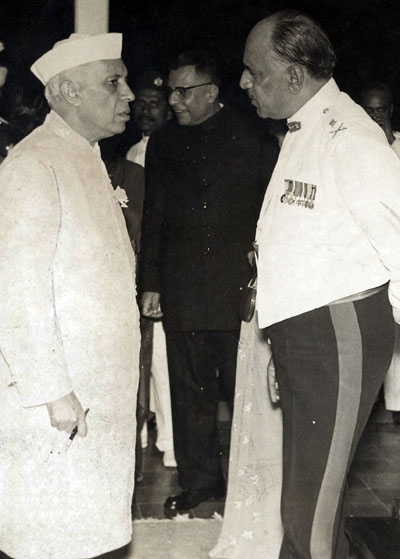
Pandit Jawaharlal Nehru with then Lt Gen. K S Thimayya, G.O.C-in-C, Southern Command, at the officers’ mess in Pune in 1956.
Thimayya, who was the fourth general of independent India, was born on March 30, 1906 in Madikeri. He studied at Coonoor and Bangalore’s Bishop Cotton Boys School before joining the Prince of Wales Royal Indian Military College in Dehradun. He served the Indian Army between 1957 and 1961.

After his retirement, he was appointed the Commander of UN forces in Cyprus, where he breathed his last.

Plea for photos of Fd, ML. Cariappa and Gen. Thimayya in Sainik Welfare office

Mysore, Feb.2:

The newly-floated Ex-servicemen`s Consultancy Services (ECS), Narayan Shastry Road, has urged the Deputy Director, Dept. of Sainik Welfare and Resettlement, Mysore, to display the photographs of Field Marshal K.M. Cariappa and General K.S. Thimmaya at the Sainik Welfare Office in view of their remarkable achievements.

S. Somashekara, Chief Consultant of ECS, has stated in a press release that these two were the only two Kanndigas who had made it to the top in the Indian Army with Field Marshal Cariappa becoming the first Commander-in-Chief of Indian Armed Forces and General Thimmaya occupying the post of Chief of Army Staff.

Stating that Field Marshal Cariappa`s bust had been installed at the entrance of Sainik Welfare Head Quarters in Bangalore and his life size photogr-aph was displayed at the Sainik Welfare Director`s Office in Banga-lore, Somashekara has urged the officers concerned at the Sainik Welfare Office in Mysore to follow the precedent set by the Director of the Department.

He has also suggested the Dy. Director to display the photographs of valiant war heroes who are either born in Mysore District or studied and settled down in Mysore after being decorated with gallantry awards such as Veer Chakra, Param Veer Chakra and Maha Veer Chakra.

source: http://www.Mysoretrendz.com / via source: www.StarofMysore.com / February 02nd, 2012

National Girl Child Day observed

Bangalore:

Karnataka State Social Welfare Board on Thursday observed National Girl Child Day in Bangalore. To mark the event, electronic Application For Women Empowerment and Development Action (e-AWEDAN), a software that enables registered voluntary organisations to submit applications for grants-in-aid under various schemes of the Central Social Welfare Board, was launched. Speaking on the occasion, Chairperson of Central Social Welfare Board and former Rajya Sabha member Prema Cariappa underscored the need to stop female foeticide in the state.

How does e-AWEDAN works?
Through e-AWEDAN, one can send request grants and check the status. For this, one needs to register their voluntary organisation and enable it to submit grant applications online. Once done, they can apply for various schemes of the CSWB like family counselling centre, condensed course of education for women programme working women’s hostel scheme, awareness generation programme, and so on. Contact 2346 0064/ 2356 8378 for details.

source: http://www.ibnlive.com.in / South> Bangalore / Express News Service / The New Indian Express / Bangalore, posted: February 03rd, 2012

Field Marshal K M Cariappa – an Officer and a Gentleman

By Richard Lasrado [ Published Date: January 29, 2012 ]

As I keep recalling the great personality I had met a few times, esp., for an interview as a budding journalist way back in 1974, the picture gets etched in the mind, deeper and deeper.

The Grand Old Man of Kodagu (then Coorg), Kodandera Madappa Cariappa (January 28 1899 – May 15, 1993), then a retired General, who was an epitome of discipline, punctuality and promptness, had graciously consented to my request to be interviewed for an Indian journal.

He, as independent India’s first and until then only Commander-in-chief, had retired in early 1952. He was made an honorary Field Marshal only later, as late as in 1986, during prime minister Rajiv Gandhi’s tenure.

A couple of kilometres down the serpentine road from Mercara, now Madikeri, to Siddapur stands the palatial ‘Roshanara’, the residence of the great man.

My nervousness was showing. Being a cub journalist, I was to meet a great warrior of world status and a hero of the world wars, who had been honoured by presidents, kings and heads of states.

Led into his drawing room by an attendant, I was awe-struck by the splendid display of military trophies, mementoes and souvenirs.
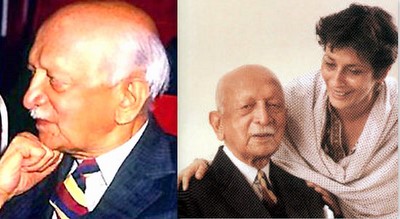
Field Marshal with his daughter Nalini
Two minutes after the appointed time, the broad-shouldered, six-foot-plus celebrity with peach-pink complexion appeared on the scene. As said already, it was not the first time that I had seen or heard him. But his simplicity and friendly nature were absolutely heart-warming and disarming at the same time. To cap it all, when the General repeatedly apologized for the two-minute delay with folded hands, I was rendered totally speechless and blank, for a moment making me forget the questions I had long planned to shoot.

Our meeting was scheduled to last just about an hour. But as the clock ticked away, the General seemed to be interested and asked to go on.

Reminiscing about that interview I had almost forty years ago invariably necessitates the quoting of some words of his, which, over the years have proved prophetic.

The following excerpts from the interview may provide an insight into his personality and thinking. They should be appraised only in the light of circumstances that prevailed in India in the early 1970s. Those among the readers who may have closely followed the India’s developments since 1970 may find his words quite fascinating.

******************

On the prospects of a military government in India and if such a measure would cure the country of all its ills and ailments.

The moment I mention a military rule, I am misunderstood. I would say, military rule can never take over India. One, we are a huge country and are beyond the control of a military machine. Two, we have too many diversities to keep us together. Three, when our defence resources are engaged at the borders, they may not be equipped to rule the country.

It makes me sad to see the inroads of foreign ‘isms’ into our body politic and havoc they have wrought. But democracy is deep down in our blood. Yet, under the present conditions, an indefinite President’s rule all over the country would do us a lot of good. Only such areas as may be unruly can be given in the hands of the army. Only after restoration of normalcy can elections be held.

The President can draw on the best talent in the country and form a cabinet of intellectuals and run the affairs of hte state more efficiently.
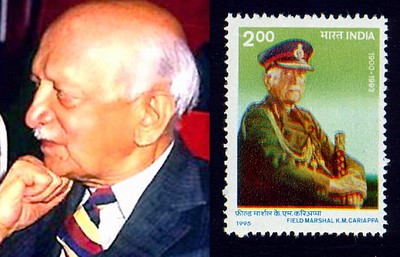
Commemorative stamp issued in his honour

On Jayaprakash Narayan’s movement against corruption in Bihar and elsewhere.

It is comforting to know there is a clean and upright person like JP to show us the way. But the public opinion is not strong enough in our country. People might curse the leader and the government. But in private the same persons run after politicians for licences, permits and favours.

Matters have come to such a dangerous pass that corruption is almost being regards as a way of life. Today’s students might call the politicians corrupt, while they indulge in copying and toehr malpractices themselves. It is just like a pot calling the kettle black.

On the future of the opposition parties and if the newly-formed Bharatiya Lok Dal (BLS) would be a mess or a Messiah?

A steam-roller of the ruling party anywhere poses a great danger to democracy. Presence of a plethora of political parties aggravates the situation.

All along, I have been advising all opposition parties to sink all their ideologies and come together on four major issues – 1. Defence of the country, 2. Foreign policy, 3. A realistic economy and 4. Internal security.

I can only say that the formation of BLD is a healthy democratic development, but how how far it is going to be a success, only the future can tell.

On the future of sports and games in India – he was a spin bowler, and a tennis and hockey player himself.

Sports is in our blood. Yet our achievements are not up to the mark. The main reason is the lack of practice as well as the grace to accept defeat. Dedicate practice is a must.

On India’s dismal failure in the field of hockey in spite of having a staggering line-up of talent.

There could be many reasons. But I would like to blame it on the lack of practice in the first place. Matters have been made worse by the ubiquitous ‘politics’. I did my best to keep this menace at bay during my tenure as three years as chairman of the All India Council of Sports (AICS), but it was in vain.

**************

I had two more issues that I wanted to broach with him. With much diffidence and hesitation, I took courage to ask him. First was about a little-known and little-publicized episode between him and Mahatma Gandhi. There was a brief pause.

Obviously, many had hesitated to put this question to him. He said, ‘Your way of asking such questions reminds of Melville de Mellow of All India Radio, who was here to meet me a few days ago.’ I was lost for words as my jaw dropped.

Then he handed me the Mahatma’s biography by Prarelal, who has devoted a whole chapter to this particur incident. The General felt that I would be better off with a third-person account than his own version.

Soon after the Indian independence, Cariappa had thundered at a metting in London that in the then-prevailing circumstances, the concept of Ahimsa (non-violence) was not going to be any help to India and a powerful army alone could make it one of the strongest nations in the world.

Gandhi was indignant at this candid outburst and shot back a rejoinder in his journal, ‘Harijan’, saying that even Generals greater than Cariappa would admit that they had no right to talk on non-violence. The concept of non-violence alone could eliminate the causes and chances of wars, wrote the Mahatma.

The General wanted to clarify matter with the Father of the Nation. They did not know each other personally and so he sought an audience. In December 1947, in full military attire, he visited Gandhi in Delhi.

It was a day of silence for the Mahatma., who was spinning his celebrated charkha. The General left his shoes behind, entered the room and saluted Gandhi. He told him that he had come to seek his blessings. Declining the chair offered by Gandhi, he preferred to squat next to him.

Bapu broke his silence and asked Cariappa if he had read the article in ‘Harijan’. Cariappa answered in the affirmative and humbly said that he felt honoured by Gandhi’s reference to his speech, all the more because he had commented on someone who he had never met before.

Then he went on to clarify that the soldiers’ community was the one that bore the brunt on many counts. They too believed in non-violence. If at all thre was a community opposed to wars, it is the soldiers’ community, he said.

Cariappa continued as Gandhi heard him with rapt attention: Soldiers did not like wars, not so much for the dangers and risks they were fraught with, but because they were aware of the futility of war in solving disputes and problems of the world. If at all soldiers fought wars, they did it as a mandate of the people. If people did not want wars, they should tell their governments so; it that didn’t work, they should change their governments. Gandhi looked impressed with the stream of thought and said he needed time to think it over.

Two days later, they met again and conferred on the same subject. On January 18, 1948 they met yet again in Birla Bhavan, Delhi. The General had come to bid good-bye on his wasy to Jammu-Kashmir action mission and seek his blessings. The Mahatma expressed the hope that the problem would be solved by peaceful and non-violent means, and asked Cariappa to report to him about his mission thereafter. The General said he would certainly do so.

By a strange quirk of fate, on January 30, 1948, the General returned to Delhi with the sole purpose of meeting the Mahatma, only to pay his last respects to the latter’s mortal remains at Raj Ghat.

====

The second question was also sensitive. I could sense a tinge of sadness and bitterness when he replied to my query. It was about the only only political shot he took by contesting a southern Mumbai – then Bombay – Lok Sabha constituency sometime in 1971.

I enquired of him as to why he had to contest from there and earn a needless tag of being a Shiv Sena candidate, although he was being supported by seven different parties, including the Bharatiya Jan Sangh and the Swatantra party. Instead, he could have contested from south Mangalore constituency which included his own home district of Kodagu, I said.

He replied: ‘ When I contested, my manifesto was simple and plain – giving priority to people’s basic needs of food, clothing and shelter and education, strongly opposing luxury life, control over pompous offices, conference and foreign tours, instilling a national feeling in everyone instead of narrow parochial and linguistic atttitude.’

I decided to contest in certain circumstances. At 71 then, I had no ambition or craving for power. One day, Congress (O) leader former railway minister Poonacha called me up and said the his party’s high command had chosen him to be their candidate. All opposition parties were to lend me their support. Hence I had to consent, he said. I thought to myself, just like General de Gaulle reached the top with military experience behind him, that I could raise my voice in the parliament at least for ex-Servicemen and thought this could give me a suitable opportunity to fight for them.

I told Poonacha, ‘ I am an VOP – very ordinary person. I do not have the resources to fight the election.’ He told me not to worry, assuring that all the parties would take care of it. However, a few days later, Poonacha called again to tell me that the party had instead chosen himself instead of me. Anyway, I said it was OK.

Another few days later, I received a telegram from the Swatantra party leaders informing me that 6 or 7 parties had chosen me as their joint candidate from southeast Bombay constituency. Shiv Sena happened to be one of them. I had a formidable Congress candidate like A G Kulkarni against me. Yet the mood was so upbeat that my victory was thought to be easy. There was even a talk going around that in the likely coalition government in Delhi, my name was thought to be the right one for the defence portfolio.

Yet I lost. Former president V V Giri once met me after the election and enquired why I lost when the chances were bright. Without mincing words, I told him, ‘One of your own central leaders came down and started saying that Cariappa was a Kannadiga and a southerner should not win in Maharashtra’ and such other narrow-minded words. There were twelve horses in the race. Jan Sangh and a few others let me down in the middle. Jan Sangh termed me pro-Muslim since I refused to attend the Vishwa Hindu Parishat programmes. Bombay Kannadigas alienated me saying that I was a Shiv Sena candidate. I called all representatives and tried to clear the misunderstanding in the presence of a Swamiji from Udupi, but it was of no avail. I fell a victim to adverse propaganda.’ Giri seemed to agree with in full.

*************************

Cariappa was a no-nonsense, no-compromise personality. There have been cases of chiefs of service staff, as they approached retirement, having tried to appease the centres of power with an eye on plum posts like those of ambassadors, governors and the like. Many retired officers have taken up adminstrative posts in corporate houses. But this intrepid fighter stood above all that. He kept on raising his voice against misrule, corruption and political chicanery.

During his tenure as India’s high commissioner to Australia and New Zealand between 1953-55, an off-the-cuff remark against the racial policy of the Australian government is said to have created a diplomatic row, which created a rumpus in the Indian parliament seeking his recall. But he stood his ground, without any fear.

His differences of opinion with the Nehru-Krishna Menon combine was a matter of an open secret. During Indira Gandhi’s rule, once he had advocated handing over of disturbed areas to the military. Politicians sought his arrest on charges of giving a call for military rule. They even demanded withdrawal of his pension.

Those were the days when a late prime minister used to blame the ubiquitous ‘foreign hand’ or the ‘CIA’ for most of the problems in the country. Cariappa did not hesitate to ridicule it saying that a day would come when the prime minister’s chest pain would be blamed on the CIA.

Naturally, he had earned the displeasure of the ruling classes. No wonder, he was not recognized until late in his life. Gen Sam Manekshaw was upgraded as Field Marshal soon after the Bangladesh war victory in 1971.

The very fact that a man like General Cariappa, who had served the Indian army for a good 33 years, was made an honorary Field Marshal 33 years after his retirement during Rajiv Gandhi’s tenure as PM, speaks of the vagaries and systemic malaise that plague our country.

Field Marshal Cariappa always said he was an Indian first, and a Kodava or Kannadiga only next. He played a major role in getting the names Mercara and Coorg changed back to their ethnic forms as Madikeri and Kodagu. He also had fought against the Kambadakada dam project which would have gobbled up thousands of acres of fertile land of Kodagu.

His residence ‘Roshanara’ and a lifesize statue at a circle on the way to Mysore stand majestically in his memory. A college in his hometown has been re-named after him.

When the messenger of death came calling in a Bangalore hospital in 1993, for sure, he mght have struggled to take away this giant, the fearless soldier who may have said good-bye to this world with sadness. Because the India of his dreams is still a long distance away.

If power lay in the hands of patriots and upright Indians like Field Marshal Cariappa, it would have been a different picture. Maybe his dream may come true some distant day, but, alas, there cannot be another Cariappa.

source: http://www.Mangalorean.com / by Richard Lasrado / January 29th, 2012
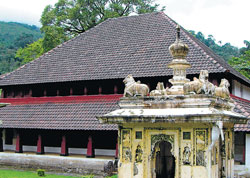
Madikeri: ‘Indian Army Ready to Face Greater Challenges’ – Lt Gen A K Singh

Madikeri:
Lieutenant General A K Singh, General Officer Commanding-in-Chief, Headquarters Southern Command, was here to be at the late Field Marshal K M Cariappa’s 113th birth anniversary observace. He arrived on Friday.

At a touching ceremony jointly organized by the department of Kannada and culture, Karnataka Kodava Sahitya Academy and Field Marshal Cariappa Forum on Saturday, Jan 28 – the day the great man had been born in 1899 – he received the military guard of honour and then spoke highly about him and the land he hailed from, namely, Kodagu.

“India is ready to face great challenges from adversaries in spite of the talks of friendship. Besides, all citizens should be alert of security threat in the country. We are fully alive and alert to face those elements which harm the trust and honour of the nation,” he asserted.

He said Kodagu district had given a number of soldiers to the armed forces. The trend must continue and more and more youngsters from here should join the Services, he said. He said that he had always longed to visit Kodagu, which had given great soldiers like Field Marshal Cariappa, General Thimmaya and Subedar Guddemane Appaiah Gowda. The visit was finally possible because of the 113th birth anniversary of FM Cariappa.

Having served as the Commander-in-chief of the armed forces of independent India FM Cariappa, he made a significant contribution to the nation. The country should always remember his discipline, efficiency, honesty and patriotism. Remembering him itself could inspire anyone to inculcate self-respect, dedication and discipline, he further said.

Lt Gen Singh also said that golden canteen, healthcare, rest-house and other facilities had been made available to former Servicemen in Kodagu district. He also revealed that a grant of Rs 2 lakh would be made towards observance of FM Cariappa’s birthday on Army’s behalf.

State legislative assembly speaker and Virajpet MLA K G Bopaiah, speaking on the occasion, said that it was fitting that the birthday of FM Cariappa, one of the greatest Army chiefs that India had seen, was being observed in a very apt way.

He also said that with the support of all elected representatives from the district, the government would be urged to observe the great man’s birthday throughout the state. The government had already declared two festivals of Kodagu, Tula Sankramana and Huttari, as official holidays. A request to declare FM Cariappa’s birthday as a public holiday would be submitted to the government, he said.

FM Cariappa was known for discipline, consistency and punctuality and the ideals and values he had stood for should be adopted by everyone. It was a healthy development that functions to recall such personalities were being arranged. During visits to elsewhere in the country or abroad, no one identifies Kodavas on their own. But a mention of Field Marshal Cariappa would give instant recognition, he further said.

Madikeri MLA Appachu Ranjan said that remembering the Field Marshal, who was known for discipline, honesty and commitment, by in itself was an inspiring experience. Pointing out the slump in the number of people from Kodagu joining the Armed forces, the youth should take his example of military discipline and dedication. Wishing that the birthday should be observed on a nationwide basis, he said already a library had been set up in Shanivarsanthe, the Field Marshal’s town of birth and assured to make more funds available for it.

MLC M C Nanaiah said the late Field Marshal deserved Bharat Ratna decoration and suggested that the state government would take steps to have it given posthumously to the great person. His birthday should be

Mysore-Kodagu Lok Sabha member H Vishwanath and FM Cariappa Forum convener Major Nanjappa also spoke on the occasion. Other highlights of the occasion was the release of a booklet on the Field Marshal, honouring of four individuals for their achievements and service, showering of flower petals on the Cariappa statue from a helicopter from above and an attractive march-past by NCC cadets, the Army band, police, Scouts and Guides etc. A traditional Kodava weapon, ‘Odikatti’ was presented to Lt Gen Singh.

C M Pemmaiah, coffee planter and Mandepanda Pushpa Kuttanna, a social activist, were also honoured. Besides, K C Ramamurthy, coffee planter, and Mukkatira Chengappa, a social activist, were honoured posthumously. There were spontaneous shouts of ‘Jai Cariappa’ when an army helicopter showered flower petals on the statue at the Sudarshan circle.

Kodava Sahitya Academy president Iymudianda Rani Machaiah, DC Dr N V Prasad, SP Manjunath Annigeri, Kanti Belliappa, Lt Gen C N Somanna, Lt Gen B C Nanda, Air Marshal K C Cariappa, Maj Gen B A Kariappa, Maj Gen K P Nanjappa, Col K C Subbaiah, FM Cariappa Forum vice president M M Ravindra, Kannada and culture department assistant director Vinod Chandra and many prominent citizens were present on the occasion.

Nanda Cariappa said on the occasion that his father was respected with awe not only by Kodavas but the entire people of Kodagu. His wife Meena Cariappa was with him.

Uliada Poovaiah welcomed the gathering. Madettira Belliappa and Daty Poovaiah compered the function. Kodava Samaj president Matanda Monnappa gave a vote of thanks.

source: http://www.connect.in.com / www.Mangalorean.com / Team Mangalorean – Madikeri / from Ashwini Appaiah / With Vartha Pics / publised January 29th, 2012

Army day greeting

Imphal: January 14:

On the occasion of Army Day 2012, Lt Gen Dalbir Singh, AVSM, VSM, GOC 3 corps, conveys his greetings and best wishes to all ranks of the Army. The Army Day which is schedule on 15 of January every year in recognition of Lieutenant General (later Field Marshal) K.M. Cariappa becoming the first Indian commander-in-chief in 1949.

GOC 3 Corps, in his message, brought out that all ranks of Army should feel proud of being a soldier of this great and glorious Indian Army. The released also said that “all ranks of spear corps have been working together with the local civil administration and the people of the land to bring in greater growth and prosperity in Northeastern region.

GOC 3 Corps also expressed his appreciation to the dedicated efforts of each soldier towards this noble cause.

The released further said that Army has been a source of inspiration and has contributed to society’s development in a number of ways. Army’s efforts to undertake infrastructure developmental projects, to motivate school children, to recruit Jawans, to conduct vocational training, to provide medical & veterinary services at remote locations and to encourage women empowerment has made significant difference in the overall growth of the region. The General also added, “We salute the brave soldiers who have made the supreme sacrifice in the performance of their duty”.

source: http://www.kanglaonline.com / by Imphal Free Press / January 14, 2012

Indian Army: Poised to safeguard the nation and uphold democratic norms

New Delhi, Jan.14 (ANI):

In India, the month of January witnesses two things in ample measure – the biting cold and a spirit of nationalism. National fervor is whipped up by the Republic Day celebrations with parades and revelries generating tremendous enthusiasm.

Yet another ode to nationalism is the Army Day celebrations held across the Nation on January, 15. It was on this historic day in 1949 that the Indian Army divested the control of the British with General (later Field Marshal) K. M. Cariappa taking over as the first Commander-in-Chief of the Indian Army from Sir Francis Butcher.

A number of parades, memorial lectures, equipment displays, investiture ceremonies organised by the Army on this day elicit tremendous response from the general public.

The Army Day is also a time to audit the achievements of the Army in the year gone by. The pace for this very sensitive exercise is set, in no small measure, by the traditional press conference of the Chief of Army Staff (COAS). This year, the press conference by General VK Singh, COAS, was held at the majestic Manekshaw Stadium on January, 12. Many issues of relevance came up during the press conference.

In the year gone by, the Army continued with its operational engagement in such pockets of the Nation where inimical forces are not desisting from spreading the cult of terrorism. 65 brave soldiers of the Army made the supreme sacrifice while upholding the safety and integrity of the Nation in 2011. These included 11 officers, 06 Junior Commissioned Officers and 45 brave soldiers.

Due to relentless anti terrorist operations by the Army, the year gone by was the most peaceful in the Kashmir Valley since 1990. Jammu province witnessed 74 per cent decline and the Kashmir Valley witnessed a 33 per cent decline in terror violence as compared to 2010.

Terrorism related violence in 2011 dropped to an all time low of around 190 incidents. Beyond internal security, the Army also upheld its tradition of being the first to respond to natural calamities. It made a sterling effort to restore the situation in earthquake afflicted Sikkim and also some flood affected regions of the country.

Operationally, the Army made quantum progress in critical aspect of modernisation and transformation designed to make the force more lethal, mobile and network centric.

Some new structures were put to test and validation. A primary validation initiative was Exercise Sudarshan Shakti which culminated in mid December, 2011. The exercise was witnessed by none other than the President of India, Pratibha Patil. It successfully validated a number of new concepts that were earlier on the drawing board.

The fighting capability of the Army was enhanced during the year by better surveillance, improved night fighting capability, air defence capability and human resource development. The Army is now better poised for tactical decision making and deeper strikes.

The Army rendered significant assistance in preparing Police and Para-military Forces (PMF) in tackling internal strife. About 33000 police and paramilitary personnel were trained for counter Naxal operations.

Advisories were given when sought and footprint in the region was improved by an increase in recruitment. However, the army desisted from getting directly involved in counter Naxal operations since it would weaken its bond with the people and negatively impact its preparedness for its primary task of defending the country’s borders against external aggression.

The environment in the neighbourhood continued to pose a challenge to India’s security. Even though Pakistan remained instable, its internal problems did not lead to a letdown in support to cross border terrorism.

The army remained ready for all eventualities; it constantly monitored the border and had complete information about the 42 camps in Pakistan occupied Kashmir which facilitate infiltration.

The circumstances dictated enhanced vigil in Jammu and Kashmir and also the continuance of enabling legislations like the Armed Forces Special Powers Act which provide protection to the soldiers performing extraordinary duties under extraordinary circumstances.

The line of actual control with the Chinese did generate issues of perceptions but confidence building measures remained in place even as necessary steps to build up defence capability in the form of force accretion and improvement of infrastructure were put into motion.

The army attempted to reach out to other countries in India’s extended neighbourhood through the medium of joint exercises and exchange of ideas on tackling terrorism and insurgencies.

The army also continued with its sizeable contribution to the United Nation (UN) peace efforts with more than 7000 personnel deployed in UN missions abroad.

The internal health of the Indian Army was addressed by emphasis on the core value systems which form the bedrock of its culture. A clear message was sent out that rank and power will not come in the way of punishing those who indulge in misdemeanours and acts of impropriety.

The army’s thrust towards sports and adventure was encouraged and the result was as many as 112 medals in the National Games. Five army sportsmen have already been selected to represent the country in the London Olympics.

The Indian nation is going through some testing times. The Indian Army is prepared for all eventualities and for effectively performing its responsibilities towards the nation.

The people of India see the Indian soldier as the epitome of all that is the best in the country due to his demonstrated qualities of courage, self sacrifice, integrity, strength of character and commitment to the cause of the nation.

It is the bounden duty of the nation to ensure that the blood spilled by the soldier as also his contribution to the national cause does not go waste. To ensure the same all out efforts should be made to maintain him at a highest pedestal professionally, socially and psychologically. By Jaibans Singh (ANI)

source: http://www.newstrackindia.com / ANI / New Delhi / Saturday, January 14th, 2012

Commemorative Issue – General Thimayya

General Kodandera Subayya Thimayya was born in Madikeri, the district town of Kodagu (also known as Coorg), Karnataka, India. He was a graduate of the Royal Indian Military College in Dehra Dun. He served in the Indian Army from many posts.

He became Chief of Army Staff of the Indian Army in 1957. He was also awarded the Distinguised Service Order. After the Korean War, he headed an United Nations unit dealing with the repatriation of prisoners of war. After his retirement from the Indian Army, he was appointed as the Commander of UN Forces in Cyprus (UNFICYP) in July 1964.

While in Cyprus, he died of a heart attack, in 1965. The Republic of Cyprus, in addition to this stamp issue, honored him by renaming an avenue of the city of Larnaca after him.

Commemorative Issue General Thimayya

Cyprus
Date of Issue: 06 June 1966 /4/1966
Technical Information
Quantity: 292329
Designer: A. Tassos

source: http://www.philatelism.com
http://www.philatelism.com/details.php?issueid=24