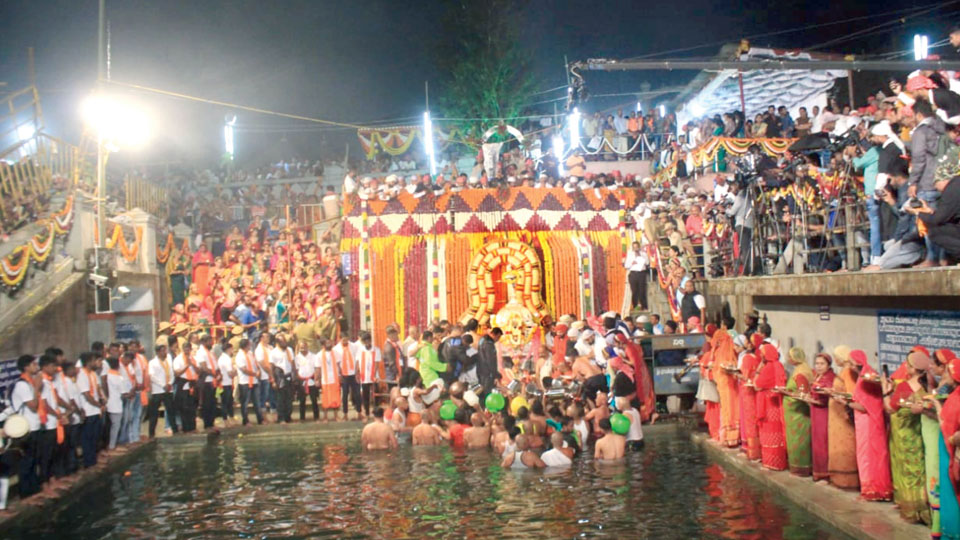
Thousands of devotees from Kodagu, across the State and Tamil Nadu congregated at Talacauvery in Kodagu last night to witness Cauvery Theerthodbhava amid chanting of mantras and other religious rituals.
The holy event took place exactly at the predetermined Muhurtha of 7.22 pm in Mesha Lagna at the foothills of Brahmagiri inside the Holy Brahmakundike, considered to be the source of River Cauvery.
It is believed that Goddess Cauvery comes in the form of a fountain-head where water gushes from the Brahmakundike. A team of priests, led by Prashanth Achar, Raviraj Achar and Gururaja Achar chanted Vedic hymns before sprinkling holy water on the devotees. Later, devotees collected the Theertha (holy water) to be distributed among community members and to be kept at homes as holy signs.
The rituals associated with the holy occurrence began at 5 pm and as the predetermined time neared, devotees chanted mantras and welcomed the Goddess. The Theerthodbhava took place after the Sankalpa Puja and Mahamangalarathi. As the water bubbles appeared in the Brahmakundike that was filled with flowers, Kumkum and vermillion, the cries of devotees reached a crescendo.
Devotees took a holy dip in the main pond (Kalyani) in front of the Brahmakundike and offered their prayers. They jostled to collect holy water in pots from the Kundike and the priests sprinkled the holy water on them.
The area around the pond was barricaded to enable crowd management and only small groups of devotees were let inside by the Police to prevent crowding and stampede. Despite barricades, devotees swarmed around the Brahmakundike and the Kalyani.
Devotees also thronged Triveni Sangama at Bhagamandala and many took a dip in the river and many offered the ritualistic Pinda Pradhana as a mark of respect to their elders.
The Kodagu Ekikarana Ranga distributed free breakfast and lunch to the devotees as part of its 27th year food distribution. Free food will be supplied till the end of Tula month on Nov. 17. Kodagu District Minister B.C. Nagesh, MLAs Appachu Ranjan and K.G. Bopaiah and others were present.
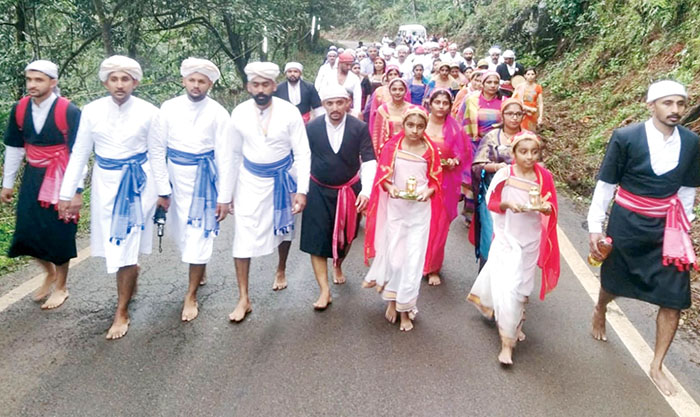
Devotees in traditional attire walk from Bhagamandala to Talacauvery
Unlike the last two years, thousands of devotees turned up to watch the spectacle and notably, many Kodava community members walked from Bhagamandala to Talacauvery along with musical bands and sang songs in praise of Goddess Cauvery. The holy place was teeming with devotees since early in the morning and the place was overcrowded by evening.
Various Kodava organisations like Akhila Kodava Samaja Youth Wing, Connecting Kodavas, Kodava Riders Club, Jabbhoomi Trust, Thingakoru Mottu Sanghatane, Ammathi Kodava Samaja, Ponnampet Kodava Samaja, Madikeri Kodava Samaja, Balele Kodava Samaja, Kodava Kootaaliyada Koota, Kodava Samajas of Napoklu, Virajpet, Hudikeri, Mysuru, Amma Kodava Samaja, Youth Council, Kodavaamera Kondata, United Kodava Organisation and Codava National Council walked along the route, singing paeans to the Goddess.
source: http://www.starofmysore.com / Star of Mysore / Home> News> Top Stories / October 18th, 2022
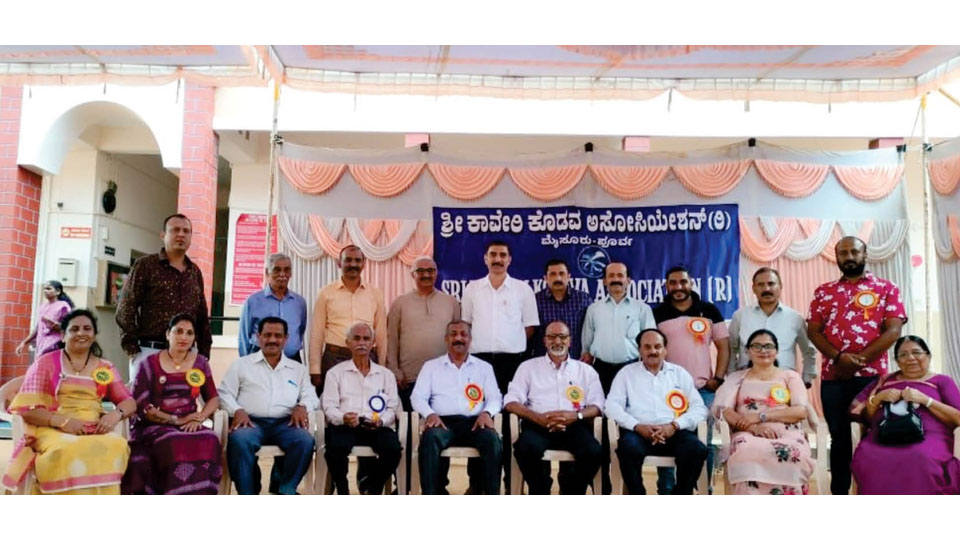
A group photo of newly elected office-bearers and Managing Committee Members of Sri Kavery Kodava Association, Mysore East, for the year 2022-2024:
President: Puliyanda S. Devaiah, Vice-President: Pandyanda K. Bopaiah, Hon. Secretary: Kademada M. Belliappa, Joint Secretary: Pemmanda D. Poonacha, Treasurer: Coluvanda M. Chengappa; Committee Members: Neravanda N. Sunil Muthappa, Pattada A. Sachin Devaiah, Pokachanda P. Narendra, Pattamada T. Charmana, Chokira Suthan Madappa, Pudiyokkada M. Chengappa, Kundranda C. Thammaiah, Chimmanda P. Subbaiah, Mookalamada B. Somanna, Mollera A. Kavitha, Medura P. Seethamma, Ajjamakkada Beena Cariappa, Chowrira K. Seethamma (Education Council Chairperson), Puttichanda Jayakumar (Building Committee Chairman) and Koppira D. Ponnappa (Internal Auditor).
source: http://www.starofmysore.com / Star of Mysore / Home> PhotoNews / October 09th, 2022
The 42-year-old Indian now breaks back into the top 20 rankings for the first time since August.
Rohan Bopanna and Matwe Middelkoop with thier first title together | Jack Guez / AFP
Rohan Bopanna partnered Matwe Middelkoop to win his third tour title of the year, when the pair beat third seeds Santiago Gonzalez and Andres Molteni 6-2, 6-4, in the ATP 250 Tel Aviv Open on Sunday.
With the doubles crown, the 42-year-old now breaks back into the top 20 rankings for the first time since August, currently placed 19. Earlier this year, he had partnered Ramkumar Ramanathan to win titles in Adelaide and Pune.
But this was the first title he won with his Dutch partner. The duo had reached the final at the Hamburg Open and semifinals at the French Open earlier this year. They also hold a 16-10 record this season.
The top seeds in Israel however, had to work their way back into each of the three matches they played before getting to the final.
They beat Hamad Medjedovic and Yshai Oliel 4-6, 7-6(4), 10-6 in the first round. In the quarterfinal they beat Denys Molchanov and Franko Skugor 4-6, 7-6(5), 10-5 before beating the all-French team of Sadio Doumbia and Fabien Reboul 4-6, 7-6(3), 10-8.
In the final though, they played their best tennis.
“I think those close matches, pulling through those you’re obviously having more court time, you’re trying to come through and fight some close battles,” Bopanna said to the ATP website.
“We were a couple of points or one point away from losing those matches, so sometimes those weeks make a huge difference for your confidence.”
This was Bopanna’s first event since the US Open. He was scheduled to compete for India in the Davis Cup World Group 1 tie against Norway, but pulled out because of a knee injury.
source: http://www.scroll.in / Scroll.in / Home> The Field> Indian Tennis / by Scroll Staff / October 03rd, 2022
Kodagu is situated around 150 km from Mangaluru and is geographically and culturally a different territory. The Mangalore University has colleges in Dakshina Kannada, Kodagu and Udupi under its purview.
Mangalore University Vice-Chancellor prof P S Yadapadithaya said no official communication has been received so far on the formation of the Kodagu University. (Representative image. Express photo)
The Mangalore University is likely to lose 24 undergraduate colleges with the setting up of a new university in Kodagu.
Decks have been cleared for the Kodagu University with the Karnataka Legislative Assembly passing a Bill last week, amending the Karnataka State Universities Act, 2000 to pave way for the constitution of eight new universities, including Kodagu University, which would be bifurcated from the jurisdiction of Mangalore University.
Kodagu is situated around 150 km from Mangaluru and is geographically and culturally a different territory. The Mangalore University has colleges in Dakshina Kannada, Kodagu and Udupi under its purview.
The new Kodagu University would also have about 10 colleges that presently come under the University of Mysore. The largest and oldest college in Kodagu district is the Field Marshal K M Cariappa College at Madikeri.
The Mangalore University postgraduate college and research centre on the Jnana Kaveri campus in Chikka Aluvara is proposed to be the headquarters of the Kodagu university.
K S Chandrasekharaiah, director of the centre, confirmed that Kodagu University administrative office is likely to be on the Chikka Aluvara campus.
He said students in Kodagu now have to move to Mysuru or Mangaluru for post-graduate studies, which can be avoided if more job-oriented courses are provided on the Jnana Kaveri campus.
Madikeri MLA M P Appachu Ranjan has requested the government to provide 200 more acres of land to the Chikka Aluvara campus, which presently has 70 acres.
The other universities proposed by the government in the Bill are to be set up at Koppal, Mandya, Bagalkot, Chamarajanagar, Bidar, Haveri and Hassan.
Mangalore University Vice-Chancellor prof P S Yadapadithaya said no official communication has been received so far on the formation of the Kodagu University.
As per the new National Educational Policy (NEP), priority is being given to local universities which can provide good education and environment to students, he said.
source: http://www.indianexpress.com / The Indian Express / Home> Education / by PTI, Mangaluru / September 30th, 2022
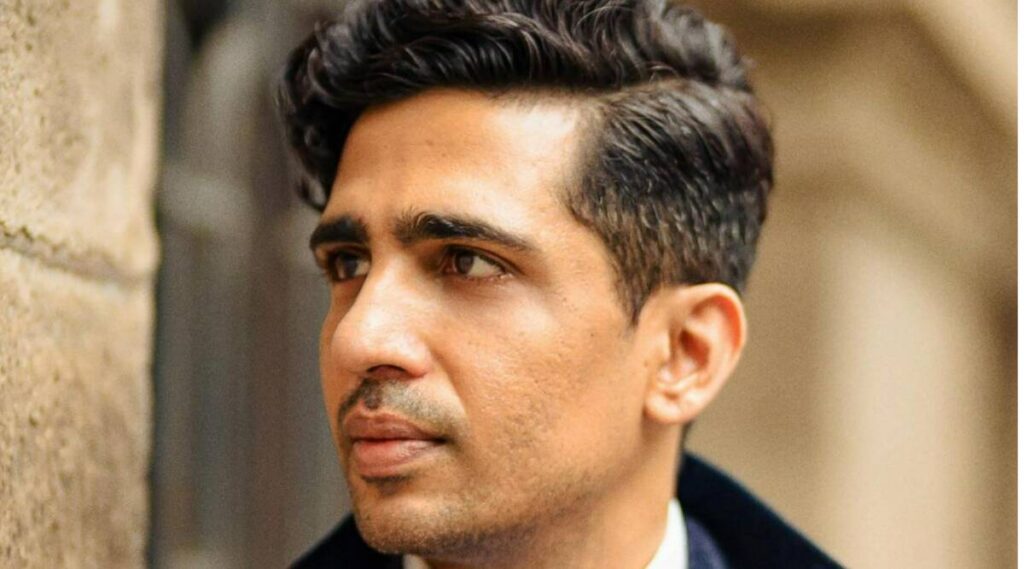
Gulshan Devaiah says he has navigated his way through the industry with sincerity, though times were testing and sometimes money–for projects he didn’t want to do–too tempting.
Gulshan Devaiah recently starred in the MX Player series Shiksha Mandal. (Photo: Gulshan Devaiah/Instagram)
In 2012, Gulshan Devaiah bagged the best debut Filmfare nomination for three diverse films Dum Maaro Dum, Shaitan and That Girl in Yellow Boots. His jubilation turned into a heartbreak when, despite the range of his performance on display, he went home without a trophy. Something fundamentally started shifting within the actor.
He realised that his love for his art should be without the expectation of a reward. That he shouldn’t look down upon others success. That he cannot fall prey to conspiracy theories in the industry about how things work– or don’t. That–despite his much loved and acclaim film with Vasan Bala six years later–Mard ko dard Nahi Hota.
In an interview with indianexpress.com to promote his latest MX Player show Shiksha Mandal, Gulshan Devaiah says he is a changed man today. He is not bitter, but grateful. He is grounded, but ambitious. And what still irks him the most, is the conversation about meritocracy in Bollywood.
Edited excerpts:
What about a project makes you think you can invest your time and energy in as an actor?
I am particular about choosing a project because it has to really, genuinely interest me. I don’t want to do projects just because they make me enough money to pay bills. Some say, ‘One for dill one for bill’. I am not criticising that, but I don’t ever want to be in that position where I am doing things just for the money. Characters and stories interest me. Sometimes it’s also about collaboration, like I wanted to work with Taapsee Pannu so one of the big reasons to do Blurr was that.
What caught your attention about Shiksha Mandal?
I liked that it was well researched about education scams. There has been no resolve to this, this stuff keeps happening, the nexus keeps going. It affects a lot of us. There is a misplaced anger about meritocracy in Bollywood. But meritocracy can’t exist in arts because you can’t measure an arts performance, can’t measure how beautiful somebody’s voice is. It is a subjective opinion.
In the case of an entrance exam scam, people work really hard, they burn the midnight oil, they prepare and then behold, there’s a scam. Then the deserving candidates are not picked because somebody else you know, cheated the system. So that way I found relevance in this story.
When it comes to misplaced anger about meritocracy in the industry, there is a section which gets easy access due to the backing that they have. Isn’t there a parallel with the ‘cheating the system’ argument of yours?
No, it is very misplaced. I’ll make it very simple. It’s a race, 10 people are running and in 100 meters you have to cross the line. You can measure who crossed the line first. But anything in arts–a performance, how beautiful a painting is, how good somebody’s poetry is– it is immeasurable. It’s always a perception. What is measurable is majority consensus or box office success. Which is a flawed standard of measure. Out of 10 people, we want all 10 to like us, to think that we are great.
If people have certain access to something, then it’s a privilege that exists. Of course, there are power structures and where there is this, there is politics. Power structure can be terribly beneficial also, but it can also have corruption all over. But to say only deserving people should… How can you decide who’s more deserving? There’s a flaw in the system. I would like to get opportunities and sometimes I get them and many times I don’t. But that’s how anything in the arts will work. Some people will be more fortunate than the others and there will be privileged. But you can’t make it about merit. I always have a problem with that.
Have you ever been at the receiving end of power play or politics because you don’t come from privilege?
In a few instances, I thought I may have been. I was of course upset. But I am not going to carry that poison in my vein and let it ruin my life.
You said you don’t do projects for money. But isn’t good money a temptation? Has there never been a point where you felt if I do this project, it can get me a bigger house, car?
Absolutely. I’m trying to buy a house and I’m short, so definitely the temptation is always there. The carrot is always juicy, but I have somehow managed to not bite it. This is also a business and I’m learning. I come from a background where I was doing business and was not very good at it. I’m still not very good at it but you have to learn how to manage your affairs, make money. I have set certain restrictions for myself. I don’t want to monetize my social media, I don’t want to do ads, I don’t want to do television, I don’t want to do voice acting.
Which means long formats are the only way I can run my thing. How do I make the best of it? This whole thing about market value is perception. One producer will think, ‘Why are paying Gulshan so much?’, the other producer I may be able to convince them to pay me a certain amount of money. It’s how you do business. It’s a game of perceptions. So here I am, accepting the game of perception trying to do my best in a sincere and authentic way.
Why have you put these restrictions on yourself?
It’s also fun to have restrictions. You can’t achieve anything new, fantastic and satisfying if it’s easy, right? The truth is I’m not interested in any of the other things. I never dreamt about being in ads or being on TV. I only dreamt of being in the movies and I would consider series format as movies too.
It’s been more than a decade for you in the industry. If you look back, what is your key takeaway about the industry and the way you’ve navigated your way?
I didn’t know anything. I knew how to act. I had to learn how to negotiate my way. I had to learn how to manage rejection. I had to learn how to hustle. I’m not really a hustler, but to some extent you have to when it’s absolutely required. And again, the whole thing about the game of perception, meritocracy and I was like everybody else, ‘How come they are getting all these opportunities? they are sh*t.’ But after a few years, my perception changed.
I’m not bitter. I’ve seen so many bitter people talk ill about everybody behind their backs in front of their faces and I figured that I don’t want to turn like this when I’m old. I didn’t want to be this bitter guy, because it didn’t make me feel nice about myself at all. It’s been a very satisfying journey. I’m very happy. I’ve achieved all of this because of good fortune and some wonderful people who have helped me and given me great opportunities. When I got these opportunities, I made good of them, I was ready for them. Could I have been successful? Yes, of course. Will I be more successful in the future? It’s very possible.
If at one point you felt how were others getting those opportunities despite not being good, when did the shift happen when you were at ease?
It started happening when I didn’t win the Filmfare award for best debut, I was nominated! Everybody has one film mentioned under the nomination, I had three (Dum Maaro Dum, Shaitan & That Girl in Yellow Boots). But I didn’t win. After that I was gutted, like what the hell is going on? Of course you hear all sorts of conspiracy theories. Friends, foes and everybody says, ‘Oh, it was fixed’ but it started to affect me.
I (realised) I can’t live like this. I don’t care if it was fixed or not, I care about how I am feeling about these things. It’s making me feel bad, I have to learn how to deal with it. It took me some time, maybe a few years, but because I was aware of it, was observant, I tried to fix it. I made sure this is not going to be poison in my veins because it will destroy me.
source: http://www.indianexpress.com / The Indian Express / Home> Entertainment> Bollywoood / by Justin Joseph Rao / Mumbai- September 29th, 2022
Sqn Ldr Devayya’s heroics to shoot down a PAF Starfighter in 1965 are among IAF’s finest hours. But he wasn’t lucky like Abhinandan & perished with his Mystere.
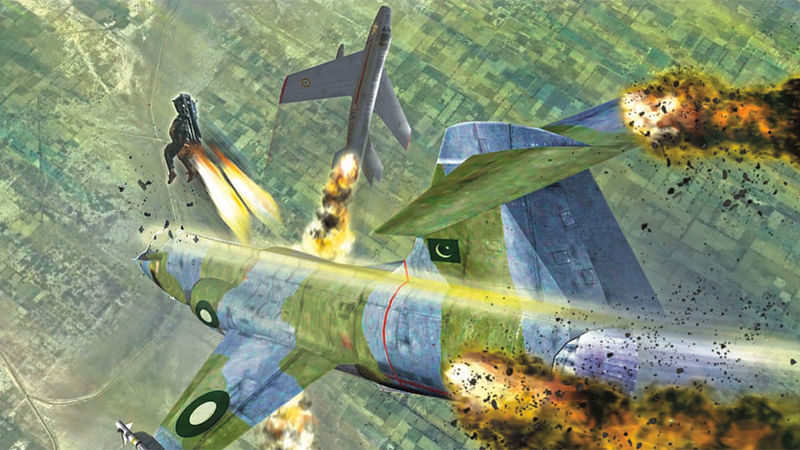
Flight Lieutenant Amjad Hussain ejecting from a Starfighter after being shot down by Squadron Leader Ajjimada Bopayya Devayya | Graphic: by special arrangement
The dogfight in the 1965 Indo-Pakistan War is counted as among the finest in IAF’s history. Squadron leader Devayya, who was on standby, was part of the mission that went in. When he joined the air battle, he was intercepted by an enemy F-104 Starfighter flown by Pakistani Flight Lieutenant Amjad Hussain.
What follows is the ensuing combat between the heavy and slow-moving IAF Mystere and the faster and more modern F-104 Starfighter from Pakistan.
Late into the night of 6 September 1965, coded IAF Command tasking orders for authorizing multiple strikes against the PAF on 7 September were issued to the bases of Agra, Adampur and Halwara. The main components of the attack force were Canberra Bombers (5 Sqn) from Agra, Mysteres (1, 8 Sqn) from Adampur and Hunters (7 and 27 Sqn) from Halwara. In spite of the chaos relating to the Pakistan Army’s Special Service Group (SSG) paratrooper drops over Adampur and Halwara, as well as the incessant B57 night bombing raids over these airfields on the intervening nights of 6/7 September, these bases buzzed with activity during late night/early morning, preparing and arming their aircraft and holding elaborate mission briefs. Though the intelligence was limited on the PAF’s disposition, all air warriors at these bases were motivated and primed to hit back at the PAF. They wanted to pay them back in kind — tit for tat post the PAF’s strikes on 6th September!
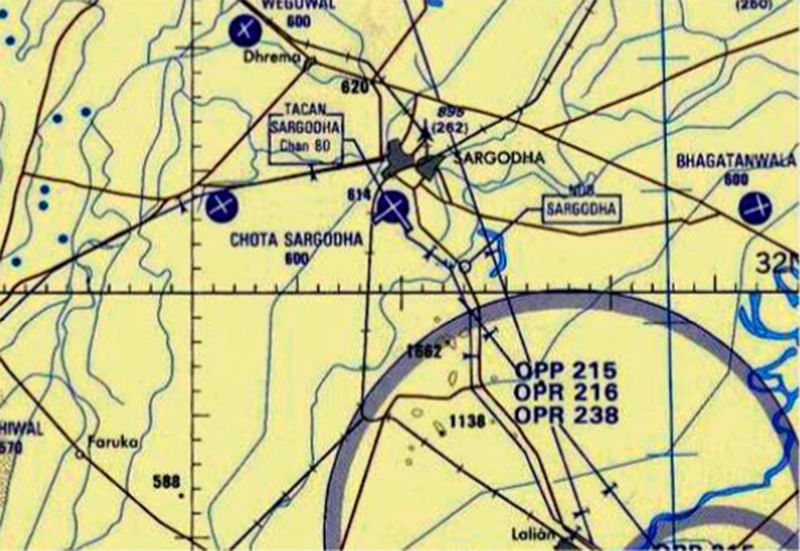
Their primary target was the Sargodha Complex!
The Sargodha complex of airfields shown on a wartime Pakistan Air Force (PAF) map | Courtesy: Sameer Joshi
Sargodha during those days, minus the bases inside the Soviet Union, was probably the most well defended target across Asia. The PAF knew that with pre-emptive strikes on 6 September, they had stirred a Hornet’s nest and the IAF would strike with vengeance at this most strategic base. However, it was confident, that with an advanced early warning and multilayered defensive capability, only the most diehard IAF strike elements would be able to get through to Sargodha. And there they would be blown away to smithereens by the high-density ack-ack.
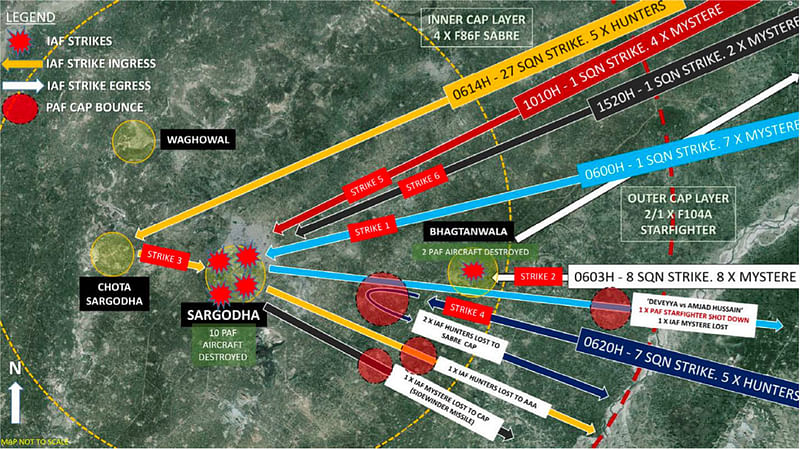
The PAF had grossly under estimated the tenacity and resolve of the IAF fighter pilots who were ready to absorb a high rate of attrition to hit back at the PAF at Sargodha. The IAF hit the Sargodha complex all through the day with daring raids. Over ten PAF jets were destroyed on the ground during these strikes. On this day, the infamous and false claim of ‘5 IAF Hunters shot down in 30 seconds’ over Sargodha, by Sqn Ldr MM Alam of the PAF was propagated by the PAF as a propaganda twist to the events of that day. However, the most significant dogfight of the 1965 war was also fought between a PAF Starfighter and an IAF Mystere jet that day. The story of which is most inspirational and beyond belief.
20 miles east of Sargodha, Pakistan. 0530 hours PST, 7 September 1965
‘Eagle, this is Sierra Control,’ the strained voice of PAF’s GCI control at Sakesar, boomed loud and clear in the ears of Flight Lieutenant Amjad Hussain. Hussain was piloting a F 104 Starfighter of 9 Sqn PAF ‘Griffins’, holding in a racecourse orbit 25 miles east of Sargodha at 15,000 feet. ‘Eagle, Sargodha is under attack. Sargodha’s ‘Killer’ (Base Air Defence) control spots three plus IAF fighters attacking the airfield. We are vectoring ‘Vulture’ and ‘Hawk’ CAPs to cover the eastern exits of the IAF aircraft inside the inner defence ring. Proceed ten miles southeast and hold anchor at 15,000 feet. No joy with the enemy aircraft presently. Stay clear of base. Guns are free over the airfield. Over anchor point, change over to Killer Control and monitor progress.’ Sakesar GCI vectored the Starfighter (Eagle) and Sabres (Vulture and Hawk) CAPs at the pre-determined points on the defensive circles around Sargodha, just as the first wave of IAF Mysteres of 1 Sqn ‘Tigers’ was striking Sargodha.
‘Roger, Eagle copies that!’ Hussain acknowledged the call and turned hard right in his sleek Starfighter, the most potent aircraft in the PAF’s arsenal. He went to full afterburner to go to supersonic speeds. The fuel-guzzling J79 turbojet responded without any lag as high-pressure jet fuel was injected in the combustion chamber to burn in mere nanoseconds. This produced the obligatory thrust through the High Pressure turbine, propelling the Starfighter to a commanding Mach 1.2 within a short period. As Hussain arrived over the position advised by GCI control, he throttled back to 450 knots, returning to subsonic speeds. The sonic boom distracted the villagers from their daily chores at Kot Nakka near Pindi Bhattian.
He grinned at the prospect of winning a Sitara-e-Jurat, the PAF’s award for getting an air-to-air kill in the coming moments. After all, nothing could stand in face of the mighty One O Four!
Amjad Hussain settled down in an orbit at 12,000 feet and started visually scanning the approaches from Sargodha determinedly to spot the IAF aircraft well in advance. He changed his R/T frequency to ‘Killer’ control, the CAP controller at Sargodha airfield, who was relaying a continuous commentary on the IAF’s raid. Amjad’s stomach tightened as he heard the call from Killer control, ‘strike exiting towards south east.’ He put the Starfighter in a gradual dive, which gave him better visibility and put the armament master ON.
A F-I04A Starfighter was the deadliest aircraft in Pakistan Air Force’s fighter fleet | Courtesy: Sameer Joshi
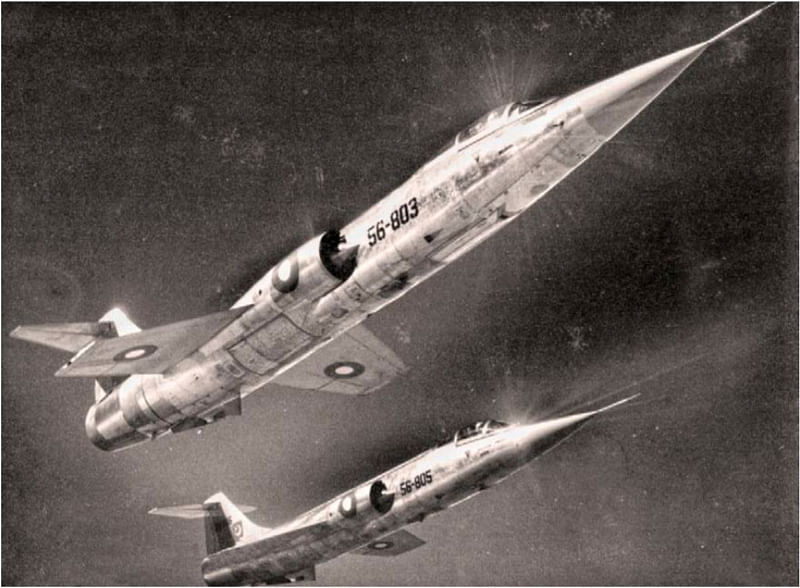
In the 1965 conflict, the F104A Starfighter was the most advanced aircraft in the PAF service. It was superior to all aircraft in the IAF’s inventory. The F104A was a supersonic interceptor with a needle nose, short wings to aid supersonic flights and a ‘T’ tail to aid stabilization at those speeds. Its acceleration was superior than anything in the world and could climb to its operational ceiling of 50,000 feet in sixty seconds. The short wings were needle thin so as to have the least amount of atmospheric drag and the aircraft would easily reach its top speed of Mach 2.2 in a very short duration of time. The pilot in a Starfighter was literally sitting on a rocket engine due to this unmatched performance.
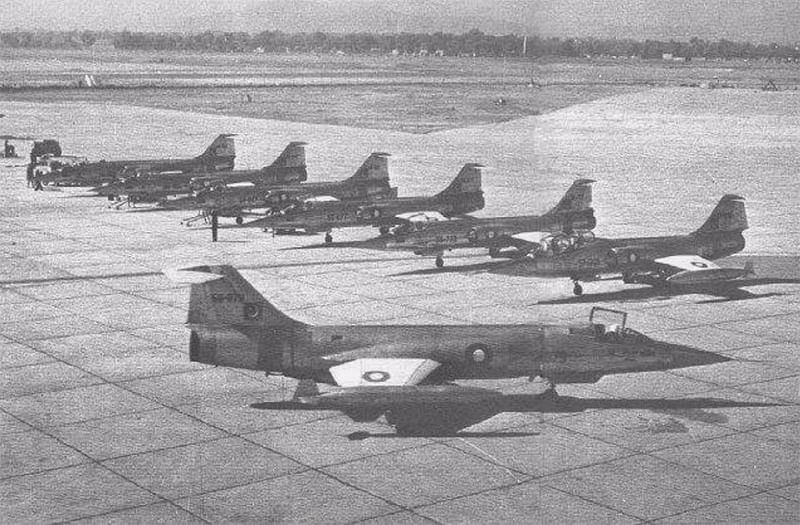
Pakistan Air Force’s 9 Squadron Starfighters in dispersal at Peshawar | Photo: By special arrangement
The Starfighter was armed with two Sidewinder AAMs and a six-barrelled Vulcan 20 mm rotary revolver cannon. The cannon, mounted in the lower part of the port fuselage, was fed by a 725-round drum behind the pilot’s seat, giving only a continuous 7 second burst of fire. The gun’s location was advantageous as the gun-flash was not in the pilot’s line of sight, therefore not robbing him of night-adjusted vision. An AN/ASG-14T ranging radar helped the Starfighter get an accurate range feed for its Gyro gun sight and the Sidewinders. The two AIM-9B Sidewinder air-to-air missiles were carried on the wingtip stations, which could also be used for fuel tanks. While the Sidewinder gave a definitive stand-off engagement capability, the Vulcan cannon was the most powerful gun on any airborne platform in the world.
15 miles South-East of Sargodha, Pakistan. 0534 hours PST, 7 September 1965 ‘Contact with single bogey on radial one two zero. It is hugging the ground,’ Amjad exclaimed excitedly on spotting a single Mystere aircraft. ‘Go for the kill and lookout for the remaining fighters,’ bawled the Sargodha CAP controller. ‘Roger Wilco,’ Amjad dived towards the low-flying Mystere. At 5000 feet and closing in 2000 yards behind the Mystere, he got an intermittent lock on the right Sidewinder and fired the missile. The missile missed the target and exploded harmlessly on the ground. Hussain continued to close in rapidly and switched over to guns. At 600 yards, Amjad opened up with the deadly six barrelled 20-millimeter cannon. The millisecond burst of the 6000 rounds per minute cannon sounded like a canvas being ripped and seemed to slow down the Starfighter in its mighty recoil.
” He saw the Mystere pass through the tracer line of his bullets. ‘Splash One,’ Amjad gave a victor’s war cry over the R/T and pulled out of his dive to turn right, attempting to pick up the other IAF aircraft.
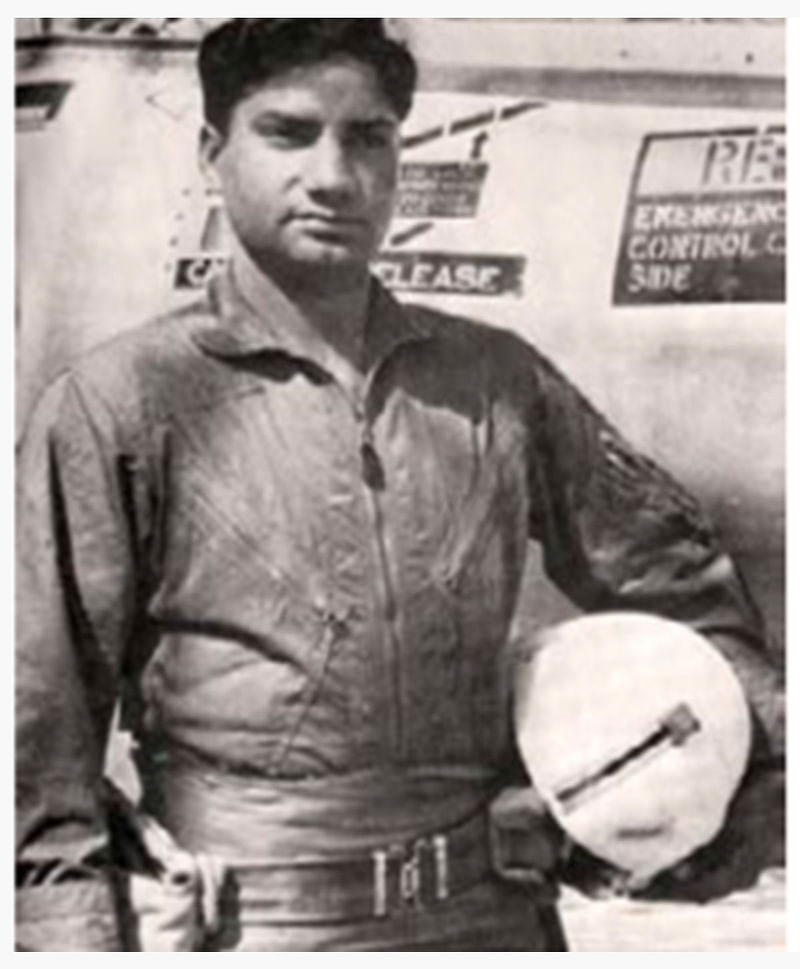
Flight Lieutenant Amjad Hussain | Photo: By special arrangement
Amjad carried out a slow roll and while passing inverted, hanging on his seat belt, he saw an IAF Mystere closing in rapidly behind him at roughly sixty-degree pitch at seven o’clock. ‘Contact with a second bogey. Engaging him,’ Amjad called out on R/T, while manoeuvring to neutralize the Mystere’s aggressive pitch towards him. He carried out a rolling reversal towards the Mystere and they crossed at a high angle off. Amjad Hussain reversed to find the Mystere cutting in rapidly inside his turn again.
He saw muzzle flashes from the nose profile of the Mystere and tracers passing too close for comfort. Hussain went to afterburner settings and pulled up in a yo-yo manoeuvre to zoom up and get a height advantage, as well as cut down his forward travel to maintain with his adversary. He dropped down on the Mystere, who again pulled up towards him, forcing Hussain to carry out another yo-yo. Dropping again, in his exuberance to cut inside the Mystere’s turn, Hussain went for a horizontal hard turn towards the Mystere. The wily Mystere pilot timely reversed towards the Starfighter and forced Hussain to get into horizontal scissors. The Starfighter was not made for low speed, high angle of attack combat and its short, negative camber wings were woefully inadequate to generate a meaningful lift at low speeds. Hussain’s Starfighter juddered near stall limits carrying out low speed scissors with a very skillful IAF Mystere pilot. The Mystere pilot had craftily trapped Amjad Hussain in a turning fight, where the Starfighter’s superior performance was progressively bled off.
‘Damn’, Hussain thought, ‘weren’t the IAF fighter pilots supposed to be dead scared of a Starfighter?’ The Mystere was manoeuvring very skillfully and managing to engage the Starfighter with vengeance. The IAF pilot appeared like a quintessential Teutonic Knight to Hussain, hell bent on dispatching him to Valhalla in the‘never say die’ code of a fanatical warrior!
As the two fighter pilots tediously battled it out over the village of Kot Nakka for their respective Air Forces in a classic one versus one situation, the question rattling Amjad Hussain’s brain continuously was, ‘Who the hell was this guy?’
Amjad Hussain’s adversary was a bold IAF Squadron Leader by the name of Ajjimada Bopayya Devayya or ‘Tubby’ as he was christened in the squadron.
A fighter pilot, whose peers described him as an ‘unusual chap, one of those World War types’! A descendant of the humble Kodava warriors from Coorg in South India, Devayya was a true soldier who lived by the virtues of honour, integrity and persistent bravery. He grew up reading about the chivalrous dogfights of the bygone era and epitomized idols like Von Richthofen, Douglas Bader, Eric Hartmann and other knights of the skies. Hence, it was only natural for Devayya to become a fighter pilot in the Indian Air Force.
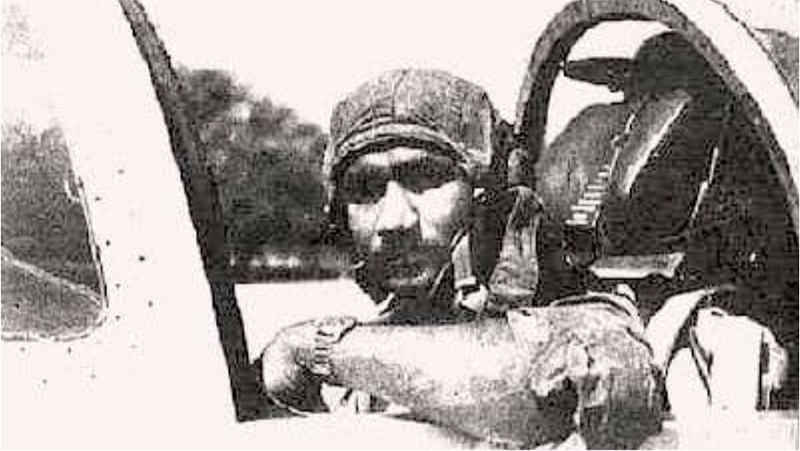
Squadron Leader Ajjimada Bopayya Devayya | Photo: By special arrangement
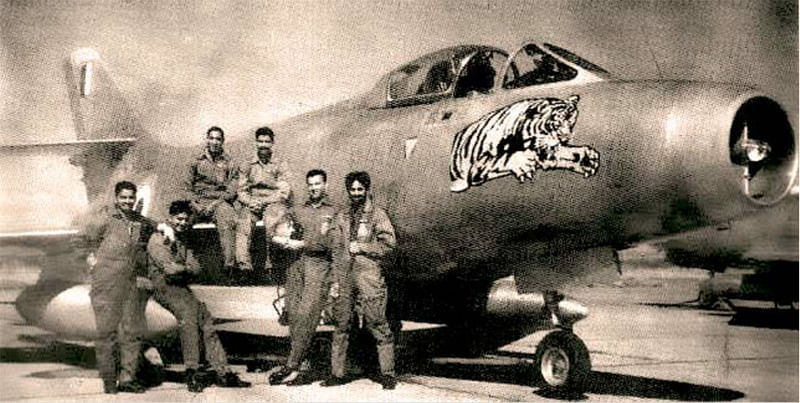
On that fateful day, Devayya, part of the IAF’s ‘Red’ formation made up of 1 Sqn Mysteres, was lagging behind Taneja and Verma when they were exiting in a south east direction at 200 feet.
Pilots of 1 Squadron ‘Tigers’ standing next to a Mystere IV aircraft during the 1965 war | Photo: By special arrangement
At about 15 miles from Sargodha, he spotted Amjad Hussain’s Starfighter in a threatening dive, with his guns blazing. Devayya carried out a late ‘Rip’ maneuver to turn rapidly into the Starfighter, which saved him from certain death. However, a small proportion of the Vulcan’s rounds may have found their mark, destroying the VHF radio setup of the Mystere, amongst other unknown damage. His bête noire, the Starfighter turned away, blissfully unaware to the fact that Devayya had survived the attack.
Indian Air Force counter strikes over the Sargodha complex | Map: Sameer Joshi
At this juncture, nursing his engine at low levels, he could have easily continued towards India, as his aircraft was flyable. Also, a low fuel reserve prevented the Mystere from engaging in wishful air combat of any manner. Devayya spottedthe Starfighter commence a slow roll in search of his compatriots. He realized that the unsuspecting Taneja and Verma would be easy kills for the undetected Starfighter. With no radio, Devayya could not warn others of the evolving threat from the Starfighter. Only he stood between the Starfighter and sure shot destruction of his comrades. Devayya did not flinch as he hauled his stick hard in his stomach and went to max engine rating to reach for the Starfighter hawking about 3000 feet high.
‘Tubby’ Devayya knew for certain that whatever the outcome of the impending engagement, he would not be returning home!
However, as he closed onto the Starfighter, saving the lives of his comrades was paramount on the mind of this gallant knight of the sky. A fact made more remarkable when we compare the capabilities of the Mystere with the Starfighter.
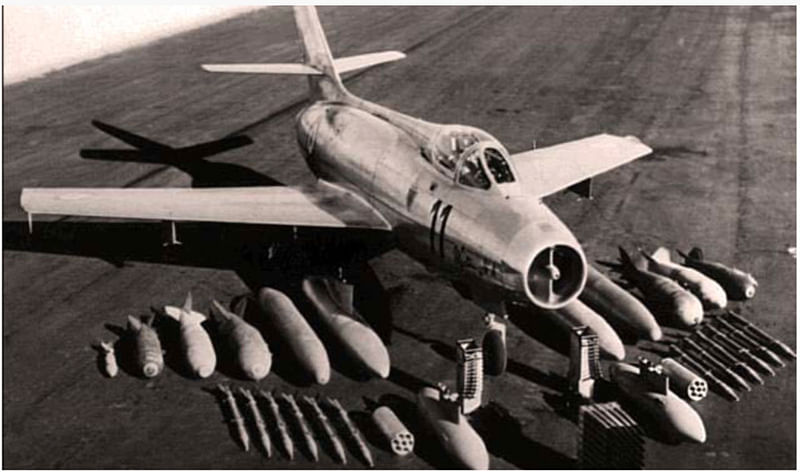
A Mystere IV displaying its complete weapon arsenal | Photo: By special arrangement
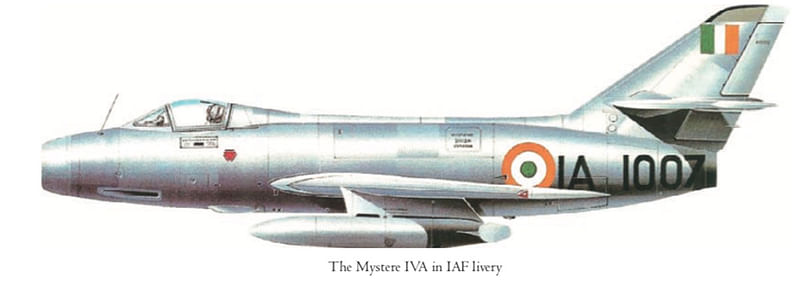
In terms of air combat capability, the Mystere was no match for the Starfighter. The Dassault Mystere IV was a subsonic fighter-bomber with a maximum speed of 690 knots at sea level and a combat ceiling of 49,000 feet. It had a 3500 kg thrust, Hispano Suiza Verdon 350 turbojet, with a first generation centrifugal flow compressor, which had a very sluggish engine response. Its rate of climb of 7500 feet per minute was nothing to be proud of.
In terms of performance, it was not suited for air combat operations. However, with two 30 mm DEFA cannons and an armament load comprising of retractable/ wing mounted 80mm SNEB/T 10 rockets and a bomb carriage capability of 1000 lbs under each wing, it was the perfect interdiction and strike aircraft. When flying at tree top levels at top speed, it could escape any PAF aircraft — except the Starfighter!
Village Kot Nakka, Pindi Bhatian, Pakistan. 0539 hours PST. 7 September 1965
Devayya successfully managed to engage the Starfighter flown by Amjad Hussain. He knew he could neutralize the Starfighter’s performance advantage if he could engage the Starfighter in horizontal maneuvering, where the Mystere would be able to ‘turn’ better than the Starfighter. After a couple of yo-yos, the Starfighter made the mistake that Devayya was waiting for.
The Starfighter pilot, in an attempt to get behind the Mystere, reduced his speed rapidly and carried out a turn in the horizontal plane to bore sight the Mystere for a gun solution. Grabbing this chance, Devayya turned hard into his adversary and managed to ‘force’ the Starfighter into horizontal scissors. Thereafter, with better handling and turning rate of the Mystere at lower speeds, Devayya began to reduce the angle required to get a shot at the Starfighter.
With each passing scissor, the fight moved to lower levels, increasing the difficulties of the battling pair! Devayya was gaining on the Starfighter, but was not there as of yet. He decided to gamble the last few knots of speed he possessed. As the Starfighter was coming for the next cross, Devayya turned hard into the Star-fighter, bleeding off his speed at a rapid rate, but was able to cut inside the turn of his adversary by his desperate action. Hence, when he reversed, he had the Starfighter within his gun sight. Devayya knew this was his only chance.
Point blank, at around 250 yards from the Starfighter, Devayya pressed the firing button. The 30 mm HE shells of the DEFA cannon caught the Starfighter in their spread some-where close to the vertical stabilizer at the rear part of the aircraft. The Starfighterwas terminally hit.
A shocked Amjad Hussain found his control jammed and the Starfighter plum-meting towards the ground. The Starfighter’s rear stabilizer was ripped away by the Mystere’s fire. Hussain ‘punched’ out. Hussain survived a harrowing low-level ejection from the doomed Starfighter and landed safely by parachute near Kot Nakka village. ‘Tubby’ Devayya’s last few moments of predicament will always remain a mystery.
After shooting down the Starfighter, his Mystere crashed close to Hinduana village, some distance away from Kot Nakka. Devayya had crashed with his stricken aircraft. It is possible, that after taking the shot at the Starfighter,Devayya was unable to eject out in the SNCASO ejection seat of his battle-damaged Mystere. Villagers found his body intact, thrown away from the burning wreckage of his Mystere by the force of the impact. Devayya was buried by the villagers in the nearby fields.
Amjad Hussain achieved what he so desperately sought that day, an award of Sitara-e-Jurat for shooting down Devayya’s Mystere. He, however, lived his life knowing that a gifted and very brave IAF pilot, while flying an inferior aircraft to his Starfighter, had got the better of him.
Unknown to Taneja and Verma, given the combat edge of the Starfighter, Devayya had saved them from certain doom. That Devayya stayed behind and managed to shoot down a supersonic, missile armed Starfighter, against all odds whilst operating a possibly damaged Mystere, speaks highly of the professional integrity, bravery and flying skill he possessed. Devayya amply substantiated the adage — it is the man behind the machine who matters most!
Taneja dejectedly reported Devayya as ‘missing in combat’ after Verma and he landed back at Adampur.
The story of this fantastic one versus one duel and Devayya’s heroism would have passed into obscurity, with Devayya’s fate remaining unknown, ironically, had it not been for the official publication of PAF’s history of the 1965 Air War with India in 1979, authored by John Fricker.
Aftermath 1979–88
Published in 1979, The Official History of the PAF in 1965 War was a book commissioned by the PAF to showcase the ‘comprehensive’ wins of the PAF over the IAF in the 1965 war as part of a dedicated propaganda effort to cloak the massive defeat suffered by the Pakistani Armed Forces. This obsequious tribute to showcase the larger than life role models like Sqn Ldr MM Alam and others, was biased in content to a great extent. However, John Fricker, the writer, did admit to the loss of a PAF Starfighter over Sargodha, which was reportedly shot down by an IAF Mystere on 7 September 1965. This may have been based on official PAF feedback after the loss of the Starfighter.
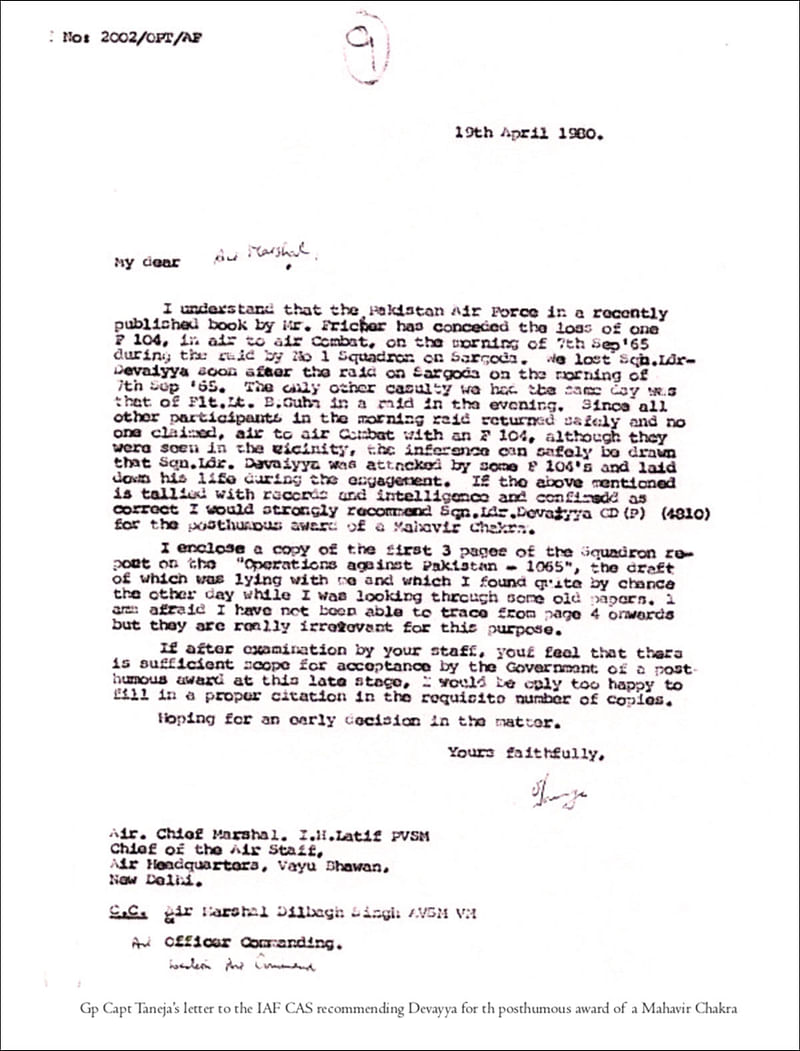
Letter recommending Squadron Leader Ajjimada Bopayya Devayya for the Mahavir Chakra
Now retired, Group Captain Omi Taneja, the 1 Sqn strike leader on that fateful day over Sargodha, happened to see this historical record and deduced that the Mystere pilot who had shot down a Starfighter, had to be A.B. Devayya. Flight Lieutenant U.B. Guha flew the only other Mystere lost by IAF on that day. A Sidewinder missile had unquestionably shot down Guha, which had been fired from a PAF Sabre.
Hence Devayya was the pilot who had shot down Amjad Hussain.
Also, Amjad Hussain was shot down again in the 1971 war against India. While interrogation as a POW, he recalled his fight with an IAF Mystere, admitting that he had ‘collided’ with the IAF jet. This provided the first clue to the inspirational dogfight between Hussain and Devayya.
In 1980, Taneja, after confirming the same details from various other sources, was left awed by this inspiring tale of valour and sacrifice. He reasoned that the Indian nation needed to know about the supreme gallantry and sacrifice of A.B. Devayya. He compiled Devayya’s story and wrote to the then IAF Chief of Air Staff, recommending Sqn Ldr AB Devayya for the awardof a Maha Vir Chakra, the second highest gallantry award of the Indian nation. Based on available evidence, the IAF was successfully able to convince the Indian government that A.B. Devayya had indeed shot down a F104 Starfighter.
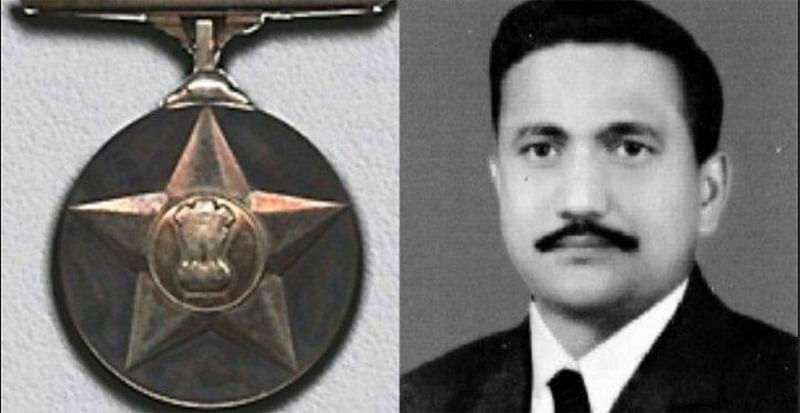
In 1988, about 23 years after his valiant tale of glory near Sargodha, Devayya’s widow, MrsSundari Devayya received the Maha Vir Chakra from a grateful Indian nation.
The Maha Vir Chakra was awarded to Squadron Leader Ajjimada Bopayya Devayya in 1988 | Photo: By special arrangement
For many decades this famous dogfight has confounded historians and air enthusiasts alike. Devayya’s story is highly inspirational! He lived and died a Knight’s death, buried in an unmarked grave somewhere in Hinduana village deep inside Pakistan, at the Valhalla of his choosing!
Rest peacefully now, O brave knight, may the clouds welcome you in their final embrace.’
— A quote on the grave of a famous WWII German ace
This article was originally published in the Medium.
source: http://www.theprint.in / The Print / Home> Defence / by Sameer Joshi / September 07th, 2019
SV Sunil’s decision to call time came a day after drag-flicker Rupinder Pal Singh and defender Birendra Lakra announced their international retirements.
SV Sunil said it was time for him to make way for younger players and help to build a winning team for the future. Courtesy: The Hockey India
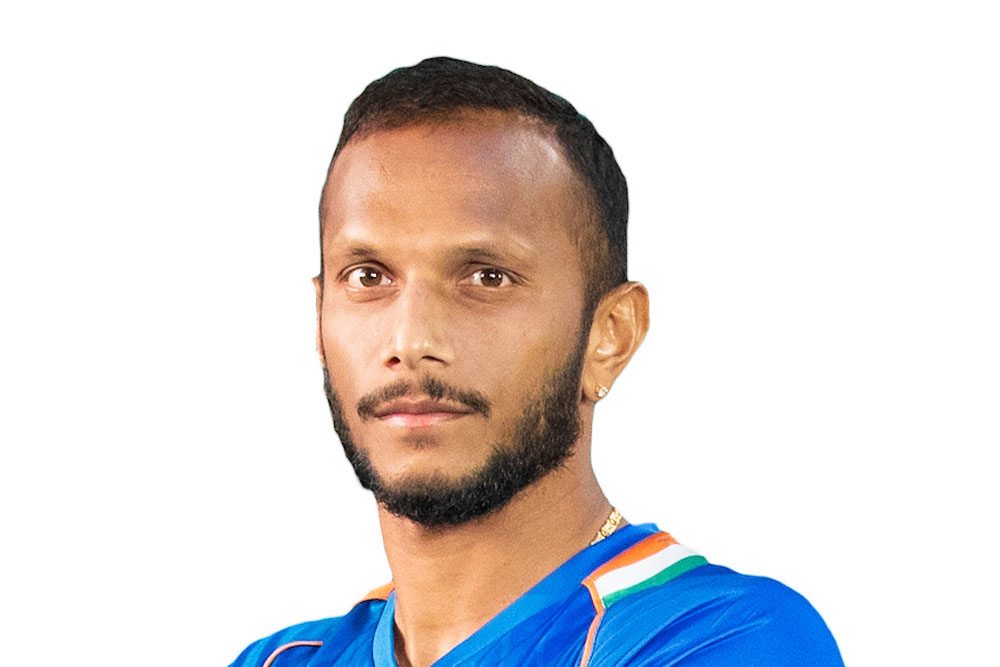
Veteran India men’s hockey team striker SV Sunil on Friday announced his international retirement, bringing the curtains down on a 14-year-long career during which he was a part of the 2014 Asian Games gold-winning side.
Sunil’s decision to call time came a day after drag-flicker Rupinder Pal Singh and defender Birendra Lakra, who played starring roles in the Indian hockey team’s historic bronze medal-winning Tokyo Olympics campaign, announced their international retirements on Friday.
The 32-year-old Sunil, hailing from Karnataka, was not a part of the team that competed in the Tokyo Olympics. Sunil, said it was time for him to make way for younger players and help to build a winning team for the future. The senior player appeared in 264 India matches, striking 72 goals.
“… time to take a break. More than 14 years after I wore India colours for the first time, I have decided to make myself unavailable for the national camp which begins next week,” Sunil, who gew up playing hockey with a bamboo stick due to his family’s limited resources, said in a statement on his Twitter handle.
“It was not the easiest decision to make, but it was not the toughest either, given that I did not make it to the team for the Tokyo Games. The omission put a question mark on my future as a player, in the 11-a-side format.
“With the 2024 Paris Olympics three years away, I think, as a senior player it is important that I make way for youngsters and help in building a winning team for the future,” he added.
The Arjuna awardee from Somwarpet in Coorg made his international debut in 2007 at the Asia Cup which India won after beating Pakistan in the Final.
There was no looking back for the speedy striker after that and he was a part of India’s incredible rise in global hockey.
The two-time Olympian (2012 and 2016) remained a key player in the Indian forward-line for over a decade with fine performances.
He was in the Indian team that won gold in the 2011 Asian Champions Trophy and silver in the same event in 2012.
He also won gold and bronze medals in the 2014 and 2018 Asian Games respectively besides a gold in the Asia Cup 2017.
He played an instrumental role in the team’s historic silver medal wins at the 2016 and 2018 FIH Champions Trophy.
In his long career, Sunil also led the forward-line in 2015 World League Final where the team won a bronze Medal and he was also part of the team that won bronze in the same event in 2017 in Bhubaneswar.
He also has a silver medal from the Commonwealth Games 2014 to his credit.
Congratulating Sunil for his contribution to Indian hockey, Hockey India President Gyanendro Ningombam said, “SV Sunil has been an inspiration to an entire generation of young hockey players.
“His commitment to the game and discipline was unmatched and he has given Indian hockey some very memorable performances.”
Sunil said he will continue to be available to play the shorter form of the game (5-a-side hockey).
He said the gold in the 2014 Asian Games was the turning point of his career.
“I am grateful that I represented my country at two Olympic Games — in London in 2012 and in Rio in 2012.
“I have seen a lot on and off the pitch in the past 14 years. I have battled personal tragedies, career-threatening injuries and other setbacks to remain focussed on giving my best for the country.”
source: http://www.outlookindia.com / Outlook / Home> Sports / by Outlook Web Desk / October 01st, 2021
The Karaga Utsav of Madikeri Dasara will be inaugurated at 5 pm today at Pampinakere in the town.
The Karagas of Sri Kundurumotte Chowti Mariamma, Sri Dandina Mariamma, Sri Kanchi Kamakshiamma and Sri Kote Mariamma will be decorated with flowers and the Madikeri Dasara will be officially launched by offering pujas to the four Karagas.
The Karagas will be brought to Bannimantap, where special pujas will be performed and later, pujas will be performed at Sri Kodandarama Temple, Sri Chowdeshwari Temple and Pete Srirama Temple.
Madikeri MLA M.P. Appachu Ranjan, DC Dr. B.C. Satish, Madikeri CMC and Dasara Committee President Anitha Poovaiah, Working President K.S. Ramesh, General Secretary Rajesh Yallappa and others will be present.
source: http://www.starofmysore.com / Star of Mysore / Home> News / September 26th, 2022
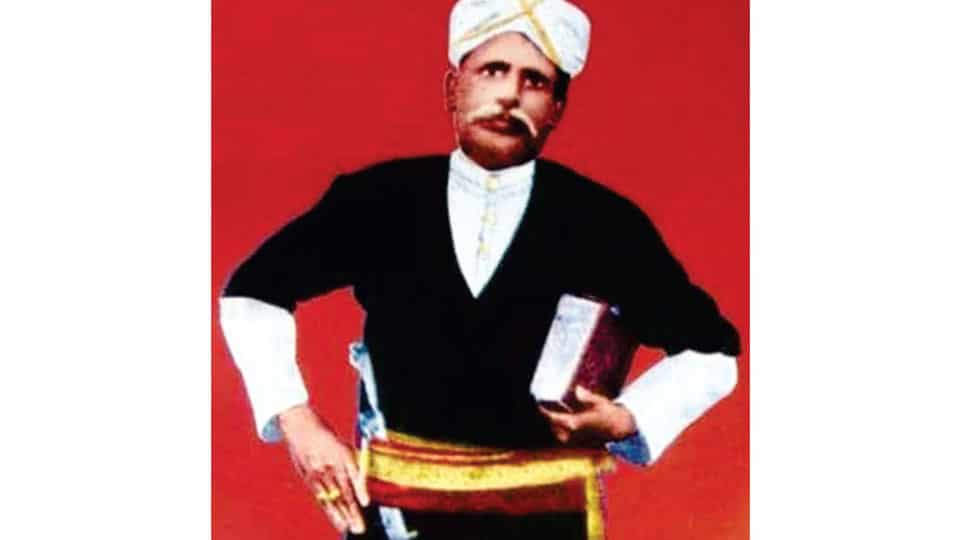
Maintaining that Haradasa Appacha Kavi was a great Kodava poet and Philosopher who followed ‘Dasa Parampare’, Rangayana Director Addanda C. Cariappa said that the Kodava community should press the Government for the establishment of Appacha Kavi Study Chair in University of Mysore.
He was speaking at Appacha Kavi birth anniversary celebrations organised by Mysuru Kodava Samaja at Field Marshal K.M. Cariappa Community Hall in Vijayanagar here recently.
Asserting that Appacha Kavi’s poems, plays and other writings were worth a study by the Kannada literary world, Cariappa argued that the Study Chair will largely help in carrying forward the rich legacy left behind by the great poet, to future generations. Kodava Samaja should exert pressure on the Government for the setting up of the chair, he added.
Continuing, Cariappa said no one should forget that Appacha Kavi was the first Indian playwright to adapt the mythological Yayathi story into a popular play. Appacha Kavi, who studied only till fourth standard, became a Sanskrit scholar and wrote exemplary plays. Through his memorable and magnificent writings, he came to be known as Kalidasa of Kodagu, he observed.
Stating that Appacha Kavi, who was born on Sept.21, 1868, was known as a Poet-Saint, he regretted that it is unfortunate that the Kannada literary world is yet to accept him and there are also no serious discussions on his plays, poems and other works. This may be because that most of his works are in Kodava language, he opined.
Celebrating the great poet’s birth anniversary as ‘Kodava Sahitya Day’ is just not enough and it should be celebrated in a more purposeful manner to attract the attention of the entire State, he added.
Artist Nellamakkada B. Kaverappa, who is also the Founder-President of city’s Bharani Art Gallery, spoke on the life and works of Appacha Kavi.
Mysuru Kodava Samaja President Mechanda Shashi Ponnappa welcomed. Kodava Samaja Cultural and Sports Club President Kuttimada D. Muthappa and others were present.
source: http://www.starofmysore.com / Star of Mysore / Home> News / September 26th, 2022
WELCOME. If you like what you see "SUBSCRIBE via EMAIL" to receive FREE regular UPDATES.
Read More »