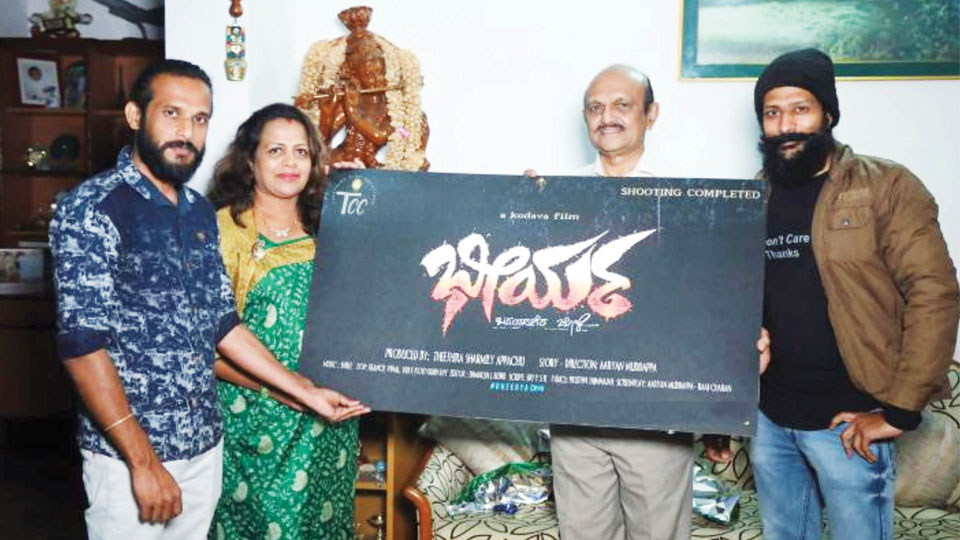
In a new trend to the release of movies, the title card of Kodava movie ‘Bheerya’ was released after the shooting, casting and editing works have been completed. The movie is ready to be released on the silver screen.
Makers of this particular movie had initially decided to keep the shooting and other works under wraps. Normally, before any movie is shot, the producers and directors would release the title with much fanfare and gain enough publicity in the media. Likewise, many such movies do not see the light of the day and many times they remain on paper.
However, ‘Bheerya’ Kodava movie makers decided to go against the flow and completed all the necessary works before launching the title in public. The title release was recently done by noted advocate and President of Bengaluru Kodava Samaja Mukkatira T. Nanaiah.
The film will be released in April. It has been produced under the banner ‘Thithira Cine Creations’ and has been directed by Balyamederira Aryan Muddappa. The film has been financed and produced by entrepreneur Thithira Sharmili Appachu.
The title ‘Bheerya’ comes with a tagline ‘Badalavanera Boli’ (the light of change) and signifies the martial race of Kodavas who are known for their valour in the war fields all over the world.
The Kodava community has contributed to the Armed Forces in a significant manner and it occupies a pride of place in India’s culture and ethos. The title signifies this spirit, said Sharmili.
Except for minor works including dubbing and other works, the entire process of movie-making has been completed and is ready for release in April, she added. The movie has senior and junior artistes and their names will be released in the due course.
Releasing the title, Nanaiah wished good luck for the movie team and said more and more Kodava movies must hit the screens and this is a way to safeguard and document the unique Kodava culture. Director Aryan Muddappa and Raj Charan of Udupi who played the role of villain in the movie were present.
source: http://www.starofmysore.com / Star of Mysore / Home> News / February 09th, 2022
The second-seeded Indians erased the first set deficit to win 6-7(10) 6-3 10-6 in one hour and 44 minutes.
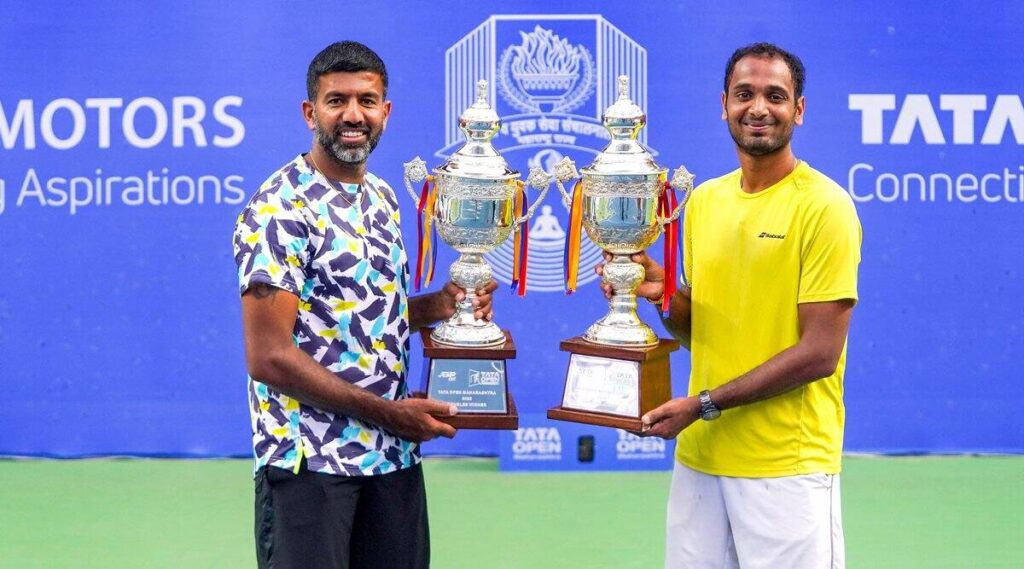
Pune: Indian duo Rohan Bopanna and Ramkumar Ramanathan pose with the trophy after defeating Australia’s Luke Saville and John-Patrick Smith to clinch the title at the Tata Open Maharashtra Tennis Tournament, at the Balewadi Stadium in Pune (source: PTI)
India’s Rohan Bopanna and Ramkumar Ramanathan won their second ATP World Tour title together after pipping the top seeded Australian pair of Luke Saville and John-Patrick Smith in the final of the Tata Open Maharashtra, on Sunday.
The second-seeded Indians erased the first set deficit to win 6-7(10) 6-3 10-6 in one hour and 44 minutes.
Bopanna and Ramkumar had combined as a team on the ATP Tour for the first time at the Adelaide event last month in the run-up to the Australian Open and won the trophy.
For Bopanna, it was his 21st ATP doubles title while for Ramkumar it is his second trophy at this level and it will push him inside doubles top-100 for the first time in his career.
They split USD 16370 as prize money and earned 250 ranking points each.
Bopanna had won this event with compatriot Divij Sharan in 2019.
Still going strong at an age of 41, Bopanna said it’s his years of playing experience that is helping him out in the circuit.
“A lot is to do with experience, which you really bring in, years and years of experience and the biggest thing is my body is feeling very very good at the moment,” Bopanna said after the match.
“I did a lot of yoga which has helped me tremendously and I am very thankful to my Yoga Teacher (Mohan) in Bangalore which has made such a difference for me and I can try something new at this age.
“It has made a difference and that really shows as long as I am playing matches, competing and doing something that is physically appealing. May be at the practice court I may not be giving my 100% but as long as I am feeling good and go out their and enjoying the pace as currently right now.”
Asked to compare the two titles that they have won together, Bopanna said performing before the home crowd was tough while in Adelaide no one watched them.
“Both are extremely special but anytime you win a title at home it’s lot more pressures. In Adelaide no one was really watching, but here there were lot more expectations and especially coming here with a win people expected an automatic win which wasn’t easy but at that tie break the crowd really helped.
“You just get that extra boost, that extra energy. Even if your legs are feeling tiered that’s the energy you need to hit the serve especially for me. Winning in India is always especial and especially with an Indian partner is truly truly great.
Ramkumar said he now wants to play ATP 500 event in Dubai and for that wil try to do well in the the upcoming two Challengers in Bengaluru.
“Let’s see if there is a chance to get in Dubai and hope I can play that,” said the 27-year-old.
Ramkumar said everyone believed in his game and that gave him confidence in this tournament.
“Coming from Bops (Bopanna) who always believes in me, my coaches and every one who have always believe in me and said you play well and that just keeps me going.
“I just have to work on a few thing on court and just keep competing at this level as much as I can which will improve my game and automatically the ranking,” he said.
Big serves marked the beginning of the contest with only Ramkumar and Luke losing a point each in the first four games.
Bopanna’s volley error on a return from Luke made it 30-all in the fifth game but Ramkumar pulled off an ace and followed that up with another huge serve to hold for a 3-2 lead.
The Indian team had got a chance to break Patrick-Smith’s serve in the next game when Luke made an error while attempting an overhead volley at 40-30 but the opportunity could not be utilised as the Australian pulled of a big serve on the deuce point.
The Australians also created break opportunity on Ramkumar’s serve in the ninth game when they found two service return winners and the Indian serving a doubler fault at 40-30 but the home team managed to hold.
A comfortable hold at love by Patrick-Smith made it 5-5.
Eventually a tie-break was required for deciding the first set. Both the teams had a number of set points as the Indians squandered two chances and the Australians three before converting their fourth.
They got the chance when Bopanna made an unforced error at 10-all and Ramkumar netted a forehand on set point.
In the second set, the Indian duo needed a good start and they got it by breaking Luke’s serve in the third game when the Australian made a volley error on deuce point.
Bopanna saved a break chance on his serve in the next game to keep their nose ahead. Patrick-Smith was serving to stay in the set in the ninth game and was broken to allow the Indian team force a Super Tie Breaker.
At 30-all, an engrossing rally ensued between the two pairs. Luke blinked to give Indian first set point which they converted when Bopanna dispatched a volley winner with ease.
Bopanna and Ramkumar dominated the STB to secure the title.
source: http://www.indianexpress.com / The Indian Express / Home> Sports> Tennis / by PTI / February 06th, 2022
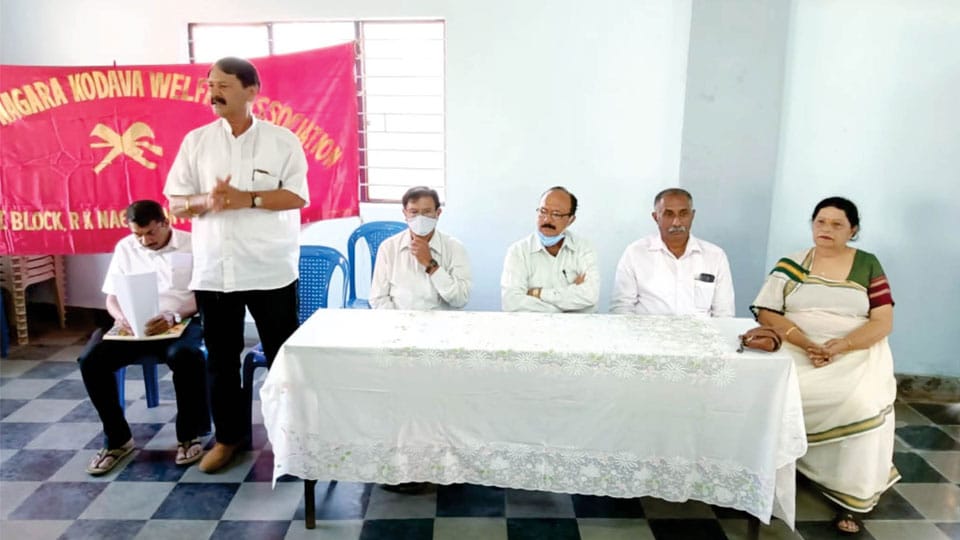
The Annual General Body Meeting (AGM)of Ramakrishnanagar I Block Kodava Welfare Association and adjoining residents was held on Jan.2 at Shree Ganapathy Temple in Ramakrishnanagar.
Association President Kattera A. Nanaiah presided.
On the occasion, Kenjangada Suchetha Cariappa – Gold Medal in M. Tech, Kadiyamada Nisha Cariappa – B.Sc. and Nayakanda Kishtij Cariappa -10th CBSE, were felicitated with cash prizes for securing highest marks.
Maletira Ganesh, Secretary, presented the annual report while the financial report for 2020-21 was presented by the Treasurer.
Kotrangada Manan Mandanna rendered the invocation. Poodrimada Somaiah, Vice-President, welcomed. Kenja-ngada Cariappa, Joint Secretary, proposed a vote of thanks. Kotrangada Shruthy Poonacha compered.
About 50 Kodava families of Ramakrishnanagar I Block and adjoining areas were present at the meeting.
The following are the new office-bearers of the Association for the next three-year term:
During my career, I have tried to learn broad-based skills rather than restrict myself to surgery alone, says Dr Kavery Nambisan
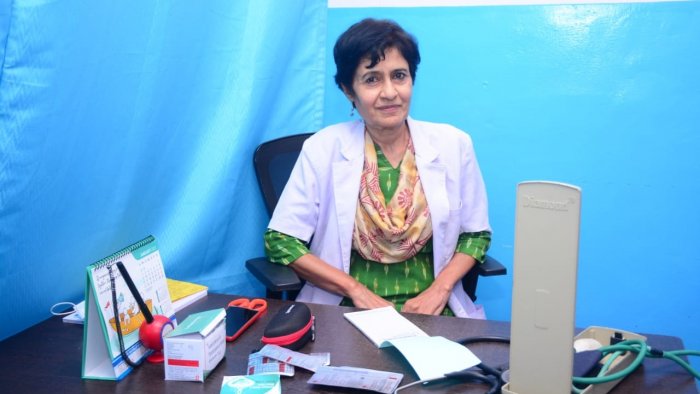
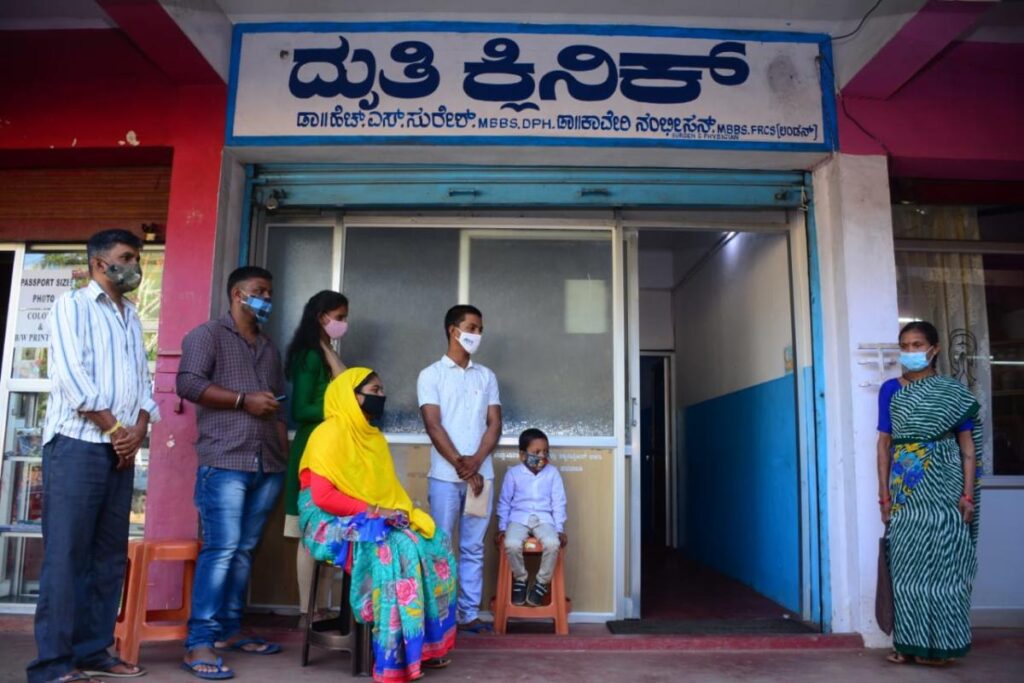
Dr Kavery Nambisan at her health clinic. Credit: DH Photo
I wound up my surgical career of 36 years in 2015 and all I wished for was to hang up my white coat and stay in the dream home that me and my husband Vijay were building in a village near Ponnampet in Kodagu, Karnataka. A house with a freshwater well, enough space for a garden, a few beautiful old trees; and a high-tiled roof that has leaked faithfully during the rains.
But secretly, secretly, I knew it was not finished. I found myself dreaming of operations (visualising them step by step), of hospital wards, a nurse’s shout, of stretchers screeching between my ears, the irascible phone bullying me out of bed.
Surgery is a bold and often risky venture. Risky because your work is a hair’s breadth away from life throbbing inside minute channels within flesh and bone; your fingers move in a disciplined trance and if you are a fraction of a millimetre off your target, you might nick life itself.
Patients line up outside her clinic. They mostly come in the morning hours from distance of up to 20 km
A month later there I was, with my rented room nestling between two barber shops. “Any professional doubts you might have, you can seek their advice,” teased Vijay as we drove back home. “Righto. When you come to me as a patient, I’ll borrow their instruments.”
Unobtrusively, I made the switch from the scalpel to the stethoscope. During my career, I have tried to learn broad-based skills rather than restrict myself to surgery alone. I worked in various departments of bigger hospitals and in teaching institutions. . It helped me enormously. As a general practitioner too, I am asked to attend to a wide variety of cases. I try to keep abreast of my medical knowledge by reading, and interacting with colleagues.
In cities, the medical profession is compartmentalised into specialities but in a small rural town, most people do not have the means to hop between doctors. My clinic is open in the morning hours only, so patients started to come home. They were the daily wage-earners who live near us and neighbours on ‘friendly visits’ who inveigle you into checking blood pressure or treating migraine or a skin rash. We partitioned off a portion of the veranda and I stocked up essential medicines and, injections, bandages and splints. Rural cordiality ensures that patients are willing to wait while I finish bathing, boiling the milk, burning chapatis or finishing a call. The telephone, especially the ‘mobile’ pins down the user in more ways than one. We doctors have it hard. “Dactre, are you at the aaspathre? No? My son has earache. I’ll bring him to your house right away.”
Some of the privileged classes are put off by the equalizer effect of my scruffy clinic. “You should discourage these labourers. They spread all sorts of diseases. And how can you trust them? They will observe everything, then come back and rob,” says a neighbour. Never mind that there has been no such incident in the village. The fish-seller stops by late in the evening. He has had no time to go home for a bath before coming to the clinic and is apologetic about the odours that waft in with him. A woman I am treating for her arthritic pains regularly requests me to ‘hide’ a few hundred rupees for her, safe from her husband. I think the man knows, or do I imagine the scowl on his face when he meets me?
Excitement is always round the corner. Patients come in with the warning signals of a ‘heart attack’, with epileptic seizures, dog bites and injuries following drunken brawls.
Between patients, I have time to reflect. I can help patients by treating them when they fall sick but the real need is to prevent them from falling sick. The irony is that my surgical career is almost all about cure and not prevention. You have a lump? I’ll cut it out. A blockage? I can unblock it. Broken bone? I’ll fix it. The results are immediate and patients, grateful. The great bulk of medical thought, medical progress and medical expenditure goes into curing patients after they fall sick. In comparison, a negligible amount is spent on prevention of disease. In medical colleges, the learning of Preventive Medicine (and Community Health) gets low priority and is somehow made to seem dull and uninspiring. It is a huge mistake.
The average citizen is led to believe that the entire responsibility for his malady rests with the doctor. Not so. It is important to understand how the body functions and to learn about your illness by asking the doctor. I like explaining to patients and those that listen find it far easier to overcome their illness because it encourages them to take charge of their own bodies.
The first step is for the patient to understand the why of his or her ailment and then the how of treatment. The main causative factors of illness are heredity; environment; diet; stress; and lack of physical activity. If every citizen is provided with clean surroundings, uncontaminated water, simple nutritious food and the amenities for physical exercise, and if mental wellbeing is ensured, many of us can live beyond a hundred years, in good health.
We live because of it, (and at times for it) but we cannot live without it: Food. Nearly half the world’s population survives on less than the required amount; the rest of us eat way too much. We worry about the waistline but care little about wastage. Sixty percent of the patients who visit my clinic are well on their way to weakened hearts, afflicted livers and the degeneration of other organs all brought on by ill-considered eating. Diseases that were once the privilege of the upper class now punish all of society. Awareness about healthy food reaches the educated first. A person moving from poverty to relative wealth goes for fried snacks, bakery goods and fizzy drinks.
The director of a company that produces a popular brand of biscuits said in an interview that Indian mothers are ‘aware’ of the health benefits of biscuits. They use it as the first solid food given to babies. The power of advertising! A young woman who works as a domestic help told me that she never cooks breakfast. Her family of four starts the day with tea and glucose biscuits. India will definitely need more dentists to take care of a generation with early dental caries. The media supplies misinformation in the form of advertisements tangled with facts. Unhealthy high-end pap is shamelessly lauded by celebrities who will not touch them. The more expensive the goods being sold, the more treacherously untrue the superlative qualities extolled.
Mental wellbeing is an ill-understood term. The mind must be able to function in a smooth and happy manner for the individual to get the best out of life. Emotional grace provides us with the ability to understand and act towards the collective betterment of people everywhere, without the prejudice of narrow divisive factors. Even in our (seemingly) tranquil rural setting where I work, stress is a constant factor. Nothing is more worrisome than hunger, homelessness, unemployment and a lack of dignity.
Many ailments are triggered or aggravated by the occupation one pursues (see box). Almost always, patients are surprised when you tell them such facts. Some of them make the effort to address the problem.
Lessons from the pandemic
The Covid pandemic taught me many things. The one fact that came back to me strongly during these two years is that the pandemic itself would not have happened if the world was more tuned to prevention of infectious disease.
An infection is when another living organism (bacteria, virus, or parasites) invades some part of the human body, multiplies and destroys the equilibrium. A simple example is when there is a cut injury to the skin which gets ‘infected’ and pours out pus; as also a common cold, where a virus enters the nose, throat and lungs, causing various respiratory symptoms like nasal congestion, throat pain, cough and fever. The defence mechanism of the body called the immune system tries to fight the invader by sending an army of white blood cells to the breached zone. If the body immunity manages to win, it stops the virus from multiplying. The cut injury heals fast, the cold is cured with ease. If immunity is weak, the virus gains easy entry through the skin and soft tissues or rampages through the throat and lungs causing serious problems.
The mechanism is no different in Covid patients. A person who has a strong immune system can fight the virus and thus avoid infection or get away with a mild attack. Those with weakened immunity, (diabetics, hypertensives and patients with kidney disease or malignancy) are more prone to serious disease.
With hindsight, it is easy enough to point out that the first ‘lockdown’ in March 2020 was botched because of the abrupt manner in which it was introduced. Our Prime Minister announced it a mere four hours earlier, giving no time whatsoever for those employed in various jobs and industries to make any plans for the fallow period that followed. (South Africa announced its lockdown four days early; Bangladesh gave a week’s notice before shutting down.) The plight of millions of our migrant workers suddenly rendered homeless and foodless, trudging back to their villages in inclement weather, their suffering and deaths cannot be forgotten. We had just one positive case of Covid infection in our district of nearly six lakh people. For several months afterwards, the lockdown was our problem. With no public transport, patients who suffered from chronic and acute ailments were unable to seek medical help.
Based on the experience of doctors in other parts of our country and abroad, I started using Ivermectin in early cases and referred only the more severe cases to the Madikeri hospital. I also used the drug as preventive medicine in a once-a-week dose for family members of infected persons and in all frontline workers in society, like the police, traffic inspectors, autorickshaw and taxi drivers, shopkeepers, vendors — all those who have to go out on work. It is best supplemented with immunity-enhancing vitamins and minerals — Vitamin C, Zinc and Vitamin D3, B complex and iron. I have been taking weekly Ivermectin through this entire period.
During the course of two years, the above method (along with simple antibiotics and cough medications) has been used in several European, Asian, African and South American countries. In Australia and the US, it is used by private practitioners but not advocated by the government. India has done a flip-flop, chiefly because of the confusing signals put out by the WHO. It is difficult to understand why the above simple measures to combat the virus have not been checked more vigorously; and why, when there are over sixty peer-reviewed trials that prove the efficacy of Ivermectin in humans, it is dismissed as “horse medicine”. WHO only needs to check its own statistical records which clearly states that over three billion doses of Ivermectin have been used worldwide since its discovery in 1976. If it were indeed ‘horse medicine’, how come we are not seeing serious side-effects or deaths due to its use?
In India, we have reputed doctors in cities and villages who have consistently used the drug to treat early Covid infections. Several state governments (UP, Odisha and Goa among them) have quietly added it to the medicine kits given to health care workers who treat quarantined Covid patients. The number of Indians treated so far would run into lakhs.
It is possible that with early and judicious use of Ivermectin, we could have avoided most of the hospital admissions, the use of antiviral drugs of doubtful efficacy, non-essential CT scans, oxygen dependence, ICU care and even death. It is puzzling and downright appalling that the WHO should continue to undermine its efficacy and safety, quoting a single hastily conducted clinical trial as the reason for its disbelief and ignoring all the other successful trials done the world over.
Effective vaccination for all, physical distancing and hygiene and early detection with treatment will curtail suffering and deaths. Our vaccination drive must pick up more speed and reach everyone. Many countries having vaccinated only a minuscule number of people, the danger of a prolonged Covid War which affects all countries might become a reality. We in India cannot afford to have another deadly surge. Malnutrition and undernutrition have increased by nearly 20% as compared to 2019.
The aftermath of the Covid years will shape the course of our nation and define the quality of life we leave for the younger generations. One can only hope that we will have learnt something from our failure. The most important lesson I have learnt is that the scales which are heavily tilted in favour of curative medicine must tilt in favour of preventive measures. And when a cure is necessary, we must try to opt for the most basic method or drug that will do the work.
I have used up a great deal of space to state a single, most obvious truth: Keep it simple.
(Kavery Nambisan is a surgeon and novelist. Her latest work ‘A Luxury Called Health’, published by Speaking Tiger, is now available online and on the stands. She can be reached at kavery.nambisan@gmail.com)
source: http://www.deccanherald.com / Deccan Herald / Home> Special Features / by Kavery Nambisan / January 29th, 2022
The contribution of the first Commander-in-Chief of the Indian Army was recalled with pride in the district
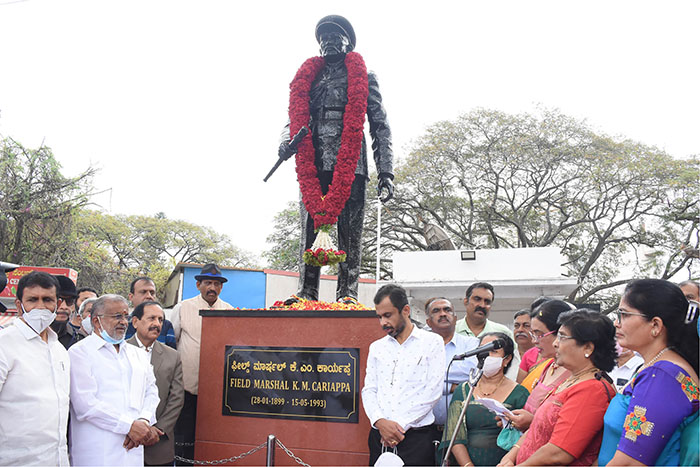
The Field Marshal KM Cariappa Circle in Madikeri (Photo | Express)
Madikeri :
The 123rd birth anniversary of Field Marshal KM Cariappa was observed with reverence across Kodagu on Friday. The contribution of the first Commander-in-Chief of the Indian Army was recalled with pride in the district.
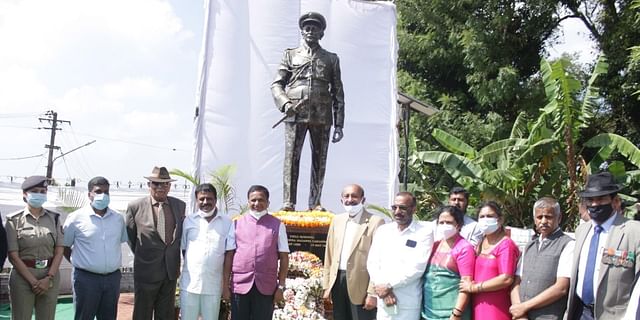
A floral tribute to the statue of FMKM Cariappa was offered at his namesake circle in Madikeri. Kodagu DC BC Sateesha, MLAs Appachu Ranjan and KG Bopaiah, former MLC MC Nanaiah, Retired Major Nanda Nanjappa and others were present during the ceremony.
A tribute to the leader was also offered at the family house of Roshanara in Madikeri. Gonikoppal Cauvery College students paid homage to FMKM Cariappa’s statue at the college premises.
Meanwhile, addressing the media after offering a floral tribute, FMKM Cariappa’s son Retired Air Marshal KC Cariappa said, “My father always taught me that my priorities are my duty to God, to my country and family. He taught me that the colour of blood that flows in my veins is the same irrespective of my religion. There is no difference in terms of caste, colour or religion in the Army. However, we are losing sight of this in India today. There are too many walls that are being created due to religious divide. I hope that we mature as a country and respect everyone’s religion and beliefs.”
source: http://www.newindianexpress.com / The New Indian Express / Home> States> Karnataka / by Express News Service / January 28th, 2022
Four Defence personnel from Kodagu have bagged Armed Forces awards on the occasion of Army Day 2022 and Republic Day 2022.
They are: Major Maletira Muthappa, who has been awarded Chief of Army Staff Commendation Card, Colonel Pandanda Bheemaiah, Sena Medal Bar – Awarded Mention-in-Dispatch, Commander Battianda K. Ponnappa (Indian Navy) – awarded NM (Distinguished Service) and Rear Admiral Iychettira Uthaiah Belliappa, VSM – awarded AVSM (Athi Vishisht Seva Medal).
source: http://www.starofmysore.com / Star of Mysore / Home> In Briefs / January 27th, 2022
Mysuru-Kodagu MP Pratap Simha said that unlike many other top Army Officers who preferred to lead their retired life in major cities, Field Marshal K.M. Cariappa chose to lead his retired life in his native Kodagu amidst nature’s splendour and beauty.
He was speaking at the 123rd birth anniversary celebrations of Field Marshal K.M. Cariappa, OBE, jointly organised by Kodava Samaja, Mysuru, Kodava Samaja Cultural and Sports Club, Mysuru and Field Marshal K.M. Cariappa Fans Club, at Field Marshal K.M. Cariappa Circle at the junction of JLB Road and Hunsur Road here this morning.
Pointing out that it was not easy for becoming the first Commander of the Indian Army post-Independence, Simha said that Field Marshal Cariappa, along with Gen. K.S. Thimayya should be credited for showing how a country’s borders can be secured by unitedly taking together all the soldiers.
Terming Field Marshal Cariappa as a true ‘Veeraputra’, he said that Cariappa was also a very able leader and brought many laurels for the country.
Chamundeshwari MLA G.T. Devegowda, in his address, said that today, the entire country is paying tributes to Field Marshal K.M. Cariappa. Recalling the contribution of Kodavas in defence sector, he said that it is the pride of the nation that Kodava is home to many war heroes.
Former Mayor H.N. Srikantaiah recalled how Metropole Circle was renamed as Field Marshal K.M. Cariappa Circle when he was the city Mayor in 1999 and the current Chamaraja MLA L. Nagendra a Corporator then.
Pointing out that as Mayor, he had put forward a proposal to the then Education Minister A.H. Vishwanath to rename the Circle as Field Marshal K.M. Cariappa Circle, to which Vishwanath readily agreed, he said that thereafter a resolution was passed at an MCC Council meeting to this effect, following which the Circle was officially named as Field Marshal K.M.Cariappa Circle. He further said that a statue of Cariappa was also proposed at the Circle when he was the Mayor.
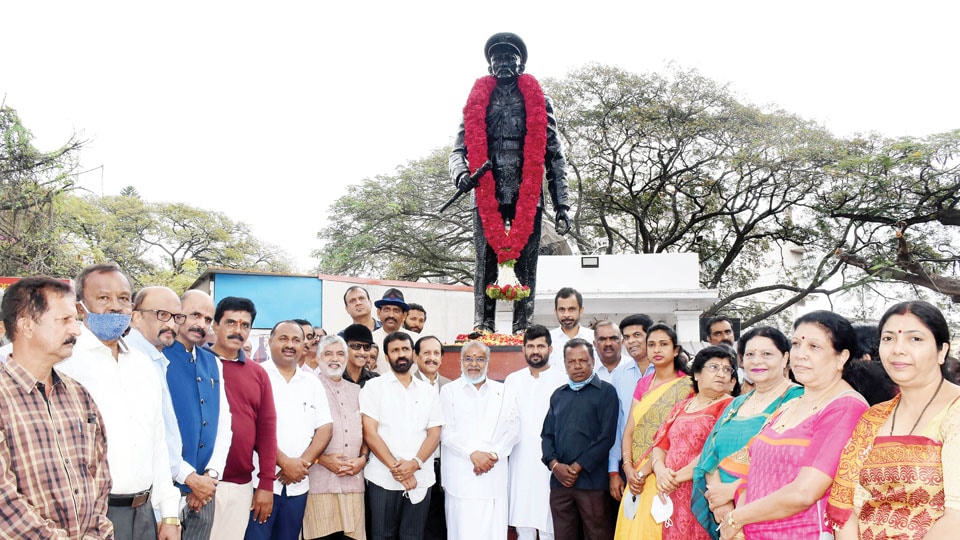
To mark the occasion, the statue of the Field Marshal was garlanded and offered floral tributes by the dignitaries
Former Mayor M.J. Ravikumar, Corporators M.U. Subbaiah and Pramila Bharath, Rangayana Director Addanda C. Cariappa, Mysuru Kodava Samaja President Mechanda M. Shashi Ponnappa, Vice-President Malachira M. Ponnappa, Hon. Secretary Mukkatira B. Jeevan, Joint Secretary Appanderanda Tara Somaiah, Treasurer Machimada P. Nanaiah, Kodava Samaja Cultural and Sports Club President Kuttimada D. Muthappa, Secretary Mechanda S. Bopanna, Field Marshal K.M. Cariappa Fans Club President Nayakanda M. Thimmaiah, Shri Kaveri Kodagu Mahila Sangha President Ponjanda Lovely Appaiah, former Mysuru Kodava Samaja Presidents Mechanda M. Karumbaiah, Poyyettira S. Ganapathy and Ballyamanda M. Nanaiah, Philanthropists Kuttimada D. Cariappa and Pudiyokkada Praveen Chengappa and others were present.
Some facts
1. Field Marshal K.M. Cariappa took over as the First Army Chief on Jan. 15, 1949, so Army Day is celebrated on this day.
2. Field Marshal K.M. Cariappa relinquished his appointment on Jan. 14, 1953, so the Veterans Day is celebrated on this day.
3. City-based VeKare Ex-Servicemen Trust (VKET) President Mandetira N. Subramani had urged the District Administration in August 2006, to install a life-size bronze statue of the Field Marshal at Metropole Circle.
source:http://www.starofmysore.com / Star of Mysore / Home> News / January 28th, 2022
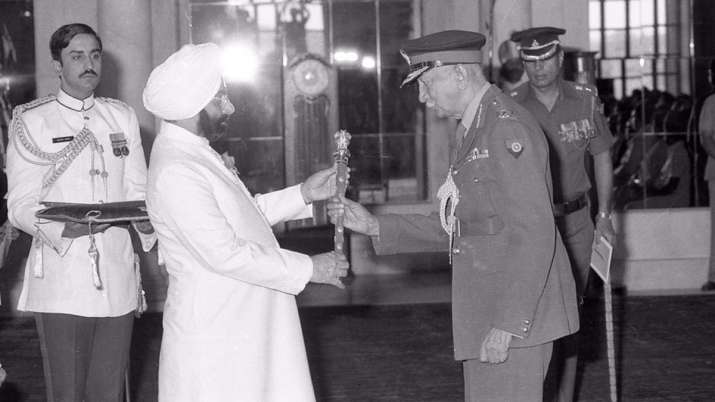
Field Marshal KM Cariappa is known as the man who took charge of the Indian Army from its last British Commander in Chief, General Sir Roy Bucher in 1949.
Image Source : TWITTER @RASHTRAPATIBHVN (FILE) /
HIGHLIGHTS
Cariappa was the first Indian Officer to be given command of a unit in 1942
He had led troops in the 1947 Indo-Pak war & successfully recaptured Zojila, Drass & Kargil
On January 15, 1949, Cariappa became the first Commander-in-Chief of the Indian Army
Army Day is celebrated on January 15 every year in recognition of Field Marshal KM Cariappa’s taking over as the first Commander-in-Chief of the Indian Army from Sir Francis Butcher, the last British Commander in 1949.
Who was KM Cariappa?
Field Marshal Sir Kodandera Kipper Madappa Cariappa is known as the man who took charge of the Indian Army from its last British Commander in Chief, General Sir Roy Bucher. Born on January 28, 1899, in Shanivarsanthe, Coorg Province (present day Kodagu district in Karnataka), Cariappa completed his education at Central High School at Madikeri and went on to study at the Presidency College in Madras. He was among the first Indians to be selected for military training.
Following his training in Indore, he joined the British Indian Army shortly after the end of World War I. Later, he was commissioned into the Carnatic Infantry. He became the first Indian Officer to be given command of a unit in 1942.
He had led his troops in World War II and the first Indo-Pak war of 1947. He successfully recaptured Zojila, Drass and Kargil and established a linkup with Leh.
He went on to receive many awards and accolades in his career spanning three decades. He received the prestigious order of the British Empire (OBE) for his role in Burma against the Japanese force during World War II.
Before taking over as the Commander-in-Chief of the Indian Army, Cariappa served as the commander of the Indian Army’s Eastern and Western Commands. He has also conferred the ‘Order of the Chief Commander of the Legion of Merit’ – the first-ever award of its kind given to an Indian General, by President Harry Truman (the 33rd President of the United States).
In 1947, he became the first Indian to be selected to undergo a training course at Imperial Defence College, Camberley, UK. On January 15, 1949, Cariappa became the first Commander-in-Chief of the Indian Army.
In 1983, he was given the title of Field Marshal (five stars). The only other person who has been conferred the title so far is Field Marshal Sam Manekshaw in 1973.
After retiring from the Indian Army, Field Marshal KM Cariappa served as High Commissioner to Australia and New Zealand till 1956. He died on May 5, 1993, at the age of 94.
source: http://www.indiatvnews.com / India TV / Home> English News> India / by India TV News Desk , New Delhi / January 15th, 2022
At 35, most players are either past their peak or face challenges to stay hungry. But that’s definitely not the case with Joshna Chinappa who continues to go stronger despite being on the international squash circuit for over two decades.
Joshna had an eventful start to the year as she returned to the top-10 in world rankings last week after a gap of over five years. “It’s obviously great to be back in the top-10. But the goal is to keep improving on it and go higher,” the world no. 10 told TOI. With the
Commonwealth Games in Birmingham and Hangzhou Asian Games scheduled later this year, Joshna is understandably keen to stay in the best possible shape.
“Both the CWG and Asian Games are important events. The key for me will be to pick and choose tournaments this year. You not only need those ranking points to maintain your ranking but must also stay fresh,” pointed out Joshna.
Joshna will be in action at the upcoming Cleveland Classic in the United States to be held from January 27 to 31. “I will be featuring in a few tournaments in the US to start off the new season,” Joshna stated. Joshna is seeded fourth in the tournament and has a bye in the first round. She is scheduled to take on the winner of Georgina Kennedy and Emilia Soini in Round 2.
Given her current form and fitness, Joshna plans to continue playing for the next two years. “The trick is to take it one tournament at a time and see how it goes. But yes, I do aim to be playing for a couple of more seasons,” she said.
Joshna, who majorly trains in Egypt and England, feels the Covid-19 pandemic has made most players mentally stronger. “It has affected everyone in the world. This phase has made me appreciate the simple things in life even more. Be it schedules or tournaments — everything has gone haywire in the last two years. One has to be prepared for events to be canceled at the 11th hour if anyone is infected. Not just physically, even mentally — players have to be prepared,” Joshna mentioned.
Has she planned on what she intends to do once she calls it quits? “I haven’t really thought about that. However, one thing is clear — it will involve helping kids take up the sport,” she said.
source: http://www.timesofindia.indiatimes.com / The Times of India / Home> News> Sports News> Others News / by Prasad RS / TNN / January 17th, 2022
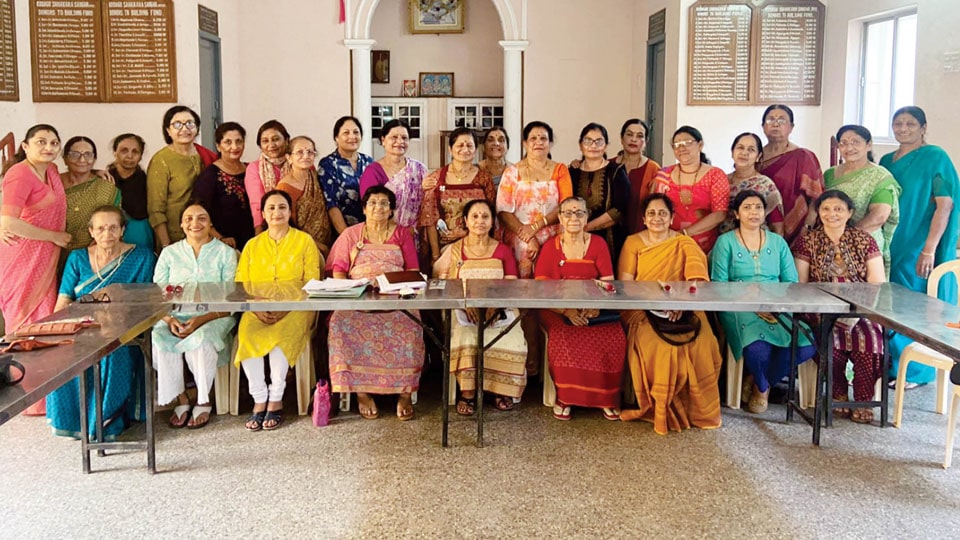
Ponjanda Lovely Appaiah was elected unopposed as the President of Shri Kaveri Kodagu Mahila Sangha, Mysuru, for the year 2021-2024 along with a new team of office-bearers.
Ponjanda Lovely Appaiah (sitting in centre) is seen with (sitting from left) Balladichanda Jerry Ponnappa – Adviser, Ajjikuttira Daina Poovaiah – Organising Secretary, Padeyanda Sumi Gopal – Joint Secretary, Chendanda Nirmala Subramani – Hon. Secretary, Kollira Bollamma (Shanthi) Kuttappa – Vice-President, Machimanda Geetha Karumbaiah -Treasurer, Ittira Jyothi Kashyappa – Joint Secretary, Thambanda Neena Devaiah – Organising Secretary; (standing) Dr. Sonia Mandappa – Medical Advisor, Mollera Kavitha Appanna – Internal Auditor and the new Committee Members; (Not in picture – Dr. Chendrimada Padmini Kaveriappa – Medical Advisor and Kaliyanda Renu Poonacha – Legal Advisor).
source: http://www.starofmysore.com / Star of Mysore / Home> Photo News / January 17th, 2022
WELCOME. If you like what you see "SUBSCRIBE via EMAIL" to receive FREE regular UPDATES.
Read More »