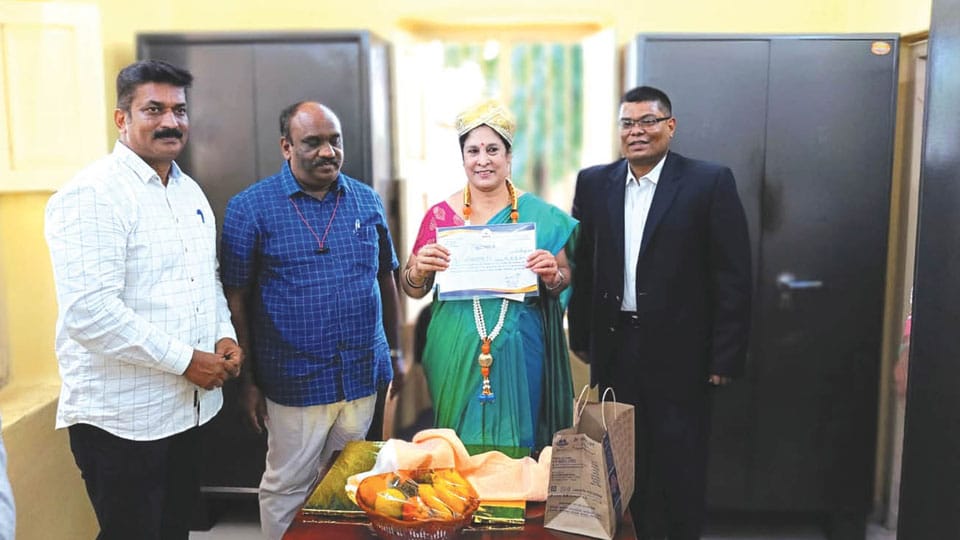
Public Prosecutor Kaliyanda Muthamma Poonacha was felicitated at her office in city yesterday by Mysuru Anti-Corruption Bureau (ACB) Superintendent of Police (SP) P. Arunamshugiri (extreme right) with a shawl, garland, Mysuru Peta and a certificate, for handling ACB cases extremely well.
ACB Dy.SPs Parashuramappa and Dharmendra are also seen.
source: http://www.starofmysore.com / Star of Mysore / Home> Photo News / August 31st, 2021
The portal has documented the lineage of some families up to 14 generations since the 16th century.
Kishore Uthappa
Madikeri :
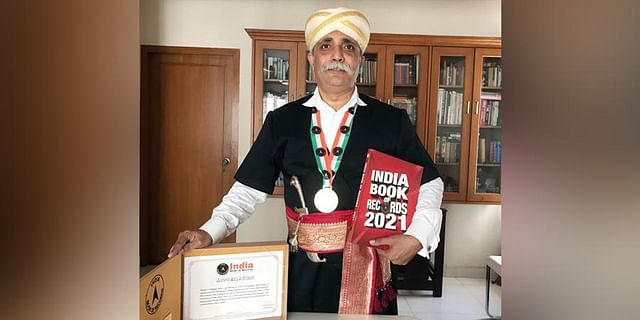
A Kodava clan portal, Kodagu Heritage Private Limited, has been named in the India Book of Records for the largest family tree linkage. Established by Kodagu native Kishore Uthappa, the portal was started nearly five years ago and has created family trees of nearly 16,000 Kodava individuals – the largest till date in the country.
“All Kodavas are related to each other and I wanted to create a larger single family of the clan. Collecting data from many elders of the clan and a few other individuals, I created the online portal that now has over 500 subscribers,” said Uthappa, who is now based in Bengaluru.
He added, “When any person from the clan meets for the first time, the first question posed to each other is ‘Which family (Kodava) are you from?’ We then try and connect relationships and end up finding out how each of us is related. This online portal helps derive that connection easily.”
The portal has documented the lineage of some families up to 14 generations since the 16th century. Any subscriber of the portal can enter the details of his/her family and find the relationship with other clan members. “One can even find how they are related to Field Marshal Cariappa or General Thimayya or any other known personality from the community. It helps find one’s relatives – irrespective of the generation one belongs to,” he shared.
Many youngsters from the community are joining the portal to study their lineage and it has currently documented the family tree of 15976 people. “We have documented at least one individual from the total 734 clans in the community,” he explained. The portal is still growing and aims to create the largest family tree with more than 5 lakh profiles in the near future.
source: http://www.newindianexpress.com / The New Indian Express / Home> Good News / by Prajna GR, Express News Service / August 26th, 2021
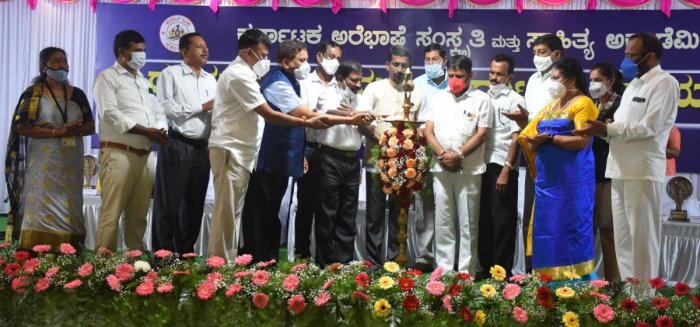
Minister S Angara inaugurates the decennial celebrations of Karnataka Arebhashe Culture and Literature Academy in Madikeri on Friday.
Bopaiah said that Arebhashe and Kodava academies will get their own offices which are being constructed at Samskritika Bhavana in Madikeri.
Every language has its own history and cultural significance. Therefore, every language should be treated with respect, opined Virajpet MLA K G Bopaiah.
He was speaking during the inauguration of the decennial celebrations of Karnataka Arebhashe Culture and Literature Academy, held at Kodagu Gowda Samaja, in Madikeri on Friday.
Arebhashe speaking people are concentrated in Kodagu and Dakshina Kannada districts, he added.
Bopaiah said that Arebhashe and Kodava academies will get their own offices which are being constructed at Samskritika Bhavana in Madikeri.
Efforts to establish Arebhase Academy were first made by the BJP-led state government in 2008. Later, the academy officially came into being during the chief ministerial tenure of D V Sadananda Gowda in 2011, he said.
Fisheries, Port and Inland Water Transport Minister S Angara said that the emotion behind all the languages is the same. There is no use in criticizing each others’ languages.
Instead of getting identifying oneself with a particular caste, one should associate with the language and achievement. People should ignore petty political games, he added.
Madikeri MLA M P Appachu Ranjan felt there is a need to preserve the language and culture of smaller communities.
He also lauded the works done by the Arebhashe Academy.
Arebhashe Culture and Literature Academy chairman Lakshminarayana Kajegadde said that efforts are on to obtain ISI code for Arebhase. The academy has been organising various programmes including workshops.
Indian Women’s Hockey team assistant coach Ankitha Suresh was felicitated on the occasion.
MLC Sunil Subramani M P, Arebhashe Academy former chairman Kolyada Girish, Kodagu Gowda Samaja federation president Surthale R Somanna, Academy members Baithadka Janaki Bellyappa, Smitha Amrith Raj, Dhananjay Agolikaje, Dr Koodakandi Dayanand and academy registrar Chinnaswamy were present.
A documentary directed by H R Anil was released on the occasion.
Musical instruments were provided to the beneficiaries.
The official website of Arebhashe was also launched on the occasion.
source: http://www.deccanherald.com / Deccan Herald / Home> State> Mangaluru / by DHNS, Madikeri / August 27th, 2021
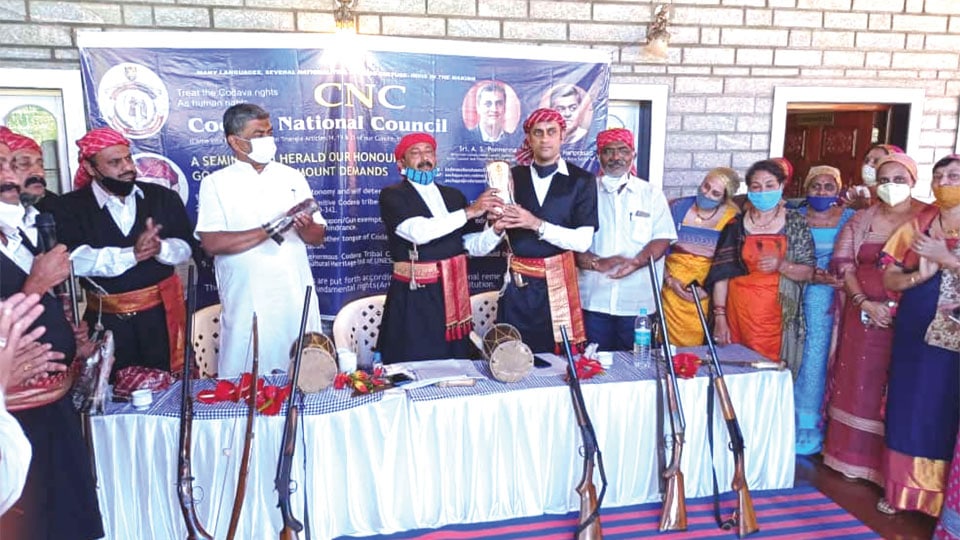
Senior Congress leader B.K. Hariprasad speaks at CNC seminar
Madikeri:
Kodavas have been agitating for over two decades seeking the grant of their Constitutionally-guaranteed rights and only these rights and privileges can guarantee the survival of this rare community, opined MLC and senior Congress leader B.K. Hariprasad.
He was addressing a seminar on Kodava rights, demands and aspirations. The event was organised by Codava National Council (CNC) at a private resort in Murnad recently.
“Kodava community must get special recognition under Article 371 (k). The community deserves recognition in the Scheduled Tribe list as their lifestyle, custom, traditions, practices and festivals reflect the tribal spirit,” he noted.
CNC’s demand and claim for geo-political Autonomy is most legitimate, logical, feasible and deserving in all sense among any other demands, he opined. The Kodava tribe which is facing the threat of extinction should be enlisted under Scheduled Tribes of the Indian Constitution. “The Government should take measures to protect the tradition of Kodavas. Provision of ST tag is necessary in this regard,” he added.
On this occasion, ‘Codava Rathna’ award was conferred on Hariprasad and eminent jurist A.S. Ponnanna. The main purpose of this award is to recognise and respect those who go out of their way even risking their well-established career for the cause of the Kodava community.
Hariprasad had raised the community’s aspirations in the Parliament and in the Legislative Council. Also, he moved a “Private Member Constitution Amendment Bill 2016” to include Kodava language in the 8th schedule of the Constitution. He advocated the grant of ST tag to Kodavas and also argued that the gun licence exemption should be continued to Kodavas forever and should not be restricted to 10 years.
According to CNC President N.U. Nachappa, certain resolutions were passed at the seminar to safeguard the genus of Kodava tribe and its civilisation. The community fulfils the definition of indigenous people promulgated by the United Nations through various declarations and steps must be taken in this regard to protect it.
“By trait, Kodavas are tribals and by our miniscule size of population, we are a minority in all senses. That is tribal, racial, ethnic, linguistic and national minority. We have every criteria and right to claim for empowerment defined for various indigenous tribes, minority groups and ethno linguistic nationals enshrined in the UN Charter,” he added.
“We are indigenous primitive tribe and it is our fundamental human right and freedom to exercise internal political self-determination right and to have geo-political autonomy in our own defined, indivisible traditional homeland,” he demanded. High Court advocate Lakkavalli Manjunath, Political Science lecturer Dr. P.E. Somaiah and others were present.
source: http://www.starofmysore.com / Star of Mysore / Home> News / August 22nd, 2021
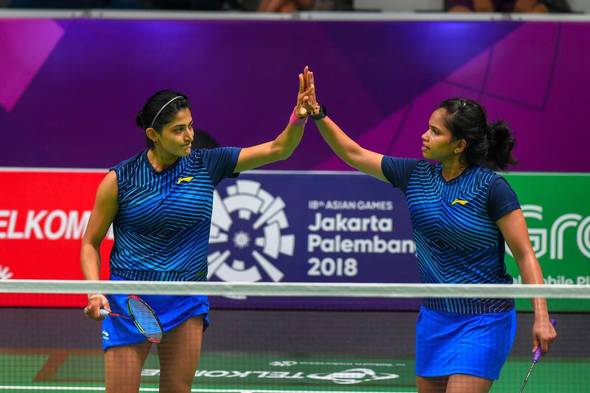
The Indian pair lost in three games to the home duo of Amalie Magelund and Freja Ravn of Denmark.
In a match lasting just under an hour, the top-seeded home duo came from behind to beat the Indian pair in three games.(File Photo)
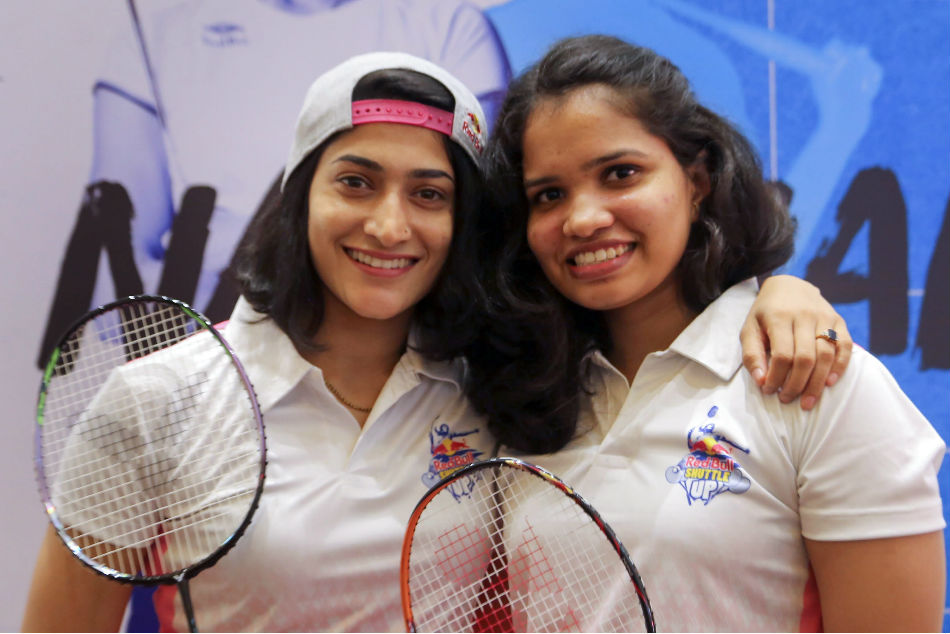
The Indian women’s doubles pair of Ashwini Ponnappa and N. Sikki Reddy finished runners-up at the Denmark Masters after going down narrowly against top seeds Amalie Magelund and Freja Ravn of Denmark in the final.
The duo, seeded second, squandered an opening game advantage to lose 21-15, 19-21, 14-21 to the Danish combination in just under an hour’s contest.
Among other Indians, Lakshya Sen had lost in the semifinals to France’s Christo Popov, while his brother Chirag Sen and Subhankar Dey, seeded fourth, bowed out at the quarterfinal stage.
In women’s singles, Aakarshi Kashyap was the most impressive but lost the semifinal to fourth seed Dane Julie Dawall Jakobsen.
source: http://www.sportstar.thehindu.com / Sportstar / Home> Badminton / by PTI / August 09th, 2021
Even though the number of the Coorgies in the regiments is coming down, the regiment still holds on to the traditions of the community and takes pride the representing the decedents of river Cauvery on the battlefield.
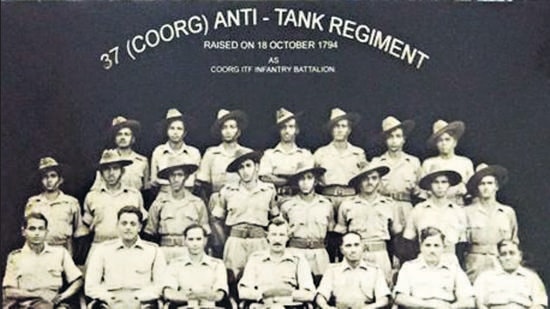
In 1946, it was converted to the 37 Coorg Anti-Tank Regiment Unit of the Royal Indian Artillery. It is now a part of the modern Indian regiment of artillery and wears the uniform of the artillery. (HT Photo)
The young officers’ the course is mandatory for all new lieutenants joining the Indian Army, but for a group of handpicked officers belonging to the 37 Coorg Regiment of the army’s artillery arm, the four-week course traditionally gets extended by two more weeks with a visit to Madikeri, a hilly town in Karnataka.
These young officers spend time in the hills learning about the origins of their regiment and the tales of legends like Field Marshal KM Cariappa and General KS Thimayya, who emerged from these very hills.
Even though contested in the modern age, the Indian army’s regiments are formed and named after the communities of the soldiers recruited into these units.
The martial race was a designation that was created by army officials in British India after the Indian Rebellion of 1857, in which they classified castes into two categories, with the ‘martial race’ being typically brave and well-built for fighting. Even now, the Indian Army designates its regiments as Sikh Light Infantry, Gorkha Rifles, Madras Regiment, Rajputana Rifles, and so on.
Even though not familiar within Karnataka, the Kodavas or the Coorgies is considered a marital race and have a regiment named after them – the 37 Coorg Regiment. This is the only regiment for the Kodavas.
The unit traces its origins back to 1794 when it was raised by the British to counter Tipu Sultan’s attack against the Kodava kingdom. Initially raised as infantry, the unit went on to fight against Tipu in the fourth Mysore war, where he was eventually killed.
Until 1901, the regiment was designated as the 11th Madras Infantry and in 1902, the regiment was reorganised, and the basis of recruitment changed from Tamil and Telugu to only Coorg soldiers. The restructured regiment was then renamed the 71st Coorg Rifles in 1903.
The new regiment was given dark green uniforms with scarlet facings. Red fezzes, which were an unusual item of uniform in the Indian Army, are reported to have been worn by the sepoys. Subsequently, described as an ‘in-out-of-the-run’ unit, they were disbanded in 1904 because of insufficient recruits.
In 1942, Coorgs were again recruited into the newly raised 1st Coorg Battalion. Like the 71st Coorg Rifles, the new battalion had a badge incorporating crossed Coorg knives. In 1946, it was converted to the 37 Coorg Anti-Tank Regiment Unit of the Royal Indian Artillery. It is now a part of the modern Indian regiment of artillery and wears the uniform of the artillery.
The regiment’s attachment to the land it represents is such that their war cry is “Cauvery.
Mata ki Jai” (Hail mother Cauvery) since river Cauvery is an integral part of the Kodava culture.
Subedar Major (Retd) KC Kalappa, a retired gunner from the regiment said that it was a matter of pride for the Kodava community to have a regiment in their name, but over the years, the number of recruits from the community is reducing. “In the early 1970s, the regiment had people only from the Kodava community and the community took pride in it. But over the years, the number of recruits is coming down and now the unit consists of soldiers from all four south Indian states,” said Kalappa.
Even though the regiment has recruited from all south Indian states, the regiment maintains the tradition of the Kodava community. For example, on the regiment’s raising day, the officers, and non-commissioned officers, regardless of their ethnicity, wear the traditional ‘Kupya Chale’,which consists of a traditional jacket and headgear. The officers wear Pichangatti (a traditional knife), and instead of handing baton, when a new commanding officer takes over, a Pichangatti is handed over as a sign of change in command.
“I’m a Punjabi but I was the commanding officer of the Coorg regiment for three years and whenever I visit Kodagu, I feel like a Coorgi because of the traditions of the regiment. The house of the commanding the officer is called a Mercara house, named after the Mercara town in the Coorg,” said Major General Sanjay Sharma (retd).
According to Maj Gen Sharma, the unit is so closely affiliated with the Kodagu community that it is a tradition for the unit to take part in the annual hockey tournament in Kodagu. “For the Kodavas, the annual hockey tournament is very important it is part of their culture. In this tournament, various families of Kodagu compete against each other. So, for the past few years, the regiment gives an award for the first goal scored in the tournament and it is a matter of pride for the people because the regiment named after their community is taking an interest,” he said.
Over the years, however, the composition of the unit has changed. According to Maj Gen Sharma, currently, the number of Kodavas is only about 15-20% in the unit, and three other south Indian states fill other vacancies. “Over the years, the number of recruits has come down. But all men of the regiment, whichever state they are from, celebrates all Kodava festivals and call themselves Coorgs with pride,” he said.
Describing the 37 Coorg Medium Regiment as a matter of ‘pride for Karnataka’, ex-Sergeant of the Indian Air Force Mandetira Subramani and the president of VeKare Ex-Servicemen’s Trust (VKET), has emphasised the need to post a few more willing young officers, junior commissioned officers (JCOs) and jawans from the community to the regiment and make it more meaningful. “We are trying to promote the heritage of the unit among the youngsters and trying to get more people to join the regiment and continue the legacy,” said Subramani.
Even though the number of the Coorgies in the regiments is coming down, the regiment still holds on to the traditions of the community and takes pride the representing the decedents of river Cauvery on the battlefield.
source: http://www.hindustantimes.com / Hindustan Times / Home> Explore> India News / by Arun Dev, Bengaluru / August 22nd, 2021
Air Marshal K.C. Cariappa, Param Vishisht Seva Medal, Vayu Sena Medal (retd.), was the chief guest at the 75th I-Day celebrations at Sainik School in Kodagu.
The chief guest and officers laid the wreath and paid homage to war heroes at the War Memorial of the School. After unfurling the Tricolor at Thimmaiah Parade Ground, the chief guest witnessed a cultural programme at Kuvempu Multipurpose Hall.
Patriotic songs, a dance displaying diverse Indian culture, a video titled ‘Awakening Dream’, which intended to imbibe sense of patriotism and integrity was screened during the programme.
The day scholar cadets performed a skit ‘Carri Came Back’. It portrayed Air Marshal K.C. Cariappa’s relentless efforts in the 1965 war.
The chief guest presented the Principal’s Commendation Certificate to B.A. Rajgolkar, TGT (English), H.M. Kavya, Lab Asst., Zakir Hussain, Shivaprasad and S.S. Ramachandra, general employees, for their yeomen service rendered to the school.
To mark the I-Day, an online group discussion competition was conducted on the topic ‘Progress of India by 2047.’
Harishna, Research Scholar, University of Kerala and N.V. Ashokan, TGT (English), coordinated the programme.
Col. G. Kannan, Principal, Lt. Col. Seema Tripathi, Vice-Principal, Sqn. Ldr. R.K. Dey, Administrative Officer, academic and administrative staff were present on the occasion.
source: http://www.starofmysore.com / Star of Mysore / Home> Photo News / August 19th, 2021
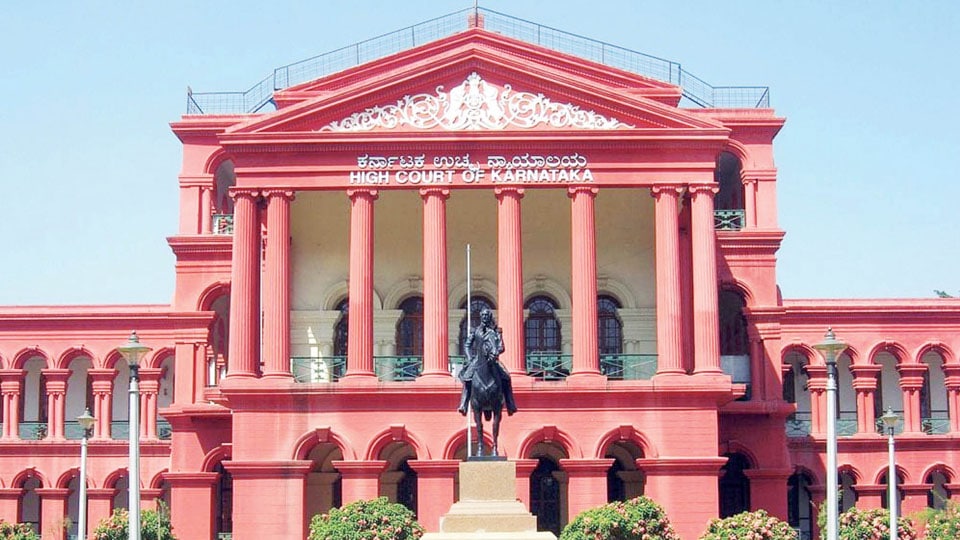
Federation of Kodava Samajas, Balugodu, Kodava Samaja Bengaluru (KSB), Codava National Council (CNC) and United Kodava Organisation (UKO) filed an Interlocutory Application (IA) urging the Karnataka High Court to consider them as respondents in the Public Interest Litigation (PIL) filed with regard to gun licence exemption to Kodavas.
The PIL has been filed by Captain (Rtd.) Yaladalu K. Chethan, who has questioned the 2019 notification of granting exemption to Kodavas in Kodagu district from the requirement to obtain a licence to carry and possess firearms as required under provisions of the Indian Arms Act, 1959.
The PIL came before the High Court yesterday and was heard by the Division Bench of Justice Satish Chandra Sharma and Justice Sachin Shankar Magadum, who have directed the inclusion of Federation of Kodava Samajas, KSB, CNC and UKO as respondents in the PIL.
While Additional Solicitor General Naragund appeared for the Central Government, senior advocate and former Additional Advocate General of Karnataka A.S. Ponnanna appeared for CNC and the Federation. Senior advocate Sajan Poovayya appeared for KSB and UKO was represented by Praveen Reddy.
The Division Bench asked the respondents and the Centre to file their objections and views in writing within two weeks and posted the PIL hearing to Aug. 31.
Petitioner Chethan, son of Yaladalu D. Keshavananda of Galibeedu village in Kodagu, has questioned the Constitutional validity of the notification issued by the Ministry of Home Affairs extending the exemption for “every person of Coorg race and every Jamma tenure land holder in Coorg” from gun licence till October 31, 2029.
“The classification and use of term ‘Coorg race’ promotes discrimination between the citizens of Coorg region on the ground of caste, violating Article 15 of the Constitution. The classification of ‘Coorg race’ itself is derogatory and possesses a threat to the life and liberty as the people exempted are permitted to hold arms and ammunition without any scrutiny of their antecedents or criminal records,” the PIL said.
source: http://www.starofmysore.com / Star of Mysore / Home> News / August 12th, 2021
File picture of Niki Poonacha. – KAMESH SRINIVASAN
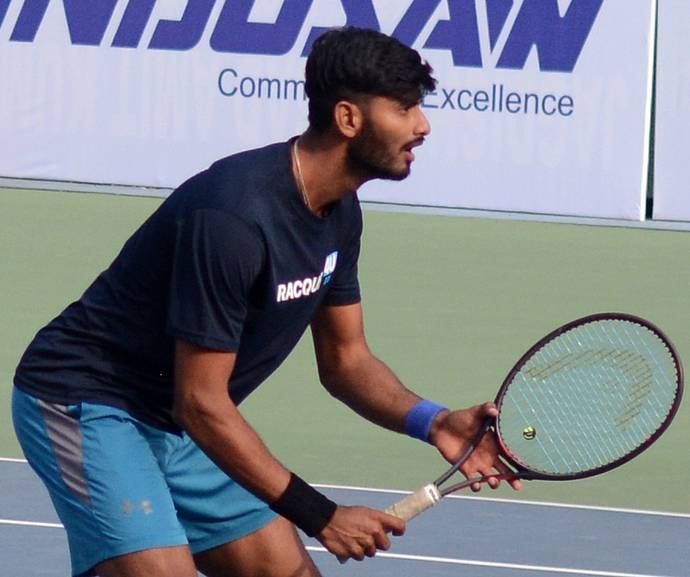
Former National champion Niki Poonachais finding time for a social cause amidst his tennis training.
The 26-year-old Niki, who had won the last ITF men’s tournament here in April, is helping in the organisation of a men’s ranking tournament in Chennai in collaboration with Rotaract Club of Madras and the Tennishub.
“The tournament will be held at the PowerPak Tennis Academy in Tharamani from September 2 to 5. The winner and runner-up will get ₹10,000 and ₹5,000 apart from goodies from tennishub,” said Niki. “All the funds raised from the event will be donated to Mahaishwar School for mentally challenged.”
Niki has been training well for the international circuit. “I am looking forward to competing in Tunisia and Egypt soon,” said Niki who trains at the Rohan Bopanna Academy in Bengaluru.
India women’s doubles pair of Ashwini Ponnappa and N Sikki Reddy finished runners-up at the Denmark Masters after going down narrowly against top seeds Amalie Magelund and Freja Ravn of Denmark in the final here.
The Indian pair, seeded second, squandered an opening game advantage to lose 21-15 19-21 14-21 to the Danish combination in just under an hour’s contest.
Among other Indians, Lakshya Sen had lost in the semi-finals to France’s Christo Popov, while his brother Chirag Sen and Subhankar Dey, seeded fourth, bowed out at the quarter-final stages.
In women’s singles, Aakarshi Kashyap was the most impressive but lost the semi-final to fourth seed Dane Julie Dawall Jakobsen.
source:http://www.mykhel.com / myKhel / Home> Badminton> News / by Unnikrishnan G / August 09th, 2021
WELCOME. If you like what you see "SUBSCRIBE via EMAIL" to receive FREE regular UPDATES.
Read More »