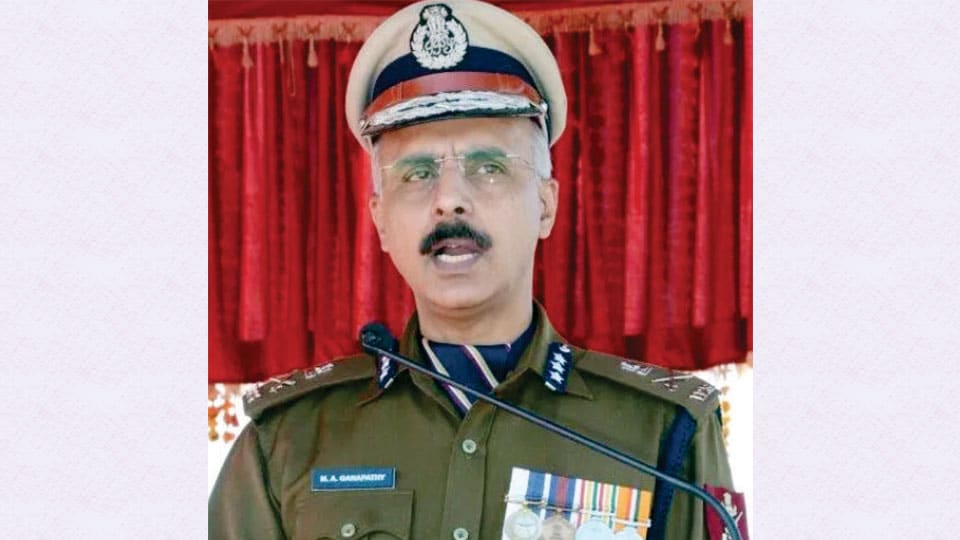
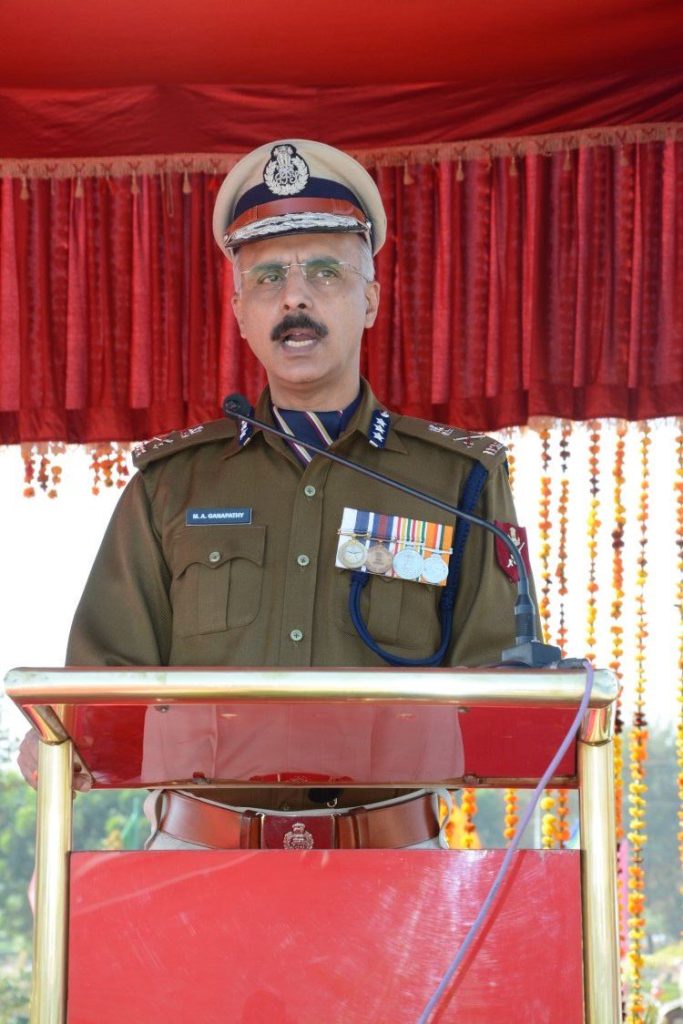
Kodagu-born Maneyapanda Appaiah Ganapathy, IPS, has been appointed as the Director General (DG) of the Bureau of Civil Aviation Security (BCAS).
The 1986 batch, Uttarakhand cadre IPS Officer, is currently CISF Special Director-General and Head of the Airport sector.
PM Modi-headed Appointments Committee of Cabinet recently approved the Aviation Ministry’s proposal to appoint Ganapathy as DG BCAS till his superannuation on Feb. 29, 2024, or until further orders, whichever earlier.
Ganapathy has been awarded the President’s Medal for meritorious service and he was later decorated with the President’s Medal for distinguished service.
He completed his primary and secondary education at Ponnampet in Kodagu and graduated from the Madras Christian College, Tambaram. He studied his Post-Graduation at JNU New Delhi.
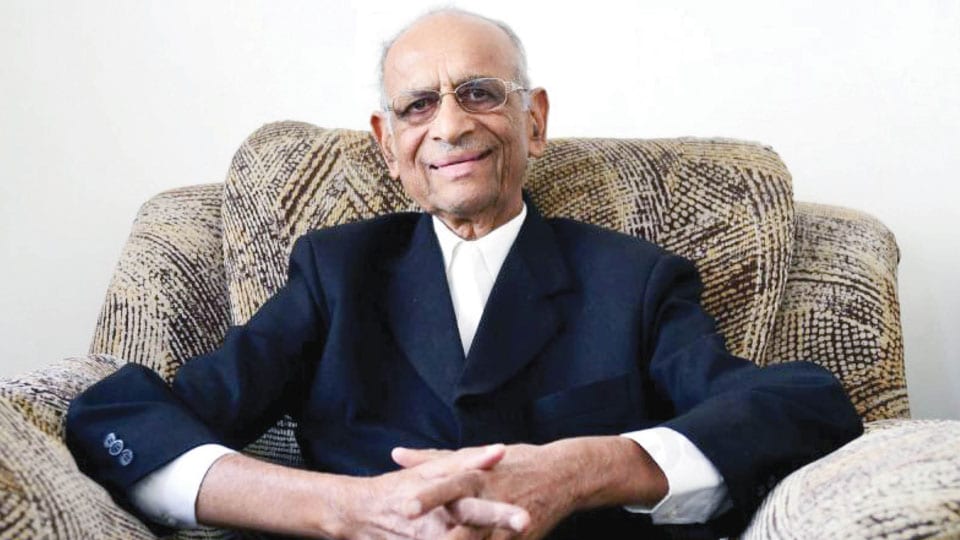
He is the son of Maneyapanda Appaiah (Vittala lawyer) and Premalatha, retired teacher, of Kunda in Virajpet taluk. Ganapathy is married to Sandhya and they have a son.
“Given his experience as heading Aviation security sector of CISF, Ganapathy is the right person for the position of DG BCAS,” said a senior official.
The post of DG fell vacant after Rakesh Asthana, a Gujarat cadre 1984 batch IPS Officer, was appointed as the DG, Border Security Force (BSF) in August this year. Asthana is also holding additional charge of DG, Narcotics Control Bureau (NCB).
source: http://www.starofmysore.com / Star of Mysore / Home> News / October 15th, 2020
I first heard of and saw A.K. Subbaiah when I was in the first year BA at Madikeri First Grade College (Kodagu). I was staying in the upper hostel close to the College and I guess he too was in the hostel doing his BSc. He was a senior student in age compared to others like me. He had come to the College after quitting his job as a Second Division clerk in the Department (Health) where he served for a few years. We students learnt that he had lost his father, when he was an infant, due to a fall from a tree and despite hardship he pursued education.
In the year 1958-59 (I think) there was a student strike demanding proper water supply, good quality food in the hostel, against corruption etc., etc. In retrospect, I realise the demands were frivolous and a lame excuse to go on a strike to embarrass the Principal for whatever reason.
The leadership of this strike and a protest march from the College to the Police Parade ground nearby was not individually identified. However, a few vocal students, displaying bravado, like me, to impress the fellow students, including girl students, got the students on to the road, holding a couple of National Flags and shouting slogans. The march began. When the Police came on the scene one student got panicky and was shouting, “I can’t hold this flag.” I, in my enthusiasm, took that flag and marched on hoping I would get a chance to speak. After all, I had just lost the College election. It was for the first time I learnt of election rigging!
Be that as it may, about 150 students gathered at the Police ground and one NCC Under-Officer began to speak. I think M.C. Nanaiah, a very good student-speaker of Communist orientation, then began to speak — in the same way he does even today — without giving us a road-map. It was then some vocal students were raring to speak, but from nowhere A.K. Subbaiah, a tall-lanky man appeared and began to speak like a sudden, lashing of summer rains. There was sound, there was force and there was flow. We were held spell-bound. He himself declared that no need for any speech, not even vote of thanks and ‘ordered’ the gathering to disperse. A motley crowd simply obeyed and our ‘great college strike’ ended for good.
It was only later, some of us were rusticated from the hostel, including me, and some removed from the College, among them were A.K. Subbaiah and a couple of my friends. I went to Bengaluru after passing BA in Madikeri while A.K. Subbaiah came to Sarada Vilas College, Mysore, where after BSc he did his Law. I came to know that he was practicing Law in Virajpet, Kodagu and also joined politics, first I think Socialist Party and then Jan Sangh. He was a successful lawyer on the criminal side and was making a name.
It must be at this time he got married from a good family, his father-in-law also famous as Chiyakpoovanda Bheemaiah lawyer (whom I knew later) who worked in UN, New York for some years. Thereon, as I know, A.K. Subbaiah joined Jan Sangh. Being a tall and very fluent, powerful public speaker he soon got elected to the Karnataka Legislative Council (1966). He had played a major role in influencing local Kodavas and other Hindus as supporters of RSS and Jan Sangh. I used to hear about his progress, so also of another Kodava politician M.C. Nanaiah, another powerful speaker both in English, Kannada and Kodava, whenever I came to Mysore to visit my parents and brothers from Mumbai and Pune.
A.K. Subbaiah came from a rich family in Kodagu known as Ajjikuttira though he himself was poor. It was like saying ‘India is a rich country where poor people live.’ The Ajjikuttira family in South Kodagu was also into politics and some like Chinnappa played a role in freedom movement. A.N. Somaiah was an MLC (Janata Party) and now we have his one son A.S. Bopanna as the Supreme Court Judge. There was also a Minister from that family in the Karnataka Ministry. But among all these famous people from the family it was only A.K. Subbaiah who made big news and was known all over Karnataka and political circles. No wonder News Media described him as ‘Suddimaduva Subbaiah’ (Subbaiah, the news-maker). And indeed he was that.
Dr. S.V. Narasimhan, a family physician based at Virajpet in Kodagu district, is an avid birder, nature lover, adept at computers, Karnatak music and astronomy.
Author of Feathered Jewels of Coorg, a field-guide to 310 species of birds found in Coorg, Dr. Narasimhan is the pioneer in spreading wildlife conservation messages through his unique hand-painted Wildlife Message Cards that are sent free to individuals throughout the world to mark the Wildlife Week.
Total number of hand-painted cards made by him this year is 1,930; in 36 years, 72,655 cards. Total recipients this year including Star of Mysore – 1,010; in 36 years – 13,004 persons.
The Special Wildlife Messenger of this year is Red-whiskered Bulbul (Pycnonotus jocosus) — This is the most common garden bird of India. It has a black chest that is turned forwards and has bright red patches on the cheeks and vent. Melodiously vocal, it feeds on fruits, nectar and small insects.
Bulbuls are mostly monogamous. They build an open cup-shaped nest made of rootlets and leaves lined with soft fibre. They live for about 10-11 years.
source: http://www.starofmysore.com / Star of Mysore / Home> News / October 20th, 2020
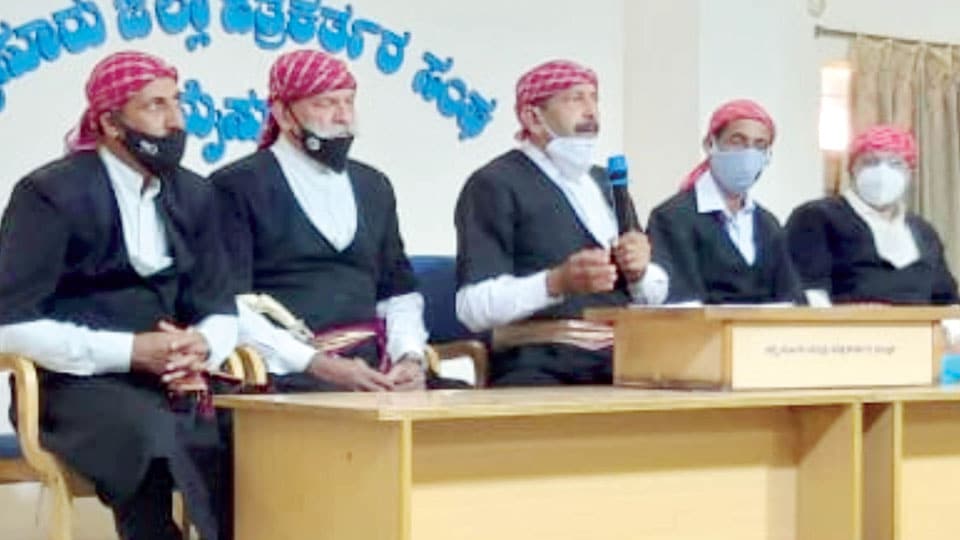
The Codava National Council(CNC) has urged the Government to include Codava tribe in the list of Scheduled Tribes (ST) of the Indian Constitution.
Addressing a press meet at Patrakarthara Bhavan here this morning, CNC President N.U. Nachappa maintained that ST tag for Codava tribe and Geo-political autonomy are synonymous for Codavas. Urging the Government to declare Codava tribe as a primitive tribe, he said that Codava tribalism must be measured through the ‘Emic approach’, an ethnographic study of Codava tribe.
Pointing out that one of the seven fundamental rights enshrined in our Constitution clearly upholds Constitutional remedy for the aspirations of the people, Nachappa argued that the Union and Karnataka Governments should concede Codava aspirations of ST tag as a Constitutional remedy.
Noting that as a result of CNC’s relentless efforts and innumerable petitions to the Union Government, the Central Government directed the State Government to conduct an ethnographic study on Codava tribalism, he said that subsequently, the Karnataka Government entrusted this responsibility to Mysuru based Karnataka State Tribal Research Institute (KSTRI).
Stating that Codava tribe has its own extraordinary tribal characteristics, he maintained that ST tag is a must for their historical continuity and for protection of Codava land, language, cultural heritage, folkloric identity and traditional habitation. Also, the tag was important for their economic and political empowerment, he said.
Accusing KSTRI Director T.T. Basavanagouda of attempting to derail Codavas demand for ST tag through dubious means, Nachappa said that a representation has been given against the actions of Basavanagouda, which are detrimental to the interests of Codavas, to Mysuru DC.
Pointing out that the then MPs B.K. Hariprasad and Kupendra Reddy had raised the issue during the Parliamentary session in Dec. 2019, which attracted the attention of the whole country, Nachappa asserted that the ST tag will also ensure protection of Codava hereditary untitled lands and traditionally defined Codava homeland.
CNC office-bearers Areyada Girish, Kaliyanda Prakash, Chambanda Janath Kumar and Appaneravanda Manoj Mandappa were present at the press meet.
source: http://www.starofmysore.com / Star of Mysore /Home> News / October 13th, 2020
The doors of diplomacy were not welcoming of women for a good part of the 20th century.
Until 1946, the UK did not allow women into its foreign service. The foreign and commonwealth office was apprehensive about British prestige being endangered abroad as it felt that a foreign government would perceive it as an insult to conduct diplomacy with a woman diplomat.
Some believed : “A clever woman would not be liked, an attractive woman would not be taken seriously.”
Both the UK and the US had rules which stipulated that a female diplomat should resign from service after her marriage.
The situation in India was not too different in the 20th century and this is the story of C.B. Muthamma, the first woman to join the Indian Foreign Service (IFS). She encountered sexism right from the initial interview conducted by the Union Public Service Commission (UPSC) and had to fight for her promotions and seniority even after putting in years of service.
Muthamma excelled in the UPSC examinations conducted in 1948. During her interview, she was in for a rude shock when the chairman of the UPSC tried to dissuade her from joining the IFS. Muthamma alleged that he later admitted that he had used his authority to ensure that she was awarded low marks in the viva voce. Soon after being inducted into the IFS, she was asked to sign an undertaking that she would resign when she gets married.
In 1979, she petitioned the Supreme Court after she was denied ambassadorship and promotion to grade I of the IFS despite an unblemished record. More importantly, the court’s attention was drawn to two misogynistic service rules of the IFS.
Rule 8(2) of the Indian Foreign Service (Conduct and Discipline) Rules, 1961 stipulated that a woman member of the service had to obtain permission from the government before marrying and the government could ask her to resign if it was satisfied that her “family and domestic commitments” would affect her performance. Rule 18(4) of the Indian Foreign Service (Recruitment, Cadre, Seniority and Promotion) Rules, 1961 stipulated that no married woman had a right to be a member of the IFS.
During the course of the hearing, the government informed the court that it had repealed Rule 18(4). However, the solicitor general defended Rule 8(2) by contending that the rule intended to prevent married women from leaking confidential information and thereby endanger security. This contention exposed how misogynistic the government was. The rule rested on an absurd premise that a married man was unlikely to leak confidential information while a married woman could not be trusted! Also, the rule presumed that it was only a woman who could have “family and domestic commitments” after marriage which could affect her performance.
As the case progressed, the government perhaps felt that the court was not inclined to accept its justification of the rule and hence assured the court that the rule was all set to be deleted and the same would be announced in the official gazette.
Interestingly, after Muthamma challenged the denial of promotion, the government suddenly retracted its assessment that she was not meritorious enough to be appointed as an ambassador. Before the court pronounced its verdict, she was appointed as the ambassador to The Hague and the government even assured the court that her seniority, which was affected by the late promotion, would be restored.
As the government addressed/promised to address, the issues raised in the petition while the case was pending, the court did not have to issue directions to the government. However, Justice Krishna Iyer, who authored the judgment, pointed out that Rule 8(2) and Rule 18(4) were unconstitutional as they violated the principles of equality and non discrimination enshrined in Articles 14, 15 and 16 of the Constitution. He began the judgement with the following line :
“This writ petition by Miss Muthamma, a senior member of the Indian Foreign Service, bespeaks a story which makes one wonder whether Articles 14 and 16 belong to myth or reality”.
He observed that “masculine hubris” haunted the Ministry of External Affairs and described the rules as misogynous and a hangover of a culture of masculinity which suppressed women. The judgment urged the government to remove “stains of gender discrimination” from all the service rules without waiting for “ad hoc inspirations” from petitions filed in the court.
Muthamma’s story suggests that calling out misogyny in the language of rights and constitutional values can act as a powerful nudge. By publicising the discrimination, she effectively abashed the foreign service and forced it to introspect. Also, her efforts enabled the Supreme Court to condemn misogyny in service rules and this judgement has served as a guiding precedent for courts while deciding cases of gender discrimination.
Rahul Machaiah is a post graduate student of law at Azim Premji University, Bangalore.
Featured image credit: Wikipedia (Editing: LiveWire)
source: http://www.livewire.thewire.in / Live Wire / Home> Gender & Sexuality / by Rahul Machaiah / October 14th, 2020
The Appointments Committee of the Cabinet has approved the appointment of Ganapathy, IPS, to the post of Director General, BCAS, for a tenure up to his superannuation on February 29, 2024, the order said.
Senior IPS officer M A Ganapathy has been appointed as the Director General of Bureau of Civil Aviation Security (BCAS), according to a Personnel Ministry order issued on Tuesday. He is a 1986 batch IPS officer of Uttarakhand cadre.
The Appointments Committee of the Cabinet has approved the appointment of Ganapathy, IPS, to the post of Director General, BCAS, for a tenure up to his superannuation on February 29, 2024, the order said. The post of BCAS chief fell vacant after Rakesh Asthana was appointed as the Director General of Border Security Force in August.
source: http://www.news18.com / News18 India / Home> India / by PTI / New Delhi, October 06th, 2020
For the first time Kodagu coffee growers, who formed a farmer producer company, Biota Coorg FPC, have exported their crop directly to a roaster in Europe.
IB Bopanna, one of the founding directors of Biota Coorg
After suffering 50-70 per cent crop loss due to excessive rainfall and landslides over the last three years, small, mid-sized and large coffee growers in Kodagu district of Karnataka, who pooled in their coffees under Biota Coorg, are set to receive a 15-20 per cent premium, on an average.
Incorporated in January, Biota Coorg made its first direct export shipment of bulk branded coffees to a large roaster in Europe last week. A container consisting of 320 bags (60 kgs/per bag) of Robusta Cherry AB sourced from 75 of its members was shipped from Mangaluru port on September 30. The company plans to ship 10 more containers to different roasters across Europe, of which two containers are scheduled to be shipped in October and the rest by December. In addition, since its inception, Biota Coorg has directly sold Arabica coffees to local roasters and local cafes at a premium. The 10 founding directors of Biota Coorg, collectively have over 100 years of domain expertise in coffee growing and allied areas including exports of agri commodities, global marketing of coffees, agro-forestry, plantation management, organisation development and coffee quality enhancement through cupping.
Unique flavour
Grown under the shade of multiple species of endemic rainforest trees at an elevation of 3,000– 4,000 feet above sea level, Coorg coffees have distinct fruity notes because of the wild figs, citrus fruits that grow in the rainforests and caramel notes from the leaf litter-enriched soil. Because of the higher elevation, Robusta coffees from Kodagu take a longer time to mature and ripen, thereby resulting in a softer cup.
“The objective of incorporating Biota is to market and put Coorg Coffee on the world map by elevating its quality based on the region’s ecology and biodiversity,” IB Bopanna, one of the founding directors of Biota Coorg and former Senior Global Director- Coffee, The Coca-Cola Company, Atlanta, USA, told BusinessLine.
“Earlier growers were selling their coffee in bulk with little differentiation to local traders, at prevailing market prices. We are a cohort of 75 members (in our first year of operation) who have committed to superior on-farm harvesting and post harvesting standards that will command a premium in the international and domestic markets. We are committed to uphold the legacy of the region’s biodiversity by adhering to an audited standard in addition to RFA (Rainforest Alliance) certification, which we have applied for. All the coffee we procure is 100 per cent traceable. Every grower’s coffee is segregated, processed at the Tata Coffee facility in Kodagu, cupped and prepared specially to fit the requirement of high quality roasts, blends and brands.”
Community initiative
MB Ganapathy, former Chairman of KPA, said: “There are many large coffee growers who export their coffees in their individual capacities however, the majority who are small growers are dependent on the local traders to sell their coffee. Biota Coorg is a great community initiative that will benefit small coffee growers who can join hands and realise better prices for their produce by following quality practices set by Biota that will adhere to international standards of roasters.”
Bose Mandanna, a large grower and Biota member, said: “The advantage for international roasters is that they are ensured of a consistent supply of quality coffees from Biota. We have received a standard of good agricultural practices from Biota which we strictly follow including the use of chemicals and labour. We harvest the coffee at the right time, pulp it on the same day, wash it clean and dry it to the correct moisture levels, after which it is inspected by a Biota representative, who then further processes it in the curing works.”
source: http://www.thehindubusinessline.com / Business Line / Home> AgriBusiness / by Sangeetha Chengappa / Bengaluru / October 05th, 2020
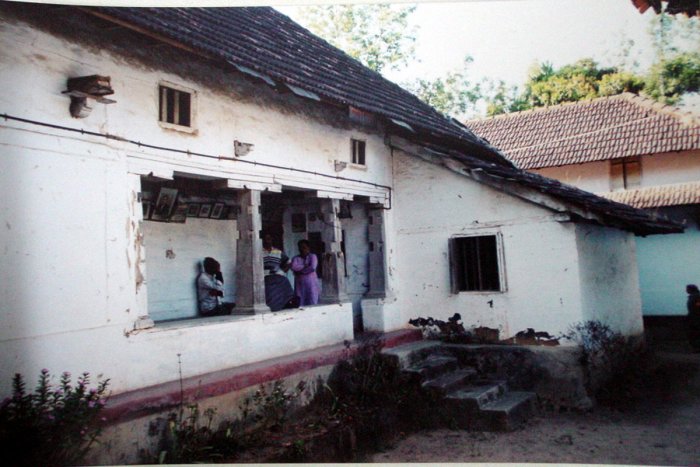
Ancient abode: The ancestral house of Mukkatira Ipanna, the sharpshooter, in Nalvathoklu village in Kodagu. Photo by Boverianda Chinnappa
Mukkatira Aiyappa of Bonda village in Kodagu had three sons: Muddayya, Ipanna and Bopayya. Muddayya became a Munshi (clerk) in the Diwan Kacheri (minister’s office). Linga Raja II was the ruler of Kodagu at that time. With his first queen, a lady from the Chowrira family, he had a son Chikka Vira Raja. His second queen, Palanganda Devaki, was his Pattada Rani (chief queen). They had two daughters Muddammaji and Devammaji.
In 1816, Linga Raja was on a hunt in Murnad, Kodagu. He was accompanied by Muddayya when they came across Ipanna. Linga Raja challenged him to shoot a bird off a bison’s back as he was a famed sharpshooter. The bison was at a long distance and a gunhad to be used. Ipanna shot it and impressed the Raja who summoned him to the court the next day.
The next day, Ipanna went to the court dressed in a white Kuppya (traditional coat). The Raja asked him the significance of the colour of his costume. Without any hesitation, he replied that a Kodava normally wore a white Kuppya on two occasions — in his wedding and then during his funeral. Those days, rarely one spoke boldly in front of the Raja. But the Raja was not displeased. Instead he surprised all by saying that he would get his elder daughter Muddammaji married to Ipanna.
Ipanna was converted into a Lingayat, since the Raja was one. Ipanna was given a new name, Chenna Basavappa. Muddammaji and Chenna Basavappa were married and gifted a farm. But Muddammaji fell sick frequently. So, this farm was exchanged with another farm which belonged to the Raja’s relatives in Appangala. However, Muddammaji died within two years after her marriage. The Raja then got his younger daughter Devammaji married to Chenna Basavappa in 1819.
In 1820, Linga Raja died. His queen Devaki committed suicide by consuming diamond dust. Chikka Vira Raja became the Raja. Chenna Basavappa and a few others were discontent with his rule. So they schemed to have him ousted. They failed in their in their endeavour and Chikka Vira Raja came to know of it. Chenna Basavappa and Devammaji were kept under house arrest.
In 1832, Chikka Vira Raja planned to have Chenna Basavappa executed. Devammaji and Chenna Basavappa learnt of this. On Shivarathri, they drugged the guards and escaped from Appangala on horseback. They crossed the borders of Kodagu and reached Mysore , where they headed to the house of the British Resident Casamajor and sought refuge. Meanwhile, the couple’s one-and-a-half-year-old son fell into the hands of the Raja’s men and was handed over to the Raja whose queen took care of him.
Muddayya was an intelligent and respected man. He had been promoted to become the Raja’s Khas Munshi (chief accountant). A favourite of the Raja, he was deemed to be a future Diwan. When Chikka Vira Raja first heard of Chenna Basavappa’s escape he got angry with Muddayya who was his elder brother. He then beat him up. His Diwan, Kunta Basava, got Muddayya executed. But, in truth, Muddayya was not aware of his brother’s plans.
Chikka Vira Raja demanded that the two fugitives should be handed over to him. But Casamajor forwarded this matter to the British East India Company Government. In 1833, the Government declared that the couple should not be surrendered to the Raja. Chenna Basavappa and Devammaji were moved to Bangalore and were given a pension. Chikka Vira Raja schemed with Nanda Lal Bharthi, a merchant from Mysore, to have Chenna Basavappa murdered. But these attempts failed.
In 1834, the Company invaded Kodagu. The Raja surrendered to the British and was exiled. Chenna Basavappa and Devammaji returned to Kodagu. Their Appangala farm was returned to them. Chenna Basavappa assumed the title of ‘Arasu’ (king). He petitioned the Company to provide him with one of the other palaces of the Raja. He also wanted the former Raja’s farm at Nanjarajapatna and be placed in charge of the Gaddige (the Rajas’ mausoleum). But the Company didn’t agree to this. Chenna Basavappa died in 1868.
source: http://www.deccanherald.com / Deccan Herald / Home> Spectrum> Spectrum Statescan / b y Mookonda Kushalappa / July 06th, 2019
Linga Raja I was the king of Kodagu and a subordinate ally of Nawab Hyder Ali of Mysore. In 1780, the king passed away, leaving his first son, the 16-year-old Dodda Veerarajendra as heir to the throne. Hyder Ali saw this as the perfect time to bring Kodagu under his complete control.
So, he moved the king’s family members from the Madikeri Fort in Kodagu to Gorur Fort in Hassan. Displeased with the king’s removal, Kodagu rose in rebellion against Hyder.
Elsewhere, the second Anglo-Mysore war was raging on. In 1782, Hyder died and his son Tipu Sultan succeeded him. Linga Raja’s family was shifted and imprisoned at Periyapatna Fort in Mysore. In December 1788, Dodda Veerarajendra, his wife, daughter, brothers Linga Raja II (aka Lingarajendra) and Appaji Raja and other family members managed to escape from their confinement.
According to scholar H Moegling (in 1855) ‘some faithful Coorg friends assisted him (the king) and conducted him safely’. Historians I M Muthanna and D N Krishnaiah identified these friends as Kulletira Ponnanna, Pattacheruvanda Boluka, Appaneravanda Achaiah, Ketolira Achuvanna and others. They disguised themselves as oil-vendors and reached Periyapatna, where they were able to release the royal family.
The people of Kodagu declared Dodda Veerarajendra their king but the new raja and his family had no place to stay. The Mysore Sultan still held the Madikeri Fort. The king first stayed at Kurchi where he made a temporary, makeshift residence.
One day, when the king was away, bandits from Wayanad attacked Kurchi; they killed the queen, looted the ornaments and burnt down the place.
D N Krishnaiah writes that with the king living near poverty, Ketolira Achuvanna recommended his own native village — Yavakapadi near Kakkabe — as a suitable place for the raja to stay till the war was over. Back then, Kakkabe was a remote location, surrounded by mountains and jungles. Achuvanna accommodated the raja in his own ancestral house until a new palace was built.
A farmland of the Puliyanda family was found to be the most secure site for a palace; hidden by natural barriers from all sides, it was relatively inaccessible to invaders.
Four brothers of a family living there were asked to vacate the place, with the promise of compensation. Everyone complied, save for the youngest brother Karichcha.
When the palace’s construction began, Karichcha troubled the construction workers during the day and hid in the forest at night. Displeased with this, the raja got him captured and put to death
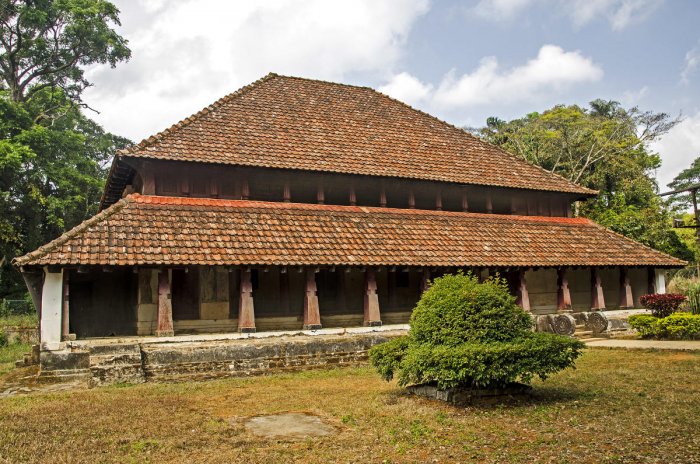
The palace eventually came up at the place and is called ‘Naalnaad aramane’ or Nalknad aramane, after the name of the region. The palace was relatively simple: a two-storey building with a thatched roof, built in the native Ainmane tradition.
The descendants of Achuvanna and his two brothers became the Aramane thakka (palace chamberlains); they were the hereditary chieftains in-charge of the Naalnaad palace. Meanwhile, Kodagu became free of Tipu’s rule in 1792. For Dodda Veerarajendra, life had come full circle, as he gained possession of his father’s old residence.
source: http://www.deccanherald.com / Deccan Herald / Home> Spectrum / by Mookonda Kushalappa / October 03rd, 2020
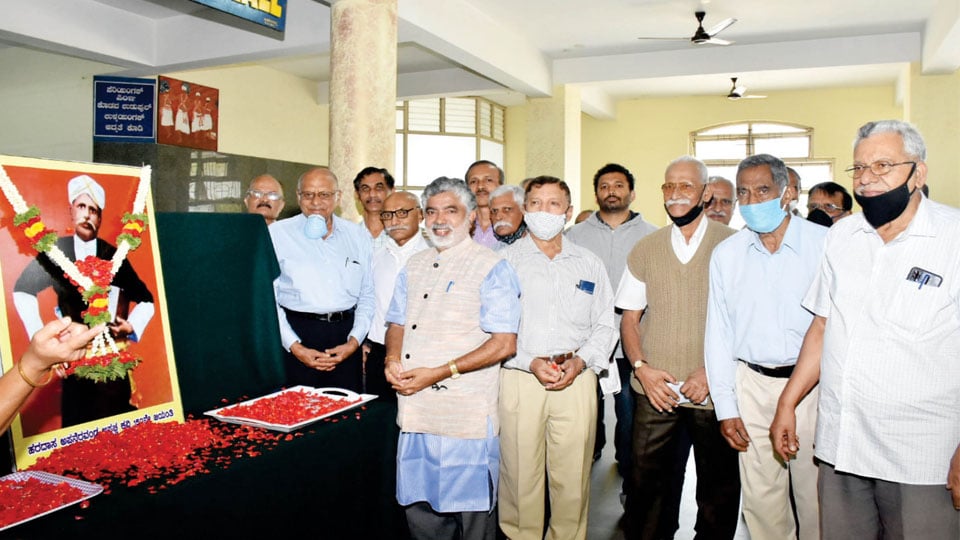
Mysuru Kodava Samaja celebrated the 152nd birth anniversary of Haradasa Appaneravanda Appacha Kavi as Kodava Thakk and Sahitya Divasa at Field Marshal K.M. Cariappa Bhavan in Vijayanagar here yesterday.
Rangayana Director Addanda C. Cariappa, Nellamakkada B. Kaveriappa of Bharani Art Gallery and Chenanda Uthappa spoke about the life and achievements of Haradasa Appacha Kavi and also about the lifetime achievements of litterateurs Dr. I.M. Muthanna and B.D. Ganapathy in their centenary year of celebration.
Maintaining that Appacha Kavi was not limited to just one community, they said that everyone should read the works of the great poet in order to have a deeper understanding of his contributions to the society.
Pointing out that Appacha Kavi is credited with scripting the first Kodava play and also acting in it, they opined that the great poet is very aptly called as Adikavi of Kodava language.
Mysuru Kodava Samaja President K.M. Belliappa, Secretary M.M. Ponnappa, Vice-President M.M. Ponnappa, Treasurer M.B. Jeevan, former Presidents Dr. A.A. Kuttappa, K.A. Kariappa, M.M. Karumbaiah, M.K. Kuttappa, B.M. Nanaiah and others were present.
source: http://www.starofmysore.com / Star of Mysore / Home> News / September 22nd, 2020
WELCOME. If you like what you see "SUBSCRIBE via EMAIL" to receive FREE regular UPDATES.
Read More »