A decommissioned MiG-21 fighter jet has been added to General K.S. Thimayya Museum in Madikeri thus adding to the existing collection of war relics at the war memorial. The fighter jet had been in use by the Indian Air Force.
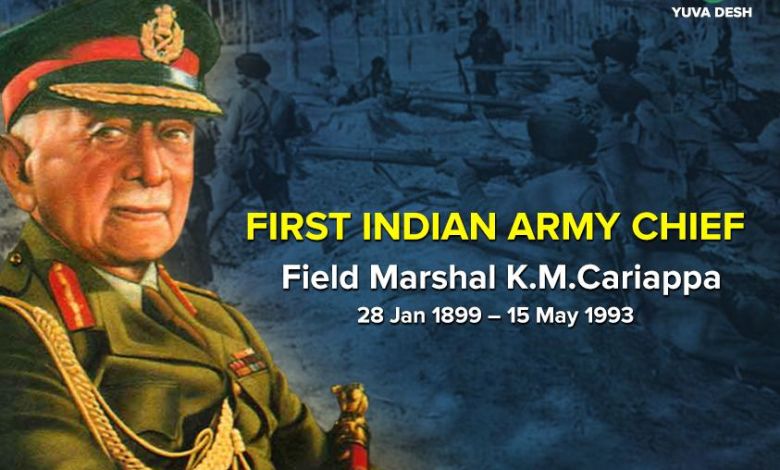
The continuous effort of Retired Air Marshal Nanda Cariappa, son of late Field Marshal K.M. Cariappa, has paved way for the inclusion of the MiG-21 C- 1624 fighter jet to the museum.
The fighter plane left Uttar Pradesh airbase on Jan.5 and was brought to Madikeri on a multi-wheeled carrier by road. The aircraft has arrived in parts and will be assembled by experts.
Nirmiti Kendra has readied three concrete platforms to support the aircraft which will be available for public view soon. The war memorial already has an Army Battle Tank.
source: http://www.starofmysore.com / Star of Mysore / Home> News / January 12th, 2020
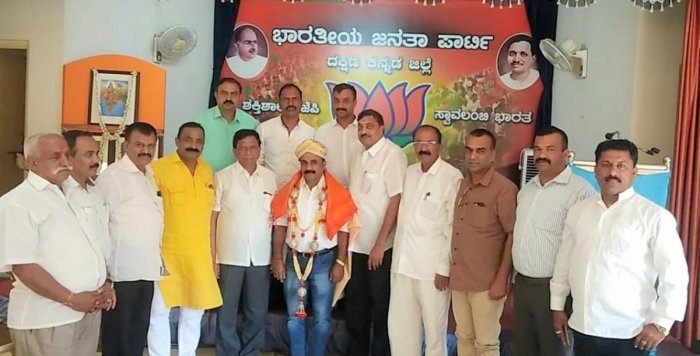
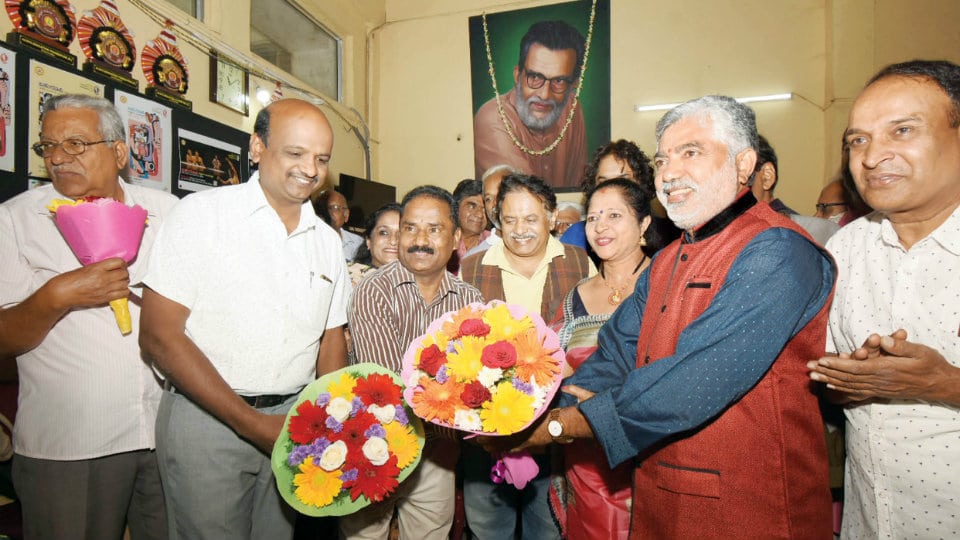
Paleyanda Robin Devaiah being felicitated by BJP leaders, after he was appointed the president of Kodagu district BJP, at Dakshina Kannada district BJP office in Mangaluru, on Sunday. DH Photo
In a sudden development, Paleyanda Robin Devaiah has been elected the president of Kodagu BJP district unit.
During a visit by the delegation led by MLA K G Bopaiah and MLC Sunil Subramani to Mangaluru, Kodagu BJP district in-charge Uday Kumar Shetty handed over the order copy to Robin Devaiah.
A native of Virajpet, Robin Devaiah belongs to Kodava community. Since his student days, he has been associated with RSS and had served as the general secretary of Kodagu BJP unit.
Two years ago, Manu Muttappa, close aide of K G Bopaiah had to step down as district president and B B Bharateesh, a leader of Vokkaliga community was elected to his place. Manu Muttappa was later appointed as state BJP secretary. Robin Devaiah was the working president of Madikeri Dasara Committee in 2019.
The responsibilities of the BJP district president has increased manifold as the party is in power both at Taluk and Zilla panchayats. Furthermore, there is the challenge of tackling dissidence also.
source: http://www.deccanherald.com / Deccan Herald / Home> State> Mangaluru / by DHNS – Madikeri / January 12th, 2020
Justice A.S. Bopanna, first judge from Kodagu to be elevated to the Supreme Court, was adjudged ‘Coorg Person of the Year, 2019’ by a Kodagu information portal.
A release stated Mr. Bopanna was the overwhelming choice for the title in a poll conducted for www.coorgtourisminfo.com, Kodagu’s first news portal, promoted by journalist P.T. Bopanna. The release said other nominations received included Fulbright scholar Sowmya Dechamma and Devika Carriapa, winner of Bal Sahitya award for 2019.
In the past, the winners of the Coorg Person title included Kaveri Nambisan, novelist (2005), Air Marshal K.C. Cariappa, environmentalist (2008), cricketer Robin Uthappa (2009), tennis player Rohan Bopanna (2010), squash champion Joshna Chinappa (2014), athlete M.R. Poovamma (2015), cartoonist Nala Ponnappa (2016), and badminton player Ashwini Ponnappa (2017).
Mr. P.T. Bopanna said: “The concept took shape in 2005 to develop role models for the people of Kodagu. The selection was made on the basis of a poll conducted through www.coorgtourisminfo.com.”
source: http://www.thehindu.com / The Hindu / Home> News> States> Karnataka / by Special Correspondent / Mysuru – January 08th, 2020
Senior theatre personality Addanda C. Cariappa took charge as the 18th Director of Rangayana, Mysuru, after offering floral tributes to the portrait of theatre repertory’s Founder-Director B.V. Karanth in the Director’s Office at Rangayana here this morning.
Speaking to presspersons, Cariappa said that it was the blessings of his parents and his over 30 years of dedicated service to the theatre that had brought him to the post. Noting that he was delighted to become the Director, he said he would give his best to take the theatre repertory to much greater heights.
Maintaining that he had only aspired for the post, but had not expected it, he said that he was satisfied with his work of promoting theatre in Kodagu, which was not an easy task.
Admitting that the National Theatre Festival Bahuroopi is a challenge, Cariappa said that Bahuroopi should have been organised during Sankranti, but this year it has been deferred due to the delay in the appointment of the Director. Although the festival may be delayed, it will be ensured that the event will be organised as a prime theatre festival of the country, he remarked and added that he will be holding a meeting with senior Rangayana artistes later this afternoon to discuss the ways to take Bahuroopi to every nook and corner of the country.
Replying to a question on the removal of Rangayana Directors even before completion of their term, he said that the heads of all cultural Institutions like Rangayana should be allowed to complete their terms, as they will have chalked out programmes for 3 years. The removal of heads of cultural Institutions with change in Government will hurt the plans envisaged by them, he said while asserting that the Directors of any Cultural Authority, including Rangayana should not be disturbed till the completion of their term. Even Baragur Ramachandrappa Committee too had recommended the same to the Government, he said .
Replying to another question on whether his political affiliations with the BJP had helped him in occupying the top post, Cariappa said that as an individual he has been in politics, engaging himself in social work. “I have contributed a lot for promoting theatre in Kodagu along with my wife Anitha, also a theatre artiste and the Government recognising my work for theatre has appointed me to the post out of trust,” he said.
Replying to another question on whether there will be more Kodava plays in Rangayana, he said that ‘Rangabhoomi’ is in itself a language and as such there is no particular language for theatre. Asserting that many Kodava plays have been staged at Rangayana in the past, he stressed that languages such as Kodava, Tulu and Konkani are brotherly languages of Kannada and as such any harm to these languages will certainly hurt Kannada.
Rangayana Joint Director V.N. Mallikarjunswamy, Kannada and Culture Assistant Director H. Channappa and others were present on the occasion.
Thereafter, Cariappa addressed Kodava Samaja members and Rangayana artistes at Bhoomigeetha, where a one-minute silence was observed as a mark of tribute to the departed Pejawar Mutt Seer.
Recalling the history of Rangayana since its inception in 1989, he said in a lighter vein how he married Anitha, who was a Rangayana artiste then.
Pointing out that Kodagu’s most acclaimed poet Appacha Kavi was inspired by Mohammad Peer, a professional theatre artiste from Mysuru in those times, Cariappa recounted his association with the theatre for over three decades.
Declaring that he will not be carried away by the top post, he assured that he would work honestly for bringing more name and fame for the city’s theatre repertory. Likening the work in Rangayana as that of a farmer, he said that a perfect co-ordination between all those involved was needed for bringing out the best of Rangayana.
Mysuru Kodava Samaja President K.K. Belliappa, Secretary M.M. Ponnappa, former Presidents Dr. A.A. Kuttappa and K.A. Cariappa, Corporator M.U. Subbaiah, actor Jadhav, noted theatre personality Nanda Halemane, senior Rangayana artiste Hulugappa Kattimani and others were present on the occasion.
Former Rangayana Directors
B.V. Karanth (1989), Y.K. Muddukrishna (1995-Incharge), C. Basavalingaiah (1996), Prasanna (2001), K.T. Chikkanna (2003-Incharge), Chidambara Rao Jambe (2004), K.T. Chikkanna (2008-Incharge), Dr. B. Jayashree (2009), K.T. Chikkanna (2009-Incharge), Lingadevaru Halemane (2010), B.T. Munirajaiah (2011-Incharge), Dr. B.V. Rajaram (2011), K.R. Ramakrishna (2013-Incharge), H. Janardhan (2013), K.A. Dayanand (2016-Incharge), M.S. Archana (2017-Incharge), Bhagirathi Bai Kadam (2017).
source: http://www.starofmysore.com / Star of Mysore / Home> News / December 31st, 2019
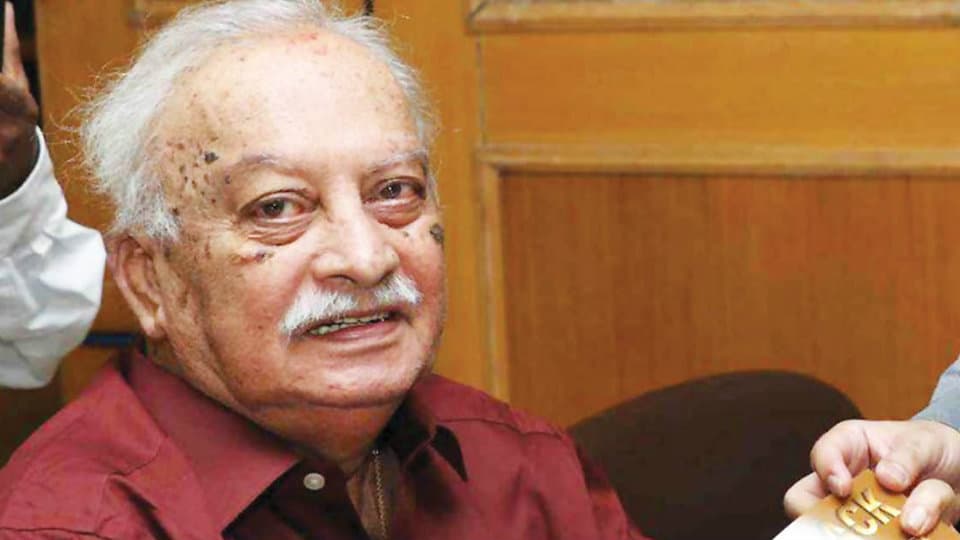
One of India’s leading Sports Administrators, five-time National Decathlon Champion, senior sports achiever in National and International arena and the first person in Kodava community to secure a Doctoral degree in Sports, Dr. C.M. Muthaiah passed away in Bengaluru on Dec. 5. He was 87.
Dr. Codanda Madappa Muthaiah was born in Madikeri on April 30, 1932 and had secured gold medal (first rank) in M.Sc. Biomechanics from Germany. Despite his education in Science, he had deep interest in sports and Muthaiah was involved in Decathlon, Long Jump and High Jump and had achieved National and International-level recognitions.
From 1956 till 1960, Dr. Muthaiah had won National-level and Asian-level championships. He had won the National Championship crown five times and recognising his achievements, he was bestowed the title “Golden Shoe” in 1977. One of his biggest regret was his narrowly missing the Decathlon Medal in the Tokyo Asian Games in 1958. Dr. Muthaiah was instrumental in bringing the Sports Authority of India, South Centre, to Bengaluru.
After dedicating his youth to the cause of sports, Codanda Muthaiah served the field as a Coach and Sports Officer. He went on to become a Senior First Grade Coach at Netaji Subhas National Institute of Sports commonly known as National Institute of Sports (NIS), the Sports Training Centre at Patiala in 1962. He later served as the chief of NIS, an Academic Wing of Sports Authority of India and Asia’s largest Sports Institute in Patiala, Punjab.
Dr. Muthaiah had also served as the Director General of the Sports Department of the Union Government and in 1982, he was conferred the ‘Asiad Vishist Jyothi’ for his contribution to Asian Games and Rajyotsava Award in 2013.
He was appointed as the Technical Advisor when the Asian Games was organised in New Delhi in 1982 and had served as Technical Director to various other National and International Games.
He also served as the Secretary General of Asian Track and Field Research Centre. After retirement, he was residing at Jayamahal Extension in Bengaluru. He is survived by wife Parvathi and a daughter.
source: http://www.starofmysore.com / Star of Mysore / Home> Sports / December 13th, 2019
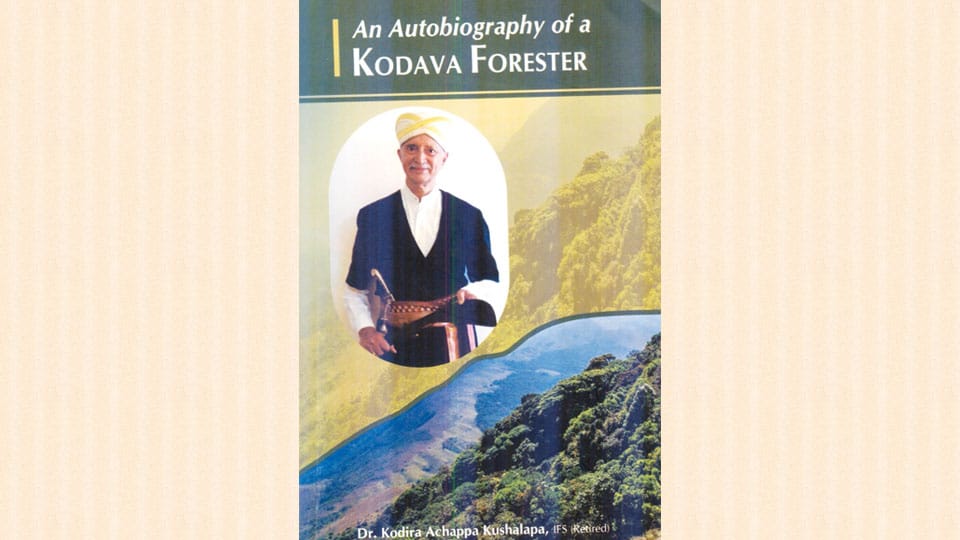
Title : An Autobiography of a Kodava Forester
Author : Dr. Kodira Achappa Kushalapa, IFS (Retd.)
Pages : 228
Price : Rs. 200
Year : 2019
Publisher : Dr. K.A. Kushalapa, Mysuru.
In the film of 90 minutes duration, titled “Beautiful people: Some call them animals,” a comic allegory produced in 1974, focussing on various animals that live in arid desert environment of Africa by Jamie Uys, humorously draws parallels between animal and human behaviour. Dr. K.A. Kushalapa can vouch for the message in the film that the denizens of the forest are indeed beautiful people in a wide sense of the term, having shouldered the arduous duties of conserving India’s forests, steadily shrinking as a percentage of the total geographical area of the country. His empathy for the denizens and concern for enduring the flora have not witnessed even an iota of diminishing to this day despite retiring from an illustrious service for long years as a professional forester. Circle for Mysuru’s intelligentsia and senior citizens who have known him can testify to the vast knowledge of the author about A to Z of forest and its importance of vital role in sustaining the balance between human beings and other species on earth.
The narrative divided into 16 chapters, each with a caption indicative of specific aspects of the author’s early life and landmark events relating to his professional career culminating in his elevation to the highest post in the Department of Forest in the State Government.
Writing about Dr. Kushal-apa, in his foreword, Man-depanda K. Appayya, former Principal Chief Conservator of Forests, Government of Karnataka, has expressed his admiration of the author’s noble qualities of head and heart, that earned him respect, recognition and rewards by his achievements both academic and professional.
The events of the author’s childhood and in later stages presented in all humility and graphic details trigger in the minds of readers what a person can achieve by being stoic and steadfast along with the support of family members, as revealed by the author himself in his preface. The trials and tribulations that he has encountered at different periods of life but overcome with courage and hope sound poignant. His life’s saga belies the myth of Kodavas as a community of only planters and warriors, by emerging as a star among them in the world of academics also. The 128 published papers listed in the book’s Chapter 14, 10 abstracts of technical papers and 10 titles of social articles listed in Chapter 15 give the readers an insight into Dr. Kushalapa’s deep interest in enlightening the lay people dispelling their utter lack of knowledge about forests.
Dr. Kushalapa has thought-fully included 69 photographs, many in colour, with images of his family members as well as people who were his colleagues, showing him as an impeccable handsome person. If his dream of generating in Kodava youth the desire to spread out into various areas of challenge by pursuing professions outside the ambit of restricted areas for which Kodavas are known, is fulfilled, the author’s autobiography gets full worth of the work of writing and publishing. The proceeds of the sale of the publication is meant to be utilised for philanthropic cause. —BRS
source: http://www.starofmysore.com / Star of Mysore / Home> Feature Articles / December 22nd, 2019
Kodava men perform ‘Huthari Kolata’ on the premises of the Old Fort in Madikeri on Thursday.
Celebrations of Huthari continued with ‘Kolata’ and various sports events on the very next day of Huthari festival in the district on Thursday.
The Pandira family and the management committee of the Omkareshwara Temple organised the ‘Huthari Kolata’ on the premises of the Old Fort in Madikeri.
‘Ummattat’, ‘Bolakkat’, ‘Kolat’, ‘Pariya Kali’, ‘Chowli Aat’ and ‘Kattiyat’ were performed by teams from the Kodava Samaja, the Pandira family and the Pommakkada Koota.
Children added sheen to the Kolata by tapping their feet to the music of the traditional Kodava Valaga, which came as the icing on the cake.
Speaking on the occasion, MLA K G Bopaiah said that Kolata is celebrated soon after Huthari festival in Kodagu. Kolata was performed on the premises of Old Fort since generations, he said.
Stating that a week-long Huthari Kolata will be celebrated in ‘Uru Mand’ and ‘Naad Mand’, the MLA stressed on the need to cherish and preserve the tradition.
Since 2008, Kodagu has been enjoying holiday for Huthari and Kaveri Sankramana, after the government recognised the festivals, he added.
History
The Pandira family members of Hebbettageri village have been performing ‘Huthari Kolata’ or Puttari Kolata, on the premises of Old Fort, since the time of the reign of royal kingdoms in Kodagu.
The paddy is harvested during the festival and brought to homes.
The Puttari Aramane Kolu was held in high regard in the palace in older days and the same is continued today.
‘Will accept minister’s post if offered’
Speaking to reporters, Bopaiah said that he is not in the race for a minister’s position. However, if offered, he will accept the same with humility and work with conviction and handle with responsibility.
He meanwhile stated that he is an honest member of the party and does not believe in lobbying. He denied pressuring any leader to give him the minister’s post. “I have fetched a lot of grants to Kodagu and will continue to strive to solve people’s problems,” Bopaiah added.
source: http://www.deccanherald.com / Deccan Herald / Home> State> Mangaluru / by DH News Service, Madikeri / December 12th, 2019
A survey conducted in 2019 revealed women in India are paid 19% less than men. While the participation of women in the workforce is only 26%, with merely 9% being in any kind of leadership position, the practices of sex-based bias and stereotypes at formal and informal workplaces gravitate from structural violence over their bodies to seeking organisation’s permission to be under wedlock as in the case of the first Indian woman Ambassador: C B Muthamma.
Image source : Twitter
Early life
Chonira Belliappa Muthamma, the first woman to clear the Indian Civil Services examinations, the first woman Indian Foreign Service (IFS) officer, the first Indian woman diplomat, later the first Indian woman Ambassador (or High Commissioner), was born in Virajpet in Karnataka’s Kodagu (then Coorg), a coffee-growing district in southern India on January 24, 1924. Muthamma’s father, who was a forest officer, passed away when C B Muthamma was nine years old. Being a single parent raising four children, her mother made it a priority to give them the best possible education. She did her schooling in St Joseph`s Girl School in Madikeri. Later, she moved to Chennai to pursue her undergrad from the Women’s Christian College and her Master of Arts degree in English Literature from Presidency College, Chennai.
IN THE END, SHE WAS GIVEN ABYSMALLY LOW MARKS, IN SPITE OF WHICH SHE TOPPED THE FOREIGN SERVICE LIST AND BECAME THE FIRST WOMAN IFS OFFICER IN 1949. WHEN SHE ENTERED THE SERVICE, MUTHAMMA WAS MADE TO SIGN AN UNDERTAKING THAT SHE MAY BE REQUIRED TO RESIGN FROM HER JOB ONCE SHE GOT MARRIED.
In 1948, a year after independence, C B Muthamma cleared the UPSC examination, becoming the first woman to join the Indian Civil Services. Her struggles started with the UPSC Board interview where the Board members tried to persuade her to change her first option for the IFS. In the end, she was given abysmally low marks, in spite of which she topped the Foreign Service list and became the first woman IFS officer in 1949. When she entered the service, Muthamma was made to sign an undertaking that she may be required to resign from her job once she got married. “This was clearly against the Constitution, but in those early days, it did not occur to me to challenge that rule…there was an attitude of vengefulness on the part of the men—a feeling that should be kept in their places, and that they should be encouraged to leave,” she cited this incident in her collection of essays, aptly entitled, Slain by the System.
Muthamma Vs Union of India
With this bizarre rule intact at the Ministry of External Affairs, Mira Sinha Bhattacharjea and Rama Mehta were among those who had to leave the service, points out Kishen Rana in the Indian Foreign Affairs Journal. In addition to facing everyday prejudices against women in Indian society, which got reflected in the ministry, Muthamma was not accepted by several Ambassadors citing various reasons as to why it was inappropriate to send a woman to the station. Finally, she was first posted to the Indian Embassy in Paris. It was there she understood that it is not only Indian diplomats who had problems with a female colleague, but also her peers in other Embassies who were equally not at ease in dealing with a woman in workplace. She then served in Rangoon, London, and on the Pakistan and America Desks in the Ministry of External Affairs in New Delhi.
SHE WAS FIRST POSTED TO THE INDIAN EMBASSY IN PARIS. IT WAS THERE SHE UNDERSTOOD THAT IT IS NOT ONLY INDIAN DIPLOMATS WHO HAD PROBLEMS WITH A FEMALE COLLEAGUE, BUT ALSO HER PEERS IN OTHER EMBASSIES WHO WERE EQUALLY NOT AT EASE IN DEALING WITH A WOMAN IN WORKPLACE.
The tipping point for her was when she was overlooked for promotion to Grade I, the highest level of Secretary to Government of India, of the IFS. In 1979, she brought the petition against the government, the Appointments Committee of Cabinet (ACC) and Ministry of External Affairs, on the grounds of professional gender bias and discrimination contradicting Article 14 (equality before the law) and Article 16 (equality of opportunity in matters of public employment) of the Constitution.
She further challenged Rule 8(2) of IFS (Conduct & Discipline) Rules, 1961 which stated that, “a woman member of the service shall obtain the permission of the Government in writing before her marriage is solemnised. At any time after the marriage, a woman member of the Service may be required to resign from service, if the government is satisfied that her family and domestic commitments are likely to come in the way of the due and efficient discharge of her duties as a member of the service,” and Rule 18(4) of IFS (RCSP) Rules, 1961 which noted that, “no married woman shall be entitled as of right to be appointed to the service.”
The Supreme Court Bench headed by Justice V.R. Krishna Iyer commented that this, “…bespeaks a story which makes one wonder whether Articles 14 and 16 belong to myth or reality.” Solicitor General, Soli Sorabjee opposed the petition saying that the rule overlooking women for ambassadorship was justified. He argued that the chances of leakage of confidential information of strategic significance were a dangerous risk, and so Muthamma’s case to be made an ambassador was rightly rejected.
Though C B Muthamma was promoted to Grade I and posted as India’s Ambassador to Hungary while the trail was ongoing, the Court struck down the blatant prejudice against women’s rights in India by the iconic judgement of the Bench headed by Justice V.R. Krishna Iyer.
Expert Judgements
“That on numerous occasions the petitioner had to face the consequences of being a woman and thus suffered discrimination though the Constitution specifically under Article 15 prohibits discrimination on grounds of religion, race caste, sex or place of birth and Article 14 of the Constitution provides the principles of equality before law….”
“If a fragment of these assertions were true, unconstitutionality is writ large in the administrative psyche and masculine hubris. If there be such gender injustice in action, it deserves scrupulous attention from the summit…“
“If a woman member shall obtain the permission of the government before she marries, the same risk is run by the government if a male member contracts a marriage. If the family and domestic commitments of a woman member of the Service is likely to come in the way of efficient discharge of duties, a similar situation may well arise in the case of a male member. In these days of nuclear families, inter-continental marriages and unconventional behaviour, one fails to understand the naked bias against the gentler of the species.”
“If a married man has a right, a married woman, other things being equal, stands on no worse footing. This misogynous posture is a hangover of the masculine culture of manacling the weaker sex forgetting how our struggle for national freedom was also a battle against woman’s thraldom.”
“Freedom is indivisible, so is Justice. That our founding faith enshrined in Articles 14 and 16 should have been tragically ignored vis-a-vis half of India’s humanity, viz., our women, is a sad reflection on the distance between Constitution in the book and Law in Action.”
“In the rat race of Indian official life, seniority appears to be acquiring a religious reverence. We have had the advantage of the presence of the learned Solicitor-General, appearing for the Union of India. With characteristic fair-ness he has persuaded his client to agree to what we regard as a just gesture, viz., that the Respondent-Union of India will shortly review the seniority of the petitioner, her merit having been discovered and her seniority to Grade II being recognised.”
The Court dismissed the petition but directed the Government to review the petitioner’s case in light of the only remaining element of her complaint—that relating to the promotion of people junior to her. The Court emphasised the need to overhaul all service rules to remove discrimination.
This ruling served as an aid at many women’s meeting in support of their struggle for equality. She thus became the first woman from within the service to be appointed Ambassador. Later, she served as ambassador in Accra in Ghana, and afterwards, she was made the Indian Ambassador to The Hague in the Netherlands. She retired as one in 1982 after 32 years of service.
A Trailblazer For Working Women
Foreign Secretary Nirupama Rao recalls C. B. Muthamma as someone who’d waive away references to being the ‘first woman diplomat’ by saying, “Someone’s got to be first—I was old enough to have been there first.” Arundhuti Ghosh, the fiery diplomat who fought for India’s concerns on nuclear issues in Geneva, remembers her as a formidable personality and feminist who always showed consideration for people who worked below her. “For example, once she pointed out that Joint Secretaries have two air conditioners in their office rooms while non officer-grade staff had none and she gladly gave up her own A/C to share with other staff. That was Muthu for you,” Gosh said.
After retiring, she continued to be an activist. C B Muthamma was nominated as the Indian member of the independent Palme Commission, a non-governmental Commission on Disarmament and Security Issues, which reported directly to the United Nations. The spinster remained active in social movements, helping riot victims and citizen groups, her philanthropy knew no bounds. In her book the Slain by the System (2003), a collection of essays criticising of the Indian political system and its political class, she writes, “Looking back, I cannot help but conclude that my tenure with the external affairs ministry was one long tussle with the anti-women bias.” She also co-authored The Essential Kodava Cookbook (2000), compiling forgotten recipes from Coorg for the culinary enthusiast inside her. She passed away on October 14, 2009 in Bangalore at the age of 85.
C B Muthamma proved that as long as social justice is an integral part of our constitutional fundamentals, gender justice will remain a non-negotiable article of faith. She not just managed to get the Supreme Court agree that gender discrimination did exist in the foreign office but also broke many visible and invisible barriers to set a level playing field for women in IFS, women in civil service and women in all workforce.
References
1) The Better India
2) Ministry of External Affairs
3) Indian Kanoon
4) The SOP
source: http://www.feminisminindia.com / Feminism in India / Home> History / by Nivedita Jayakumar / December 16th, 2019
Attributed to Ozias Humphry (British, 1742–1810), Dodda Vira Raja (or, Vira Rajendra Wodeyar), Ruler of Coorg 1780-1809, c. 1787. Watercolor on ivory. Gift of Shirley Latter Kaufmann in memory of Harry and Anna Latter, 74.649.
New Orleans, LA :
The New Orleans Museum of Art (NOMA) presents the museum’s Latter-Schlesinger Collection of Portrait Miniatures. Cradled in the palm of the hand or worn close to the heart, portrait miniatures were never intended for public consumption, but rather, functioned as personal tokens of affection, love, or memorial. Drawing from NOMA’s permanent collection, the installation of more than 100 portrait miniatures is now on view in the Lupin Foundation Decorative Arts Galleries on the museum’s second floor.
“NOMA’s Latter-Schlesinger Collection of Portrait Miniatures, given in 1974 by Shirley Latter Kaufmann in honor of her parents, Harry and Anna Latter, is one of the singularly important collections at this museum,” said Susan Taylor, NOMA’s Montine McDaniel Freeman Director. “Ranging from the court of Henry VIII to Napoleonic France, the collection includes masterful examples of the important artists and techniques used in the art of miniature portraits.”
Andrew Plimer (British, 1763–1837), Henrietta Ponsonby, Countess of Bessborough, c. 1795. Watercolor on ivory, frame with pearls. Gift of Shirley Latter Kaufmann in memory of Harry and Anna Latter, 74.654.
Portrait miniatures were the passion of New Orleans collectors Harry and Anna Latter. In 1957, the Latters traveled to London to oversee a government project and dedicated the trip to the pursuit of English portrait miniatures. After her parent’s passing, Kaufmann gifted the comprehensive collection to NOMA, where she was a trustee for more than twenty years and board president in 1978. The family continues Kaufmann’s tradition of supporting the museum through the Milton H. Latter Educational and Charitable Foundation, which sponsored the design and fabrication of a custom cabinet for the magnificent collection.
Nicholas Hilliard (English, 1547–1619), Portrait of an Elizabethan Court Lady, c. 1590. Watercolor on parchment. Gift of Shirley Latter Kaufmann in memory of Harry and Anna Latter, 74.337.
Portrait miniatures feature details of historic lace, jewelry, ornate hairstyles, royal adornments and military regalia, all executed by the artist sometimes using a single hair as a brush. The earliest 16th-century miniatures were painted with watercolor onto vellum (animal skin) or cardstock, but by the 18th-century heyday of portrait miniatures, artists painted on thin sheets of ivory for a natural luminescence to the watercolor portraits. NOMA’s collection includes master miniature artists Nicholas Hilliard (English, 1547-1619), John Hoskins the Elder (English, c.1590-1665), Samuel Cooper (English, 1609-1672), Richard Cosway (British, 1742-1821), and George Engleheart (British, 1752-1829). On view are examples of portraits framed with the sitter’s hair, intricately arranged and braided, and two “lover’s eye” miniatures, capturing just an intimate close-up of the sitter’s eye, recognizable only to her dearest confidants.
A tablet produced by NOMA details the stories behind these portrait miniatures, with the stories of royalty and historic celebrities, the highly-skilled craft of miniature painting, and the Latter family collection.
NOMA’s installation was made possible with the support of the Milton H. Latter Educational and Charitable Foundation.
source: http://www.artandobject.com / Art & Object / Home> Museum / December 11th, 2019
MLC Sunil Subramani and Deputy Commissioner Annies Kanmani Joy inaugurate classrooms and computer laboratory of Government PU College in Madikeri.
Acharya Patashala Shikshana Datthi Samsthe has constructed classrooms and computer laboratory at Government PU College in Madikeri. The classrooms and lab were inaugurated by MLC M P Sunil Subramani.
Speaking on the occasion, he said, “Members of organisations play a vital role in the growth of government schools.
He lauded Acharya Patashala Shikshana Datthi Samsthe for contributing to the construction of classrooms at a time when the district faced floods.
Deputy Commissioner Annies Kanmani Joy appealed to the members of various organisations in joining hands with the district administration to rebuild Kodagu.
Acharya Patashala Shikshana Datthi Samsthe President T V Maruthi said, “The organisation decided to contribute to Kodagu district when the district was affected by natural calamities in 2018. Two classrooms, a computer lab and a hi-tech toilet have been constructed at the college at a cost of Rs 52 lakh.”
Bodha Swarupananda Swami of Ponnampet Ramakrishna Sharadashrama called upon the students to inculcate the teachings of Swami Vivekananda.
source: http://www.deccanherald.com / Deccan Herald / Home> State> Mangaluru / by Adithya K A / DHNS, Madikeri / December 07th, 2019
WELCOME. If you like what you see "SUBSCRIBE via EMAIL" to receive FREE regular UPDATES.
Read More »