Category Archives: Leaders

Cauvery: A time to pause

The role played by Kodagu, which has nourished and nurtured the Cauvery over time, needs to be recognised.

The Supreme Court of India has determined the manner in which the waters of the Cauvery river are to be shared among the beneficiary States. In its recent judgment on the long-pending issue, the court virtually pulled the proverbial rabbit out of the hat. The decision has received with muted acceptance, understandably, by all concerned, and some token opposition.

The Cauvery dispute has been a long-standing issue among the States, each one trying to tweak the 1924 Agreement forged during the British administration. Much water has flowed down the river since, and each State was trying to secure the best deal for itself.

A noteworthy aspect is that the matter has engaged some of the brightest minds, be it engineering, law, administration or politics, and the fortunes of many rose and fell at each turn of events. The din has for the present subsided. The bigger and immediate challenge now is to save the river to ensure lasting harmony and sustained development of the beneficiary States of Karnataka, Kerala, Puducherry and Tamil Nadu.

Amid all the arguments, the role played by Kodagu district in Karnataka, which has nourished, nurtured and nursed the river over time, has hardly been recognised or acknowledged.

Kodagu is part of the lower Western Ghats and at its highest point, is around 5,000 feet above sea level. Originally administered directly by the British from Madras, it became a Part ‘C’ State at the time of Independence, with its own legislature and Ministers. Subsequently, after the Reorganisation of States it became the smallest district, with a wealth of natural resources. It is in the Brahmagiri hills of Kodagu that the Cauvery rises and disappears, till it is seen again outside the boundaries of the district. The scenic beauty of the Brahmagiri range is a feast for any nature-lover. A mind-boggling phenomenon can be seen between October 14 to 17 every year unfailingly, when the Cauvery, which is nowhere to be seen, suddenly gushes forth from a spring and then swells into the river that bestows its bounty on millions of people along the way, till it reaches the Bay of Bengal in Thanjavur district of Tamil Nadu.

Kodagu has the largest acreage under coffee in the country, with one of the Tata companies owning approximately 40,000 acres. Trees of vintage growth, bamboo, pepper vines, spices, fruits and other agricultural produce make Kodagu a nature’s paradise. Kodagu hosts many species of wildlife, including the tiger, making it an attractive tourist destination.

Kodavas, the numerically small Hindu ethnic community, are different from neighbouring communities in their costume, language, and social practices. Suffice it to say that they have distinguished themselves in many fields and contributed to India significantly. This, however, is not about the Kodavas.

Journey to Tamil Nadu

Abundant green cover in Kodagu is of vital importance as this will ensure that the district receives sufficient rainfall to bring the river to life and flow in all its glory up to Tamil Nadu. Unlike Himalayan rivers, which are snow-fed, the Cauvery depends primarily on the Southwest monsoon. The river is impounded at the Krishnaraja Sagar dam, outside Mysore, conceived and constructed during the British period by the legendary engineer Sir M. Visvesvaraya. From here water is released, reaching Tamil Nadu, where it is stored in the Mettur Dam (Stanley Reservoir). Further release of water is dependent on the agricultural requirements of farmers downstream.

It would be facile to assume that the court decision has solved all problems and that the States concerned will live happily ever after. In a year when there is copious rainfall in Kodagu and the Cauvery is in spate, Karnataka releases water freely, making a virtue out of necessity. There is then no need for any water- sharing formula. It is only in years when rainfall in Kodagu and the catchment of the Cauvery is below par that the problem arises. This results in constant wrangling, and heated arguments between the States over the quantity of water released, the timing of the release and the manner of release, often resulting in violence. Matters get worse if the ‘deficit’ year happens to be an election year. This is the real issue and to date no satisfactory acceptable formula for sharing the distress has evolved, nor is a sound mechanism in place, for delivery in such situations.

It would be relevant to examine data for the decade 2007-2008 to 2017-2018 relating to release of water. Flows received from Karnataka were measured at the Mettur Reservoir up to 2012-13, and from 2013-14, at the Biligundlu gauging site maintained by the Central Water Commission. Against an annual 205 tmc ft (thousand million cubic feet) at Mettur, only 69.727 tmc ft was realised in 2012-13. At Biligundlu, against an annual figure of 192 tmc ft, the receipt in 2015-16 was 15.385 tmc ft. In 2016-17 the figure was 69.316 tmc ft and in 2017-18 it was 113.084 tmc ft. The statement shows that in the preceding decade there was deficit in four years. This is a matter of concern.

Reason for ‘deficit’

The main reason for deficit is reduced rainfall in the catchment area of the Cauvery in Kodagu district, mainly on account of loss of ‘green cover’. One needs to understand the reason for this loss. It is stated that construction of high tension power lines across Kodagu required felling of large number of mature trees, which reduced the ‘green cover’ substantially along the alignment. Perhaps that was the price to be paid for providing sustained power supply to areas beyond Kodagu. But who paid the price? The farmers in Karnataka and Tamil Nadu were the ones directly affected, along with all those areas that depend on assured water supply, such as Bengaluru which supports major industrial activity and large populations. In recognition of this need, the Supreme Court has specifically earmarked a certain quantity of water for Bengaluru.

Disturbing news

A matter of serious concern is news that certain infrastructure projects have been lined up for implementation in Kodagu. Two railway lines are planned: the Mysore-Kushalnagar-Madikeri (Makkandur) line and the Thalasssery-Kodagu-Mysore line. Four National Highways are planned. These are the Mysore-Kodlipet-Sunticoppa-Madikeri- Gonikoppal- Kutta-Mananthawadi; the Bangalore-Bantwal highway via Kushalnagar and Madikeri; Pannathur-Bhagamandala-Madikeri, and Mattanur-Gonikoppal- Thithimathi-Hunsur. This will connect the new Mattanur airport to Mysore and Bangalore at a cost of Rs. 1,000 crore. Additionally, existing roads are to be upgraded into four-lane highways.

These projects will undoubtedly result in the felling of a large number of trees, constant influx of persons transiting Kodagu without any concern or commitment for the local environment, increasing issues of waste disposal and management. Many other unacceptable activities will disturb the ethos of Kodagu and its natural environment.

The question to be asked is whether Kodagu, which is the major watershed and catchment for the Cauvery, requires these projects that are likely to cause more harm to the beneficiary States, while bringing only marginal and doubtful benefits. The ryots in the Thanjavur delta of Tamil Nadu that covers vast acreage, the farmers of Mandya in Karnataka, the drinking water supply needs of burgeoning cities such as Bengaluru and Chennai and many areas in the other States will be affected by any reduction in the flows of the Cauvery. There is no indication that the long-term impacts of these actions have been considered. No consultation with local communities appears to have been done. The impression at the ground level is that a very short-sighted view has been taken, and these projects have been mooted at the instance of local politicians as part of vote bank politics, in some cases backed by lobbies eager to monetise the natural wealth that will need to be extracted before implementation.

The way forward

It is clear that India needs to walk the ‘development path’. The right way is ‘sustainable development’, which does not appear to be the case in respect of the above-mentioned projects. The waters of the Cauvery have nourished downstream civilisations for centuries. It is the life blood of the States that now comprise the region. The time has come to save the river, bring back its glory as a provider and nourisher of humans, enabling them to live in peace, harmony, and rise to their full potential in every sphere of endeavour. There is no case for inter-State political one-upmanship or victory or loss for any group. The goal and cause are one…. save the Cauvery for the good of all, for all time to come, by taking a long-term view. Everyone needs to be on the same page.

The following steps need to be taken immediately.

1. Suspend all infrastructure projects, proposed or under implementation, for six months or a year. This short postponement will give time to study the issues necessary for saving the Cauvery.

2. Set up a competent neutral body to assess the real need for connectivity through Kodagu with contiguous areas and examine alternative options.

3. Identify the best option that will cause least damage to the environment and catchment of the Cauvery.

4. Having completed the above three tasks, arrange for a ‘carrying capacity study’ to be done by a credible professional body.

5. On the basis of the findings of this study, the implementation of projects should be supervised by an empowered body to be named the ‘Kodagu Sustainable Infrastructure Projects Board’, with the Deputy Commissioner of the district as Chairman, and the representatives of different agencies and local non-officials as members, to ensure timely implementation in accordance with project specifications.

6. Quarterly meetings of Chief Secretaries of the four States to be convened by the board to update them on the progress and the status of safeguards for the Cauvery.

The need of the hour is statesmanship, avoiding political short-sightedness. It should not become a case of winning the battle of sharing the Cauvery waters and losing the war of saving the river for posterity.

The author, who retired from the Indian Administrative Service, has written this as a concerned citizen. Email: sonnabel@gmail.com

source: http://www.thehindu.com / The Hindu / Home> Opinion> Open Page / by P.M. Belliappa / March 18th, 2018

Rashmika Mandanna is the Bangalore Times Most Desirable Woman 2017

Twitter
Twitter

Karnataka has voted and here’s the winner of the Bangalore Times 30 Most Desirable women. The results of the poll on our website, along with our internal jury, gave us a new person on the throne — actress Rashmika Mandanna. She practically ruled the year, with Kirik Party being the most talked about film in the first half, while the second half had her in two big-ticket releases — Anjaniputhraa and #Chamak. From being the Times Fresh Face National Winner in 2014 to the Most Desirable Woman in 2017, Rashmika finds this surreal.

Excerpts from a chat…


Most Desirable Woman — happy?

Last year, when I made it to the top 25, it felt good. But this time, I was pleasantly surprised that I made it to the top. When you make it to the top, it means that you’ve the support of the entire state. It is very nice and sweet, but it is also very unexpected for me. For me, desirability is having so much support from the people who we work for. As artistes, we want to keep the audience happy and I think this is one of the ways they say we have kept them happy. I’m not big enough to say what desirability is, but I am happy that people think of me as desirable.

The Belageddu song from Kirik Party had you dubbed as the ‘Karnataka Crush’. Your reaction to that?

I need to ask people why, because I don’t know what it is in me that people like so much. Even if I wasn’t in the industry and was doing something else, I’d be the same girl. I don’t know what it is, there are times when it doesn’t feel real and I wonder if it is all a dream and I must wake up sometime. I had the same feeling when I was crowned the Fresh Face. Till date, I can’t call myself the Fresh Face of India. And now, I can’t even believe I’m the most desirable woman.

As for Kirik Party, it is something that I hadn’t seen coming. When you’re destined to be somewhere, you will reach there, no matter what. I met some of the most amazing human beings while shooting for the film. To me, Kirik Party means everything, because it is the reason I am what I am today.

Three big releases and another biggie lined up next — does the Next Big Thing tag given to you feel overwhelming?

Honestly, right now everything scares me. But I don’t really see myself as the Next Big Thing. I just think of myself as someone who does good work. I’ve not let myself to think that I am the next star. If someone sees the real me running across the streets barefoot, they would definitely be in disbelief. I’m still that little girl inside.

What do you find desirable in a man?

If a man cares about the people around him, he is truly desirable. This caring quality is important in a man for anything, be it for work or keeping his family happy — this is the most desirable quality for me. Apart from this, respecting people and remaining down to earth is equally important. And I find my man, Rakshit Shetty, the most desirable.

In the film industry, traditionally, the ‘taken’ tag equals women being written off. Here you are, with this title! A sign of changing times?

I do think that times have changed, most definitely. Though, I’d like to also point out, even now when I talk to some of my friends, they are still scared to reveal their relationship status. It is almost like people are scared to live with the truth. This is totally unnecessary. Now that I’m engaged, two years from now I’d be married. If not the film industry, I’ve many things to go back home to and it isn’t the end of the world. But I’m still taking my chances. Times have changed, but there are people who still ask me — ‘why did you get engaged when you had such a good future ahead’. It is almost as if a heroine has to remain single forever or get married late; this doesn’t make sense one bit.

source: http://www.timesofindia.indiatimes.com / The Times of India / Home> News> Entertainment> Kannada> Movies> News / by Sunayana Suresh / TNN / March 03rd, 2018

Meet Brijesh Kalappa-The Man behind Karnataka’s Victory in the Cauvery Case

BrijeshKF28feb2018

The Supreme Court delivered its historic verdict on Friday that the state of Karnataka will get 14.75 TMC or thousand million cubic feet more water, in addition to the 270 TMC awarded by the Cauvery Water Disputes Tribunal (CWDT) in 2007. The Cauvery water sharing dispute has been a bone of contention between Karnataka and Tamil Nadu since the time of the British Raj.

This verdict is a clear victory for the poll bound Karnataka. However, Karnataka’s victory is mainly credited to Brijesh Kalappa who quit his cabinet rank post for the case.

Brijesh Kalappa is an advocate in the Supreme Court and Former Additional Advocate General, Haryana. He is an alumnus of the National Law School of India University and has also been a Legal Advisor to the Government of Karnataka (with the rank of Minister of State.) He has a sustained interest in public affairs even from his student years. He is a former journalist and has a wide range of interests including reading and travelling. On the professional front, he has worked with several legal luminaries on subjects of importance in civil, criminal, water and electoral laws and has individually represented governments, eminent individuals and major industrial houses. He is gifted with the prowess for distinctive sharp-edged analysis and has the advantage of surmounting well accepted beliefs by his inquiring nature. He is also the spokesperson of the Indian National Congress.

As a Legal Adviser, Kalappa could not appear on behalf of the State of Karnataka. The Cauvery Water Dispute had been very close to his heart, more so since he hailed from Kodagu. Thus he expressed his desire to re-join legal practice in order to continue to appear for the State of Karnataka when the prospect of the final hearing in the Cauvery Dispute before the Supreme Court loomed. The Chief Minister Siddaramaiah understood its significance, since he belonged to the basin area of the Cauvery River and thereby consented. Kalappa therefore resigned from the position of Legal Adviser to the Government of Karnataka/Chief Minister and re-entered the legal team that he was a part of for a decade and a half.

Kalappa had written a detailed post sharing his experience of appearing in the Cauvery case

In this interview, Kalappa has an exclusive chat with The Indian Jurist regarding the latest victory of Karnataka in Cauvery River dispute and his all over experience throughout the case.

The Indian Jurist: Sir, First of all Congratulations for the victory in the Cauvery Judgment. To begin with- you quit your position as the cabinet minister to concentrate on this case. So what exactly gave you the courage and the motivation to do so?

Brijesh Kalappa: In 2007, when the Cauvery Water Dispute Tribunal award has come, at that time I was very much a lawyer and then I had also prepared the SLP and had worked in regard to the Cauvery case. From 2007 onwards we kept waiting that the Supreme Court will hear the matter and finally when the Supreme Court actually decided to hear the matter on a day-to-day basis in 2017, ten years later, I had been by then appointed as legal advisor to the Chief Minister of Karnataka and Mr.Siddaramaiah was kind enough to have conferred me the rank of minister so at that time my first instinct was that we should succeed in Cauvery just like we had succeeded in Krishna earlier. I was the Advocate on Record for the State of Karnataka in the Krishna Water Disputes, where Karnataka was the beneficiary of the greatest possible award of 524.256 m for the Almatti Dam and enhanced share of the share of Karnataka from 734 to 910 Tmc.

TIJ: Though there has been a reduction in the share of Tamil Nadu but now Karnataka is obligated to release a monthly share. So this in turn does benefit Tamil Nadu and is not complete loss for the state?

BK: No, certainly it is not a loss for Tamil Nadu and I would actually look at it this way that as far as Tamil Nadu is concerned, it is important only if they have a workable order- doesn’t matter if they receive 500 TMC from Karnataka every year. But if Karnataka has refused to give them 500Tmc and they are running to Court every year then what is the joy of having an order like that. It should be a workable order. If it doesn’t work then there is no point. Tamil Nadu will also not enjoy the sweet success of having an order which isn’t going to be implemented. The thing which is important is to have something which is implementable.

TIJ: In one of the media interactions with the reporters at Vidhan Soudha, Karnataka Chief Minister Mr.Siddaramaiah stated that the verdict was not in full accordance with the plea and only some relief had been sought. So are you satisfied with the judgment?

BK: As far as the complete requirements are concerned they are certainly not fulfilled. One can see straight off that Karnataka people could have had much more. But I think there has to be a sense of give and take. We also have a sense that this is final because after the Supreme Court where else can you appeal? You can only go to God next.

TIJ: The major grouse of Karnataka was that the farmers in the Cauvery basin were restricted by curbs on the water usage. So how far this judgment would be beneficial for the farmers now?

BK: The victory is straightaway for farmers. About a lakh and half farmers are going to be benefitted straightaway and as far as the Bengaluru city is concerned, I think the needs of Bengaluru city, which was considered as of the most unlivable city after Cape Town (South Africa), that will finally be resolved.

TIJ: So how has been your experience throughout the entire case these years? You might have been receiving both brickbats and bouquets as well in the case?

BK: See, when you appear in a case like this, a daily assessment is made about your performance. The Cauvery Case is not about the final order, like as if it were to happen in a single day, For instance whenever there is distress, fate is ours to release say maybe 15 cu ft or 20 cu ft of water, many people don’t understand the outcome or implications of this, they would immediately say that the legal team have totally failed us and then there will be burning of effigies and people sending us very vicious WhatsApp messages and people making very horrible comments and mainly these people have lived of the state for so long but what they forget that this is an ongoing case and it is going on, at least as far as I am concerned, for a decade and a half. Suppose they say look Rs 1 Crore has been given to “X” lawyer then public says ‘look at this lawyer they have received such a huge amount’. But 1 Crore rupees over 15 years is nothing or 2 crore rupees a year means nothing because once you are living in Delhi, the living standards are very high there and how much a lawyer earns is very high. So in comparison to all of that what you are actually earning is probably less than a techie who is working in a top software firm. But people will say, “No-No Look at the kind of money these guys are making”. So this is the kind of campaign which really hurts you. But the overall point is that there must be satisfaction in what you do and satisfaction comes from within. So once you understand that this all blaming is just people’s frustration then you are okay with it. Even the normal client, when fails to get justice, he will always blame the lawyer and he will not say anything against the judge or anyone else. So we think of it in that sense. I have personally received both brickbats and bouquets during these years. I have endeavored to treat both with equanimity. This is actually what Lord Buddha says. There is much more to do, miles to go before we sleep. Threats to our environment ought to be thwarted, greater concern for water usage implemented and selfish concerns repelled.

TIJ: So finally this landmark judgment has held that a river is no one’s exclusive property; it is a national property and not a state owned. Will this judgment become a basis for all the other water disputes as well?

BK: This is indeed a wonderful law which has been laid down by the Supreme Court because the previous law had always been laid down under a reference for under such circumstances. So this is a particular law in regard to equitable apportionment which has been now laid down and it’s of course a high point as far as the law in regard to equitable apportionment is concerned. And further, everybody will certainly look at this judgment for all times to come.

source: http://www.theindianjurist.com / The Indian Jurist / Home / by Naazish Fatima / February 19th, 2018

Retain sanctity of traditional dance, experts urge Kodavas

Kodava Sahitya Academy makes suggestions on `Ummathat’

Traditional glory : Dancers performing a traditional dance of Kodagu.

Madikeri :

Kodavas have a unique culture and their folklore too is distinct from others. “Ummathat”, a special dance, a mixture of folklore with a dainty touch of medieval and modernity, performed by Kodava women, is a case in point.

Kodava women lag behind in variety of dances vis-a-vis men. Men attired in traditional costumes perform “Bolakkat”, “Peeliyat”, “Chowriyat”, “Kappeyat”, “Pareyakali”, “Kolatt”, and “Kombatt” whereas women dressed in colourful saris perform “Ummathat”.

There was a debate whether these dances should be performed in public or only at Kodava religious and cultural ceremonies.

The Karnataka Kodava Sahitya Academy, which had organised a seminar on “Ummathat” at Devanageri in Virajpet taluk recently, has come up with some suggestions concerning “Ummathat”. A decision was taken to maintain a uniform pattern of “Ummathat” in future.

Some of the suggestions are: Ummathat should not be performed in open or public functions or in front of the tableux as it loses sanctity. The dance shall be performed only in venerable places. Dancers shall remove footwear, wear traditional “bottu podiya” (a grand sari with rich brocade) while performing the dance.

The songs, an assortment of over 12 songs, sung in different tunes, will be retained without giving it a touch of modernity, was another decision taken at the seminar.

The “taleyatakki bolakk”, a brass plate containing a burning lamp sprinkled with rice, will replace the woman dressed up as Goddess Cauvery in the middle. The seminar arrived at a decision to formulate enough programmes in future to foster “Ummathat”.

Pace and rhythm

Akhila Kodava Samaja president Matanda C.Monnappa agrees with most of the suggestions that “Ummathat” must be nurtured. There ought to be a touch of modernity to go with it, he says. Increasing the pace of songs to match the rhythm will make it more attractive. At the same time, changes should not dilute the original nor affect the decorum of the dance. It should not portray women in poor light.

No one is sure of the origin of the songs or the nuances of “Ummathat”. Most people believe the songs were compiled by the late Haradasa Appacha Kavi several decades ago. Certain songs are contained in the book written by Kavishishya Haridasa Mukkatira S. Poovaiah. Late Puggera Karumbaiah, who was instrumental in reviving the “Ummathat” in the early Seventies, too had contributed to the dance form.

Origin of Ummathat

According to Puggera Aiyappa, a senior citizen from Devanageri, Ummathat was practised centuries ago though there are no records available to prove it. Mr. Monnappa says his 95-year-old mother (who passed away recently) used to sing “Ummathat” songs.

Other dances performed by men such as “Bolakkat” have religious sanctity. Bolakkat is offered to the deity unlike “Ummathat”, Mr. Monnappa said.

Similarly, dances such as “Peeliyat”, “Chowriyat” and “Kombatt” are performed at the religious places where the deities are worshipped. “Ummathat” and “Bolakkat” were performed in public in the past even in New Delhi. It had drawn criticism.

source: http://www.thehindu.com / The Hindu / Home> Karnataka> Madikeri / by Staff Correspondent / July 20th, 2005

‘Balopat’, ‘Ummathat’ and much more

bonding: The president of Mysore Kodava Samaja, Kattera A. Cariappa, inaugurating the Kodava cultural convention in Mysore recently; (right) Kodava men performing a folk dance at the convention

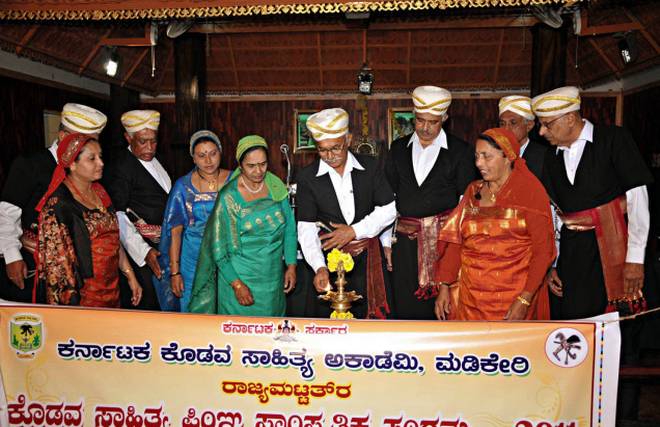
There was not much of an activity or even talk in public relating to preserving and nurturing the unique Kodava customs before the advent of the Karnataka Kodava Sahitya Academy in the early 1990s. Cultural observations essentially remained within the domains of the Kodava Samaja bodies or during the festivals and feasts. A new epoch had begun almost simultaneously with the coming into being of Kodava news weeklies. And, Kodava literary activities and cultural displays came into the limelight. Identifying those who had achieved laurels in various fields too began, thanks to the activities of the Academy, not just in Kodagu but also outside the district.

The two-day State-level Kodava Sahitya Samskritika Sangama (literary and cultural convention), held in Mysore here on March 1 and 2 was one such programme aimed at taking the Kodava culture to its people spread across the length ad breadth of the State and the country. It provided a platform for various speakers to give a clarion call for preserving and nurturing the Kodava culture for posterity.

The first day of the convention featured competitions involving different Kodava folk dances while on the second day selected speakers presented papers in a seminar with emphasis on arresting the trend of cultural degeneration. Speakers expressed concern at the erosion of Kodava culture and suggested various ways and means to stem the rot of Kodava language, literature and folklore. Traditional ‘Ummathat’ by women, and ‘Bolakkat’, ‘Kathiyat’, ‘Pareyakali’ and ‘Kolat’ by men stole the show.

Special drive

The president of the Mysore Kodava Samaja, Kattera A. Cariappa, observed that all-out efforts were needed to maintain the rich cultural practices of the Kodavas. There was a need to maintain unity among the members of the community. The president of the Karnataka Kodava Sahitya Academy, Rani Machaiah, said the Academy had embarked on a special drive to popularise ‘Kodavaism’ by taking up various programmes. The Academy had also invited three dance troupes from the Karnataka Janapada Academy — ‘Dollu Kunita’, ‘Pattada Kunita’ and ‘Puja Kunita’ — to perform as part of the exchange programme.

The Kodava Academy had organised programmes earlier in collaboration with the Karnataka Beary Academy and Karnataka Tulu Academy as part of the exchange programmes. This move was aimed at enhancing the camaraderie among the different communities. Ms. Machaiah, at the Mysore convention, expressed concern at the migration of Kodava people, particularly youth, from the district in search of greener pastures. Of late, many farmers had sold their land to move out of the district, she said, adding such a development could jeopardise the culture and growth of the Kodava language in Kodagu.

Efforts made by the Academy bodies in the past too are worthy of a mention here. For instance, the Academy took the learning of ‘Balopat’, the traditional folksong of the Kodavas, even to schools under the “Aat-Pat” (Dance and Song) programme. Cultural conventions across Kodagu have turned out to be crowd pullers.

Organising programmes in the rural parts of the district generated more awareness on the need to arrest the decline or dilution in Kodava culture.

Controversies

However, the Academy was not without controversies. Allegations of financial irregularities against certain office-bearers of the Academy had come as a slur on the fair name of the body. Moves to organise a World Kodava Conference in Madikeri had come to a naught as a result. There were controversies over the appointment of members to the Academy. Some were vociferous in demanding nominations to all Kodava-speaking groups and some were against it.

It happened that the political party in power on the day would have the final say in choosing the members to the Academy. At times, political party workers who owed allegiance to the party in power were comfortably accommodated.

A section of the Kodava-speaking groups felt that the Academy remained confined to organising cultural activities. There were more of displays relating to Kodava folk dances and cultural practices rather than literary activities, some still feel.

The talk that literary research works in Kodava should have come about, is also doing the rounds.

The efforts being made by the Kodava Elthkarada Koota, a body of Kodava writers, which had been bringing out books in Kodava every month, needs a mention here. Thanks to the advent of the Kodava weeklies, a number of budding Kodava writers have come to the fore.

This has indeed helped the spread of the Kodava language, though it has adopted the medium of Kannada for the script.

Jeevan Chinnappa

Vigorous efforts are on to preserve and nurture Kodava culture

source: http://www.thehindu.com / The Hindu / Home> Features> District Plus / by Jeevan Cariappa / March 12th, 2011

‘Male habba’ showcases rich culture of Kodavas

MaleHabbaKF28feb2018

45 lakh released for Kodava Sahitya Academy: Appachu Ranjan

MLA dancing to the tune of music of Kodagu, Kodava Sahithya Academy President and ZP members engaged in retransplatation of seedlings, Taluk Panchayat members ploughing the field, running race with a dog, tug of war and marshy field race… These were the scenes at ‘Male habba’ organised by the Karnataka Kodava Sahithya Academy in the field of Mukkodlu Hotteyanda S Thimmaiah in Madikeri Taluk on Sunday.

The habba was inaugurated by MLA M P Appacchu Ranjan. Amidst the greenary of the nature, the villagers actively took part in ‘Male habba.’

Irrespective of caste, creed and age, all took part in the competitions. On a whole, it was reflecting the Kodava culture, tradition and agriculture activities.

MLA M P Appacchu Ranjan, Kodava Sahithya Academy President Rani Machaiah, ZP Member B C Neelamma, TP Member Napanda Ravi Kalappa and others were taken out in a traditional procession.

Speaking on the occasion, the MLA said that it was good to see that Male Habba is being organised by uniting all the villagers. “The tradition and culture of Kodavas should be passed on to the future generation and Male Habba will help in showcasing the rich culture of Kodavas.”

Race, dancing and having meals together was the speciality of the ‘Male habba.’

The MLA said a sum of Rs 45 lakh was released to Kodava Sahithya Academy. Public should join hands with the Academy in preserving the Kodava language, culture, tradition of the land.

Academy President Rani Machaiah said additional grants are being released to the Academy, which helps the Academy in organising several programmes. The Academy will bring out a CD to showcase the rich Kodava culture to the future generation.

source: http://www.deccanherald.com / Deccan Herald / Home> District / Madikeri – DHNS / August 08th, 2010

Mini Vidhana Soudha to be inaugurated today

A view of the mini Vidhana Soudha in Virajpet.

The first phase of the Mini Vidhana Soudha in Virajpet has been completed and will be inaugurated on Sunday.

With this, the long-pending demand of the people in the taluk will be realised. The first phase of the work was taken up at a cost of Rs 2 crore. It has seven rooms including the tahsildar’s court and toilets.

In the second phase, two-storeys will be built. A proposal for Rs 6 crore has been submitted to the state government. With the completion of the first phase of the work, the taluk office, sub-treasury, Department of Survey will be shifted. Once the second phase of the work is complete, entire Revenue Department of the taluk will function under one roof, according to officials.

The mini Vidhana Soudha for Virajpet was sanctioned way back in 1997. A committee was constituted to decide on the place for the Vidhana Soudha. Though there was a demand to build the Soudha at Ponnampete or Gonikoppa, it was decided to construct it at Virajpet keeping in mind the convenience of the citizens.

It was said that three years were spent on identifying the land. As suitable land was not available it was decided to construct it in a place where the old taluk office existed. The old building was demolished to facilitate the work on the Vidhana Soudha.

Accordingly, PWD invited e-tender for the work. Two contractors who had taken up the work left the work halfway. Later, once again tender was invited in 2013. Owing to a shortage of sand, and change in contractor, the work was further delayed.

District-in-charge minister M R Sitharam will inaugurate the Mini Vidhana Soudha, while MLA K G Bopaiah will preside.

With the completion of the first phase work, the offices will start functioning from mini Vidhana Soudha from March itself, said tahsildar R Govindaraj.

source: http://www.deccanherald.com / Deccan Herald / Home> District / DH News Service, Virajpet / February 17th, 2018

Traditional dance marks mela opening

GRACEFUL: Kodava women perform Ummathat dance at the Kodava Samskrutika Mela at Napoklu in Kodagu on Monday.

Karnataka Kodava Sahitya Academy president Rani Machaiah on Monday called upon the Kodava-speaking groups to foster the unique Kodava culture to perpetuate it for posterity.

She was addressing a gathering at the Madikeri taluk Kodava Samskritika Mela (Kodava cultural convention) held at the Napoklu Kodava Samaja premises in Madikeri taluk, an official release said here.

The academy had been doing its best to preserve the unique Kodava culture by organising various cultural programmes across the district, she said. The Virajpet taluk convention would be held in Birunani on February 7 and in Somwarpet taluk in March, Ms. Machaiah said.

The traditional Bolakkat dance was inaugurated by Neriyandammanda Prabhu, Ummathat by Ikolanda Dotty Aiyappa, Kolatt by Mechira Ravishankar Nanaiah and Kodava song competitions by Boppanda Bollamma Nanaiah.

The former president of the Academy Bacharaniyanda P. Appanna presented a paper on the history of Nalnad area, comprising Napoklu and surrounding areas, at a seminar later.

There were five taluks in Kodagu in 1834 and several ‘nads’ (nad is a group of villages), he said. However, they had undergone geographic changes, Mr. Appanna said.

There were 26 villages in the Napoklu nad. The credit of preserving the Kodava culture should go to Napoklu nad, he added.

Mr. Appanna remembered the contributions of Kodavas of the past to nurture Kodava culture such as Appachira Mandanna, Kaliyatanda Ponnappa, writers such as Appaneravanda Appacha and Nadikeriyanda Chinnappa, all of whom hailed from the Nalnad area (Napoklu and surrounding areas).

Biddatanda Ramesh Chengappa, vice-president of the Napoklu Kodava Samaja, presided over the function.

Writer Moovera Rekha Prakash spoke on the history of Cauvery on the occasion.

source: http://www.thehindu.com / The Hindu / Home> National> Karnataka / by Staff Correspondent / Madikeri – February 01st, 2011

Karnataka halts Kerala in its tracks, saves Kodagu

CoorgKF28feb2018

Says it has not approved the Thalassery-Mysuru rail link

A burgeoning environment movement across Kodagu was put to halt — albeit breifly — by the state government on Wednesday.

Putting an end to the rising levels of anxiety among thousands of Kodavas and green activists, the state government clarified that it has not approved the controversial rail link connecting Thalassery (Kerala) with Mysuru (Karnataka) via Kodagu. Further, the state government clarified that it would not even allow preparation of detailed project report (DPAR) for the proposed rail link as the project would jeopardise the fragile ecosystem of the pristine Western Ghats.

Allaying the fears of thousands of people, RV Deshpande, Minister for Large and Medium Scale Industries and Infrastructure, told the state legislature that the government expressed its opposition for the project. Drawing the attention of the state government, BJP MLA from Virajpet KG Bopaiah alleged that both Karnataka and Kerala already met once and agreed to carry out survey for the proposed rail link amidst stiff opposition from the local population.

Deshpande acknowledged that a meeting between secretaries of Karnataka and Kerala did take place recently, however, the Karnataka government had not consented for the project. “Holding a meeting does not ensure our approval for the project. We have not consented for the rail link project. Further, the project is yet to be approved by the Railway Board and thereafter a formal request has to be made by the Kerala government. Only then, we will be able to take a decision,” Deshpande revealed.

Going further, Deshpande stated, “We already had discussion about the project at government level. Our forest department has not only expressed reservations but also opposed the project as it would jeopardise the green cover and affect elephant corridor through which the rail link passes. Hence, the state government in principle has not consented for the project.” According to Bopaiah, as per the Railway minister’s reply in the Lok Sabha in December 2017, a joint meeting between Kerala and Karnataka secretaries had resolved to take up survey along the route only if the Kerala government submits a proposal to Karnataka provided it does not cause disturbance to wildlife areas. Interestingly, the rail link spanning more than 200 km would pass through Wyanad of Kerala and enter Kodagu at Kutta to pass through thick forest regions like Balele-Nittor-Canoor and Thithimati to reach Mysuru.

Perturbed that the new railway line with a project cost of Rs 6,685 cr would result in clearing of about 40 per cent of Kodagu’s forest, Kodavas, including retired defence officials, planters, environmentalists and public had staged massive protest rallies recently at Kutta and Madikeri. Fighting against the projects that would spell doom over the fragile eco-system of Kodagu where the River Cauvery originates, people from Kodagu, Mysuru and Bengaluru had launched Save Kodagu and Cauvery campaign led by Coorg Wildlife Society. Col (Rtd) Muthanna had even accused Kerala political leaders, including Congress parliamentarian KC Venugopal, of misusing his office as the Congress in-charge in Karnataka by leading Kerala delegations to push for destructive projects cutting through Kodagu benefiting Kerala.

source: http://www.bangaloremirror.indiatimes.com / Bangalore Mirror / Home> News> States / by Niranjan Kaggere, Bangalore Mirror Bureau / February 08th, 2018

Winds of change hit Kodavas

The Kodavas were always a martial race with a pronounced colonial hangover (Agency Photo)

It’s an impressive roll call. Field Marshal K M Cariappa, Gen Thimmaiah, B C Nanda, M P Ganesh, Prasad Bidapa, Len Aiyappa….The Kodava community, from southwestern Karnataka, has always punched above its weight in Indian public life. Kodavas rose high in the Indian Army; they excelled at sport, particularly hockey and flourished in the coffee trade. But that was then. Today, the Kodavas are buffeted by the winds of change. Modernity and migration are taking their bewildering toll on a people that set great store by tradition.

This is the context of renewed demands for a separate Kodava autonomous region, which would give them a separate place of their own, in keeping with their claims of being vastly different from everyone else. For this would also accrue all the benefits that go with a distinct identity. The men are strikingly handsome and their women appealing winsome. Their customs and traditions too are quite different from those in the rest of the region,one being that an uncle usually marries his niece. For nearly two decades, the Codava National Council (CNC) has been fighting for autonomy and the issue is back on the agenda with regular dharnas and sporadic protests at the state legislature.

The Kodavas were always a martial race with a pronounced colonial hangover. Their loyalty to the British meant they found secure footing in the armed forces. Even though they had few officers and mainly made up the rank and file, the Army had a significant Kodava presence. No longer. Kodava recruitment at the Bangalore Army headquarters, which caters to Karnataka, Kerala, Mahe and Lakshadweep, fell steadily from 85 in 2001-02 to 28 in 2007-08. Today, the highest-ranking Kodava officer is a lieutenant-general and they have just a few major-generals.

The once-famous Coorg Regiment has suffered too. Twenty-five years ago, every Kodava family could proudly list several of its men in uniform. That’s history. Sons prefer to head for engineering colleges now or professions more lucrative than the Army, say recruitment officers.

It is the same with sport and the Kodava’s once-legendary skill on the hockey field. M P Ganesh, the first Kodava to captain the national team, heads a list that also features ace players such as M M Somaiah, B P Govinda, Len Aiyappa and Mandepanda Monappa. The community always enjoyed and excelled at traditional war games such as pareya-kali and shakti-kolu. This is why Ganesh, who started playing hockey late, was deemed a natural.

Army hockey teams, particularly those that played for the Madras Engineering Group, had several Kodavas. They were robust, used to walking to school several miles a day. And they had the right temperament for the game. But now, hardly any Kodavas play hockey, says Ganesh. “High coffee prices, other employment opportunities and a more sedentary lifestyle have led to a lack of interest in the game,” he says.

Today, the Kodava’s passion for hockey surfaces only during the annual tournament in Madikeri, the town in the Kodagu district that Kodavas regard as home. The tournament is hosted by one Kodava family or clan. Other families and clans play for pride and honour. Women are allowed to compete. National and state players are welcome but Ganesh says they are nothing like yesterday’s Kodava hockey stars. “Players should be picked up from here and coached,” he suggests. Eight Kodavas play in the Karnataka team today, but none in the national team. Len Aiyappa was the last to distinguish himself at the national level.

It is hardly different in the former Kodava mainstay, the coffee plantation. Once upon a time, almost every Kodava family owned a coffee estate, or part of it, ranging from a few acres to vast swathes of land. Coffee is cultivated on roughly 2.5 lakh acres in Kodagu, says M C Nanaiah, a member of the state legislative council, but the Kodavas no longer rule the roost.

Many Kodava families are selling off their ancestral homesteads and estates and migrating to Bangalore or Mysore. The trickle grew to a flood after coffee prices slumped a few years ago. Kodavas are also converting their palatial bungalows into home-hotels, burgeoning business ventures for sure but emblematic of their decision to swap a timeworn culture for modern commerce.

The winds of change are sweeping the little district, bearing the scent of the white coffee flowers. The Kodavas are hanging up their hockey sticks and Army boots. Many argue that it is all to the good for a community to change with the times, embracing newer professions such as IT and science. For the Kodavas, the change may be eagerly sought but bewildering.

deepa.bhasthi@timesgroup.com

source: http://www.timesofindia.indiatimes.com / The Times of India / News> India News / by Deepa Bhasthi / TNN / November 02nd, 2008