Category Archives: Leaders

The roots of Kannada in Kodagu…

The coffee land is all set to witness the 80th Kannada literary meet scheduled to begin on January 7, after a long gap of 32 years. Earlier, Madikeri has witnessed two literary meets – the 18th literary meet in 1932 under the leadership of D V Gundappa and the 54th literary meet in 1982 under the leadership of Dr Shambha Joshi.

Interestingly, despite being one of the smallest districts in Karnataka, it has a wide variety of culture as well as languages that include Kodava, Arebashe Gowda and Malayalam, yet the region has managed to retain the flavour of State language.

If one goes down the pages of history, the little district with unique weather and culture has contributed immensely for the development of Kannada language. The Ganga – Kongwala – Hoysala and Haleri dynasties, perhaps laid the strong foundation for Kannada through inscriptions way back in the 9th century. In the 10th century, Nagaverma had created ‘Chandombudi’ and ‘Punyashrava,’ according to the reference available at ‘Kodagu Sahithya – Sanskrithi Darshana,’ published by Kodagu District Kannada Sahithya Parishat.

During the Chengalva dynasty, the third Mangarasa had published ‘Jayanrupa Kavya’ and ‘Samyukta Kaumudi’ (1508), while his cousin Nanjunda had written ‘Kumara Ramana Kathe.’

There are documents to prove that the first epic ‘Rama Vijaya Kavya’ was written by Devappa, a Jain poet in 1540. Similarly, Dodda Veera Rajendra, who ruled Kodagu between 1789 and 1809, has the credit of documenting history titled ‘Rajendra Name’ in Kannada. The II Linga Rajendra, who ruled Kodagu between 1810 and 1820 had written a book pertaining to land in Kodagu entitled ‘Lingarajana Shisthu.’

The 19th century

The leading name of 19th century pertaining to literature is that of Panje Mangesh Rao, who served as a teacher in Kodagu in 1920s. He had penned poems pertaining to Hutthari festivities among other literary works. In fact, he was the president of All India Kannada literary meet held in Raichur in 1934.

Haradasa Appacchha Kavi, popularly known as the Adi Kavi of Kodagu had penned many plays including ‘Savithri,’ ‘Yayathi,’ ‘Kaveri’ and ‘Subramanya’ in Kodava language. The same were translated to Kannada language by Dr I M Muttanna, who also hailed from Kodagu.

Kodagina Gowramma

The first woman story writer in Kannada literary field, Gowramma, hailed from Kodagu and she is known as ‘Kodagina Gowramma.’ Born in Madikeri in 1912, she did her early schooling in Madikeri and married to B T Gopalakrishna in 1928.

From 1931, she wrote a number of articles and stories in the name of ‘Mrs G T G Krishna’. Most of her stories were based on the theme of women’s problems. However, she passed away in 1940 when she was just 28 years old. When Mahathma Gandiji arrived at Kodagu, she had invited Gandhiji to her home and she had donated her jewellery for the cause of freedom.

Bharathisutha

A teacher by profession, ‘Bharathisutha’ was the pen name of S R Narayana Rao. Based on the life story of Kodagu ruler Siribai Dodda Veerappa, he had written ‘Huliya Haalina Mevu,’ which was later made into a film by the same name.

His other stories too have been made into films and they include ‘Girikanye,’ ‘Edakallu Guddada Mele’ and ‘Bayalu Daari’ among others. His work on ‘Solle Haraduva Rogagalu’ (Diseases transmitted by mosquitoes) and ‘Giliyu Panjaradolilla’ (The parrot is not in the cage) earned him Central government award and Karnataka Sahithya Academy award respectively.

Kittel’s footsteps

Rev Fr Ferdinand Kittel, who contributed immensely to the field of Kannada literature has left indelible marks in Kodagu, prominent among them include the Kannada – English dictionary.
A German missionary, who served in Kodagu church (presently knownn as Shanthi church) between 1871 and 1876, was the first parish priest of the church. Rev Kittel started learning Kannada after going around the coffee land, says the present parish priest of the church.

DH News Service

source: http://www.deccanherald.com / Deccan Herald / Home> District / by Srikanth Kallammanavar / Madikeri – DHNS, January 05th, 2014
Chikkaveerarajendra’s descendants visit Kodagu

Lakshmidevi is the great granddaughter of the king

Chikkaveerarajendra of the Haleri dynasty was last ruler of Kodagu

Akhila Bharata Veerashiava Mahasabha received the members of the ruler’s family

Madikeri:

Descendants of the last ruler of Kodagu, Chikkaveerarajendra of the Haleri dynasty, carrying memories of the glory their ancestors, arrived in the district on Sunday to a rousing reception accorded to them by the members of the Kodagu unit of the Akhila Bharata Veerashiava Mahasabha.

Family

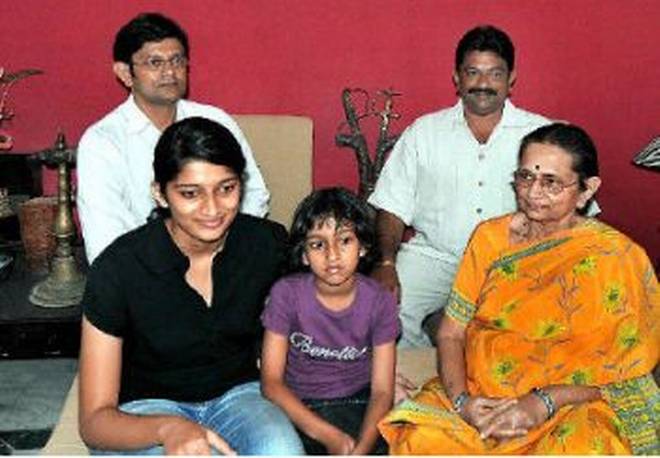
Lakshmidevi, great granddaughter of the last ruler of Kodagu Chikkaveerarajendra, her sons, Praveen Sardesai and his brother Girish, wife of Dr. Sardesai, Anuradha and their two daughters, Deepti and Disha, arrived at the Anechowkur gate on the Kodagu-Mysore border on Sunday afternoon.

The president of the Akhila Bharata Veerashaiva Mahasabha, Kodagu unit, S.P. Mahadevappa and members of the mahasabha from various parts of the district welcomed the royal descendants.

Mr. Mahadevappa said that the British, after wresting power from Chikkaveerarajendra in 1834 and banning him from Kodagu, had prohibited the royal family members from entering Kodagu.

The members had not thought of venturing into the district till 1947. However, Lakshmidevi, paid a secret visit to Kodagu in 1974, thanks to a Minister, who was in the State Government at that time, he said.

Dr. Sardesai is a ENT specialist serving in Hyderabad and his brother is pursuing a business, he said. Dr. Sardesai had also visited Kodagu in 1986 as part of the bird watching team in 1986.

He is said to be a member of the Andhra Pradesh Bird Watchers’ Society. The royal family members were just here to reminisce the past and not to claim any property in the district, Mr. Mahadevappa clarified.

Felicitations

The members were taken to the Bamboo Club in Polibetta and later they went to a private resort in Kakkabe, near Napoklu.

On Monday, the family members were felicitated by Shantamallikarjuna Swamy of Arameri Kalancheri Math near Virajpet.

The members will be felicitated at the Gaddige located in Madapur on Tuesday, Mr. Mahadevappa said.

Lakshmidevi is the great granddaughter of Chikkaveerarajendra and granddaughter of Gangamma, one of the three daughters of Chikkaveerarajendra. Gangamma was married to a zamindar in Hyderabad. Veeramma, the other daughter was married to a prince in Madhya Pradesh and the other Muddamma was married to a former Prime Minister of Nepal, Mr. Mahadevappa said.

source: http://www.thehindu.com / The Hindu / Home> National> Karnataka / by Staff Correspondent / September 29th, 2009

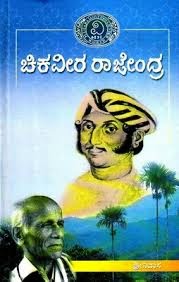
Book Review: Chikaveera Rajendra (A Kannda Novel)

BookChikkaKF28dec2017

Chikka Veerarajendra was the last king of Kodagu (Coorg) before it fell into British hands.

This book provides a picturesque account of life and time of the ruler, cultural preferences of Kodava community (the locals), gods worshipped by them, and their attitude towards the rulers.

Chikka Veera Rajendra, a spoilt prince has only one confidant in kunta (lame) Basava and when he becomes king, he makes Basava his minister not to support him in administration but to make arrangements for his whims.

The kingdom is mostly run by his other two ministers, Bopanna and Lakshminarayanaiah, while the king is busy fulfilling his bodily needs, leaving no money in treasury and acting cruelly when forced to take decisions. While the public in general dislike their ruler, a balancing act is done by the queen, making correcting efforts wherever possible to protect the interests of her family and the kingdom.

The king has a sister, Devammaji and her husband Chennabasavaiah who is interested in dethroning the king and taking power into his hands by making his wife the ruler. Becoming aware of this plan, the king puts his sister in captivity but releases her later as per requests from the queen, his daughter and a priest, Dikshit who advises the same.

Devammaji delivers a baby boy after her release and her husband devises a plan to run away from the clutches of the king and seek help from the British in dethroning the king. While he puts this plan to work, the couple in a hurry loses their baby on the way and it reaches the hands of the king and the palace. The king receives letters from the British to return the baby to his parents but he refuses to do so and in an act of madness, he kills the baby.

This incident causes a revolt in his administration who could not tolerate evil deeds of the king anymore and the opportunist British too come down with a force to attack. The turnout of events leads to capture of the king by the British and Kodagu being annexed into the British administration.

After losing the kingdom and being deported from Kodagu, life of Veerarajendra continues, he lives on the compensation fund he receives from the British. His wife meets death on the pilgrimage and his daughter marries a British, goes on to live in London.

This historical novel won the author the prestigious literary honor Jnanapith award in 1983. This hardbound book also provides the images of paintings and historical photographs, and descriptions of references to the history and also about the life of the celebrated author Masti Venkatesha Iyengar.

source: http://www.booksmarketsandplaces.blogspot.in / by Anand Maralad / Monday – August 18th, 2014

Coorg connection

EXOTIC LINEAGE The Coorg royal descendents   | Photo Credit: PHOTO: SATISH H
EXOTIC LINEAGE The Coorg royal descendents | Photo Credit: PHOTO: SATISH H

It’s interesting to note how the descendents of Coorg royal family came to settle down in Bodhan

In a sub-continent that has been in existence for ages, it is no surprise that there is every possibility of us crossing paths with the descendents of some king or sultan who had reigned over some part of the Indian soil. Within the confines of this city, or more so a fairly small place called Bodhan in this State (Nizamabad district to be precise), we’d come across the direct descendents of the Coorg royalty — the Haleri clan that had held sway over the exotic tract of land for nearly 234 years. That they found their way to Bodhan is mind-blowing, for Coorg is nowhere in the horizon of Andhra Pradesh! But as Lakshmi Devi Sardesai and her son Ajay Rajendra Wadiyar point out, there is a third dimension to the riddle —the Benaras factor.

The jigsaw nature of Coorg history started unfolding no sooner than Lakshmi Devi began her crisp narration introducing herself as the great granddaughter of the last king of Coorg Chikka Veera Rajendra. The beautiful lady is grace personified, albeit a little frail. Says she, “to cut a long story short, the last rajah was arrested by the British (East India Company) and put in house arrest at a place of his choice and this happened to be Benaras.” The East India Company provided him with a privy purse which allowed him, his four sons and daughter Gowramma to live in comfort if not luxury. One of the sons was Lakshmi devi’s grandfather on the paternal side. Chikka Veera Rajendra along with his daughter went to Britain to plead for his case to no avail. His daughter was baptized there after the Queen of England who took a liking to the beautiful Gowramma but the Rajah refused to convert, it was reported. Heart-broken, he left his daughter along with the royal jewels in the care of a British royal couple and died quite suddenly in London. The mortal remains of his body buried in that country was later sent to Benaras to be immersed in the Ganga as per Hindu custom.

Now, where is the Bodhan link? Smiling, Lakshmi Devi shares the information for the Veera Shaiva sect, there was a mutt (Jangamvadi) in Kasi (Benaras) headed by a Panchacharya (seer). Congregation of all lingayat priests (Jangam) from across the length and breadth of the country at this mutt at least annually was not uncommon then and even now. It so happened that one Jangam from Bodhan Samsthan met Chikka Rajendra’s son at Benaras during one of his visits to the place. An alliance for the two daughters of the king was proposed to the Deshmukh of Bodhan. Both were without heirs and it was then that one of the sisters decided to call her brother’s son (nephew) to Bodhan to take care of the family and property. That’s how Linga Rajendra (third son of Veera Rajendra) came to settle down at Bodhan. The other three sons of the rajah were Veera Rajendra, Mudhu Rajendra and Chandrashekara Rajendra. Since Linga Rajendra at a young age his and my widowed grandmother called for her youngest brother-in-law to take care of the Samsthan at Bodhan.

It’s interesting to know that Lakshmi Devi’s second son was adopted by her father to take on the family name as there was no male progeny. The silverware, brassware embossed with the royal seal and gazette notifications are the only precious preserves now with the family while the original Madikeri (Markara) palace at Coorg has been housing the Collectorate now.

The erudite Lakhmi Devi, is personification of the three ‘Bs’ (beauty, brains and breed) not to talk of the Coorg secularism.

source: http://www.thehindu.com / The Hindu / Home> Features> MetroPlus / by Ranee Kumar / November 01st, 2008

CNC observes Thok Namme

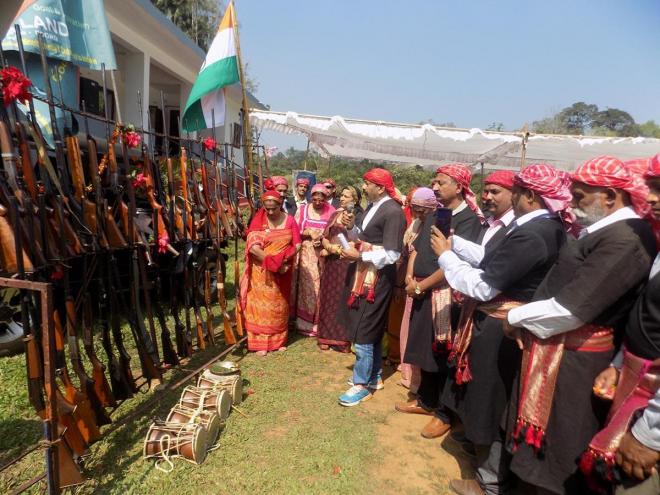
Codava National Council President N U Nachappa offers prayers to firearms as a part of Thok Namme, at an estate in Kolakere near Napoklu on Monday.

Codava National Council observed Thok Namme at an estate in Kolakere near Napoklu on Monday.

Speaking after offering prayers to firearms, CNC President N U Nachappa said that ‘Thok Namme’ (Gun Carnival) is organised to highlight the significance that guns represent in Kodava culture and life. “Possessing firearms is a right of the Kodavas.

It is also a religious and cultural symbol of the Kodavas.

The programme is being conducted in order to create awareness on the constitutional rights of Kodavas to own a gun. The programme also features mass worship of guns and aims to pass the message to the government that the possession of a gun is a birthright of a Kodava,” he said.

Nine resolutions, including urging the government to recognise the importance of guns in Kodava culture were passed on the occasion.

source: http://www.deccanherald.com / Deccan Herald / Home> District / DH News Service / Napoklu – December 18th, 2017

Sreevidya is new DC of Kodagu

SreevidyaKF13dec2017

Kodagu :

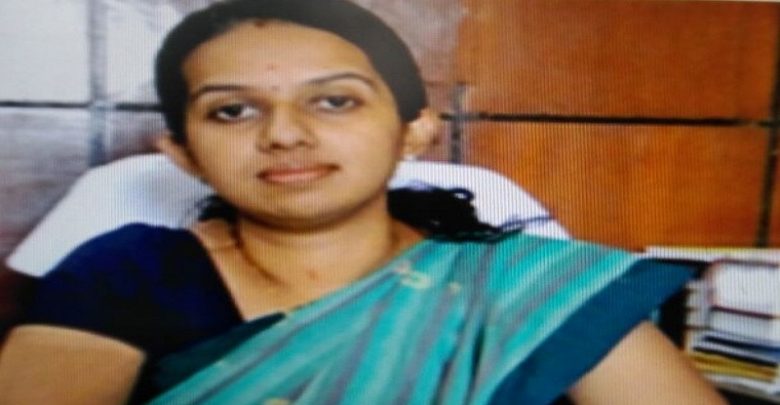
Sreevidya P I has been appointed as the new Deputy Commissioner of Kodagu District replacing Dr Richard Vincent D’Souza.

The state government has transferred Dr D’Souza and he has been replaced by Sreevidya who had earlier served as the Chief Executive Officer of the Kodagu Zilla Panchayat.

Earlier, Sreevidya has also served as the Assistant Commissioner at Sakleshpur in Hassan district.

It is alleged that the state government has replaced Dr D’Souza in the wake of allegations against him with regard to an order passed by him in a property dispute.

The Karnataka High Court recently directed the Chief Secretary of the state to initiate department proceedings with regard to the alleged orders passed by Dr D’Souza in a property dispute. The case has been adjourned to December 14. Now the appointment of the new DC to Kodagu has raised many eye-brows in the district.

It is alleged that Dr D’Souza had issued two different orders in a property dispute matter involving conflicting parties on the same day and a case was filed against him in the High Court. -(KK, NGB)

source: http://www.citytoday.news / City Today / Home> Mysore / December 13th, 2017

Asia’s first woman coffee taster was nearly ‘brewed’ out

SunaliniKF10dec2017
Bengaluru :

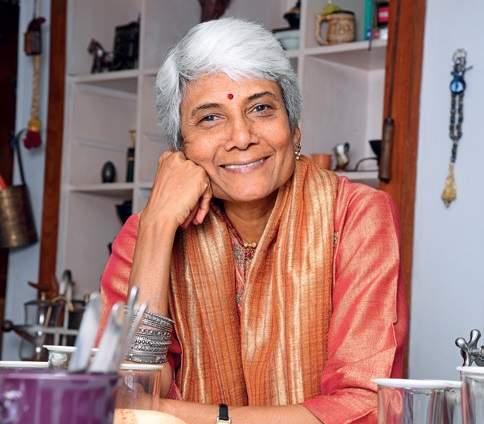
Asia’s first lady of coffee Sunalini Menon says she never planned on being a coffee-taster. She says that she decided on a course in Dietetics or a Phd. in Foods, when she chanced upon an advertisement calling for Assistant Cup tasters at the Coffee Board of India. “I had tried tea tasting as a child at an uncle’s tea estate in Munnar and the ad brought back happy memories of sipping, slurping, spitting and looking wise. I applied for the post and was called for the interview.”

She had to compete with eight men with more experience and qualifications, and that was her first job interview. Sunalini came first in the written and oral tests.

Sunalini, Asia’s first woman coffee taster, says, that the internal panel of examiners were not too keen to appoint her because she was young, had no knowledge about coffee and was a woman who could get married and give up the assignment. “But the then chairman of the Coffee Board was insistent that gender should not come in the way of a job and that as I had topped the interview, that I should rightfully be given the assignment.” Sunalini then joined the Coffee Board of India in 1972.

It wasn’t easy working at the Coffee Board of India, she says. She was the only woman at the officer’s cadre level in the Board then. “The staff working under me refused to accept my instructions or the schedule I had set for work, they were not used to taking instructions from a woman,” she says. “Fortunately, I had a chief who took me under his wing and advised me to first learn the subject and give them time to accept me. His parting words were ‘Tread slowly, but firmly’.”

The in-house training she was given was intense. Every day, she would taste washed arabicas, unwashed arabicas, washed robustas and unwashed robustas, to understand the various nuances in a cup.
Also, a founder trustee of the Women’s Coffee Alliance – India Chapter, Sunalini was present at the Coffee Santhe held recently at Karnataka Chitrakala Parishat. She says, “This is our annual fund raiser to help empower women coffee-plantation workers and their girl children.”

Coffee tasting is both a science and an art

While carrying out coffee tasting, there is a protocol that one needs to follow. The attributes that are evaluated in the cup are fragrance, which is the smell of the coffee powder in the dry state, and aroma, which is the smell in the wet state, when water is added to the powder. During the aroma evaluation, the crust (floating particles on the surface of liquor or the brew prepared for tasting and all the aromatic volatiles) is broken. With“Breaking of Crust”, fragrance, aroma and the other attributes are evaluated for flavour, aftertaste, acidity, mouthfeel, uniformity, balance, cleanliness, sweetness and, finally, the overall rating of the cup.

source: http://www.newindianexpress.com / The New Indian Express / Home> Cities> Bengaluru / by Akhila Damodaran / Express News Service / December 08th, 2017

‘Strengthen JD(S) in Kodagu’

The JD(S) should be strengthened for the growth of the party in Kodagu district. The party workers should create awareness on the secular stand of the JD(S) by visiting households, said former minister B A Jeevijaya.

He was speaking at JD(S) workers meet in Madikeri on Sunday. The political change in the country should start from the state. To meet this goal, JD(S) workers should unitedly work for the victory of JD(S), he said.

JD(S) district President Sanketh Poovaiah said that The Congress and BJP are engaged in dividing the society on the basis of caste and religion and people have lost faith in the Congress and BJP.

source: http://www.deccanherald.com / Deccan Herald / Home> District / DH News Service – Madikeri / December 04th, 2017

Hockey World League Final: AB Subbaiah wants India to play attacking game

Indian hockey team drew one match and lost one match, in their first two ties at the Hockey World League Final so far

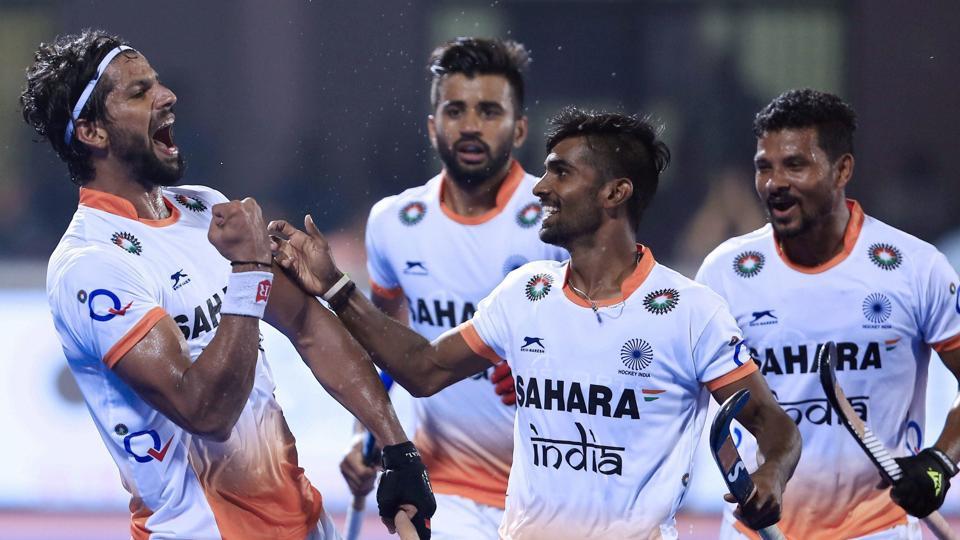
India lost 2-3 against England during the Men's Hockey World League Final 2017 in Bhubaneswar on Saturday.(PTI)
India lost 2-3 against England during the Men’s Hockey World League Final 2017 in Bhubaneswar on Saturday.(PTI)

AB Subbaiah, former Indian hockey team goalkeeper and coach, isn’t worried with team’s inconsistent showing in the ongoing Hockey World League Final. But he is concerned with their defensive play, which resulted in 2-3 loss to England in their second league match on Saturday.

He wants the young Indian side to play an attacking game from the start to end and suggests it as the only way of getting success against the rivals. “We need to play an attacking hockey till the end. To match-up with world’s top team this is the only formula to adopt,” Subbaiah told HT on Sunday.

“Look at team like Germany, which kept the rivals at bay throughout the match on Saturday, but on the other hand our boys in the match against England looked slow and in defensive mode from the very beginning,” he said, adding, “Indian could wake up only after sustaining two goals in the match. Though they came up with some good hockey by restoring parity, they lost steam thereafter.”

Known for his flawless expertise at tiebreakers during his days in the game Subbaiah admitted that India have good bunch of fit youngsters, who can surprise any team in the world, but they need to maintain pace in the match till the end. “Defensive errors in the match let India sustain all three goals against lower ranked England. We could have won the match easily, had we not committed unforced errors,” he said.

He, however, praised the young goalkeepers Akash Chikte and Suraj Karkera for showing well in absence of regular and experienced custodian PS Sreejesh, who is nursing injury. “These youngsters are quite good under the bar, but need to have experience. The number of young goalkeepers in the national camps should be five at least and should be given match practice and exposure too,” said Subbaiah.

“Only with a big pool of talented goalkeepers, we can pick the best one for a particular match of the event. I don’t find any of these young goalkeepers 60 percent close to the caliber of Sreejesh, but it’s true that in future they may achieve that reputation.”

Advocating for a quick but solid return of a fit-again Sreejesh in the team soon, Subbaiah said that the experienced keeper is the need of the hour for India, especially when they would be playing in the Asian Games, Commonwealth Games, World Cup and Olympic qualifiers next year.

“We don’t have any other option, and Sreejesh would be the key players in India’s things of scheme next year, which can change the fortunes of the Indian hockey,” he said. “It’s good to know that Sreejesh has been recovering fast and is 70-80 percent match fit, but he should take the field only when he is fully fit,”

source: http://www.hindustantimes.com / Hindustan Times / Home> isl 2017-2018> Other Sports / by Sharad Deep, Bhubaneswar / December 04th, 2017

CNC observes Huthari in traditional fervour

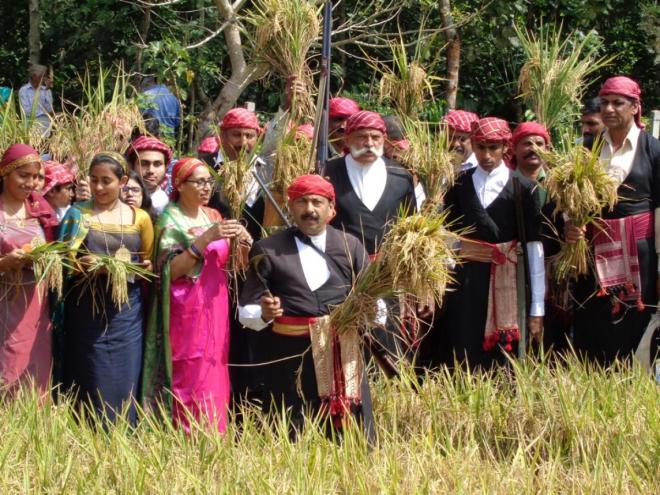
CNC President N U Nachappa and CNC members observed Huthari festival by cutting paddy sheaves in the filed of Uthappa at Chikkabettageri near Kushalnagar on Sunday.

The Codava National Council (CNC) led by its president N U Nachappa celebrated Huthari, the harvest festival of Kodagu, at a paddy field of Nandineravanda Uthappa, in Chikkabettageri village near Kushalnagar in Kodagu on Sunday.

By cutting paddy sheaves in the paddy field of Uthappa, the members celebrated the festival in a traditional manner.

The members offered prayers to the gods and began the Huthari celebrations with ‘Nere Kattuvo’ ritual. The leaves of mango, jackfruit, “Arali”, “Kumbali” and cashew nut trees were used in the ritual.

After the ritual, the participants walked in a procession to paddy fields accompanied by the ‘Dudikottpat’ (Dudi is a small drum of Kodavas).

After firing thrice in the air, the paddy sheaves were cut and brought home in a procession.

The CNC members performed traditional Kolata, Pareya Kali and Chowkata on the occasion. People relished Payasa, “Thambittu,” “Kadubu”, “Pandikari” and other delicacies on the occasion.

Speaking on the occasion, the CNC President urged the government to include Kodava language in the 8th Schedule of the Constitution.

He said that the government should accord tribal status to Kodavas.

The central government should declare a holiday for Huthari festival.

The CNC is continuing its struggle for an autonomous Kodava land and Kodava land should be declared a union territory. The culture and tradition of Kodavas should be included in the Intangible Cultural Heritage of Unesco, he said.

source: http://www.deccanherald.com / Deccan Herald / Home> District / by DH News Service, Kushalnagar / December 03rd, 2017