What would life be without spicy food, ice-creams, perfumes, fragrant flowers, late-night parties and alcohol? Ask Sunalini Menon, who swears by this regimen.
No, she’s not a health freak or someone prone to allergies. She’s been practising abstinence for the sake of her passion, which is also her profession.
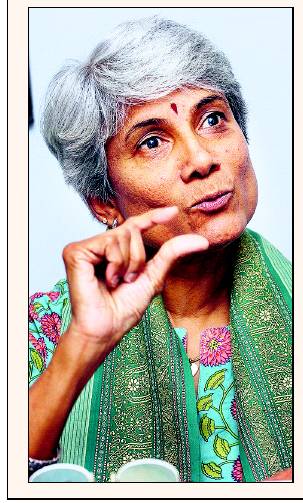
Asia’s first and only woman professional in the field of coffee cupping (tasting), Sunalini has experienced the aroma of several thousands of coffee types and spent a considerable time in the fields. “I love ice-creams and soft drinks but they affect my taste buds. My profession requires them to be extremely sensitive. So, I steer clear of cold food items or beverages,” she said. The chief executive of Coffeelab, one of India’s largest coffee exporters, Sunalini spoke to TOI on the ocassion of Coffee Santhe, a three-day carnival hosted by Karnataka Chitrakala Parishath.
Restraint and discipline are core attributes of a good coffee cupper. “It is essential to preserve the palate, the instrument vital for coffee tasting. We’re advised to avoid spicy food. Alcohol and smoking are a strict no no. Late nights and poor health can be a hindrance to the job,” she explained.
Coffee cuppers have to perform regular tongue exercises not only to keep their taste buds active but also to pick up foreign flavours. “Cupping with experts from other parts of the world helps calibrate one’s potential and understand the coffee produce of other countries. One also needs to perceive through the eyes, nose and palate of other cuppers,” she said.
Habituated to taking a sip and playfully swirling the liquid in her mouth before spitting, Sunalini said her job doesn’t allow her to swallow the coffee, however aromatic and delicious it be. “Coffee can have the distinct enzymatic flavours of apples, apricots, peaches and berries; sugar-browning flavours of chocolate, caramel, honey or those of spices like clove and pepper. It is an inborn acuity of taste, knowledge, experience, memory and good communication skills which help the cupper differentiate one flavour from another,” she said.
Sunalini, who entered the male bastion decades ago, said her journey hasn’t been easy. “I wasn’t lucky enough to be handheld when learning the tricks of the trade. I had to learn on my own, especially the chemistry of the coffee bean. It took a long time for me to be accepted into the fold, but once there, you are in,” she said.
Cupping as a Career
There are certifications for coffee tasters issued by the Specialty Coffee Association of America (SCAA) and Specialty Coffee Association of Europe (SCAE). The SCAA issues two types of certificates. One is called the Licensed ‘Q’ grader and the other, the Licensed ‘R’ grader. The ‘Q’ grader licence is a certificate for proficiency in evaluating arabica coffees and the ‘R’ grader for proficiency in evaluating robusta coffees,” said Sunalini.
She admitted that coffee tasting as a career could have some limitations.
“To overcome them, one needs to perhaps complement tasting with other jobs such growing, roasting or marketing coffee,” she said.Coffee tasting is more of a passion; it may not help you financially, especially in the first 10 or 12 years. Credibility comes only through knowledge and experience,” Sunalini signed off.
source: http://www.timesofindia.indiatimes.com / The Times of India / News Home> City> Bengaluru / by Sreemoyee Chatterjee, TNN / September 26th, 2015
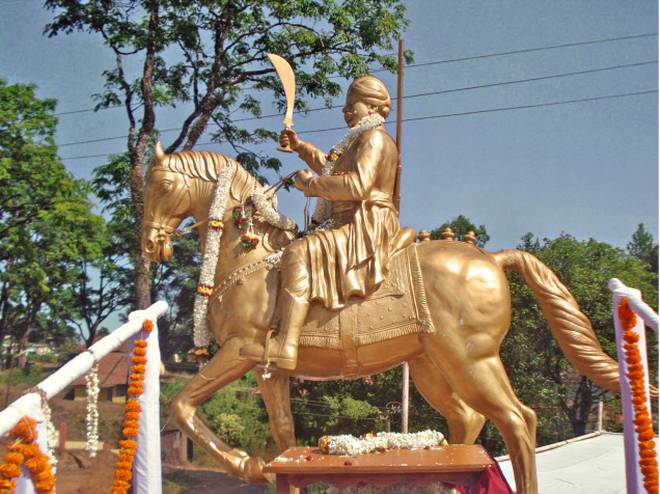
The bronze statue of freedom fighter Guddemane Appaiah Gowda, which was unveiled in Madikeri on Monday.
He was hanged by the British in Madikeri on October 31, 1837
Chief Minister D.V. Sadananda Gowda said on Monday that his government would take steps to initiate the process of development in Kodagu, a land known for its warriors, freedom fighters and natural landscape.
He was addressing a gathering at the Gandhi Maidan here after unveiling a bronze statue of Guddemane Appaiah Gowda at Field Marshal K.M. Cariappa Circle.
Appaiah Gowda was a freedom fighter, who was hanged by the British on charges of sedition on the fort premises here on October 31, 1837.
Mr. Sadananda Gowda’s wife Dotty hailed from Guddemane family. She was also present.
The Chief Minister said that he had taken nearly six months to visit Kodagu as he was being pressured by Madikeri MLA M.P. Appachu Ranjan and Speaker of the Legislative Assembly K.G. Bopaiah to take steps to solve the vexed Jamma Bane issue in Kodagu before the visit.
Responding to the demands made by Mr. Ranjan and M.C. Nanaiah, MLC, Mr. Gowda said that he would take steps to include a proposal to set up a medical college in Kodagu in the next budget.
A sum of Rs. 322 crore had been spent on various development projects such as roads, bridges, and buildings in Kodagu in the past few years. A sum of Rs. 115 crore would be sanctioned to the district in 2011-12, he said.
On considering Mr. Ranjan for inclusion in the next Cabinet expansion, Mr. Gowda said how could he deny it when he himself was the Chief Minister and he was versed with the requirements of Kodagu. All 122 MLAs from the BJP were capable of becoming Ministers, but it was not possible owing to restrictions.
Mr. Gowda, who conducted a progress review meeting involving officers of various departments at the Sudarshan Guesthouse, took exception to the tardy progress in the execution of projects under the Mahatma Gandhi National Rural Employment Guarantee Act (MGNREGA) in Kodagu. He instructed the officials to speed up work on the projects.
Of the 3,850 projects planned under the scheme in Kodagu, only 508 had been completed, according to officials.
Expressing dissatisfaction over the implementation of drinking water projects in the district, Mr. Gowda directed the officials to complete them in a month.
Of the 235 projects, only 22 had been completed in the current year, the officials stated.
Of the Rs. 8.5 crore earmarked for drinking water schemes in Kodagu in the current year, only Rs. 3.75 crore had been spent. Mr. Gowda announced that he would take the issue of lack of progress in the execution of projects in six departments seriously.
Mr. Gowda and Air Marshal K.C. Cariappa (retd.), son of Field Marshal K.M. Cariappa, paid respects to Field Marshal Cariappa’s statue.
source: http://www.thehindu.com / The Hindu / Home> National> Karnataka / by Jeevan Chinnappa / Madikeri – January 03rd, 2012 (updated July 25th, 2016)
The corporators-elect of Congress,who are camping at two resorts in Madikeri, were on Wednesday given a special lecture on the rights and responsibilities of the corporators.
Yeshwantpur legislator S T Somashekhar, Tarikere MLA Srinivas and senior corporator Gunashekhar delivered lectures for two hours at Vivanta By Taj hotel.
Senior corporator Padmavathi said that the elected members should understand the stand of their party on a particular issue. She said that they should support their party colleagues in meetings and should launch an attack to counter the Opposition parties. She said that the mayor should allot the funds available at his/her disposal equitably. The members elected for the first time heard the lectures attentively.
Some members expressed the opinion that the poor and the downtrodden had overwhelmingly voted for them. Hence, special programmes should be launched for their welfare. The corporators-elect cancelled their plan to visit the Dubare elephant camp in order. According to sources, the plan was dropped as otherwise it would convey a wrong message to people.
source: http://www.deccanherald.com / Deccan Herald / Home> City / Madikeri (Kodagu Dist) / DHNS – September 10th, 2015
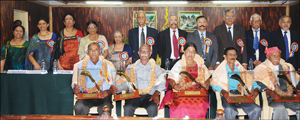
The senior members of Kodava Samaja, Mysuru (sitting from left): Machura N. Kaveriappa, Napanda U. Aiyappa, Kakamada Ganga Chengappa, Bottolanda M. Ponnanna and Ponjanda S. Arjuna, who were felicitated with a shawl, garland and memento at the annual get-together held at Field Marshal K.M. Cariappa Community Hall in city yesterday, are seen with (standing from left) Ponjanda Lovely Appaiah (Hon. Secretary, Sree Kaveri Kodagu Mahila Sangha); Thambanda Neena Devaiah (Jt. Secretary, Kodava Samaja); Balyamanda Sarasu Nanaiah (President, Sree Kaveri Kodagu Mahila Sangha); Chembanda Nanjamma (President, Kodagu Sahakara Sangha); Mechanda Mithra Karumbaiah; Mechanda M. Karumbaiah (President, Kodava Samaja); chief guest Kambeyanda C. Biddappa (retired Senior Vice-President, ITC); Moovera K. Kuttappa (Vice-President, Kodava Samaja); Kekada M. Belliappa (Hon. Secretary, Kodava Samaja); Kuppanda P. Subbaiah (Treasurer, Kodava Samaja) and Prof. Kambeyanda C. Belliappa (Chairman, Sree Cauvery Educational Institution)
Mysuru :
The annual Kail-Poldh get-together was celebrated at Field Marshal K.M. Cariappa Community Hall in Vijayanagar 1st stage here yesterday under the auspices of Kodava Samaja, Mysuru.
The day-long programme began with Ayyalapanda Pattu Pemmaiah performing Ayudha Puja to the traditional weapons of Kodavas. Kail-Poldh festival is celebrated in Kodagu during the end of the paddy sowing. Kail means weapon or armoury and Poldh means worship. The festival also signifies the day that men should prepare to guard their crop. Hence, on the Kail-Poldh day, the weapons are taken out of the puja room, cleaned and puja is offered.
Kambeyanda C. Biddappa, retired Senior Vice-President, ITC Ltd., who was the chief guest, felicitated eminent Kodavas and senior members of the Samaja in recognition of their service to the Samaja and the society.
Speaking on the occasion, K.C. Biddappa said that higher education was the most important enabler for all-round development of a community. He then said it was unfortunate that while Kodava students in urban areas are doing well academically their rural counterparts are lagging behind and needed help.
“These rural poor Kodava students need support from the community, and organisations like Kodava Samaja, Coorg Education Fund and Deena Bandhu Charitable Trust should help poor Kodava students without making merit the only criteria,” he added.
Stating that in most of the district head quarters every community has hostels to help their poor students to study with free boarding, lodging and financial support, he rued that there was not a single Kodava hostel any where. “If only we were to have Kodava hostels in Madikeri , Mysuru and Bengaluru, a lot of poor Kodava students would have benefited and progressed,” he opined.
Referring to the dwindling population of the community in Kodagu, he said Kodavas are losing relevance in their own homeland and that the Government does not bother because Kodavas are not a vote-bank.
Stating that Kodava population in Kodagu is just between 80,000 and 90,000, he said to become relevant Kodavas needed to take the support of all the moolanivasis of Kodagu like Peggade, Iri, Amma Kodava and other original inhabitants.
“We should all unite and take up our cause under one umbrella to create a sustainable and significant vote-bank, then only the Government will respond to our demands,” he said.
Biddappa reiterated that Kodavas must be united and said if Kodavas have to survive then they should focus on higher education and support poor Kodava students.
The senior members, who were felicitated by the Samaja are: Napanda U. Aiyappa, an exserviceman; Machura N. Kaveriappa, also an exserviceman; Bottolanda M. Ponnanna, who runs a private business; Ponjanda S. Arjuna, retired Circle Inspector and recipient of Chief Minister’s and President’s Medal and Kakamada Ganga Chengappa, who runs Swastha, a school for specially-abled children in Sunticoppa, Kodagu and recipient of Rajiv Gandhi Manav Seva Award for service to special kids. The above achievers were introduced by Mandira P. Kalaiah, Ammatanda Madhu Medappa, Machanda S. Muthappa, Thambanda Neena Devaiah and Kekada M. Belliappa respectively.
Replying to felicitations, the senior members, who are actively involved in the Samaja activities, called upon the Samaja, area-wise Kodava Associations and the community members to preserve and promote the unique Kodava art, culture and tradition by encouraging the Kodava youth to come forward and pursue the same.
On the occasion, various scholarships instituted by the Samaja members were presented to meritorious Kodava students (from 7th std. to Post-Graduation) and achievers in sports.
Kattera A. Kariappa, former President of Kodava Samaja and President of Deena Bandhu Charitable Trust, Mysuru, who also spoke, sought the support of the Samaja members to the Trust, which has been helping poor and needy Kodava students in their studies.
Earlier, Keethiyanda Kavya Kuttappa, Ketolira Bhavani and Appanderanda Thara rendered the invocation. Samaja President Mechanda M. Karumbaiah welcomed and presided. Treasurer Kuppanda P. Subbaiah read the names of the deceased members after which a minute’s silence was observed as a mark of respect to the departed souls.
Ponnachanda S. Bheemaiah read the names of the scholarship awardees.
Vice-President Moovera K. Kuttappa introduced the chief guest.
Ponjanda Lovely Appaiah compered and proposed a vote of thanks.
Hundreds of Kodavas attended the day-long get-together which concluded with sports and games for the members and their children in the afternoon session.
source: http://www.starofmysore.com / Star of Mysore / Home> General News / Monday – September 07th, 2015
Infosys co-founder and former Aadhaar chairman Nandan Nilekani donated Rs 50 lakh to the alumni association of Bishop Cotton Boys’ School in the city. The funds donated by Nandan, an Old Cottonian, will go to the school’s Benevolent Fund, created for retired teachers, administrative staff and sub-staff.
The fund goes to the General KS Thimayya Memorial Trust, an Old-Boys-of-Cottons endeavour established to commemorate General Kodandera Subayya Thimayya, also an Old Cottonian, who was in school from 1918 to 1922.
CN Kumar, senior trustee, General KS Thimayya Trust, confirmed Nilekani’s contribution. “The Trust is grateful to Nandan Nilekani, Old Cottonian, for becoming the anchor donor to the Fund. Nilekani has made a generous contribution of Rs 50 lakh. We are confident that other Old Cottonians will also contribute to the corpus,” said Kumar.
He also said this is perhaps the only such fund established by old students of a school.
The official communication sent to Nilekani read: “Thanks to OC Nandan Nilekani, from whom we have received a donation of Rs 50 lakh for an endowment to be used exclusively for the said purposes. Our first set of beneficiaries have been honoured on the occasion of Teachers’ Day. Thank you, Nandan, for this very generous gesture.”
The Benevolent Fund was established under the umbrella of the Trust to show our gratitude and appreciation to the teachers, administrative staff and subordinate staff whose contribution in our personal growth in the formative years is immeasurable.
The Trust will use the proceeds generated by investing the corpus to recognize and provide support to past teachers, administrative staff and subordinates every year.
source: http://www.timesofindia.indiatimes.com / The Times of India / News Home> City> Bengaluru / by Sunitha Rao, R – TNN / September 06th, 2015
Kodava Federation and Kodava Heritage Centre 1) M.N. Belliappa 2) M.C. Nanaiah 3) K.C. Cariappa
[Continued from August 22]
For a good friend, one would make a journey of a thousand miles and my visit to Bengaluru too was such a journey. A 50th wedding anniversary followed, a day later, by a wedding.
For the couple blessed with 50 years of married life, I wrote in the Visitor’s Book: “50 years of togetherness with understanding and the bliss that comes with it. Great. Here is wishing another 50+ years of wedded glory. — From friends of Dr. Sanmathi and Dr. Nitya.”
This was at Tamarind Tree Resort on the outskirts of Bengaluru on Kanakapura Road. The wedding too was on the same road at a Kalyan Mantap with a mythological name ‘Panchavati Pavilion,’ so far away, roads so bad. A friend asked me at the wedding, ‘Hey, couldn’t they find any other place in such a big Bengaluru?’ I merely grinned, still striving to overcome the tension that gripped us while driving at night to this place. Suffice to say it was a great wedding of the kind only few could afford or organise or spend. Apparently, an exclusive place, far away from the madding crowd, was needed for the wedding to be an extravaganza !
The following day, I found time to meet another friend at the other end of Bengaluru — Vasanthanagar. Mallengada N. Belliappa, Dada to his friends and family. A swashbuckling young Kodava entrepreneur since 1960s in Bengaluru, now a matured senior with commendable record of social service to the people where he lives and to the Kodava community in Bengaluru. A talkative person, he is also a doer bursting at the seams with energy even at this age.
A great philanthropist, every good cause will have him respond instantly and positively. It was under his initiative the first Coorg Public School (1996) at Gonikoppa, Kodagu, was set up, which has become a much sought after residential school. It was again under his initiative that Coorg Institute of Technology (an engineering college), again a first for Kodagu, was established in Ponnampet, South Kodagu (1999).
However, my interest was in the Federation of Kodava Samajas that was set up, again under his initiative, in the year 2000 at Balugodu, off Telllicherry (Thalassery) Road, 3 kms from Virajpet, Kodagu. As one occupied 24X7 as a coffee planter and a builder of many years in Bengaluru and now in Mysuru, Belliappa indeed has a vision for the good of Kodagu and its people. “For Kodagu to be saved from the present exploitation of its land and environment, all the original inhabitants of Kodagu of the days of the Rajas must come together and fight. Specially the prosperous communities — Kodavas and Kodagu Gowdas. The Britishers, known for their divide and rule policy, divided these two communities in 1937 at the time of Amar Sulya rebellion against the British occupation,” says Belliappa. I agree. He smiles and hopes this ‘coming together’ will happen for the greater good of both the communities and Kodagu as a unique geographic area tucked away under the shadow of Western Ghats with rain forests.
I go back to his pet project ‘Federation of Kodava Samajas’ and he goes off at a tangent telling, nay, re-telling the initial trials and tribulations in getting the land, the support extended by the former Minister M.C. Nanaiah etc. The then Chief Minister of Karnataka B.S. Yeddyurappa and the present Chief Minister Siddharamaiah have both generously given substantial amount of money that enabled the Federation to construct the buildings. He regretted that donations from the Member-Samajas and individual donors were not encouraging considering the size and scope of the project.
Belliappa then narrated an incident where a sum of about Rs. 94 lakh that was sanctioned to the Federation by the Union Ministry of Tourism with the help of the then Tourism Secretary, Rathi Vinay Jha, IAS (now retired). I am told that she is the sister of the famous Kodava of Codanda family, late C.G. Somiah, Comptroller and Auditor General of India (CAG). Here is how the Federation lost that grant as told to me by Belliappa.
It appears, Rathi Vinay Jha had come to Virajpet, Kodagu, to inspect the land of the Federation at Balugodu before releasing the grant. After the visit, she stayed overnight as a guest in the house of her relative, a retired high-ranking Army Officer. Well, the next news Belliappa heard was that the grant was diverted to a new entity, conceived by the host Army Officer, called ‘Kodava Heritage Centre’ to be set up in the District Head Quarters Madikeri where it will have maximum exposure, including from tourists, unlike at the Federation site away at the border of Kerala State near Virajpet.
Personally, I thought there was some sense in the idea though Belliappa may not agree. In fact, when the idea of a Federation was first mooted I had told Belliappa that it must be at Madikeri. However, I was told there was no land available in Madikeri, hence Balugodu was chosen.
In retrospect, I wonder, how come the District authorities, who could not find land for the Federation near or around Madikeri, could now find 5 acres of land at K. Badaga village near Madikeri for the Kodava Heritage Centre? Now I learn that the Centre will get another 10.68 acres of land as well. Well, where there is a political and bureaucratic will, there is a way. Where Belliappa and his friends failed, the high-ranking Army Officer, all by himself, succeeded.
M.C. Nanaiah, then MLC, Appachu Ranjan, then (now also) MLA and Air Marshal K.C. Cariappa (retd.), who are members of this Kodava Heritage Centre, should do some introspection on the issue of the Federation not being able to get the land for its establishment in and around Madikeri. Great iconic institutions have always born first in the minds of visionary leaders. Did these leaders lack that kind of vision for locating an important institution of Kodavas like the Federation in right place? I do not know.
Here I must salute Air Marshal K.C. Cariappa (son of Field Marshal K.M. Cariappa) for speaking out on the issue like shooting straight from the hips, as they say. At the meeting held on 24.6.2010 in the Deputy Commissioner’s Office, Madikeri, to discuss about the Kodava Heritage Centre with the DC in the chair, there were members and officials numbering 15 as per the minutes of the meeting. It was only Air Marshal K.C. Cariappa, who had the gumption and honesty to ask, “As I know, a plan is afoot to construct a Kodava Heritage Centre at Balugodu by the Federation of Kodava Samajas and, therefore, what is the purpose of constructing another separate Kodava Heritage Centre in Madikeri? Is it required?”
Surprisingly, M.C. Nanaiah parried the question like a typical politician saying, ‘Since this project is financed by the Central aid, it is not wise to make any change in the project (location).’ I learn, M.C. Nanaiah knew that this Central aid was originally meant for Balugodu project of Kodava Heritage Centre. If so, why did he not support Air Marshal K.C. Cariappa? Of course, Rathi Vinay Jha’s reasoning was sound and sensible when she said that for such a project Madikeri, the District Head Quarters was the ideal location as it would get maximum exposure. It was the very reason why I was asking Belliappa to bide the time to start the project till land is available in or near Madikeri.
How I wish the Federation got this 5+10 acres of land near Medikeri in the year 2000 so that every iconic Kodava-centric project like the Kodava Heritage Centre, Library, Hall of Fame, Kodava War Room, etc., could be located in one place.
Be that as it may, so far the PWD has been given Rs. 153.54 lakh for the construction of this building and Rs. 9.38 lakh is lying without being spent. The total cost has been revised to Rs. 2.68 crore from the original estimate of Rs. 1.45 crore. The Central Tourism Department has released another Rs. 1 crore on 16.2.2015 to the account of the DC. Now, money is no constraint for completing the project, it is the will to complete.
I am left wondering how some good projects lose proper direction because of indifference or ego on the part of the decision-makers as in this case.
Finally, an effort should be made by all concerned to bring this Kodava Heritage Centre, Madikeri, under the umbrella of the Federation of Kodava Samajas. May be, it is possible, if Rathi Vinay Jha co-operates. After all, the ship is greater than the crew! Did you get me Steve?
e-mail: kbg@starofmysore.com
source: http://www.starofmysore.com / Star of Mysore / Home> Abracadabra….Abracadabra / by K.B. Ganapathy /Saturday – September 05th, 2015
The world has a dark fascination about war and particularly the Second World War. The last of the war action may have ended in 1945, but our imagination never seems to stop wondering about the large scale hostilities and the repercussions that wars have come to represent.
Every new book or movie about the Second World War opens us to some aspect of that war not known to people.
Raghu Karnad’s book, Farthest Field – An Indian Story of the Second World War, is what the title suggests and much more. It not only takes us through a journey of three men lost to war, but talks about India’s role in the Second World War and throws in snatches from the country’s nationalist movement that ran concurrently with the war.
Death, we have often believed, has an element of finality. But Karnad says people have two deaths. The first death occurs when they die, and the second when all those who remember them also die. Beautifully put.
The second death is the farthest field from which no one returns, says Karnad, and so the name of his book.
But war, says Karnad, brings the two deaths close, because it “chooses young people most deliberately to die”. A life barely lived, most of these young people lost in wars often end up as photographs.
And it was photographs of three young men that stood on table tops in his grandmother’s house that prompted him to prise open a history unknown not only to him, but to a whole generation of Indians.
These youngsters who stood in the photographs — Bobby Mugaseth, Manek Dadabhoy and Ganny or Kodandera Ganapathy — had their lives intertwined with each other through marriage and through their involvement in World War II. Bobby’s sisters had married Ganny and Manek. Ganny was Karnad’s maternal grandfather, while Manek and Bobby his grand-uncles (his mother’s uncles). Bobby’s sister Nugs (the author’s grandmother) was married to Ganny.
The book opens in Calicut, at the residence of Mugaseths, and follows the personal stories of these three men, a story recreated by the author with the help of research, conversations, chronicles and his own creative mind’s eye.
In the process of recreating the story that started unfolding 80 years ago, Karnad also had to understand the role of Indian Army in the Second World War and the country’s own nationalist movement that was playing out at the same time.
India’s broader role in the Second World War is that it had the largest volunteer army fighting the war for the British Empire. As per Karnad’s estimates, more than two million men and women served in it.
“As a part of the British Empire, India had won its war. Then, ceasing to be a part of the Empire, it won its independence,” says Karnad in his book. To a large extent, one was born of the other and yet India’s part in the world war is absent from its own history, he says.
Bobby’s journey took him to Roorkee training camp and then to Iraq and later to the Burmese frontier to defend India against Japanese forces. Bobby’s life was hell during the last few months with death staring at him daily, but he died of a shot from his own revolver. The gun went off in error was the explanation given. The truth was that nobody would know what caused that death. That was 1944.
By the time Bobby was gone, his brothers-in-law Manek and Ganny were already lost to war. Manek joined the Indian Air Force as a fighter pilot and died in 1943 when he crashed into a mountainside in Manipur. Ganny became an army doctor in North-West Frontier and died in 1942 of bronchitis, at the frontier. “The farthest field is not just a conceit about Bobby’s death but one that applies to all those Indians who were lost to the Second World War,” says Karnad in his afterword to the book.
Undoubtedly, Farthest Field opens up India’s forgotten role in the Second World War and at the same time helps the reader to refurbish memories about the war itself and the events unfolding at home in the country that led to its independence from Britain. The author’s brilliance is evident in the fact that the reader is not only transported to that era, but helps to stay connected with the book until the end.
Delving into the effortless storytelling ability of the book, one can fathom the kind of work the author has put in to bring out this book, probably prompting readers to say that Karnad is a writer to watch out for in the years to come.
source: http://www.deccanherald.com / Deccan Herald / Home> Supplements> Sunday Herald Books / by Latha Venkatraman / August 30th, 2015
Kushalnagar, which is popularly known as the commercial centre of Kodagu district, has many historical monuments which are in a deplorable condition and crying for attention.
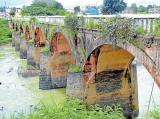
One such structure is the Praserpett Bridge built across River Cauvery, 167 years ago. The bridge, situated near the Kushalnagar Tollgate is 200 metre long and rests upon eight stone pillars of 40 feet wide each. Every pillar is 30 feet far from each other. The specialty of the pillars is that they have been plastered with a ground mixture of sand, eggshell and lime. The pillars from the ground level, are built in the shape of towers.
Every pillar contains valves so as to release the excess water during floods. When River Cauvery is in full spate, people drop by to watch the splendorous scene at the bridge.
The protective walls built on either side of the bridge are built to resemble the constructions in palaces and are intact to this day. The bridge dates back to the regime of Madras Presidency. The then Superintendent of Kodagu W C Hanslow, laid the foundation for the bridge on January 1, 1846. The construction of the bridge was completed in 1848.
The then Madras Governor George Markawis of Twidel and the then Mysore Commissioner Major General Mark Cubbon left the bridge open for public on May 12, 1848. The name of the bridge has been inscribed in English as well as Kannada on marble stone slabs, on either sides of the bridge.
But, after the new bridge was built, the old Praserpett Bridge was completely neglected.
Peepul trees have grown on the protective wall and pillars of the bridge. The people have urged to protect the historical monuments such as Praserpett bridge, Tippu’s Fort and the Old Inspection Bunglow.
Bar Association, Kushalnagar, president R K Nagendrababu urged that the Archeological Dept take an initiative and protect the bridge.
source: http://www.deccanherald.com / Deccan Herald / Home> District / Khushalnagar – DHNS, August 25th, 2015
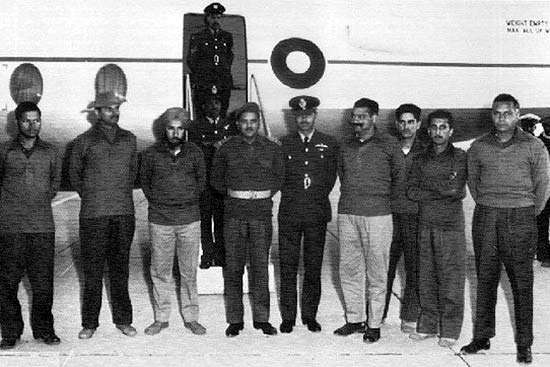
Prisoners of war at Delhi’s Palam airport after repatriation on January 22, 1966. The author is second from left
Fifty years ago, Cariappa’s Hunter aircraft got shot down over Pakistan. This is the fascinating story of the four months that followed…
by Kodendera ‘Nanda’ Cariappa
The second, or could it be called the third, Indo-Pak War was now nearly three weeks old, and there were no talks of a cease fire. To us in the field we did not really have a clear picture of how the war was going, or how either the Army or the Air Force was doing, on the ground or in the air. We knew of Air Force casualties more through the grapevine rather than through authentic sources. Our hope as young fighter pilots was to be detailed for as many operational missions as possible against the enemy. And of course, each of us hoped we would encounter him in the air and to shoot him down.
So it was on 22nd Sep ’65, I was detailed as the leader of what was meant to be a four-aircraft formation of Hunters. We took off at about 0830. Our target was enemy armour in an area some distance South of Lahore. Once the primary mission was accomplished, we could take on any ‘targets of opportunity’ that we might see. Now, in hindsight it would appear that our mission was not going to be as successful as one might have wished. At the take-off point final checks were carried out by the ground crew, rockets were ‘armed’ and the 30mm cannon were made ‘live’. This was when one of the aircraft had to return to dispersal because of a technical snag.
The first few minutes of the mission were over Indian territory, but as always, we were ‘keyed’ up and on the look out for enemy aircraft that might be on a sortie to attack our positions. As always happened, at least where I was concerned, there were butterflies in my stomach. The uncertainty of what awaited us across the border and what enemy opposition we might encounter was at the back of my mind. It was at this point that the pilot of the third aircraft found something seriously amiss with his aircraft and I ordered him to return to Base. And then there were two!
However, once over Pakistan, nothing mattered other than finding the enemy and doing what we could to destroy his armoured formations. We did not see too much by way of enemy activity other than a few dust columns that were kicked up by vehicles that were slow in following the standard dictum of ‘freezing’ in their tracks if enemy air was in the sky. We attacked what little we could see and then decided to return home. On the way back we spotted an enemy target that gave away its position by opening fire on us. We retaliated. Within moments of doing so my aircraft was hit by ground fire.
All the warning lights in my cockpit were illuminated, indicating that many systems and my controls had failed, and also to tell me that my aircraft was on fire. Shrapnel went through my cockpit and I found my controls jammed. My ‘wing-man’ called out on the radio that I was on fire and that I should abandon the aircraft. I acknowledged his transmission and ejected. All I can recall is my boots flying off and within seconds I was on the ground lying in a semi-supine position. Within moments I was surrounded by troops who ordered me to raise my hands in submission, and to stand up. I replied that I could not do so as I was hurting badly, and felt paralysed. The troops were in khaki uniform and for some unknown reason I thought they were Indian. At about that time I could hear artillery opening up and one of the troops said, “Those are your guns firing at us”.
I was a Prisoner of War!
The time was 0904 because my watch had stopped, presumably on impact with the ground. I was asked who I was and from where I had taken off. As per standard procedures, I rather parrot-like gave my ‘name, rank and number’. It was then that I was asked if I was related to General Cariappa. I feigned a faint because of the pain, or maybe I did pass out. The next thing I knew was that I was lying on a litter in the back of a jeep and was being questioned by a Brigadier.
After some first aid I was moved to a rear location, to a place called Luliani where for some time I was left on the floor awaiting treatment and then as it transpired, evacuation to a hospital. I have no recollections of that journey. When I did come to, I found myself in a hospital bed and in excruciating agony. This was the military hospital in Lahore. The following day I was taken to the operation theatre and was told the extent of my injuries. I was impressed by the number of doctors who had returned from abroad to be of service to their nation at this juncture in its history.
I stayed in hospital for about a week during which time General Musa the Pakistan Army Commander in Chief visited. He came to see me, knowing by now that I was General (KM) Cariappa’s son. He asked if there was anything I wanted. All I could think of was being with the other Indian prisoners of war. From Lahore I was flown to Rawalpindi and kept in the hospital there, and it was during this time that I was visited by President Ayub Khan’s son. Treatment and food in the hospital was good, yet being in solitary confinement I was hankering to be with the other Indians.
This happened soon enough and suddenly one fine morning I was discharged from the MH and moved blindfolded to what turned out to be a prison cell. Here I was given a pair of black armoured corps overalls, and a pair of rubber-soled slippers. It was by now almost mid-October with the winter chill beginning to manifest itself. There was one charpoy for furniture and nothing else. I was also given three typical army blankets; one served as the mattress and the other two as a covering. By day the outer wooden doors were closed, I was in darkness with no light penetrating, and by night they were kept open with the single dull electric bulb switched on.
If I wanted to use the toilet I would be taken blindfolded to the lavatory about 50 yards away. There the sentry would wait till I was through, and then would escort me back to my cell. It was here that a Major first interrogated me, and it was here that I really experienced the ‘fear of the unknown’ for the first time as a POW. There is no more frightening condition than being in solitary confinement. I was not subjected to ‘third degree’ treatment, but I was told that I had better answer all questions because if I did not, there would be no hesitation in ‘putting me away’!
I realized then that the standard ‘rank/name/number response would not help and so I did ‘reveal’ what I thought to be innocuous information. This lasted over a period of three days. During this tend days I was incarcerated in the cell I was fed thick wholesome ‘chappatis and dal’ twice a day. There would be a mug of sweet ‘langar’ tea at 0700 and again at 1500. ‘Lights on time’ was 1600. A few days later I was told that I would be moving to the main POW camp. I first moved to a transit camp in Rawalpindi itself where I was kept in ‘solitary’ again for two days. It was here that I met a Pakistan Army JCO who, having learned that I was my father’s son, came up to me and said he heard that I was in the Sadr Kothi (he meant the President’s home). I, of course, denied this.
A train journey to Dargai, throughout which I was blindfolded, to the main POW camp followed. Winston Churchill was supposed to have been billeted here too! Meeting with the 38 other Indian prisoners was a momentous occasion for me, who had, for the preceding six weeks been deprived of any form of company. I was the only airman with that group. I learned later that the others were kept in separate enclosures within in the same complex.
The next few days were filled with getting to know my mates, and settling into some kind routine. Soon thereafter, I joined the other airmen, who were Squadron Leaders Sikand and Pilloo Kakar, and Flt Lieutenants Mani Lowe, Lal Sadarangani, MV Singh and Vijay Mayadev. A third compound housed the twelve Sikh officers who had been segregated for political reasons. Our compound had a small forecourt about thirty feet long and some seven feet across. Then the billet that housed us comprised three rooms. One that had our seven charpoys packed closely together, a dry-toilet facility (more about this later) and our dining area.
We were given three blankets, and an olive green army pullover was all that we had to protect ourselves from the severe winter chill of the NWFP. As a result by 1700 hours we got into our beds and were regaled by stories and experiences by ‘Siki’ Sikand who seemingly had an endless fund of them. He often had us in splits of laughter! In the first week of November, quite inexplicably, Mani Lowe and I were told to ‘pack our bags’ as we were going “somewhere”. Blindfolded, we were put into a van and driven off to a place about two hours South from Dargai and put into two adjacent dank, cold and airless cells, similar to the ‘lock-up’ in our own Air Force Guardrooms.
The toilets were about fifty paces of so from our cells, and as was the practice, we would be blindfolded when being taken to and from there. We were not interrogated, and were unable to figure out as to why on earth we were separated from our mates. All we knew is that we were at an air force base because every evening and through the night we would hear the typical and unmistakable whine of Hercules aircraft starting up, taxiing and taking off. About ten days later we were returned to Dargai, much to our delight, and indeed relief.
The first Red Cross parcels came in on 7th Dec and our lot improved considerably. One packet that thrilled us was that the film star Asha Parekh had sent us dried fruit! Now, we were even provided with a quilt that was paid for from out of the approximately Rs 60 that was our entitlement as prisoners. The arrival of the ‘goodies’ from the Red Cross was an indication that our folks at home knew that we were alive!
Food was always the focus of attention. Breakfast was a boiled egg with three puris and a mug of tea. Lunch and dinner were always, monotonously identical; either lacy, glutinous “lady’s fingers” or well watered turnips to be eaten with chappatis and/or rice. We would be given a mug of tea at about 1500 hours and then we would play quoits for an hour or so. Once a week we had the luxury of a hot bath. Dinner would come by 1700 hrs after which Pilloo (Sqn Ldr Kakkar) would read to us from the Bhagavat Gita that we received with our Red Cross parcels.
Siki our ‘master chef’ was able to convince our ‘minders’ that we needed mustard oil to keep away the winter dryness from our skins. This then was used as a cooking medium and our dinner was a much more palatable meal with fried onions and some condiments being added. Dessert was usually a biscuit sandwich that had cocoa or melted chocolate providing the filling.
As 31st December approached we agreed that we must do something to celebrate New Year’s Eve. The first pre-requisite for a successful party was ‘hooch’! So, we decided to make some moonshine. The main ingredient would be methylated spirits to be purloined from the nursing orderly’s tray when he came every afternoon to dress MV’s wounds and mine. Our stratagem was to keep him distracted somehow, and for this Siki was particularly successful.
I cannot remember what excuse or reason we gave for asking for a pitcher, but we were given one. This was our ‘still’ into which put raisins, the bitter lemon (rind and all, and called for some unknown reason as “mitha”) that was provided as dessert and jaggery. We also added a few chappatis for good measure in the belief that the yeast would cause fermentation and therefore provide the desired ‘kick’ to our hooch. The ‘matka’ was then wrapped in a blanked and placed close to the fireplace where we hoped and believed its contents would mature!
Came New Year’s Eve, Dec 1965, the evening progressed as usual and we looked forward with eager anticipation to the dinner that Siki had planned. Dinner came at the usual time and then our chef got down to work. It is now almost 50 years since then, and I don’t remember too well all that we had to eat. But I do recall the unexpected arrival of the Camp Commandant who turned out to be a very pleasant chap. He wished us and then produced the unbelievable…some mutton, or, was it chicken? He left soon thereafter. We then drank our brew that tasted like nothing on earth, enjoyed a veritable repast, and talked late into the night.
Life carried on unchanging from day to day, when suddenly about the January 10 we received some intelligence that something was afoot. The source of our information was the sweeper who came in every morning to clean our ‘thunder boxes’. He was a Hindu, and therefore it appeared was sympathetic towards us. Given the menial and unpleasant nature of his duties it was not surprising that the guards accompanying him were reluctant to enter the toilets.
Siki ‘cashed’ in on this and wrapping his face securely to keep out the obnoxious smells, he would ‘chat up’ the sweeper. It was he who mentioned that in a few days a tailor would come to take our measurements, but he was unsure as to why. The tailor did arrive and within a few days we were outfitted with warm serge trousers and shirts, and even provided new olive-green pullovers. Events now moved fast, so fast that we did not realize we were being prepared for repatriation!
In fact, I don’t think we knew till the day of departure on 22 Jan 66. We were once again blindfolded, bundled into a vehicle and driven to Peshawar where we emplaned a Fokker F-27 that was going to Delhi to bring back the Pakistan COAS. We crossed the international border at approximately 0905, about the identical time that I was shot down exactly four months earlier.
Thus ended an unforgettable period in our lives. Siki retired as Air Marshal, Pilloo became a Wing Commander but was killed in an HF 24 accident. Lal Sadarangani, Mani Lowe and Vijay Mayadev left the Service as Wing Commanders and joined Air India. MV continued in uniform and retired as Air Commodore.
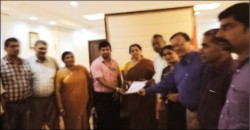
Mysuru-Kodagu MP Pratap Simha and others are seen presenting the memorandum to Union Commerce Minister Nirmala Seetharaman in New Delhi recently.
New Delhi :
A delegation of Kodagu Coffee Growers Federation, led by Mysuru-Kodagu MP Pratap Simha, met Union Commerce Minister Nirmala Seetharaman in New Delhi recently and presented a memorandum, demanding announcement of permanent solution for the problems being faced by coffee growers.
Speaking on the occasion, Nirmala Seetharaman said she would take appropriate action on loan waiver, package announcement besides addressing other related issues, after going through the facts and figures presented by the Coffee Board.
The delegation also met the Minister’s Secretary Rajani Ranjan Rashmi and discussed with her the losses faced by the coffee growers on account of the vagaries of nature.
Earlier, the delegation met former Karnataka Chief Minister and MP B.S. Yeddyurappa, during which he assured that he would raise the issue of problems of coffee planters along with that of the difficulties faced by growers of horticultural crops such as grapes, pomegranate etc., in the Parliament.
The delegation also met Rajya Sabha MP from Karnataka Kupendra Reddy and discussed with him the issues concerning coffee planters.
The MP said that all MPs representing coffee growing regions should come together in bringing pressure on the Govt. for addressing their issues and added that he would make all efforts to draw the attention of the Government towards the problems being faced by the coffee planters.
Federation President Ajjamada Shankaru Nachappa, Secretary Annira Harish Madappa, Treasurer Maanira Vijaya Nanjappa, Director Kaibulira M. Harish, officer-bearers Jammada Mohan Madappa, Maanira Muthappa, Ajjamada Chengappa and Machamada Sumanth, ZP President Chodumada Sharin Subbaiah, Coffee Board member Adengada Tara Ayyamma and others were part of the delegation.
source: http://www.starofmysore.com / Star of Mysore / Home> General News / Thursday – August 13th, 2015
WELCOME. If you like what you see "SUBSCRIBE via EMAIL" to receive FREE regular UPDATES.
Read More »