Category Archives: Leaders

Mysuru: Sacerdotal golden jubilee of Fr Louis Noronha celebrated

Mysuru :

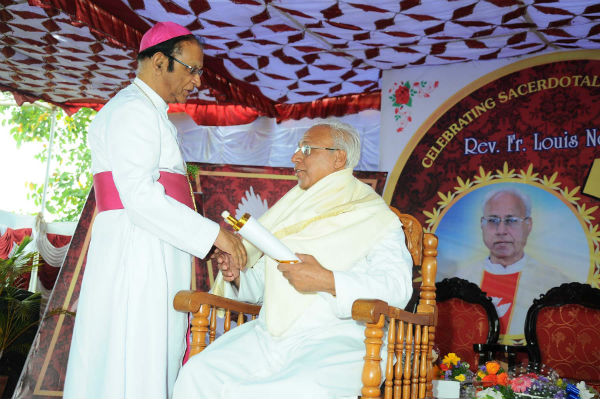
Fr Louis Noronha celebrated his sacerdotal golden jubilee on December 2 in Mysuru.

Thanks giving mass was held at St. Peter’s Church, Bogadi, Mysuru. Dr Thomas Antony Vazhapilly, Bishope of Mysuru and around 80 priests including the native priests, namely Fr Joseph Aloysius D’Mello, Fr John Francis Texeira, Fr Leslie Vernon Moras, Fr Michael Gonsalves, Fr Edaward William Saldanha, Fr Michael Menezes SMM, Fr Richard Britto, Fr Ronald Dhanthi, Fr Melwin Lobo SJ were present for the Eucharistic celebrations. There were hundreds of nuns and around 1000 people who took part in the thanks giving mass.

After the Holy Eucharist, there was short felicitation program for Fr Louis Noronha and to Bishop Vazhapilly who was also ordained on the same day. All the priests, nuns and faithful took part in the programme and wished Fr. Louis Noronha long life, good health, peace and happiness.

RevFrNoronhaKF18dec2014

All the Parish council members and the 21 Religious houses belonging to St. Peter’s Church, Bogadi, Antony Fernandes and John William D’Souza and their families worked hard for the success of golden jubilee celebrations.

Fr Noronha born on December 17,1938 is the son Joseph Noronha and Benedicta D’Souza in Kedamullur in Virajpet, which is called the cradle of religious vocations. He did his schooling at Kedamullur, then in St. Anne’s school, Virajpet and finished his 10th from the government high school Virajpet. In 1956 he joined St. Mary’s minor seminary, Mysuru and in 1958 he went to St. Peter’s Seminary, Begaluru, to do his philosophy and Theology studies. In the august presence of Pope Paul IV on December 2nd, 1964 Fr. Louis Noronha was ordained as priest during 38th International Eucharistic Congress at Oval Maidan, Bombay.

For the last 50 years Fr Noronha has worked in the diocese of Mysuru, being parish priest of different parishes in Coorg deanery, in Hunusur deanery, Kollegal deanery and in Mysuru deanery. He was also the Rector of St. Mary’s minor seminary for seven years.

source: http://www.daijiworld.com / DaijiWorld.com / Home> Karnataka / Media Release / Mysuru – December 04th, 2014

Stars bask in awards glory

Bengaluru :

Governor Vajubhai Vala congratulated the top athletes and coaches of Karnataka including Asiad gold medalists Ashwini Akkunji (athletics) and Sushmitha Pawar (kabaddi) on Wednesday for winning the Karnataka Olympic Association (KOA) awards 2014 and said more laurels could be won through the combined efforts of state government and KOA.

Addressing the gathering in Raj Bhavan, Vala said the state can be proud of its achievements in sports. “I’m happy to note that there are seven players in the Indian hockey team from Karnataka. Likewise, there are many others from the state who have done well at the international level,” the governor said after giving away KOA’s special awards to hockey players SV Sunil, Nikkin Thimmaiah, VR Raghunath, discus thrower Vikas Gowda, badminton player Ashwini Ponnappa, pistol shooter PN Prakash and other medal winners at the Incheon Asian Games.

The governor also recalled the Gujarat model of sports development which is now rated highly. “There is competition at the village, district and zonal level before they reach the state level and winners at all these levels are rewarded,” said Vala, who also served as the finance minister of Gujarat.

He also exhorted all youngsters to take up sports. “Today we see the absence of good character in many youngsters and that’s why sport is important as it helps in character building,” he said.

Chief minister Siddaramaiah stayed clear of committing anything more on the sports cess, despite being prodded by KOA president Govindaraj, but reaffirmed the government’s commitment to support sportspersons. “I’ve never said no whenever the sportspersons have come to me for help. We are improving the infrastructure in all the districts and that will help athletes from rural areas,” he said.

Ace badminton doubles player Ashwini Ponnappa was happy to receive the award in what was a big year for her. “It was a satisfying year as we have improved a lot winning medals in ABC, Uber Cup and Commonwealth Games. It is going to be another busy season from January with the World Championship in August,” Ashwini said.

Middle distance runner Ashwini was all smiles after collecting two awards. The lanky athlete said the awards are a big motivation to improve further. “This was a big surprise I was never expecting it,” she said.

The KOA also honoured several coaches including N Lingappa (athletics), DY Biradar (athletics), Manoharan G (boxing), Aslam Khan (football), Jude Felix (hockey) and Vasant Madhav (tennis). TOI’s principal photographer Syed Asif also received the honour.

Earlier, Govindaraj said the government has cleared the proposal for the construction of the Olympic Bhawan at the Sree Kanteerava stadium. “Karnataka will only be the second state after Andhra Pradesh to have their Olympic Bhawan,” he said.

source: http://www.timesofindia.indiatimes.com / The Times of India / Home> Sports> More Sports / by Biju Babu Cyriac, TNN / November 28th, 2014

K.M. Chengappa no more

KallichandaKF05dec2014

Mysuru :

Kallichanda M. Chengappa (45), Editor, Star of Mysore, passed away at his residence in Balele, South Kodagu, early this morning following a brief illness.

He leaves behind his wife, two daughters, two younger sisters, brothers-in-law and a host of friends and relatives. Last rites took place at his native village in Balele this afternoon.

Condoled:
Star of Mysore management and staff have condoled his untimely death at a meeting held at SOM office in Bannimantap this morning.

source: http://www.starofmysore.com / Star of Mysore / Home> General News / November 29th, 2014

Talks Honouring General Cross A Milestone

Aditya Sondhi (standing fourth from left) with other 'Old boys' of Bishop Cotton School
Aditya Sondhi (standing fourth from left) with other ‘Old boys’ of Bishop Cotton School

Bengaluru :

An annual lecture series in memory of General K S Thimayya enters its tenth year on November 22.

‘Old Boys’ of Bishop Cotton School started the lectures to commemorate the memory of General Kodandera Subayya Thimayya, also an alumni of the school. In an exclusive Aditya Sondhi interview with the City Express, managing trustee recounts the decade-long journey.

What inspired you to start this lecture series?

When Col Lalit Rai addressed a small group of us on his experiences in Kargil (where he won a Vir Chakra), it struck me that Bishop Cotton had an alumni that had so much to share. The lecture series was started in the memory of Gen Thimayya, one of our most towering old boys and one of India’s greatest generals. This would not only showcase the depth of the alumni, but also improve the quality of interaction among the participants and inspire the younger listeners to greatness.

Did any of you know Gen Thimayya personally?

Most trustees were born only after the General had passed on. But one trustee, Jairaj Daniel, remembers his father leaving him in the care of the General while he attended meetings of the board of governors at the school. Gen Thimayya had no reservations about spending the next hour or so chatting with the four-year-old! Another trustee, C N Kumar, fondly remembers him visiting the school as Chief of the Army Staff and the patron of the Old Cottonians’ Association. ‘Timmy’ was regarded as a ‘Soldier’s General.’ He was always close to his men, witty and jovial in tough situations, and fearless in thought and execution.

In the ZoJi la sector, he personally implemented the movement of tanks to hitherto unseen heights. His brand of leadership is to be treasured.

Is Bengaluru a good place to hold strategic affairs lectures?

Indeed, for the critical mass of retired military and government officers coupled with the Bengalurean hunger for intellectual stimulation.

However, I must clarify that our lectures go beyond strategic affairs and span art, science, social service and entrepreneurship.

Over the past 10 years, what difficulties have you encountered in organising these lectures?

This endeavour is run by seven friends, six of whom are large-hearted and spirited. Expectedly, with such ‘start-ups’, funding and logistics are always a challenge. Initially, we also found it challenging to convey our intent behind the lectures.

Fortunately, our patrons took to the lectures early enough to convince us that the effort was not in vain and needed to be sustained. Special thanks are due to the school, the family of the General and the armed forces veterans for their unstinting support.

Which lectures sparked the most intense discussions?

By far, Col Rai’s talk on Kargil in 2007 evoked the strongest feelings among the audience, with an intense and moving account of the valour of his troops. Dr Ajit Varki’s talk on experiments in glyco-biology, Phil Wollen’s talk on ahimsa and the vegan movement, and G K Pillai’s talk on internal security were very robustly received by the guests.

Give us an overview of how the lectures could shape up in the next 10 years. Any long-term vision?

The trustees aim to invite younger speakers and those with more eclectic life experiences. We also hope the lectures become more of a Bengaluru calendar-event and attract wider participation.

source: http://www.newindianexpress.com / The New Indian Express / Home> Cities> Bangalore / by Saloni Mital / November 12th, 2014

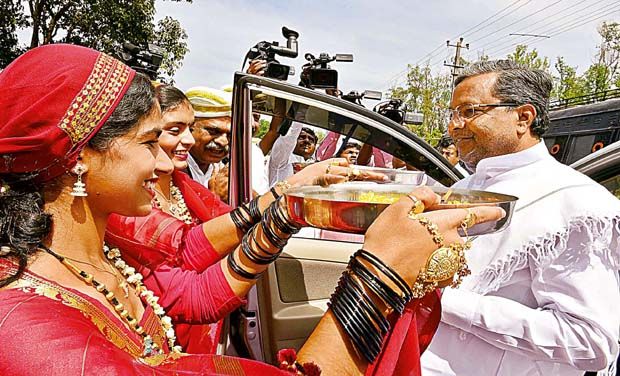
Like Ganga, like Cauvery: Chief Minister Siddaramaiah

Chief Minister Siddaramaiah being greeted in traditional style on his arrival in Kodagu to launch developmental projects on Monday

Mysuru:

The State will soon evolve a plan of action on the model of that for River Ganga, to purify Cauvery river water which is getting polluted with every passing day, said Chief Minister, Siddaramaiah at Madikeri, here on Monday.

Speaking to press persons, Mr Siddaramaiah, said, Cauvery is not just the source of drinking water for Bengaluru and other cities in Karnataka but the lifeline for neighboring States like Kerala, Tamil Nadu and Puducherry. ‘Hence the State will take necessary action to ensure its cleanliness,” he said.

He reiterated that the State has already opposed the Union government’s proposal to include the eco sensitive Western Ghats in the UNESCO’s list of World Heritage sites.

The State Government is very much committed to honor local sentiments in this regard, he said.

The Chief Minister also said that, the State government is evolving a permanent solution for the elephant attacks, for which the government has allocated 212 Crores in the current budget. The State has already released 58 crores for the purpose.

Barricades will be built alongside railway tracks across the forests to prevent elephant deaths, he said.

Mr Siddaramaiah also said, that among 22,000 vacant posts in the state police department, his government is committed to fill 11,000 posts in phases in the coming years.

Speaking after inaugurating the District Administration Complex in Kodagu worth Rs 14.44 Crores and laying foundation stones for various developmental projects at Gandhi Maidaan (Grounds) at Madikeri, Mr Siddaramaiah said, “Accepting a bribe to do the government’s work by government officials by itself is not corruption, but creating undue delay to get bribes amounts to corruption which every government servant should remember. Government’s work is God’s work’” he reminded.

source: http://www.deccanchronicle.com / Deccan Chronicle / Home> Nation> Current Affairs / DC / Shilpa P / November 04th, 2014

Queen of cuisines

Ranee Vijaya Kuttaiah talks about the intense relationship of her Kodava community with food, her quest for recipes across two States, and reveals secrets of the early years of food styling in India

Bursting with ideasRanee Kuttaiah has collected recipes from households of different communities in Karnataka / Photo: Bhagya Prakash k. / The Hindu

Avid golfer. Kalakshetra student. Bharatanatyam and Kathakali dancer. Great grandmother. Lived the good life in the Nilgiris. Travelled the world giving performances. Anjaneya bhakt. Ford Motors PR in New York. Writer. Food stylist. Lecturer. Hotel manager. A very good cook.

Ranee Vijaya Kuttaiah is so many things rolled into one, it’s difficult to keep pace with this energetic Kodava matriarch as she flits from one story of her life to another. She can hold forth on anything from how politics is dirty to why prostitution should be legalised. And from how to boil lobster just so, to how to make ice cream that won’t melt under bright lights. All this coming from a woman who, when she got married, didn’t know how to make a cup of tea.

“I used to write for The Hindu when I lived in the Nilgiris with my husband. I’m a Kalakshetra dancer. My husband died when he was young. I was just too heart broken and swore never to wear my anklets and dance again. I started writing short stories, started a company called Shadow Light Co-ordinators and we would do high-end food and fashion shoots in Bangalore,” says Ranee, of the beginnings of how she came to write about food.

ITC Windsor and Sterling Paperbacks re-launched a revised edition of her famous recipe book, Cuisine from Karnataka with her other classic Cuisine from Coorg this week at an evening that saw the who’s who of Coorg and Ranee’s friends bond over food and wine. Talking of the strong bond that her Kodava community has with food, she points out: “We worship our ancestors with liquor! On any occasion, we first offer a little bit of whatever we cook in front of the photos of our ancestors. We are a kshatriya race used to good food, and we are big agriculturists.”

While studying for her masters in the United States in the 1960s, during her summer break she chanced upon a food styling course in one of the hotels. She signed up for it and a whole unknown world was revealed to her. “Cooked food doesn’t style well. It creates a mess. Food is best shot uncooked. I’ll tell you a secret. You can’t photograph steam. So when I had to shoot a hot, steaming kettle, I would blow out smoke from a cigarette just in time for the photographer to shoot. Mind you I don’t smoke. Ice-cream melts under lights. So we would whip paint and freeze it to look like ice cream! I would par-boil lobsters and then paint them with lovely orange oil paints before setting it up on a silver platter.” When she styled food for the famous Sangeeta Khanna cookbook, her present publisher appreciatively ate a meal in her house and asked her to write a book on Coorg cuisine. Ranee turned to her mother for the classic recipes of Coorg. It’s a book that’s been going into reprint for the last 14 years.

One book led to another. Having lived 30 years in Tamil Nadu and having performed all over the State, she recalls taking down recipes whenever she travelled in Madurai, Ramnad, Thirunelveli and Thanjavur, recording recipes of Nadar and Thevar cuisine, which featured in her book Cuisine from Tamil Nadu. Her own personal favourite, though, is Syrian Christian non-vegetarian food from Kerala, she pipes in.

She decided to write about Karnataka cuisine because — “it’s my State and largely ignored” she says, with a mix of pride and hurt. “It’s was as if holige and bisi bele bhath were the only things Karnataka had to offer,” she says talking of the limited popularity of food from the state then. She had close friends in political circles like Ramakrishna Hegde. “Many of the ministers were Lingayats and Gowdas. I would travel to Mandya and Maddur, visit the homes of the Gram Panchayat chiefs and ask their wives what they cook at home. I would collect four to five recipes from different families of the same dish, come home and try them in my kitchen and arrive at what I thought was the best of them.” Her book on Karnataka covers food from the Lingayat, Gowda, Bunt, and Madhwa Brahmin community (into which her sister was married).

source: http://www.thehindu.com / The Hindu / Home> Features> MetroPlus / by Bhumika. K / October 17th, 2014

Surgeon’s write path

Kavery Nambisan. (Photo: DC)

Hyderabad:

While she was still studying surgery at the University of Liverpool in England, Kavery Nambisan was informed by her friend that a mission hospital in Bihar was in desperate need of a surgeon, and asked if she would be interested in the offer. She took it up as a challenge and landed in the town of Mokama, a dacoit infested area, where she went on to treat patients who had faced several degrees of violence.

After Mokama, she worked at rural hospitals in Uttar Pradesh, Tamil Nadu and Karnataka, where she presently works in the Coorg district. But in the meanwhile, Kavery found time to write seven novels in the last two decades.

Her last book, The Story That Must Not Be Told was shortlisted for the DSC Prize for South Asian Literature as well as the Man Asian Literary Prize. “I started writing once I had become a doctor; initially it was few flippant pieces here and there, and then I ended up writing two children’s novels. It was a revelation for me, because I don’t have a literary background,” she says.

Kavery soon ventured into writing adult novels because she felt there was more to her imagination that she could put down on paper. Her recently released seventh book A Town Like Ours, chronicles the growth of Pingakshipura, a village that has now become a town. It is a place where the water runs a poisonous black and the hair on every child’s head is white. And all of this is through the eyes of an ageing prostitute who resides at a temple premises.

The central character is borrowed from one of Kavery’s childhood memories. “When my father was transferred to Delhi, there was a temple we used to visit often. Right next to the temple, in a room, I found this scantily clad elderly lady who was smoking a hookah and had several men huddled around her. She had a loud voice, and as a young girl, I was mystified and yet disgusted by her appearance,” she adds. But do most of her memories, or her medical experience find place in her books?

“Not constantly, but since I am a writer, I do observe. I listen to my patients intently when they confide in me about their family problems. Any inclusion is not always intentional but I guess once you have the seed of something, you can always create,” she says.

Kavery, who writes early in the mornings and during weekends, says that she never had a problem juggling her professional expertise with her passion for writing. “Since I have always had it this way, I never have really seen it as a problem. Apart from medicine and writing, I don’t feel the need to socialise because I meet so many people anyway. However, I have discovered that I can write an awful lot in hotel rooms when I am travelling, because there I have no other responsibilities,” she adds.

In the present times, when bookstores are stocked with new authors writing about college romances and urban life, there are barely a handful of voices which document the rural facets of our country. The author adds, “It’s not their fault that most of these young authors did not have any rural experience to write about. On my part, I am deeply saddened by injustice which plagues our society. When I have the opportunity of education and upbringing, someone else is continuously being denied it. I constantly think of it, but I haven’t been able to come up with an answer. But instead of feeling helpless, we must realise that we can’t do everything to resolve the situation, but can continue to do what we do best.”

And Kavery’s decision to spend her life writing about and aiding the rural folk in villages, where healthcare is deemed a luxury, is a clear example of that. “It was partly the influence of my father and my teachers, who instilled in me the sense of purpose, of why you do something. And being born and brought up in a village, I realised this is what I should do, because this is what I do best,” she says.

source: http://www.deccanchronicle.com / Deccan Chronicle / Home> LifeStyle> Books/Art / DC / Amrita Paul / August 30th, 2014

Hearth in heart

Author Kaveri Ponnapa stresses how we're all becoming a monoculture. Photo: V. Sreenivasa Murthy / The Hindu
Author Kaveri Ponnapa stresses how we’re all becoming a monoculture. Photo: V. Sreenivasa Murthy / The Hindu

Kaveri Ponnapa worries that her small community of Kodavas are slowly getting dissolved in the monoculture that the world is morphing into. She tells her book The Vanishing Kodavas could be the starting point to explore the people from the hills of Kodagu

So we sing.

Singing this song/ What do we gain?

If we sing with faith…

Planted vegetables will thrive/

And the baby in the cradle will live

This excerpt from a song of the Kodavas exemplifies the simplicity and beauty of the life of the Kodava community. It offers a whiff of the essence of the community — establishing its agrarian roots, its oral tradition, the questioning of what one gains in continuing a tradition, of the hope that its warrior people will flourish…

The song is one of the many lesser-known aspects of the Kodava people, that author Kaveri Ponnapa has recorded in her book, The Vanishing Kodavas. In popular culture, knowledge of the community is limited to facts such as they are good-looking people, valiant warriors with a phenomenal presence in the country’s armed forces and the place is home to beautiful hill stations, is where pandhi curry and bamboo-shoot pickle comes from.

Born and brought up outside Coorg, and having lived a large part of her life overseas, Kaveri was mesmerised by how “the presence of Coorg within me has been a constant part of my interior landscape”. That presence drew her back to her homeland, where right through childhood, she spent two months a year during summer vacation. “We all shift cities, countries, continents. We should look at ways to internalise culture and pass it on, carrying it within us,” is Kaveri’s hope for her people. Painstakingly researched over 15 years, the book goes deep into the community’s history, its grand houses, laws of the land, customs, worship, songs of the warriors, the forests and sacred landscapes, coffee, stories of its people.

Kaveri holds a masters in social anthropology from the School of Oriental and African Studies (SOAS) London. Even her thesis was on the culture of the Kodavas.

“After I shifted to Bangalore 16 years ago, I started visiting Coorg more often. It was a search to find what hold this place had on me. It became a quest for identity, exploring the unarticulated parts of you.” Slowly she started documenting festivals, ancestor propitiation ceremonies, whatever she witnessed in the villages of Coorg, and what came out of conversations with people on the rural areas. “I became conscious that the culture was vanishing and dwindling away.”

As she kept going back year after year, fewer people were attending annual celebrations with each passing year, older people in the community pointed out how youngsters weren’t learning their songs; how young men don’t know the ritual dances. “When I titled the book as ‘vanishing’, people from within the community too questioned me. It’s such irony that though numerically we are larger than we ever were, we are becoming like everybody else. Monoculture is a global problem. Just as there is a need for biodiversity for survival, so is it with people. Now with borders being porous, how are we going to continue looking at ourselves in new circumstances…that is the question,” she elaborates. The culture, which has been maintained in the living culture of the villages of Coorg, says Kaveri — “even there an erosion has taken place, with economics in play, and people moving away…”.

“Small cultures are well balanced with the environment. The link to land and agriculture anchored us to our culture. Now you have a dominance of the economy and tourism. While we were the prominent community in Coorg, we maintained equilibrium with other communities. There was great foresight among our forefathers to acknowledge that we can’t survive on our own,” says a passionate Kaveri.

The research that went into the book took Kaveri on a search for records. Official records, correspondence, colonial accounts, recorded history of the Rajahs of Kodagu… she sifted through them all. The book also has a detailed account of the Lingayat Rajahs and their council of Kodava chieftains and the role they played in the rise of the East India company in south India.

Finding archives was not easy, she admits. There were a few books from the early 20th century and gazetteers written by Missionaries from the then Britishadministered Coorg.

“The thing that really struck me is that the history of my people from manuals and gazetteers spans about the last 200 years, but we’ve been around 2,000 years. But the people had a definite sense of history that comes out in folk histories. I’ve interwoven these micro-histories into the book. Just because it wasn’t in a book doesn’t mean those events didn’t happen.”

She travelled alone into the villages, introduced herself, having the advantage of being an ‘insider’ to participate in ceremonies, got invited into ain manes (ancestral homes).

Some events, she went back to every year, sometimes seven years running! “It possessed me and sucked me in…I was no longer the writer,” observes Kaveri, who, incidentally chronicles oracles and spirit mediums in the Kodava community. At the end of it all, she had developed a great network.

Elders were forthcoming and gave permission to photograph intimate ceremonies related to everything from birth to death.

“Despite the photography being intrusive, I’m grateful to my community that they placed trust. Not one door was closed on me…so in that sense it’s not my book really.” So when the book was published in September this year, she launched it in Madikeri, Coorg, where 250 people from the villages turned up to look at the book they had made together. “What struck me was the great sense of dignity in their lives, the beauty of their lives and how they balanced between the hard times they have had. Despite being a warlike people, there was a tremendous sense of justice and fairness.”

“The book was a personal journey; despite both our families (hers and husband’s) being rooted in Coorg, we knew very few people in the villages…with education and going away, you tend to lose links,” she points out.

You definitely can’t dismiss it as a coffee table book laden with fantabulous pictures, though it can also be seen that way. “For the non-reader who would want to just look at the pictures, we put in detailed captions that should make you go back to the text. This is to bring in the younger generation, yet retain the depth of the work.”

You can find details on the book, of more than 350 pages and 300 images, and place orders from www.thevanishingkodavas. com or www.coorg.com.

Proceeds from the sale of the book, priced at Rs. 7,500 will be donated to the Coorg Education Fund.

source: http://www.thehindu.com / The Hindu / Home> Books> Authors / by Bhumika K / December 19th, 2014

Former Kodagu ZP VIice-President Iqbal Hassan shot dead

IqbalHassanMPOs24sept2014

Virajpet :

Local Congress leader and former Kodagu ZP Vice-President Iqbal Hassan (46), was shot dead in broad daylight by unidentified assailants at Virajpet town in Kodagu district on Wednesday.

Iqbal was taking his seat for having lunch at a hotel in the busy Gadiyara Kamba area of the town at about 2 pm, when one of the two miscreants who came in a maroon coloured Maruti Alto car shot him in the chest, killing him instantly.

The miscreant reportedly fired another round which hit another person by name Chandrasekhar, a resident of Shivakeri, who was having lunch in the hotel, injuring him on his leg and chest. He was immediately rushed to Virajpet Government Hospital, from where he was shifted to Madikeri Hospital for advanced treatment. The miscreants managed to flee in the car in which they had come.

It is said that Hassan was reportedly involved in a dispute over a property with one Moosa, his neighbour, which had resulted in a clash between the two rival groups a few days ago, with both the groups complaining to the Virajpet Police.

Following the complaint and counter complaint, the Police had summoned both the groups to the Police Station yesterday and had succeeded in making both the groups arrive at a compromise, it is learnt.

The deceased Hassan is survived by wife and two sons aged 15 and 12. On hearing the news, residents of Virajpet town and surrounding areas streamed into the hospital and demanded arrest of the culprits.

Iqbal Hassan, who was associated with the Congress was serving as on office-bearer of the party’s Kodagu District Minority Cell.

He was elected to Kodagu ZP from Kadanur Constituency in Virajpet Taluk and served as ZP Vice-President from July 12, 2000 to March 12, 2002. He had also been ZP incharge-President for some time.

IGP (Southern Range) B.K. Singh, Kodagu SP Varthika Katiyar and other senior officials rushed to the spot. The Police have stepped up security in Virajpet Town following the murder.

source: http://www.starofmysore.com / Star of Mysore / Home> General News / September 18th, 2014