Category Archives: Leaders

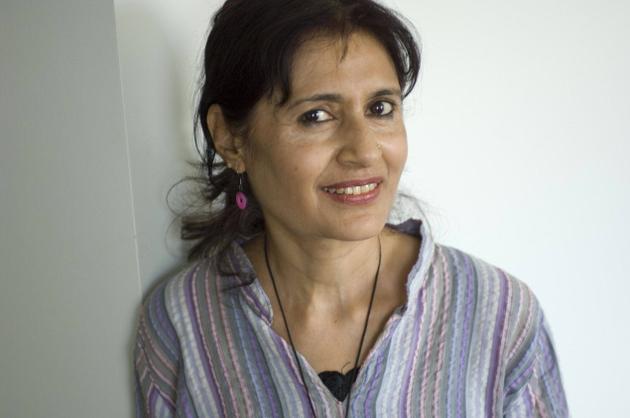
This Woman from Srirangapatna is the Queen Bee Among Entrepreneurs

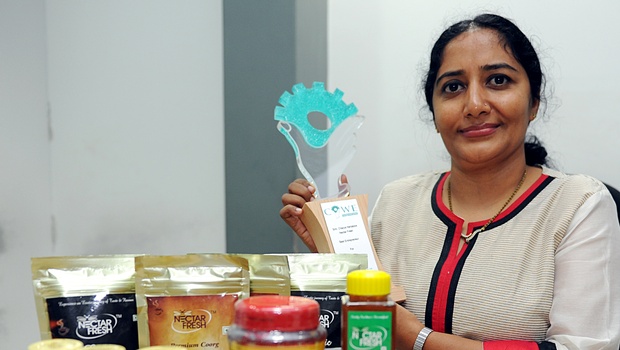
Chayaa nanjappa National Best Entrepreneur Award From the Confederation of Women Entrepreneurs of India was presented toher in Hyderabad on Monday. |EPS

Bangalore :

From Srirangapatna to Europe, it has been a long and difficult journey for 42-year-old Chayaa Nanjappa. But she has battled the odds and today heads a rural enterprise which produces high-quality honey that sweetens many a home even in Europe and the United States.

As a reward for her hard work, Chayaa was on Monday awarded this year’s ‘National Best Entrepreneur Award’ in food processing by the Confederation of Women Entrepreneurs of India.

Her path to success has not been a smooth one; she had to overcome many an adversity, physical abuse and traumatic relationships. But now, this gentle, self-made woman provides a livelihood for not only many illiterates of Mysore and Mandya districts, but also some tribals across the state. She is also the largest buyer of forest honey from Malayalis and tribes like Siddis and Jenu Kurubas.

She began her journey by setting up a small unit at Bommanahalli with the help of a `10-lakh loan. She then shifted operations to Nanjangud and later, to Srirangapatna.

Today her enterprise Nectar Fresh, which produces monofloral honey, has a capacity of 200 tonnes and is worth `6 crore. It is one of the largest bulk suppliers and packers of honey in the country and falls in the top five bulk exporters of raw as well as processed honey. Nectar Fresh also has the ISO 22000:2005 certification.

Chayaa told Express, “With no work experience or exposure, I started a rural industry in 2007 that could be identified with my hometown, Coorg. After doing a basic course from Central Bee Research and Training Institute (CBRTI), I jumped into the industry completely, sourcing honey from tribes and farmers.” She has 20 mobile apiary vans across the country.

Going International

To earn her brand a significant international presence, she decided to market it as a basket of products, including jams and sauces. The result: it found a place in the European market. “I added jams and sauces to my basket by purchasing pulp from sick units run by women in places like Bangalore and Mangalore, and sourcing fruits like papaya and tomato directly from farmers,” she said.

With exports to Germany and France, Nectar Fresh has broken the monopoly of global companies like Bereenberg, Darbo and Bonne Maman. “We met the stringent standards necessary for approval to export to Germany and made a strong impact by packaging our honey and jam in polypropylene sachets for high quality and shelf life. The European competitors feel threatened by our presence,” said Chayaa, who is now busy tying up with a Saudi Arabian company for the production of jams from dates.

She credited the Karnataka Village Industries Board (KVIB), CBRTI, the Horticulture Department, the Central Food Technological Research Institute (CFTRI), Le Meridien, ITC Foods and a host of others who supported her. “Any small and marginal farmer in Karnataka producing quality honey can contact me. My sole aim is to promote rural products and help women in distress by providing employment opportunities,” she said.

source: http://www.newindianexpress.com / The New Indian Express / Home> States> Karnataka / by Meera Bhardwaj / July 31st, 2014

Nanaiah may head panel on safety of women, children

Bangalore :

Former law minister MC Nanaiah is likely to head the expert committee to suggest measures for safety of women and children.

Several rapes in the state, especially in Bangalore, prompted the government to constitute the committee comprising legislators, representatives of social organizations, women and children’s organizations and legal experts.

“The official notification will be issued in a day or two. The panel will have eminent persons,” home minister KJ George told TOI.

This apart, for the first time, the term “rapist” will be incorporated in The Karnataka Prevention of Dangerous Activities of Bootleggers, Drug Offenders, Gamblers, Goondas, Immoral Traffic Offenders and Slum Grabbers Act, 1985, commonly known as the Goonda Act.

The amendments to the Goonda Act would be introduced in the ongoing session of legislature. Though sexual offences are not covered under the act in its present form, the six accused in the gang-rape of a law student on the Jnanabharathi campus in October 2012 were booked under the Goonda Act. Normally, repeat offenders in crimes are included under the Goonda Act, but amendments to the act will include first-time rape offenders.

Persons booked under the Goonda Act can be detained for one year without trial.

source: http://www.timesofindia.indiatimes.com / Times of India / Home> City> Bangalore / July 25th, 2014

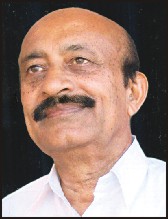
M.C. Nanaiah, as I know him

NanaiahKF14jul2014

by K.B. Ganapathy
Former Law Minister and JD(S) leader M.C. Nanaiah, Merianda Chengappa Nanaiah to give him his full Kodava name, bid adieu to Karnataka Legislative Council when his six-year term ended on June 30, 2014. Many MLCs have spoken in the past when their terms in the House had ended. In keeping with that tradition, M.C. Nanaiah too made his oration; but that was a class apart from what I have heard others speak before. In Nanaiah’s speech there was much food for thought for all those who swear by Democracy and Secularism.

If Democracy works best ONLY where there are checks and balances, where there is synthesis of various shades of opinions, where there is dialectical debate and discussion, then there also must be a House in the form of a Rajya Sabha (Upper House) at the Centre and a Vidhana Parishat (Legislative Council) in the States to act as a sieve to further filter what is processed in the Parliament or the Legislative Assembly. After all, law-makers are not Solomons, nor above reproach in their thinking and conduct. It is obvious Nanaiah has realised this deficiency, lack of maturity and haste on matters of Bills deliberated in the Parliament or the Assembly and therefore, in his farewell speech, he devoted much time on the need for making the institution of Legislative Council mandatory by amending the Constitution.

At present, the Constitution allows only Rajya Sabha to be a permanent house but not the Vidhana Parishat. As a result some States have abolished the Council. Hence Nanaiah’s concern. He may also have apprehended that such a doomsday may overtake Karnataka Legislative Council too at a future date and hence his appeal to the Speaker to take up the issue as an amendment to the Constitution to make the Legislative Council mandatory for all States. Tamil Nadu for example had a Legislative Council for many years. However, it was abolished by M.G. Ramachandran Government on Nov. 1, 1986.

In his impassioned oratorical flourish, as is his wont whenever on his feet to deliver a speech, he said the existence of the Legislative Council is imperative in view of the seriousness with which Bills have to be debated before passing them into Law.

In order to corroborate his point, he gave the example of the system prevalent in the United States where the US Congress (their Lower House equivalent to our Lok Sabha) always appreciated the role of the US Senate. Nanaiah said that in US the members of the Congress used to say that the Senators “Pour the Legislation into the Senatorial saucer for cooling.” And the Legislations (Bills) vetted by the Senators were the only ones that could be considered as Law. Let us hope our politicians heed Nanaiah’s words of wisdom distilled after over 40 years in State politics.

M.C. Nanaiah is Mr. Clean politician of Karnataka who survived in the “cesspool of corruption” without blemish, like a lotus in the murky waters. I know him since 1956. He was one year senior to me in the then Government First Grade College in Madikeri, Kodagu, now Field Marshal K.M. Cariappa College and in law college at Bangalore. Loud with a silver tongue, he would stand out in any group of students. He was assertive and daring in speech but some students thought that he was a master manipulator. I had no occasion to test this allegation which I thought was made by those who envied his dash and drive.

A.K. Subbaiah, Ajjikuttira Kariappa Subbaiah to give him his full Kodava name, who also became famous as a politician like Nanaiah, was one year junior to Nanaiah like I was. I don’t know about the age though. I remember Nanaiah defeating Subbaiah in the 1957-58 college elections. Later in life as both marched like knights-in-arms to fight the political battle, it was Nanaiah who made it once to the Legislative Assembly, then as MLC and finally to the State Cabinet. He was Forest Minister and then, many years later, Law and Parliamentary Affairs Minister for five years with the additional charge of Information Ministry.

In contrast, Subbaiah only made news, acquiring the epithet in Kannada as “suddi maduva Subbaiah,” which means “Subbaiah who makes news.” Some even called him as “Five day Lawyer, weekend Crusader.” If ego and hubris destroyed Subbaiah’s political opportunities (of which he had so many as a BJP Leader), as for Nanaiah it was the gift of the gab and indeed the intelligent persuasive ability and manipulative skills that took him to the acme of State Political Office via Legislative Council as he was not able to win Assembly elections except once.

After Kodagu got integrated with the then Mysore State, (now Karnataka) following the State reorganisation (1956), two persons who came on the political horizon of Kodagu are M.C. Nanaiah and A.K. Subbaiah, separated in their political ideologies as sharply as oil and water. If Nanaiah was a leftist, Subbaiah was a rightist. Nanaiah was into Congress, a change over from his Communist beliefs and Subbaiah was into Jan Sangh. Nanaiah then switched to JD(S) and became an achiever; but in contrast, Subbaiah followed his saffron brothers into BJP and almost came out as an achiever, but no. Soon he committed political harakiri because of hubris after winning some 18 Assembly seats under his leadership in the year 1983. It was a case of the time-tested maxim “pride goes before the fall.” Subbaiah was so presumptuous he thought without him BJP in Karnataka could not survive. He was unable to grasp the importance of a national political party in a democracy where individuals come and go but the party goes on. He was unceremoniously ousted from the BJP and despite changing political parties thereafter, rather shamelessly, he became a political pariah. His political career was doomed once and for all. In contrast, Nanaiah played his political cards well even when he was dealt with bad cards. Once he joined the JD(S), he became its loyal worker, nay soldier. Naturally, he rose to the rank of a General – Minister !

When Nanaiah was in Congress, political churning was taking place in Karnataka’s Congress Government led by D. Devaraj Urs, following the defeat of Indira Gandhi in the post-Emergency election. Nanaiah was inducted into Devaraj Urs ministry as Forest Minister. R. Gundu Rao, who had by then moved too close to Indira Gandhi and Sanjay Gandhi derisively called Nanaiah as a “Peppermint Minister.” Soon Devaraj Urs was dethroned, dumped from Congress and Gundu Rao became the Chief Minister. Thanks to Sanjay Gandhi. Being old friends, Gundu Rao urged Nanaiah to join Congress. But Nanaiah’s loyalty to Urs did not allow him to renege. For a time he was in political doldrums, but soon found himself a place in Janata Party and then the JD(S). If politics is the “art of possibilities,” Nanaiah indeed has mastered that art. It was a case of discovering the truth of the Kannada proverb “thaalidavanu baaliyanu.” He who has patience will survive. Speaking to media recently, Nanaiah has said, “politics is a strange coincidence of incidents.” Indeed true in this game of ‘snake and ladder’ which is politics.

Yesterday morning, I was speaking to Nanaiah to express my appreciation for his “hurrah” speech in the Legislative Council and mentioned of what the former Chief Minister and JD(S) State President H.D. Kumaraswamy has brought upon himself unwittingly, by demanding Rs. 40 crores for a MLC seat etc. Of course, those who know how these “tickets” are given by all political parties were not surprised but Kumaraswamy was caught on tape and got huge negative publicity. Responding, Nanaiah recalled his friendly talks with MLAs on the subject some six years ago. Indeed, some MLAs opined that they being the voters in the MLC election, they must get a share in the money collected from the candidate by the party. After all, these MLAs claimed that they too have spent a fortune to get elected as MLAs.

However, Nanaiah asked them what if a candidate like him who has no money to pay to the party and is given the ticket on merit. The good MLAs told Nanaiah, “Then there is no problem. We don’t make any demand.” Nanaiah got smart and told the MLAs: “Well then, go and tell Deve Gowda and Kumaraswamy that you would not ask for money if the ticket is given to me” and Nanaiah became the JD(S) MLC six years ago to retire on June 30, 2014.

e-mail: kbg@starofmysore.com

source: http://www.starofmysore.com / Star of Mysore / Home> Abracadabra….Abracadabra .. / by K.B. Ganapathy / July 09th, 2014
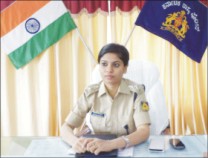
Ganapathy , IPS from Kodagu is PS to Union Home Minister

GanapathyKF08jul2014
Mysore :

M.A. Ganapathy, a 1986 IPS batch officer, has been appointed the Personal Secretary (PS) to Union Home Minister Rajnath Singh.

Ganapathy, who had won the President’s Medal twice, had earlier served as the Spokesperson for the Union Home Ministry. He had also served as the Secretary to the Sectoral Magistrate. Ganapathy, son of Maneyapanda Appaiah and Premalatha, hails from Eachoor near Kunda in Kodagu.

source: http://www.starofmysore.com / Star of Mysore / Home> General News / July 03rd, 2014

Nanaiah’s parting request: make Council mandatory in every State

M.C. Nanaiah
M.C. Nanaiah

This will facilitate threadbare discussions on all legislations, he says

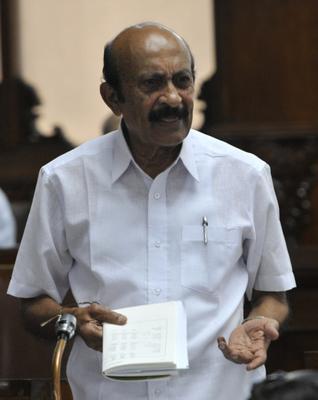
M.C. Nanaiah of the Janata Dal (Secular), on the day of his retirement on Monday, made an impassioned plea to Chairman of the Legislative Council D.H. Shankaramurthy in the Upper House to take up the issue of an amendment to the Constitution so asto have a Legislative Council in every State. This would facilitate threadbare discussions on all legislations.

Delivering his last speech as member of the House, Mr. Nanaiah said such an Act was necessary in view of the seriousness with which bills have to be discussed before their passage. He said that the Constituent Assembly had allowed Rajya Sabha to be a permanent House, while not extending the same facility to the Council in States. This lacuna must be corrected.

Giving a chronological history of the House, he said it came into existence in 1881 as Mysore Representative Assembly and became the Legislative Council in 1907. The Legislative Assembly came into being in 1952 after the first general elections. The Council is the oldest and has the natural right to continue, he said, arguing against the opinion of some who said the Upper House was not necessary.

He said Members of the Congress, Lower House, in the United States, used to say that “they pour the legislations into the senatorial saucer for cooling” and added that the American Congress members were of the view that the legislations vetted by the Senators were the only ones that could be considered as law.

He wanted Indian politicians to learn from such an observation.

Supporting M.V. Rajasekharan’s (Congress) criticism that moneybags were entering the portals of Parliament and State legislatures, Mr. Nanaiah reminded him that former Prime Minister A.B. Vajpayee had passed a remark before presspersons when they asked him about his government’s defeat by one vote in 1996: “There are commodities for sale in the market and brokers too, but I was not ready to purchase them.”

Mr. Rajasekharan (Congress), who also retired, expressed his happiness over his achievement as Union Minister of State for Planning during which he was instrumental in raising the plan outlay from around Rs.10,000 crore to Rs.13,000 crore.

The others who retired are S.R. Leela, Doddarange Gowda, M.R. Doreswamy, B.B. Shivappa, Bharati Shetty, K.V. Narayana Swamy, Siddaraju, K. Monappa Bhandari and A.H. Shivayogiswamy. Puttanna (JD-S) and K. Abdul Jabbar (Congress), who have been re-elected, have returned to the House.

source: http://www.thehindu.com / The Hindu / Home> News> National> Karnataka / by Special Correspondent / Banglaore – July 01st, 2014

MP Pratap Simha receives rousing reception in Kodagu

MpPratabSinhaKF06jun2014

Madikeri :

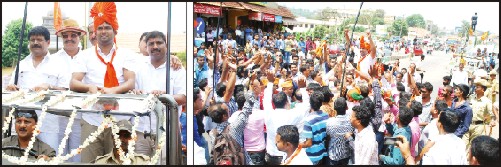
The newly-elected MP from Mysore-Kodagu constituency, Pratap Simha, was given a rousing welcome on his arrival here yesterday. The district BJP members had organised a road show in which Simha participated after offering special pujas at prominent temples in Talacauvery and Bhagamandala.

The open jeep road show commenced from Gadduge with MLAs K.G. Bopaiah, Appachu Ranjan, former MLC S.G. Medappa, District BJP President Suja Kushalappa and others participating in it.

Simha was later felicitated at a function held at Cauvery Kalakshetra. Addressing the press later, he assured that he would not allow any project which would be detrimental to Kodagu.

When questioned whether he would explore the possibility of providing a rail link to Kodagu, Simha said that with D.V. Sadanandagowda as Railway Minister the project would be explained as the survey work on the project has already been done from Mysore to Kushalnagar.

When a reporter pointed out that the survey report had opined that the railway project was not feasible, Simha said that all projects need not be profitable as railways was a service oriented department.

When asked about the development plans for Kodagu, Simha said that he would go by the suggestions of locals MLAs. He observed that the taluks of Hunsur and Periyapatna were deprived of good infrastructure and assured to give top priority for that.

When pointed out that the DC was not responding properly to the grievances of the people, Simha said that he would call for a meeting of all officers of district to discuss the matter and bring in harmony.

source: http://www.starofmysore.com / Star of Mysore / Home> General News / June 01st, 2014

The story of the Coorg Education Fund and its mission

VISIONARIES: This group of 10 got together in 1863 and contributed and collected Rs. 7,305, to start the Kodava Education Endowment Fund./ by Special Arrangement / The Hindu

For a small agricultural community of approximately one hundred thousand, the Kodavas have added to India’s cultural and ethnic diversity through the uniqueness of their dress, customs, rituals, festivals, language and so on. Even more significant is the contribution of individual Kodavas to public life. They include a Field Marshal, a Chief of the Army Staff, a number of Generals, Air Marshals and senior naval officers. There have been Governors, Ministers, IFS and IAS officers, UN experts and Vice-Chancellors. They have brought credit to India in cricket, tennis, squash, athletics, and shuttle badminton as well. Rani Pooviah was part of the Cholamandal group of artists who pioneered the Madras Movement.

In this milieu, the work of the Coorg Education Fund (CEF) over a period of 150 years in the cause of education can only be described as an awesome activity initiated with remarkable foresight.

To better understand the value of the CEF it is necessary to place it in context. Coorg, or Kodagu as it is called, is today a district of Karnataka. It was ruled by local Rajas and came under British rule in 1834. Writing in Blackwoods Magazine in 1922, Hilton Brown of the Indian Civil Service, District Magistrate of Coorg, wrote of the identity of the Coorgs (now called Kodavas): “That is the standing riddle of South India ethnologists … barring all ethnology and arguing from common sense one would call Coorgs a separate people … they are a community of people whose customs, ceremonies, from birth to death, festivals, dress, language are quite different from those of other communities among Hindus.”

A survey done between 1815 and 1817 by Lt. Connor found that Coorgs were “addicted to husbandry, their only education consists in acquiring a practical knowledge of it.” It made the unflattering observation that they were an “unlettered and unaltered race.”

With the starting of an Anglo-Vernacular school and another in Kannada in 1835, the first steps towards introducing formal education were on. Subsequently more schools were opened. However, the mere opening of schools did not meet the objective of educating the community, as only children from affluent families could access them. Many bright children fell by the wayside due to lack of financial resources. To address this lacuna, a group of far-sighted and philanthropic elders of the community got together and sowed the seeds that grew into the CEF.

The credit for identifying the need to provide financial assistance to deserving children and encouraging them to enrol in educational institutions goes to Rev. Richter, the first Principal of the Mercara High School. He persuaded the British authorities to grant land that could be used to raise resources to provide financial assistance.

An extent of 150 acres was gifted, on which a coffee plantation was established in 1863. The income was used to provide student scholarships. Revenue from the estate was used to create the Mercara High School Endowment Education Fund. Separately, a group of 10 visionaries from the community got together with the idea of providing financial aid to needy students. Meeting in 1863, they made individual contributions and collected a princely sum of Rs. 7,305 which was used to establish the Kodava Education Endowment Fund. It now has a corpus of close to Rs.3 crore. They included Cheppudira Subbiah and Mathanda Appachanna.

In 1916, the two funds were merged and it became the Kodava Education Fund. It was administered by the Commissioner of Coorg assisted by eminent Kodavas. In 1954, the corpus was handed over to a committee comprising Kodavas. Thus was born the CEF. Its first president was Kodira T. Uthappa.

The CEF represents foresight and service rendered silently over the years, helping many a Kodava to blossom and contribute to society.

One of the beneficiaries of the fund was Pemanda Monappa, the father of the author. He was selected to join the police force under the British and was a well-known officer, also during the post-Independence period.

As a tribute to and recognition of the value of committed public service and integrity, this author has established a scholarship at Cambridge University in his name. Applicants should not have crossed 25 years. It is available for study leading to a Master’s in English literature, physical sciences, biological sciences (excluding medicine and veterinary science), economics, computer science, law, and technology. Details are at the Cambridge University website.

sonnabel@gmail.com

source: http://www.thehindu.com / The Hindu / Home> Opinion> Open Page / by P. M. Belliappa / May 25th, 2014

Mysore flour mill owner gets possession of palace

Nagaraju’s dogged fight over a period of 18 years for his ancestral property began from scratch

Claiming to be a descendent of the erstwhile rulers of Kodagu, a flour mill owner from Mysore has now gained possession of the historic 17th century palace and fort which is predominantly in the heart of Madikeri town.

“My efforts of 18 years have ended with the President of India ordering that the palace belongs to me,” a beaming H C Nagaraju, the owner of the flour mill in Shivarampet, told Business Standard.

He has displayed a notice in his shop that says: “As per the order of His Excellency President of India, the Mercara Palace belongs to H C N Wadeyar.” It quotes the order No.F.No.1-204/2013-RTI (Hq) dated 26-9-2013, Government of India, Janpath, New Delhi.

This is the latest notice displayed in his shop to inform his customers of his successful fight, in addition to already putting up copies of other documents and photos of his forefathers belonging to the erstwhile Haleri dynasty of Kodagu.

Nagaraju’s dogged fight for his ancestral property began from scratch, from corresponding on the issue with a number of authorities like the Departments of Archaeology, and the state and Central governments and moving the courts. Before approaching the courts, he began to acquire documents from various sources, including the British Library in London to establish that he descended from the Haleri rulers.

“My father often told me that we belong to the Kodagu royal family and the Madikeri Palace belongs to us, based on what his father and grandfather had told him,” he said, narrating how he began to establish his right over the palace and the surrounding fort in Madikeri. “To establish what my forefathers were saying, we had swords, shields, palm leaf manuscripts in our house which my father gave away, finding them of no use,” he adds.

Calling himself H C N Wodeyar, he has displayed his claim he is the Maharaja of Coorg and owner of the Madikeri Palace. According to him, his lineage starts from Queen Devajammanni, wife of Lingaraja. The palace, which witnessed rebellious uprisings against the colonial rulers in 18th century, it presently houses the Kodagu’s Deputy Commissioner’s office within the fort.

“They have agreed to shift to a new place and hand over possession to me,” he said, adding he intends to convert his ancestral palace into a tourist attraction. Beside the palace stand two life-size statues of elephants that attract people who visit the monument.

Lingaraja succeeded the famed Dodda Veera Rendra Wodeyar (1780-1809), the hero from Kodagu history, as the Coorg Raja. His successor Viraraja was deposed in 1,834 following which the British annexed Kodagu and exiled the last of the rajas, bringing an end to the nearly two-century-long reign of the Haleri dynasty that came to power in the 17th century, in the district nestling amidst the lush Western Ghats, known for coffee and oranges, besides elephants.

source: http://www.business-standard.com / Business Standard / Home> Current Affairs> News> Et cetera / by Gouri Satya / Mysore – May 04th, 2014

King Wants to Take Over Kodagu Palace

H C N Wadiyar, the Maharaja of Coorg, has strongly objected to opening of Balamandira inside the Mercara Palace without his permission.

In a letter to the Kodagu Deputy Commissioner, he claimed he is the owner of the palace as his ancestors did not transfer it to the then Government of Mysore or the Government of India.

He said Archaeological Survey of India officials had stated that the fort at Madikeri and two masonry elephants are being protected by the ASI, adding state government offices are still functioning in the palace.

He clarified the British government had not given any letter pertaining to the transfer of the palace to the government.

He said he wants to take over the palace soon.

source: http://www.newindianexpress.com / The New Indian Express / Home> States> Karnataka / by Express News Service – Mysore / May 04th, 2014

Forum to raise funds to convert Sunny Side into a memorial

The Tipu Sultan Nagarika Vedike Kodagu district unit has said that the unit was ready to raise funds from the public to pay Rs 7,80,541 to the Transport department to get the custody of Sunny Side, ancestral house of General K S Thimmaiah.

It was a long pending demand to convert Sunny Side into a memorial.
ThimmaiahKF13apr2014
Addressing a press meet, district unit President K M Kunhi Abdulla said, that the government had announced that Sunny Side would be converted into a memorial eight years ago. However, it has not seen any progress. After the death of General Thimmaiah, his wife had sold the building to the Transport department.

However, owing to lack of maintenance the building was in a deplorable condition. The government should respond to the demands of the people.”

Kannada and Culture department has already written to the government to pay Rs 7,80,541 to take over the building. “If the government fails to initiate measures to convert the building into a memorial, a protest rally will be held in Bangalore. We will extend our support to the Field Marshal K M Cariappa and General Thimmaiah Forum.”

Former chief minister H D Kumaraswamy said that the State government had earmarked Rs 1 crore in the budget in 2006. “The respective BJP and Congress governments failed to convert the building into a memorial,” he said.

source: http://www.deccanherald.com / Deccan Herald / Home> District / DHNS – Madikeri, April 04th, 2014