10,000 rare Mahseer fingerlings released to Harangi River at Koodige
Kushalnagar:
There are many possibilities of utilising Harangi Reservoir in Kodagu and its backwaters. One among them is fishing and fisheries development. Realising this potential, an exclusive fishing cultivation pond will be set up at Kushalnagar with Rs. 2 crore assistance from National Bank for Agriculture and Rural Development (NABARD).
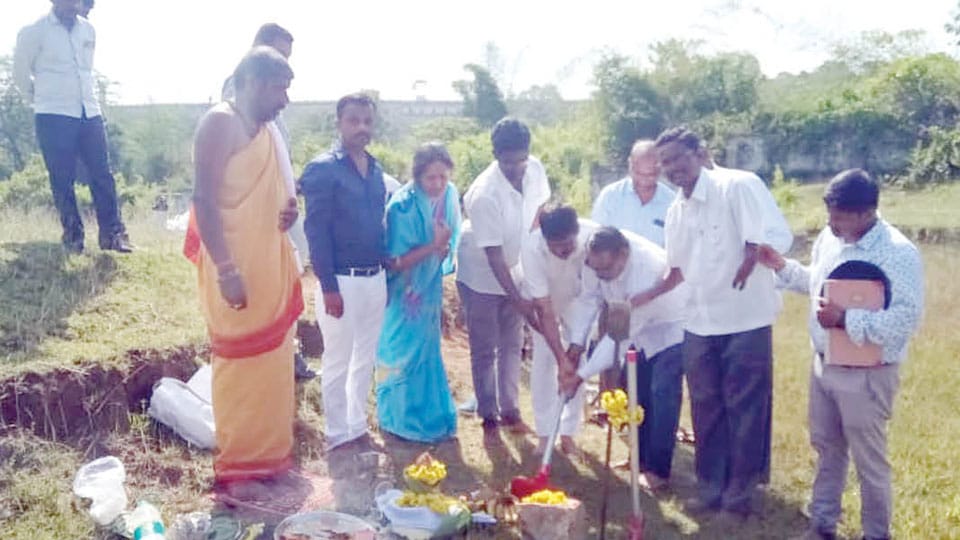
The Bhoomi Puja for the 2-acre pond was performed recently in Kushalnagar by Madikeri MLA M.P. Appachu Ranjan. Speaking on the occasion, the MLA said Harangi was one of the major reservoirs built across River Cauvery. “Due to the reservoir, there are great possibilities of pisciculture in a large scale due to abundant availability of water backed by groundwater support. Rare fish varieties like the Mahseer can be cultivated and six such ponds will be constructed in the land owned by the Fisheries Department,” he said.
Traditional fishing is being held from many years in the backwaters of Harangi, which spreads over 1,886 hectares in area. Lakhs of fingerlings are released into the reservoir every year. “As part of the project, fish cultivation enclosure has been set up in the backwaters of Harangi Reservoir and the sample of fish is being collected to study the growth of fingerlings, said Sachin, Assistant Director, Harangi Fish Rearing Centre.
He added that the Centre was set up by the Government 25 years back to support farmers who are willing to rear fish in the cultivation ponds. Varieties of fish, including Mahseer, Katla and Rohu, are reared in the Centre. Along with these, fingerlings procured from Kabini and Bhadra reservoirs are being provided to farmers at subsidised costs, he said.
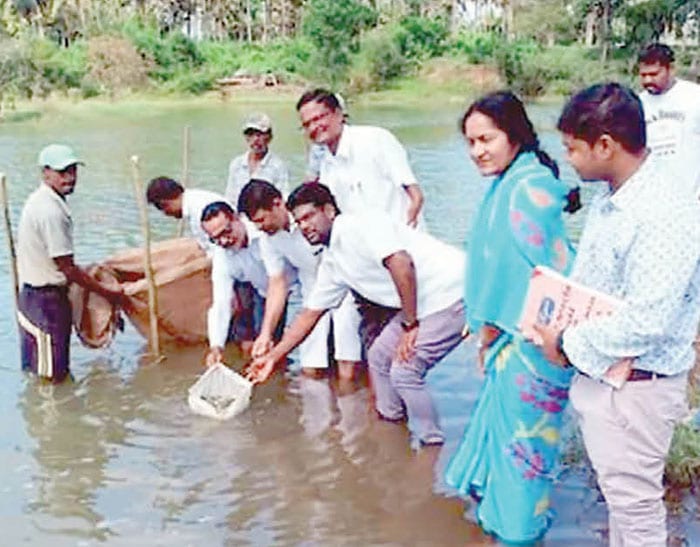
On the occasion, over 10,000 Mahseer fingerlings were released to 5.6 km Harangi River stretch from the Dam to Koodige Bridge. “Through this, we intend to cultivate the Mahseer fish that is on the verge of extinction. Fishing has been banned on this particular stretch to save the Mahseer variety,” he added.
source: http://www.starofmysore.com / Star of Mysore / Home> News / November 25th, 2019
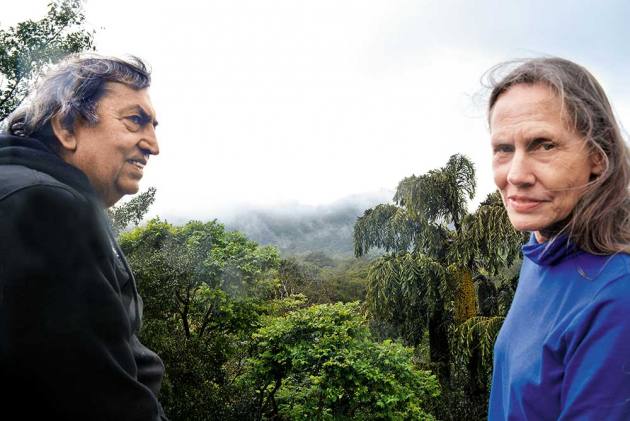
Foresters Anil and Pamela Malhotra have found peace among the coffee plantations of Coorg. Embracing nature has been their passion.
PHOTOGRAPH BY AJAY SUKUMARAN
Around four in the evening, after a late lunch, Pamela Gale Malhotra is standing at a bay window of her living room looking out at a picture-perfect landscape—a gushing stream in a rain-soaked forest with the abutting Brahmagiri hills framing the backdrop. It was about 25 years ago that she first stumbled onto this view. At the time, she was out scouting for a site for their home and had been hurrying up a hill trying to escape the rain and leeches when it struck her speechless.
The place is now more wooded than it was in 1995 when Pamela, 67, and husband Anil Malhotra, 78, built their home in south Coorg—in a coffee estate that had been listed. How they got here is quite a story, told amidst a primordial symphony—the burble of the stream and the call of the crickets.
Their first port of call in India was in the Himalayas in Uttarkashi along the Assi Ganga, where they stayed for nearly a decade before deciding to move south. After scouting through a few states, they finally found what they were looking for at the Brahmagiri foothills in Theralu—a remote plantation where they could raise a forest, as bizarre as it sounded to the folks around back then.
It might still sound like a nutty proposition, until you drive past the gates of the Save Animals Initiative (SAI) Sanctuary. Suddenly, you are in a thicket with a narrow driveway that meanders some distance to a garage and beyond that the dark peach walls of the Malhotra home. Around you is a 300-acre native rainforest through which the elephant and tiger freely saunter.
___________________________________________
“When you are away from Nature you aren’t thinking clearly…This is our passion.”
___________________________________________
Every morning, in more hospitable weather, Pamela and Anil set forth into this grove—their walks take an hour-and-a-half usually unless she’s checking on the dozen or so camera traps dotting the landscape, replacing batteries, swapping memory cards or switching locations. Over the years, Pamela has collected a mountain of data—otter, porcupine, leopard, sambhar, all kinds of species on video. Since it’s a wilderness—whatever remained of the coffee plants became humus for the trees—the couple merely follow the paths the elephants have cleared.
“We’ve set up this private model,” Anil tells Outlook. “We want other Indians who can afford it, we need even those who can’t, to join together to build this.”
The hills get covered up and the rain comes down. It’s been bucketing down all through the south-west monsoon this year, casting a gloomy outlook for coffee growers in Coorg. “When we came here, it was normal to have 350 inches of rain a year. Even if it was buckets of it, we had this,” says Pamela, pointing to the woods. “This is what the forest canopy is for. It’s like using an umbrella with pores in it, it’s going to break it up and slow it down.” But over the decades, Coorg’s forest cover has been dwindling. “The coffee plant is useless when it comes to retaining moisture…they have extremely small, shallow roots. We’ve warned people again and again, “don’t cut down your big native trees.””
The Malhotras put together their 300-acre sanctuary piece by piece, starting 1991, first by purchasing a 55-acre coffee estate. “Patches were cleared for coffee. So what we did was to fill up the patches with native trees,” says Anil. They planted jackfruit, Nandi, Rosewood, Matti and hundreds of fruit trees. “And, of course, the native trees come out way on top in absorbing carbon,” adds Pamela, pointing to sequestration studies which show that SAI Sanctuary acts as a carbon sink, helping the neighbourhood as well as providing a haven for the wildlife moving between the Brahmagiri reserve forests and Nagarahole national park, an hour away by road.
Down by the stream, a snake slithers away as we approach the water. Most days, the couple crosses over onto two rocks on a small island to meditate. “We were sitting on these rocks once and a matriarch elephant came up,” says Anil. It didn’t sound pleased, he recalls. “We kept sitting and mentally saying we have come in peace. They may not speak English but they know vibrations. She started eating the bamboo and then 8-10 members of the family came. They surrounded us for 45 minutes. It was such a beautiful experience.” Frequently, local people and the forest department bring them injured animals—dogs, cats, parakeets—which find a ready home.
Anil says it is possible for others to do what they did—buy land and restore forests—even if it’s difficult. “It can be done. People tell us “we haven’t made the money you made in America”. We bought at the right time. I can’t afford it today.”
Pamela and Anil met in the US in the early 1970s at her hometown, Red Bank, New Jersey, where he ran an Indian restaurant. She worked at an all-night cafe at Asbury Park, where a young Bruce Springsteen (then playing in a band called Steel Mill) would drop in to play sometimes during breaks from the music club upstairs.
“But Anil and I were on complete opposite sides of the political spectrum then,” she laughs. “I’ve always described it as fire and petrol…explosive encounters.” Mostly over the Nixon presidency and the anti-war movement. Soon after, she went back to college to study political science—the breaking-out of her conservative mindset of ‘materialistic Americana’ happened then. He sold up and followed her to Colorado, where they stayed for a few years, she working as a sales rep in a pharma company and he with a mortgage firm. The commissions he got were reinvested in real estate in Colorado and then in a forested patch in Hawaii, which they fell in love with on their honeymoon. The couple moved to India in 1986 to visit Anil’s ailing father and eventually settled in Uttarkashi where they wanted to recreate their wooded Hawaii home. The land ceiling regulations prompted the decision to look at plantation land in the south.
“I could have continued the real estate and all that in America, but what is the point of life then. I can’t take it after me,” says Anil. “I’d rather drink pure water and breathe fresh air than breathe carbon dioxide and be ill half the time and give all my money to doctors and hospitals.” Adds Pamela: “Being in Nature helps us physically. Kids today are being hot-wired by not having time out in Nature to play.”
Pamela, who received the Nari Shakti awards for her efforts in afforestation in 2016, has given numerous presentations across the country—including a recent one at the Apple facility in Cupertino while on her first visit to the US in 20 years—to raise awareness. She’s currently working on an autobiography titled From the Heart of Nature, slated for publication next year. “When you are away from Nature you aren’t thinking clearly,” says Anil. “Grow fruit trees, grow organic food…the demand far outstrips supply. We have planted thousands of native fruit trees now. Last year, we distributed thousands of saplings at schools and colleges telling them this is the future.”
The Malhotras, like successful permaculturalists, are mostly self-sufficient for most of the year. They rely on roof-top solar panels, installed in 1997—a year after the house was built. The patch next to the house is an organic food garden where most of their vegetables and salads come from. Pamela prefers cooking on biogas.
“Everything comes out of our pockets, except approximately two per cent in the form of donations if we are lucky,” says Pamela. Eco-tourism—they have four rooms for guests—helps meet expenses. “This is our passion, our life. So we have to keep things going. But there are things we’d love to do, like Payment for Ecosystem Services. We’d like to sponsor more organic farming,” says Pamela. “I cannot tell you how frustrating it has been trying to raise money for any of these programmes.”
The rain lets up for a bit, but the clouds hang low. Pamela and Anil climb up a wet, metal ladder to the rooftop for a sweeping view of their sanctuary. Pamela recalls a dream she once woke up with, years earlier. “I had seen a house on a small hill, overlooking a pond with the river flowing past in the middle of a wooded valley with white-capped mountains all the way around and a lot of wildlife. This was that view…those mountains are white-capped from the mist.” This was before they bought this place in Coorg. “I thought we’d find that in the Himalayas. But it wasn’t in the Himalayas, it was here. So, you never know.”
By Ajay Sukumaran in Coorg
source: http://www.outlookindia.com / Outlook / Home> Magazine> National> Cover Stories / by Ajay Sukumaran / November 21st, 2019
Surendra Varma, a scientist at Indian Institution of Science, said he was happy to see the turnout during the festive season.
Bengaluru :
Heavy rain and Deepavali celebrations didn’t stop corporate communication professional, Danielle S, to attend an event organised by Friends of Elephants, an informal group dedicated to promote wildlife diversity. “I have attended previous events of this group. I was out of town and came back soon to attend it. These are good knowledge-sharing platforms,” she said, adding that she and her friends believe in celebrating festivals in meaningful ways like this.
Friends of Elephants conducts panel discussions and art and cultural activities on every fourth Sunday. Titled Elephants, Tigers and Lions (conservation and conflict), their last event on October 27 included movie screenings like Shanti Samsara by Ricky Kej, talks by Manoj Kumar, chief conservator of forests, Kodagu Circle, and Ravi Chellam, wildlife expert, and panel discussion with speakers and villagers from Bandipur. The forest officers shared their experiences of tackling wild animal attacks in estates and their translocation, while villagers shared how difficult their day-to-day life is because of animal attacks.
Surendra Varma, a scientist at Indian Institution of Science, said he was happy to see the turnout during the festive season. “We had organised one event during an IPL match in the city. There was no drop in the number of participants,” he added.Prabha Ramakrishnan, a resident of Indiranagar, said she always tries to attend the events. “We are a small group of women who are interested in nature and wildlife. We go for trekking, visit wildlife sanctuaries and attend events. Why should one miss such events in the name of festival?,” she asked.
source: http://www.newindianexpress.com / The New Indian Express / Home> Cities> Bengaluru / by Lesly Joseph / Express News Service / October 29th, 2019
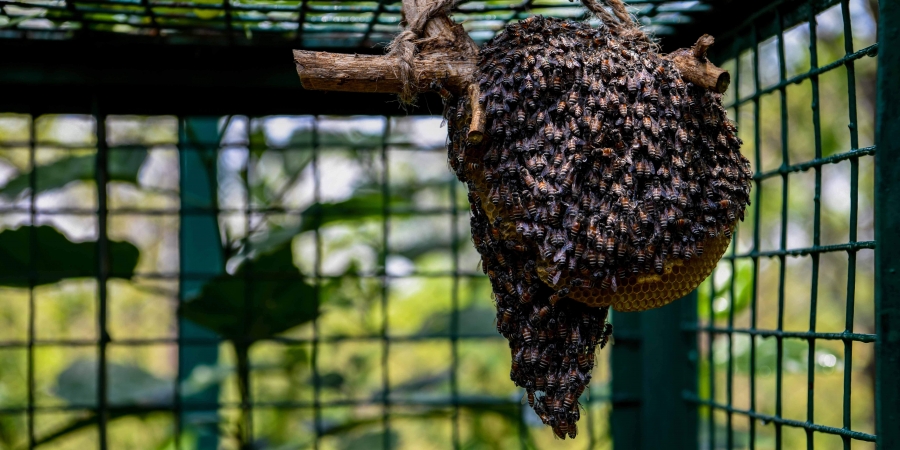
Indian and European bees are the most sought after while stingless bees are slowly catching our attention for its medicinal properties.
(Photo | Meghana Sastry, EPS)
Your favourite mango will definitely become dearer if not extinct, if we don’t act now. Pollinators, which include bees, need a major protection boost.
There are 2,00,000 pollinators of which honeybees are the most sought after, why?
There’s a popular saying ‘as busy as a bee’. That term comes from the fact that honey bees are the only species who identify a flower and make multiple visits to the same flower until they get all the nectar and pollen out of it. They are the best pollinators and work in the most methodical fashion. From identifying to communicating and dividing work. Their social structure is fascinating and one that we can learn a lot from. There are 20,000 types of bee species of which the ones mentioned below are the most popular types in India. Indian and European bees are the most sought after while stingless bees are slowly catching our attention for its medicinal properties.
Common Name Scientific Name Natural Nesting Site Honey Yield
(KG)
____________________________________________________________
Indian Bees Apis Cerena Cavity, Termite Mounds, Tree Hollow etc. 8-10
European Bees Apis Mellifera Cavity 25-30
Rock Bees Apis Dorsata Tree Branches, Buildings etc 30-35
Dwarf Bees Apis Florea Twig in a bush <1
Himalayan Rock Bees Apis Laboriosa Underside of rock cliffs 40-45
Indian Stingless Bees/Dammer Bees Tetragonula Iridipennis Cavities, Hollows in tree trunks and walls <500 grams
_______________________________________________________
There’s been a lot of buzz about bees going extinct and people have been trying to find a way around it.
Here is a story from beekeepers who have found it very lucrative to harvest them.
There are multiple beekeepers like Apoorva - the bee man of India and organisations like the University of Agricultural Sciences in GKVK, Bangalore who conduct workshops and help people understand the importance of bees, train them on beekeeping and provide them with bee boxes.
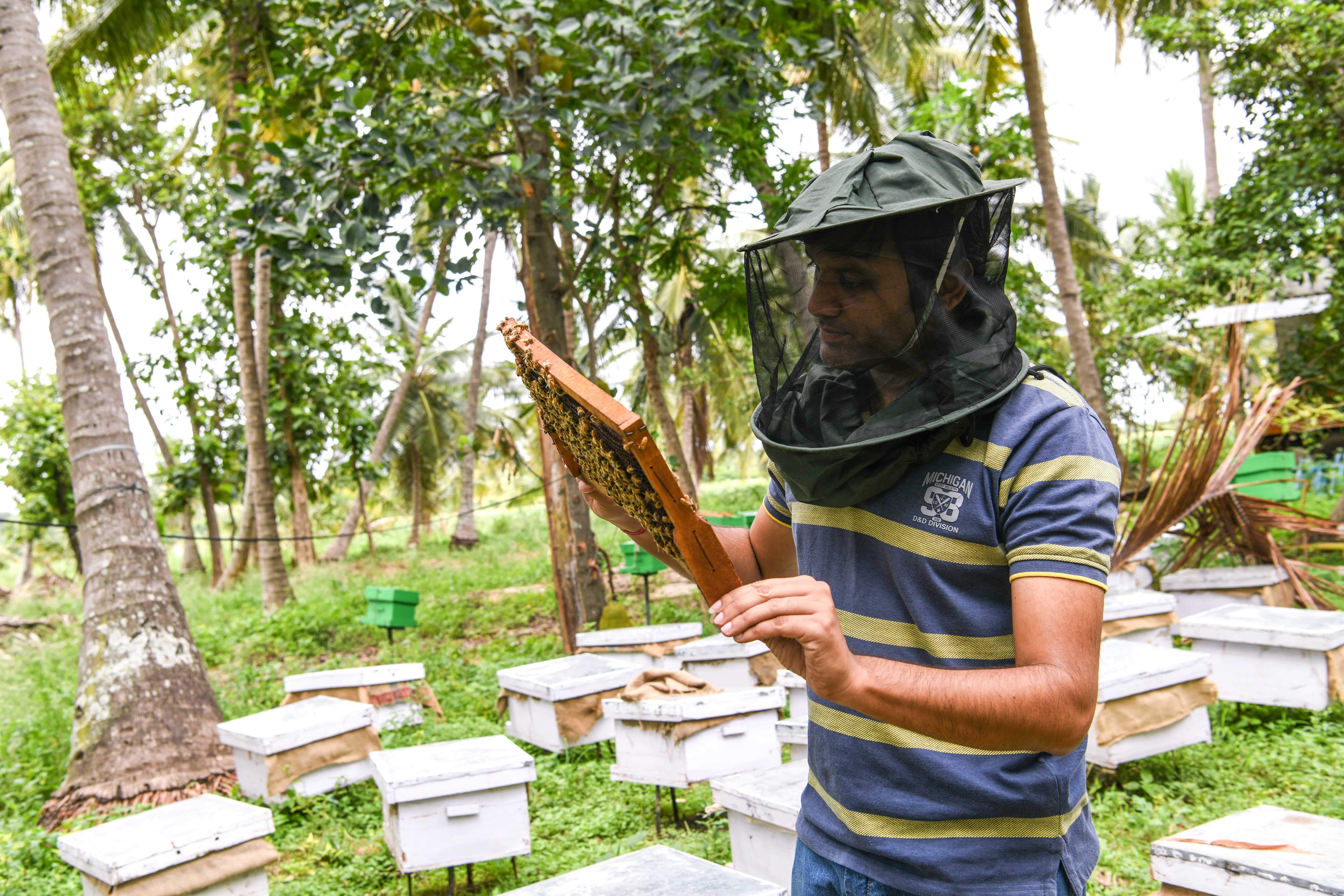
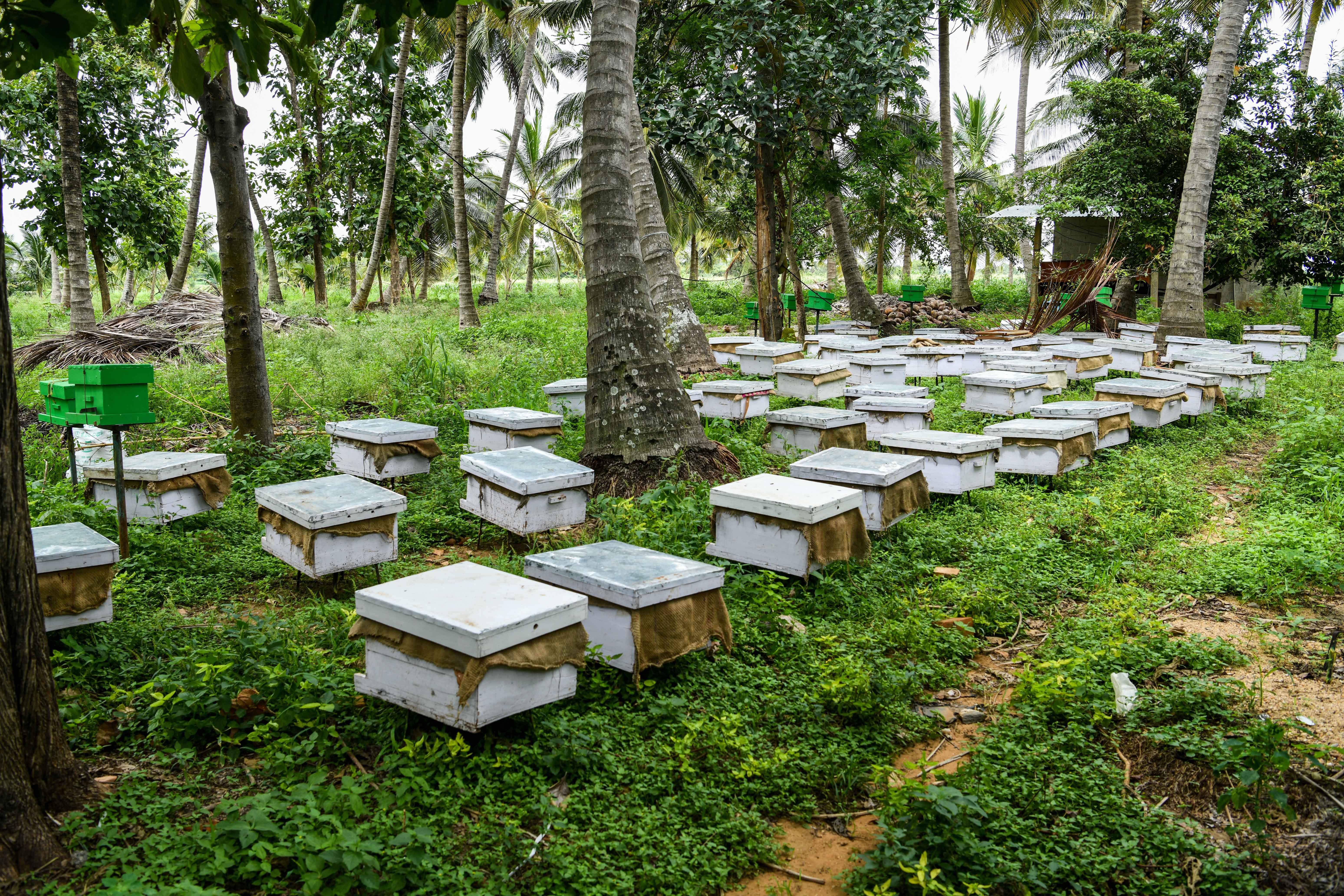
Apoorva visits his bee farm in Bidadi regularly to check the health of the bees. He is a mechanical engineer but a beekeeper by profession. He found his passion for bees even before he graduated and took it up soon after. He’s been working on bees for over 10 years and works closely with farmers across the country. He travels, meets farmers, trains them, gives them bee boxes, follows up with them on the progress and reviews the health of the bees regularly. He also helps them sell their produce. While Apoorva works with a lot of people across the country, this is a story close to home where he’s been working with flood victims in Coorg.
He is involved in multiple activities such as honey production, bee breeding, manufacturing beekeeping equipment, selling honey and beehive by-products, mainly wax. His company’s annual turnover is over 2 crores. He has both Indian and Italian bees.
He initially collected bees from hives and then started breeding them in his apiary during the natural division season of bees. He also buys colonies from farmers when they multiply. This bee farm is near a cornfield which is rich in pollen. It is important to understand your demography he says. Having bee flora next to an apiary is very beneficial to harvest more honey and keep bees in good health. He harvests Indian bees in forests and hilly regions and also promotes only Indian bees to farmers as it’s easier since most of them cannot handle migratory beekeeping.
European bees which in India are Italian bees requires 4-7 migrations in a year for which, he travels around 1,200 kms pollinating thousands of acres in North Karnataka mainly Sunflowers, Til, Niger, Coconuts, Arecanuts, Banana, Avacado, Litchi and more. Honey yielding fields for Italian bees are Sunflowers, Eucalyptus, Til and Niger. He has more than 200 colonies now and will split them to make about 800 during the breeding season. A farmer keeps anywhere between 4-25 boxes. He needs about 3 boxes per acre and has to distance each colony by at least 10 feet.
Bee Harvesting has helped Coorg flood victims make a livelihood
Vijay Panduranga talks about the effects of the flood and the rehabilitation work in Coorg.
After the floods in 2018 that hit Coorg, a lot of farmers lost their land in turn livelihood and haven’t received much relief from the government. There were rescue operations but then not much is being done on the rehabilitation front.
With paltry compensation from the govt. Coorg flood victims are finding solace in the new beekeeping venture. Nectar flow is an initiative/program started by a few local people, spearheaded by Retd. Brigadier Devaiah to help provide a steady income to people interested in beekeeping. People have seen returns in the 1st few months. They say that the money that comes in lets them breathe. While beekeeping in an age-old tradition in Coorg, the methods are ancient. Devaiah was on the lookout for someone with a scientific approach to help them and that’s when he found Apoorva and sought help. Apoorva readily agreed and continues to work closely with the farmers. He has helped the farmers understand the species better, eventually getting them better yields. At Coorg, each farmer makes a minimum of 5 kgs of honey per year and each box sells at Rs. 600/- per kg. They also make money by selling colonies at Rs. 1,500/- per colony. Farmers produce about 2-3 kgs of beeswax per year which is approximately Rs. 350/ kg
Farmers from the North East, Chhattisgarh, Coorg and other parts of India find it difficult to sell the honey and wax that they produce. Apoorva helps them by buying the whole lot from them, filters them further if there’s moisture and sells them as and when he gets enquires. Honey is labeled as per the flowering season such as litchi, cardamom, clover, mustard, chilli, etc., the honey tastes different too.
The by-products such as beeswax, royal jelly and bees venom are other sources of income and, used in pharmaceuticals and beauty products.
The below-mentioned statistics are only an example of how bee pollination increases the yield anywhere between15% – 80%. These are scientifically proven numbers in ideal conditions (these are underestimated values).
Estimated global economic value of pollination is 217 billion USD in 2005
_______________________________________________
Crop Increase in yield per acre (%) Increase in yield per acre Income generation by pollination per acre
_______________________________________________
Coffee 15% 5 Bags 15,000/-
Aracanut 25% 2 Quintals 64,000/-
Coconut 20% 3,000 nuts 36,000/-
Banana 20% 5 Quintals 10,000/-
Watermelon 80% 4 Tonnes 20,000/-
___________________________________________
Farmers tell us their personal stories of how beekeeping has helped increase their yield with pollination in crops such as coffee, fruits and spices. They also make a good livelihood but extracting honey and wax. What they make is pure and unadulterated making the quality far more superior than the ones available off the shelves at supermarkets.
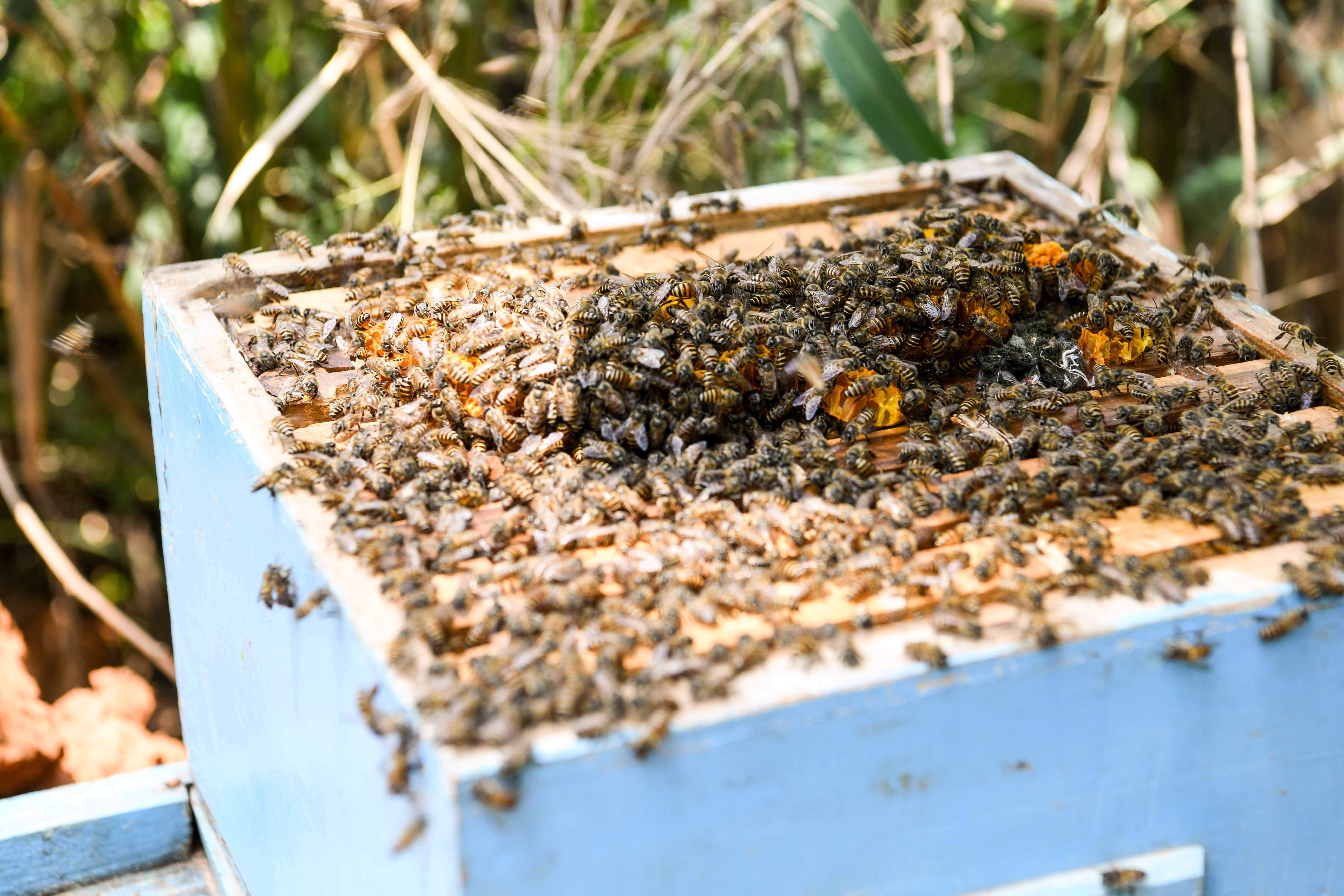
This is what a bee box looks like. This is one bee colony. They come on top to feed. There are multiple wooden frames inside quoted with wax, which help them construct combs.
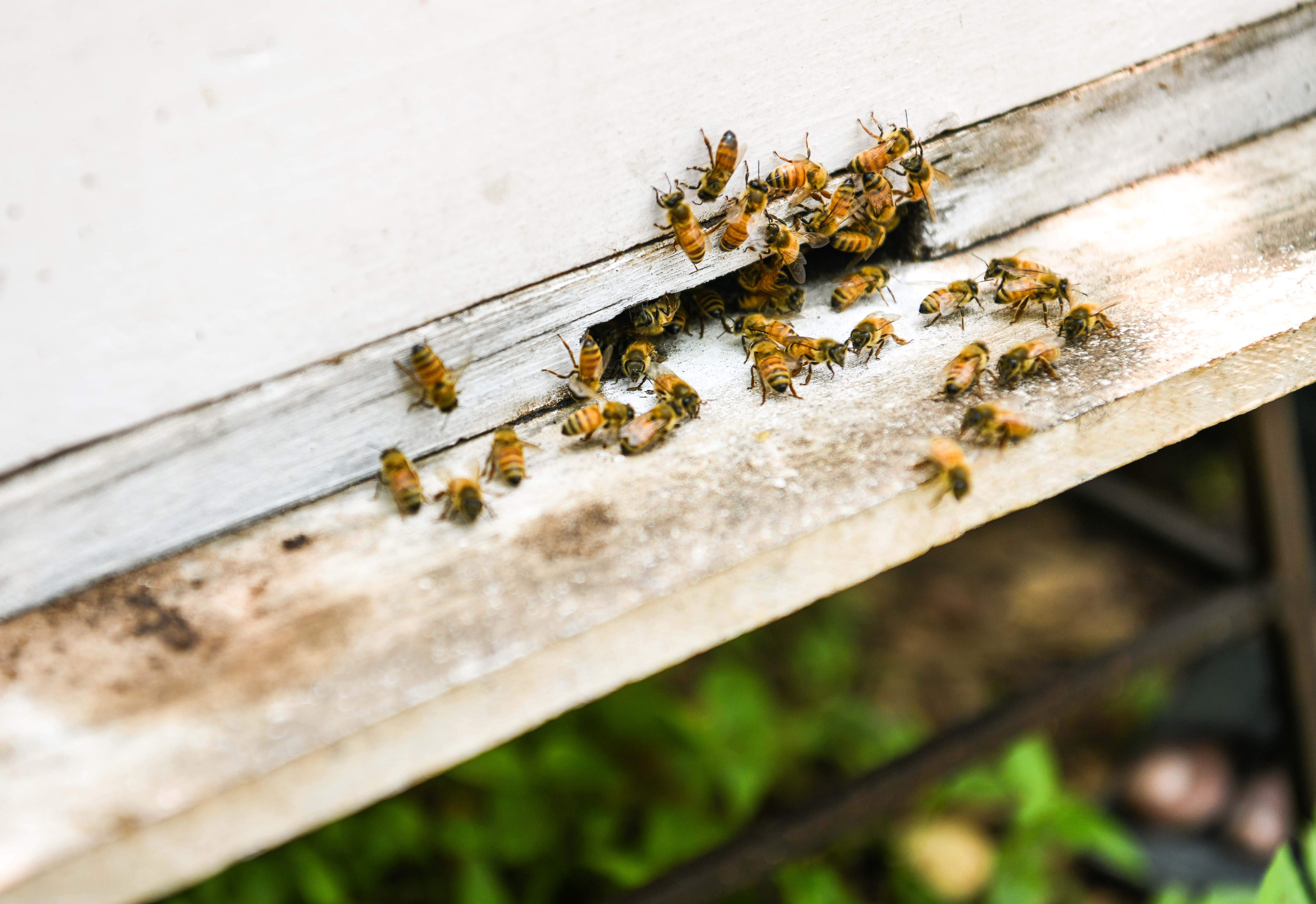
Every bee box has an opening at the bottom which allows the bees to move in and out of it, to go out and collect nectar and pollen. Some farmers who have these bee boxes are also given out on rent for pollination to seed producers or other farmers who are in need of pollination.
Naganna (Saachi) Kalappa lives 3 kms away from the main Madhapur town in Somwarpet Taluk. He has been harvesting bees for 18-20 years. Bees were available in abundance then as the ecology was healthy and rich, and filled with plants that the bees needed to survive. However, the species has seen a massive decline in numbers as the human population has been increasing and trees are being cut down for personal benefits such as planting silver oak trees as it yields timber and in a short span of time. Since the decline in numbers, they now need to procure boxes and up their skills and knowledge. After adopting this scientific method, he has benefited as his crops are multiplying. He is making enough money to take care of the needs of his family. He also says I request people to stop destroying forests and help in sustaining them and grow trees that are required for agriculture instead of timber to improve the ecology.
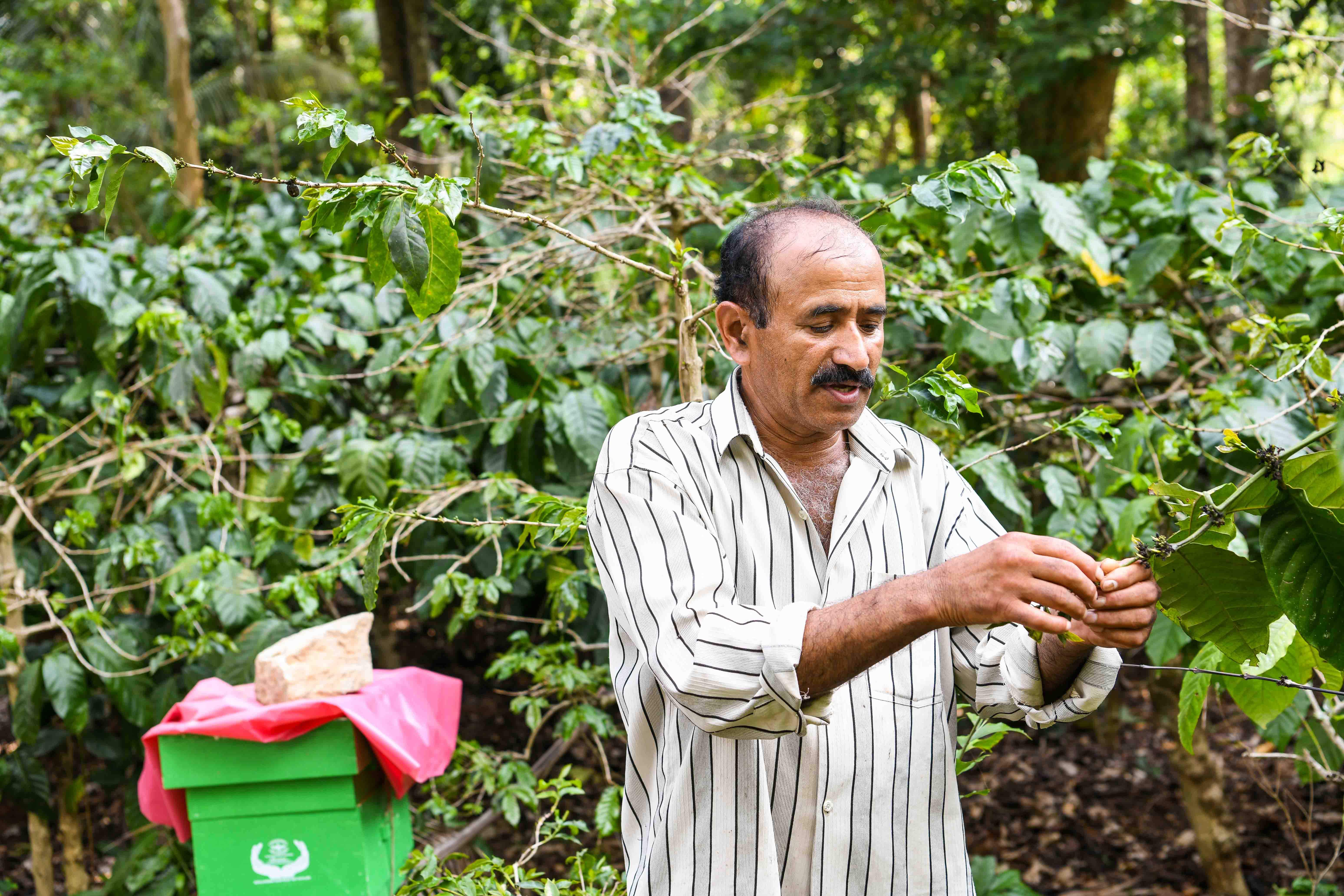
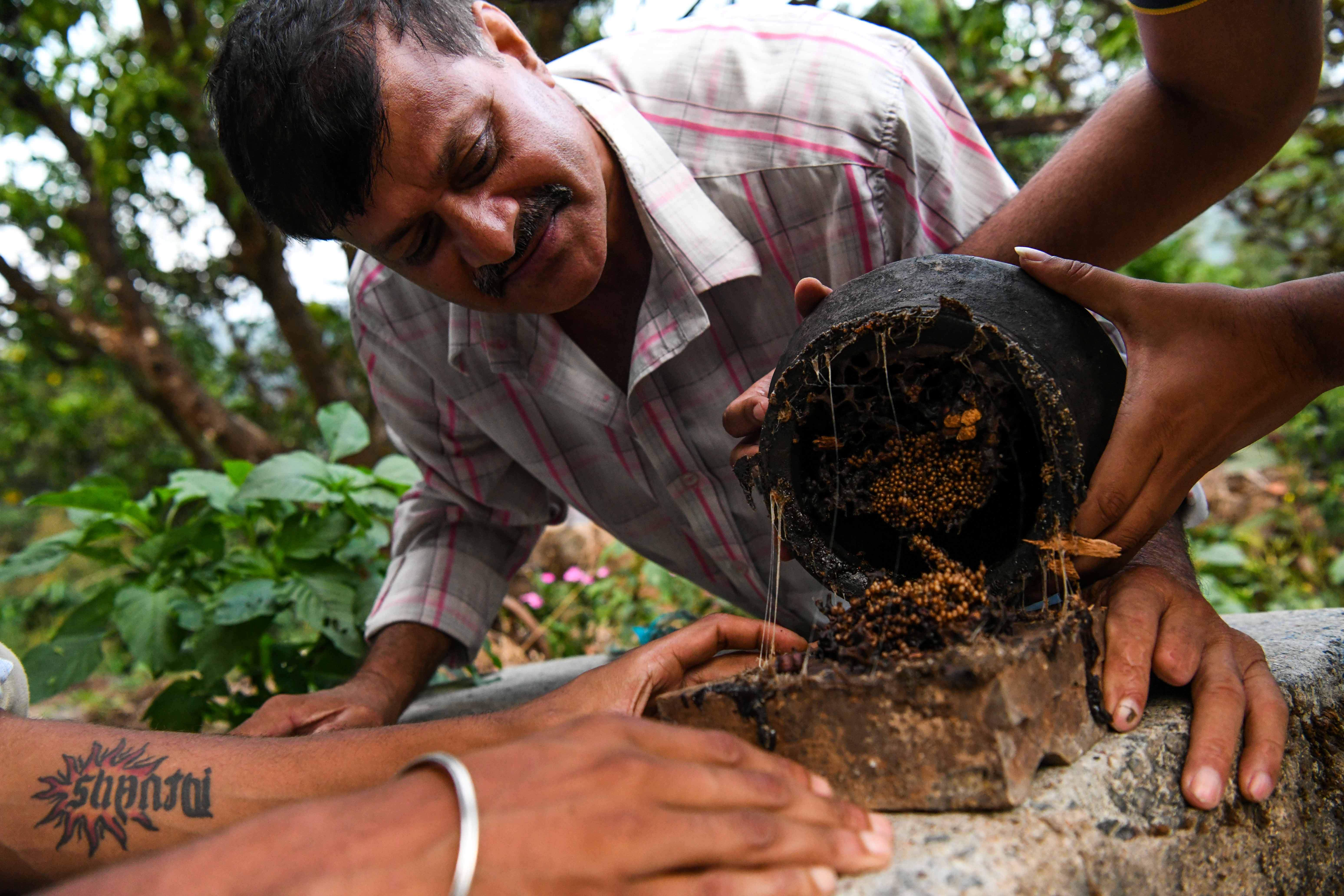
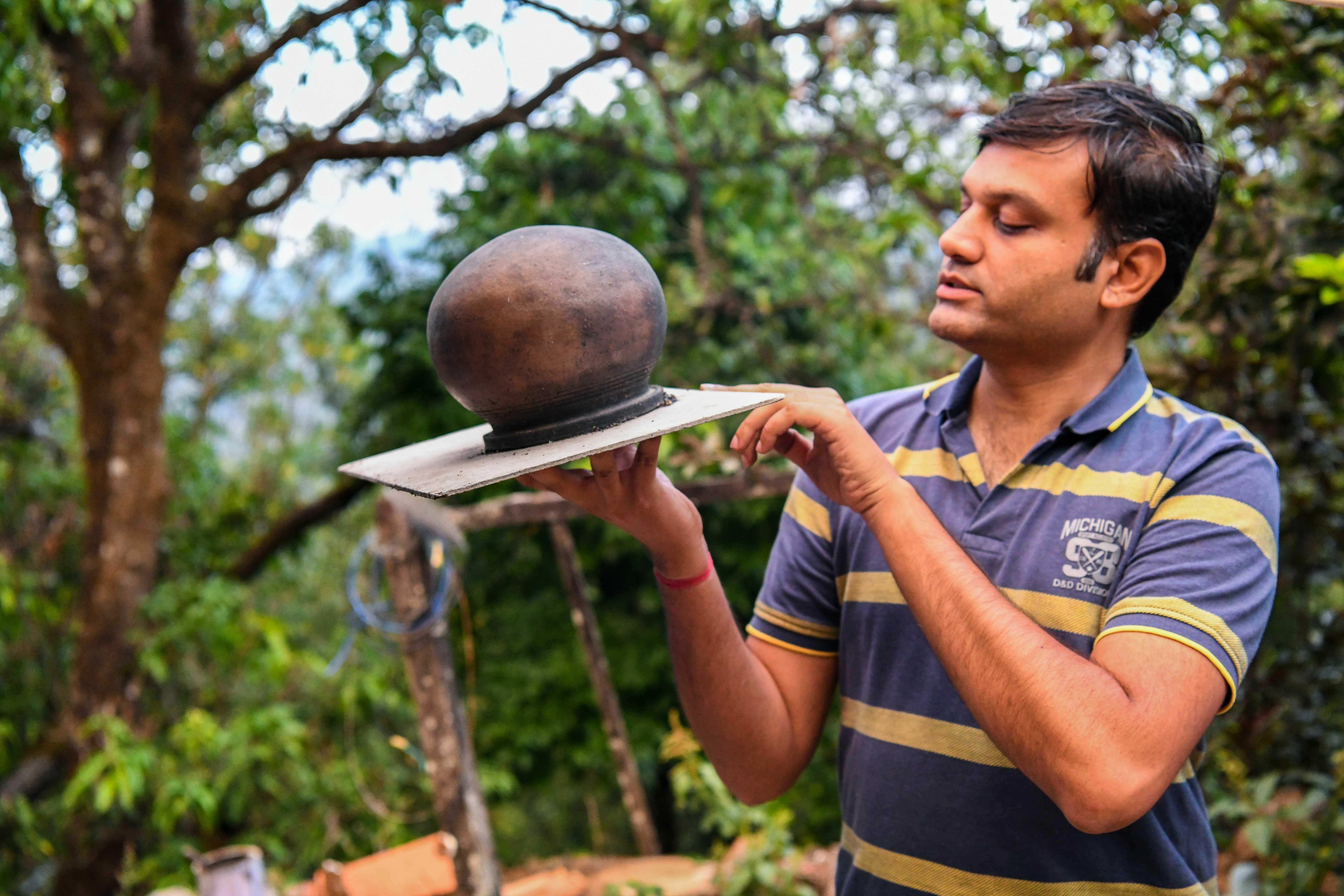
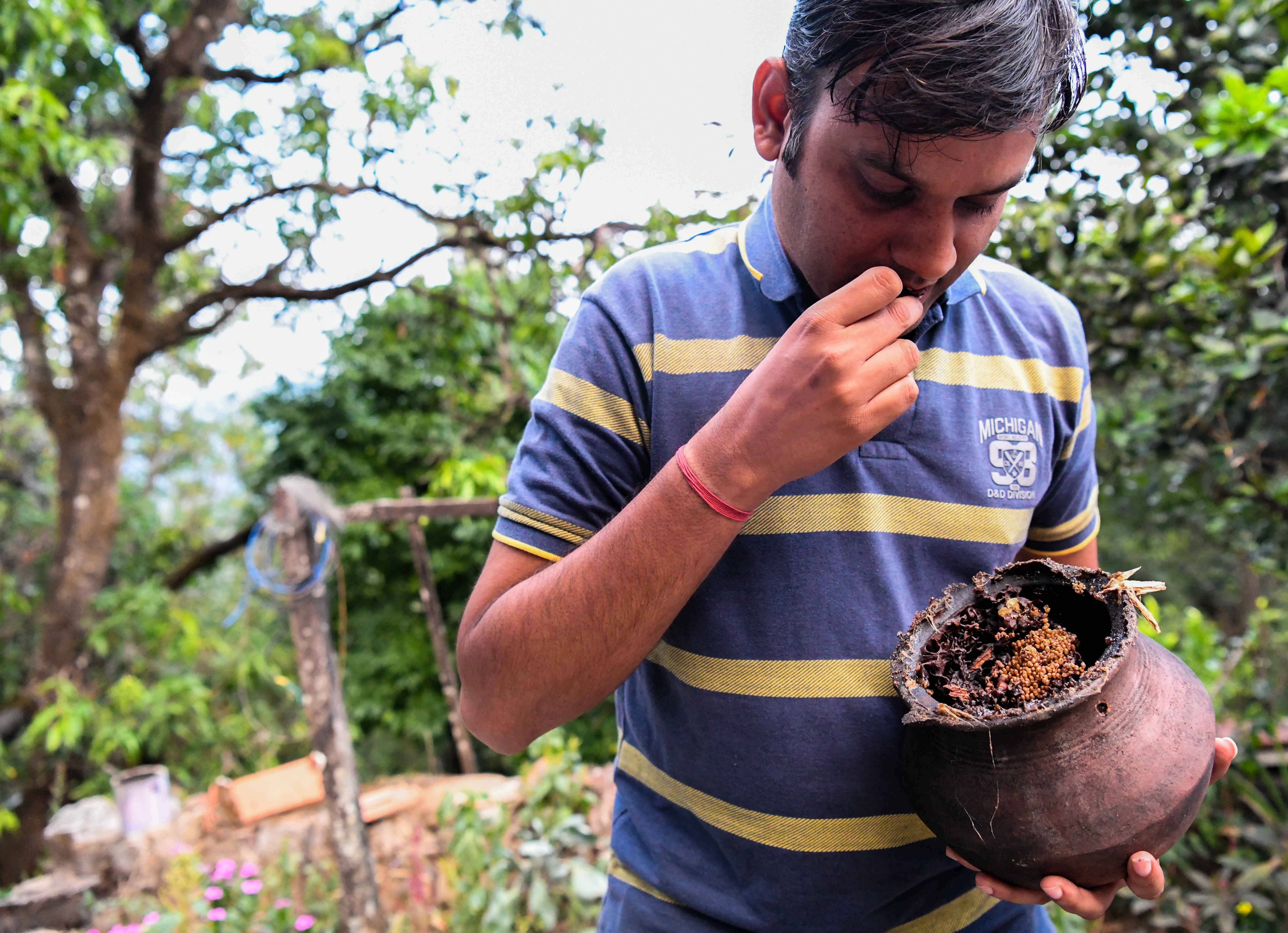
Thammaiah CB (Dolly) lives 7 kilometers away from the main Madhapur town in Somwarpet taluk in the Coorg district. This part of Coorg witnessed the worst of nature’s fury in 2018. While he has been harvesting Indian Apis Cerena Bees in boxes he also harvests stingless bees in pots. The quantity of honey is way lesser than what is produced by other bees however, the quality is far more superior as it has a lot of medicinal properties and is sold at a much higher rate.
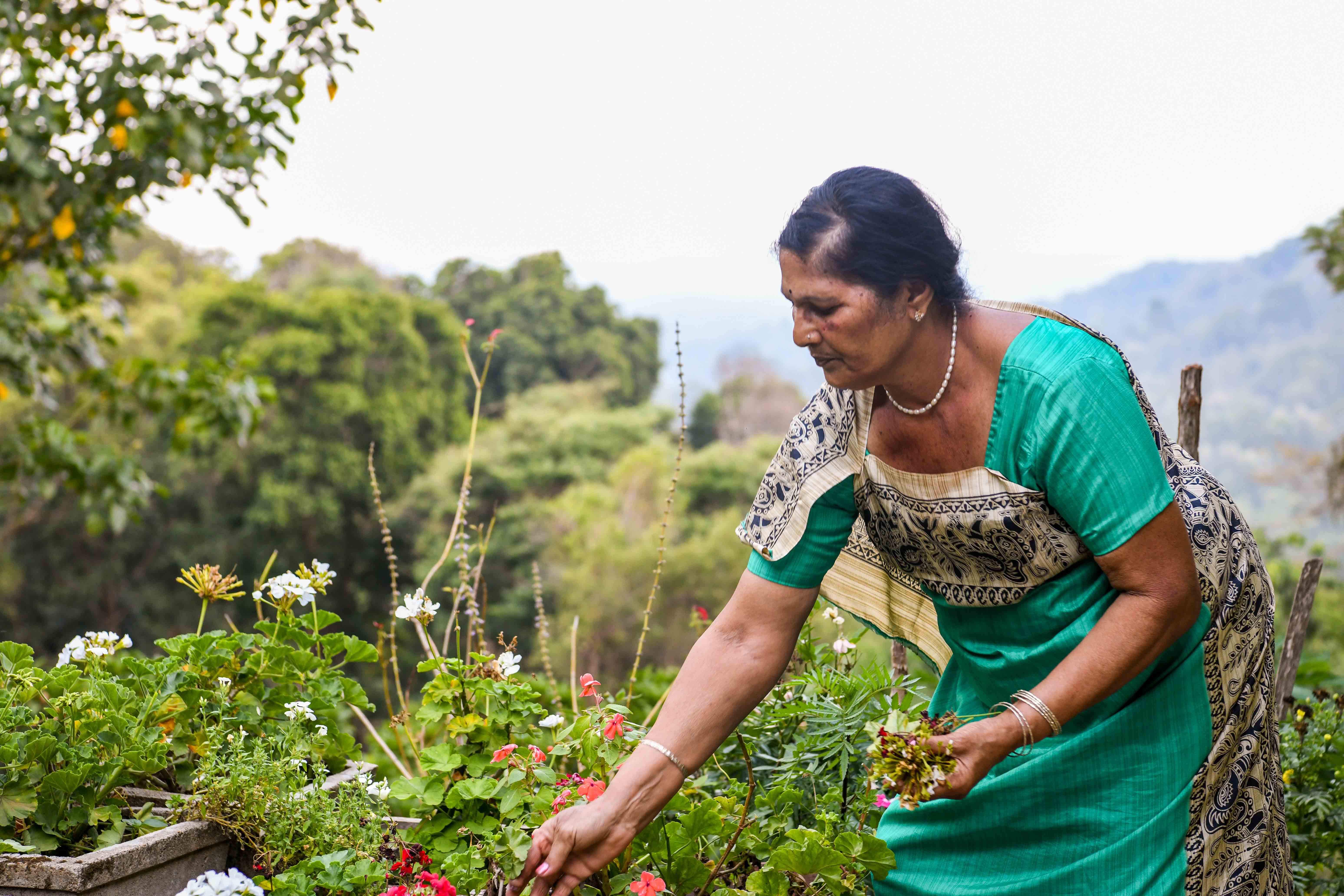
Thammaiah’s mother tends to her garden every day. She says it isn’t enough if you just harvest bees and have a coffee estate, it is very important to understand what kind of flowers and fruits attract them and cultivate them in your garden. This helps in increasing pollination and nectar production.
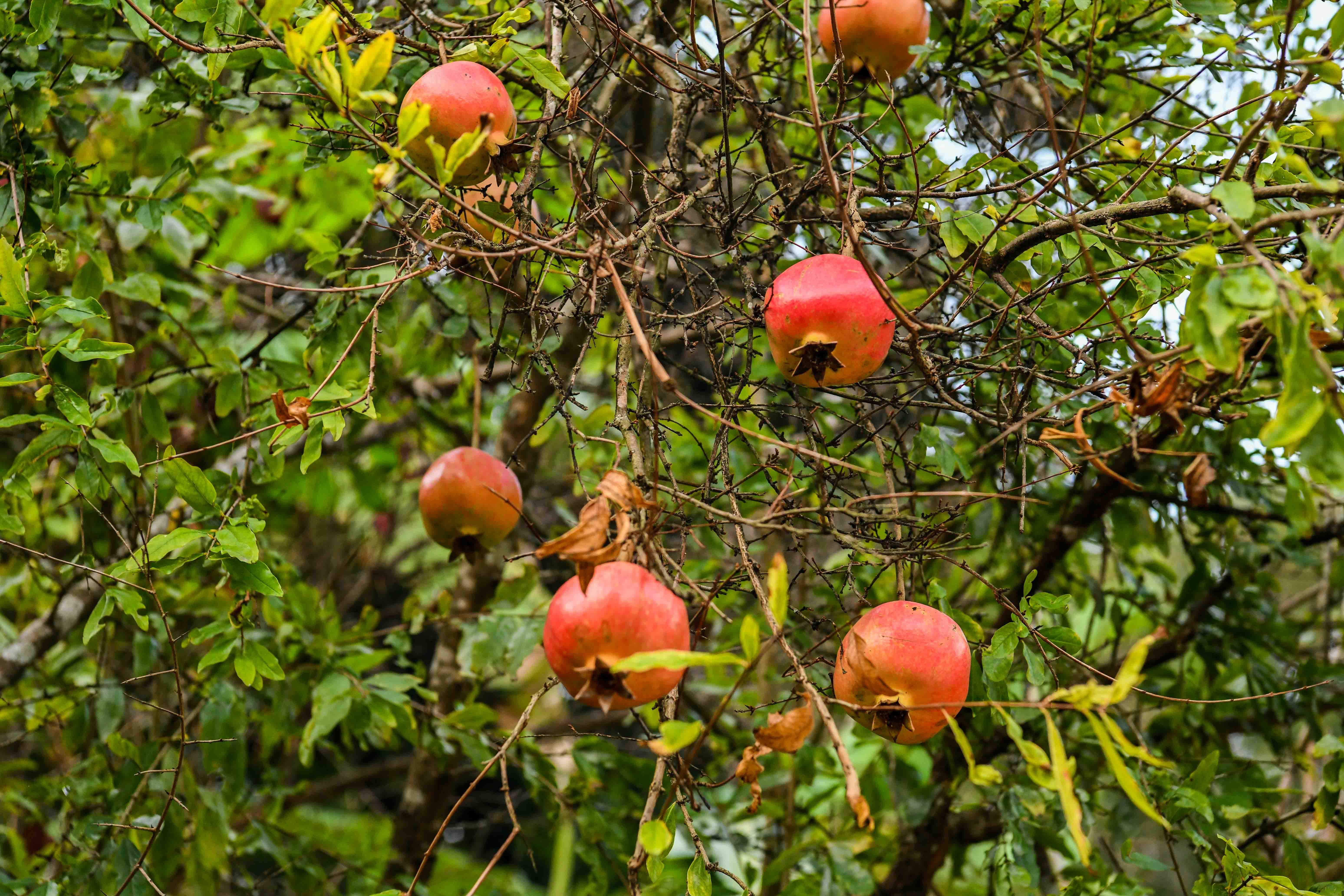
Fruit especially those with seeds are good pollinators.
Plants that one should cultivate to yield better results
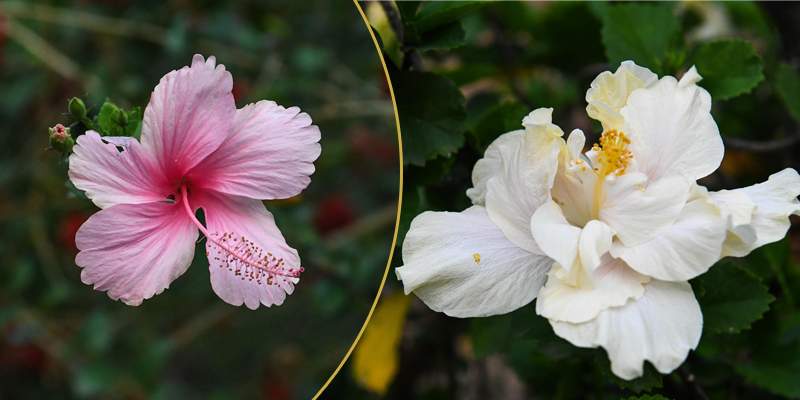
Nectar: Plants such as Avocado, Litchi, Hibiscus etc.
Pollination: Plants such as Sunflower, Sesame, Mustard, Coriander, Niger, Coconut and more (bees are attracted to vibrant colours such as yellow and blue)
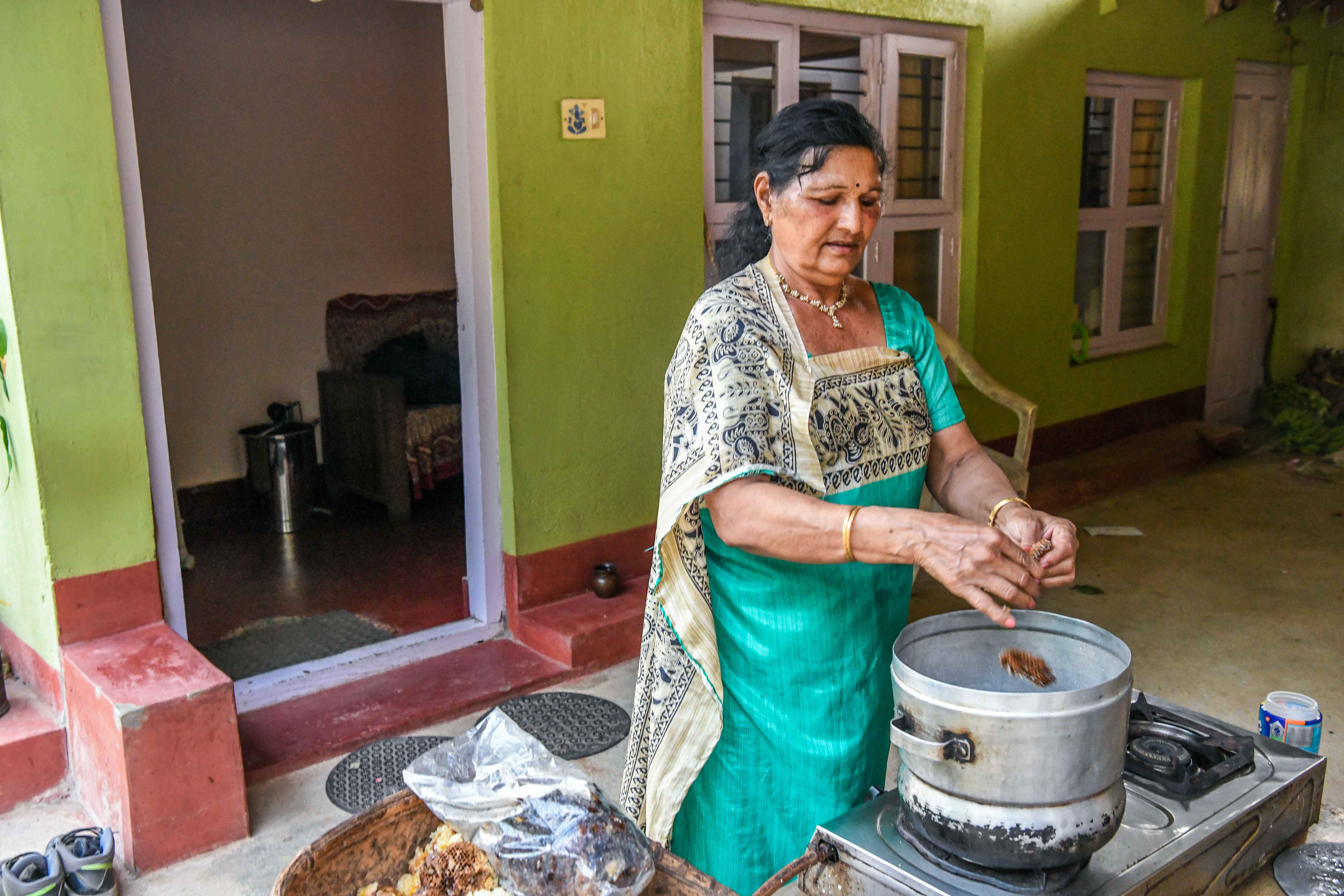
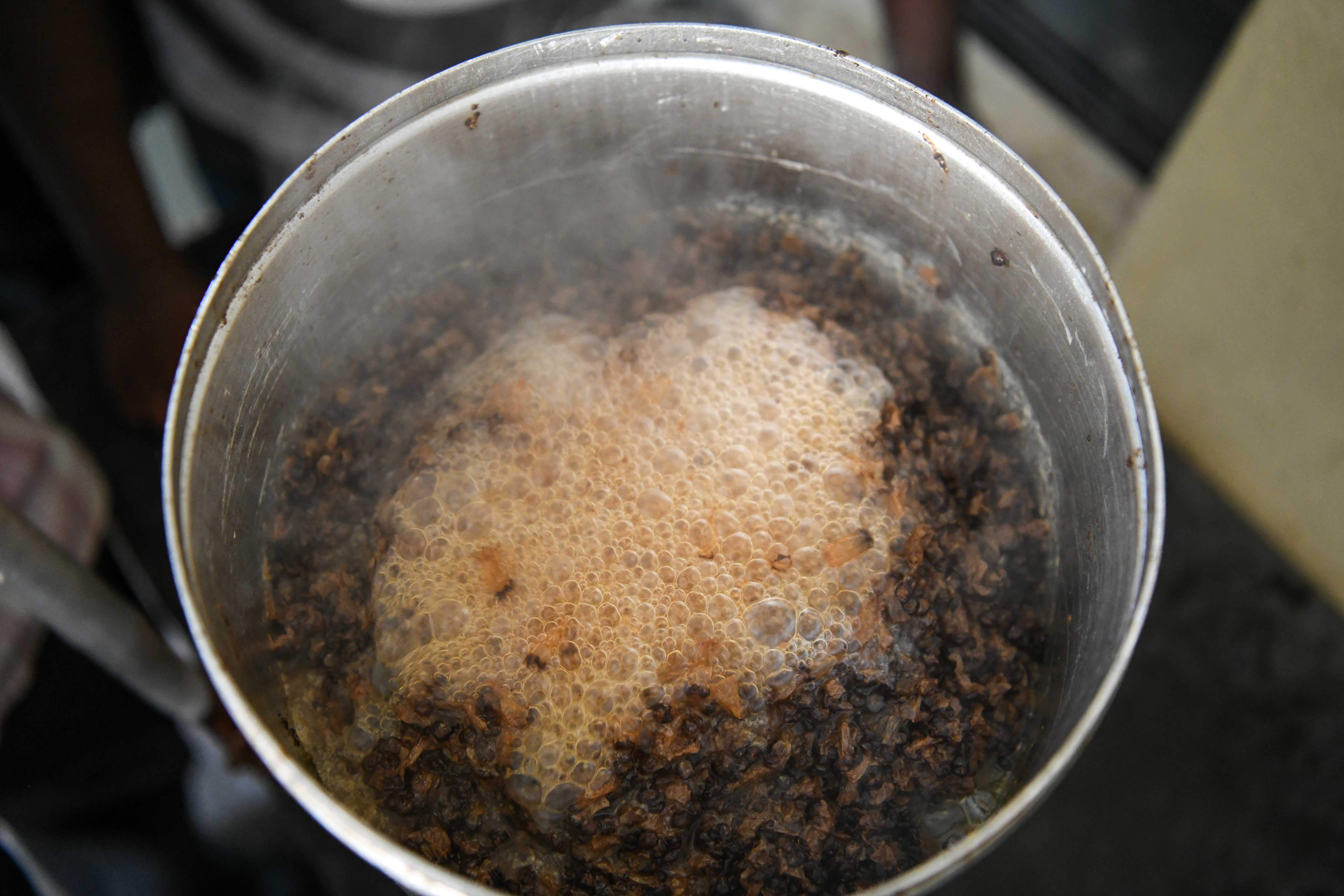
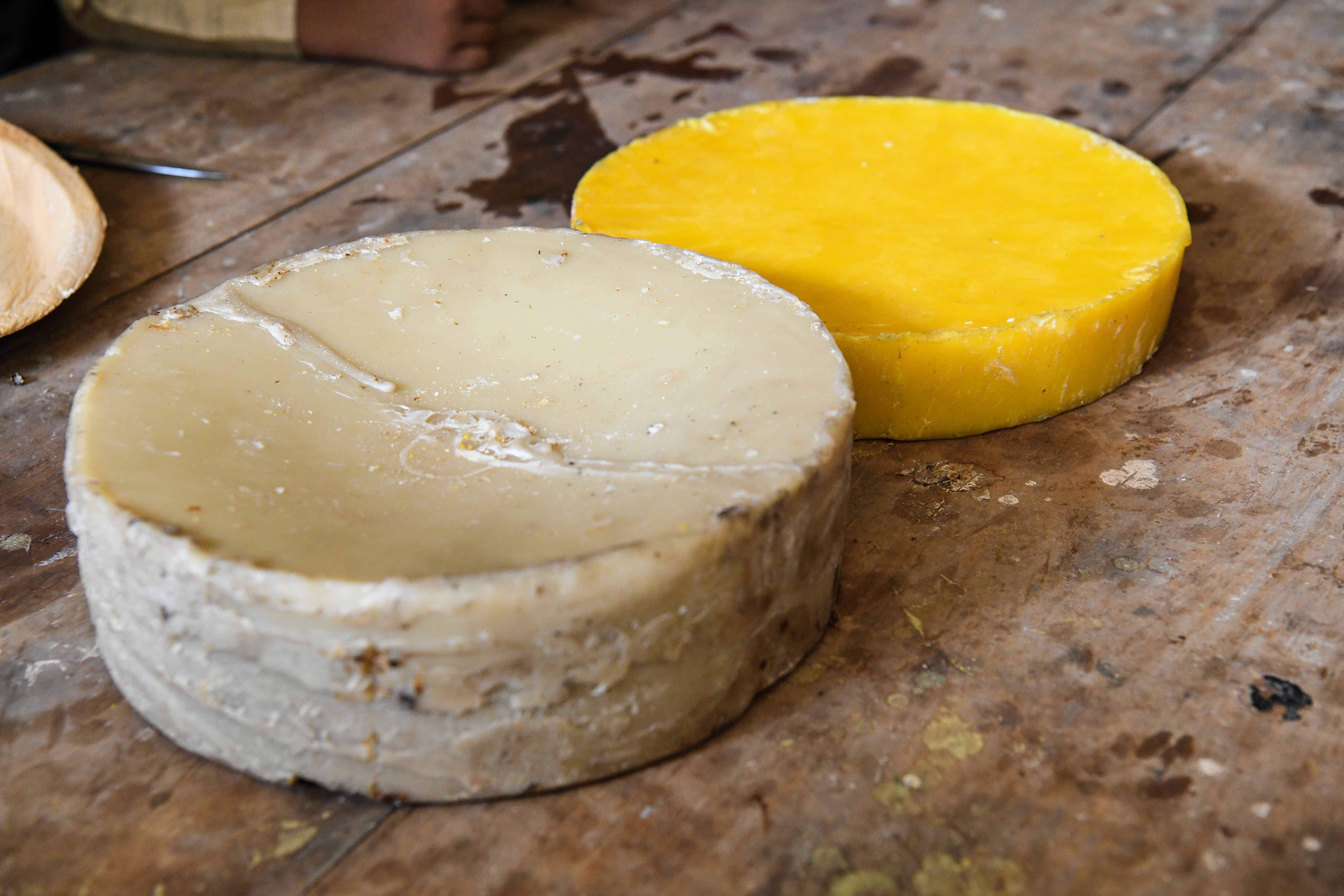
She also makes beeswax at home which is another income generator. She says that it is not a very laborious process and demonstrates. You first break the comb into a utensil with enough water and let it boil.
You let it boil until it reaches the required consistency.
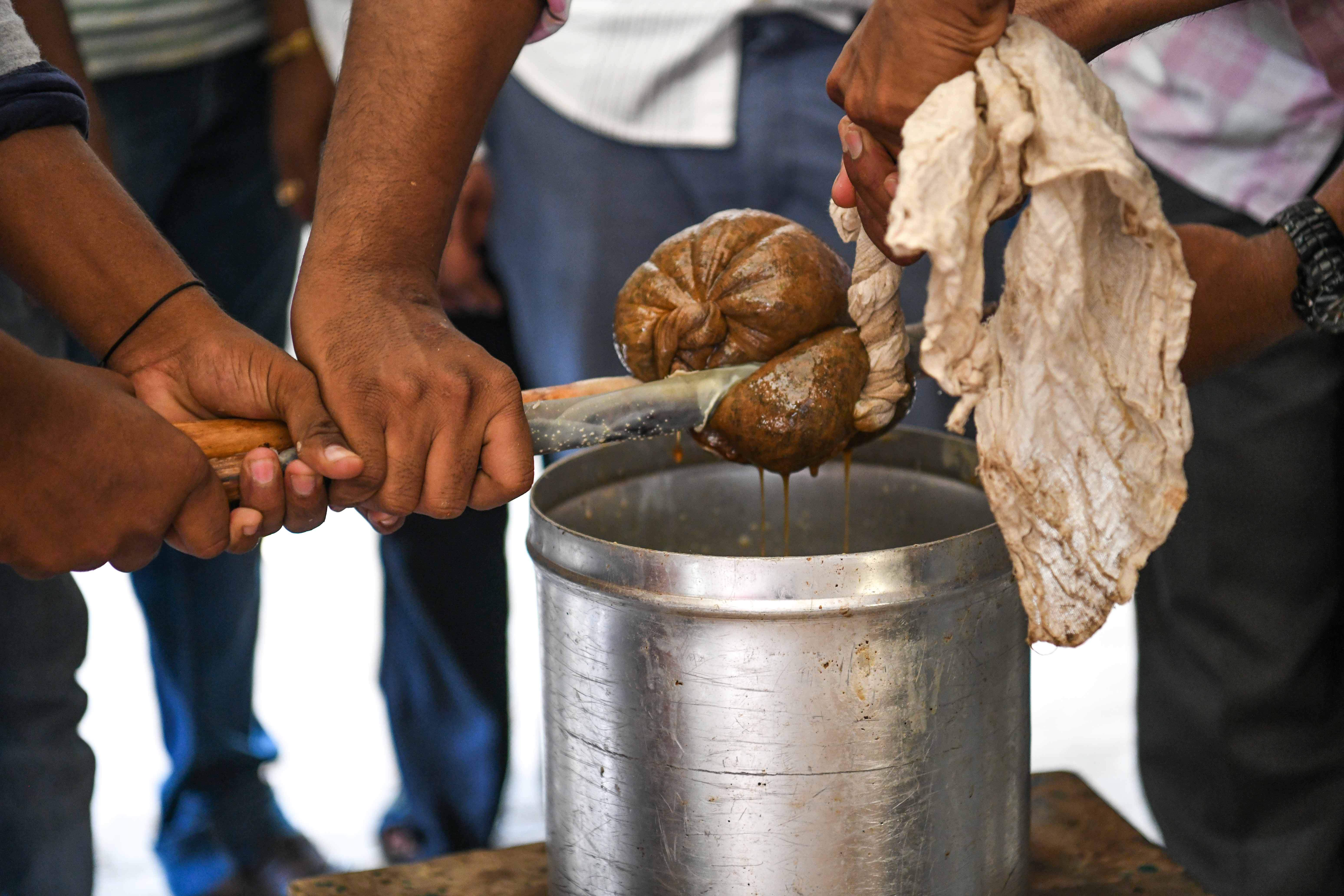
You then squeeze out all the excess water and use the residue to make wax cakes.
This is the final product.
Apoorva pays regular visits to all the farmers across the country and conducts a health check.
It is very important to taste it as well. Every house he goes to gives him honey to taste. He jokes and says I am glad I don’t have diabetes. If I did, for the amount of honey I consume, I would be in a lot of trouble.
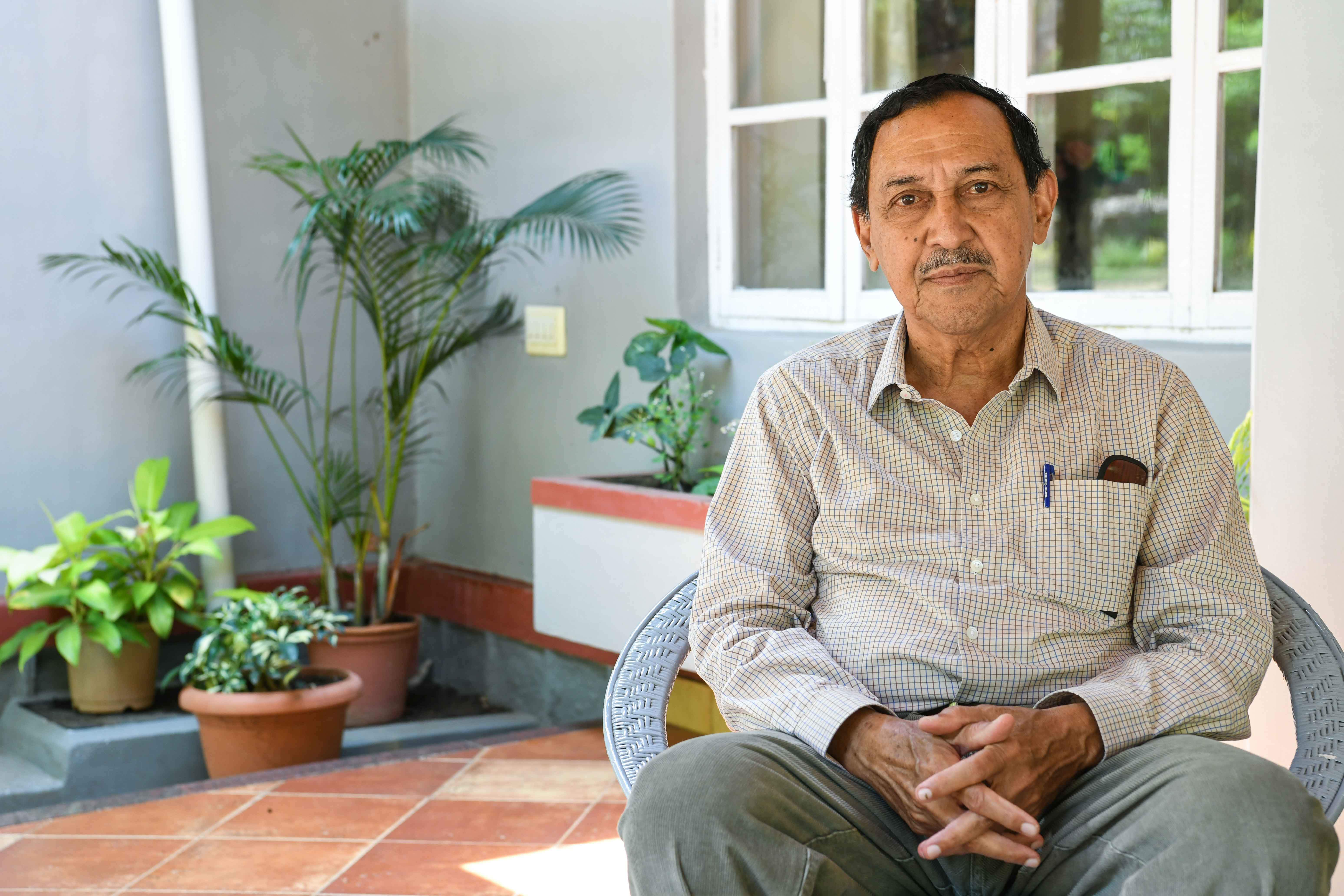
Bose Mandanna is the fourth generation coffee grower. He moved back to Coorg 53 years ago after completing a bachelor’s degree in Agricultural Economics. He talks of how he has seen farming change in the years to come. Back in the day farming was done in a very environmentally friendly way. Over a period of time, when they found pests taking over the plantation, they used some chemicals to deal with the pest issue. However, they soon realised that they were not only harming humans but also the bees and other pollinators in the environment. These chemicals known as weed killers have cancer-causing properties. On realising this, they decided to go back to organic farming. However, a lot of farmers have been affected by this chemical especially in Punjab as they are one of the largest agriculturists, and the Punjab mail is popularly called the cancer express as a lot of them are coming to Bombay for treatment. Also to note the groundwater gets affected by these chemicals. People are saying that there are bee-friendly pesticides available. He jokes and says “there are all chemicals and they cannot be friendly, they might not kill you but make you unconscious”. Please avoid chemicals and use bio controlled agents.
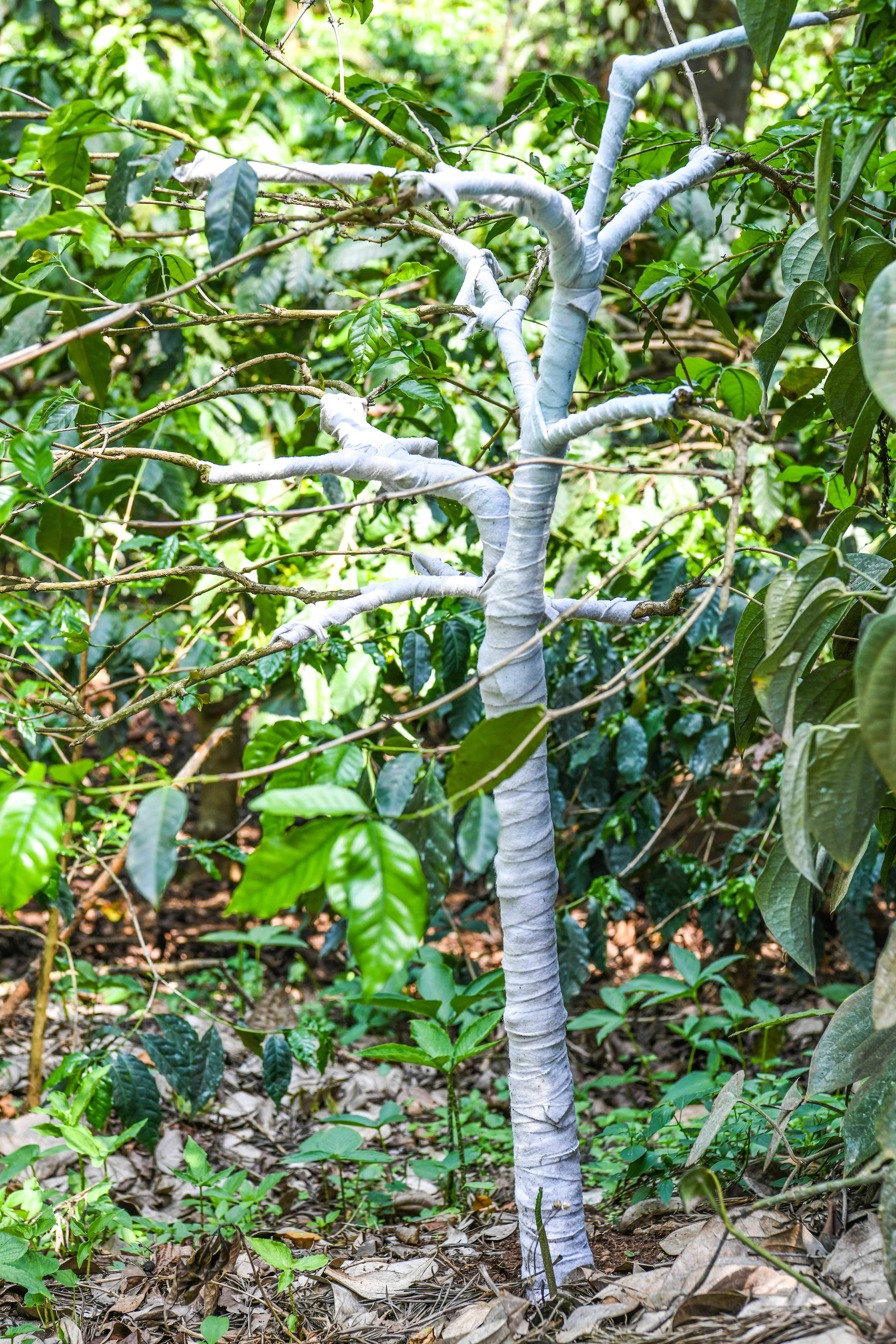
White Stem Borer Problem: These pests are known to attack the coffee plants and wreak havock hence they wrap the plants with white cloths to avoid this menace. There is a mild chemical in it but it only
touches the trunk of the plant and does not reach the coffee flower thereby not harming humans or bees.
May 20th is International Bees Day. UAS in GKVK conducted a 2 day class for people interested in beekeeping. Urban beekeeping is also becoming popular as people from the cities have started showing
interest.
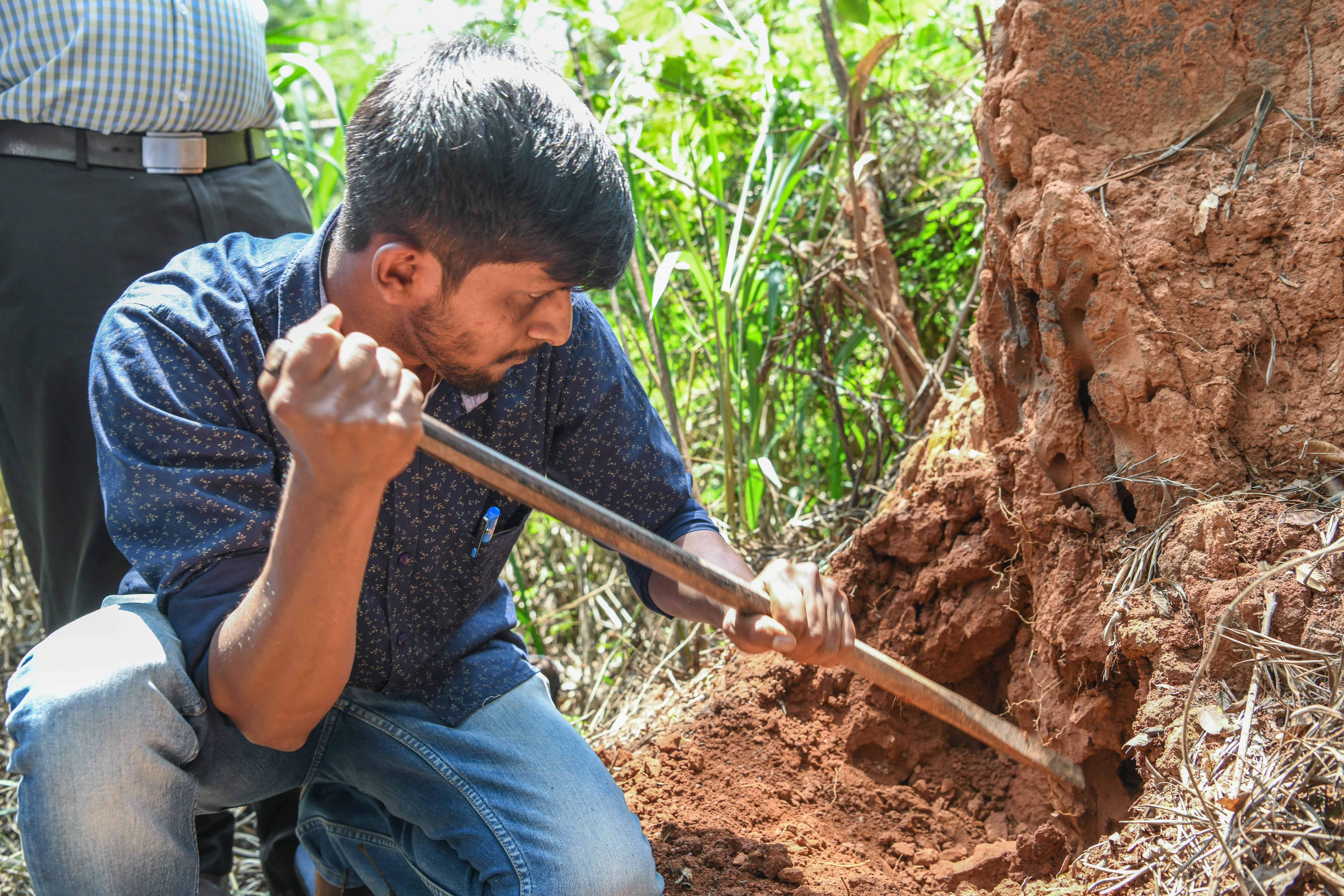
The staff showed them how to identify and dig out for a beehive as they can build hives anywhere. This has to be done with caution so as to not break the hive.
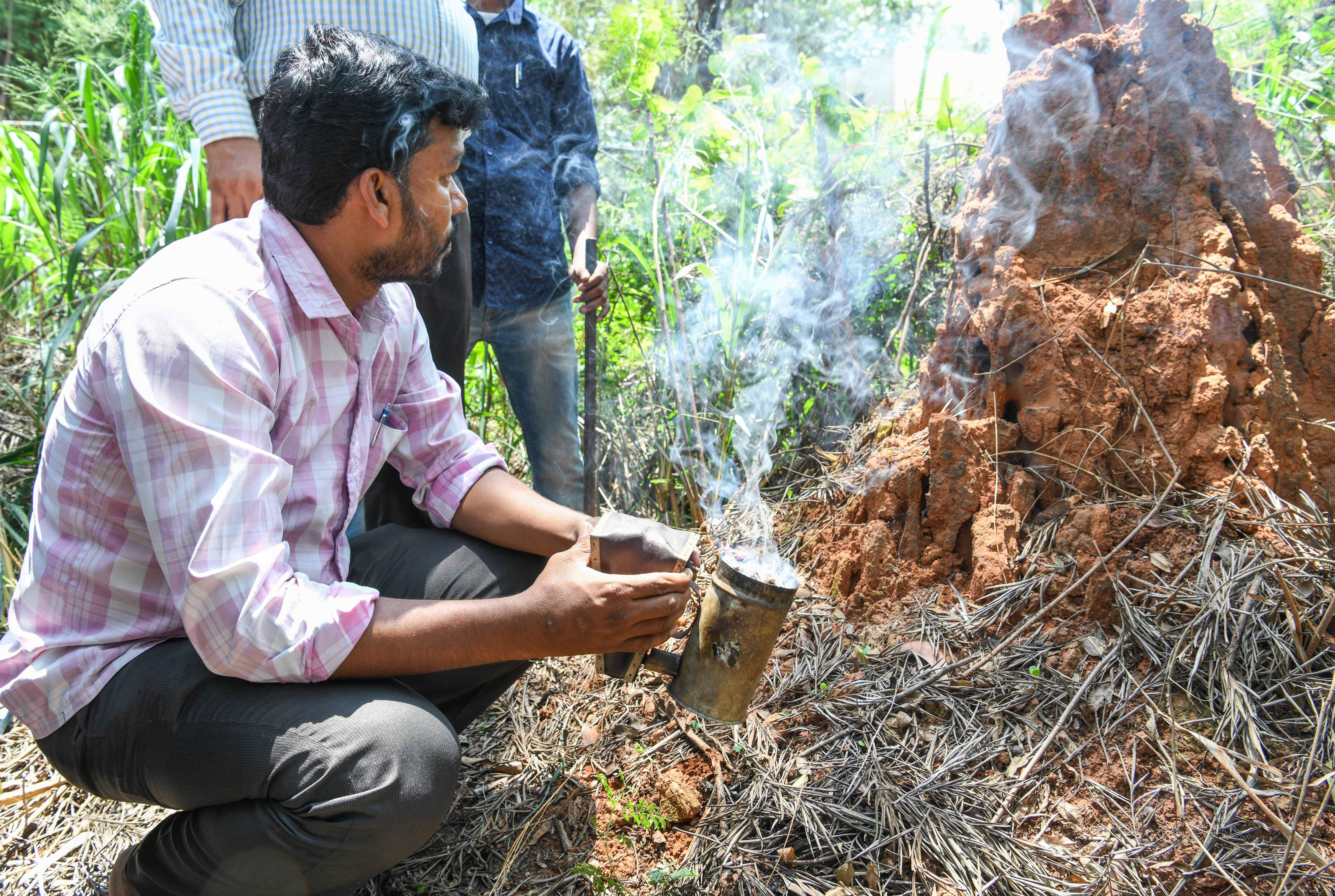
You then mildly sedate the bees with some smoke by burning dry cotton cloth and get the comb out
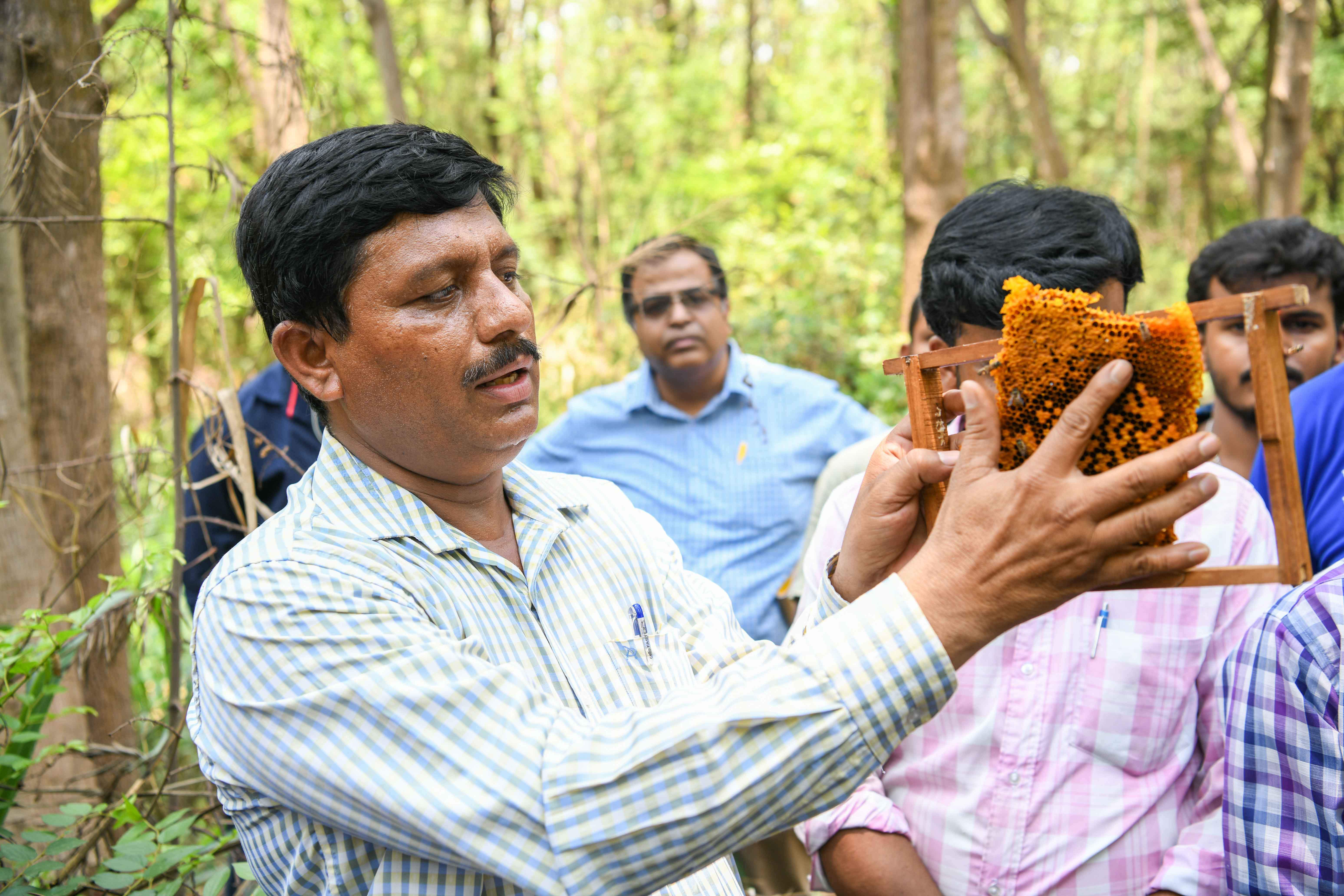
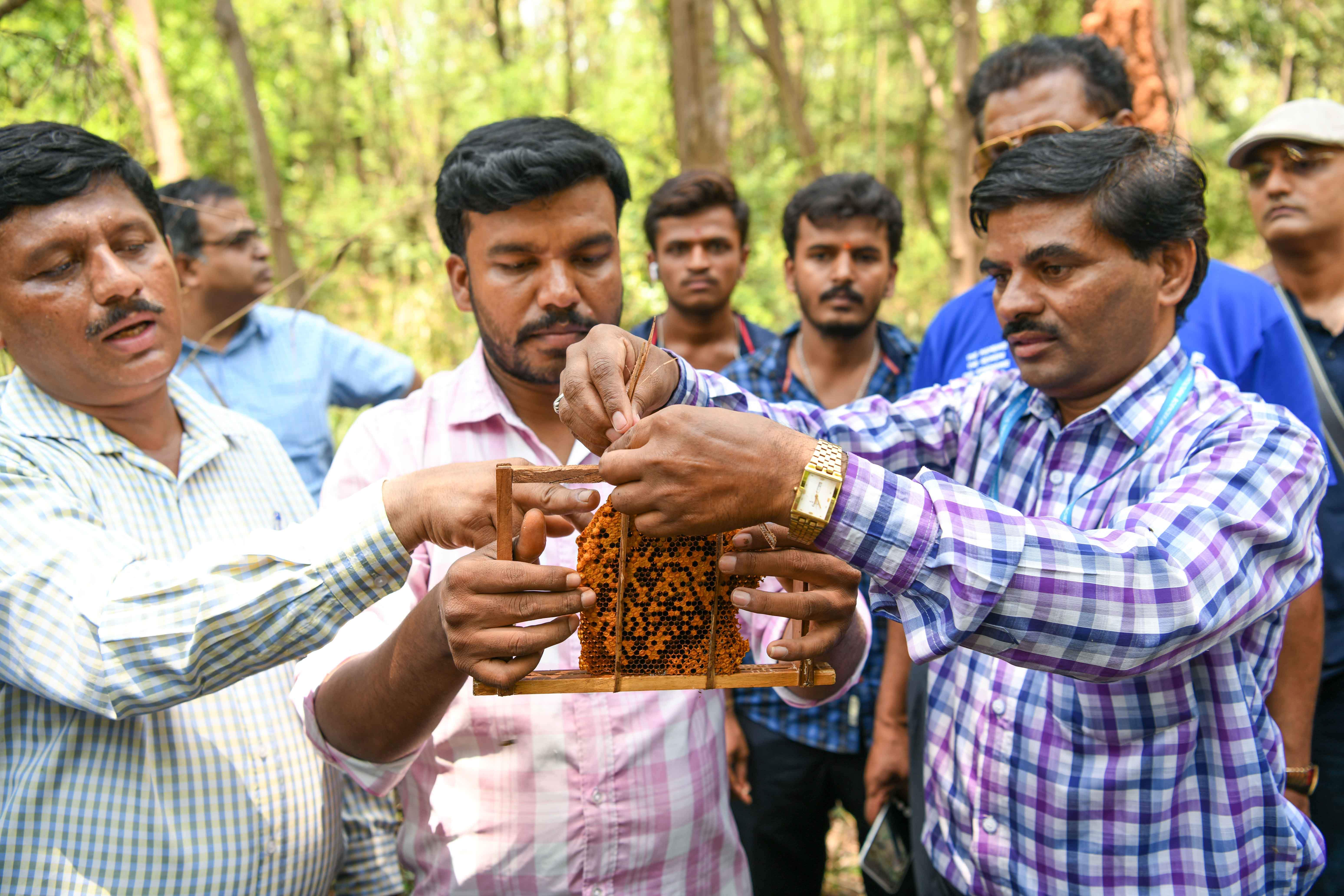
Once you get the comb out, you tie them tightly to a frame but not so tight that they break.
Students learn to tie the comb to the frame.
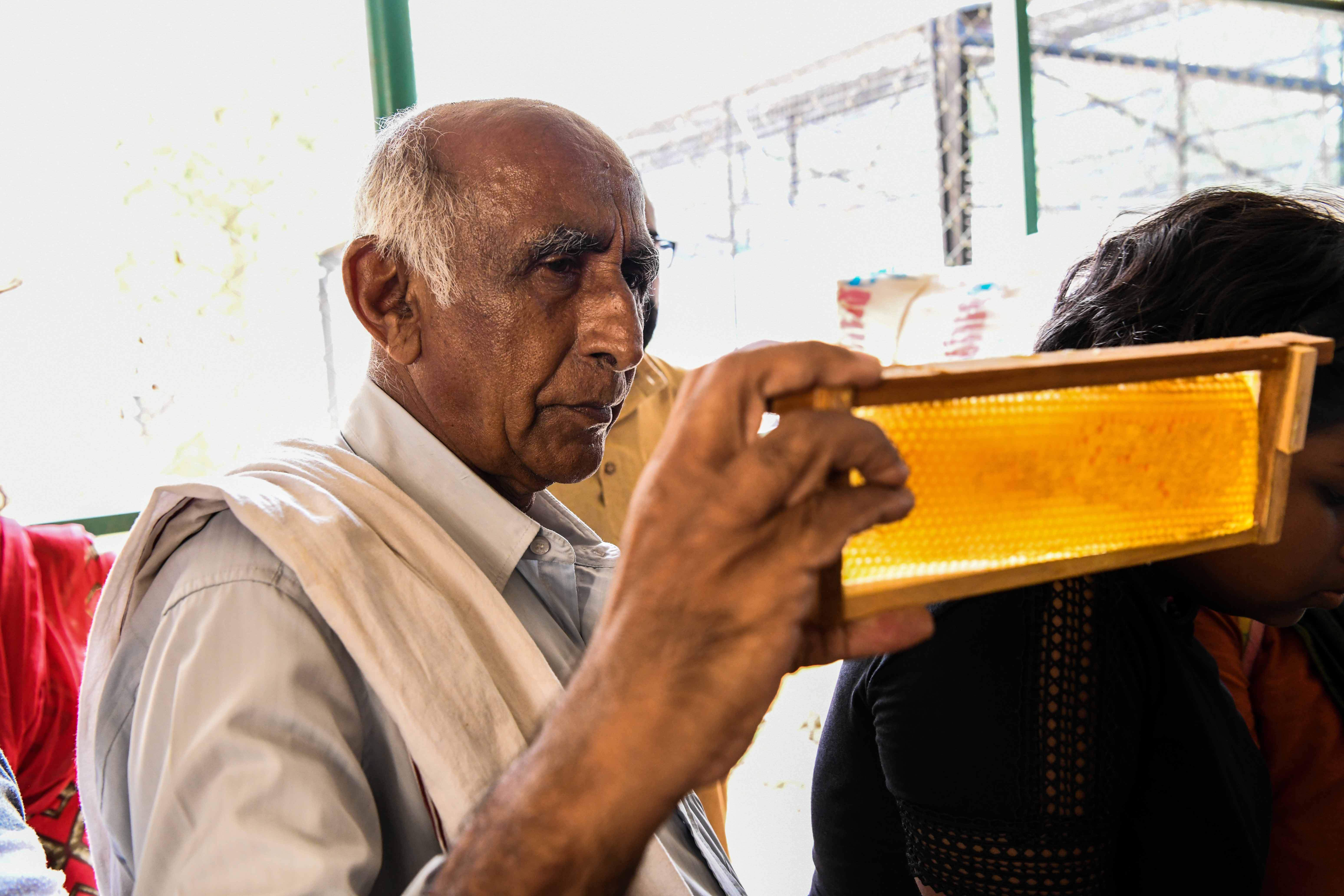
While they learn to make honey, a student observes the comb.
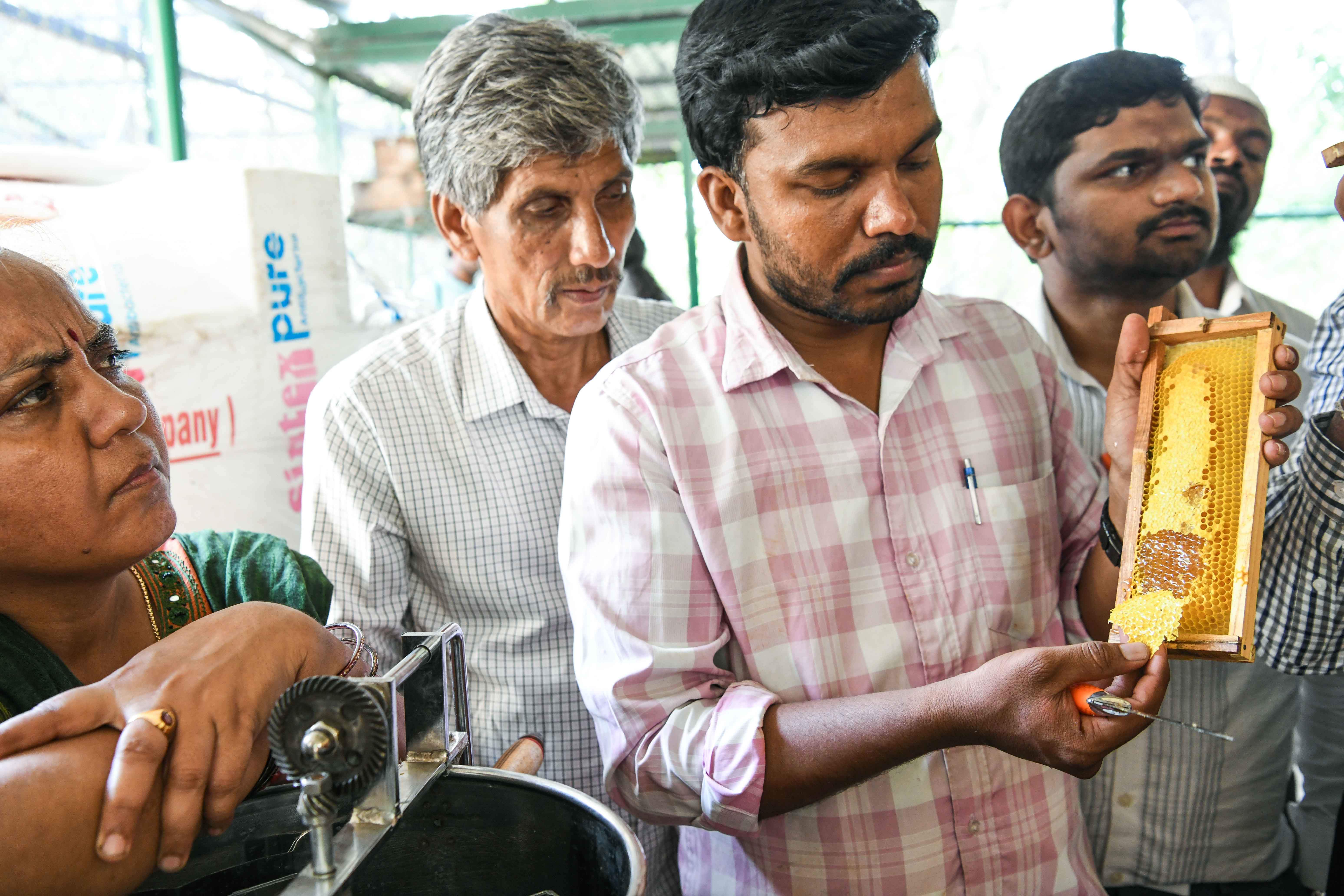
Santosh from the faculty shows the class how to peel the comb before you can put it into a vessel to churn honey. The peeling has to be very fine.
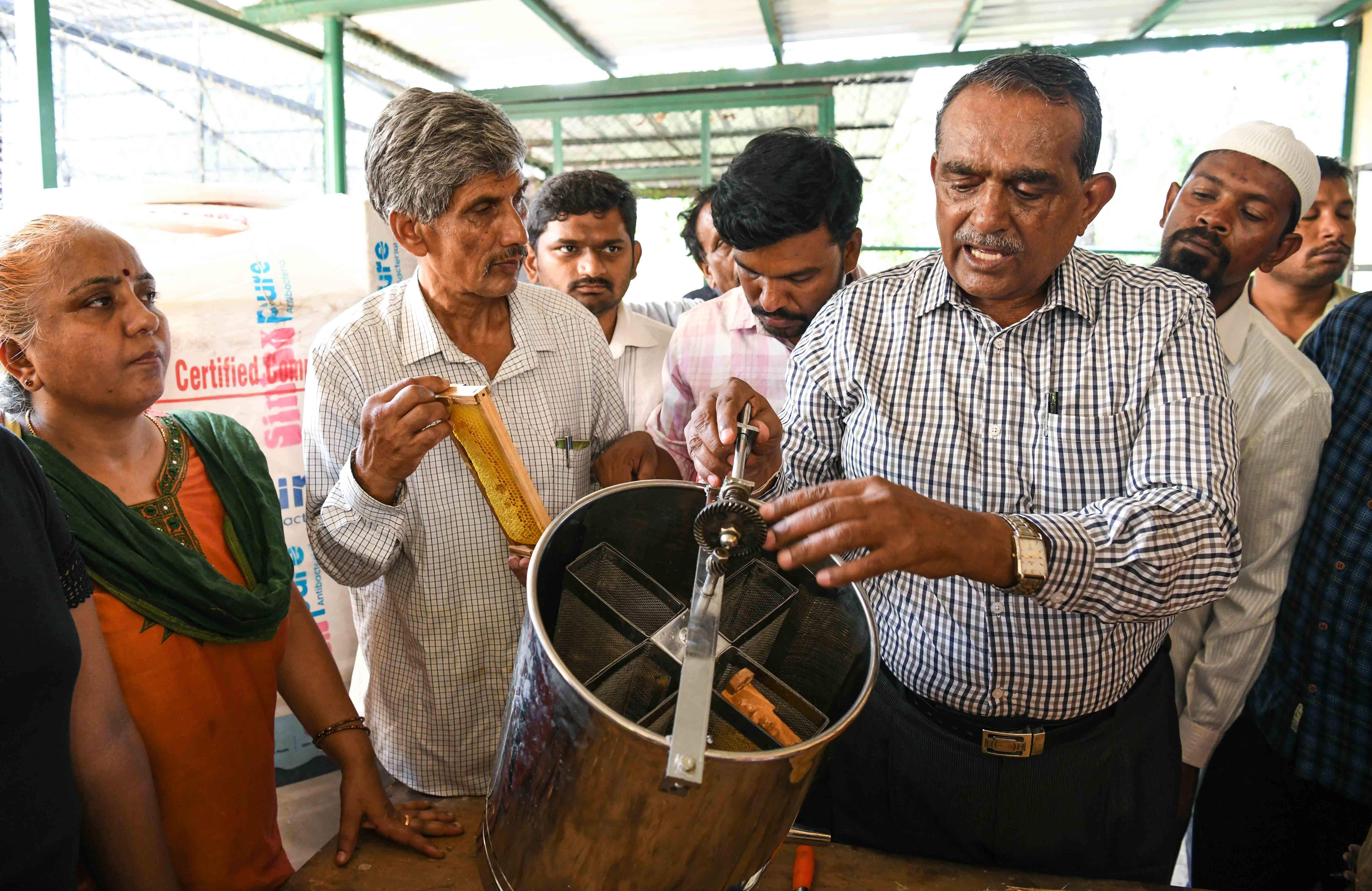
These are the machines in which you put the combs in to extract honey. These machines are also made by Apoorva and sold to the farmers. There is a particular way the combs have to be kept and then manually churned.
A small community of farmers can only do so much, the government needs to step up and help take this initiative forward, make this bigger and reach more people.
source: http://www.newindianexpress.com / The New Indian Express / Home> Specials / by Meghana Sastry / Express News Service / October 28th, 2019
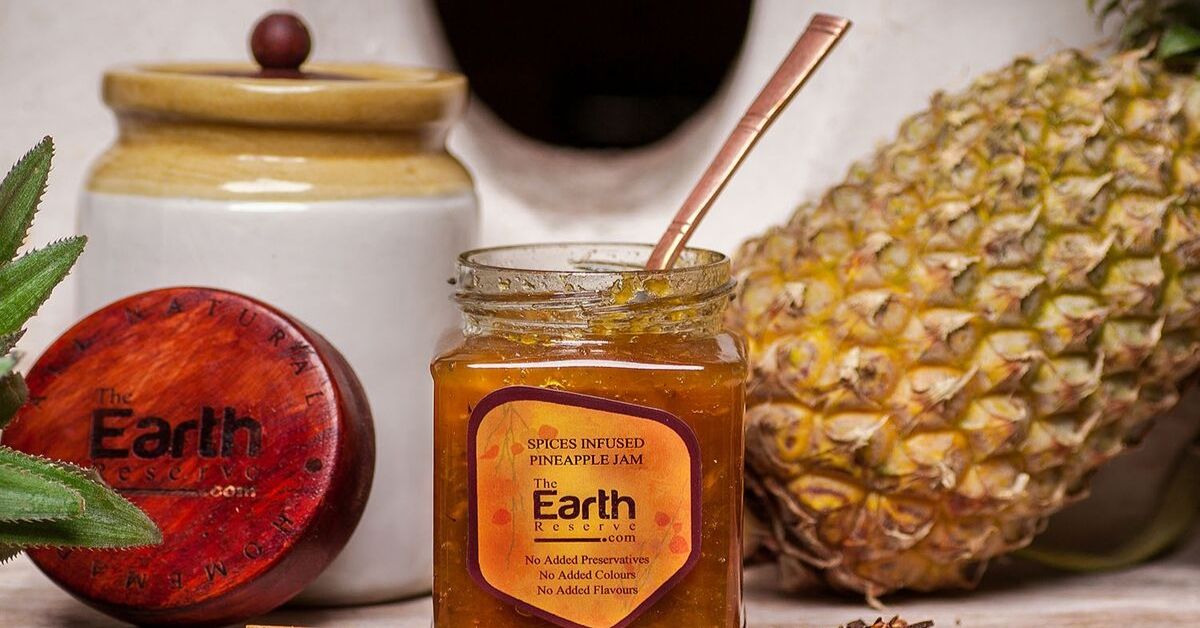
A few years ago, George Ramapuram fell seriously ill and preservative-induced food was a total no-no. So, the Coorg family decided to make it themselves!
The Earth Reserve was formed in 2017 and is based in Coorg. It has nine people and makes jams, pickles and preserves.
So far, so normal. But two things that will make their products the most unique bottle on your shelf.
Firstly, they get fruits entirely from the wild and organic – no farms, no harmful chemicals.
Every day, a couple of hands to go into the wilds of Coorg and collect organic ripe fruits, spices and vegetables. The fruits are then sun-dried.
And here’s the second fantastic thing about these products – 64-year-old Sheela handmakes these delicious jams and pickles and is involved until the very last step. You will be eating preserves made from the hands of a mother – literally!
Now that is special indeed.
How it all came about:
“Contains artificial colouring and preservatives”- a sign that should ideally motivate one to keep the product back in the shop shelf. For the sake of convenience, we continually risked our health.
For 27-year-old architect George Ramapuram, this realisation came after months of hospitalisation, due to a pancreatic condition he had developed.
“We were forced to go out hunting for jams, pickles and juices that contained no preservatives but we could not find them in the market. Back when we were young, this was no problem. Our mothers and grandmothers would always have containers of such foods ready. When we found it nearly impossible to get preservative-free food in the market, we decided to go back to those roots,” Thresi, George’s sister shares with The Better India.
At the time, Thresi had just returned from the USA and was caring for her ill brother. The two bounced ideas off each other to see if this can be scaled on a market level.
Preservative-free, organic, handmade foods. Would people like them?
The two had grown up eating jams, pickles and juices made from the wild fruits that grew in their backyards.
Plums, figs, passion fruit and mango – all grew in their hometown of Coorg. Their mother, Sheela, would pluck them, dry them and make them into delicious preserves for the children to have.
The jams and pickles were always made in abundance and shared with friends and family. What Thresi and George wanted was for these to be sold commercially so people across India could get the goodness of preservative-free handmade food at the click of a button.
“It was an exciting but quite ambitious project. Asking mom to make jams and pickles for friends and family is one thing. But making a business from this idea also requires us to consider costs, resources as well as the responses we may get. Plus, we wanted our products to be purely handmade, so that was another challenge,” she adds.
Through cautious experiments, the Ramapuram trio set a process for The Earth Reserve.
And the idea has worked indeed.
“We hadn’t expected such a positive response from not just Karnataka but also Delhi, Madhya Pradesh and several other states. We are excited to expand into bath and body ranges too!” Thresi says.
Completely organic and handmade, just like your grandma made them, these food preserves are as healthy as they are tasty. Click here to purchase them and make a tasty addition to your kitchen!
(Edited by Vinayak Hegde)
source: http://www.thebetterindia.com / The Better India / Home> Food> The Better Life / by Tanvi Patel / October 01st, 2019
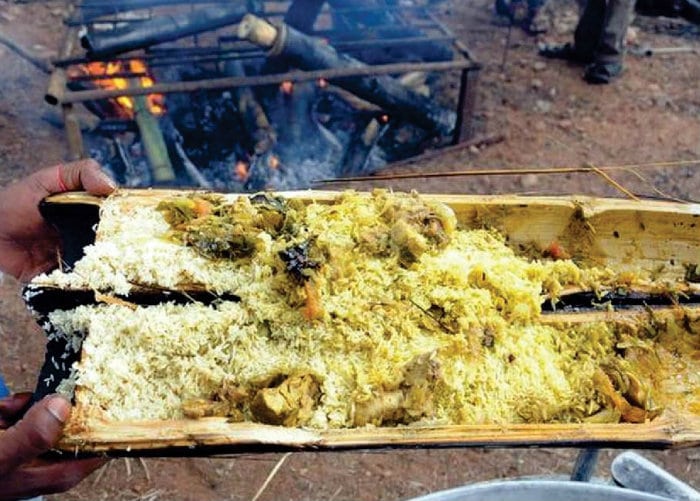
Tribal food section at ‘Dasara Aahara Mela’ to be held at Scouts and Guides Grounds will have new inclusions with more delicious Bamboo Biriyani to tickle the taste buds of foodies.
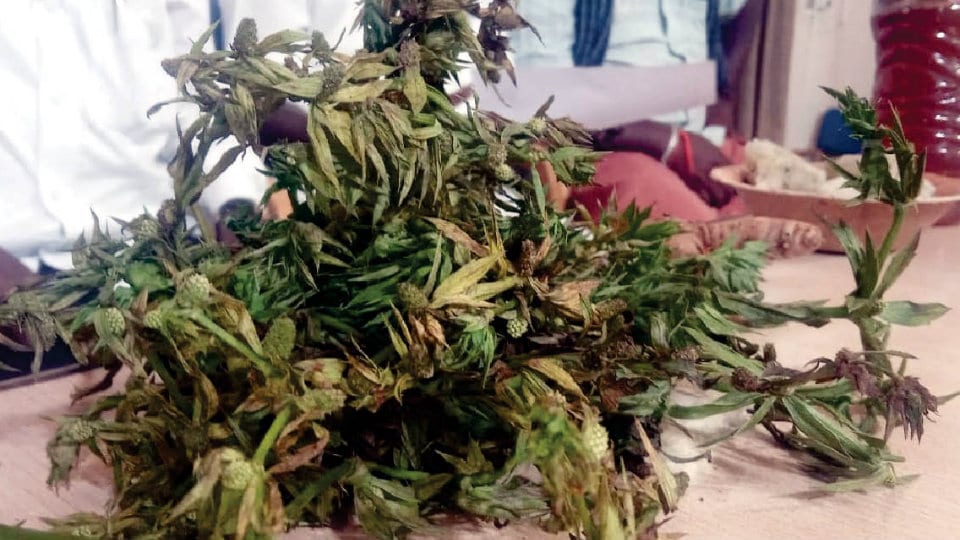
Addressing a press meet at Pathrakarthara Bhavan yesterday, Karnataka Adivasi Rakshana Parishat State President M. Krishnaiah revealed that special wild coriander leaves, curry leaves and turmeric usually grown in forests would be used to spice up the popular bamboo biriyani to give a new look and rare and exotic taste. He said that tribal foods are being served at ’Aahara Mela’ since 2014 and has been very popular.
Continuing, Krishnaiah said that the exclusively and traditionally decorated stall would deliver ‘Haadi Mane Oota’ (tribal home food) with authentic tribal delicacies other than Bamboo Biriyani like boiled sweet potato with honey, ‘Bidirakki Payasa’, ‘Makali Beru tea’ and crab soup with ragi balls. They will be priced at Rs. 50 (a bowl), Rs. 50 (a cup), Rs. 20 (a cup) and Rs. 100 (a plate) with the popular Bamboo Biriyani at Rs. 180 a plate, he said.
Krishnaiah further said that Nagamma will be back with her herbal medicines. She sells herbal medicines and medicines to cure skin diseases. Nagamma, a nature therapist or Naati Vaidya, will come from Doddabettageri Village in Dubare Forest of Kodagu district to provide medicines to visitors. Krishnaiah added that a 30-member team would be readying the stall and prepare food for visitors.
source: http://www.starofmysore.com / Star of Mysore / Home> News / September 27th, 2019
This is in response to the letter by Geologist Mrinmoy Chakraborty (SOM dated Aug.11, 2019) defending the views of the Geological Survey of India (GSI) published in SOM dated Apr.25. I write this to bring to light a few facts that go to show that Chakraborty has hastened to defend the warnings given by GSI a bit too early and to furnish some clarifications regarding the extreme events that wreaked havoc in Kodagu this August and perceptions arising out of them.
The series of landslides that devastated Kodagu in 2018 occurred mostly during the period 15th, 16th and 17th August. Some intriguing data on rainfall pertaining to this period tells the story. This data is from the rain gauge at Kudigana, a place near the border of the catchment of Harangi, which witnessed the worst kind of disasters in 2018.
Record rainfall
Till 6th August, the station had recorded about 5,500 mm of rain, and then on rainfall on the successive days read (in mm): 81, 250, 269, 90, 115, 121, 262, 295, 320, 461 (16th), 394, 197, 164, 95, the total for the fortnight amounting to 3,114 mm (Mysuru’s annual rainfall is 780 mm). Probably the 5-day extreme rainfall recorded then at Kudigana (1,686 mm) is the highest ever recorded in the rain gauging history of Kodagu (which extends for over 120 years now), the earlier highest being 1,462 mm in 1964 pertaining to the station of Bhagamandala.
On the other hand, the records at Kudigana for this year read thus: Total rainfall up to 1st August – 2,041 mm; then on – 30, 0, 16, 136, 183, 254, 312, 276, 298, 158, 90, 46, 35, 100 (15th), during the next 14 days – this is the period when the floods ravaged the district. The extremes here are just about 75% of last year’s and the total for season up to 20th Aug. is not even half of last year’s (nearly 4,090 and 8,614 mm respectively).
Once in 10-12 years
The highest one-day rainfall recorded this year has been reported from Bhagamandala, places around which contribute to flow in Cauvery and stands at 400 mm. The seven-day extreme for this year here has been 1,142 mm. Strangely, these values have return periods of 12 years and 10 years respectively.
This means, the type of flood-causing rain that fell this year occurs, according to data available, nearly once in 10-12 years. Even the flood magnitudes in the four rivers of the basin that were reported this year have return periods of 15 – 20 years.
On the other hand, the rainfall of 2018 that caused havoc in areas around Madikeri and in the catchment of Harangi shows a return period of over 50 years! This is the reason why even though Kodagu experienced severe floods this August, only just a couple of incidents of severe landslides have occurred.
Technical data
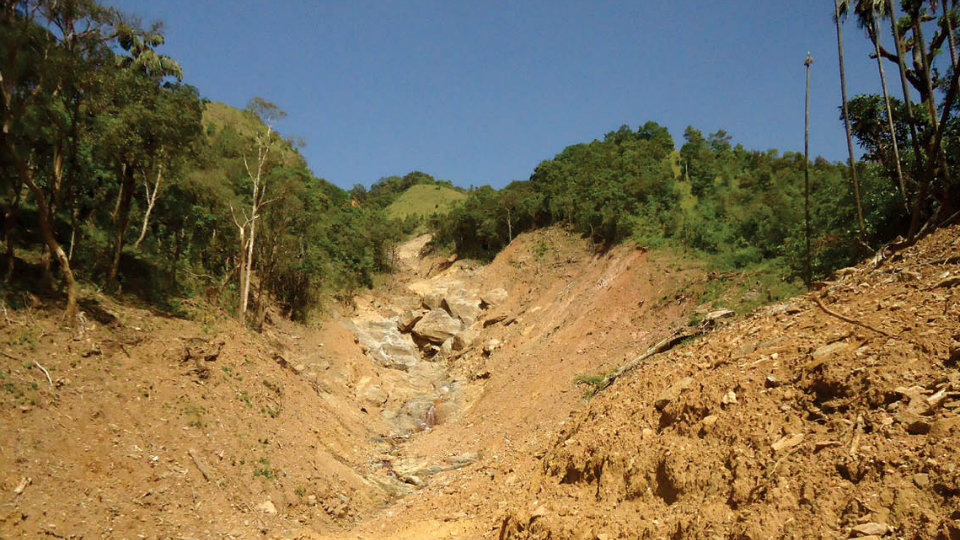
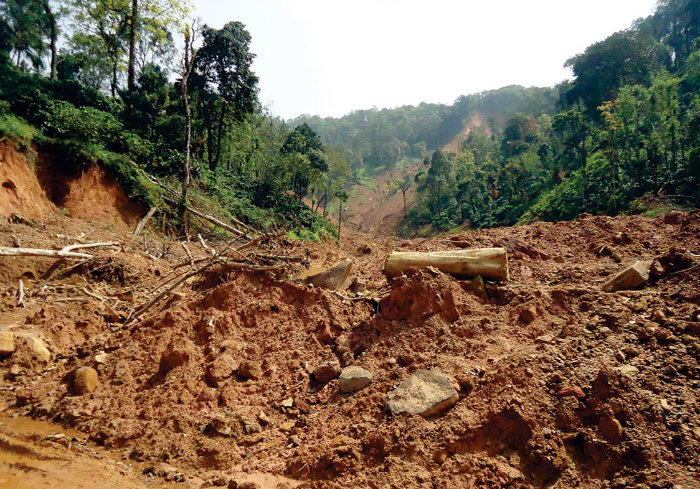
Very often, blockage of roads due to mud falls from tall and nearly vertical cuttings (Plate 1), many times triggered by uprooting of trees and washing away of the valley side road formations, are also termed as landslides, while the landslides of 2018 were removal of unimaginably large portions of hills, mostly in the valleys.
A large number of the over 150 landslides that occurred then got initiated far away from the highways and inhabitations (Plate 2), in total contrast to the common belief that tampering with nature and cutting land indiscreetly is the root-cause of landslides.
Many of these slides carried tens of thousands of cubic meters (like 200 m x 100 m x 2 m) of earth submerging hundreds of hectares of land downstream in mud (Plate 3 and 4). However, even earth falls of volume of a few hundred cubic meters (20 m x 10 m x 2 m) block roads and cause damage to houses — only one landslide of the former nature has been reported this year. It is not strange that extremes not quantified by measurements are blown out of proportion, painted colourfully and projected as catastrophes in this era of rampant use of mass and social media.
Predictions fail
Dr. H.S.M. Prakash, Director General of GSI, is reported to have explained (SOM, 25th April) thus: “There are indications of excessive downpour happening in five phases just like last year …”; “likewise, three to four more similar downpours are likely to be experienced… The rainfall in August is likely to result in floods”. Yes, one spell of rainfall has resulted in floods. But what about the rest? It is a common experience that any astrologer, once approached, would point out a number of cases in which his predictions have gone perfectly right, hiding others! The fact is that rainfall in Kodagu this year has been very poor except for that one spell — even after that week of deluge, the total seasonal rainfall for the year remains 25-40% lower than the normal (except in small pockets of Virajpet), while the last year it was about 25-50% higher than the normal.
Strong low pressure
It is claimed by Chakraborty (SOM, 11th Aug.) that the predictions for this year have been those based on “evidences”. Dr. Prakash had explained: “There is a possibility of heavy rain being caused due to volcanic eruptions in Hawaii and Mauritius. And, as if an indication, it has already started raining in Kodagu (in April)”.
It is utterly sad that an agency with a legacy of 200 years has fished out evidences for the floods in August, in the excessive rainfall of April! It is well established that the pre-monsoon rains of April and May are a phenomenon occurring due to local convections, while the monsoon rains in Kodagu are due to the global circulation, aided by strong low pressures in North/ Central India and the local orography (high rising mountains) of the Sahyadris.
It is now popularly known that the excessive rainfall of the ten days of August this year has been due to a strong low pressure that developed in the Odisha coast, and experts from GSI claim it to be due to excessive heat of magma in Mauritius!!
Better to err on safer side
Being half correct about events not known of is one hundred perfect in Statistics — probably the messengers, the people at the helm of affairs, believe that it is better to err on the safer side than on the other. Sweeping and arbitrary long-range predictions are not only unwarranted, but are also dangerous.
Rather, there shall be healthy introspection and debate on why even extreme events of smaller magnitude have been resulting in excessive damages in recent days. Further, very little of the Hydrology of this region has been understood, much remains to be done. It is hoped that the agencies concerned take a more pragmatic and purposeful look at the recent events and use them to learn about the region.
– Yadupathi Putty, Mysuru, 3.9.2019
You can also mail us your views, opinions, and stories to voice@starofmysore.com
source: http://www.starofmysore.com / Star of Mysore / Home> Voice of the Reader / September 16th, 2019
India’s first environment school — World Environment School — is all set to be opened in Coorg, Karnataka. It will also be the first school in entire South Asia to take a leading role in promoting and delivering environmental education with sustainability at its core. Spread over a hundred acres across the beautiful hills of Coorg, the school’s focus will be to build strong environmental and moral values among its students.
Mobius Foundation, a non-profit organization working towards environmental sustainability, in partnership with the UK-based Whitgift School announced the launch of this initiative at International Conference on Sustainable Education.
“WESc will be operational from 2021 for Grade 6 to 12 students from India and around the world. The school will cater to the parents who want the next generation to be actively involved in the protection and sustainability of the environment apart from a world-class education,” said Pradip Burman, Chairman, Mobius Foundation.
WESc will offer an international curriculum with affiliation from Cambridge Assessments and International Baccalaureate.
“The need for environmental education is growing rapidly as the degradation of the environment is taking place at a fast pace and we have taken a lead role in this direction by launching India’s first environment school,” said Chris Ramsay, Head Master, Whitgift.
source: http://www.dailypioneer.com / The Pioneer / Home> India / by PNS, New Delhi / September 12th, 2019
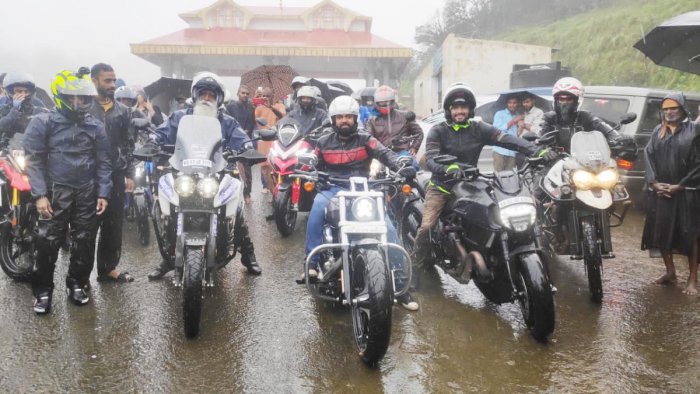
Isha Foundation Chief Sadhguru Jaggi Vasudev at the launch of ‘Cauvery Calling’ campaign, at Talacauvery in Kodagu, on Tuesday. Actors Rakshith Shetty and Diganth took part in the rally.
Cauvery Calling, a campaign conceptualised by Isha Foundation was launched in Talacauvery, the birthplace of River Cauvery, on Tuesday.
Isha Foundation Chief Sadhguru Jaggi Vasudev rode a motorbike himself to arrive in Madikeri on Sunday. Film actors Rakshith Shetty, Diganth and Shashi followed him.
A puja was offered at the ‘Theerthakundike’ in Talacauvery, earlier to the launch event.
Sadhguru Jaggi Vasudev said that through the campaign, there is an aim to plant 242 crore saplings on the banks of River Cauvery.
Trees help to increase the capacity of soil to retain water. Isha Foundation will work towards getting the necessary assistance from the government, he said.
He pointed out that the River Cauvery has become thinner by 39% in the last 70 years.
“The groundwater level in the river catchment area has been depleting drastically. Due to excessive deforestation in the catchment areas of the river, water is not flowing further and the river is getting dry even before reaching the sea. As a result, a drought-like situation has been arising during the months of April-May itself. This has created repercussions in terms of droughts in Karnataka and Tamil Nadu. Around 47,000 farmers living on the banks of River Cauvery have ended their lives in the last 10 years. It is noteworthy that the places of massive landslides have been due to excessive human interference. It is the need of the hour to wake up to the warning sign,” said Sadhguru Jaggi Vasudev.
Udupi-Chikmagalur MP Shobha Karandlaje said that the Central and the state governments will support the ‘Cauvery Calling’ campaign.
This month, the state government will sign a memorandum of understanding with Isha Foundation in this regard, she said.
MLA K G Bopaiah strongly felt the need to conduct a scientific study so as to know the reason behind massive landslides in Kodagu. He also demanded action against those who have encroached the government lands.
Air Marshal (retd) K C Nanda Cariappa and sportsperson Ashwini Nachappa were present during the programme held at Crystal Hall in Madikeri.
PM tweets
Replying to a tweet by Sadhguru Jaggi Vasudev, Prime Minister Narendra Modi tweeted at 4.13 pm on Tuesday, conveying his wishes to ‘Cauvery Calling’ campaign.
“Happy to know about your effort. It will surely add to the endeavour of harnessing Jal Shakti and preventing unnecessary wastage of water,” said the prime minister.
He also wished Sadhguru on his birthday saying, “Also wishing you a Happy Birthday! Praying for your long life and best health!”
15-day bike rally
The motorbike rally organised as a part of ‘Cauvery Calling’ campaign will pass through Hunsur, Mysuru, Mandya and Bengaluru. Public functions will be held in these places. The rally will reach Bengaluru on September 8.
The bike rally will traverse a distance of 1,500-km in Karnataka and Tamil Nadu and will culminate in Chennai on September 17.
source: http://www.deccanherald.com / Deccan Herald / Home> State> Mangaluru / by DH News Service, Madikeri / September 03rd, 2019
Chief Minister B S Yediyurappa releases the handbill on ‘Cauvery Koogu’ campaign.
Chief Minister B S Yediyurappa had a discussion with Isha Foundation’s Sadhguru Jaggi Vasudev on ‘Cauvery Calling’ campaign which will commence on September 3 from Talacauvery in Kodagu district.
The latter met the chief minister in Bengaluru on Thursday, in connection with the campaign, and sought coordination from the state government.
Responding positively to the request made by Sadhguru, the chief minister said that the state government will extend necessary cooperation.
Speaking on the occasion, Udupi-Chikmagalur M P Shobha Karandlaje lauded the ‘Cauvery Calling’ campaign led by Isha Foundation under the guidance of Sadhguru Jaggi Vasudev and called upon the people to join hands with the movement for a better tomorrow.
The ‘Cauvery Calling’ drive will be flagged off from Talacauvery, the birthplace of River Cauvery, on September 3, proceed through Thiruvaroor and will culminate in Chennai.
‘Cauvery Calling’ is a part of ‘Rally for Rivers’ campaign conceptualised and implemented by Isha Foundation.
The journey covers a distance of 1,500 km. Public awareness programmes will be held along the course of the campaign, stressing on the need to undertake steps to conserve River Cauvery.
Many celebrities, sportspersons, political figures and entrepreneurs have already associated themselves with the campaign, which has gathered an immense response from the general public, especially from the farmers.
The drive also focuses on planting saplings along river banks and improving the economy of farmers. ‘Cauvery Calling’ campaign will support farmers to plant 242 crore trees to rejuvenate River Cauvery.
source: http://www.deccanherald.com / Deccan Herald / Home> State> Mangaluru / by Adithya K A / DH News Service, Madikeri / August 29th, 2019
WELCOME. If you like what you see "SUBSCRIBE via EMAIL" to receive FREE regular UPDATES.
Read More »