The annual theerthodbhava of river Cauvery will occur at the holy pond at its birth place Talacauvery at 12.15am on October 17.
Cauvery water will spring at the ‘Kundike’ at the thula sankramana muhurtham.
Apart from devotees from Kodagu, a large number of people from Mandya, Mysuru and Bengaluru and also from neighbouring Kerala and Tamil Nadu are expected to witness the religious ceremonies.
source: http://www.timesofindia.indiatimes.com / The Times of India / News Home> City> Mysuru / TNN / September 12th, 2015
Cauvery — which is the lifeline of the people in south Karnataka and people living along the downstream in Tamil Nadu — has its origins in Kodagu which is the key catchment area of the river.
Kodagu received 33 per cent excess rains when the monsoon set in during June this year. It recorded a rainfall of 826.2 as against the normal of 622.4 mm. But the monsoon slackened during July and August.
In July, Kodagu received 360.2 mm of rains as against the normal of 904.7 mm, which is 60 per cent below normal whereas in August the district as a whole received only 289.4 mm of rains as against the normal of 597.7 mm which is 48 per cent below normal.
The cumulative rainfall deficiency for the period June 1 to September 6 is minus 31 per cent and against the normal of 2181.2 mm of rains, Kodagu received only 1,504 mm rainfall. The deficient rain was uniform across the district, resulting in depleting inflow into the KRS.
Likewise, the adjoining districts of Mysuru and Mandya through which the Cauvery flows, also received deficient rains during July and August, adding to the reduction in the inflow into the reservoirs.
source: http://www.thehindu.com / The Hindu / Home> National> Karnataka / by R. Krishna Kumar / Mysuru – September 07th, 2015
Two Sundays back, over 100 vehicles were parked in and round the Kodava Samaja club in Vasanthanagar in Bengaluru. There were shiny Sedans and rusty Jeeps, perky hatchbacks and burly SUVs.
For all their differences in name, colour and models, they had one thing in common: The light green triangular shape Coorg Wildlife Society (CWS) stickers plastered on windshields or bumpers.
“For decades, people of Kodagu have used the CWS as a moving identity card. It symbolizes the driver is proud of his place (Coorg) and also it offers a glimpse of their love and fascination with nature, It’s a great way to find common ground to begin a conversation, when Kodavas meet outside Coorg” said Jeeth Devaiah, strength and conditioning coach at Galen Gym, Airport road.
The CWS sticker was the brainchild of Pratap Chittiappa, chairman of Skanda Coffee, one of the founding members of CWS. In 1983, he influenced M/s Hindustan Thompson to design a crest that eventually turned into the bumper sticker in the 1990s. The members of the society began promoting the CWS by sticking it on their windshields and it gradually became a fad.
“Initially the fad was limited to Kodagu alone but now it shifted across the world. I even happened to see such stickers in cars driven by non-Coorgs in San Francisco some time ago,” Ajith Nanjappa, who pursued his MBA degree there recently said.
Sales of CWS stickers have eroded during the past decade. Buoyed by the popularity of CWS stickers, unauthorized vendors started marketing it in their own with giving it various colour combinations. “We sell roughly around 1,000 stickers per month for a prices ranging between Rs 25 and Rs 100. But the fad is dying now compared to what it was a few years ago. Now people have been switching to other stickers like Coorg warrior 1839, Coffeeland, among others,” said Ayub Zameer, a vendor at Madikeri.
“We had got it patented a few years ago to prevent misuse of our logo but it was tough to stop the illegal trade. Now we have decided to lodge a formal complaint to ensure only registeredd CWS stickers are sold,” said colonel CP Muthanna (Retd), president of the CWS, now with a membership of 920,
Tarun Cariappa, secretary of the NGO said the stickers which have registered trademark symbol ® are only the genuine ones. “We sell these stickers to general public for a nominal sum of Rs 30 at our office. The money will be used in promoting conservation activities. “People can buy online through our website at a cost of Rs 75,” he added
CWS activities however are not just limited to business of selling stickers. Formed in 1980, CWS is actively engaged in organizing programmes to increase awareness of nature, wildlife and environment in schools and colleges of Kodagu district. “CWS has a long history of campaigning to ensure that government policies and laws help safeguard Coorg’s wildlife. Our aim is to make Coorg a leader in the field of wildlife protection and restoration, a dream of the late brigadier CM Cariappa who was the moving spirit behind its establishment” said colonel Muthanna.
CWS has been in the forefront of an activism against the decision of the Power Grid Corporation of India Limited (PGCIL) to draw a 400kv power line from Yelawal in Mysore to Kasaragod in Kerala via Kodagu. “The project will see as many as 50,000 trees felled, affecting the ecology and increasing man-animal conflict. We will do everything to protect the nature,” said Cariappa.
source: http://www.timesofindia.indiatimes.com / The Times of India / News Home> City> Bengaluru / by Manu Aiyappa, TNN / September 11th, 2015
They have worked in the tea gardens of Assam but in Madikeri they are tending the Coffee plants. Labourers from Assam working in coffee plantations in Kodagu have become a common sight since the past two years.
It is in south Kodagu that more number of Assamese labourers find work in houses and estates.
A few days ago, nearly 200 people arrived from Assam and were divided in teams to meet the demands of the local agents.
According to the labour department officials, there are seven labour camps in and around Kodagu where these people stay.
A few big planters will host some of the Assamese labourers in their own camps in the estates.
In Kodagu, over the years, shortage of labourers have been very severe and existing workers have been demanding more salary and benefits. In 2011, the acute shortage of labour and the high demands of local labourers had put the planters in a spot.
Earlier, the planters were getting labourers from Sullia in Dakshina Kannada and Arasikere in Hassan district, but the Assamese labour comes much cheaper than the usual lot, the officials added.
A labour contractor from Dakshina Kannada, Rajappa Gowda, who takes labourers from Sullia and Puttur every week, says Kodagu has a heavy demand for labourers.
Many escape the labour work in the estates and get into more cozier jobs as servants at home-stays.
But the migrants tend to stay for longer as they get all the benefits, from schooling for their children and higher social security.
Former vice-chairman of Coffee Board of India, Bose Mandanna, told Express that though Assamese workers do not know the scientific work of coffee cultivation, those who settle here learn how to spray, borer tracing and other works. Since all migrants show records like BPL cards, voter IDs and other records, it is the responsibility of the officials to trace fake cards, he says.
However, according to Codava National Council president N U Nachappa, these workers are all Bangaldeshis possessing fake documents. He recalled the protests held early this year urging officials to verify the labourers’ antecedents.
A coffee planter from Gonikoppa told Express, “Since we are getting Assamese labour, demand for more salary from workers who come from far away places cease.”
Another planter from Suntikoppa in Somwarpet taluk said many estates would run into trouble if the Assamese labour did not flow into Kodagu.
The police department have asked all coffee growers to check the documents and collect photos of workers and their family members and submit copies to them without fail.
source: http://www.newindianexpress.com / The New Indian Express / Home> States> Karnataka / by Express News Service / August 24th, 2015
The rain deficit in Kodagu, the origin of Cauvery river, has become a major cause of worry for the farmers here.
As far as the monsoon is concerned, the rainfall seems to be following an erratic pattern.
Heavy rain lashed the district in the beginning of the monsoon causing havoc. Later, it slowed down causing a drought-like situation.
Generally, in the 90-day monsoon season, the rainfall was sufficient for farmers as it was enough to fill the Harangi reservoir. But this year, the situation is different.
Though Harangi is full, Krishna Raja Sagar (KRS) reservoir is yet to be filled as the crest gates in Harangi were opened only once.
Kodagu district received 60 cm of rain in the first 10 days of the monsoon causing floods.
In July and August, rainfall was deficient by 70 and 60 per cent respectively.
Cloud seeding was taken up in Kodagu six years ago, but it was not conducive with the weather here.
According to figures available with Express, the average expected rainfall in January was 5 mm, but the district received 0.3 mm; February – 3.2 mm (5.6 mm expected); March – 37.4 mm (14.7 mm); April – 133.4 mm (73.5 mm); May – 191.4 mm (146 mm); June – 804 mm (486 mm); July – 366 mm (938 mm) and till August 20 – 164 mm (250 mm).
This erratic rainfall seriously impacted the water requirements of paddy, coffee and pepper crops.
The total average rainfall from January to August should have been 2,100 mm, but Kodagu has recorded 1,710 mm. The district is facing a deficit of 300 mm rainfall.
A minimum of 600 mm rain is required on a weekly basis to fill the reservoirs in Kodagu.
source: http://www.newindianexpress.com / The New Indian Express / Home> States> Karnataka / by B C Dinesh / August 24th, 2015
Kushalnagar (Kodagu):
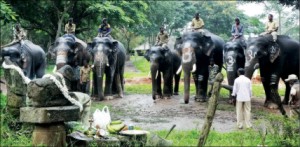
The Forest Department celebrated World Elephants Day at Dubare Elephant Camp near here yesterday in a meaningful manner by creating awareness amongst the public on wildlife.
The day was celebrated by performing puja to the camp elephants at Sri Basaveshwara Temple premises in the presence of hundreds of tourists, who were excited to see 25 elephants including 3 calves together.
Kodagu Conservator of Forests Yelukondala spoke about the significance of World Elephants Day.
CFO B.B. Mallesh, ACF Bhaskar Rao, RFO M.S. Chinnappa, ARFO Ranjan, Senior mahout Dobi and others were present on the occasion.
source: http://www.starofmysore.com / Star of Mysore / Home> General News / Thursday – August 13th, 2015
ANUBHUTI KRISHNA grudgingly climbs through slippery rocks and hills, but the heady aroma of coffee keeps her going
The woods are lovely, dark and deep, but I have promises to keep, and miles to go before I sleep. The closing verse from Robert Frost’s famous poem, Stopping by Woods on a Snowy Evening, reverberates in my mind as I pant my way along the muddy path, evading grasshoppers, beetles, bugs and an occasional salamander. Even though these are no woods, and I have had a good night’s sleep, this is the closest I have been to the woods in years, and I am on the verge of giving up. The lines, therefore, make perfect sense.
Remembering and playing the verse in my head repeatedly could also be my way of shutting out the nasal voice of Arun, my guide for the morning. He is the owner of the coffee plantation I am staying at and a compulsive talker too. He insisted that I come for the early morning trek with him (he also arranged for a pair of gum boots for me and helped me put them on – much to my embarrassment) and has been talking non-stop right from the time we left the cottage.
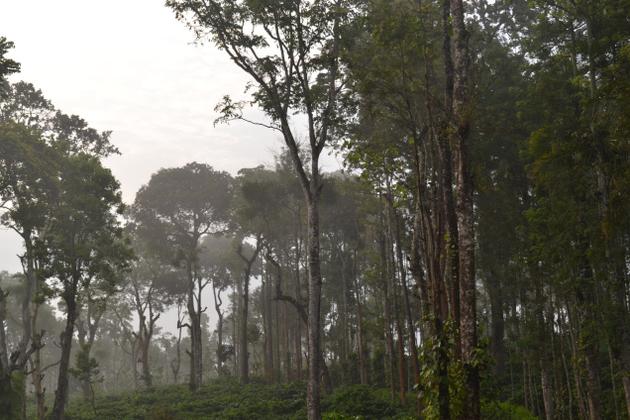
A visit to Coorg had been on my mind for years. I had been to the Himalayas, I had been to the Nilgiris, I lived not far off from the Aravallis, but I had yet to set foot on the Western Ghats. So when my friend suggested that I come with her to the plantations, I jumped at the opportunity. There was something else that she had told me: the coffee plants bloom in the middle of summer and that was the best time to be in Coorg, among low and dense foliage bursting with delicate white flowers which look and smell just like jasmine. It was only after we had reached our home stay, a neat set of cottages built alongside Arun and his wife Kaveri’s residence, that we realised the coffee flowers had already bloomed in spring. But by then, I was so absorbed in the shades of green that surrounded us that the lack of white hardly mattered.
Located at an hour’s drive from Madikeri, the estate is as green as green can possibly be. We had reached there driving through narrow winding hill roads lined with tall oaks and shrubs and had almost missed the elusive turn to the estate. Far removed from habitation, our place of stay is a true example of the back of beyond. The cottages – there are only two of them, since the owners do not want to overcrowd the place – stand bang in the middle of the plantation. The day was bright and sunny when we had arrived in the afternoon; by early evening, however, the sky had already turned a shade of charcoal, and soon rains were lashing at the tiled roof of the cottages: what else could a parched soul from a concrete jungle ask for?
We spent the evening sitting on the cemented ledge of the long verandah, savouring strong coffee and munching on crunchy onion and potato bhajjis made by Lakshmi, the doe-eyed housekeeper of the home stay. It was here, with the coffee and the bhajjis that I met Arun: he had come to say hello and had hung around through the evening, talking animatedly about coffee, climate and Coorg; he had left only after I had agreed to go out with him around the estate in the morning.
In the middle of a thicket now, drenched in sweat, with a steady stream of water dripping from millions of thick, broad coffee leaves on my arms and legs, struggling to climb the slippery hill, and surrounded by unruly branches and the abundant insect life, I curse myself for having agreed to the trek: how nice it would have been to just sit in the verandah and write!
My chain of thoughts is broken by Arun’s voice. He is as energetic as ever, and busy explaining to me why he has brought me here. “I want you to remember Coorg for a long time,” he says, while offering me his hand. I reluctantly take it and climb another tricky rock. He keeps talking and offering me his hand, even as I gasp for breath and almost slip over a pile of soggy leaves, wondering if the climb will ever end.
I am close to tears of frustration and exasperation when I finally see the rays of the early morning sun streaming in through the canopy of leaves. In another few minutes, the dense shrubs magically disappear and we are standing on a large rocky clearing atop a hill that has no road or walkway.
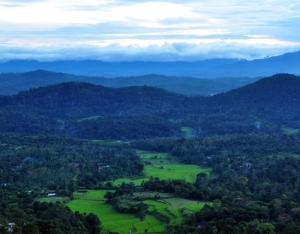
As I look down at the sea of fluorescent paddy fields sprinkled with tiny ponds formed by last night’s rain, the thick forest along the horizon with trees that touch the clouds, the silver mist rising from the earth and mingling with the golden rays of the sun midway, and the height of the hill I have just climbed, my heart fills with gratitude for Arun. I now know what he meant when he said that he wanted me to remember Coorg for a long time. Thanks to him, I will never forget it.
source: http://www.thehindu.com / The Hindu / Home> Features> MetroPlus / by Anubhuti Krishnan / Chennai – August 07th, 2015
With rains drenching the hilly, wooded landscape of the Kodavas, it is time to visit the Kodagu district in Karnataka, the birthplace of the mighty Cauvery.
Originating at Talacauvery, the Cauvery gently flows from the Western Ghats and in the process, traces a long journey of 800 kilometers in the South-Eastern direction and empties in the Bay of Bengal. With monsoon gaining vigour once again, the coffee land especially during the months of July and August, is at its best. It is a sublime experience to visit Madikeri and surrounding areas that are home to many a waterfall.
As these are located in dense jungles, one has to trek and walk a few kilometers to take a peek at silver cascades in both the Brahmagiri and Pushpagiri hill ranges. Both these hill ranges are home to many waterfalls but the Mallali Falls near Somwarpete and Irupu near Virajpete, attract many tourists before, during and after the monsoons.
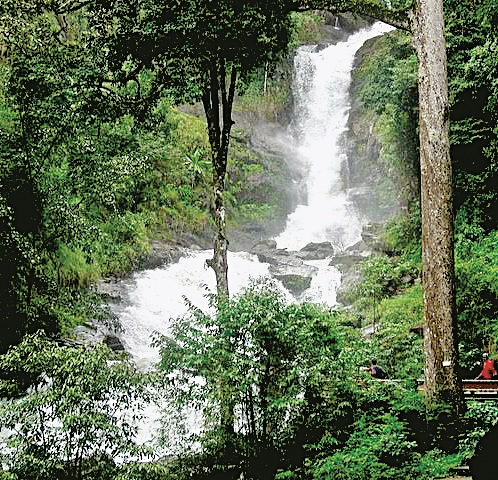
A fresh water cascade, the Irupu comes to life during the heavy downpour that is so common in these hilly ranges. This (also called the Lakshman Tirtha Falls) is situated on the highway to Nagarhole and just 20 kilometers away from the National Park. One has to walk at least half a mile to reach this place which is in the midst of a forest and far away from the cacophony of urban life.
Enjoying the sounds of the serene hill ranges and the gushing foamy waters, one can relax and forget all about urban stress. The roaring sound of the falls can be heard from a distance as one walks on the rocky twisting pathway with the chirping birds and the lush forests for company.
The pristine scenery resonates with the chirping of birds one has never heard before. The falls criss-crossing the hills and the forests tumble down from a height of just 150-200 feet while the spray of the gushing waters during monsoons is so intense that one can get easily wet. However, it is not safe to venture into the waters as the currents are strong. If you planned a visit before the monsoons, you can stand literally below the falls and get a soothing shower.
But do not miss visiting during the monsoons as Irupa falls from a cliff in all its mesmerising glory. If you are interested in visiting the nearby temple, you can take a peek as legends associate it with the visit of Ram and Lakshman when they were searching for Sita.
There are good spots to relax and enjoy, clean, wholesome vegetarian food but make it a point to place your orders in advance if you are visiting this place in a group. If you are carrying food and drinks, do not litter the place with plastic debris as it is a fragile ecology and home to many birds and animals.
Just two to three hours drive from Madikeri, one has to take the Virajpete route to reach this breathtaking place where the waterfall plunges from the Brahmagiri peaks in all its beauty and finally joins the Lakshman Teertha River. Since it is a very popular tourist spot, the place is easily accessible via tarred roads, concrete steps, viewing seats and affordable lodging and boarding facilities in and around the densely wooded ranges.
source: http://www.newindianexpress.com / The New Indian Express / Home> Cities> Bengaluru / by Meera Bharadwaj / July 30th, 2015
Karnataka district has India’s highest concentration of home-stays, according to HolidayIQ study
The picturesque scenery of Coorg
The Kodagu district of Karnataka, also known as Coorg, offers the largest amount home-stay accommodation in India, according a new study.
HolidayIQ, the Indian online travel site, has revealed a series of trends relating to the country’s home-stay sector. And according to its listings, 13% of Indian home-stays are located in Coorg, followed by Kochi with 9%. Located in the Western Ghats, Coorg is famous for its mountainous jungles and its native Kodava residents.
In total, HolidayIQ found a total of 1,663 Indian home-stay options distributed among 207 destinations. And many are concentrated in the same areas; destinations with 10 or more home-stays accounted for 76% of the entire market.
Home-stays in Coorg and Kochi, plus the Kerala destinations of Alleppey, Wayanad and Munnar, were found to offer better value-for-money than other types of accommodation.
“With the growth of the online travel industry, in all its different guises, people now have a lot more information at their fingertips and the research has become a larger, richer part of holiday planning. At the same time, travel industry providers have grown exponentially in India, so travellers now have more options than ever,” HolidayIQ said in its report.
“The diversity of India is legendary presenting travellers with endless opportunities to sell its charms. Home-stays in India are now becoming the popular new concept of tourism. In the recent years Home-stays and the trend of offering budget accommodation is picking up. Homes are the new hotels,” it added.
source: http://www.traveldailymedia.com / Travel Daily India / Home> Hote & Spa / by Mark Elliot / July 24th, 2015
Mysuru-Kodagu MP Pratap Simha, who is also the member of Spices Board, has demanded setting up of a Spices Park in Kodagu district.
Pratap Simha, who was in Kashmir to attend the Spices Board meeting along with former Chief Minister and MP B.S. Yeddyurappa, urged the Board authorities to set up a Spices Park in Kodagu district, which is also famous for growing spices such as pepper and ginger apart from coffee.
Speaking to Star of Mysore, Pratap Simha said that Spices Board officials had agreed for a feasibility study and added that a team of officials would visit Kodagu in the coming days to conduct a study for setting up the Spices Park.
Setting up Spices Park in Kodagu would help pepper and ginger growers in Kodagu district and Cardamom growers in Sakaleshpur in Hassan to market and get good rates for their products, he added.
Our aim is to provide a sustainable market for the spices grown in this part of the region, he said and added that there is a proposal to start a Spices Park in Haveri which intends to provide a good market for chilli growers in the region.
But, for the growers to transport spices from Kodagu and Hassan districts to Haveri would be a problem and for that reason it was proposed to set up Spices Park in Kodagu, said Pratap Simha.
He said that the State Government has to provide 50 acre land for the Spices Park like it has been done in Haveri district.
Once the land is allotted, the work on Spices Park would commence after the proposal is approved by the Spices Board officials, Simha added.
Pratap Simha further said that issues pertaining to Saffron growers were also discussed during the meeting held yesterday in Srinagar.
He said that the Spices Board has decided to work towards providing assured market for Saffron within the country and also exporting the same throughout the world.
source: http://www.starofmysore.com / Star of Mysore / Home> General News / Thursday – July 02nd, 2015
WELCOME. If you like what you see "SUBSCRIBE via EMAIL" to receive FREE regular UPDATES.
Read More »